Abstract
The study of a drug’s absorption, distribution, metabolization, and excretion by the body is known as pharmacokinetics (PK). In pharmacokinetics, the two-compartment model is used to understand the distribution and elimination of drugs. The two-compartment model represents the body as two distinct compartments: the central compartment (such as the blood) and the peripheral compartment (such as tissues). This work aims to enhance the understanding of drug kinetics inside the human body by comparing different mathematical models. The important focus of this study is to compare the distribution patterns of the drugs methadone, buprenorphine, tramadol, and tapentadol when administered intravenously using a two-compartment model. To mathematically describe the distribution of drugs in the body, a system of nonlinear ordinary differential equations is employed. These equations capture the dynamics of drug concentration in the different compartments over time. The roots are obtained by solving this system of equations using numeric analysis techniques. The study determines the duration of the drugs to attain the minimum effective concentration in the blood by analyzing the obtained results. Furthermore, the study also determines the time it takes for these drugs to be eliminated from the body. This data is significant for understanding the drug’s clearance rate and its potential duration of action. By comparing the distribution patterns and elimination rates of methadone, buprenorphine, tramadol, and tapentadol, the study provides insights into the differences between these drugs in terms of their pharmacokinetic properties. Healthcare professionals can utilize this information to optimize drug therapy, ensuring that the drugs are administered in accurate amounts and at precise intervals to target the desired therapeutic effect. Overall, this study provides a comprehensive analysis of drug kinetics, aiding in a better understanding of drug behavior within the human body and facilitating informed decision making in clinical settings.
1. Introduction
Pain is an unpleasant sensory and emotional experience associated with, or resembling that associated with, actual or potential tissue damage as defined by The International Association for the Study of Pain [1]. An analgesic is a medication or substance that is used to relieve pain without causing a loss of consciousness [2]. Opioids are powerful pain relievers that act on specific receptors in the brain and spinal cord. They can be prescribed for severe pain, such as after surgery or in cases of chronic pain [3]. Due to their potential for dependence and abuse, opioids are typically used with caution and under medical supervision. Pharmacokinetics is the branch of pharmacology that deals with the study of how the body processes a drug after administration. It involves the study of the absorption, distribution, metabolism, and excretion of drugs, collectively known as ADME, within a living organism [4]. Absorption is the process by which a drug enters the bloodstream from its site of administration, which may be orally, through topical application, or infusion. The drug is distributed throughout the body to various tissues and organs depending on the affinity of the drug to bind to proteins and cross cell membranes. Metabolism refers to the chemical conversion of a drug into various compounds. Excretion is the way of eliminating drugs and their metabolites from the human body. The primary route of excretion is usually through the kidneys, where drugs and their breakdown products are filtered from the blood and excreted via urine [5].
Buprenorphine is an opioid with a complex and distinguished pharmacology that sets it apart from other potent analgesics. Davis et al. listed several reasons for considering buprenorphine as an efficient opioid for managing moderate to severe pain, which includes cancer pain, neuropathic pain, etc. [6]. Unlike buprenorphine, which is a partial mu agonist, methadone is a full mu-opioid receptor agonist [7]. It binds strongly to the mu-opioid receptors in the brain, providing potent pain relief and suppressing withdrawal symptoms in individuals with opioid dependence. It has complicated pharmacokinetics, a long half-life, very variable conversion ratios with other opioids, and a considerable interindividual variance in response. The early, careful observation is very crucial [8].
Tramadol is a synthetic opioid analgesic used to manage moderate to severe pain [9] that is often prescribed to treat varieties of pain, such as post-surgery pain, chronic pain, and pain associated with injuries or medical conditions [10]. Another frequent analgesic to add to this list is tapentadol for managing moderate to severe pain. Tapentadol combines two mechanisms of action—mu-opioid receptor agonism and norepinephrine reuptake inhibition [11]. All these drugs have the potential for misuse, abuse, and addiction. They should only be used under the close supervision of a healthcare professional and taken exactly as prescribed. All four of these drugs are used for cancer pain management and work in those patients where morphine and fentanyl are not accessible or not useful.
Compartment models are mathematical models used to describe the dynamic behavior of complex systems. These models are widely applied in various fields such as epidemiology, pharmacokinetics, ecology, economics, and engineering to understand and predict the interactions between different components or compartments of a system over time [12]. In the present study, a comparative analysis of the pharmacokinetics of buprenorphine, methadone, tramadol, and tapentadol is carried out to estimate the duration for reaching the minimum effective concentration in the blood. It also helps in understanding the efficacy and long-term conduct of the drug inside the body.
2. Methodology
Mathematical models provide insight into optimal solutions for intricate problems, making it necessary to develop mathematical models for calculating the concentration of a drug at different sites within the human body [13]. When a medicine is administered orally, the digestive tract dissolves and releases the medication. After reaching the blood, the medicine travels to the site where therapeutic actions take place [14]. The drug is progressively removed from the blood via excretory organs. The transition of medicine into and out of each compartment is tracked to simulate the flow of pharmaceuticals in the body by taking different body parts as compartments. The rate at which the drug moves across the compartments is characterized by first-order kinetics [15]. Let x(t) be the drug concentration at time ‘t’ seconds.
2.1. Oral Administration
When an opioid analgesic is administered orally, the gastrointestinal tract diffuses it into the blood. If x0 is the initial concentration of the drug, x1(t) and x2(t) are the concentrations of the drug in the gastrointestinal tract and bloodstream, respectively.
where k1 and ke are the rate constants from one compartment to another.
2.2. Intravenous Administration
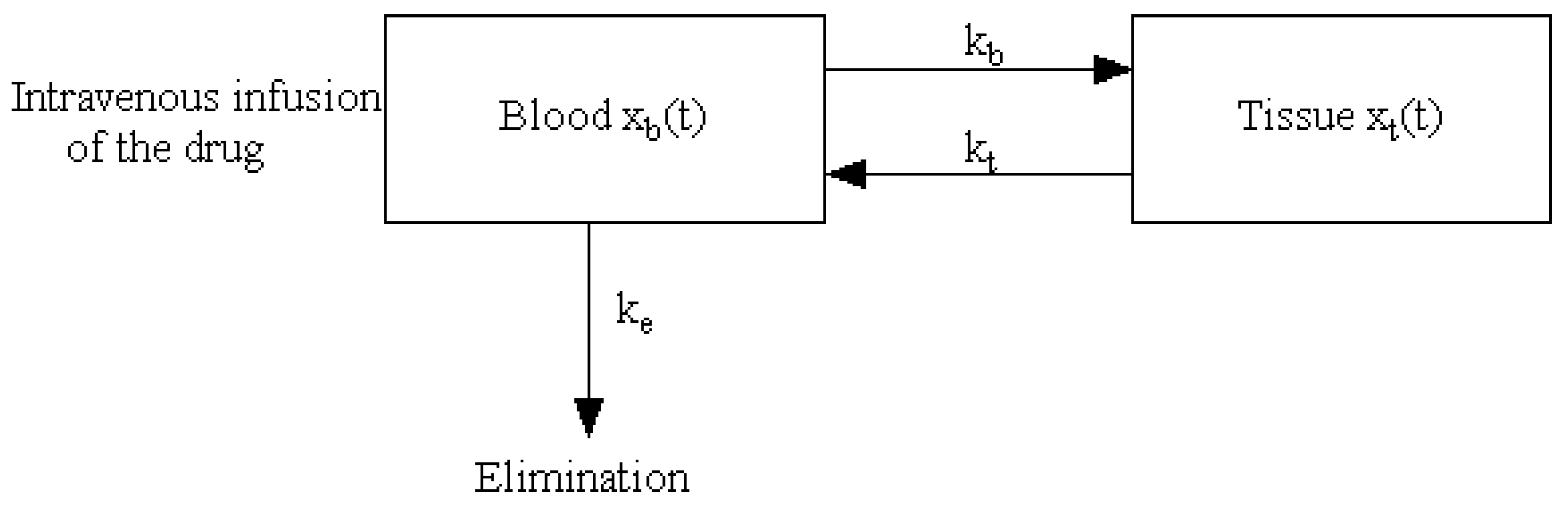
When a patient requires immediate action of a drug or has a sensitivity to a drug, the oral route of delivery is not recommended. In such circumstances, intravenous delivery of the medicine is recommended since it avails injection directly into the blood [16]. Hence, intravenous administration is preferred to directly inject the medication into the blood. The blood is considered the first compartment and the tissue is the second compartment where the drug has a significant impact, as shown in Figure 1. With the rate constant kb, the drug reaches the tissue from the blood and excretes at a rate constant of ke through the liver and kidneys. Redistribution of the drug occurs from the tissue to the blood at a rate constant of kt. Let the drug concentration in the blood be xb(t) and that in the tissue be xt(t), then the following set of equations describes the mathematical model of drug delivery.
Figure 1.
The distribution of intravenous drug in blood and tissue.
When short-term drug delivery is necessary, intravenous bolus injections are preferred, which result in immediate effects within 1–30 min. Opioid analgesics such as buprenorphine, methadone, tramadol, and tapentadol are frequently used for managing moderate to severe pain in cancer chemotherapy and in some emergency departments [8]. The typical intravenous dosage of buprenorphine for an adult with a normal physiological state is 0.3 mg [17]. Similarly, methadone is prescribed at 2.5–10 mg via intravenous infusion [8]. Tramadol can be administered intravenously with a dosage of 50 mg [18]. Tapentadol is an oral preparation with a dosage of 50 mg for an adult [19].
The molecular weights of buprenorphine, methadone, tramadol, and tapentadol are 467.64 g/mol, 309.445 g/mol, 263.38 g/mol, and 221.339 g/mol, respectively.
For a minimum of 50 ng/mL of drug in the blood,
These ordinary differential equations (ODEs) may be solved numerically using the fourth-order Runge–Kutta method, which is also used for parameter estimation [20]. For the given ODE, which is in the form of , the new value of ‘x’ can be computed as
For a particular step size h and initial values x0 and t0, , , , and .
The therapeutic impact can be achieved early and the incidence of toxicity can be avoided by choosing the appropriate dosage at a definite rate. By calculating the different rate constants, the duration to achieve the minimum effective concentration in the blood and the time to completely eliminate it from the body are estimated and projected in the upcoming section.
3. Results
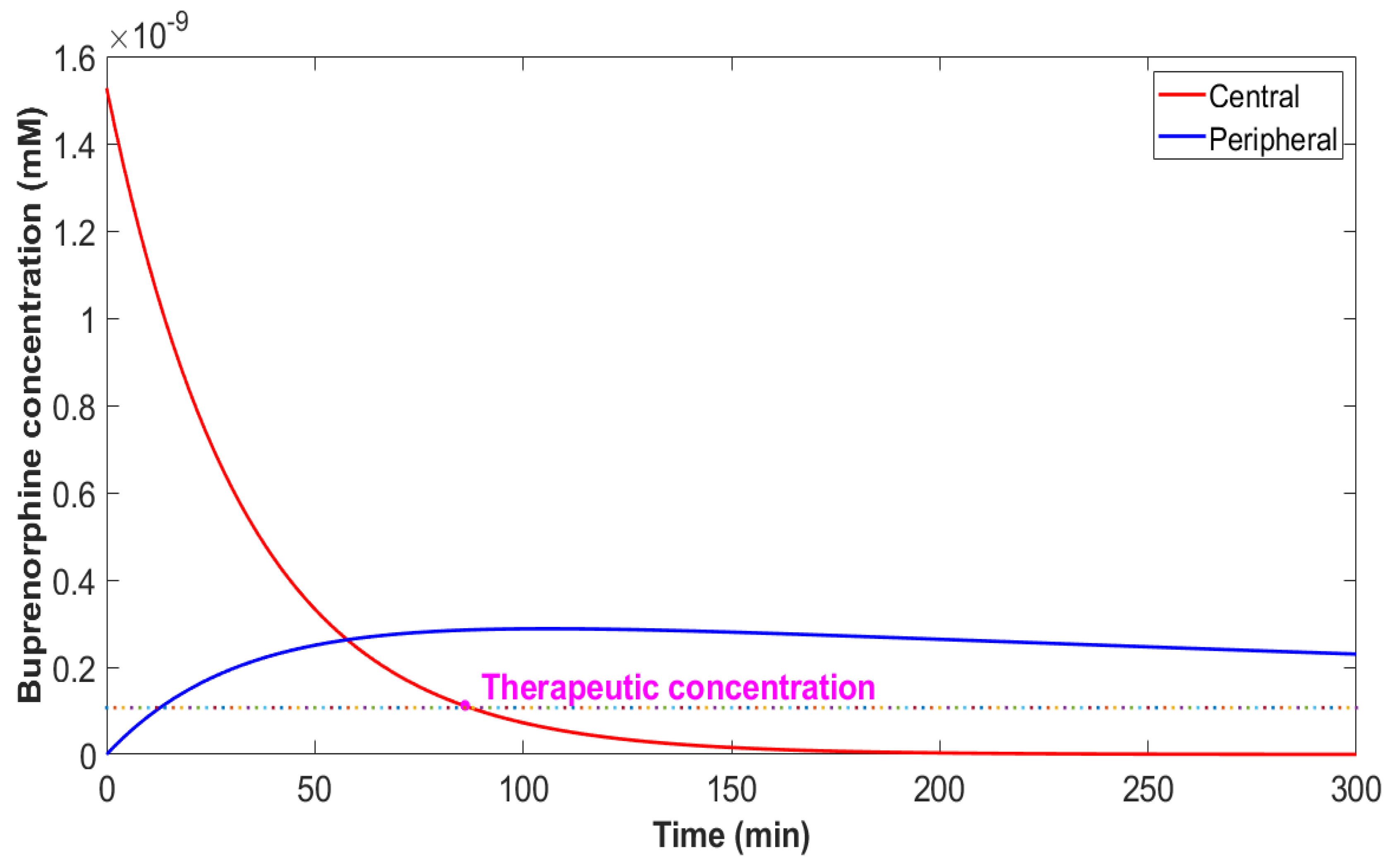
The two-compartment model estimates the drug concentration in the tissues and blood. It results in assessing the medicine’s efficacy. A buprenorphine bolus injection has been modeled for central and peripheral compartments, as shown in Figure 2. The model estimates a time of 3578 min for it to completely leave the blood and tissues, as seen in Figure 2. It takes 86 min for the body to reach the therapeutic concentration of 50 ng/mL.
Figure 2.
Pharmacokinetics of buprenorphine.
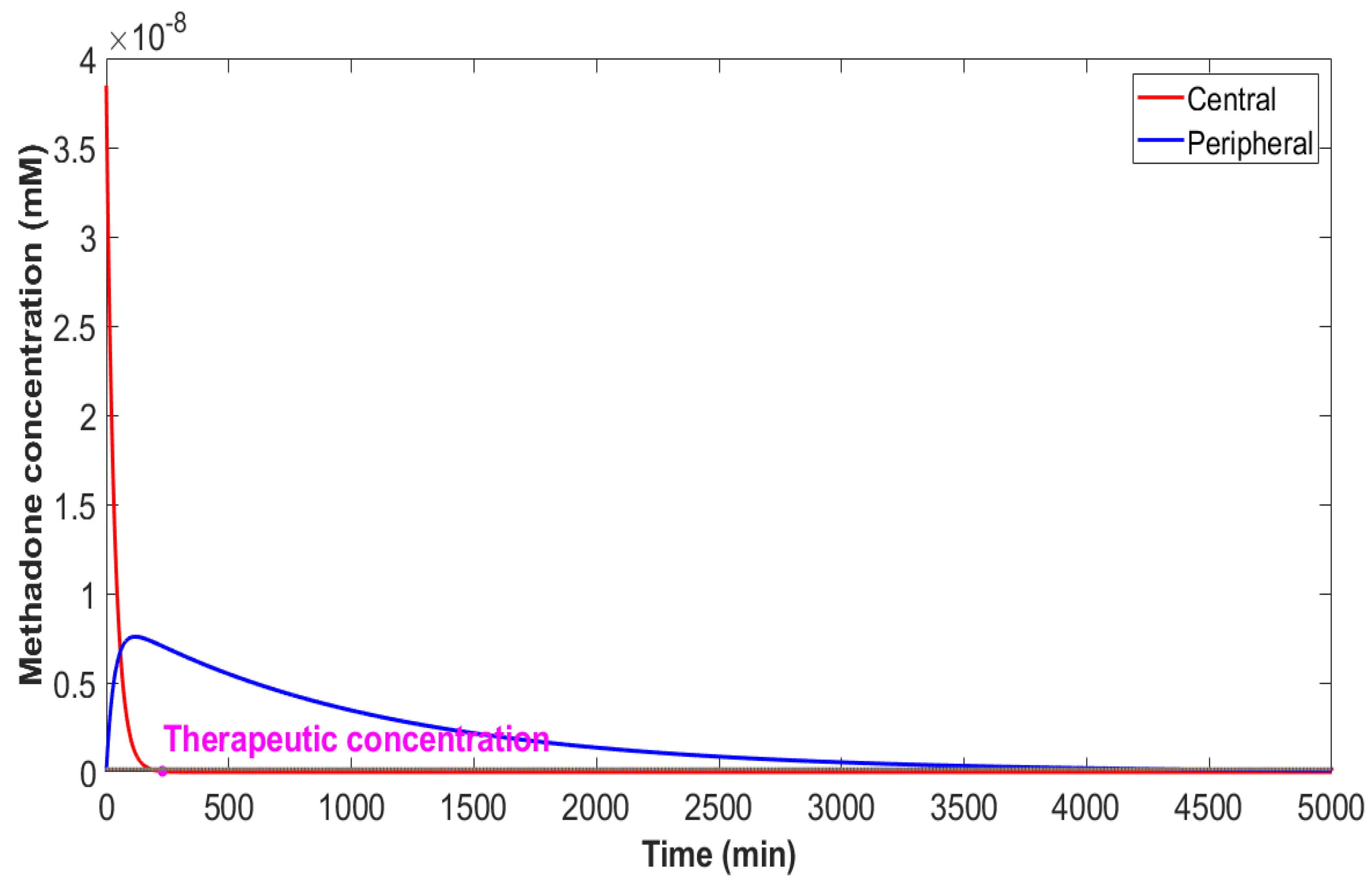
Similarly, methadone takes 4590 min to completely excrete from the blood and tissues, as seen in Figure 3. It takes 230 min for the body to reach the therapeutic concentration of 50 ng/mL.
Figure 3.
Pharmacokinetics of methadone.
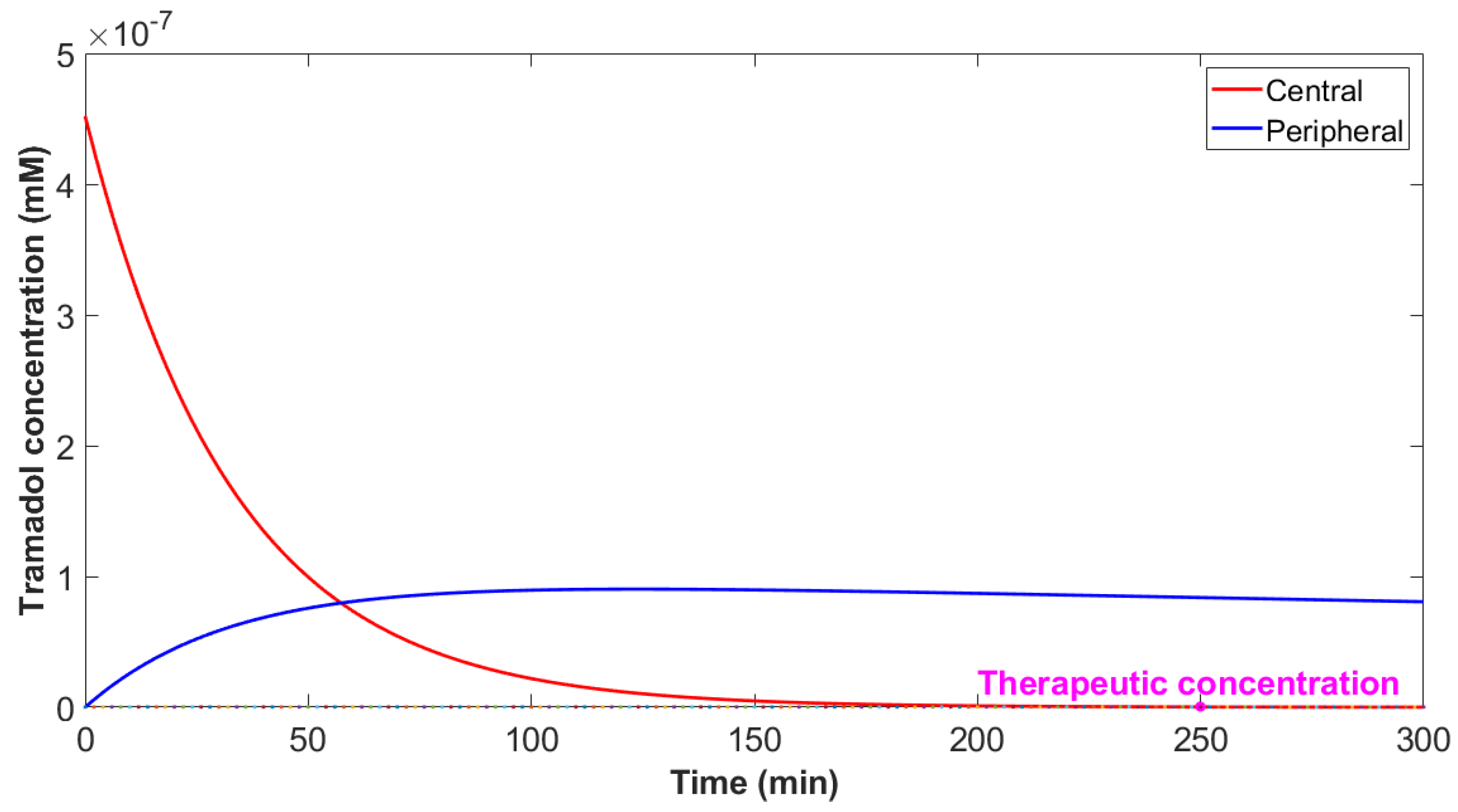
Tramadol takes 4990 min to completely leave the blood and tissues, as seen in Figure 4. To achieve the therapeutic concentration of 50 ng/mL, it takes 250 min.
Figure 4.
Pharmacokinetics of tramadol.
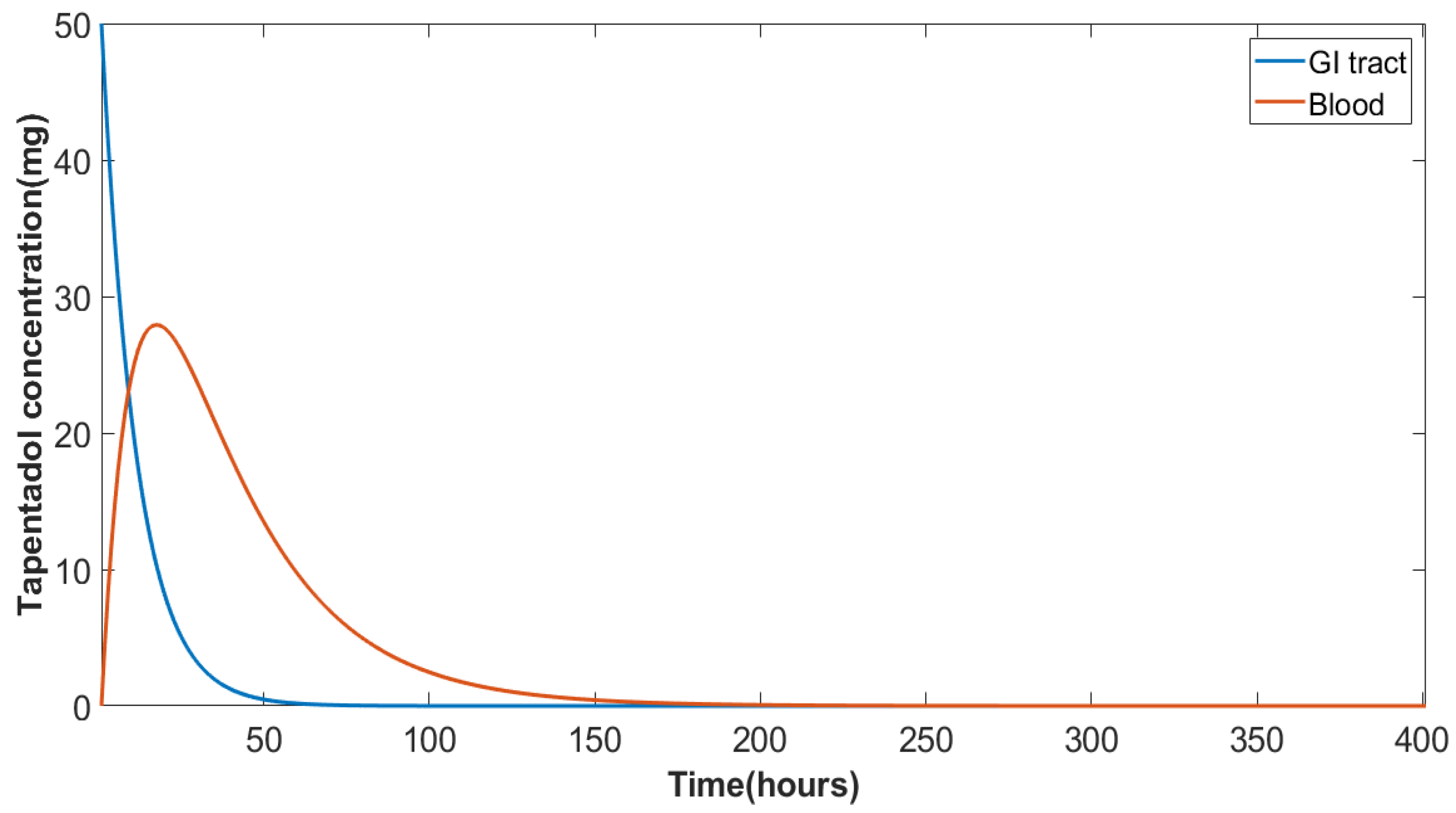
Tapentadol is available as an oral solution. Hence, the path for the drug is via the GI tract to the blood. Using the differential equations for oral administration described in Equations (2) and (3), its pharmacokinetic behavior is observed (Figure 5). It takes 409 min after oral administration to reach the minimum effective concentration of 50 ng/mL, as depicted in Table 1.
Figure 5.
Pharmacokinetics of tapentadol.
Table 1.
Drug pharmacokinetic properties.
4. Discussion
Opioid analgesics are a strong classification of powerful pain-relieving medicines with the properties of opium. The primary objective is to manage moderate to severe pain, which is difficult with other types of pain relieving mechanisms. Morphine is one such opioid that is considered the standard by all other drugs. In addition to this, fentanyl serves as an extremely potent opioid often used in pain management for handling post-surgery pain or chronic pain in individuals tolerant to other opioids. In this study, the pharmacokinetic behavior of buprenorphine, methadone, tramadol, and tapentadol are compared in terms of their efficacy. Parameters such as the duration for achieving the minimum effective concentration in the blood and the time to completely leave the body are estimated. This determines the drug efficacy and helps the clinician to decide the next dosage and interval. From the study, buprenorphine results in the minimum time to reach the target threshold concentration in the blood, and the tapentadol oral formulation takes a relatively long period. Methadone and tramadol follow relatively the same curve. However, buprenorphine leaves the body relatively slow compared to the other three.
Methadone has a long half-life and remains in the body for an extended period due to the complex and multiple drug interactions. Although it is an excellent drug for cancer pain management, it requires significant caution while determining its dosage or frequency to avoid toxicity. Buprenorphine, on the other hand, has a ceiling effect, and it has excellent transdermal and sublingual absorption, avoiding first-pasts metabolism. Tramadol and tapentadol are weak opioid receptors, whereas tramadol has its predominant action on the serotonergic pathway, and tapentadol has its action on the norepinephrine pathway and, hence, has distinctly different potency and toxicity.
Because of the high risks associated with these analgesics, healthcare providers are recommended to evaluate each patient’s individual needs and monitor them closely during opioid therapy. Before adjusting to alternative pain management techniques, it is crucial to adhere to these directions.
5. Conclusions
This study focuses on understanding the kinetics of drugs such as buprenorphine, methadone, and tramadol when administered intravenously and tapentadol with oral administration within the human body. Mathematical models using MATLAB were used to calculate various parameters, such as the duration for achieving the minimum effective concentration in the blood and the time to completely leave the body, to compare these drugs in terms of efficacy and potency. Buprenorphine is used in opioid replacement therapy as a substitute for other opioids. Hence, this study helps in knowing its appropriate dosage and interval for prescribing it post any other drug. Methadone and tramadol are prolonged agonists, which activate the receptors in the brain like all other opioids do, but in a relatively slower fashion. As only oral formulations of tapentadol are available, models including the GI tract to blood path were followed to obtain its pharmacokinetic characteristics. Understanding the kinetics of these drugs is significant for optimizing dosing regimens and enhancing treatment efficacy. By knowing the time it takes for the drugs to reach the minimum effective concentration and the duration of their presence in the body, healthcare professionals can make informed decisions regarding dosing strategies. These models are specific to bolus intravenous administration by treating the body as two compartments. The models assume the volumes in the compartments and reaction rates to be constant. These models also assume that every patient reacts similarly to the drug. Further, this study can be extended to models consisting of more compartments to categorize various organs depending on the perfusion. These complex models will enhance the accuracy of the results obtained.
Author Contributions
Conceptualization, P.S. and N.S.; methodology, P.S.; software, P.S. and S.C.; validation, N.S., M.R. and S.C.; formal analysis, P.S., N.S., J.D., M.R. and S.C.; writing—review and editing, P.S., N.S., M.R. and S.C.; supervision, N.S.; project administration, N.S.; funding acquisition, P.S., N.S., M.R. and S.C. All authors have read and agreed to the published version of the manuscript.
Funding
This research was funded by the Indian Council of Medical Research (ICMR), 5/3/8/81/2020-lTR.
Institutional Review Board Statement
Not applicable.
Informed Consent Statement
Not applicable.
Data Availability Statement
No new data were created.
Conflicts of Interest
The authors declare no conflict of interest.
References
- Cohen, M.; Quintner, J.; van Rysewyk, S. Reconsidering the International Association for the Study of Pain definition of pain. Pain Rep. 2018, 3, e634. [Google Scholar] [CrossRef] [PubMed]
- Negus, S.S.; Vanderah, T.W.; Brandt, M.R.; Bilsky, E.J.; Becerra, L.; Borsook, D. Preclinical Assessment of Candidate Analgesic Drugs: Recent Advances and Future Challenges. J. Pharmacol. Exp. Ther. 2006, 319, 507–514. [Google Scholar] [CrossRef] [PubMed]
- Cooper, T.E.; Fisher, E.; Gray, A.L.; Krane, E.; Sethna, N.; van Tilburg, M.A.L.; Zernikow, B.; Wiffen, P.J. Opioids for chronic non-cancer pain in children and adolescents. Cochrane Database Syst. Rev. 2017, 7. [Google Scholar] [CrossRef]
- Currie, G.M. Pharmacology, Part 2: Introduction to Pharmacokinetics. J. Nucl. Med. Technol. 2018, 46, 221–230. [Google Scholar] [CrossRef]
- Doogue, M.P.; Polasek, T.M. The ABCD of clinical pharmacokinetics. Ther. Adv. Drug Saf. 2013, 4, 5–7. [Google Scholar] [CrossRef] [PubMed]
- Davis, M.P. Twelve reasons for considering buprenorphine as a frontline analgesic in the management of pain. J. Support. Oncol. 2012, 10, 209–219. [Google Scholar] [CrossRef] [PubMed]
- Pasternak, G.W.; Pan, Y.-X. Mu Opioids and Their Receptors: Evolution of a Concept. Pharmacol. Rev. 2013, 65, 1257–1317. [Google Scholar] [CrossRef] [PubMed]
- Hain, R.; Goldman, A.; Rapoport, A.; Meiring, M. Oxford Textbook of Palliative Care for Children; Oxford University Press: Oxford, UK, 2021. [Google Scholar]
- Nicholson, B. Benefits of Extended-Release Opioid Analgesic Formulations in the Treatment of Chronic Pain. Pain Pract. 2009, 9, 71–81. [Google Scholar] [CrossRef]
- Subedi, M.; Bajaj, S.; Kumar, M.S.; Yc, M. An overview of tramadol and its usage in pain management and future perspective. Biomed. Pharmacother. 2019, 111, 443–451. [Google Scholar] [CrossRef]
- Flecknell, P. Chapter 4—Analgesia and Post-Operative Care. In Laboratory Animal Anaesthesia, 4th ed.; Flecknell, P., Ed.; Academic Press: Boston, MA, USA, 2016; pp. 141–192. [Google Scholar] [CrossRef]
- Arifin, D.Y.; Lee, L.Y.; Wang, C.-H. Mathematical modeling and simulation of drug release from microspheres: Implications to drug delivery systems. Adv. Drug Deliv. Rev. 2006, 58, 1274–1325. [Google Scholar] [CrossRef] [PubMed]
- Siepmann, J.; Siepmann, F. Mathematical modeling of drug delivery. Int. J. Pharm. 2008, 364, 328–343. [Google Scholar] [CrossRef] [PubMed]
- Alqahtani, M.S.; Kazi, M.; Alsenaidy, M.A.; Ahmad, M.Z. Advances in Oral Drug Delivery. Front. Pharmacol. 2021, 12. Available online: https://www.frontiersin.org/articles/10.3389/fphar.2021.618411 (accessed on 24 July 2023). [CrossRef] [PubMed]
- Khanday, M.A.; Rafiq, A.; Nazir, K. Mathematical models for drug diffusion through the compartments of blood and tissue medium. Alex. J. Med. 2017, 53, 245–249. [Google Scholar] [CrossRef]
- Peterfreund, R.A. Intravenous administration of medications during an anesthetic: A deceptively simple process. J. Clin. Monit. Comput. 2019, 33, 547–548. [Google Scholar] [CrossRef] [PubMed]
- Huestis, M.A.; Cone, E.J.; Pirnay, S.O.; Umbricht, A.; Preston, K.L. Intravenous buprenorphine and norbuprenorphine pharmacokinetics in humans. Drug Alcohol. Depend. 2013, 131, 258–262. [Google Scholar] [CrossRef] [PubMed]
- Minkowitz, H.; Leiman, D.; Lu, L.; Reines, S.; Ryan, M.; Harnett, M.; Singla, N. IV Tramadol—A New Treatment Option for Management of Post-Operative Pain in the US: An Open-Label, Single-Arm, Safety Trial Including Various Types of Surgery. J. Pain Res. 2020, 13, 1155–1162. [Google Scholar] [CrossRef] [PubMed]
- Therapeutic Guidelines. Tapentadol for analgesia. Aust. Prescr. 2013, 36, 105–107. [Google Scholar] [CrossRef]
- Dormand, J.R.; Prince, P.J. A family of embedded Runge-Kutta formulae. J. Comput. Appl. Math. 1980, 6, 19–26. [Google Scholar] [CrossRef]
Disclaimer/Publisher’s Note: The statements, opinions and data contained in all publications are solely those of the individual author(s) and contributor(s) and not of MDPI and/or the editor(s). MDPI and/or the editor(s) disclaim responsibility for any injury to people or property resulting from any ideas, methods, instructions or products referred to in the content. |
© 2023 by the authors. Licensee MDPI, Basel, Switzerland. This article is an open access article distributed under the terms and conditions of the Creative Commons Attribution (CC BY) license (https://creativecommons.org/licenses/by/4.0/).