Proceeding Paper

Machine Learning-Based Weld Classification for Quality Monitoring †
Department of Mechanical Engineering, School of Engineering and Information Technology, Manipal Academy of Higher Education, Dubai Campus, Dubai PO Box 345 050, United Arab Emirates
*
Authors to whom correspondence should be addressed.
Presented at the International Conference on Recent Advances in Science and Engineering, Dubai, United Arab Emirates, 4–5 October 2023.
Eng. Proc. 2023, 59(1), 241; https://doi.org/10.3390/engproc2023059241

Published: 15 March 2024
(This article belongs to the Proceedings of Eng. Proc., 2023, RAiSE-2023)

Abstract

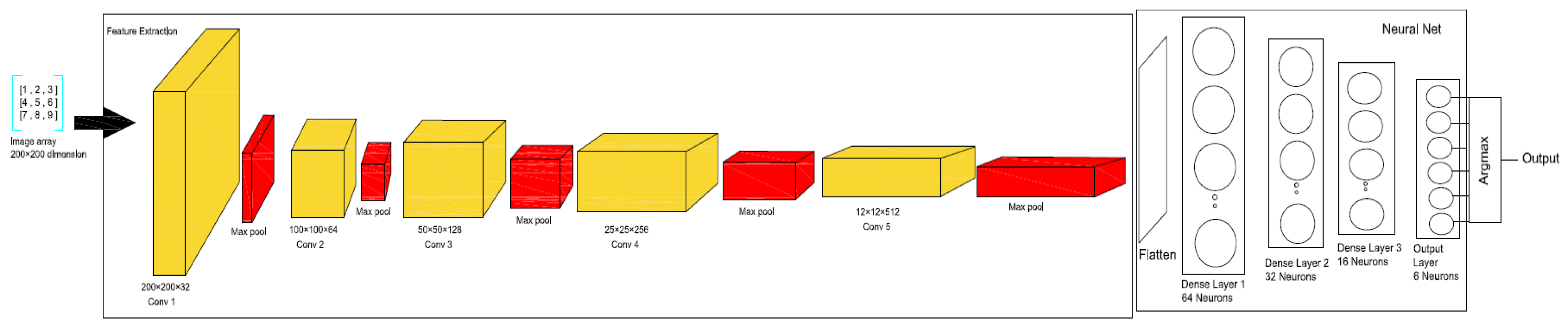
The welding industry plays a fundamental role in manufacturing. Ensuringweld quality is critical when safety, reliability, performance, and the associated cost are taken into account. A ungsten inert gas (TIG) weld quality assessment can be a laborious and time-consuming process. The current state of the art is quite simple, with a person continuously monitoring the procedure. However, this approach has some limitations. Operator decisions can be subjective, and fatigue can affect their observations, leading to inaccuracies in the assessment. In this research project, a deep learning approach is proposed to classify weld defects using convolutional neural networks (CNNs) to automate the process. The dataset used for this project is sourced from Kaggle, provided by Bacioiu et al. The proposed CNN-based approach aims to accurately classify weld defects using the image data. This study trains the model on the welding dataset, using five convolutional layers followed by five pooling layers and, finally, three fully connected layers. The softmax activation function is employed in the output layer to categorize the input into the six weld categories. The per-class metrics, such as precision, recall, and F1-score, suggest that the model is dependable and accurate.
Keywords: automation; CNN; deep learning; TIG; weld classification automation; CNN; deep learning; TIG; weld classification