Abstract
The adoption of renewable energy sources, particularly wind energy, has seen remarkable growth in recent years. Wind energy generation requires efficient and reliable generators that can convert wind energy into usable electrical energy. Switched Reluctance Generators (SRGs) have been gaining popularity in wind energy applications due to their high efficiency, reliability, and low maintenance requirements. The multiphase switched reluctance generators are used especially in wind power plants due to their ability to operate in variable speed ranges. In this paper, a MATLAB/SIMULINK based model of Switched Reluctance Generator (SRG) is presented. The obtained results show good agreement under different operating conditions. The obtained results (current, voltage, torque, speed, flux, and angle of generator) are shown in graphs.
1. Introduction
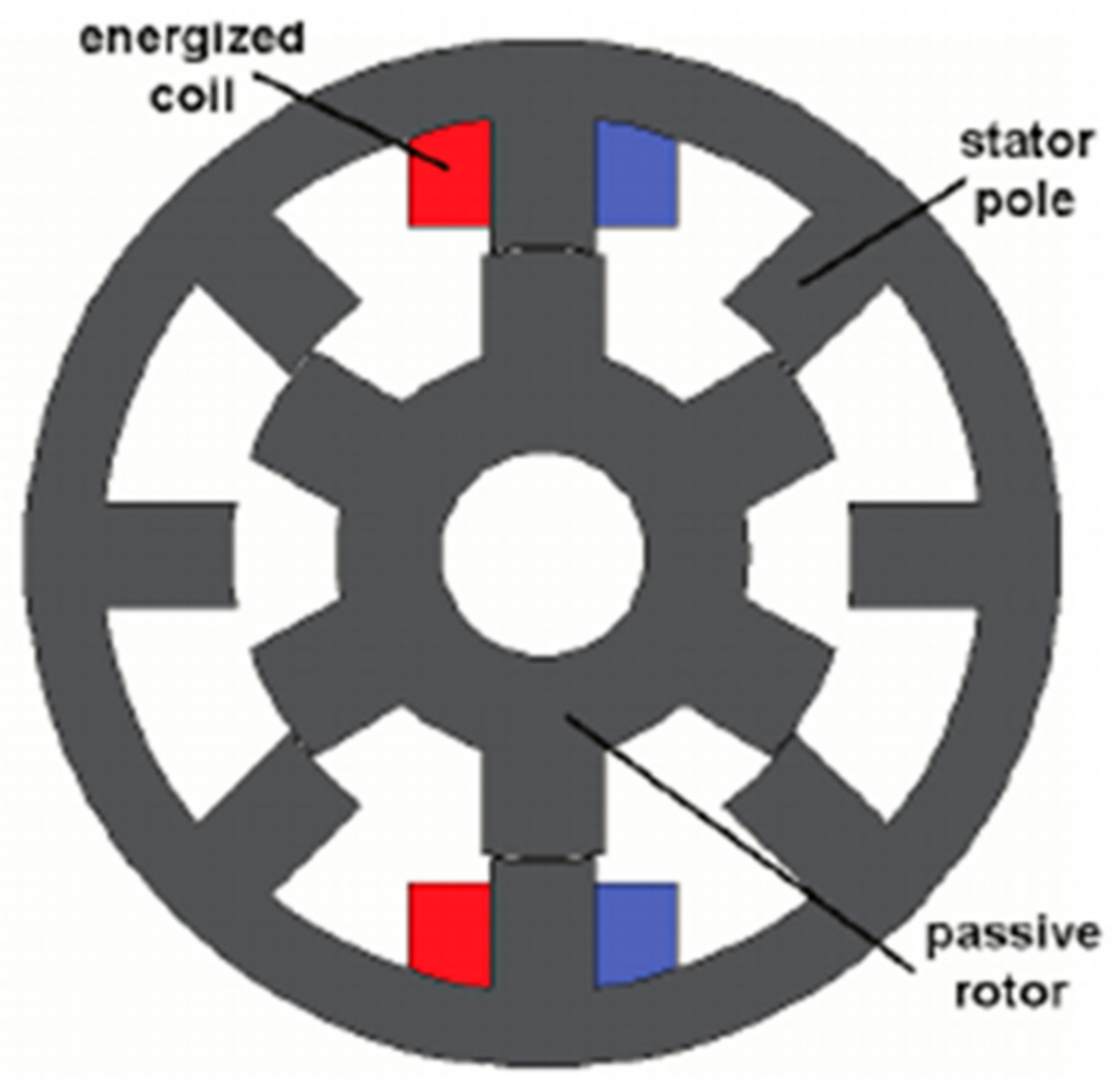
The growing demand for clean and sustainable energy has resulted in a significant increase in the adoption of renewable energy sources, particularly wind energy. Wind energy is an essential component of the global transition towards sustainable and renewable sources of electricity generation. As the demand for clean energy continues to grow, there is an increasing need for efficient and cost-effective wind turbines that can harness the power of the wind. In this research, Switched Reluctance Generators (SRGs) have emerged as a promising technology with the potential to enhance the performance and economic viability of wind energy systems. Wind energy generation requires efficient and reliable generators that can convert wind energy into usable electrical energy. Traditional generator technologies, such as permanent magnet generators and induction generators, have been widely used in wind energy applications. However, these generators have some limitations in terms of efficiency, reliability, and cost. Switched reluctance generators (SRGs) have been proposed as a potential solution for wind energy generation due to their simple robust design, high efficiency, and low cost compared to conventional generators. The key advantage of the SRG is that it does not require permanent magnets, which can be expensive and difficult to source, making it a more cost-effective solution for wind energy generation. SRGs have been tested for wind energy generation in both horizontal and vertical axis wind turbines and have shown promising results. This paper provides a comprehensive review of SRG technology and its suitability for wind energy applications [1]. Zeki Omaç, Ceren Cevahir (2021) presented a control method for a switched-reluctance generator in wind power system applications at variable speeds. The author used MATLAB/Simulink to simulate the SRG driver and control its real-time implementation. The proportional-integral (PI) voltage controller was used to regulate the SRG’s output voltage [2]. Da-Woon Choi presented a study on the maximum power control method of a switched-reluctance generator for wind turbines. The modelling and power control strategies of a Switching Reluctance Generator (SRG) driven by a wind power generation system are discussed in this work [3]. Cardenas, R has presented an innovative control system for a Switched Reluctance Generator (SRG) powered by a variable speed wind turbine is presented in this paper. Using closed loop control of the power output, the SRG is steered to propel a Wind Energy Conversion System (WECS) to the point of maximum aerodynamic efficiency. In summary, switched reluctance generators have the potential to be a cost-effective and efficient solution for wind energy generation. However, further research is needed to optimize their performance for different wind speed regions and to investigate their long-term reliability and maintenance requirements. Figure 1 shows a cross-sectional view of an 8/6 pole SRM.
Figure 1.
Cross-sectional view of 8/6 pole SRM.
2. SRM Performance as Generator
Switched Reluctance Machines (SRMs) have shown promising performance as generators in various applications. They can operate at a wide range of speeds, allowing for efficient power generation in different operating conditions, and possess inherent fault tolerance, as they can continue to operate even in the presence of certain faults or irregularities in the system. However, SRMs typically require advanced control strategies to optimize their performance and overcome challenges such as torque ripple and acoustic noise. Ongoing research focuses on improving the efficiency and power quality of SRMs as generators, as well as exploring their integration with renewable energy sources such as wind and solar. Overall, SRMs demonstrate considerable potential as generators and continue to be an active area of research and development.
3. Methodology
The objective of this research is to assess the performance of a multiphase Switched Reluctance Machine (SRM) in wind energy applications. The focus is on analyzing the suitability of multiphase SRMs for wind energy conversion and identifying their advantages and limitations in the context of wind turbine applications. Wind turbines are used as a source of mechanical power. SRMs rely on the proper control of magnetic flux to generate power. By adjusting the excitation current, the magnetic flux in the motor can be regulated, allowing for precise control of the power delivered. In this research, we have used half-bridge cells to control the excitation current of poly-phase SRMs. A further excitation current control circuit is implemented using the rotor position control method. In the rotor control method, the rotor position is predicted based on the data of rotor speed.
4. Simulation Model and Results
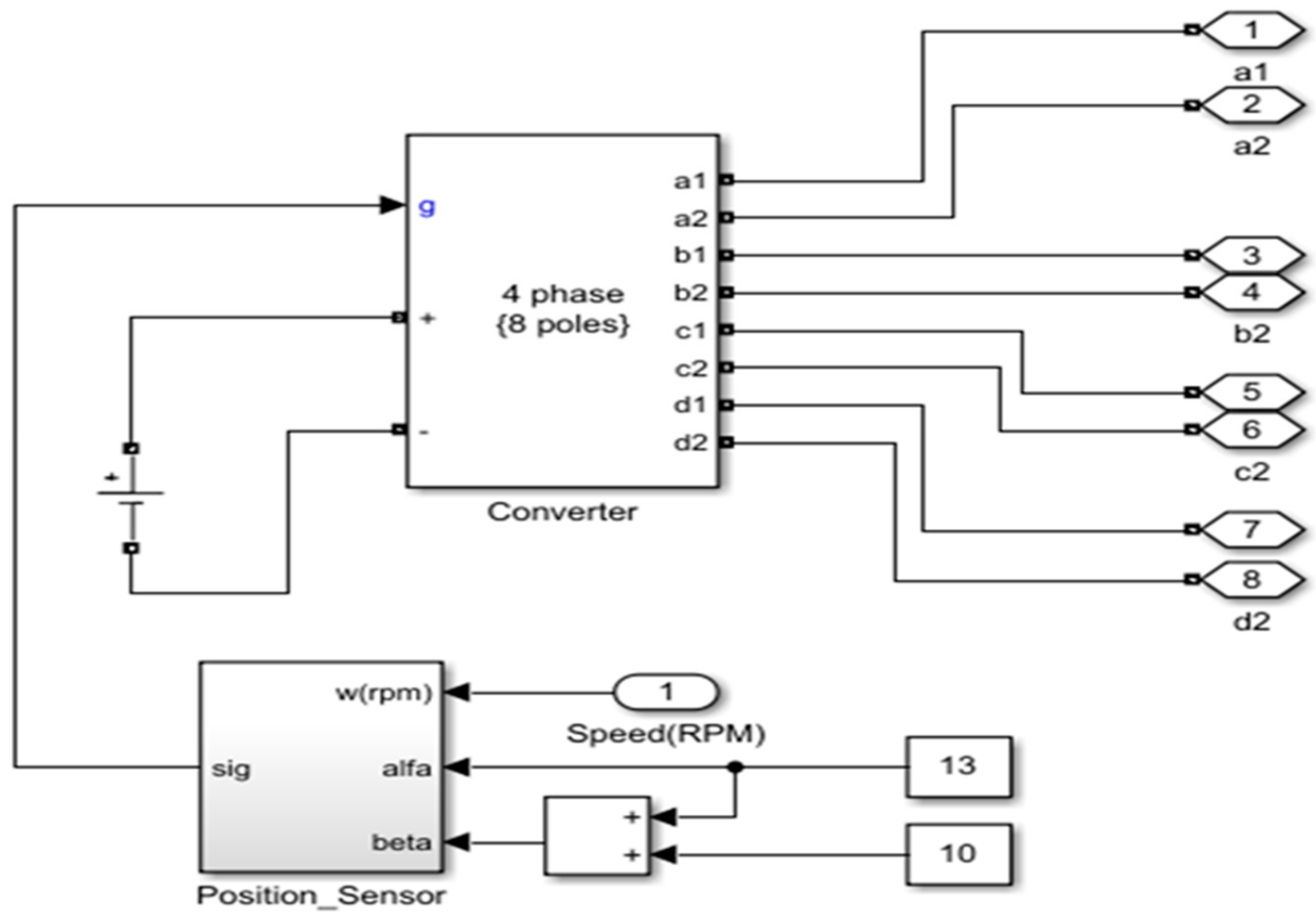
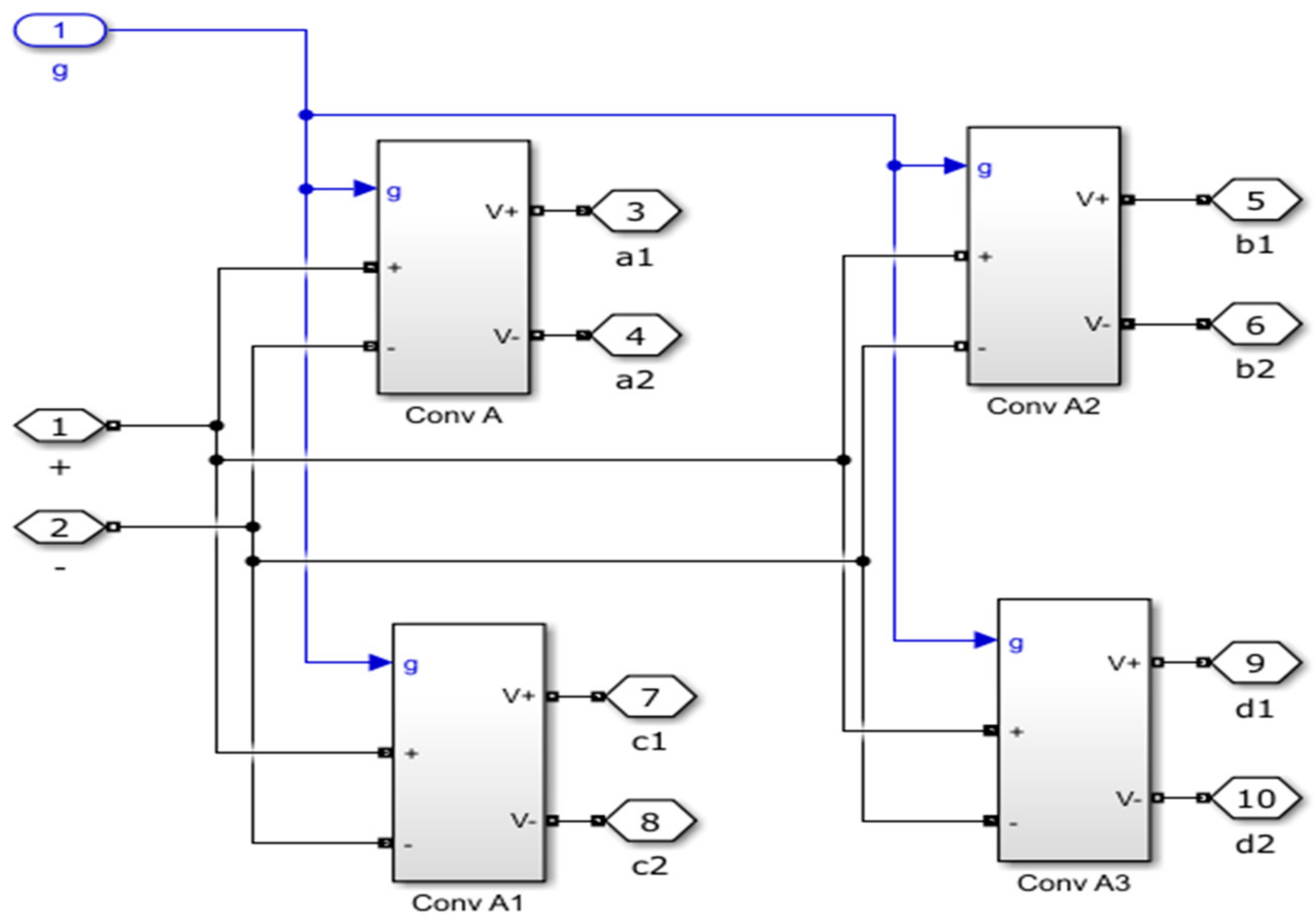
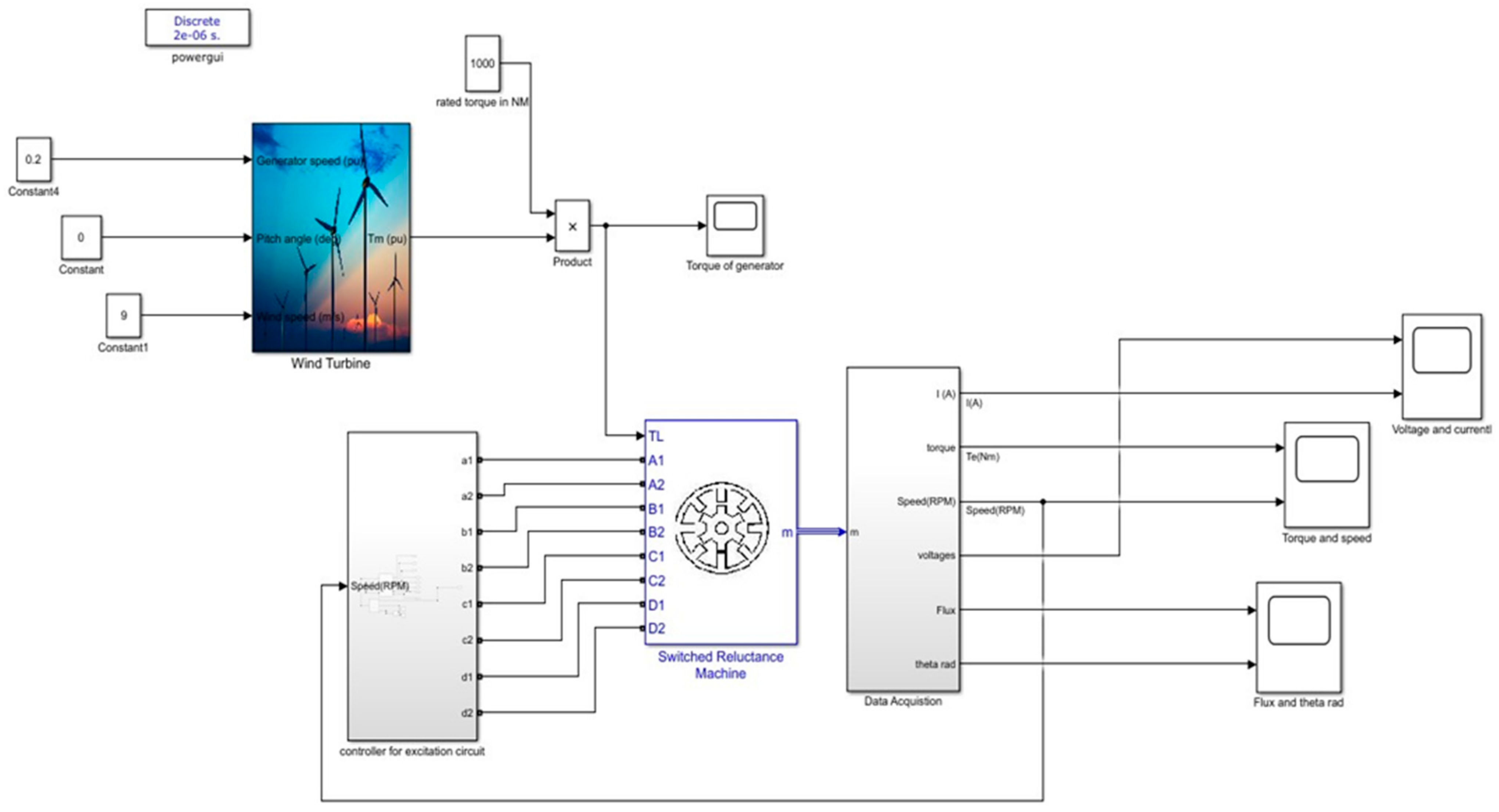
Using MATLAB/Simulink, R2021b a mathematical model for Switched Reluctance Machines was created in which a Switched Reluctance Machine (SRM) was directly connected to a wind turbine and operated it as a generator. To control the Switched Reluctance Machine (SRM) output voltage, an excitation control circuit was used. The Switch Reluctance Generator (SRG) is controlled with a four-phase half-bridge power converter with four legs. During operation, selected stator poles are energized. Rotor poles which are near to energized stator poles are attracted. When the poles are sufficiently attracted, the phase current via diodes begins to charge the DC link capacitor. By checking the DC link voltage, the excitation control circuit switches to the subsequent phase through a power electronics converter. In this way, it controls the DC voltage according to the reference above. The excitation circuit is shown in Figure 2 and Figure 3, and the complete model is shown in Figure 4 developed in MATLAB/Simulink environment. For simulation purposes, the rated DC voltage is taken as 200 V, the turn-on angle is taken as 13 degrees, and the turn-off angle is taken as 23 degrees. Simulations are carried out in MATLAB. The developed model is based on general voltage equation of switched reluctance machine which governs the stator current of SRG.
Figure 2.
Power circuit of the excitation control circuit.
Figure 3.
Complete excitation circuit of SRG.
Figure 4.
MATLAB model of SRG with Wind.
The voltage equation is given as,
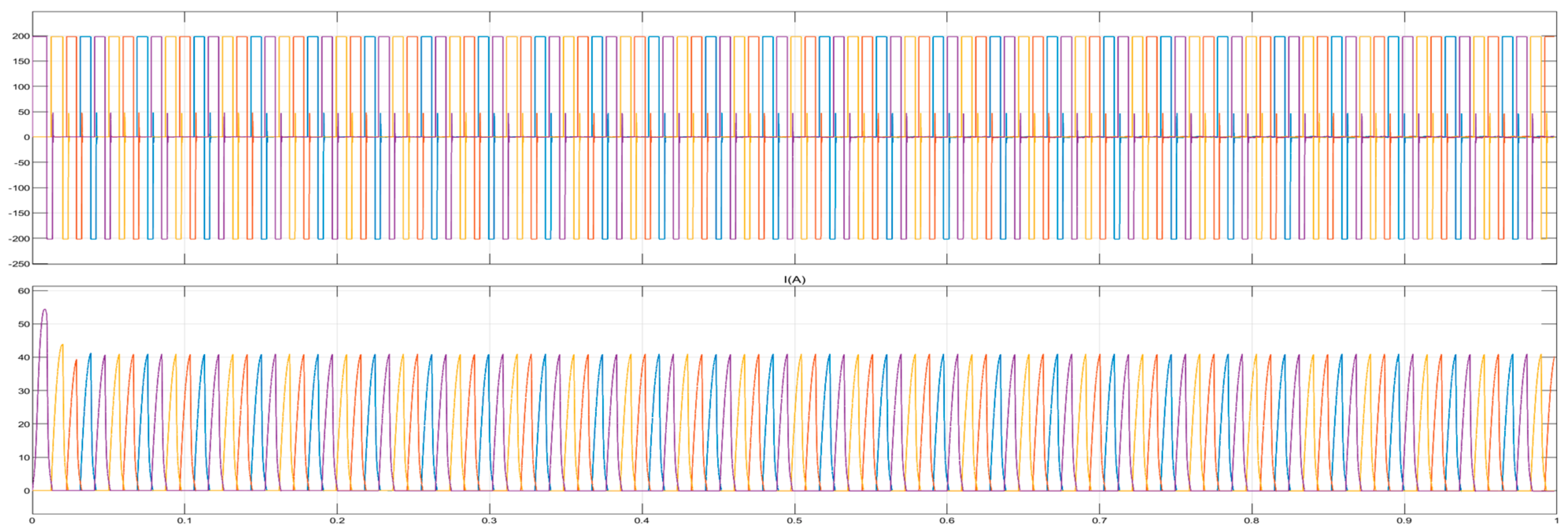
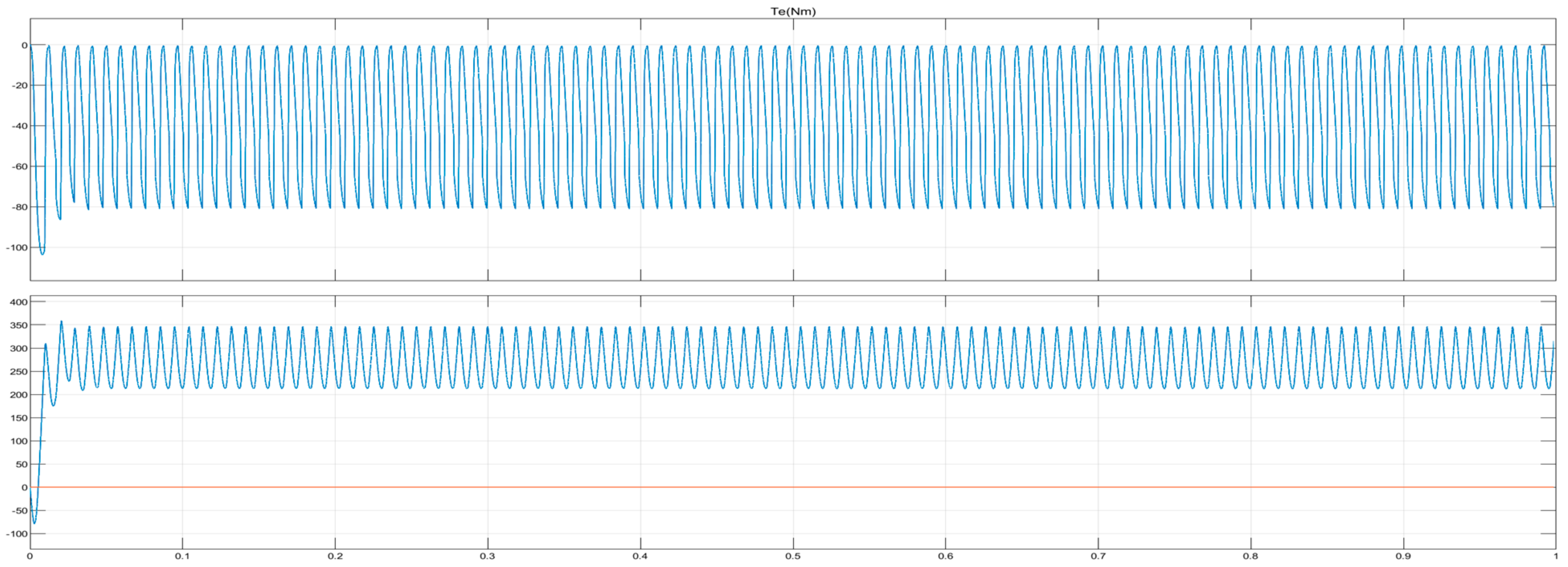
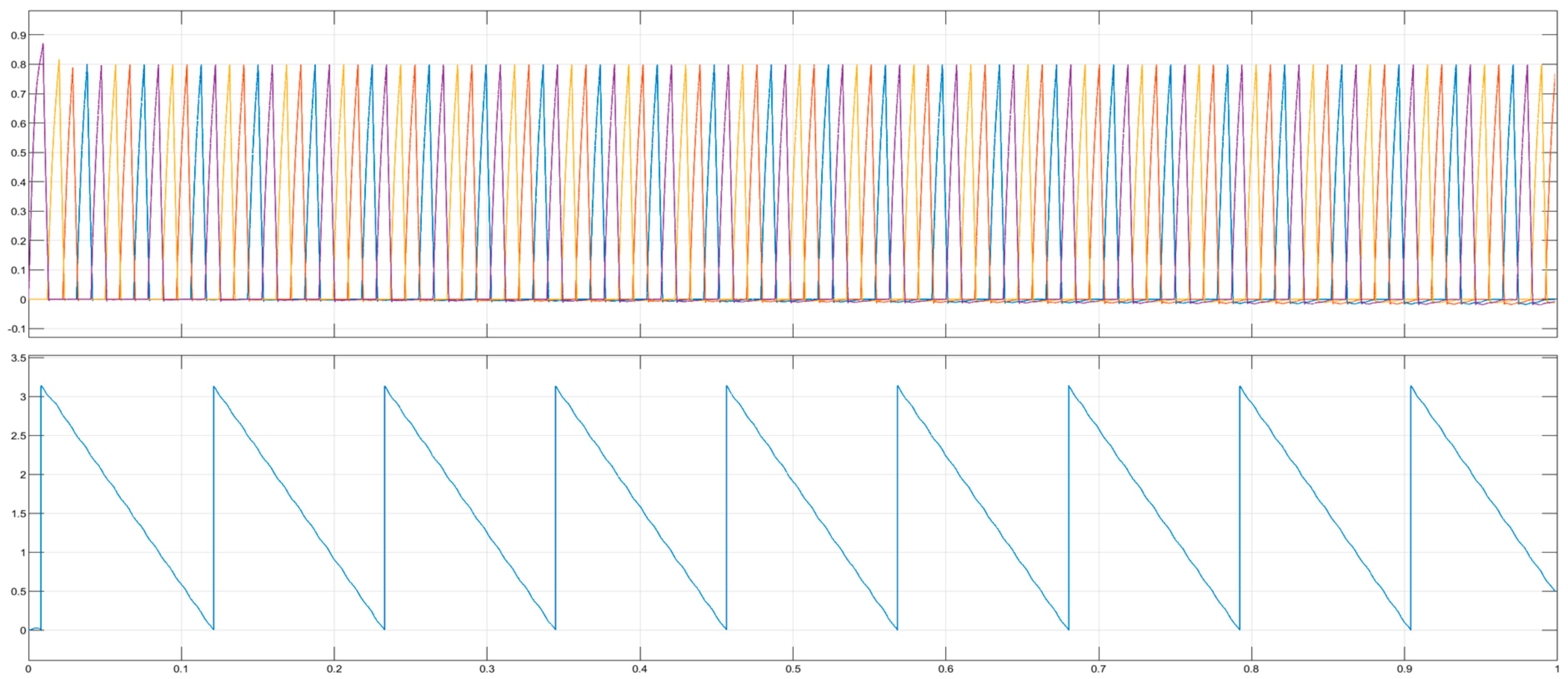
where v is applied voltage and R is winding resistance of SRG which is take as 2.5 ohms as in input data along with necessary input data of flux, co energy and static torque separately in the model of SRG [4]. Memon, A.A has efficiently used the data and produced better results of SRM in different applications. In [5,6,7], a input data table based model are presented in the literature. The output current has been investigated, and Figure 2 shows that the output current is being controlled by the excitation control circuit. The voltage and current profile of the generator are shown in Figure 5. Figure 6 represents the total torque and sped profile of SRG. Figure 7 shows angle variation with respect to time.
Figure 5.
Generator output voltage (upper waveform) and current (lower waveform). Purple color shows phase A, Dark yellow color shows phase B, light yellow color shows phase C and blue color shows phase D.
Figure 6.
SRG total torque (upper waveform) and speed (lower waveform).
Figure 7.
Flux and rotor angle profile of 8/6 switched reluctance generator. Purple color shows phase A, Dark yellow color shows phase B, light yellow color shows phase C and blue color shows phase D.
5. Conclusions
The performance and efficiency of wind turbines can be significantly improved by selection of SRG with appropriate inverter. Multiphase SRG has proved reliability and continuous operation in absence of one or more phases if compared with traditional three phase generators. The multiphases Switched Reluctance Generators (SRGs) have proved a better option for wind energy applications. The obtained results have shown current, torque, flux and speed profiles of SRG in dynamic conditions.
Author Contributions
Conceptualization, A.A.M.; methodology, W.A.A.S.; software, W.A.A.S.; validation, W.A.A.S. and A.A.M.; formal analysis, W.A.A.S.; investigation, A.A.M.; resources, W.A.A.S.; data curation, W.A.A.S.; writing—original draft preparation, W.A.A.S.; writing—review and editing, A.A.M.; visualization, A.A.M.; supervision, A.A.M.; project administration, A.A.M. All authors have read and agreed to the published version of the manuscript.
Funding
This research received no external funding.
Institutional Review Board Statement
Not applicable.
Informed Consent Statement
Not applicable.
Data Availability Statement
Not applicable.
Conflicts of Interest
The authors declare no conflict of interest.
References
- Omaç, Z.; Cevahir, C. Control of switched reluctance generator in wind power system application for variable speeds. Ain Shams Eng. J. 2021, 12, 2665–2672. [Google Scholar] [CrossRef]
- Choi, D.-W.; Byun, S.-I.; Cho, Y.-H. A study on the maximum power control method of switched reluctance generator for wind turbine. IEEE Trans. Magn. 2013, 50, 1–4. [Google Scholar] [CrossRef]
- Cardenas, R.; Pena, R.; Perez, M.; Clare, J.; Asher, G.; Wheeler, P. Control of a switched reluctance generator for variable-speed wind energy applications. IEEE Trans. Energy Convers. 2005, 20, 781–791. [Google Scholar] [CrossRef]
- Memon, A.A.; Shaikh, M.M.; Bukhari, S.S.H.; Ro, J.S. Look-up Data Tables-Based Modeling of Switched Reluctance Machine and Experimental Validation of the Static Torque with Statistical Analysis. J. Magn. 2020, 25, 233–244. [Google Scholar] [CrossRef]
- Cheok, A.D.; Ertugrul, N. Computer-based automated test measurement system for determining magnetization characteristics of switched reluctance motors. IEEE Trans. Instrum. Meas. 2001, 50, 690–696. [Google Scholar] [CrossRef]
- Chancharoensook, P.; Rahman, M.F. Magnetization and static torque characterization of a four-phase switched reluctance motor: Experimental investigations. In Proceedings of the 4th IEEE International Conference on Power Electronics and Drive Systems (IEEE PEDS 2001), Denpasar, Indonesia, 25–25 October 2001; pp. 456–460. [Google Scholar]
- Lin, Z.; Reay, D.S.; Zhou, B. Experimental measurement of switched reluctance motor non-linear characteristics. In Proceedings of the 39th Annual Conference of the IEEE Industrial Electronics Society (IECON 2013), Vienna, Austria, 10–13 November 2013; pp. 2827–2832. [Google Scholar]
Disclaimer/Publisher’s Note: The statements, opinions and data contained in all publications are solely those of the individual author(s) and contributor(s) and not of MDPI and/or the editor(s). MDPI and/or the editor(s) disclaim responsibility for any injury to people or property resulting from any ideas, methods, instructions or products referred to in the content. |
© 2023 by the authors. Licensee MDPI, Basel, Switzerland. This article is an open access article distributed under the terms and conditions of the Creative Commons Attribution (CC BY) license (https://creativecommons.org/licenses/by/4.0/).