


Abstract
Recently, integrating Internet-of-Things (IoT) for an interactive learning has become a topic of interest. For cultural inclusion, young individuals need to be more aware of the culturally diverse community and embrace it. However, this is not possible without proper cultural education and awareness. With maker-based education, individuals can participate in active learning where they share their cultural heritage story. Hence, this research focuses on analyzing whether integrating IoT into a cultural game authoring tool will be an interesting and innovative approach in maker-based education for culture.
1. Introduction
Recently, there has been a tremendous change throughout the world as a result of globalization and internationalization. In a diverse country, cultural heritage is a substantial aspect for its people with different ethnicities. Therefore, it is essential for people in a diverse country to be taught about cultural heritage as it is a part of their identity, subsequently increasing respect for each other’s social values [1]. Museums and schools have recently been trying to find better ways to do so other than visiting sites and viewing historical artifacts [2]. With a great edutainment value, games have been known to grasp the minds of mainly young individuals [3]. However, making specific games for each museum might be time-consuming and financially expensive. This is where the importance of a game authoring tool comes in, with which any individual can make a unique experience for their fellow peers to indulge in cultural history [4]. Recently, Internet-of-Things (IoT) has been known to give an additional interactive method to further increase the edutainment value, but game designers have faced issues previously with properly integrating IoT [5,6]. This research focuses on a cultural game authoring tool that mainly is based on sharing the story of Kristang culture of Malacca in Malaysia and investigates the best way to integrate IoT into this game authoring tool. Furthermore, it also researches whether adding IoT is beneficial in this type of maker education that utilizes serious 3D game for cultural education. The aim of paper is to understand the appropriate method of integrating IoT in the form of radio-frequency identification (RFID) cards in a cultural game authoring tool to increase edutainment value.
2. Materials and Methods
The study comprised 56 participants playing a short cultural game focusing on Malacca with the use of IoT in the form of RFID cards. Figure 1 shows the adopted research methodology. The RFID cards depicted certain actions and credit in the game. Later, the participants tried the game authoring tool to make a small game and filled up a survey as shown in Table 1 to help understand whether integrating IoT to act as a form of interaction would be a helpful addition. The survey was of a linear scale, where 5 showed the most interest and 1 showed the least interest.

Figure 1.
Research methodology framework.

Table 1.
Survey questionnaire to evaluate the interest in IoT with the game authoring tool.
3. Results
The participants were from school, aged between 11 and 15 years old with an average age of 12.93 years, and involved 38 males and 18 females. Figure 2 shows the survey analysis of the study conducted. In total, 47 participants mentioned that they found cultural game authoring tool to be an effective way to share their cultural heritage in an immersive way. However, only 6 participants chose 5 as a scale regarding integration IoT in the game to be engaging, while 39 participants chose 4 as a scale. Moreover, 53 participants mentioned that they enjoyed making a short scene with the game authoring tool prototype, and 48 participants liked the form of using RFID cards in the game, where 9 participants chose the scale of 5 and 39 chose the scale of 4. Further, 55 participants showed interest in using RFID cards as actions in the game. Lastly, 53 participants did not find the game authoring tool prototype hard to use while designing the game scene, where 38 participants chose the scale of 5 and 15 participants chose the scale of 4.
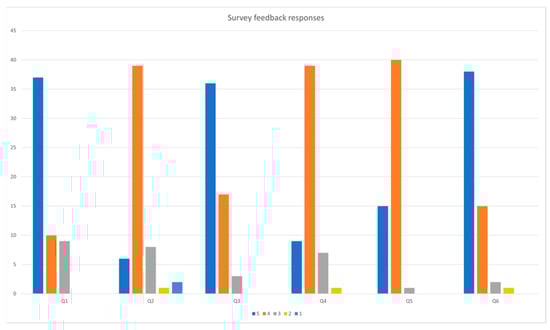
Figure 2.
Survey analysis of the study to understand interest in IoT with the game tool.
4. Discussion
Younger individuals aged 11–15 years found the game authoring tool with the IoT integration as RFID cards for actions such as trading to be entertaining. It can be said that integrating IoT into the game authoring tool might not be a necessity for the cultural heritage education. However, integrating IoT in the form of RFID cards for simple interactions such as trading can improve engagement and involvement for the individuals. The reason for conducting the study with young individuals was that the purpose of the game authoring tool was to increase their interest in cultural heritage. It is to be noted that, with sharing and knowing each other’s cultural story, diversity and cultural inclusion will be improved.
5. Conclusions
Integrating IoT into the cultural game authoring tool in the form of RFID cards for actions and credit for the game seems to be a fitting way to get more young individuals to be interested in cultural heritage. The participants showed more preference to RFID cards as forms of interaction. As a future development, RFID card may be depicted as a debit card to make it more engaging for young individuals. This study introduces an effective way to integrate IoT with the 3D game authoring tool directed for cultural heritage education and awareness.
Author Contributions
Conceptualization, M.O.M.A. and M.R.S.; methodology, M.O.M.A.; validation, M.O.M.A. and M.R.S.; formal analysis, M.O.M.A.; writing—original draft preparation, M.O.M.A.; writing—review and editing, M.R.S.; visualization, M.O.M.A.; supervision, K.H.N. All authors have read and agreed to the published version of the manuscript.
Funding
This research received no external funding.
Institutional Review Board Statement
The study was conducted in accordance with the Declaration of Helsinki and approved by the Institutional Review Board and Ethics Committee of UNIVERSITY OF NOTTINGHAM MALAYSIA (project code MOMA250722, Science and Engineering Ethics Committee and 09 August 2022).
Informed Consent Statement
Informed consent was obtained from all subjects involved in the study.
Data Availability Statement
The data presented in this study are openly available in Mendeley Data titled “Survey to integrate IoT in cultural game authoring tool” at doi:10.17632/gzy6fckmb7.1, V1, 2022.
Conflicts of Interest
The authors declare no conflict of interest.
References
- Hofstede, G.; McCrae, R.R. Personality and Culture Revisited: Linking Traits and Dimensions of Culture. Cross Cult. Res. 2004, 38, 52–88. [Google Scholar] [CrossRef]
- Marshall, M. Interacting with heritage: On the use and potential of IoT within the cultural heritage sector. In Proceedings of the 2018 Fifth International Conference on Internet of Things: Systems, Management and Security, Valencia, Spain, 15–18 October 2018. [Google Scholar]
- Ćosović, M.; Brkić, B.R. Game-Based Learning in Museums—Cultural Heritage Applications. Inf. Int. Interdiscip. J. 2019, 11, 22. [Google Scholar] [CrossRef]
- Abdulrazic, M.O.M.; Sanzana, M.R.; Ng, K.H.; Maul, T.; Wong, J.Y. Maker Education for Cultural Awareness With a Serious 3D Game Authoring Tool: Design Considerations. SSRN Electron. J. 2022, in press. [Google Scholar] [CrossRef]
- Huang, H.; Lo, W.H.; Ng, K.H.; Brailsford, T.; O’Malley, C. Enhancing reflective learning experiences in museums through interactive installations. In Proceedings of the 13th International Conference of the Learning Sciences (ICLS’18), London, UK, 23–27 June 2018. [Google Scholar]
- Huang, H.; Ng, K.H. Designing for cultural learning and reflection using IoT serious game approach. Pers. Ubiquitous Comput. 2021, 25, 509–524. [Google Scholar] [CrossRef]
Publisher’s Note: MDPI stays neutral with regard to jurisdictional claims in published maps and institutional affiliations. |
© 2022 by the authors. Licensee MDPI, Basel, Switzerland. This article is an open access article distributed under the terms and conditions of the Creative Commons Attribution (CC BY) license (https://creativecommons.org/licenses/by/4.0/).