Integrating the Approach of Adjustable Reliability into the System Development Life Cycle †

Abstract
1. Introduction
2. Redundancy Management in Dependable Distributed Systems
3. The Conceptual Framework
3.1. The Approach of Adjustable Reliability
- Determining Rtotal.
- Determining the parameters describing the environment—fault types, fault rates.
- Determining the system requirements—mean time to failure, mean time to repair, availability, mean downtime, possibilities for local and system repair, and the respective repair rates.
- Determining the important control parameters and the critical components.
- Determining the criticality levels.
- Determining the system configurations with adjustable reliability that is equal to or greater than the total reliability Rtotal.
- Checking which of the possible configurations fits in the best way into the application requirements.
- In case no appropriate configuration is found, the input specifications are changed, and the procedure is repeated.
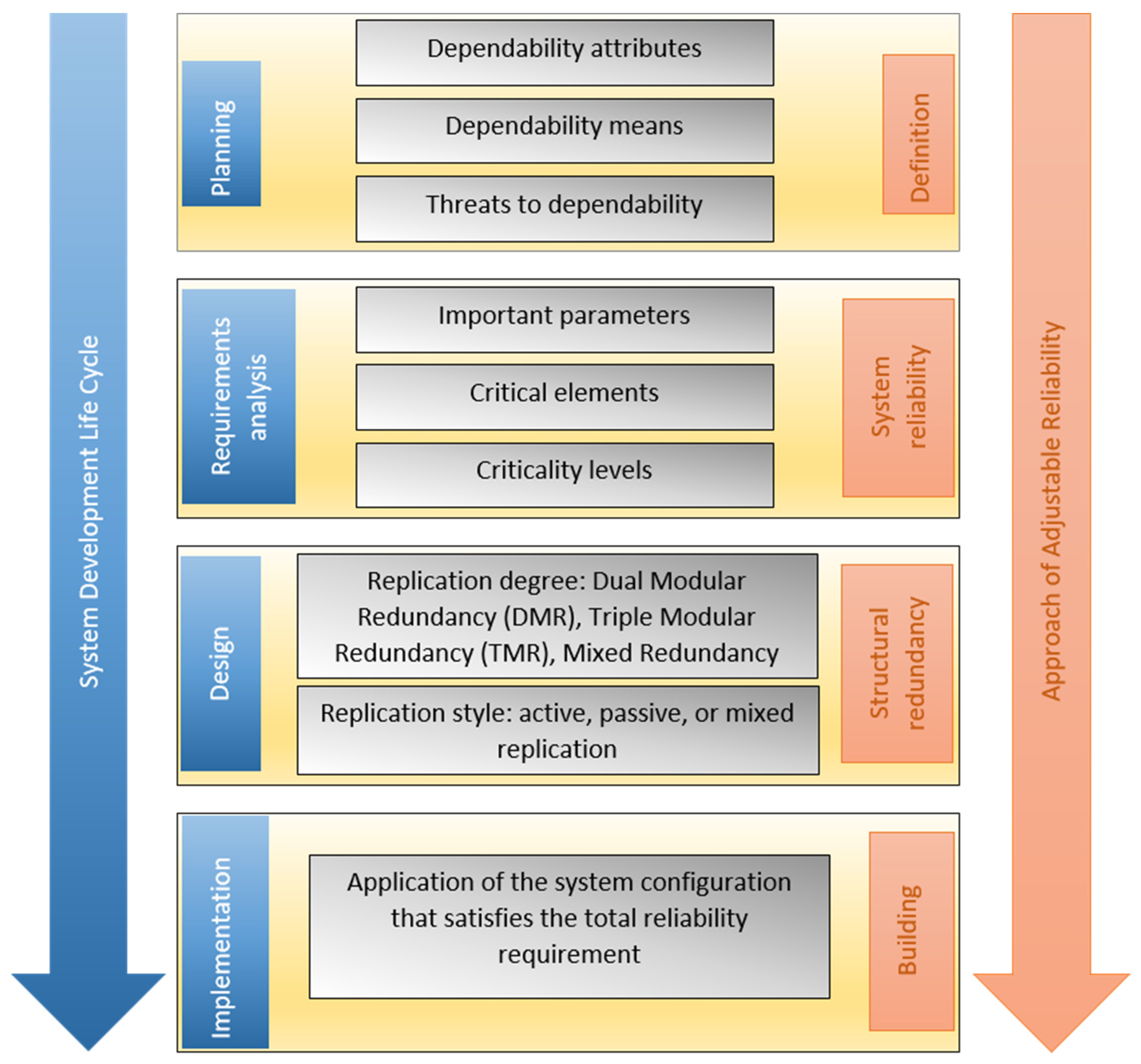
3.2. Conceptual Framework of Integrating the Approach of Adjustable Reliability into SDLC
4. Related Work
5. Discussion
5.1. Advantages of the Conceptual Framework
5.2. Risks and Challenges
6. Conclusions
Funding
Institutional Review Board Statement
Informed Consent Statement
Data Availability Statement
Conflicts of Interest
Abbreviations
| DMR | Dual Modular Redundancy |
| TMR | Triple Modular Redundancy |
| SDLC | System Development Life Cycle |
| NMR | N-modular redundancy |
References
- Avižienis, A.; Laprie, J.-C.; Randell, B.; Landwehr, C. Basic concepts and taxonomy of dependable and secure computing. IEEE Trans. Dependable Secur. Comput. 2004, 1, 11–33. [Google Scholar] [CrossRef] [Scilit]
- Kopetz, H. Real-Time Systems: Design Principles for Distributed Embedded Applications, 2nd ed.; Springer: New York, NY, USA, 2011. [Google Scholar]
- Barranco, M.; Derasevic, S.; Proenza, J. An architecture for highly reliable fault-tolerant adaptive distributed embedded systems. Computer 2020, 53, 38–46. [Google Scholar] [CrossRef] [Scilit]
- Birman, K.P. Reliable Distributed Systems: Technologies, Web Services, and Applications; Springer: New York, NY, USA, 2005. [Google Scholar]
- Dubrova, E. Fault-Tolerant Design; Springer: New York, NY, USA, 2013. [Google Scholar]
- Erciyes, K. Distributed Real-Time Systems: Theory and Practice; Springer: Cham, Switzerland, 2019. [Google Scholar]
- Geffroy, J.-C.; Motet, G. Design of Dependable Computing Systems; Springer: Dordrecht, The Netherlands, 2002. [Google Scholar]
- Koren, I.; Krishna, C.M. Fault-Tolerant Systems, 2nd ed.; Morgan Kaufmann: Amsterdam, The Netherlands, 2021. [Google Scholar]
- Lee, P.A.; Anderson, T. Fault Tolerance: Principles and Practice, 2nd ed.; Springer: Berlin, Germany, 1990. [Google Scholar]
- Pradhan, D.K. Fault-Tolerant Computer System Design; Prentice-Hall: Upper Saddle River, NJ, USA, 1996. [Google Scholar]
- Shooman, M.L. Reliability of Computer Systems and Networks: Fault Tolerance, Analysis, and Design; Wiley: Hoboken, NJ, USA, 2002. [Google Scholar]
- Sorin, D.J. Fault Tolerant Computer Architecture; Morgan & Claypool: San Rafael, CA, USA, 2009. [Google Scholar]
- Kopetz, H. Simplicity Is Complex: Foundations of Cyber-Physical System Design; Springer: Cham, Switzerland, 2019. [Google Scholar]
- Djambazova, E. Achieving system reliability using reliability adjustment. In Proceedings of the 23rd International Conference on Computer Systems and Technologies (CompSysTech’22), Ruse, Bulgaria; ACM: New York, NY, USA, 2022. [Google Scholar]
- Kopetz, H.; Damm, A.; Koza, C.; Mulazzani, M.; Schwabl, W.; Senft, C.; Zailinger, R. Distributed fault-tolerant real-time systems: The MARS approach. IEEE Micro 1989, 9, 25–40. [Google Scholar] [CrossRef] [Scilit]
- Veríssimo, P.; Casimiro, A.; Pinho, L.M.; Vasques, F.; Rodrigues, L.; Tovar, E. Distributed computer-controlled systems: The DEAR-COTS approach. IFAC Proc. Vol. 2000, 33, 113–120. [Google Scholar] [CrossRef] [Scilit]
- Randell, B.; Laprie, J.-C.; Kopetz, H.; Littlewood, B. Predictably Dependable Computing Systems; Springer: Berlin, Germany, 1995. [Google Scholar]
- Herzner, W.; Schlick, R.; Schlager, M.; Leiner, B.; Huber, B.; Balogh, A.; Csertan, G.; LeGuennec, A.; LeSergent, T.; Suri, N.; et al. Model-based development of distributed embedded real-time systems with the DECOS tool-chain. SAE Tech. Pap. 2007. [Google Scholar] [CrossRef] [Scilit]
- Kopetz, H.; Bauer, G. The time-triggered architecture. Proc. IEEE 2003, 91, 112–126. [Google Scholar] [CrossRef] [Scilit]
- Powell, D.; Arlat, J.; Beus-Dukic, L.; Bondavalli, A.; Coppola, P.; Fantechi, A.; Jenn, E.; Rabejac, C.; Wellings, A. GUARDS: A generic upgradable architecture for real-time dependable systems. IEEE Trans. Parallel Distrib. Syst. 1999, 10, 580–599. [Google Scholar] [CrossRef] [Scilit]
- Pinho, L.M.; Vasques, F.; Wellings, A. Replication management in reliable real-time systems. Real-Time Syst. 2004, 26, 261–296. [Google Scholar] [CrossRef] [Scilit]
- Obermaisser, R.; Peti, P.; Huber, B.; El Salloum, C. DECOS: An integrated time-triggered architecture. Elektrotech. Inftech. 2006, 123, 83–95. [Google Scholar] [CrossRef] [Scilit]
- Dumitras, T.; Srivastava, D.; Narasimhan, P. Architecting and implementing versatile dependability. In Architecting Dependable Systems III; LNCS 3549; Springer: Berlin, Germany, 2005; pp. 234–254. [Google Scholar]
- Narasimhan, P.; Dumitras, T.; Paulos, A.; Pertet, S.; Reverte, C.; Slember, J.; Srivastava, D. MEAD: Support for real-time fault-tolerant CORBA. Concurr. Comput. Pract. Exp. 2005, 17, 1527–1545. [Google Scholar] [CrossRef] [Scilit]
- Djambazova, E. A fault-tolerant real-time system with adjustable reliability. In Proceedings of the 22rd International Conference on Computer Systems and Technologies (CompSysTech’21), Ruse, Bulgaria; ACM: New York, NY, USA, 2021. [Google Scholar]
- Lisda, H.S.M.; Bayunanda, E.; Madhika, Y.R. Systematic literature review SDLC in software engineering. Int. J. Comput. Inf. Technol. 2023, 12, 31–42. [Google Scholar] [CrossRef] [Scilit]
- Acharya, B.; Sahu, P.K. Software development life cycle models: A review paper. Int. J. Adv. Res. Eng. Technol. 2020, 11, 169–176. [Google Scholar]
- Gorrod, M. The Software Development Lifecycle, in Finance and Capital Markets Series; Palgrave/Macmillan: London, UK, 2002. [Google Scholar]
- Tang, Z.; You, J.; Li, Y. A distributed adaptive multipath redundant transmission mechanism for high-reliability communication. Electronics 2025, 14, 4735. [Google Scholar] [CrossRef] [Scilit]
- Siyadatzadeh, R.; Ansari, M.; Shafique, M.; Ejlali, A. RL-TIME: Reinforcement learning-based task replication in multicore embedded systems. arXiv 2025, arXiv:2503.12677. [Google Scholar] [CrossRef] [Scilit]
- Murimi, A.K. Machine learning-driven replication strategies for enhancing fault tolerance in large-scale distributed systems. arXiv 2025, arXiv:2511.11749. [Google Scholar]
- Rajagede, R.A.; Santriaji, M.H.; Fikriansyah, M.A.; Nuha, H.H.; Fu, Y.; Solihin, Y. NAPER: Fault protection for real-time resource-constrained deep neural networks. arXiv 2025, arXiv:2504.06591. [Google Scholar] [CrossRef] [Scilit]
- De Souza, K.E.; Ferrari, F.C. A systematic review of fault tolerance techniques for adaptive and context-aware systems. In Proceedings of the 2022 IEEE International Conference on Autonomic Computing and Self-Organizing Systems (ACSOS), Virtual, 19–23 September 2022; pp. 21–30. [Google Scholar] [CrossRef] [Scilit]
- Aguilar, A. Lowering mean time to recovery (MTTR) in responding to system downtime or outages: An application of Lean Six Sigma methodology. In Proceedings of the International Conference on Industrial Engineering and Operations Management; IEOM Society: Southfield, MI, USA, 2023; pp. 1234–1245. [Google Scholar]


| SDLC Phase | Contribution of Adjustable Reliability |
|---|---|
| Planning | Sets configurable dependability goals |
| Requirements | Identifies criticality levels |
| Design | Manages hardware structural redundancy |
| Implementation | Reliability embedded into architecture |
| Category | Main Risk |
|---|---|
| Architecture | Increased structural complexity |
| Verification | Combinatorial explosion of configurations |
| Performance | Trade-off management complexity |
| Economics | Higher development and maintenance costs |
Disclaimer/Publisher’s Note: The statements, opinions and data contained in all publications are solely those of the individual author(s) and contributor(s) and not of MDPI and/or the editor(s). MDPI and/or the editor(s) disclaim responsibility for any injury to people or property resulting from any ideas, methods, instructions or products referred to in the content. |
© 2026 by the author. Licensee MDPI, Basel, Switzerland. This article is an open access article distributed under the terms and conditions of the Creative Commons Attribution (CC BY) license.
Share and Cite
Djambazova, E. Integrating the Approach of Adjustable Reliability into the System Development Life Cycle. Eng. Proc. 2026, 150, 59. https://doi.org/10.3390/engproc2026150059
Djambazova E. Integrating the Approach of Adjustable Reliability into the System Development Life Cycle. Engineering Proceedings. 2026; 150(1):59. https://doi.org/10.3390/engproc2026150059
Chicago/Turabian StyleDjambazova, Edita. 2026. "Integrating the Approach of Adjustable Reliability into the System Development Life Cycle" Engineering Proceedings 150, no. 1: 59. https://doi.org/10.3390/engproc2026150059
APA StyleDjambazova, E. (2026). Integrating the Approach of Adjustable Reliability into the System Development Life Cycle. Engineering Proceedings, 150(1), 59. https://doi.org/10.3390/engproc2026150059