Proceeding Paper

Influence of Chemical Composition on Microstructure and Hardness of 24Cr–Ni Steels Alloyed with Nitrogen †
Department of Materials Science and Materials Technology, Faculty of Industrial technologies, Technical University of Sofia, 1000 Sofia, Bulgaria
*
Author to whom correspondence should be addressed.
Presented at the 15th International Scientific Conference TechSys 2026—Engineering, Technologies and Systems, Plovdiv, Bulgaria, 14–16 May 2026.
These authors contributed equally to this work.
Eng. Proc. 2026, 150(1), 123; https://doi.org/10.3390/engproc2026150123
Published: 6 August 2026

Abstract

Chromium–nickel steels represent an important class of engineering materials due to their excellent corrosion resistance, good mechanical properties and structural stability. The present study investigates the influence of chemical composition on the microstructure and hardness of three chromium–nickel steels containing constant chromium content (24 mass%) and varying nickel concentration. Nitrogen was introduced only in the steel with the lowest nickel concentration through nitrided ferrochromium during melting in an induction furnace. Three steels were investigated: 24CrNi8N containing 0.3 mass% nitrogen, 24CrNi14 without nitrogen addition, and 24CrNi20 without nitrogen. The measured hardness values were 360 HV, 230 HV and 190 HV respectively. Optical metallographic analysis revealed significant differences in the microstructure of the investigated steels. The nitrogen-containing steel exhibited dendritic morphology with partially transformed regions, whereas the steels with higher nickel content showed predominantly austenitic and fully austenitic structures. The results demonstrate that both nitrogen alloying and nickel concentration strongly influence phase stability, microstructure and hardness of chromium–nickel steels.

1. Introduction

Chromium–nickel steels are widely used engineering materials due to their excellent corrosion resistance and mechanical stability [1] (pp. 15–20). These steels are commonly applied in chemical equipment, energy systems and structural components operating in aggressive environments [2] (pp. 40–95). The microstructure and mechanical properties of Cr–Ni steels are strongly influenced by their chemical composition. Chromium improves corrosion resistance and contributes to carbide formation, while nickel stabilizes the austenitic phase and enhances ductility and toughness [3] (pp. 80–82).
Nitrogen has gained increasing importance as an alloying element in high-alloy steels [4] (pp. 135–145). Nitrogen is considered one of the most effective strengthening elements in austenitic steels because it significantly increases yield strength while maintaining good ductility [5] (pp. 233–265). Nitrogen atoms occupy interstitial positions in the iron lattice and cause significant lattice distortion, which increases resistance to dislocation movement [6] (pp. 110–115).
However, introducing nitrogen into molten steel presents technological challenges due to its limited solubility and the tendency for nitrogen to escape during melting [7] (pp. 95–98). One effective method for nitrogen alloying is the use of nitrogen-bearing ferroalloys such as nitrided ferrochromium [8] (pp. 233–235). Nitrided ferrochromium simultaneously introduces chromium and nitrogen into the melt and increases nitrogen recovery due to the strong affinity between chromium and nitrogen. The aim of the present study is to investigate the influence of chemical composition on the microstructure and hardness of chromium–nickel steels containing 24 mass% chromium with varying nickel concentrations and nitrogen addition in one composition.
In addition to strengthening effects, nitrogen significantly improves corrosion resistance in chromium-containing steels. The presence of nitrogen enhances pitting corrosion resistance by increasing the stability of the passive layer formed on the steel surface. Another important advantage of nitrogen alloying is the possibility of partially substituting nickel in austenitic steels. Nickel is one of the most expensive alloying elements used in stainless steels, and therefore replacing part of the nickel content with nitrogen may lead to significant economic benefits in industrial steel production [9] (pp. 233–235).
Nitrogen also has a strong influence on phase stability in the Fe–Cr–Ni system. Due to its interstitial nature, nitrogen strongly stabilizes the austenitic phase and shifts phase boundaries toward lower nickel contents [10] (pp. 90–150). For this reason, nitrogen-alloyed steels are often referred to as high-nitrogen steels, which represent an important group of advanced structural materials used in chemical, energy and mechanical engineering applications.
Despite the numerous advantages of nitrogen alloying, introducing nitrogen into molten steel remains technologically challenging. Nitrogen solubility in liquid steel is limited and nitrogen tends to escape from the melt during processing.
One practical method for introducing nitrogen into steel is the use of nitrogen-bearing ferroalloys such as nitrided ferrochromium. This ferroalloy simultaneously introduces chromium and nitrogen into the melt and improves nitrogen recovery due to the strong chemical affinity between chromium and nitrogen [11] (pp. 200–210).

2. Materials and Methods

The investigated steels were produced by melting in a medium-frequency induction furnace Model M250,GIT Engineering, Gabrovo, Bulgaria. The base charge consisted of steel scrap and alloying additions.
Chromium increases nitrogen solubility in liquid steel due to its strong chemical affinity with nitrogen atoms [9] (pp. 233–235).
After melting, the liquid metal was poured into molds and allowed to solidify under controlled cooling conditions.
Three experimental chromium–nickel alloys were investigated in the present study. The alloys were produced by induction melting and differ mainly in nickel content and nitrogen addition. Chromium content was maintained at approximately 24 mass% in all alloys in order to ensure high corrosion resistance.
The investigated alloys represent different compositional concepts within the Cr–Ni system, including a high-nickel austenitic steel, a corrosion-resistant Cr–Ni–Mo alloy with nitrogen addition, and a medium-nickel austenitic steel.
The chemical compositions of the investigated alloys are presented in Table 1.
The alloy 24CrNi8N contains the lowest nickel concentration (8 mass%) among the investigated steels but includes significant additions of molybdenum (3.3 mass%) and nitrogen (0.3 mass%). Nickel is the main austenite-stabilizing element in Cr–Ni steels; therefore, the relatively low nickel content would normally reduce the stability of the austenitic phase. However, this effect is partially compensated for by the presence of nitrogen, which is also a strong austenite stabilizer. Nitrogen is an interstitial alloying element that dissolves in the iron lattice and produces significant lattice distortion. This leads to strong solid-solution strengthening and an increase in hardness. The relatively high molybdenum content (3.3 mass%) improves corrosion resistance, particularly resistance to localized corrosion such as pitting and crevice corrosion. Due to the combined presence of nitrogen and molybdenum, this alloy can be classified as a nitrogen-alloyed corrosion-resistant Cr–Ni–Mo steel. The strengthening effect of nitrogen together with the lower nickel content may also promote partial phase transformations during cooling, which could lead to increased hardness compared with the other investigated alloys.
The alloy 24CrNi14 represents an intermediate composition within the investigated Cr–Ni system. The nickel content of 14 mass% is sufficient to stabilize the austenitic phase under most cooling conditions. Compared with the 24CrNi8N alloy, the molybdenum content is significantly lower (0.67 mass%), and nitrogen is not present in the composition.
As a result, the strengthening effect associated with nitrogen alloying is absent. The microstructure of this alloy is therefore expected to consist predominantly of austenite.
The presence of titanium (0.25 mass%) may contribute to the formation of stable carbides or carbonitrides, which can improve microstructural stability and reduce the risk of sensitization.
Copper is present in small amounts (0.22 mass%) and may contribute slightly to improved corrosion resistance and precipitation behavior.
Because of the moderate nickel content and the absence of nitrogen strengthening, this alloy is expected to exhibit intermediate mechanical properties compared with the other investigated steels.
The alloy 24CrNi20 contains the highest nickel concentration (20 mass%) among the investigated steels. This high nickel content strongly stabilizes the austenitic phase and promotes the formation of a fully austenitic microstructure. The molybdenum content is relatively low (0.5 mass%), and nitrogen is not present in this alloy. Therefore, the strengthening effect associated with nitrogen alloying is absent. However, the high nickel concentration ensures excellent phase stability and prevents phase transformations during cooling. Titanium is present in a relatively higher amount (0.33 mass%), which may contribute to carbide or carbonitride formation and improve structural stability.
Because of the fully stabilized austenitic structure and the absence of strong solid-solution strengthening elements such as nitrogen, this alloy is expected to exhibit lower hardness but higher ductility compared with the other investigated steels.
A comparison of the three alloys clearly demonstrates the influence of nickel, molybdenum and nitrogen on the properties of chromium–nickel steels.
The alloy 24CrNi8N combines low nickel content with nitrogen strengthening and high molybdenum addition. This combination is expected to produce the highest hardness and improved corrosion resistance.
The alloy 24CrNi14 represents an intermediate composition with moderate nickel content and without nitrogen alloying. Its microstructure is expected to be predominantly austenitic with moderate mechanical strength.
The alloy 24CrNi20 contains the highest nickel concentration and therefore exhibits the most stable austenitic structure. This alloy is expected to have lower hardness but higher ductility and structural stability.
Thus, the investigated alloys illustrate how variations in nickel and nitrogen content can significantly influence the phase stability, microstructure and mechanical properties of chromium–nickel steels.
Metallographic samples were prepared using standard metallographic procedures including grinding, polishing and etching. Optical microscopy was used for microstructural analysis.
A total of 3 samples were ground with the following sequence of “Struers” sandpaper—240, 400, 600, and 1000. They were given a final finish with polishing cloth “Mediolap” and polishing paste DP-LUBRICANT RED HQ Struers 3 μm, Struers ApS, Pederstrupvej 84, DK-2750 Ballerup, Denmark and electrolytically etched with a solution of 10% oxalic acid in water for several minutes.
For the optical metallographic analysis an inverted optical reflected-light microscope Carl-ZEISS (Jena), model EPITYP-2, Carl Zeiss Jena GmbH (Jena, Germany), Carl-Zeiss-Promenade 10, 07745 Jena, Germany was used and samples were observed and photographed under the magnification 200×.
Hardness measurements were performed using the Vickers hardness method according to standard metallurgical testing procedures [2] (pp. 90–95). A total of 3 hardness measurements of the samples were made with a hardness-tester „ЗИП”, model „ТПГ-2” Zavod Ispytatelnykh Priborov (ZIP), 11 Stankostroiteley St., 153032 Ivanovo, Russia., with a loading equivalent of 5 kgf.

3. Results

3.1. Microstructure

The metallographic examination revealed clear differences in the microstructure of the investigated steels.
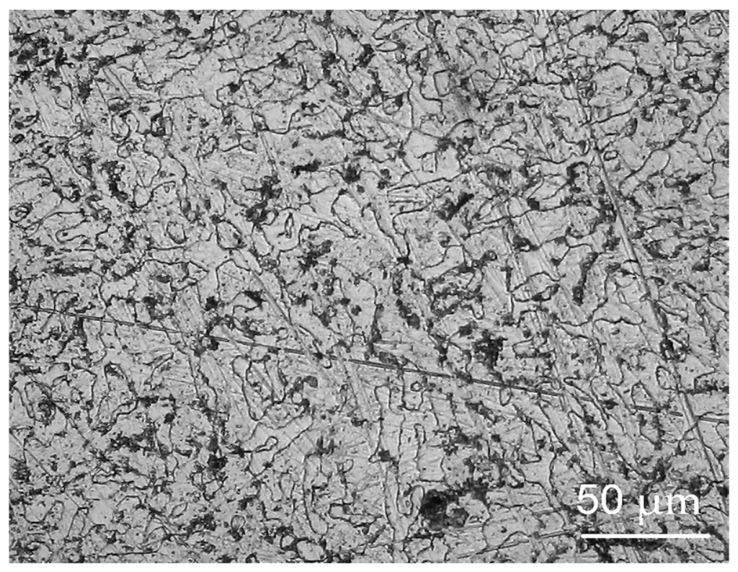
The microstructure of the nitrogen-alloyed steel 24CrNi8N shows a dendritic solidification morphology with pronounced interdendritic regions (Figure 1). These features are typical for cast steels solidified from the melt [11] (pp. 70–75). The structure shows significant chemical segregation between the dendrite cores and interdendritic areas, which is typical for high-alloy steels solidified from the melt.
The dendritic pattern observed in the micrograph indicates that solidification occurred through primary austenitic dendrite formation. The dendrite arms appear relatively coarse, suggesting solidification under moderate cooling conditions.
The interdendritic regions show a darker contrast, which may be associated with segregation of alloying elements such as chromium, molybdenum, and nitrogen. During solidification, elements with lower partition coefficients tend to segregate toward interdendritic areas, producing local variations in chemical composition.
The relatively high molybdenum content (3.3 mass%) and the presence of nitrogen (0.3 mass%) may also contribute to the formation of fine secondary phases or precipitates in interdendritic regions. Nitrogen acts as an interstitial strengthening element and increases the stability of the austenitic phase.
The matrix of the alloy appears predominantly austenitic, which is expected for Cr–Ni steels containing significant amounts of austenite stabilizers such as nickel and nitrogen. However, due to the relatively low nickel content compared with the other investigated alloys, the stability of the austenitic phase may be slightly reduced, potentially allowing partial transformation during cooling.
The combination of dendritic segregation and nitrogen strengthening may contribute to the relatively high hardness measured for this alloy. Interstitial nitrogen atoms distort the crystal lattice and increase resistance to dislocation movement, which leads to higher strength and hardness.
Overall, the microstructure of the 24CrNi8N steel can be described as a dendritic austenitic matrix with pronounced interdendritic segregation zones typical of cast high-alloy steels.
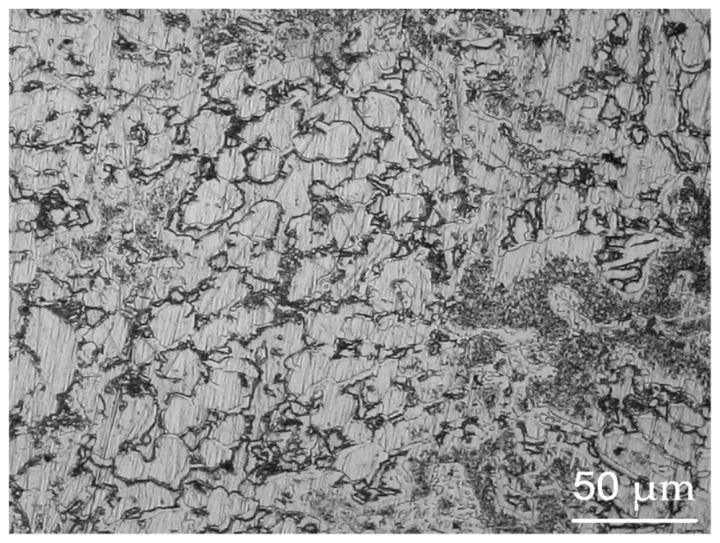
The microstructure of 24CrNi14 appears more homogeneous with predominantly austenitic grains (Figure 2). The dendritic morphology is still visible but less pronounced and exhibits a more uniform distribution of the structural constituents.
The observed structural features include:
  • Relatively fine cast morphology;
  • Reduced contrast between dendrite cores and interdendritic regions;
  • More uniform phase distribution throughout the observed field.
The increase in nickel content from 8 mass% to 14 mass% significantly improves the stability of the austenitic phase. Nickel is the principal austenite-forming element in Cr–Ni steels, and at this concentration the alloy is expected to exhibit a predominantly austenitic matrix.
In contrast to 24CrNi8N, this alloy does not contain nitrogen and therefore does not benefit from interstitial solid-solution strengthening. As a result, the strengthening effect associated with nitrogen is absent, and the hardness is lower.
The lower molybdenum content compared with 24CrNi8N also reduces the likelihood of strong interdendritic segregation effects and contributes to the more uniform appearance of the structure.
The microstructure suggests a predominantly austenitic cast alloy with limited phase transformation during cooling. The finer and more homogeneous appearance of the structure is consistent with the measured hardness of 230 HV, which is lower than that of the nitrogen-alloyed steel but still characteristic of a Cr–Ni austenitic alloy with moderate nickel content.
Some polishing scratches are visible in the micrograph, but they do not prevent the identification of the main structural features.
Overall, the microstructure of the 24CrNi14 steel can be described as a relatively homogeneous predominantly austenitic cast structure with reduced segregation contrast compared with the 24CrNi8N alloy.
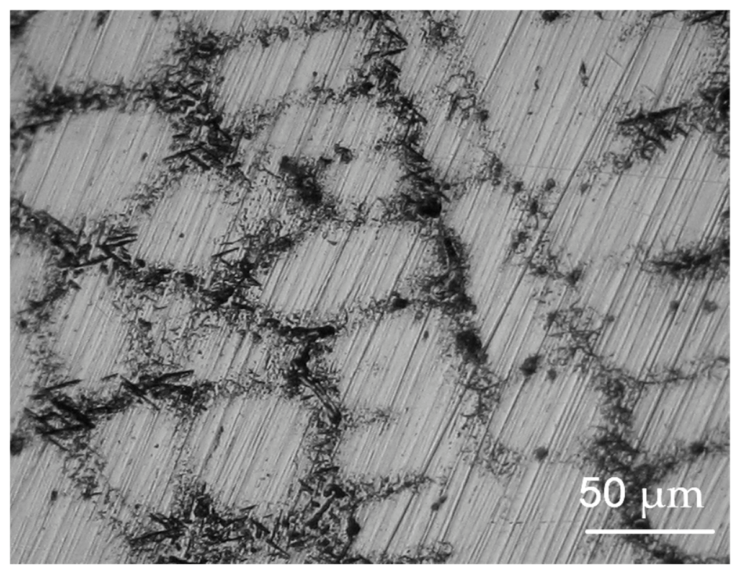
The steel 24CrNi20 shows a fully developed austenitic structure with equiaxed grains and visible annealing twins (Figure 3). Annealing twins are characteristic for high-nickel austenitic steels [3] (p. 235). Compared with the other investigated alloys, this microstructure appears to be the most homogeneous and the least affected by dendritic contrast, which indicates a higher degree of phase stability and a more uniform distribution of the principal alloying elements.
The observed structural features include:
  • Clearly defined grain boundaries;
  • Relatively equiaxed austenitic grains;
  • Limited contrast between grain interiors and grain boundary regions;
  • Absence of pronounced transformation products.
The high nickel content of this alloy (20 mass% Ni) plays a decisive role in determining its structural constitution. Nickel is the principal austenite-stabilizing element in Cr–Ni steels, and at this concentration it strongly promotes the formation and retention of the γ-austenitic phase during both solidification and subsequent cooling.
Because of this high nickel concentration, the austenitic phase remains stable and phase transformations such as martensitic transformation are not expected to occur under normal cooling conditions. This explains the absence of obvious transformed regions in the microstructure and the generally uniform appearance of the matrix.
The chromium content is maintained at 24 mass%, which ensures high corrosion resistance and contributes to the formation of a stable passive layer. However, chromium alone would tend to promote ferritic tendencies; this effect is fully counterbalanced by the high nickel level, resulting in a stable austenitic structure.
The alloy contains only a relatively small amount of molybdenum (0.5 mass%) and does not contain nitrogen. Therefore, the microstructure is not additionally strengthened by interstitial nitrogen solid-solution strengthening, unlike the 24CrNi8N alloy. This is an important factor explaining the lower hardness of the 24CrNi20 steel.
Titanium is present at 0.33 mass%, which is slightly higher than in the other investigated alloys. Titanium may contribute to microstructural stability through the formation of stable carbides or carbonitrides; however, based on the optical micrograph, no distinct coarse titanium-containing precipitates can be clearly identified. Its main role in this alloy is therefore likely related to stabilization effects rather than dominant structural modification.
The grain boundaries are well outlined and appear decorated by darker etched regions. These may correspond to segregation products or fine precipitate accumulation along grain boundary areas. Nevertheless, the overall microstructure remains much more uniform than in the lower-nickel alloys.
Another visible feature is the presence of straight parallel polishing lines across the grains. These are preparation artifacts and should not be interpreted as structural constituents. Despite these surface scratches, the grain morphology can still be clearly distinguished.
From a metallurgical point of view, the microstructure of 24CrNi20 can be interpreted as a fully austenitic cast structure with high phase stability and relatively low structural heterogeneity. The limited segregation contrast suggests that the alloying elements are more uniformly distributed than in the 24CrNi8N alloy, where dendritic segregation is much more pronounced.
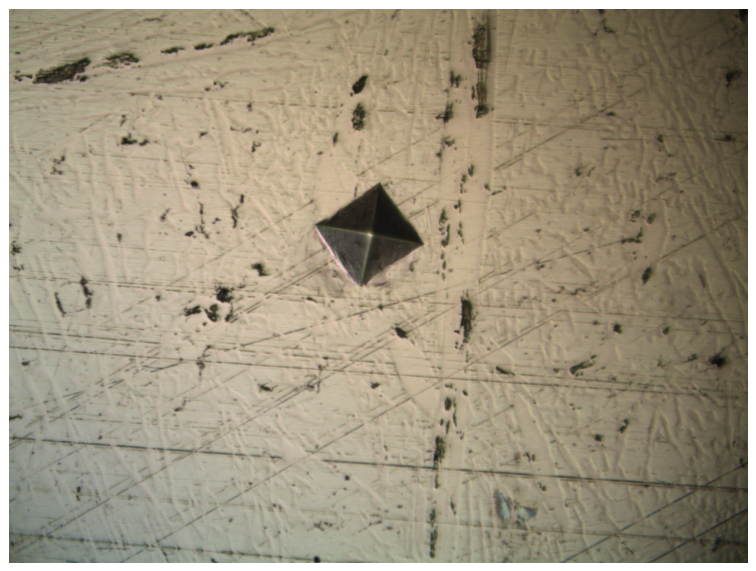
This structural condition is fully consistent with the measured hardness of 190 HV (Figure 4). Indentation, which is the lowest among the investigated alloys. The lower hardness can be explained by the following factors:
  • Absence of nitrogen strengthening;
  • High stability of the austenitic phase due to 20 mass% Ni;
  • Absence of transformation hardening during cooling;
  • More uniform and ductile austenitic matrix.
Therefore, the 24CrNi20 alloy can be classified as a highly stable austenitic chromium–nickel steel with good structural uniformity, high expected ductility, and relatively low hardness compared with the other investigated alloys.
Overall, the microstructure of the 24CrNi20 steel confirms that increasing nickel content promotes full stabilization of the austenitic phase, suppresses transformation phenomena, reduces hardness, and leads to a more homogeneous microstructure.

3.2. Hardness

The measured hardness values for the investigated steels are presented in Table 2.
The highest hardness value was obtained for the nitrogen-containing steel 24CrNi8N.
Nitrogen increases hardness through solid-solution strengthening because nitrogen atoms occupy interstitial positions in the iron lattice and distort the crystal structure [5] (pp. 145–147).
The steels with higher nickel content exhibit lower hardness values because the microstructure becomes fully austenitic and transformation hardening does not occur [7] (pp. 110–115).

4. Discussion

The obtained results clearly demonstrate the strong relationship between chemical composition, microstructure and hardness of the investigated Cr–Ni steels. Although all alloys contain approximately the same chromium content (24 mass%), significant differences in microstructure and hardness were observed as a result of variations in nickel and nitrogen content.
Chromium is the primary element responsible for corrosion resistance and promotes the formation of a stable passive oxide layer on the steel surface. However, chromium alone tends to stabilize ferritic phases. The stability of the austenitic phase is therefore primarily controlled by nickel and nitrogen additions.
The investigated alloys represent three different compositional states within the Cr–Ni system:
  • Nitrogen-alloyed steel with lower nickel content (24CrNi8N),
  • Intermediate nickel austenitic steel (24CrNi14),
  • Highly stabilized austenitic steel (24CrNi20).
The microstructural observations reveal typical cast morphologies characterized by dendritic solidification structures. However, the degree of structural homogeneity varies significantly among the alloys.
The 24CrNi8N alloy shows the most pronounced dendritic morphology and segregation between dendrite cores and interdendritic regions. This can be attributed to the combined presence of molybdenum and nitrogen, which influence element partitioning during solidification. Nitrogen acts as a strong interstitial alloying element and causes lattice distortion within the austenitic matrix, leading to significant solid-solution strengthening.
The relatively high hardness measured for this alloy (360 HV) can therefore be explained by the combined effects of:
  • Nitrogen interstitial strengthening;
  • Segregation-induced microstructural heterogeneity;
  • The relatively lower nickel content which reduces the full stabilization of the austenitic phase.
In contrast, the 24CrNi14 steel exhibits a more homogeneous microstructure with reduced dendritic contrast. The higher nickel content improves the stability of the austenitic phase and suppresses phase transformations during cooling. Because nitrogen is not present in this alloy, the strengthening effect associated with interstitial alloying is absent.
As a result, the hardness decreases to approximately 230 HV, which corresponds well to typical hardness values for chromium–nickel austenitic steels with moderate nickel content.
The 24CrNi20 alloy shows the most stable and homogeneous microstructure among the investigated steels. The high nickel content strongly stabilizes the γ-austenitic phase and suppresses phase transformations during cooling. The microstructure consists of relatively equiaxed austenitic grains with clearly visible grain boundaries.
Because this alloy does not contain nitrogen and exhibits a fully stabilized austenitic matrix, the hardness is the lowest among the investigated materials (190 HV). This behavior is consistent with the well-known metallurgical principle that increasing nickel content enhances austenite stability but generally reduces hardness and strength while improving ductility.
The results therefore demonstrate a clear compositional trend: increasing nickel content promotes structural stability and microstructural homogeneity, while nitrogen additions significantly increase hardness through interstitial solid-solution strengthening.
These observations are in agreement with previously reported studies on nitrogen-alloyed Cr–Ni steels, which indicate that nitrogen can partially substitute nickel as an austenite stabilizer while simultaneously improving mechanical strength.
From a metallurgical perspective, the investigated alloys illustrate how relatively small compositional modifications can significantly affect the microstructural evolution and mechanical properties of high-alloy steels.

5. Conclusions

Based on the experimental investigation of the microstructure and hardness of three chromium–nickel steels with different nickel and nitrogen contents, several important conclusions can be drawn regarding the relationship between chemical composition, microstructural evolution and mechanical properties.
All investigated alloys exhibit cast microstructures characterized by dendritic solidification morphology typical of high-alloy chromium–nickel steels. Despite the similar chromium content of approximately 24 mass%, significant differences in microstructural features and hardness were observed due to variations in nickel and nitrogen content.
The alloy 24CrNi8N, containing 8 mass% Ni and 0.3 mass% nitrogen, shows the most pronounced dendritic segregation and the highest hardness value of approximately 360 HV. The increased hardness can be attributed primarily to the strengthening effect of nitrogen. Nitrogen acts as a powerful interstitial alloying element that causes lattice distortion within the austenitic matrix and significantly increases resistance to dislocation movement. As a result, nitrogen alloying contributes to strong solid-solution strengthening and improved mechanical performance.
The alloy 24CrNi14, containing 14 mass% Ni and no nitrogen addition, exhibits a more homogeneous microstructure and intermediate hardness of approximately 230 HV. The higher nickel content stabilizes the austenitic phase and reduces the likelihood of phase transformations during cooling. However, the absence of nitrogen eliminates the strengthening effect associated with interstitial alloying, resulting in lower hardness compared with the nitrogen-containing alloy.
The alloy 24CrNi20 demonstrates the most stable and uniform austenitic microstructure due to the high nickel content of 20 mass%. The microstructure consists of relatively equiaxed austenitic grains with clearly defined grain boundaries. Because this alloy does not contain nitrogen and the austenitic phase is strongly stabilized by nickel, the hardness is the lowest among the investigated materials, with a measured value of approximately 190 HV.
The obtained results clearly confirm the strong relationship between chemical composition, microstructure and hardness in chromium–nickel steels. Increasing nickel content improves the stability of the austenitic phase and leads to a more homogeneous microstructure, but generally reduces hardness. In contrast, nitrogen additions significantly increase mechanical strength through interstitial solid-solution strengthening of the austenitic matrix.
From a technological perspective, nitrogen alloying offers important advantages in the development of high-performance corrosion-resistant steels. Nitrogen can partially substitute nickel as an austenite stabilizer while simultaneously improving mechanical properties. This makes nitrogen alloying particularly attractive for modern stainless steel design.
In addition to the metallurgical benefits, nitrogen alloying may also provide economic advantages. Nickel is one of the most expensive alloying elements used in stainless steels, and its market price is subject to significant fluctuations. Partial replacement of nickel through nitrogen alloying can therefore reduce alloying costs while maintaining or even improving mechanical performance.
The results of the present study demonstrate that nitrogen alloying represents a promising approach for optimizing the balance between mechanical strength, structural stability and economic efficiency in high-alloy chromium–nickel steels.
Overall, the investigated alloys illustrate how controlled variations in nickel and nitrogen content can be used to tailor the microstructure and mechanical properties of corrosion-resistant steels, providing valuable insights for the development of advanced nitrogen-alloyed stainless steels.

Author Contributions

Conceptualization, A.M.; methodology, G.B.; validation, G.B. and A.M.; formal analysis, B.I.; investigation, A.M.; resources, G.B. data curation, B.I.; writing—original draft preparation, G.B.; writing—review and editing, A.M. and B.I.; visualization, B.I.; supervision, A.M.; project administration, G.B. All authors have read and agreed to the published version of the manuscript.

Funding

The authors would like to thank the Research and Development Sector at the Technical University of Sofia for the financial support.

Institutional Review Board Statement

Not applicable.

Informed Consent Statement

Not applicable.

Data Availability Statement

The data presented in this study are available on request from the corresponding author. The data are not publicly available due to ongoing research activities.

Conflicts of Interest

The authors declare no conflicts of interest.

References

  1. Honeycombe, R.; Bhadeshia, H. Steels: Microstructure and Properties, 3rd ed.; Butterworth-Heinemann: Oxford, UK, 2006; pp. 15–20. [Google Scholar]
  2. Callister, W.D.; Rethwisch, D.G. Materials Science and Engineering, 9th ed.; Wiley: New York, NY, USA, 2014; pp. 40–95. [Google Scholar]
  3. Davis, J.R. Stainless Steels; ASM International: Materials Park, OH, USA, 1994; pp. 210–235. [Google Scholar]
  4. Pickering, F.B. Physical Metallurgy of Steels; Applied Science Publishers: London, UK, 1978; pp. 80–82. [Google Scholar]
  5. Gavriljuk, V.; Berns, H. High Nitrogen Steels; Springer: Berlin/Heidelberg, Germany, 1999; pp. 120–147. [Google Scholar]
  6. Berns, H.; Theisen, W. Ferrous Materials; Springer: Berlin/Heidelberg, Germany, 2008; pp. 233–270. [Google Scholar]
  7. Krauss, G. Steels: Processing, Structure and Performance; ASM International: Materials Park, OH, USA, 2005; pp. 110–115. [Google Scholar]
  8. Totten, G.E. Steel Heat Treatment Handbook; CRC Press: Boca Raton, FL, USA, 2007; pp. 95–98. [Google Scholar]
  9. Sedriks, A.J. Corrosion of Stainless Steels, 2nd ed.; Wiley: New York, NY, USA, 1996; pp. 233–235. [Google Scholar]
  10. Reed, R.C. The Superalloys; Cambridge University Press: Cambridge, UK, 2006; pp. 90–150. [Google Scholar]
  11. Lippold, J.C.; Kotecki, D.J. Welding Metallurgy of Stainless Steels; Wiley: Hoboken, NJ, USA, 2005; pp. 200–210. [Google Scholar]
Figure 1. Microstructure of steel alloy 24CrNi8N (200×).
Engproc 150 00123 g001
Figure 2. Microstructure of steel alloy 24CrN14 (200×).
Engproc 150 00123 g002
Figure 3. Microstructure of steel alloy 24CrN20 (200×).
Engproc 150 00123 g003
Figure 4. Indentation from Vickers hardness measurement (sample 1) (200×).
Engproc 150 00123 g004
Table 1. Chemical composition of the investigated alloys (mass%).
AlloyCSiMnPSCrNiMoTiCuMgN
24CrNi8N0.030.90.70.070.032483.30.040.8-0.3
24CrNi140.0511.40.060.0324140.670.250.22--
24CrNi200.0411.40.020.0224200.50.33---
Table 2. Chemical composition and hardness of investigated steels.
SteelHardness HV
24CrNi8N360
24CrNi14230
24CrNi20190
Disclaimer/Publisher’s Note: The statements, opinions and data contained in all publications are solely those of the individual author(s) and contributor(s) and not of MDPI and/or the editor(s). MDPI and/or the editor(s) disclaim responsibility for any injury to people or property resulting from any ideas, methods, instructions or products referred to in the content.