1. Introduction
The ceramics industry is a comparatively traditional manufacturing sector. With the continuing advancement of a new round of scientific and technological revolution and industrial transformation, intelligent manufacturing has become a major direction in the global restructuring of manufacturing systems. The ceramics industry is therefore gradually shifting from experience-driven production and single-process automation toward data-driven operation, coordinated production lines, and intelligent control.
Previous studies provide methodological and technical support for this research. Abbas et al. [
1] reviewed patent analysis methods and argued that patent data can reveal technological trends, innovation hotspots, and competitive layouts. Daim et al. [
2] further showed that patent analysis can be combined with bibliometrics to forecast emerging technologies. In intelligent manufacturing, Wang et al. [
3] pointed out that deep learning supports process monitoring, fault diagnosis, and quality control, while Plathottam et al. [
4] summarized AI applications in predictive maintenance, process optimization, and manufacturing decision support. In the ceramics field, Kaufmann et al. [
5] demonstrated that machine learning can accelerate the discovery of high-entropy ceramics, and Zhang et al. [
6] emphasized its value in exploring complex ceramic composition spaces. For ceramic quality control, Wan et al. [
7] and Zhou et al. [
8] showed that deep-learning-based methods can improve surface defect detection and inspection automation. However, existing studies mainly focus on methods, materials, or specific detection tasks, while systematic patent-based analysis of AI applications in ceramics remains limited. Accordingly, from the patent perspective, this paper focuses on the current application status and development trends of AI in the ceramics industry, thereby providing a theoretical basis for the intelligent transformation of the sector.
2. Data Sources and Methodology
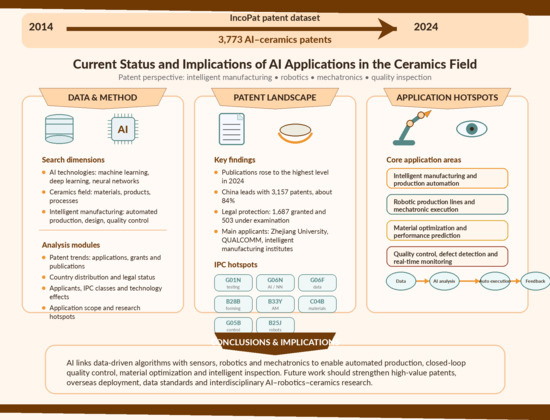
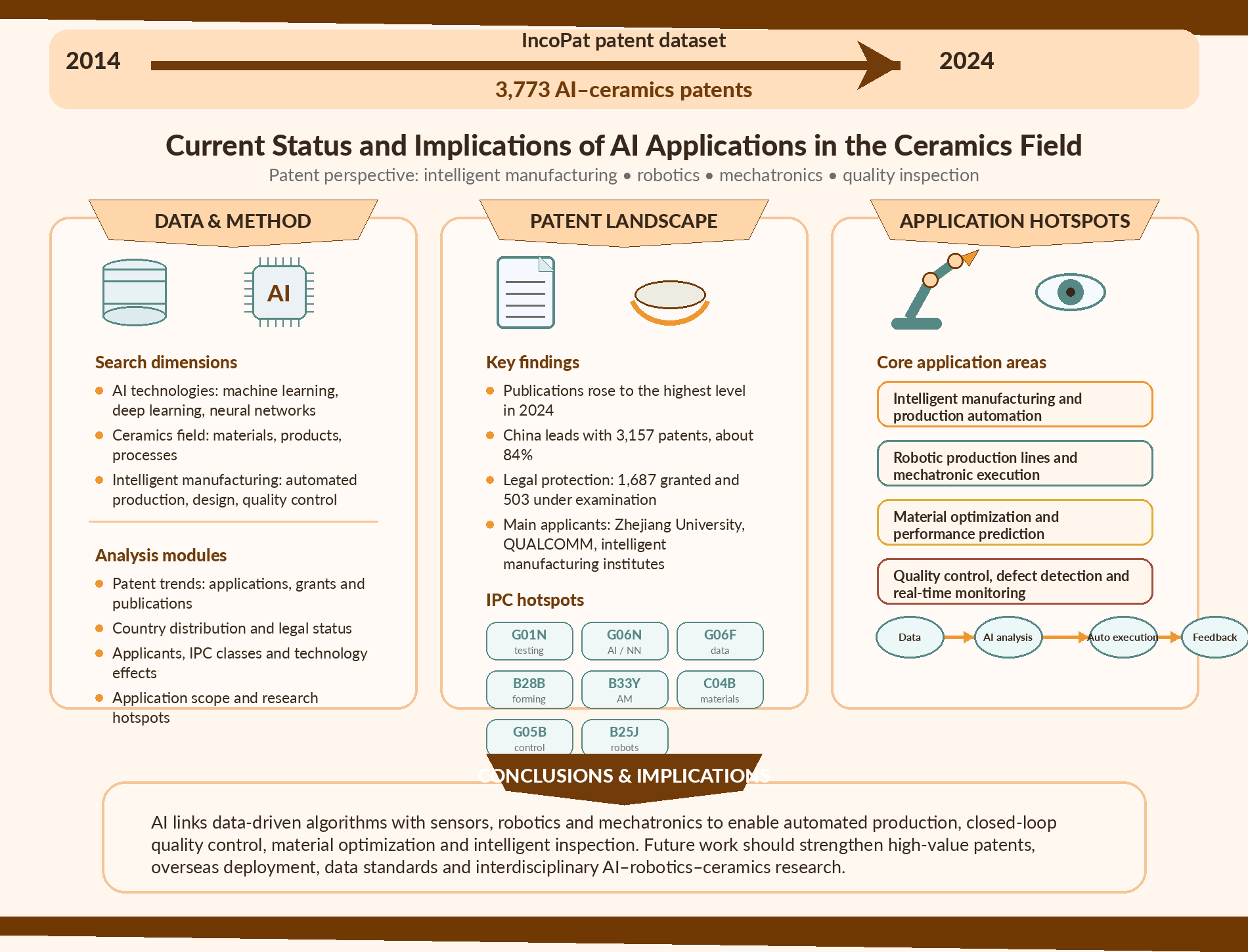
To ensure the reproducibility of the patent search results, this study used the IncoPat Global Patent Database as the data source. The search was conducted on 24 June 2025. The search fields were restricted to title, abstract, and claims, while the publication date was limited to the period from 1 January 2014 to 31 December 2024 (
Table 1). No limitations were applied with respect to country or region, applicant, IPC classification, or legal status. Patent records under various legal statuses, including granted, under substantive examination, published, withdrawn, rejected, and lapsed due to non-payment of annual fees, were included in the sample. As a result, 3773 patents related to artificial intelligence applications in the ceramics field were retrieved.
After retrieval, the patent data were checked and organized before statistical analysis. Bibliographic fields, including publication number, title, applicant, publication date, legal status, IPC classification, and country or organization of publication, were used to verify the consistency of the records. The exclusion of irrelevant documents was mainly controlled through the search strategy, which restricted the retrieval fields to title, abstract, and claims and required the simultaneous occurrence of artificial intelligence-related terms, ceramics-related terms, and intelligent manufacturing/application-related terms. Then the authors manually reviewed selected records from the largest applicants and most represented IPC classes to ensure sample relevance. The validation confirmed the relevance of the selected records to ceramics, AI-based technologies, and practical application scenarios. Finally, the sample of 3773 records represents patent documents retrieved from IncoPat rather than deduplicated patent families or unique inventions.
3. Patent Data Analysis of AI Applications in the Ceramics Field
3.1. Trends in the Number of Patents
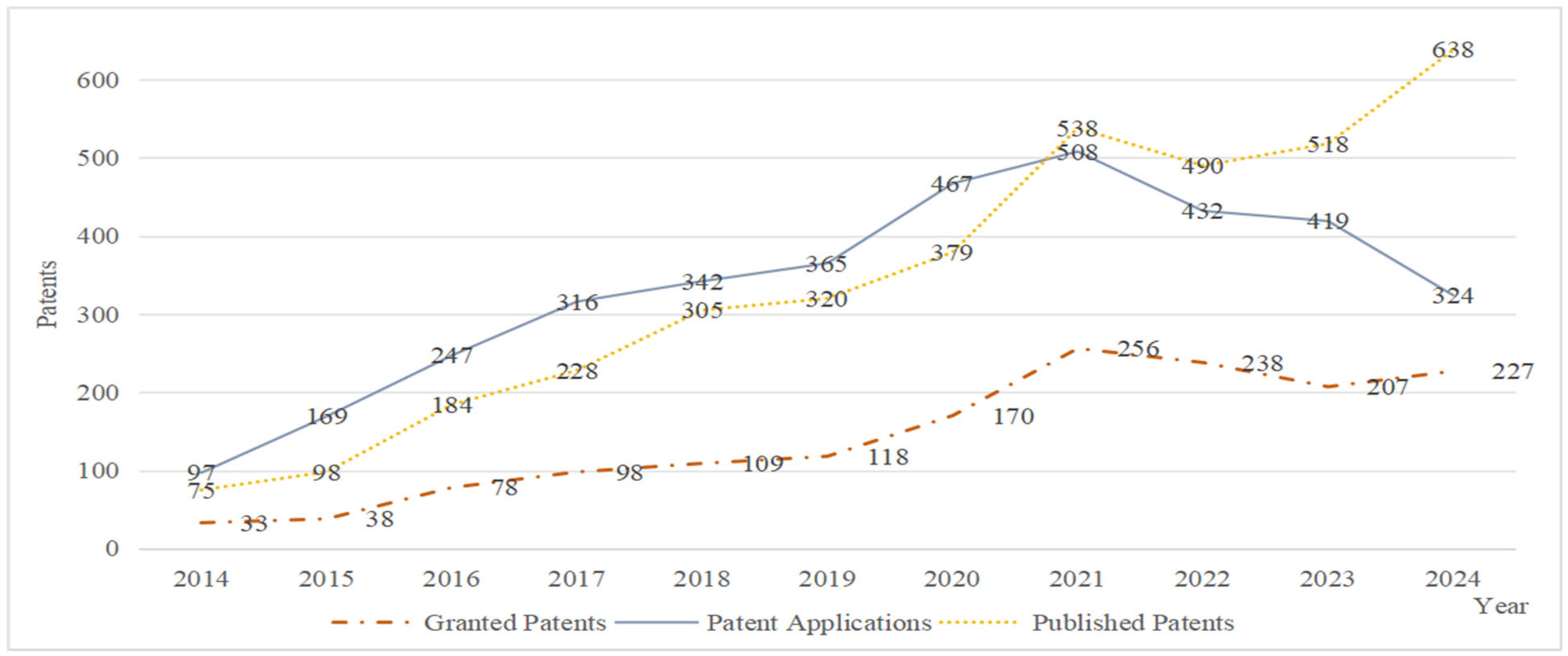
According to the patent retrieval results, the changing trends in granted patents, patent applications, and published patents related to AI applications in ceramics from 2014 to 2024 are shown in
Figure 1. Overall, the number of patent documents increased markedly from 2014 to 2021, indicating the continuous expansion of AI-related technological activity in the ceramics field during this period. After 2021, the number of patent applications and granted patents fluctuated, while the number of published patents remained relatively high and reached its highest level in 2024. However, the data for 2023–2024 should be interpreted with caution. Because patent applications are usually published after a time lag, and because the most recent records may not have been fully published or indexed at the time of data retrieval, the apparent decline in patent applications in 2024 should not be regarded as definitive evidence of a decrease in innovation activity. Instead, the data for the most recent years should be considered provisional and should be updated in future studies when more complete patent records become available.
On a patent-document basis, China accounts for 3157 records in the retrieved IncoPat dataset, followed by the United States and the World Intellectual Property Organization, each with more than 100 patent documents (
Table 2). This distribution indicates a high concentration of patent disclosures in China within the scope of the search strategy. However, because the dataset is based on patent documents rather than deduplicated patent families or unique inventions, this result should not be interpreted as direct evidence of comprehensive technological leadership, market dominance, or commercialization performance. Overall, the national distribution reflects the geographical concentration of patent disclosures in the retrieved sample and provides a basis for further comparative analysis.
3.2. Legal Status of Patents
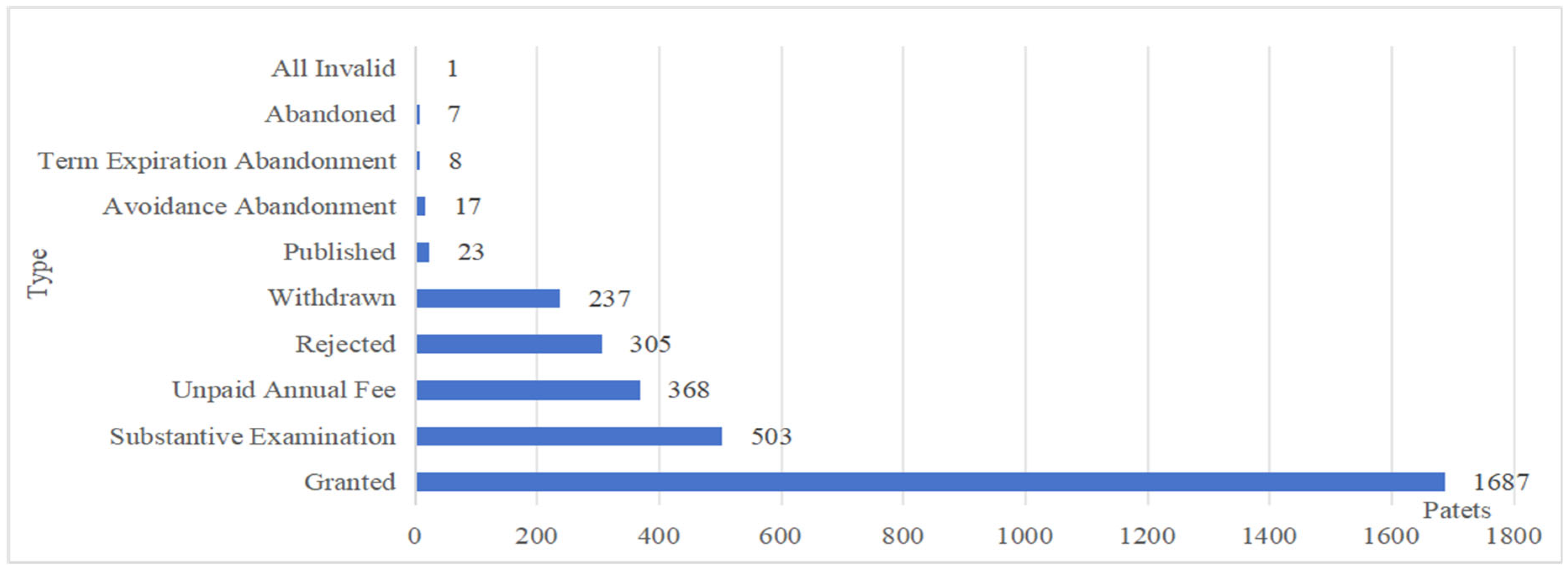
The legal status of patents related to AI applications in ceramics is generally favorable (
Figure 2). Among them, granted patent documents represent the largest category, with 1687 patents, indicating that a large number of AI application technologies in this field have obtained legal protection. There are 503 patents under substantive examination, reflecting sustained patent application activity. The categories of annual fee unpaid, rejected, and withdrawn include 368, 305, and 237 patents, respectively, showing that some patents were not maintained during subsequent procedures for various reasons. The numbers of patents in the statuses of published, avoiding double patenting, expired, abandoned, and invalidated are relatively small; in particular, only one patent is fully invalidated. This suggests that granted patents in the field are relatively stable. Overall, the patent protection outcomes for AI applications in ceramics are significant, while the different legal statuses also reflect differentiated development across the application, examination, and maintenance stages.
3.3. Patent Applicants
As shown in
Table 3, Zhejiang University leads ceramic AI patent applicants with 56 patent documents, followed by QUALCOMM (San Diego, CA, USA) and Guangdong Institute of Intelligent Manufacturing (Guangzhou, China). Other universities and research institutions also perform well. Applicants mainly include universities, research institutes and relevant manufacturers, showing AI ceramic research has expanded from algorithm study to intelligent equipment, robotic lines and mechatronic integration. Zhejiang University took an early lead and realized intelligent upgrading of traditional ceramic production. QUALCOMM focuses on intelligent hardware, IoT and system coordination to boost interconnection, real-time sensing and automatic operation in ceramic manufacturing.
3.4. Technological Characteristics of Patents
In terms of IPC classification, G01N tops the list for material property testing, followed by G06N for AI neural networks and G06F for digital data processing (
Table 4). B28B, B33Y and C04B cover ceramic forming, additive manufacturing and material optimization. G05B and B25J involve automatic control and robotic application, while B01D and G06T support filtration and image processing. Overall, relevant technical layouts have evolved from equipment, inspection and material optimization into an integrated system covering intelligent devices, mechatronics, robotic production lines, quality detection and material improvement.
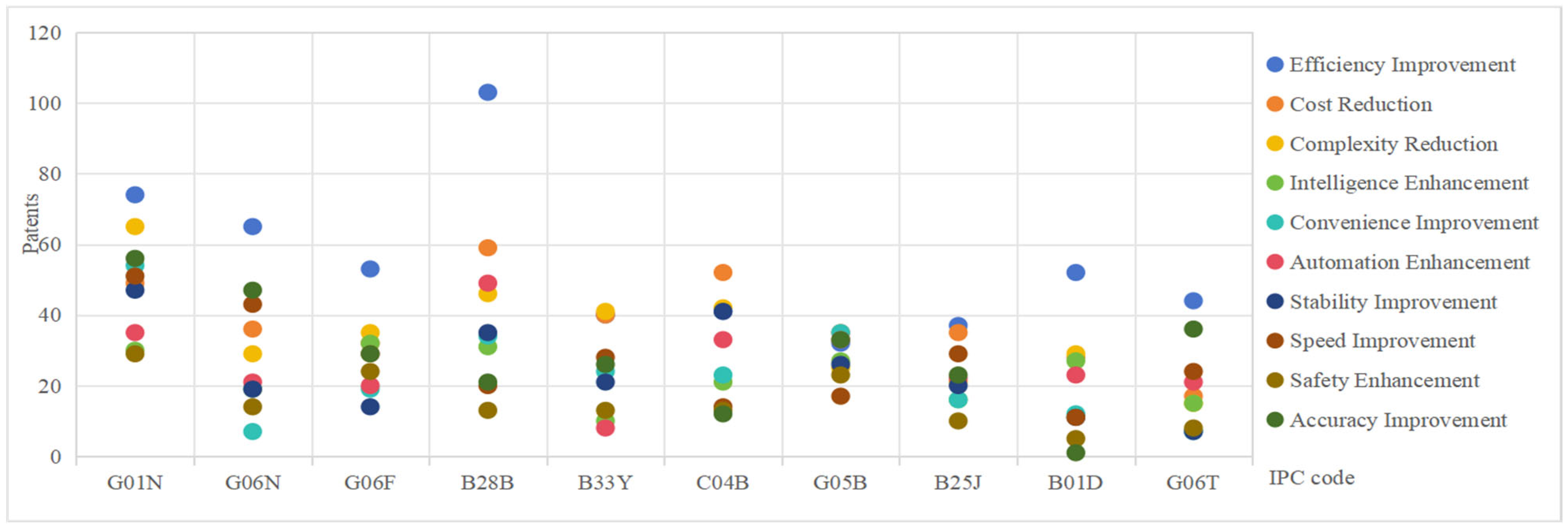
Different IPC categories of ceramic AI patents deliver distinct technical effects (
Figure 3). Ceramic processing equipment-oriented B28B excels in boosting efficiency, cutting costs and advancing automation. Material testing-focused G01N optimizes testing via higher efficiency, lower complexity and better accuracy. AI-centered G06N improves efficiency, speed and precision remarkably. Automation control and robot-related classifications realize on-site production scheduling, precise execution and safe operation beyond basic algorithmic analysis. Image processing and control technologies also enhance accuracy and operational convenience. Together, these technologies comprehensively elevate efficiency, cost control, precision, automation and intelligence in ceramic industry.
3.5. Application Scope of Patents
In recent years, AI application in ceramics has advanced from single-process optimization to full-process coordinated operation covering raw material treatment, forming, glazing, firing and sorting. Combined with sensors, vision devices, robots and other mechatronic systems, it realizes data collection, intelligent analysis and automatic execution, and achieves real-time closed-loop process control to raise yield and cut energy consumption and downtime.
AI optimizes core production links via intelligent algorithms and completes on-site operations through automated equipment, realizing the shift from algorithmic judgment to physical execution. It also enables equipment fault prediction to stabilize production efficiency. In terms of materials, it shortens R&D cycles and lowers costs by optimizing material formulas and properties.
For quality control, computer vision empowers precise intelligent detection and forms a closed-loop quality management system with automatic sorting and adjusting devices to stabilize product quality. In product design, AI design tools break traditional restrictions, facilitating the development of personalized and diversified ceramic products.
4. Research Hotspots of AI Patents in the Ceramics Field
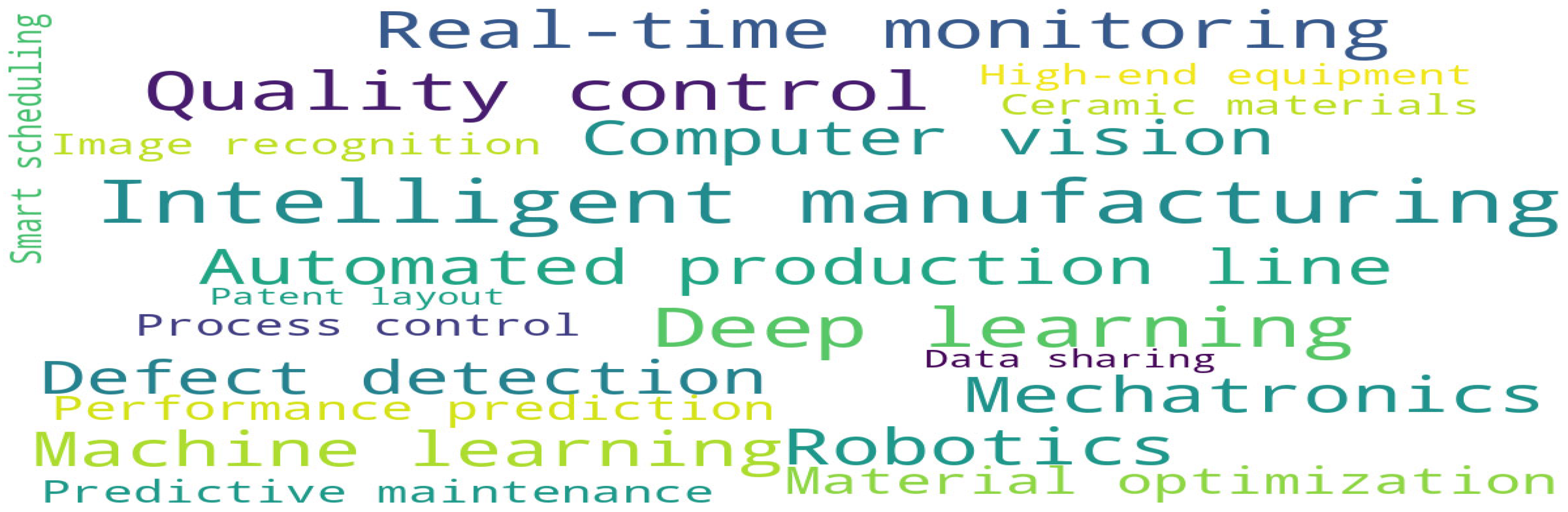
Cluster analysis results show that technological hotspots in the ceramics industry have concentrated on intelligent manufacturing and production automation, robotic production lines and mechatronic systems, ceramic material optimization and performance prediction, and quality control and intelligent inspection technologies over the past decade. These areas have accumulated both technological achievements and application results. In the keyword cloud shown in
Figure 4, terms such as intelligent manufacturing, deep learning, quality control, and real-time monitoring appear frequently.
4.1. Intelligent Manufacturing and Production Automation
Cluster results show that automated production lines and intelligent scheduling are important research hotspots. Robots and mechatronic systems perform diversified ceramic manufacturing tasks and convert AI algorithms into practical operations, easing manual-induced quality differences. Core IPC technologies including B28B, G05B, B25J and G01N support automated processing, system control, robotic execution and online quality testing, and intelligent algorithms optimize operational parameters to streamline production. Industrial data from Yang et al. (2023) reveal China’s ceramic industry suffers high material, energy and labor costs, proving digital and intelligent upgrading essential for cost control and efficiency growth [
9]. Nie et al. (2021) realized production line monitoring and fault early warning via digital transformation [
10], while Huang and Deng (2021) optimized kiln firing processes to lower operational anomalies [
11].
AI enables scientific scheduling and predictive maintenance to cut operational expenses. Vision-based intelligent inspection works well for single customized ceramics yet has limitations in diversified batch detection. Integrated intelligent equipment can build full-process closed-loop control, effectively enhancing overall production performance.
4.2. Ceramic Material Optimization and Performance Prediction
Cluster results indicate ceramic material optimization research centers on formula adjustment and performance prediction, which helps satisfy performance demands, cut costs and shorten research cycles. Machine learning boosts new ceramic material design and property prediction. Wu et al. (2022) adopted multimodal data learning algorithms to raise the prediction accuracy of ceramic coating properties, verifying AI’s predictive advantages [
12]. Patent data show C04B and B33Y dominate material optimization research. Relevant technologies assist raw material proportioning and process improvement to endow ceramics with superior mechanical properties. As stated by Yang et al. (2023), AI integrates diverse data to forecast material properties under varied formulas and procedures in material design [
13].
Intelligent algorithms also accelerate high-performance ceramic development. Combined with automated experimental facilities, AI can form a closed-loop research system integrating prediction, preparation, testing and optimization, greatly lifting overall R&D efficiency.
4.3. Quality Control and Intelligent Inspection Technologies
Research hotspots of ceramic intelligent quality inspection lie in defect detection and image recognition. Insufficient public defect datasets restrict algorithm popularization and practical application. Integrating vision, deep learning and mechatronic technologies can realize full-process automatic inspection and disposal to stabilize product quality. IPC classification shows G01N and G06T serve core detection and image analysis functions, while B25J and G05B support subsequent automatic sorting and parameter regulation. Vision-based AI systems can accurately identify diverse ceramic defects and raise qualified product rate.
Nie et al. (2024) constructed improved YOLOv5 detection models with high industrial detection accuracy [
14]. Sun et al. (2025) optimized lightweight YOLOv8 structures and achieved superior detection performance on multiple datasets [
15]. Optimized deep learning methods balance detection accuracy and speed well. Compared with manual inspection, such intelligent inspection schemes feature higher efficiency, fewer errors and stronger industrial promotion value.
5. Conclusions and Implications
The patent-document analysis indicates that AI-related patent activity in ceramics increased overall during 2014–2021, while data for 2023–2024 should be interpreted cautiously due to publication lag and possible database incompleteness. In the retrieved IncoPat dataset, China accounts for the largest share of patent documents, followed by the United States, WIPO, the Republic of Korea, and the European Patent Office. This finding reflects a concentration of patent disclosures in the sample, rather than comprehensive technological leadership or market dominance. Legal-status results show that granted patents form the largest category, with other records under examination, withdrawn, rejected, or lapsed, indicating legal-status distribution rather than commercialization performance. Applicants mainly include universities, research institutes, and technology-related enterprises. IPC results show concentrations in material testing, AI and neural-network technologies, data processing, ceramic forming, additive manufacturing, material optimization, automation control, robotics, and image processing. Overall, AI-related ceramic patents are mainly associated with intelligent manufacturing, robotic and mechatronic systems, material optimization, and quality inspection. Future studies should use updated patent data, patent-family deduplication, full-text screening, and market or technology-transfer evidence.
Author Contributions
Conceptualization, M.T. and C.M.; methodology, M.T.; software, M.T.; validation, M.T. and C.M.; formal analysis, M.T.; investigation, M.T. and C.M.; resources, C.M.; data curation, M.T.; writing—original draft preparation, M.T. and C.M.; writing—review and editing, M.T. and C.M.; visualization, C.M.; supervision, C.M.; project administration, M.T.; funding acquisition, M.T. All authors have read and agreed to the published version of the manuscript.
Funding
This paper was supported by the 2025 Jiangxi Provincial Key Research Base Project of Philosophy and Social Sciences, “Research on the Evolution of the Digital-Intelligent Innovation Ecosystem in the Ceramic Industry from a Patent Perspective” (No. 25ZXSKJD33) and the 2026 Jingdezhen Municipal Guiding Science and Technology Plan Project, “Research on Patent Layout and Key Technology Breakthrough Strategies for the Ceramic New Materials Industry: A Case Study of Jingdezhen” (No. 2026RKX020).
Institutional Review Board Statement
Not applicable.
Informed Consent Statement
Informed consent was obtained from all subjects involved in the study.
Data Availability Statement
The patent raw data analyzed in this study were retrieved from the commercial IncoPat Global Patent Database on 24 June 2025. Restrictions apply to the availability of these proprietary patent datasets due to the database’s commercial copyright and access authorization rules. The aggregated statistical results, search strategy and classification tables supporting the findings are fully presented within the article. The raw patent dataset is available from the corresponding author upon reasonable request with permission from the database vendor.
Conflicts of Interest
The authors declare no conflicts of interest.
References
- Abbas, A.; Zhang, L.; Khan, S.U. A literature review on the state-of-the-art in patent analysis. World Pat. Inf. 2014, 37, 3–13. [Google Scholar]
- Daim, T.U.; Rueda, G.; Martin, H.; Gerdsri, P. Forecasting emerging technologies: Use of bibliometrics and patent analysis. Technol. Forecast. Soc. Change 2006, 73, 981–1012. [Google Scholar] [CrossRef]
- Wang, J.; Ma, Y.; Zhang, L.; Gao, R.X.; Wu, D. Deep learning for smart manufacturing: Methods and applications. J. Manuf. Syst. 2018, 48, 144–156. [Google Scholar] [CrossRef]
- Plathottam, S.J.; Rzonca, A.; Lakhnori, R.; Iloeje, C.O. A review of artificial intelligence applications in manufacturing operations. J. Adv. Manuf. Process. 2023, 5, e10159. [Google Scholar] [CrossRef]
- Kaufmann, K.; Maryanovsky, D.; Mellor, W.M.; Zhu, C.; Rosengarten, A.S.; Harrington, T.J.; Oses, C.; Toher, C.; Curtarolo, S.; Vecchio, K.S. Discovery of high-entropy ceramics via machine learning. npj Comput. Mater. 2020, 6, 42. [Google Scholar] [CrossRef]
- Zhang, J.; Xiang, X.; Xu, B.; Huang, S.; Xiong, Y.; Ma, S.; Fu, H.; Ma, Y.; Chen, H.; Wu, Z.; et al. Rational design of high-entropy ceramics based on machine learning—A critical review. Curr. Opin. Solid State Mater. Sci. 2023, 27, 101057. [Google Scholar]
- Wan, G.; Fang, H.; Wang, D.; Yan, J.; Xie, B. Ceramic tile surface defect detection based on deep learning. Ceram. Int. 2022, 48, 11085–11093. [Google Scholar] [CrossRef]
- Zhou, M.; Wu, T.; Xia, Z.; He, B.; Kong, L.B.; Su, H. Research progress in deep learning for ceramics surface defect detection. Measurement 2025, 242, 115956. [Google Scholar]
- Yang, Y.L.; Li, J.G.; Yan, B.; Hua, H. Exploration and application of digital transformation in the building ceramics industry. Foshan Ceram. 2023, 33, 60–63. (In Chinese) [Google Scholar]
- Nie, X.Y.; Yao, Q.S.; Chen, S.L.; Bai, M. Research and application of digital transformation of building ceramic production lines. Foshan Ceram. 2021, 31, 32–37+45. (In Chinese) [Google Scholar]
- Huang, J.P.; Deng, X.Z. Research and application of key technologies for intelligent manufacturing of building ceramics. Foshan Ceram. 2021, 30, 10–13. (In Chinese) [Google Scholar]
- Wu, X.; Hu, M.T.; Ding, P. Multimodal data representation learning for ceramic coating materials. J. Shanghai Univ. (Nat. Sci. Ed.) 2022, 28, 492–503. (In Chinese) [Google Scholar]
- Yang, K.L.; Gong, W.; Lin, W.P. Performance prediction of phosphogypsum porous ceramic materials based on machine learning. China Ceram. 2023, 59, 23–29. (In Chinese) [Google Scholar]
- Nie, Y.; Zha, Q.L.; Li, C.W.; Zhang, Y.; Li, C.; Peng, Y.; Li, J.; Xu, J.; Xu, Y.; Fu, R.; et al. Research progress on artificial-intelligence-based image processing in the ceramic field. J. Ceram. 2024, 45, 670–688. (In Chinese) [Google Scholar]
- Sun, P.; Hua, C.; Ding, W.; Hua, C.; Liu, P.; Lei, Z. Ceramic tableware surface defect detection based on deep learning. Eng. Appl. Artif. Intell. 2025, 141, 109723. [Google Scholar]
| Disclaimer/Publisher’s Note: The statements, opinions and data contained in all publications are solely those of the individual author(s) and contributor(s) and not of MDPI and/or the editor(s). MDPI and/or the editor(s) disclaim responsibility for any injury to people or property resulting from any ideas, methods, instructions or products referred to in the content. |