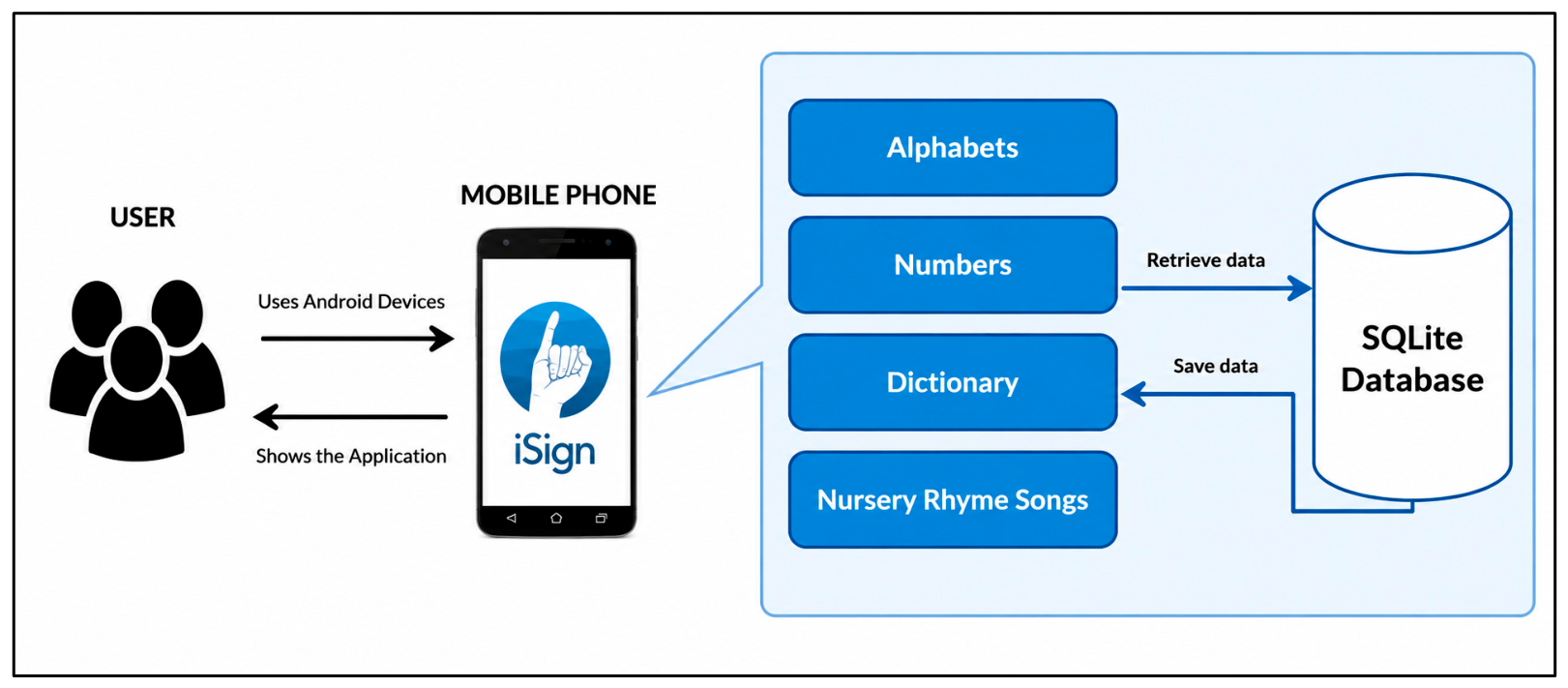
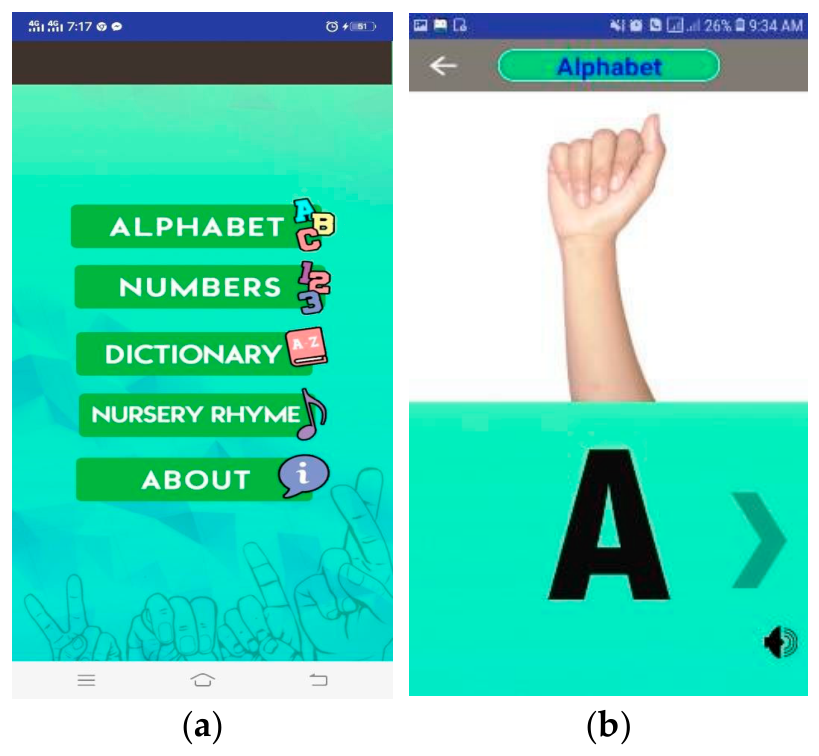
Design and Development of iSign: An Android-Based Educational Mobile Application for Deaf and Hard-of-Hearing Individuals †
 ,
, 
Abstract
1. Introduction
2. Materials and Methods
2.1. Research Design
2.2. Study Setting
2.3. Participants and Sampling
- Hearing or communication impairment;
- Residency in the selected barangays;
- Willingness to participate in the study.
2.4. System Development Procedure
2.4.1. Analysis and Design Phase
- Alphabet learning (A–Z);
- Number learning (0–9);
- Sign language dictionary;
- Multimedia learning resources;
- Video demonstrations and search functionality.
2.4.2. Development Phase
- Alphabet and phonetic audio;
- Numbers;
- A total of 160 commonly used vocabulary words;
- Definitions and video demonstrations in sign language;
- Nursery rhyme songs interpreted in sign language.
2.4.3. Implementation Phase
2.4.4. Software Evaluation and Ethical Considerations
- Evaluation Instruments
- B.
- Data Collection Procedure
- Needs assessment through surveys and interviews;
- System evaluation after application deployment.
- C.
- Data Analysis
- D.
- Ethical Considerations
3. Results and Discussion
3.1. User Interface of iSign Application
3.2. Deployment
3.3. Software Evaluation and Results
3.3.1. Software Evaluation
- Functionality;
- Reliability;
- Usability;
- Efficiency;
- Maintainability;
- Portability.
3.3.2. Participants in the Evaluation
3.3.3. Community Profile Context
- Bangon: 1364 population, six recorded individuals;
- Liwanag: 1047 population, one recorded individual;
- Amatong: 1272 population, one recorded individual;
- Budiong: 2596 population, one recorded individual;
- Panique: 2713 population, four recorded individuals;
- Pato-o: 2862 population, two recorded individuals;
- Tabobo-an: 1322 population, five recorded individuals;
- Tumingad: 2222 population, three recorded individuals.
3.3.4. Evaluation Results
4. Conclusions
Author Contributions
Funding
Institutional Review Board Statement
Informed Consent Statement
Data Availability Statement
Acknowledgments
Conflicts of Interest
References
- Crompton, H.; Burke, D.; Gregory, K.H. The use of mobile learning in PK-12 education: A systematic review. Comput. Educ. 2017, 110, 51–63. [Google Scholar] [CrossRef] [Scilit]
- Felisoni, D.D.; Godoi, A.S. Cell phone usage and academic performance: An experiment. Comput. Educ. 2018, 117, 175–187. [Google Scholar] [CrossRef] [Scilit]
- Pima, J.M.; Odetayo, M.; Iqbal, R.; Sedoyeka, E. A thematic review of blended learning in higher education. Int. J. Mob. Blended Learn. (IJMBL) 2018, 10, 1–11. [Google Scholar] [CrossRef] [Scilit]
- Iskakova, M. Electronic technologies to ensure individual learning of education seekers with special needs. Futur. Soc. Sci. 2023, 1, 4–20. [Google Scholar] [CrossRef] [Scilit]
- World Health Organization. World Report on Hearing; World Health Organization: Geneva, Switzerland, 2021. [Google Scholar]
- Hall, W.C.; Levin, L.L.; Anderson, M.L. Language deprivation syndrome: A possible neurodevelopmental disorder with sociocultural origins. Soc. Psychiatry Psychiatr. Epidemiol. 2017, 52, 761–776. [Google Scholar] [CrossRef] [Scilit] [PubMed]
- Berrezueta-Guzman, S.; Daya, R.; Wagner, S. Virtual reality in sign language education: Opportunities, challenges, and the road ahead. Front. Virtual Real. 2025, 6, 1625910. [Google Scholar] [CrossRef] [Scilit]
- Armijos Paucar, B.J. The Effects of the Mobile-Assisted Language Learning Method in the EFL/ESL Context; Universidad de Cuenca: Cuenca, Ecuador, 2023. [Google Scholar]
- Chapelle, C.A. The Concise Encyclopedia of Applied Linguistics; John Wiley & Sons: Hoboken, NJ, USA, 2019. [Google Scholar]
- Nikolopoulou, K. Self-regulated and mobile-mediated learning in blended tertiary education environments: Student insights from a pilot study. Sustainability 2023, 15, 12284. [Google Scholar] [CrossRef] [Scilit]
- Escudeiro, P.; Gouveia, M.C.; Escudeiro, F.; Escudeiro, N. VirtualSign: Revolutionizing Accessibility and Inclusivity in Education Through Automatic Sign Language Translation. In Proceedings of the International Congress on Information and Communication Technology; Springer Nature: Singapore, 2024; pp. 95–107. [Google Scholar]
- Antonio, R.P.; Espino, C.L. Mapping the Mobile Shift: A Bibliometric Exploration of Mobile Learning Innovations in STEM Education. Int. J. Educ. Math. Sci. Technol. 2026, 14, 46–65. [Google Scholar] [CrossRef] [Scilit]
- Yasue, T.Y.M.; Oliveira, C.D.S.; da Silva, A.P.; da Silva Boschi, S.R.M.; Scardovelli, T.A.; Bissaco, M.A.S.; de Oliveira Gonzalez, T.; da Silva, R.R.; Martini, S.C. Mobile application: Digital health card for deaf adolescents. Rev. Esc. Enferm. USP 2024, 58, e20230366. [Google Scholar] [CrossRef] [Scilit] [PubMed]
- Rahman, S.; Thankachan, B.; Samposalo, H.M.; Pade, C.S.; Tandon, C.; Kinnula, M.; Monga, C.; Turunen, M. Technology-Assisted Sign Language Learning for Elementary Schoolchildren—A Cross-Country Study. In Proceedings of the 11th International Conference on Software Development and Technologies for Enhancing Accessibility and Fighting Info-Exclusion; Association for Computing Machinery: New York, NY, USA, 2024; pp. 222–232. [Google Scholar]
- Dostal, H.M.; Scott, J.A.; Chappell, M.D.; Black, C. A scoping review of literacy interventions using signed languages for school-age deaf students. Behav. Sci. 2025, 15, 1104. [Google Scholar] [CrossRef] [Scilit] [PubMed]
- Ruhama, U.; Yulian, R.; Asy-Syifa, S.N. Uncovering the Needs for a Web-based Sign Language Model for Deaf Students with American Sign Language (ASL). JPI (J. Pendidik. Indones.) 2024, 13, 629–639. [Google Scholar] [CrossRef] [Scilit]
- Suriani, W.; Ammade, S.; Larekeng, S.H. Supporting vocabulary learning in deaf learners through assistive technology: A study of the Pocket Sign App. Klasikal J. Educ. Lang. Teach. Sci. 2025, 7, 1016–1025. [Google Scholar] [CrossRef] [Scilit]
- ISO/IEC 25010:2011; Systems and Software Engineering—Systems and Software Quality Requirements and Evaluation (SQuaRE)—System and Software Quality Models. International Organization for Standardization: Geneva, Switzerland, 2011.



| Component | Specification |
|---|---|
| Processor | Intel or AMD processor with 64-bit support, 2 GHz or faster processor |
| Operating System | Microsoft Windows 7 with Service Pack 1, Windows 8.1, or Windows 10 |
| Memory (RAM) | At least 2 GB RAM (8 GB recommended) |
| Hard Disk Space | 4 GB of available hard disk space for installation |
| Screen Resolution | 1024 × 768 display (1280 × 800 recommended) |
| Component | Specification |
|---|---|
| Operating System | Windows 7/8/10 (32-bit or 64-bit) |
| Memory (RAM) | 3 GB RAM minimum; 8 GB RAM recommended; plus 1 GB for the Android |
| Hard Disk | 2 GB available disk space minimum; 4 GB recommended (500 MB for IDE+) |
| Screen Resolution | 1280 × 800 minimum screen resolution |
Disclaimer/Publisher’s Note: The statements, opinions and data contained in all publications are solely those of the individual author(s) and contributor(s) and not of MDPI and/or the editor(s). MDPI and/or the editor(s) disclaim responsibility for any injury to people or property resulting from any ideas, methods, instructions or products referred to in the content. |
© 2026 by the authors. Licensee MDPI, Basel, Switzerland. This article is an open access article distributed under the terms and conditions of the Creative Commons Attribution (CC BY) license.
Share and Cite
Lota, D.D.; Estabaya, P.S.; Famini, R.N.; Madali, A.M.S.; Vargas, K.M.; Foja, W.M.Q.; Tupas, P.B. Design and Development of iSign: An Android-Based Educational Mobile Application for Deaf and Hard-of-Hearing Individuals. Eng. Proc. 2026, 143, 42. https://doi.org/10.3390/engproc2026143042
Lota DD, Estabaya PS, Famini RN, Madali AMS, Vargas KM, Foja WMQ, Tupas PB. Design and Development of iSign: An Android-Based Educational Mobile Application for Deaf and Hard-of-Hearing Individuals. Engineering Proceedings. 2026; 143(1):42. https://doi.org/10.3390/engproc2026143042
Chicago/Turabian StyleLota, Dave D., Pia S. Estabaya, Regine N. Famini, Angelie Mae S. Madali, Kimberly M. Vargas, Wenna Mae Q. Foja, and Preexcy B. Tupas. 2026. "Design and Development of iSign: An Android-Based Educational Mobile Application for Deaf and Hard-of-Hearing Individuals" Engineering Proceedings 143, no. 1: 42. https://doi.org/10.3390/engproc2026143042
APA StyleLota, D. D., Estabaya, P. S., Famini, R. N., Madali, A. M. S., Vargas, K. M., Foja, W. M. Q., & Tupas, P. B. (2026). Design and Development of iSign: An Android-Based Educational Mobile Application for Deaf and Hard-of-Hearing Individuals. Engineering Proceedings, 143(1), 42. https://doi.org/10.3390/engproc2026143042