1. Introduction
Wind energy continues to expand rapidly as global power systems shift toward cleaner and more sustainable energy generation technologies [
1]. As the penetration of DFIG-based wind farms increases, their dynamic behavior and inherent stability characteristics have become critical considerations for secure grid operation [
2].
The DFIG is a nonlinear, multi-input, multi-output electromechanical system whose dynamics arise from the interaction between the stator and rotor electrical circuits, the converter action, the DC-link voltage behavior, and the mechanical torque–speed coupling [
3]. Accurate dynamic modeling using the synchronously rotating d-q reference frame provides a foundation for assessing system stability under varying operating conditions and voltage disturbances [
4]. Small-signal stability analysis, which linearizes the nonlinear model around an operating point, is widely used to evaluate modal behavior, damping characteristics, and electromechanical interactions in DFIG-based wind turbines [
5,
6]. Small-signal stability analysis has become a standard approach for understanding the dynamic behavior of DFIG wind turbines under realistic disturbances and operating conditions [
7,
8]. Unlike time-domain simulations, eigenvalue-based analysis provides direct insight into oscillatory modes, damping margins, and the underlying physical mechanisms driving instability [
8,
9,
10].
Several studies have reported that open-loop DFIG systems may exhibit lightly damped electrical modes, low-frequency electromechanical oscillations, and strong sensitivity to parameters such as grid voltage, rotor resistance, and operating slip [
4,
8,
11]. Voltage sags and weak-grid conditions can significantly shift eigenvalues toward the right half-plane, potentially degrading performance and causing instability if not properly controlled [
12,
13]. Participation-factor analysis has proven effective in identifying dominant states associated with each mode and explaining modal interactions within the DFIG structure [
14,
15,
16].
Although numerous works have proposed PI controllers, optimal LQR approaches, or robust H-infinity methods to enhance DFIG damping, these methods rely on a deep understanding of the system’s intrinsic open-loop modal behavior [
17,
18]. A thorough, controller-independent small-signal analysis is therefore essential as a foundation for advanced controller design, especially for modern grid-code-compliant wind-energy systems [
10,
19].
This paper addresses this need by developing a comprehensive nonlinear d-q frame model of a 1.5 MW grid-connected DFIG wind turbine and linearizing it around a realistic steady-state operating point. Eigenvalue analysis, modal classification, and participation-factor evaluation are performed to characterize unstable, electromechanical, and electrical-interaction modes inherent to the DFIG dynamics. Parameter-sensitivity studies are conducted to quantify the effects of rotor speed, stator voltage, and rotor resistance on dominant modes and damping behavior across typical operating ranges. Finally, small-signal step-response simulations under temporary voltage sags highlight the vulnerability of the DC-link voltage and power outputs when coordinated control is absent.
This paper is organized as follows:
Section 2 presents the detailed nonlinear modeling of the 1.5 MW DFIG and its linearization.
Section 3 describes the eigenvalue-based modal analysis framework.
Section 4 discusses sensitivity studies and small-signal dynamic responses under voltage disturbances.
Section 5 provides concluding remarks and outlines future controller-design extensions to this work.
2. System Modeling of the DFIG Wind Turbine
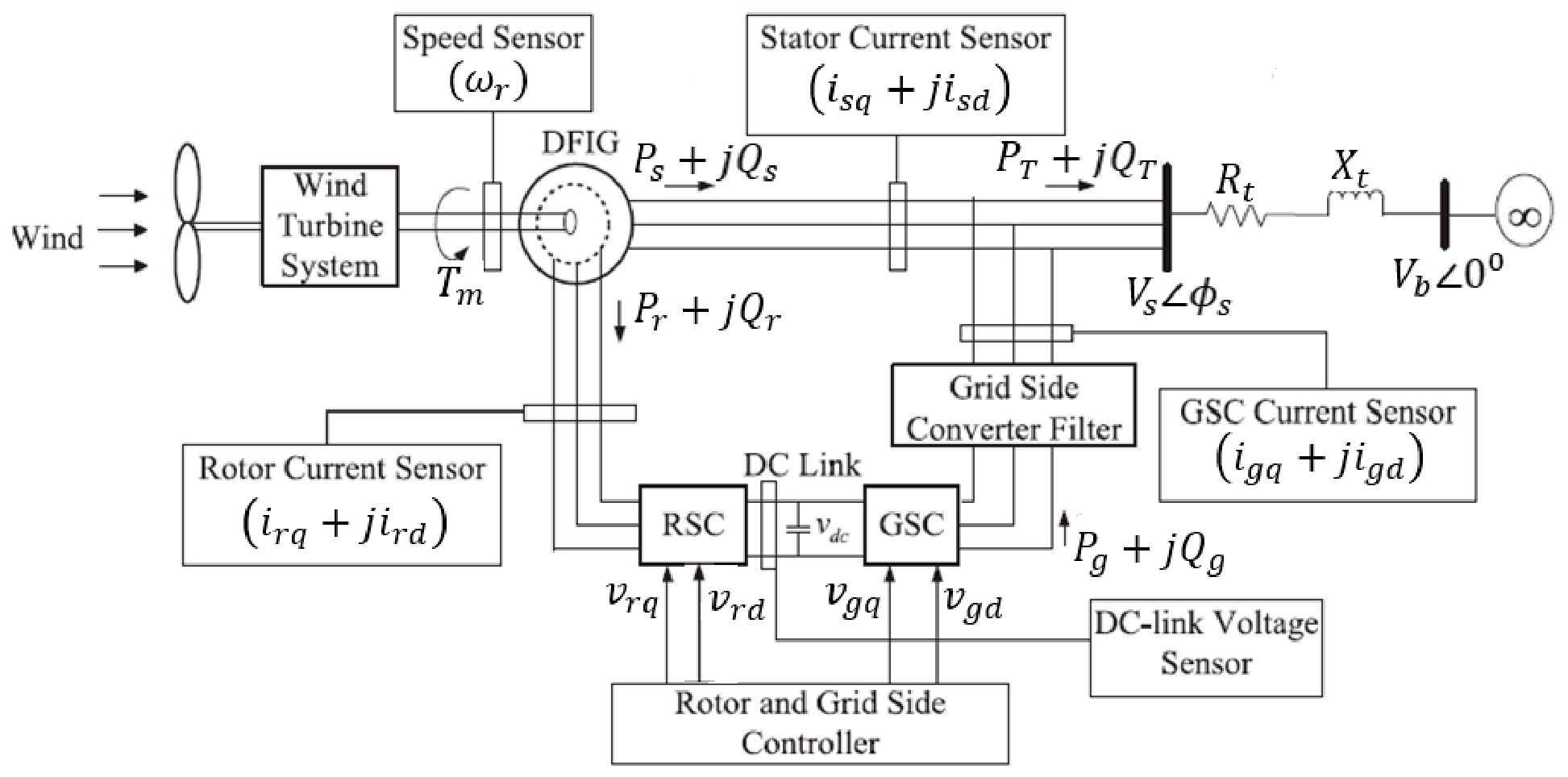
The overall configuration of the system is illustrated in
Figure 1, which includes the wind turbine, drive-train model, and the DFIG with its rotor-side and grid-side converters [
20,
21]. The stator is directly connected to the grid, while the rotor is interfaced via back-to-back voltage-source converters linked through a DC-link capacitor [
8,
20]. These converters enable the decoupled control of active and reactive power, enhancing dynamic stability [
6,
21]. The high frequency switching dynamics of the converters are neglected because they have a minimal effect on the electromechanical response of the system [
22]. The complete model is expressed in the synchronously rotating d–q reference frame, and the governing electrical and mechanical equations are derived using the standard formulation presented in [
20,
21,
23].
The rotor-side converter governs the electromagnetic torque and rotor current components to regulate active power and rotor speed. In contrast, the grid-side converter is responsible for sustaining the DC-link voltage and facilitating reactive power exchange with the grid [
8,
10]. As fluctuations in wind speed cause shifts in the DFIG’s operating point, linearization around the steady-state condition is essential for evaluating system stability and dynamic response under perturbations [
10,
22]. Before presenting the detailed modeling of the system components, the symbols used in the modeling equations are summarized in
Table 1 and
Table 2.
2.1. Generator Model
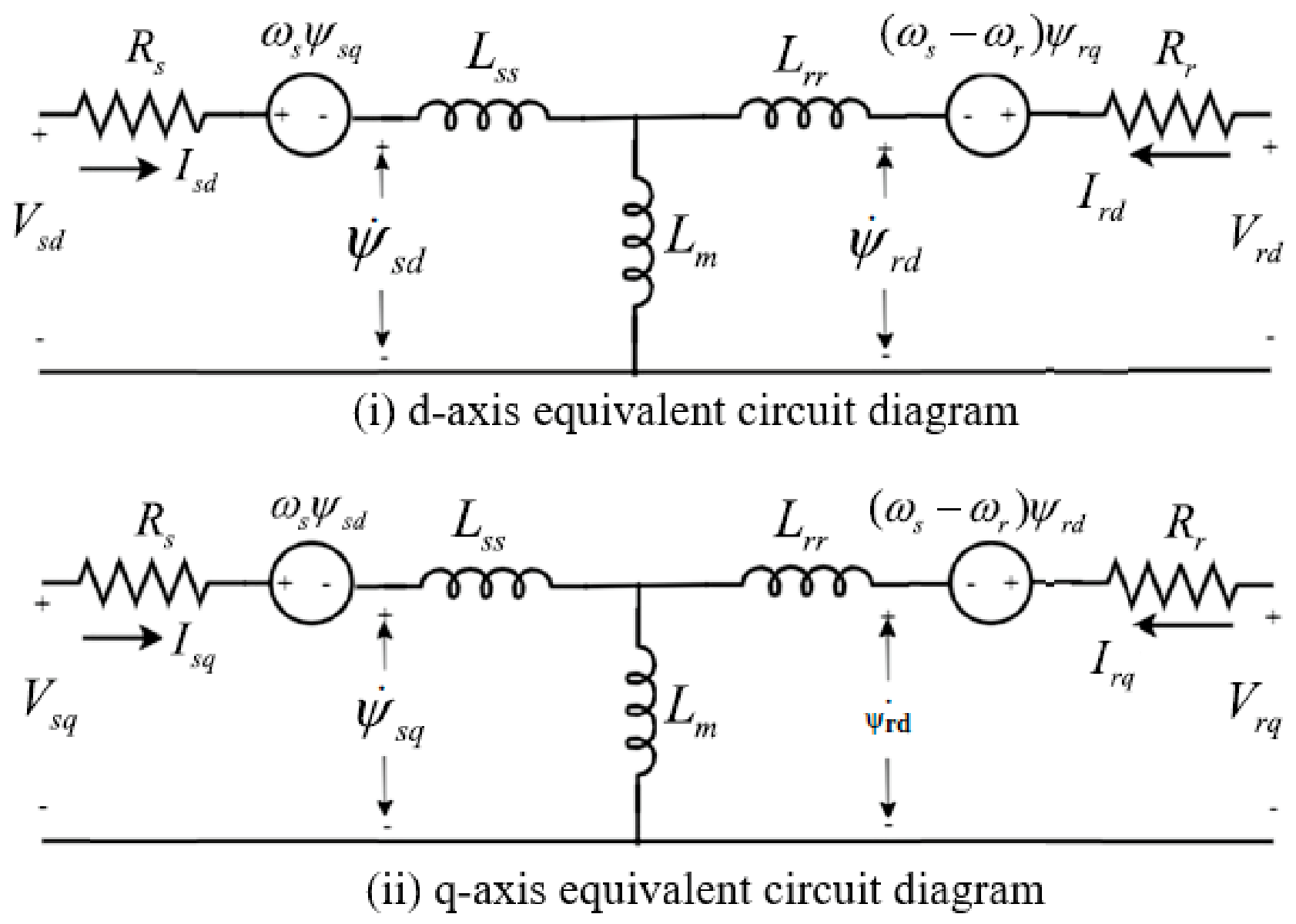
The electrical representation of DFIG closely resembles that of a conventional wound-rotor induction machine. The corresponding d–q axis equivalent circuit of the DFIG is illustrated in
Figure 2 [
10]. Although this model primarily represents the machine under steady-state conditions, it can also be applied to both sub-synchronous and super-synchronous modes of operation, depending on the rotor speed relative to the synchronous frequency [
8,
20]. Similar equivalent circuits and modeling assumptions have been used in several studies to analyze DFIG dynamics and to design control systems [
5,
21].
By applying Kirchhoff’s voltage law to the equivalent d–q axis circuits shown in
Figure 2, the stator and rotor voltage expressions in the synchronously rotating d–q reference frame are formulated as [
24]:
The difference between the synchronous angular speed and the generator (rotor) angular speed defines the slip angular speed,
. The symbol
represents the time derivative of the flux linkage. The stator and rotor flux linkages along the
axes can be expressed as follows [
21,
24]:
where
and
are the combined leakage and mutual inductances of the stator and rotor, given by (i.e.,
and
). The subscript
denotes stator variables, while
corresponds to rotor quantities; the second subscript specifies the axis orientation, either direct (d) or quadrature (q) [
25]. By applying Kirchhoff’s voltage law (KVL) to the
equivalent circuits of the DFIG and eliminating the stator and rotor flux linkages, the current dynamics can be expressed in the compact matrix form as
where
2.2. Wind Turbine Model
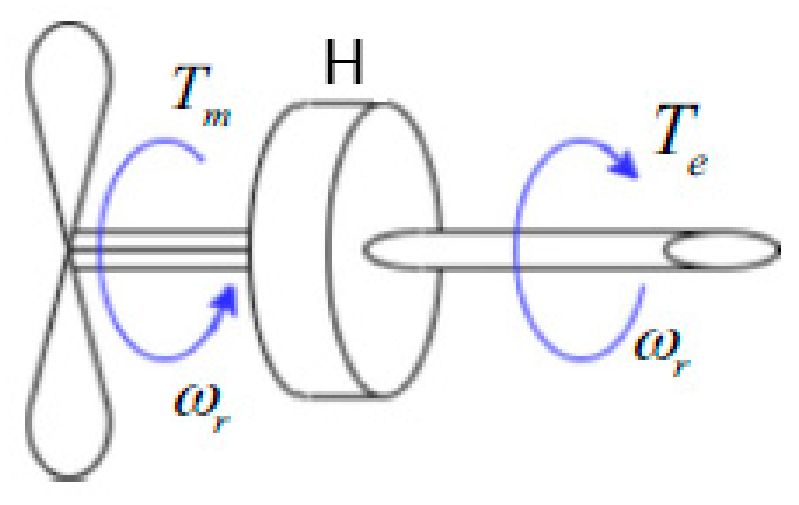
The variable-speed wind turbine driving the DFIG is represented by a single-mass model as shown in
Figure 3, where the mechanical shaft of the turbine and the generator rotor are assumed to rotate at the same angular speed.
The dynamics of the gearbox and pitch-angle controller are neglected due to their comparatively slow response relative to the electrical subsystem [
21]. The electromechanical interaction between the aerodynamic torque produced by the turbine and the electromagnetic torque developed by the generator is governed by the following swing equation [
26]:
where H denotes the total equivalent inertia constant of the turbine–generator system,
is the aerodynamic (mechanical) torque,
is the electromagnetic torque of the generator, and
represents the rate of change of the rotor angular speed. During operation, the turbine is controlled to maintain the optimal tip-speed ratio, as given by (11), so that maximum aerodynamic power is extracted from the wind.
The mechanical power available at the turbine shaft and the corresponding torque can be expressed as
where the constant
is defined as shown in (14) and depends on the air density on
, turbine-blade radius R, and the maximum power coefficient
, corresponding to
. Equation (12) shows that the captured wind power varies proportionally with the cube of the rotor speed for an optimally controlled turbine.
The electromagnetic torque produced by the DFIG, resulting from the interaction between the stator and rotor magnetic fields, is written in the synchronously rotating d-q reference frame as
Substituting (13) and (15) into (11) yields the mechanical dynamic equation that couples the aerodynamic and electrical subsystems:
Equation (16) indicates that the rotor accelerates when the mechanical torque exceeds the electromagnetic torque and decelerates in the opposite case. The first term on the right-hand side represents the mechanical power extracted from the wind, while the second term accounts for the electromagnetic coupling between the stator and rotor circuits. The inertia constant H determines how quickly the rotor speed responds to torque imbalances.
2.3. Grid Filter Model
The grid-side filter is a crucial component of the DFIG-based wind energy conversion system, ensuring a smooth power transfer between the converter and the grid. The overall power flow scheme of the system is illustrated in
Figure 1. In this arrangement, the stator delivers active and reactive power directly to the grid, while the rotor-side converter (RSC) and grid-side converter (GSC) manage the control of power and DC-link voltage, respectively.
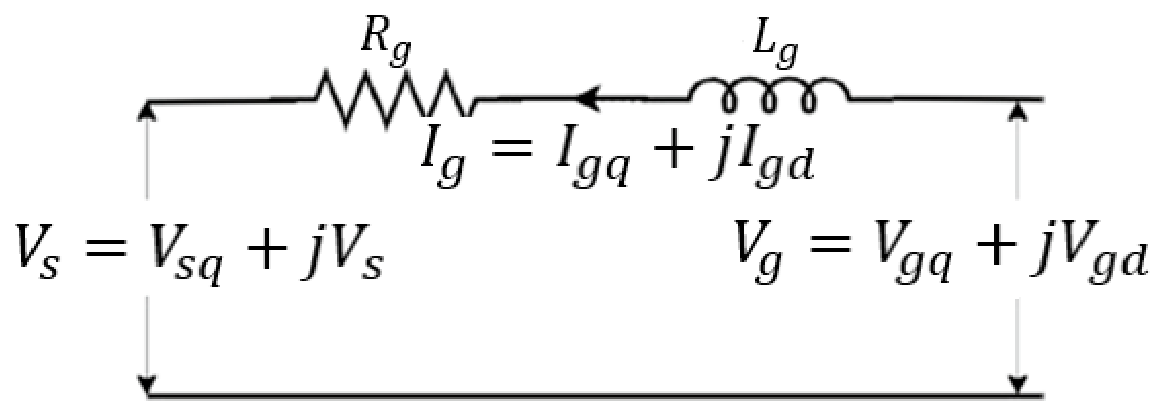
The primary function of the grid-side filter is to suppress high-frequency harmonics generated by the switching action of the converters and to align the amplitude and phase of the converter output voltage with that of the grid. This filter can be modeled as a first-order low-pass circuit, which allows fundamental frequency components to pass while attenuating higher-order harmonics. The equivalent circuit of the grid-side filter is depicted in
Figure 4.
The voltage equation of the grid-side filter in the synchronously rotating d–q reference frame is given by
represents the grid current vector. Rearranging (17) and expressing the equations for the
components yields
Equations (18) and (19) describe the dynamic behavior of the grid-side currents in the d-q frame, which are used for regulating active and reactive power exchange between the converter and the grid. The filter parameters and are typically small but play a crucial role in damping current transients and improving the quality of injected grid currents.
2.4. DC Link Model
The back-to-back converter system of the DFIG consists of the rotor-side converter (RSC) and the grid-side converter (GSC), interconnected through a DC-link capacitor that serves as an intermediate energy storage element. The capacitor stabilizes the DC-link voltage and facilitates bidirectional power transfer between the rotor and the grid. Neglecting converter losses, the instantaneous DC-link power
can be expressed as the difference between the active powers at the AC terminals of the RSC and GSC [
1,
2].
The DC capacitor and voltage are related by [
26]:
Substituting (46) into (47) gives the following DC-link dynamic equation:
A positive
increases the DC-link voltage, while a negative difference discharges it. Equations (23)–(28) present the instantaneous active and reactive powers of the stator, rotor, and grid-side converters in the synchronously rotating d–q reference frame [
21,
24].
Using these relationships, (29) expresses the rate of change of the DC-link voltage in terms of the converter voltages and currents [
8]:
3. Linearized Model
The DFIG-based wind energy system is inherently nonlinear, as it couples electrical, mechanical, and control subsystems through dynamic interactions among the stator, rotor, and converter circuits [
21,
26]. To analyze its small-signal stability and design suitable controllers, the nonlinear model is linearized around a steady-state operating point. The linearization process enables the use of classical control and eigenvalue-based techniques to assess system dynamics and performance under small perturbations [
6,
7]. Let the nonlinear dynamic behavior of the complete system be represented in state-space form as
where
is the vector of state variables,
is the input vector, and
represents the output variables. The functions
and
describe the nonlinear relationships among electrical and mechanical quantities within the DFIG system. At the equilibrium (i.e., steady-state) point, the derivatives of all state variables are zero. To study the dynamic response to small perturbations, the inputs and states are expressed as the sum of their steady-state values and small deviations [
10]:
By substituting these expressions into (30) and (31) and neglecting higher-order perturbation terms, the system can be linearized as
where A, B, C, and D are the Jacobian matrices evaluated at the operating point
. These matrices contain the partial derivatives of the nonlinear functions
and
with respect to the state and input variables, and they define the small-signal model of the system. For the DFIG system under study, the state vector consists of the stator, rotor, and grid-side current components, mechanical speed, and DC-link voltage, expressed as [
8,
10]:
The input vector represents the control voltages applied to the converters:
The output vector typically includes the measurable electrical quantities, such as active and reactive powers from both stator and rotor circuits, and the DC-link voltage:
Hence, the complete small-signal representation of the DFIG-based wind energy conversion system can be written compactly as shown in (33). This linearized model provides a fundamental framework for eigenvalue analysis and controller design, enabling the study of DFIG’s dynamic behavior under small disturbances. The accuracy of this model depends on the precision of the linearization around the chosen steady-state operating point, which is typically obtained through load-flow computation or steady-state simulation [
8,
10].
Table 3 summarizes the steady-state operating point obtained from the load-flow analysis. The state-space matrix A shown below was derived from the linearization of the system around this operating point.
Appendix A provides the system’s base and parameters.
Following is the resulting eigenvalue matrix:
Table 4 reports the eigenvalues obtained directly from the linearized state matrix A, which represents the small-signal dynamics of the 1.5 MW DFIG around the operating point. To interpret these eigenvalues, the corresponding modal participation factors were evaluated, allowing the dominant states contributing to each mode to be identified and grouped into physically meaningful modal families [
23,
27]. Based on this modal identification process,
Table 3 indicates that at the steady-state operating point, the DFIG exhibits a slow, unstable electrical mode dominated by the
d-
q axis stator and rotor current states
,
, a near-integrator DC-link voltage mode primarily influenced by
two lightly damped oscillatory modes reflecting combined electrical and electromechanical behavior through strong participation of
,
,
,
, and
, and a fast, well-damped grid-side converter mode shaped by the grid-filter currents
,
. Together, these findings confirm that the open-loop DFIG exhibits insufficient damping in its dominant electrical and torque–speed modes, while the grid-side converter dynamics remain inherently stable.
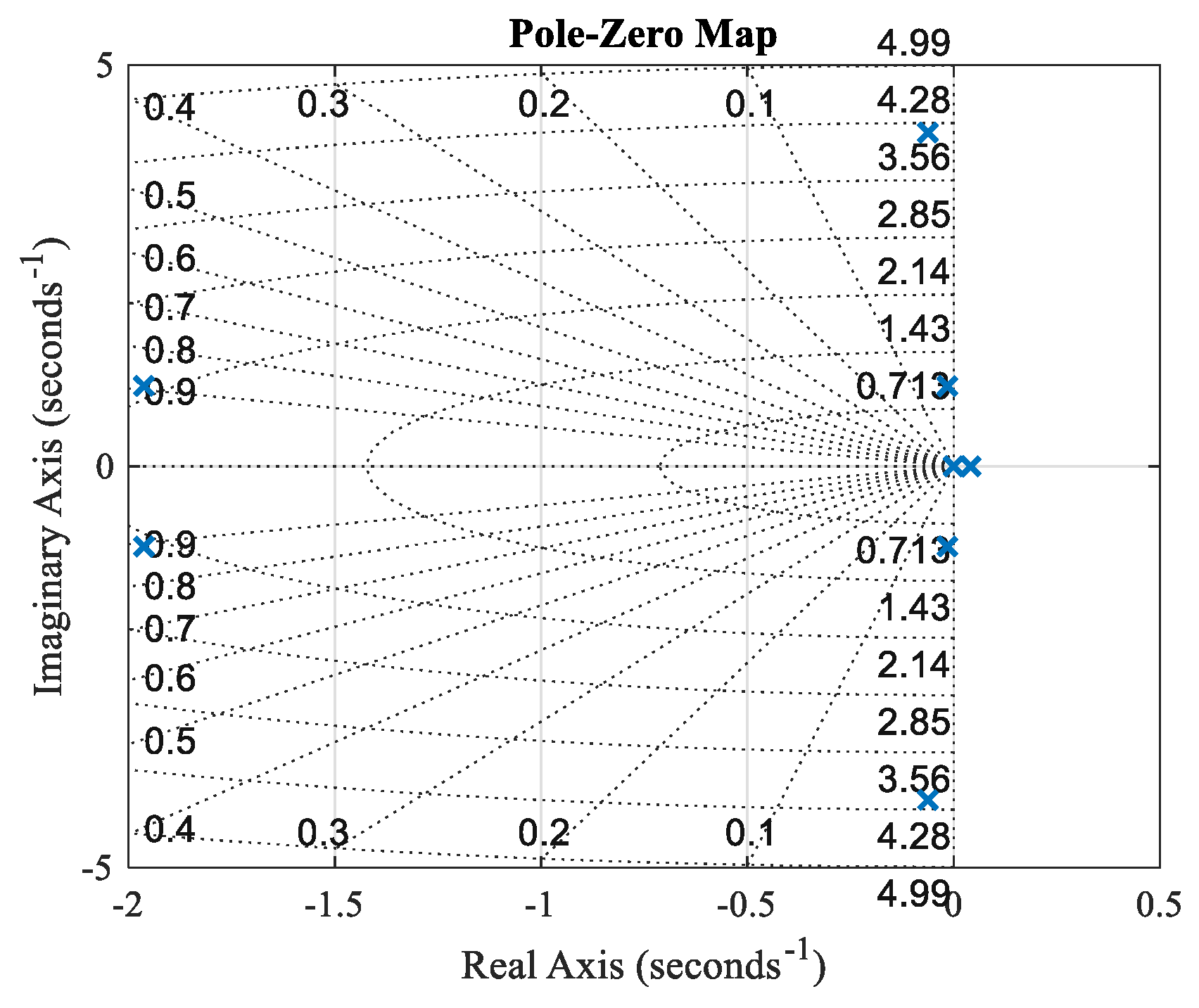
The pole–zero map shown in
Figure 5 provides a complementary view of the eigenvalue distribution of the linearized DFIG model.
A lightly unstable pole near the origin reflects the slow electrical instability already identified from the eigenvalues. The cluster of poles close to the imaginary axis, with frequencies ranging from 0.15 to 0.7 Hz, corresponds to the lightly damped electrical–electromechanical modes responsible for weak oscillatory damping. Their limited separation from the imaginary axis agrees with the low damping ratios reported in
Table 4. In contrast, the poles located further to the left, between approximately −2 and −5 s
−1, represent fast, well-damped grid-side converter dynamics that do not influence the critical modes. Overall, the pole–zero map confirms that weakly damped and marginally unstable modes characterize the open-loop DFIG, while the high-frequency converter dynamics remain stable.
4. Results and Discussions
This section presents a comprehensive assessment of the small-signal behavior of the 1.5 MW DFIG, motivated by prior studies that demonstrate DFIG stability is strongly influenced by operating conditions and machine parameters [
4,
28]. First, a parametric sensitivity study is performed to evaluate how mechanical speed, stator voltage, and rotor resistance shape the dominant eigenvalues, damping ratios, and oscillatory frequencies of the linearized model, consistent with earlier analyses demonstrating the sensitivity of DFIG modes to wind speed, grid voltage, and rotor-circuit variations [
4,
29]. This provides insight into which conditions most severely degrade stability margins.
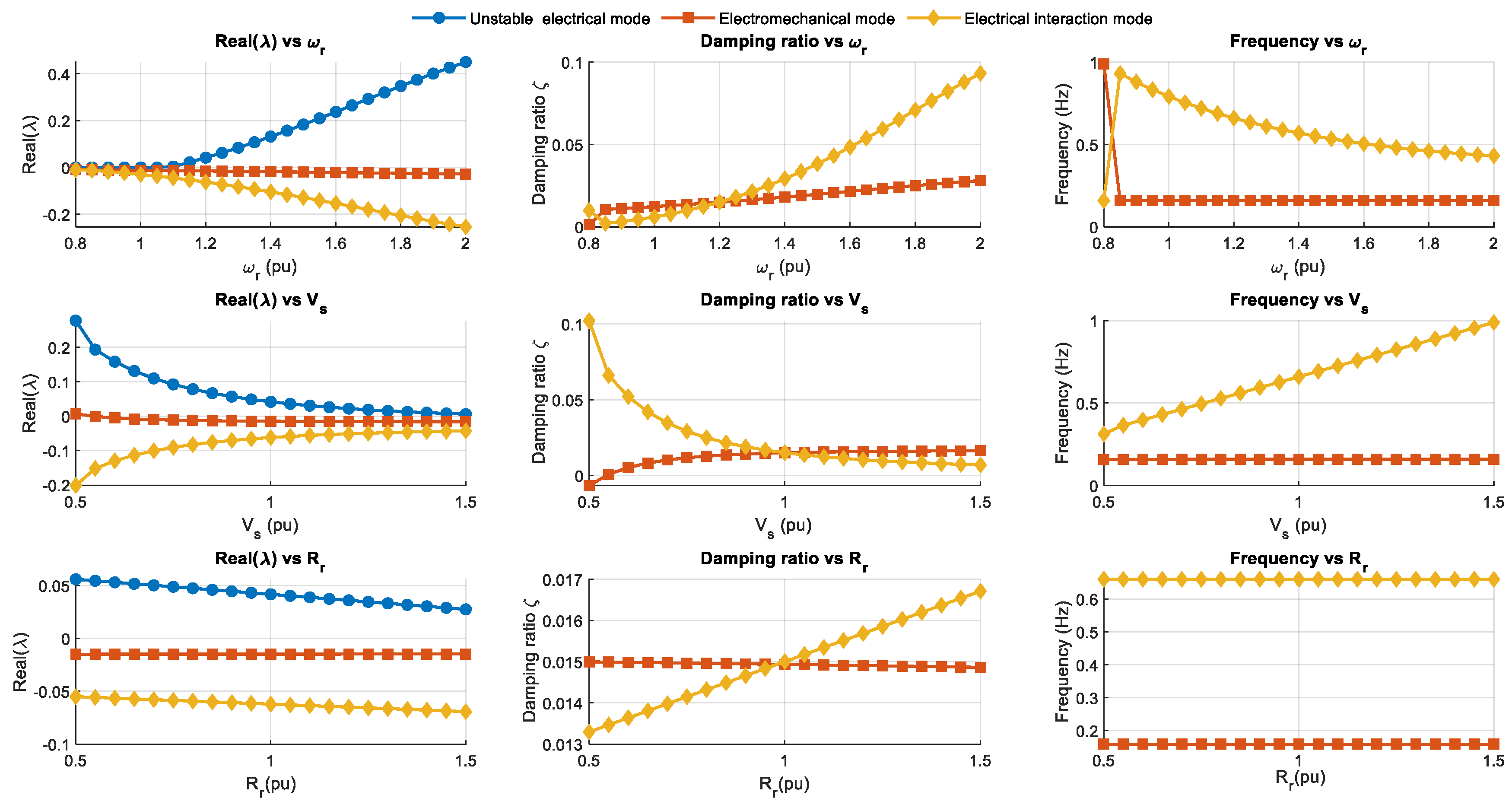
The sensitivity analysis shown in
Figure 6 examines how the dominant eigenmodes evolve under variations in rotor speed, stator voltage and rotor resistance.
To complement these trends, modal identification and participation-factor techniques were employed to determine the dominant states and classify the critical modes, following standard modal analysis practices widely applied in DFIG stability research [
8,
29]. The most critical operating points corresponding to the worst-case behaviors observed in the sensitivity plots are summarized in three modal tables. Finally, open-loop small-signal responses were obtained under 20–60% temporary voltage sags in
, which is essential since voltage disturbances are known to excite weakly damped electrical and electromechanical modes in DFIG systems [
30].
Understanding these trends is essential because electrical parameters and operating conditions strongly influence the oscillatory behavior and stability margins of DFIG-based wind turbines [
4,
31,
32]. As the rotor speed increases, the unstable electrical mode progressively shifts toward the right-half plane, confirming that higher slip conditions weaken electrical damping in the rotor circuit. This trend agrees with classical analyses showing that increases in rotor electrical frequency tend to decrease the effectiveness of d-q axis current damping, making the DFIG more susceptible to instability during high-speed operation [
32,
33]. The electromechanical mode remains weakly damped but consistently stable throughout the entire speed range, reflecting its dominant dependence on turbine inertia and torque–speed dynamics rather than electrical variations [
15]. Meanwhile, the electrical interaction mode exhibits an increasing oscillation frequency and a slight reduction in damping at higher rotor speeds, indicating enhanced coupling between the stator and rotor currents, consistent with earlier observations in [
33].
Variations in stator voltage reveal that low-voltage conditions substantially deteriorate stability. A reduction in
causes the unstable electrical mode to migrate toward the imaginary axis, confirming well-documented evidence that DFIGs are highly vulnerable to weak-grid and low-voltage operation due to reduced electromagnetic stiffness [
12,
28,
34]. The electromechanical mode shows minimal sensitivity to
reinforcing that its behavior is governed by mechanical inertia rather than terminal voltage strength. By contrast, the electrical interaction mode displays strong voltage dependence: its damping decreases sharply when
drops, while its oscillation frequency increases nearly linearly with
. This pattern suggests that stator voltage has a direct influence on current-coupling strength, consistent with the findings in [
33].
Changes in rotor resistance (
) demonstrate a moderate stabilizing effect on the unstable electrical mode. Increasing
shifts this mode further into the left-half plane [
32,
35]. The electromechanical mode remains nearly unaffected by
, once again underscoring that mechanical oscillations are largely decoupled from rotor resistance variations [
36,
37]. The electrical interaction mode exhibits gradually increasing damping for higher
, with relatively stable oscillation frequencies, an expected behavior aligned with previously observed small-signal characteristics of DFIG current-interaction modes [
36].
Table 5,
Table 6 and
Table 7 present the dominant eigenvalues at the most critical operating points identified in the sensitivity study. Across all three worst-case scenarios, the same trends persist: the slow electrical mode remains the least stable, the DC-link mode behaves as a near-integrator with negligible natural damping, and the lightly damped oscillatory modes involving coupled stator–rotor currents show reduced damping under high rotor speed and low stator voltage. Meanwhile, the grid-side converter mode remains consistently well-damped and largely unaffected. These results confirm, in a more focused manner, the patterns already revealed in the sensitivity plots: open-loop DFIG dynamics are most vulnerable under high rotor speed and stator voltage, with weakly damped electrical modes dominating the system response [
4,
8].
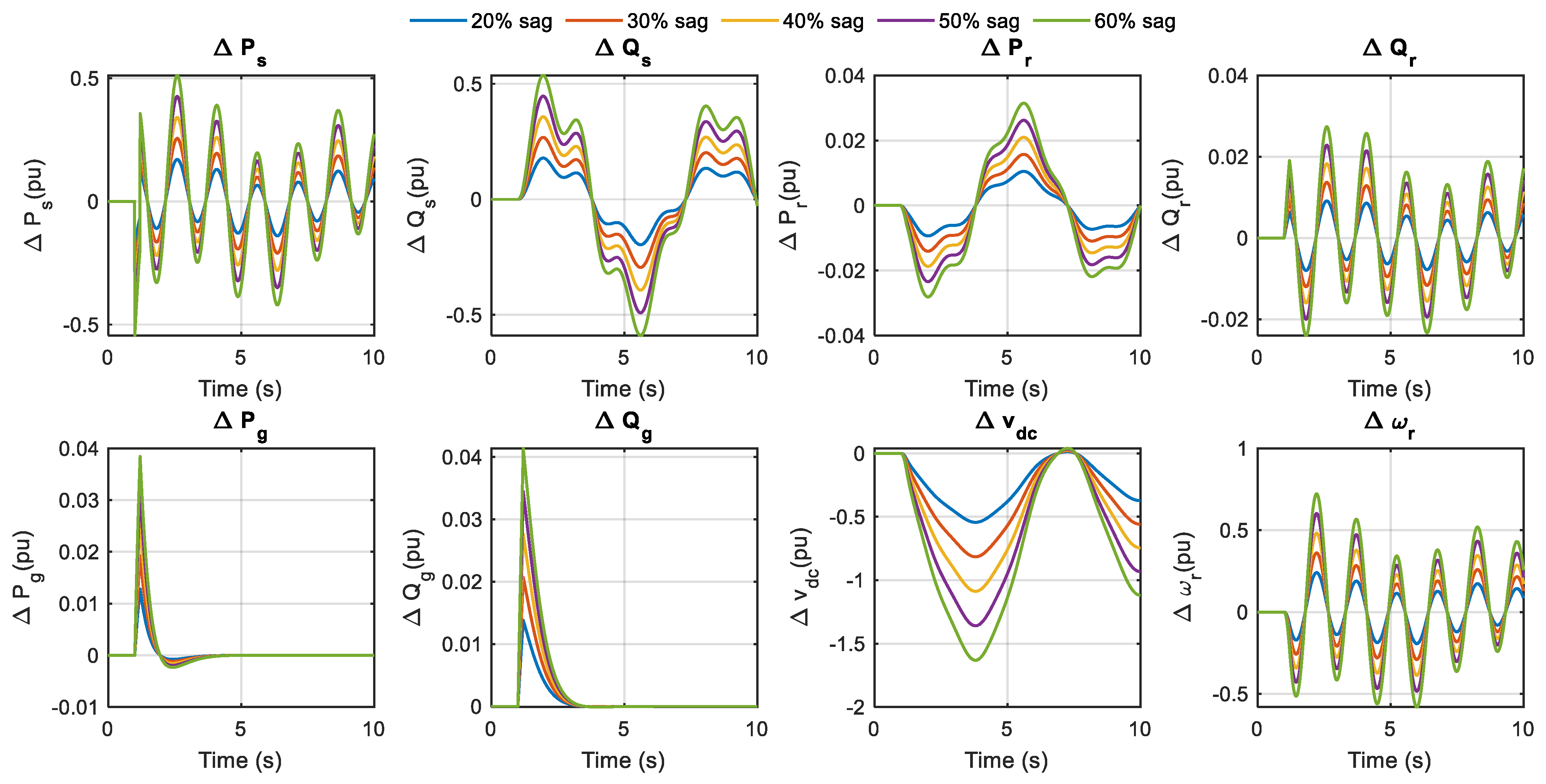
Figure 7 presents the open-loop small-signal responses of the DFIG states and power outputs under temporary stator voltage sags (
) ranging from 20% to 60%. The results show that the active and reactive stator powers (
,
) experience pronounced oscillations whose magnitude increases with the depth of the sag, reflecting the weak damping of the dominant electrical and electromechanical modes identified in the modal analysis.
Rotor power and reactive power deviations (, ) follow a similar trend, further indicating strong coupling between stator and rotor dynamics during voltage disturbances. The grid-side converter quantities (, ) settle rapidly with minimal oscillatory behavior, confirming their inherently stable and fast dynamics.
In contrast, the DC-link voltage deviation () undergoes large excursions up to almost twice its nominal value, highlighting the near-integrator nature of the DC-link mode and its sensitivity to power imbalance during sags. Mechanical speed deviations () also exhibit lightly damped oscillations driven by the electromechanical torque–speed interaction. Overall, the responses reinforce the conclusion from earlier eigenvalue and sensitivity analyses that the open-loop DFIG is most vulnerable to electrical and electromechanical modes. In contrast, high-frequency converter modes remain stable and non-limiting.