1. Introduction
Wind turbines are increasingly called upon to provide fast frequency control, i.e., rapid adjustment of power output to stabilize grid frequency during sudden changes in demand or supply. To achieve this, turbines must quickly adjust blade pitch in response to frequency deviations, a capability that is crucial for maintaining grid stability and preventing power outages [
1,
2]. Unlike traditional steady-state operation, frequency support requires small-amplitude, high-frequency pitch-angle adjustments that occur continually to regulate power output. These frequent pitch movements impose novel fatigue loads on the blade pitch bearings and can introduce transient anomalies in the turbine’s electrical DC-link [
3,
4], as pitch bearings accumulate fatigue damage from repeated load cycles.
Classic bearing life models, such as International Standard Organization (ISO) 281, the standard for rolling bearing basic rating life
[
5], assume constant rotation under steady loads. In contrast, turbine blade pitch bearings do not rotate continuously; they oscillate back and forth through small angles, which violates the assumptions of ISO 281 [
6,
7]. Understanding how these pitch control events contribute to bearing fatigue and affect DC-link voltage (DCV) and current (DCC) is therefore critical for reliability. This study utilizes techniques for pitch-bearing lifetime estimation under oscillatory motion and examines empirical links between rapid pitch activity and DC-link signal anomalies; by integrating cycle counting, load reconstruction, and prognostics, we propose a workflow to estimate pitch-bearing life and monitor DC-link health in turbines operating under blade motion control regimes.
2. Background
2.1. ISO Standards for Fatigue Life Estimation in Oscillating Bearings
ISO 281:2007 provides the classical basic rating life
for rolling bearings based on dynamic load rating, equivalent load and speed [
5], assuming steady loads and continuous rotation. For oscillating pitch bearings, this standard is commonly adapted by converting the accumulated oscillation angle into an “equivalent number of revolutions”, after which the ISO 281 formula is applied [
6,
8]. This equivalent-rotation concept offers a simple, first-order approach to include small-amplitude pitch motion in fatigue-life calculations and forms the baseline used in this work. ISO 16281 extends on ISO 281 by considering internal bearing geometry and load distributions on individual rolling elements, enabling life calculations under partial rotations and arbitrary load combinations [
7,
9]. It is more data- and computation-intensive but can capture asymmetric and oscillatory loading more realistically, which is relevant for yaw and pitch bearings. These ISO-based methods are consistent with the International Electrotechnical Commission (IEC) 61400-1 design requirements and provide a reference framework when rolling contact fatigue is the dominant failure mode [
10,
11].
2.2. Wind-Specific Bearing Life Prediction: NREL DG03 Approach
NREL’s Design Guideline DG03 [
12] is a wind-specific guideline for yaw and pitch bearings, proposing practical methods to incorporate oscillatory loads into life prediction. Comparative studies show that simple global-equivalent-load approaches can be overly optimistic, whereas more detailed DG03 and ISO 16281-style methods produce shorter but more realistic life estimates [
12]. The guideline, therefore, emphasizes that oscillating pitch bearings require specialized analysis or appropriate correction factors if simplified models are used.
2.3. Lundberg–Palmgren Theory
The Lundberg–Palmgren theory underpins ISO rating-life concepts by relating rolling contact fatigue life to stressed volume and the number of stress repetitions [
13]. It defines the basic rating life
at 10% probability of failure, usually expressed in millions of revolutions or oscillations. Extensions of this theory, including simplified oscillation treatments and more advanced segment-based methods, provide a theoretical basis for adapting rating-life calculations to oscillatory pitch bearings [
7,
14,
15].
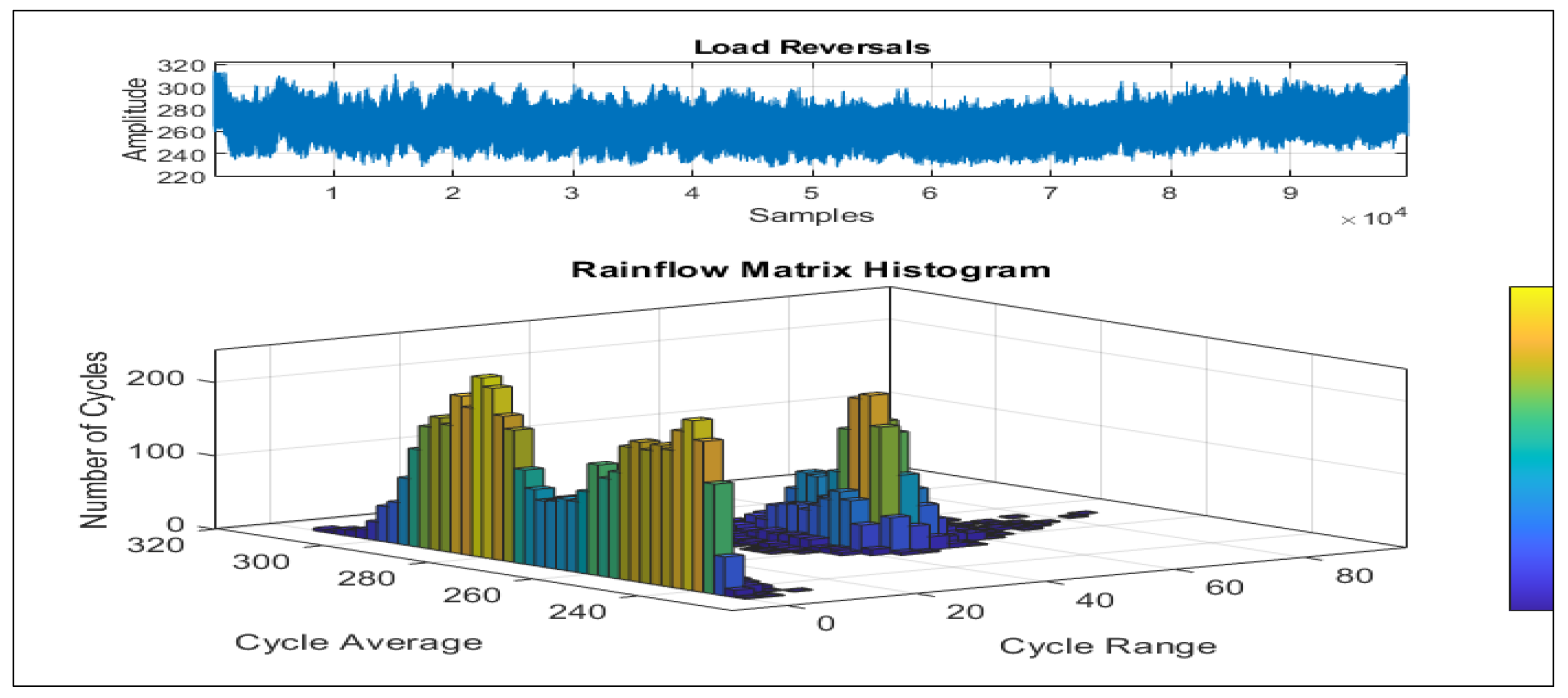
2.4. Rainflow Counting
Rainflow counting decomposes an irregular load or strain history into a set of cycles characterized by amplitude and mean [
16]. Applied to reconstructed pitch-bearing loads or pitch angle histories, it quantifies how often cycles of different magnitudes occur due to frequent pitch control actions [
16,
17]. The resulting cycle histogram is the essential input for fatigue damage evaluation using S–N curves and Miner’s rule.
2.5. S–N Curve and Miner’s Rule
Stress–life (S–N) curves relate stress amplitude to the number of cycles to failure and are widely used for high-cycle fatigue, including rolling contact [
5]. In bearing applications, S–N behaviour is embedded via the dynamic load rating and life exponent (typically
for ball bearings and
for rollers), allowing variable-amplitude load histories to be reduced to damage-equivalent cycles. For pitch bearings, an appropriate S–N curve from manufacturer data is combined with rainflow-derived load spectra to estimate damage under realistic control-induced oscillations. Miner’s linear damage, on the other hand, accumulates fatigue damage by summing life fractions. Failure is expected when
. For pitch bearings under fast frequency control, many small-amplitude cycles contribute to
; Miner’s rule provides a practical first approximation of life consumption from these numerous oscillatory pitch actions.
3. Methodology
3.1. Exploratory Data Analysis
In this study, we used the 20 Hz SCADA and structural load data from the Chalmers (Björkö) research wind turbine [
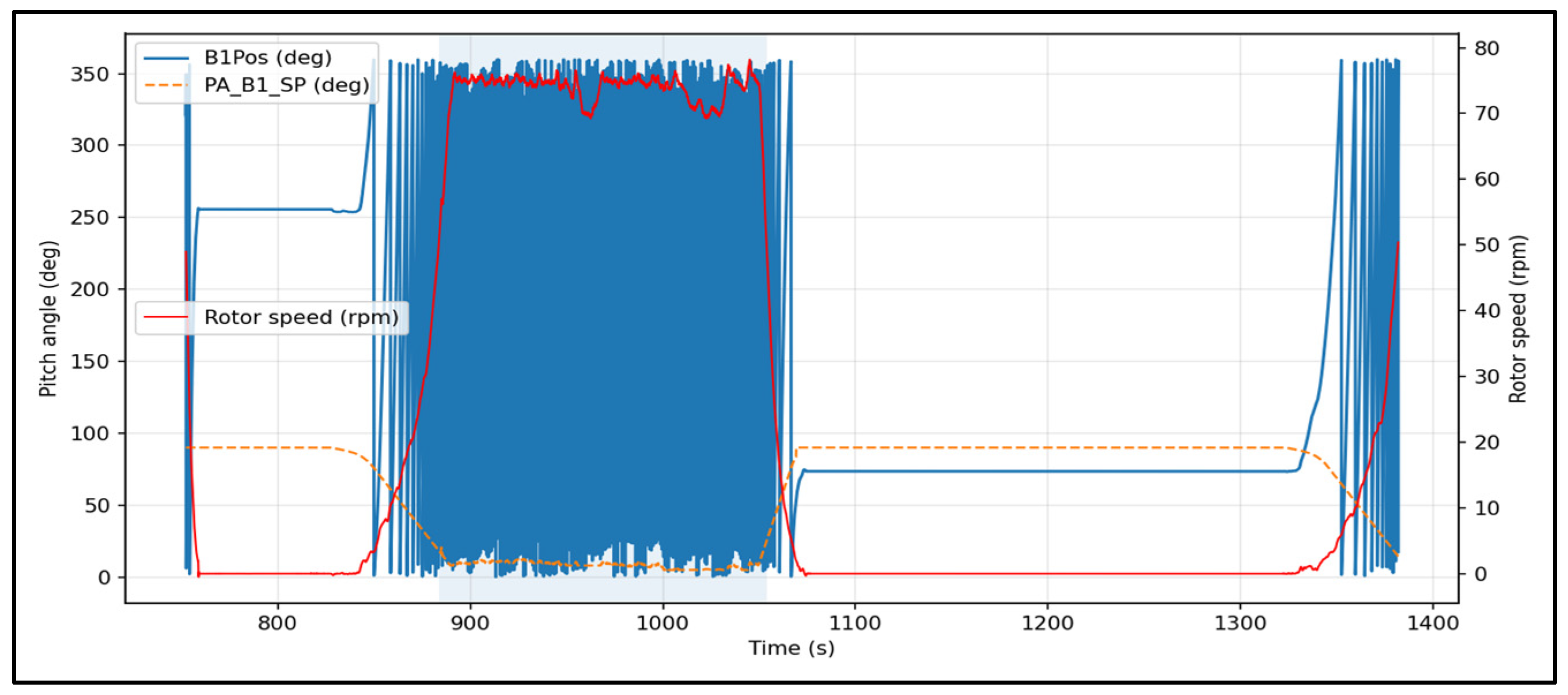
18]. A preliminary exploratory data analysis (EDA) was performed on the two-year SCADA dataset. It revealed extended intervals with parked or idling operation, standstill periods with no pitch motion, as well as gaps and sensor errors, which are not relevant for fatigue evaluations. Using a Matlab R2024a program and Kaggle Notebook on a 12th Gen, Intel(R) Core(TM) i3-1215U, 1200 Mhz, 6 Core(s), 8 Logical Processor(s) laptop, we managed to isolate mechanically meaningful operations; consequently, we then developed a Python 3.10.0-based segmentation procedure derived from the Chalmers test turbine five-region control strategy. Using rotor-speed thresholds of 50 to 70 rpm, pitch events were defined as park-run-park sequences in which (i) blade setpoints move from 90° to a new value, (ii) rotor speed remains between 50 and 70 revolutions per minute (rpm), and (iii) blades return to 90°. This procedure yielded 223 pitch events and reduced the full dataset to a fatigue-relevant interval.
Figure 1 below shows an example of one event from the 223 extracted.
Within each event, the EDA identified active pitch intervals via pitch-rate thresholds, confirmed the availability of load-proxy channels for blade flap moment for reconstructing radial and axial bearing loads, and quantified the prevalence of small-amplitude pitch oscillations. Following [
5], cumulative pitch motion above a 0–2.5° threshold was interpreted as possibly damaging movement on the bearings, motivating the use of rainflow counting for variable-amplitude cycle extraction. Event-level mechanical indicators were then aggregated and correlated with electrical variables (DC-link voltage/current and torque set-point) to verify that pitch activity leaves observable signatures in the electrical domain. This EDA provides the empirical basis for subsequent ISO 281 equivalent-load computation and fatigue damage assessment using S–N curves and Miner’s rule.
The event datasets are synchronized by subtracting the earliest timestamp from each timestamp in the dataset, thus having the event start from t = 0 s. We also filtered out missing values and outlier handling with respect to time, for example, when the time between the last measurement and the current is greater than 0.1 s, because the sampling rate for the dataset is 20 Hz; thus, any time gap between measured values greater than double the sampling rate would indicate a sensor error or disruption in measured intervals. An essential part of the pitch events is the pitch-rate thresholds in degrees per second, which is the rate of change ∆ω(t
n) of the blade position (θ) minus the previous position over time (t). This rate of change in degrees is calculated in (1) as follows:
Thus, using the equation above, data points below the pitch rate of 2 degrees per second were filtered out.
3.2. Load Reconstruction
The blade pitch-bearing loads are not directly measured in the turbine dataset; instead, strain gauges located approximately 2 m from the blade root provide flapwise and edgewise bending moments in accordance with [
11]. Because the strain gauges are not located at the bearing center, an effective load radius reff was introduced to represent the distance from the pitch axis to the resultant aerodynamic load. Radial and axial bearing loads were, therefore, reconstructed from these measured blade-root moments and operating data. In particular, the flapwise root moment was used to derive a radial load component, while torque-derived tangential forces and the edgewise root moment were used to estimate the axial load component. The objective of this load-reconstruction step was to obtain time series of radial and axial loads acting on the pitch bearing and to combine them into an equivalent dynamic bearing load Peq(t) that is compatible with DG03 and ISO 281 life calculations [
6,
19].
The blade-root moments are defined in a local coordinate system with the spanwise axis along the blade, the flapwise axis normal to the rotor plane, and the edgewise axis tangential in the plane of rotation. The radial load Fr is taken as the resultant transverse load perpendicular to the spanwise axis, arising from the flapwise and edgewise components, while the axial load Fa is aligned with the spanwise axis and is influenced by pitching torque and structural preload. The measured flapwise and edgewise moments, Mflap(t) and Medge(t), were then converted into equivalent point forces at the pitch-bearing center using this effective radius, forming the basis for subsequent equivalent-load and fatigue-life calculations. The corresponding equivalent forces in the flapwise and edgewise directions were then calculated in (2) and (3) as follows:
The radial load at the pitch bearing was taken as the magnitude of the transverse resultant of the reconstructed forces; this quantity represents the overall transverse load transmitted through the pitch bearing due to aerodynamic bending at the blade root calculated in (4) as follows:
Direct measurement of the axial load
Fa at the pitch bearing was not available. Instead, an approximate axial load was inferred from the pitch torque about the spanwise axis. According to [
6], when there is no direct measurement of Fa, it can be calculated in (5) as follows:
where e is the calculation factor found in the product table of [
6]. In our study, the bearings are 100 mm in diameter and thus e = 0.24. Therefore, given
Fr(
t) and
Fa (
t), the equivalent dynamic bearing load Peq(
t) in (6) was computed using the standard SKF [
6,
7] and DG03 formulation for spherical roller bearings (SRB), such as the SKF 22,220.
where
e,
Y1, and
Y2 are bearing-specific factors taken from the SKF catalog for the SKF 22,220 bearing and its other variants. The factor 0.67 reflects the reduced radial load contribution at higher axial load ratios for SRBs.
Lastly, the overturning moment Mover was calculated in (6) as follows:
With this, we can calculate an ISO equivalent load [
5] that is then formed using. That will later be fed into the life-estimation models.
3.3. Basic Life Rating L10
Using the dynamic equivalent axial load Peq and the basic dynamic axial load rating (Ca), where Ca = 220 [
20] kN, it is then possible to calculate the basic rating life L10 in millions of revolutions.
According to [
21], each time step of a time series can be considered as a bin with duration ∆t; thus, each event can be seen as a single bin, and the accumulative combined life of all bins, L, is then calculated as follows:
where L1, L2, till Ln are the lives of each respective bin, measured in degrees, revolutions, oscillations, or time; and θ1, θ2, and till θn are the proportion of degrees, revolutions, oscillations, or time that occurred while in the corresponding bin.
3.4. Combination of Rainflow Counting, S-N Curve, and Miner’s Rule
The calculated
is fed to Rainflow in accordance with the American Society for Testing and Materials, ASTME1049-85 (2017) [
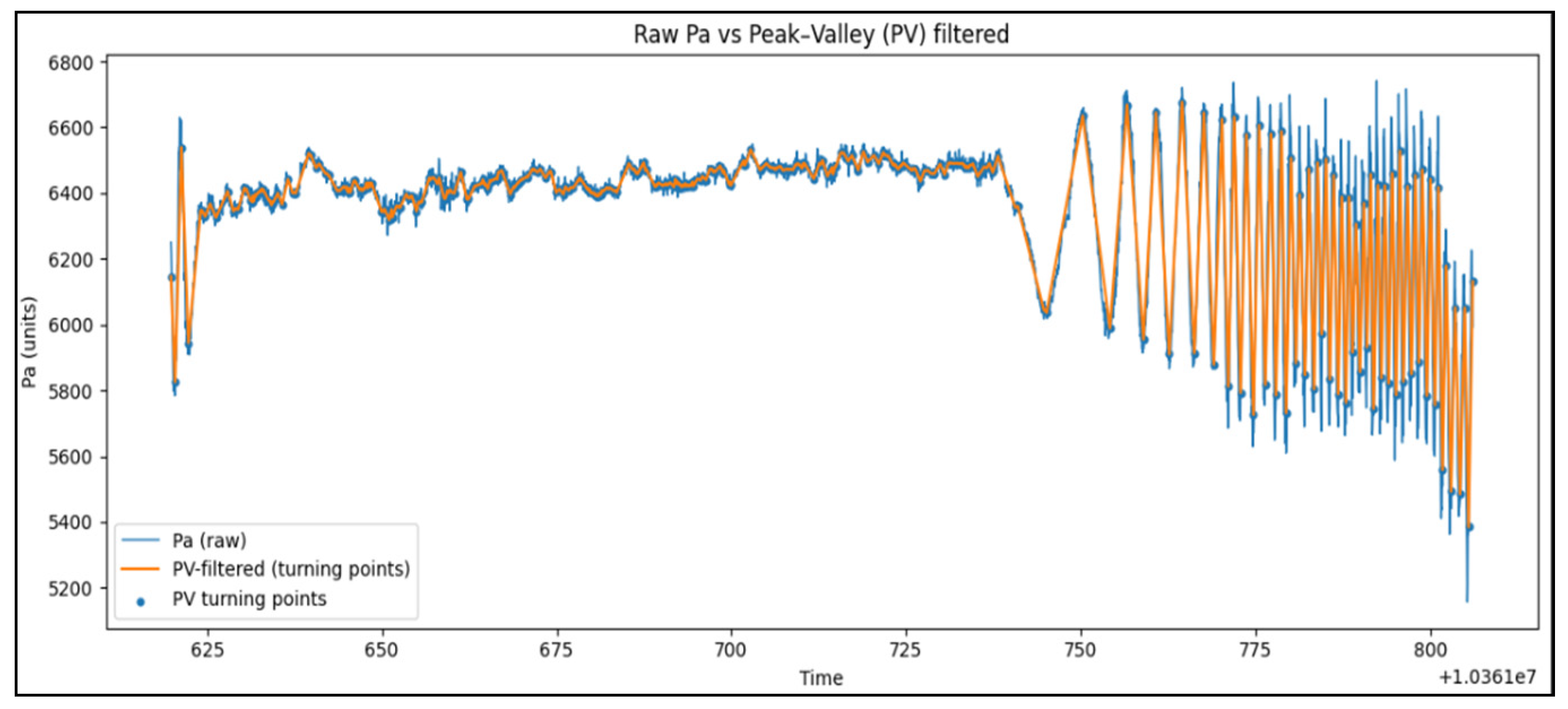
22], to obtain cycle ranges/means and counts.
Figure 2 and
Figure 3 below are the signals of the Pa range with rainflow counting filtering.
Using the Miner’s rule, the summation of damage fractions for each applied stress cycle is calculated in (10) as follows:
where D represents the total damage, when it is equal to or exceeds 1, it means the material is likely to fail, n denotes the number of different stress levels to which the material is exposed. ni is the number of cycles at stress level i. Ni refers to the number of cycles to cause failure at the stress level.
3.5. K-Means Clustering
To investigate whether pitch-bearing degradation leaves a measurable fingerprint in the electrical response of the turbine, we applied K-means clustering to event-level features extracted from the DC-link voltage and current. The aim of this step is not direct prediction of damage but rather exploratory to identify latent groups of events with similar DC-link behavior and examine whether these groups correspond to different levels of accumulated pitch-bearing damage. For each segmented pitch event, time-series measurements of DC-link voltage (DCV) and current (DCC) were summarized into statistical and spectral features. In the time domain, we computed the mean, standard deviation, median absolute deviation, selected percentiles (5th, 50th, and 95th), inter-percentile range, skewness, kurtosis, and root-mean-square (RMS) for both DC-link variables; these were achieved using standard Euclidean distance (11) and mean-based centroid (12).
Because the DC-link signals are strongly influenced by turbine operating conditions, we first reduced the linear impact of the principal operating variables so that clustering emphasizes anomalous electrical behavior rather than routine variations in wind or load. For each event, we computed the average rotor speed, generator torque set-point, wind speed, and a binary park/run indicator. Each event was also associated with a cumulative damage index
, obtained in MATLAB R2024a from rainflow counting on the equivalent moment Mover, followed by a Palmgren–Miner damage calculation. The damage index
was not used as input to K-means; instead, it was retained as an external variable to interpret and validate the resulting clusters. To mitigate noise and collinearity, principal component analysis (PCA) was conducted on the scaled features. The first
p principal components, which collectively accounted for at least 90–95% of the total variance, were preserved. This reduced-dimensional representation
yi ∈ ℝ
p for each event
i was subsequently utilized as the input space for clustering. In the reduced PCA space, we employed the standard k-means algorithm to partition the
events into
clusters based on Euclidean distance. K-means seeks to minimize the within-cluster sum of squared distances:
where
is the set of events assigned to the cluster
, and
is the centroid of that cluster. For each candidate
, the algorithm was initialised with 42 random seeds, and the solution with the minimum objective value was selected to reduce sensitivity to initialisation. The optimal number of clusters was then chosen by jointly inspecting the inertia (within-cluster sum of squares), the silhouette coefficient, and the Calinski–Harabasz index as functions of
, seeking a balance between cluster compactness and separation.
3.6. Electromechanical Link
For each event, DC-link voltage and current signals were summarized into features such as mean, standard deviation, percentile values, skewness, kurtosis, and residuals with respect to simple baseline models of DCV and DCC as functions of wind speed, rotor speed, and torque set-point. To reduce computational load, the 223 events were partitioned into five consecutive batches (1–27, 28–54, 55–111, 112–166, and 167–223). Within each batch, features were standardized and k-means clustering was applied. The number of clusters was selected using the elbow method and silhouette scores, typically yielding two or three regimes per batch. Cluster assignments were then compared against event-level Miner damage indices to explore whether distinct DC-link regimes are associated with different levels of mechanical severity.
4. Results
Across all the events in the datasets analysis, a consistent picture emerges. We can see that damage severity is governed by two complementary modes (i) a sustained harshness and (ii) a spike-driven transients, both of which are strongly reflected in the DC-link electrical signatures. The clustering of event-level electrical traces separates the data into distinct operating regimes with moderate but stable separability, with an average silhouette being 0.17–0.30 across all events. This indicates overlapping clusters, which is expected, as features in the dataset are influenced by coupled subsystems such as controls and aerodynamics. A breakdown of the findings is as follows:
4.1. Event 1–27
For the first batch with k-means with K = 2, produced:
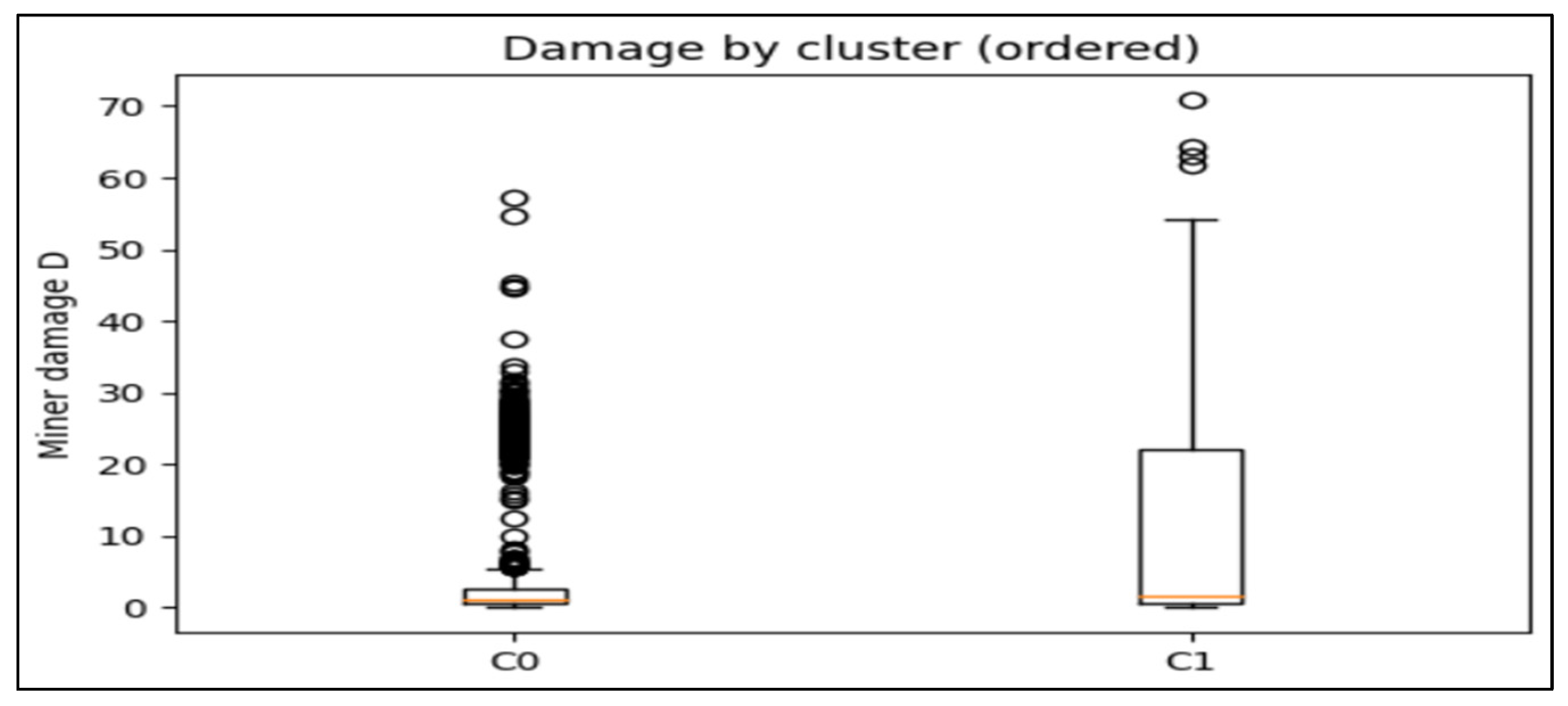
The cycle-wise Miner damage statistics across all events in this batch showed: Dmin = 0; median D = 0.16; 75th percentile = 0.22; 99th percentile = 0.29; and Dmax = 0.708. Thus, most cycles are low-to-moderate in damage, with a small tail of highly damaging cycles.
Figure 4 below shows the results obtained for this event. Cluster-level comparisons revealed that Cluster 0 contains most cycles and events, with higher average damage per cycle than Cluster 1, indicating that it hosts most of the moderately damaging load cycles. While cluster 1 has fewer cycles but a slightly higher relative share of exceedingly high-damage cycles, although these remain rare overall. Below is also
Table 1, which is a compact side-by-side of key averages for the DC signals of the event.
4.2. Other Events and Overall Pattern
Using the same method to analyze events 1–27, this was carried out for all other regimes, and the observed results are presented in
Table 2 below, together with
Figure 5 which visualises the overall pattern across all events. While detailed numbers vary, a consistent pattern emerges as follows:
In each batch, one regime is characterized by long elevated DC-link operating levels and a stronger damage period. The other has a short, elevated DC-link level and strong damage transients.
Events assigned to these regimes tend to exhibit higher average Miner damage indices than events in lower-DC regimes.
Clusters with small membership often correspond to rare, more severe electrical conditions and carry higher uncertainty due to limited sample size.
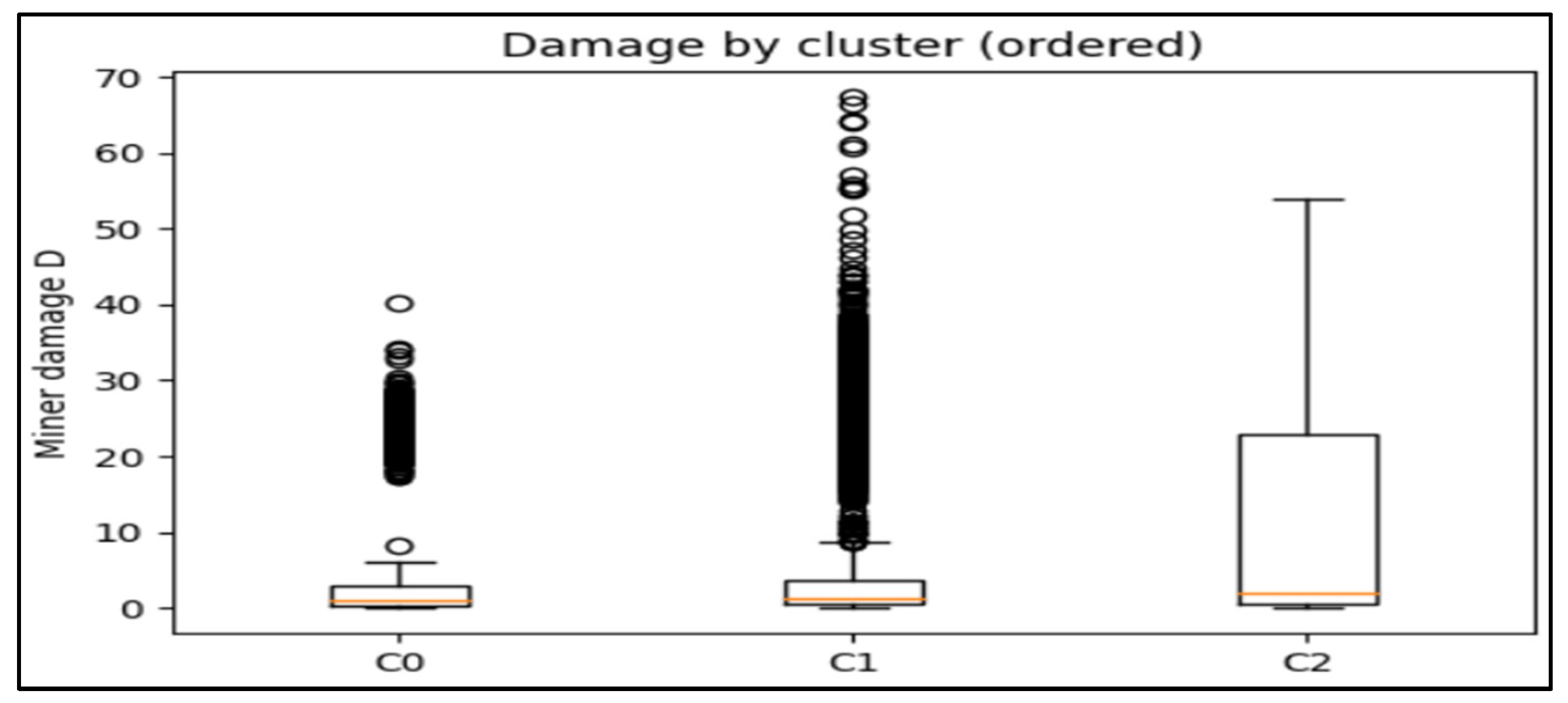
Finally, we also found a subset of events with more than two clusters. These clusters have high Dmean and long durations at elevated DCV, indicating sustained harshness, while a different cluster exhibit extremely high Dmax but for short, sporadic intervals. This shows, in an event, that if a pitch bearing reaches full damage condition, there will be a significant trace in the electrical signature, which can then be measured and used as a feature in condition-monitoring tools.
Figure 5 shows the results for such an event.
5. Discussion
The results from this study support an electromechanical link between pitch-bearing loading and DC-link behavior at the event level. Events that consume more fatigue damage, as measured by Miner’s index derived from reconstructed bearing loads and rainflow analysis, tend to fall into DC-link regimes with higher mean voltage or larger fluctuations. This implies that for SCADA-only monitoring, operators can use DC-link regimes, identified via clustering or simple thresholds on DCV and DCC features, as proxies for mechanically severe pitch events, enabling prioritization of inspections or more detailed analysis.
Combining physics-based damage metrics offers a hybrid approach, with unsupervised electrical analysis that leverages the strengths of both domains: interpretability and statistical power. However, several limitations must be acknowledged. This study was conducted on a single turbine’s data, and no cross-validation was performed. The k-means algorithm is sensitive to feature scaling and the choice of K; minor clusters with very few events introduce statistical uncertainty; and the damage index D is a proxy based on reconstructed loads, not a direct measurement of raceway stress. Moreover, there are instances where DC-link behavior is influenced by multiple subsystems, such as grid conditions and other components, so unless they are carefully filtered out, the observed correlations may not be unique to pitch-bearing degradation.
Future work should therefore include:
- (1)
Closing the loop by integrating full ISO-281 or ISO-16281 or the NREL DG03 fatigue accounting on the same events.
- (2)
Considering the lubrication, temperature, and maintenance schedules influence the pitch bearings.
- (3)
Employing group-aware cross-validation and temporal hold-out sets to confirm the robustness of DC-link regimes as predictors of high-damage events.
- (4)
Validate the methodology on multiple turbines, different control strategies, and grid conditions.
6. Conclusions
The main objective of this paper was to present a methodology to estimate pitch-bearing fatigue damage at the event level from operational turbine data and to relate these damage metrics to DC-link electrical behavior. The K-means algorithm, along with boxplots of the analyzed variables, has been employed to detect outliers and identify unusual behaviors in the electrical traces. This approach facilitates predictive maintenance and the forecasting of wind turbine performance. It is evident that across multiple event batches, regimes with elevated DC-link levels and transients tend to correspond to higher average Miner damage, indicating that DC-link signals carry information about pitch-bearing mechanical loading. The approach demonstrates how existing SCADA and structural measurements can be transformed into interpretable life metrics and used to define unsupervised electrical regimes useful for pitch-bearing condition monitoring, without installing additional sensors.
However, there are some limitations. Firstly, the small size of some clusters, especially minor regimes, introduces uncertainty as K-means is sensitive to feature scaling and the chosen . Secondly, the damage index D remains a derived proxy rather than a directly measured mechanical stress. Though even with these caveats, the evidence presented in the results across datasets is consistent. Thus, with further validation and refinement, such physics-informed, data-driven techniques could support more proactive, cost-effective maintenance strategies for wind turbines operating under increasingly demanding grid-support requirements.