Proceeding Paper

Parametric Evaluation of Stress Field Variations in and Vibration Mode Responses of a Flywheel Within the Linear Elastic Limit †
by
Kgotso Koketso Leema
,
Desejo Filipeson Sozinando
*,
Vhahangwele Colleen Sigonde
,
Bernard Xavier Tchomeni
and
Alfayo Anyika Alugongo
Department of Industrial Engineering, Operations Management and Mechanical Engineering, Vaal University of Technology, Vanderbijlpark Campus Private Bag X021, Andries Potgieter Blvd, Vanderbijlpark 1911, South Africa
*
Author to whom correspondence should be addressed.
Presented at the 2025 SAIMechE Central Branch Conference on Mechanical Engineering and Related Disciplines, Johannesburg, South Africa, 28 October 2025.
Eng. Proc. 2026, 132(1), 4; https://doi.org/10.3390/engproc2026132004
Published: 23 April 2026

Abstract

A combined analytical model and finite element analysis (FEA) framework is used to assess how the stress field evolves together with the vibratory response of the flywheels within the elastic limit range. Results indicate that circumferential stress rises faster than the radial component, and the outer rim emerges as the dominant failure-prone region. According to the Tresca criterion, the analysis yields an estimate of the maximum safe rotational speed associated with the design. Modal analysis reveals natural frequencies at 613.82 Hz, 616.35 Hz, 1231.1 Hz, and 1514.9 Hz, with a peak mass participation factor of 0.904 in the Y-direction. The framework links material, geometry, and operating conditions, supporting optimized design for high-speed applications.

1. Introduction

Flywheels are parts of rotating machines which play the vital roles of storing kinetic energy of a rotating machine, mitigating speed variations and incorporating power transmission stability. Centrifugal forces acting on their rotating mass together with elastic properties and geometry constraints result in the creation of the stress fields. The stresses occur in the radial and circumferential directions that form complicated interaction patterns affecting the patterns of deformation, like radial dilation and circumferential stretching towards the rim. The yielding of the outer radius by hoop stress and fatigue initiation close to the geometric discontinuities are controlled by potential failure modes [1,2]. The stress distribution problem affecting flywheels is mainly attributed to centrifugal forces during rotary movement which may cause pressure and decompression differences to be generated in the structure of the flywheel. The stress pattern is also essential because it influences the stability and performance of the flywheel that may cause disastrous performance in cases when it is not controlled appropriately [3]. The material composition of flywheels, like the utilization of 30Cr2Ni4MoV steel, is an important aspect in their fatigue life; internal defects and crack propagation behavior are important factors that affect the stress variation and fatigue life under cyclic loading conditions [4]. Also, dynamic control of the torsional stiffness of flywheels with the incorporation of smart materials such as magnetorheological elastomers can be used to eliminate the impact of stress changes caused by changes in system properties [5]. The moment of inertia can be adjusted in the design of flywheels by use of variable inertia systems and electromagnetic control, which may be optimal in vibration damping and reducing stress concentrations [6,7]. Also, the introduction of composite materials into flywheel rotors (e.g., carbon fiber composites) brings about distinctive stress distribution properties because they can be anisotropic, necessitating close consideration of the interference fits, as well as stress superposition to verify structural integrity [8,9]. Multiphysics, a combination of electromagnetic, thermal, and mechanical fields, is necessary in optimizing flywheel designs to manage the variations in stress to be able to ensure reliable performance in high-capacity energy storage systems [10,11]. Damping strategies and dynamic force transmissibility are the main factors that influence the vibration responses of flywheels. A typical fault in flywheel energy storage devices is air-gap eccentricity in motor rotors, which has a great impact on the dynamic response of flywheels. This type of fault causes unbalanced magnetic pull (UMP) that shifts the displacement waveform and axis orbit, and adds new frequency content and resonance peaks to the vibration spectrum. These peaks grow exponentially with the level of eccentricity origins and the acute role of mechanical faults on flywheel dynamics is emphasized [12]. Better perception of nonlinear friction-induced vibration is further understood when one takes into consideration that drill string–casing interaction in an inviscid fluid may create hidden frequency components and chaotic orbit patterns even in the case of low-damping conditions [13]. Friction ring dampers have been demonstrated to be effective in reducing vibrations in flywheels by dampening the level of vibration by dissipation of energy at the level of friction interfaces. The appropriate value of normal load of these dampers is that which minimizes vibration, and the damping behavior is described with nonlinear dynamic analysis [14]. Also, the operational conditions tend to cause friction faults in flywheel bearing cages that can also modulate characteristic frequencies, making it difficult to detect faults. One possible method of diagnostics is a modulation sideband ratio technique that can be used to identify the extent of such faults [15]. To prevent vibration in three dimensions, a new strategy of planned-motion flywheel assemblies has been carried out that stabilizes flexible beams within the shortest time possible and minimizes displacement in forced vibration [16]. Structural electromagnetic tuned mass dampers using flywheels (EM-FW-TMD) to control vibrations have also been used, and these devices have adjustable damping coefficients as well as adjustable inertance to optimize the performance [17]. Within the framework of vehicle uses, the dynamic performance study of flywheel batteries takes into account the direct effect of vehicle vibrations, which results in a better algorithm of control parameter adjustment [18]. Moreover, in the railroad systems, a variable damping vibration energy harvester based on a half-wave flywheel has been developed to extract the vibrational energy and has shown high power generation and vibration reduction properties [19]. Nimble flywheels with active magnetic bearings (AMBs) have been tested for their stability, and the plans for the suppression of synchronous vibration and the stability of suspension at ultra-high speeds have been adopted [20]. Lastly, the transmissibility of the dynamic forces between flywheel rotors provided by the angular contact ball bearings can be influenced by fit clearance and axial preload which impact the nonlinear behavior and resonant peaks in the system [21].
A comprehensive understanding of stress fields and the resulting vibration reactions in flywheels remains essential for developing structural integrity and operational safety. The present study addresses the gap between analytical formulations and FEA by examining how centrifugal loading, geometric constraints, and material properties interact to shape deformation behavior and stress distribution. The analysis of the modes allows this study to include critical information on resonance features and prevailing vibration modes. It allows for defining the operational limits and design policies that minimize the risks of failure. The integrated strategy provides a unified approach towards optimization of flywheel designs and can also give useful advice in the usage in high-performance mechanical, automotive and energy storage systems.

2. Model Formulation of Stress Characteristics of Flywheels

The stress situation in a rotating flywheel is the result of the combination of centrifugal forces, interactions of material elasticity, and geometric constraints imposed by the disc shape. In the steady state used in a flywheel, all the infinitesimal parts of the flywheel experience a distributed centrifugal load to cause radial and hoop stresses whose magnitudes change with the radial location. In the context of the theory of elasticity, statistical formulation may be used, which can be characterized by a constant rotational velocity and material homogeneity. Nevertheless, small-scale irregularities that cause flywheels are due to tolerances of manufacturers, thermal effects, microstructural inhomogeneities, and changes in loads. The physical system presented in Figure 1 is the rotating flywheel and an infinitesimal element by which the governing equilibrium equations are derived. The element is expressed in the cylindrical coordinates, and it is subjected to radial and hoop stresses and centrifugal force. The effects of the stress cause local differences in the stress and temporary reactions that have to be reflected in an enhanced model to boost the prediction of stress field analysis.
The formulation of the stress and displacement fields in a rotating flywheel is instigated with the radial equilibrium equation, which expresses the fundamental requirement of force balance for an axisymmetric rotating body. Derived from Cauchy’s equations of equilibrium in cylindrical coordinates, it captures the divergence of internal stresses, the centrifugal body force produced by rotation, and inertial contributions associated with radial motion. To enrich this model and account for localized dynamic effects or imperfections, a perturbation field is superimposed, leading to the following expression:
1 r r r σ r r σ θ θ r + ρ ω 2 r = ρ 2 u r t 2 + η 2 Φ ( r , t )
where ρ stands for the material density of the flywheel and ω represents the angular velocity.
σrr and σθθ denote the radial and hoop stresses, respectively, while ρω2r represents the centrifugal body force, ur the radial displacement, and Φ(r,t) a perturbation function scaled by the constant η. Hooke’s law for plane stress is used to connect these stresses with measurable in-plane deformations. Plane stress conditions suit thin discs particularly well because out-of-plane components remain negligible relative to the dominant in-plane stresses. The constitutive relation for an isotropic, linearly elastic material then takes the form:
ε r r ε θ θ = 1 E 1 v v 1 σ r r σ θ θ
where εrr and εθθ are the radial and tangential strains, E is Young’s modulus, and ν is Poisson’s ratio. The cross-coupling terms (−ν) reflect Poisson’s effect and the stress in one direction induces strain in the orthogonal direction. Geometric compatibility must also be satisfied, ensuring that the strain field arises from a single continuous displacement function. In order to achieve this, it is required to apply the compatibility condition in radial coordinates:
r ε r r + ε θ θ + κ 2 Φ r 2 = 0
The additional term that contains κ∂2Φ/∂r2 introduces localized perturbation effects into the compatibility formulation that allows for the modeling of higher-order variations in the strain field. Once the governing relationships are in place, the equilibrium expression can be integrated to obtain the general form of both radial and hoop stresses.
σ r r ( r ) = A r 2 + B r 2 + ρ ω 2 r 2 8 3 + v + μ Φ ( r , t )
σ θ θ ( r ) = A r 2 B r 2 + ρ ω 2 r 2 8 1 + 3 ν + μ Φ ( r , t )
Such forms are characteristic of Lame-type solutions for axisymmetric rotating discs, with the terms proportional to r2 and r−2 arising from the integration of the equilibrium equations. The centrifugal loading terms explicitly represent the influence of rotational speed, while the perturbation terms introduce small-scale corrections to the stress field. Determination of the constants A and B requires the application of traction-free boundary conditions at the inner and outer radii of the flywheel:
σ r r ( R 1 ) = 0   and   σ r r ( R 2 ) = 0
Solving the resulting system of equations yields explicit expressions for the constants A and B.
A = ρ ω 2 8 R 2 2 R 1 2 3 + v R 1 2 + R 2 2   and   B = ρ ω 2 R 1 2 R 2 2 8 R 2 2 R 1 2 3 + v
Substituting the constants A and B into Equations (4) and (5) provides the explicit forms of the radial and hoop stress distributions:
σ r r ( r ) = ρ ω 2 8 3 + ν R 1 2 + R 2 2 r 2 R 2 2 R 1 2 + 3 + ν R 1 2 R 2 2 R 2 2 R 1 2 r 2 + μ Φ ( r , t )
σ θ θ ( r ) = ρ ω 2 8 1 + 3 ν R 1 2 + R 2 2 r 2 R 2 2 R 1 2 1 + 3 ν R 1 2 R 2 2 R 2 2 R 1 2 r 2 + μ Φ ( r , t )
Equations (8) and (9) describe the complete stress field of the flywheel and show how the stresses depend on the geometry, material properties, rotational speed and radial position. The hoop stress increases more rapidly with radius than the radial stress, which explains why the outer rim of a flywheel is often the critical location for failure. The radial displacement field is obtained by integrating the strain–displacement relations in polar coordinates and can be expressed as:
u = 1 E A + B r 4 1 ν r + Ψ ( r , t )
where Ψ ( r , t ) = ε Φ ( r , t ) represents the displacement perturbation component.
The maximum safe rotational speed of the flywheel is obtained by applying the Tresca yield criterion, which states that yielding begins when the maximum shear stress reaches the material’s yield strength. The angular velocity at the onset of yielding can be expressed as:
ω Y = 4 σ Y ρ R 2 2 3 + v + 1 v R 1 2 / R 2 2
Equation (11) directly links the material strength, geometric parameters, and operating speed, providing a crucial design limit for safe operation.
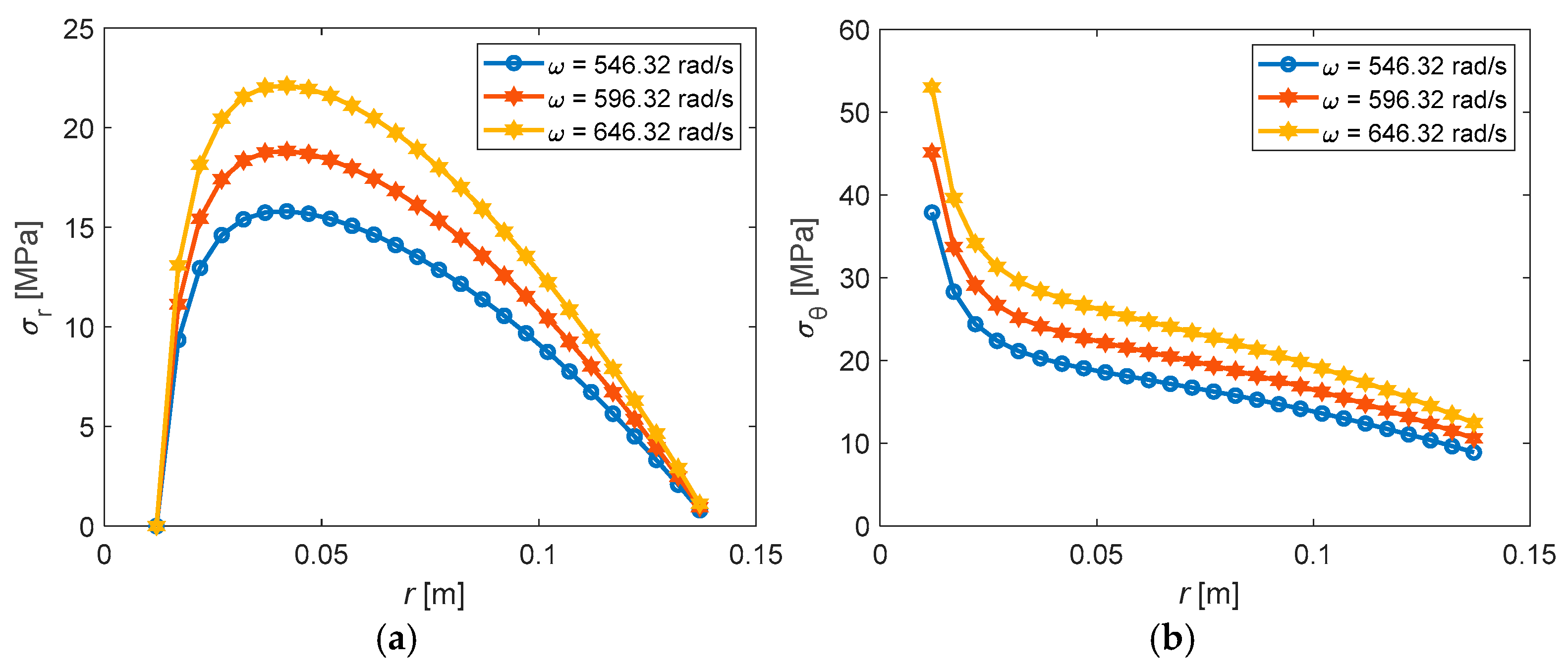
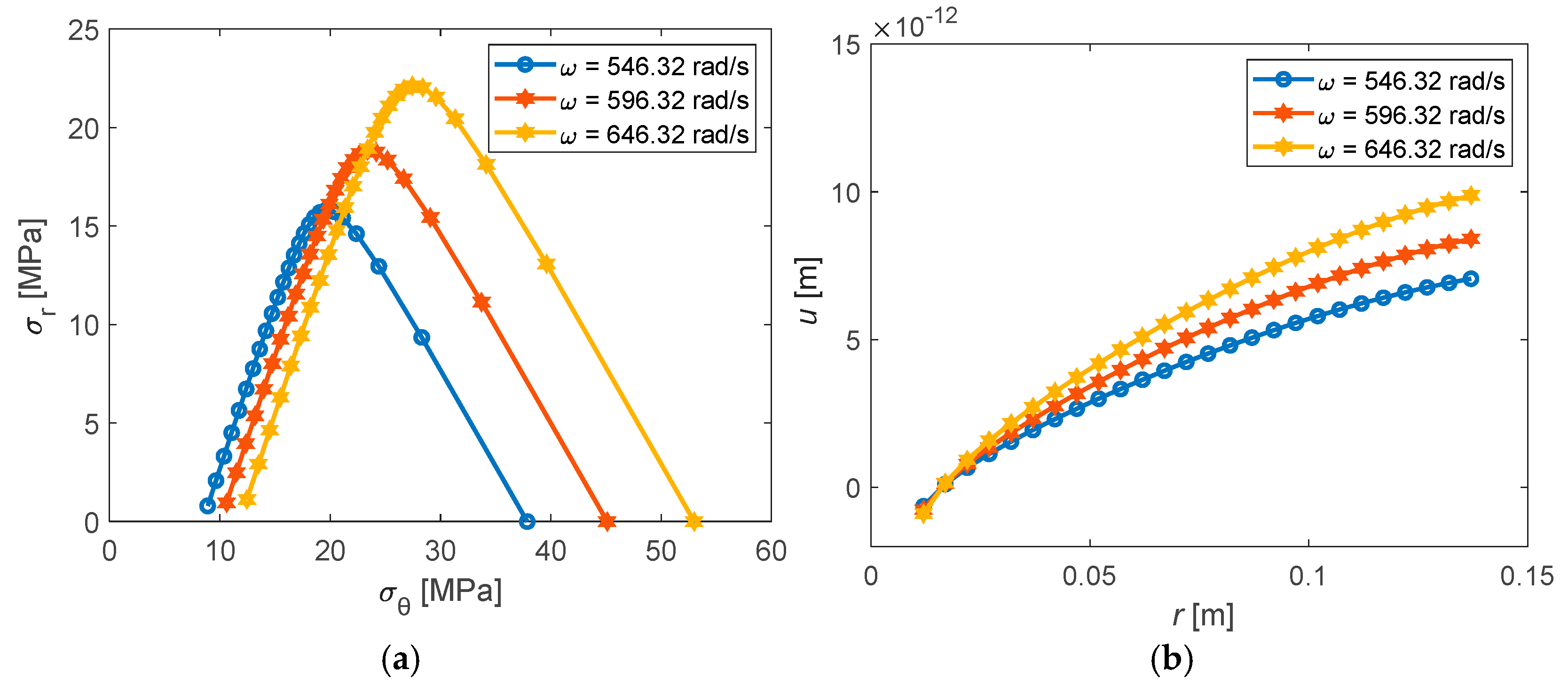
Figure 2a, through its radial distribution, highlights a stress trajectory that moves through at least one inflection point, deviating from monotonic behavior. It emanates off the inner radius up to a point of maximum at a mid-point and then drops steadily to the outer rim. This trend is an expression of the collective effect of centrifugal loading and the material constraints of the disc geometry. The greater the rotational speed, the stronger the radial stress at all positions and the higher the peak stress which moves a little outwards. This behavior shows the proportionality of the centrifugal term (ρω2r) to the square of the angular velocity and highlights the fact that radial stresses are highly sensitive to operational speed. Figure 2b shows that in the tangential stress, the profile is a decreasing one along the radius. The greatest values are found towards the inner edge and decreasing stresses towards the outer rim. This type of distribution is consistent with classical-type Lame solutions when the effect of circumferential constraints causes the hoop stresses to prevail along smaller radii. The parametric effect of rotational speed is also very clear in that greater angular velocities are accompanied by much higher tangential stresses throughout the disc, which is the user of the quadratic correlation between hoop stress and rotational speed. Figure 3a depicts that in the case of tangential–radial stress, the trend between the two is nonlinear. Radial stress rises to its peak at tangential stress, and then falls, even as tangential stress keeps on increasing. This behavior is a result of the sum of circumferential constraint force and centrifugal force at the flywheel. With increasing rotational velocities, the curves of stress would descend to higher values, and therefore the two components of stress would depend quadratically on the angular velocity. The fact that the stress spreads more at increased speeds implies that the redistribution is more intense with intense centrifugal loading. Figure 3b indicates that the radial displacement rises uniformly with the radius at all the rotational speeds. Instead, the profile takes the form of a smooth curve with the greatest frequency of deformation in the outer rim, which can be explained by the fact that centrifugal effects are strongest at a larger radius in rotating discs. The rotational speed increases, and the magnitudes of the displacements increase dramatically and suggest that the flywheel deformation is highly sensitive to the operating speed. The results validate the assumption that radial deformation, despite its small magnitude in terms of absolute values, is a significant contributor to overall stress condition formation and probable failure modes.

3. Finite Element Modeling and Modal Analysis of a Flywheel

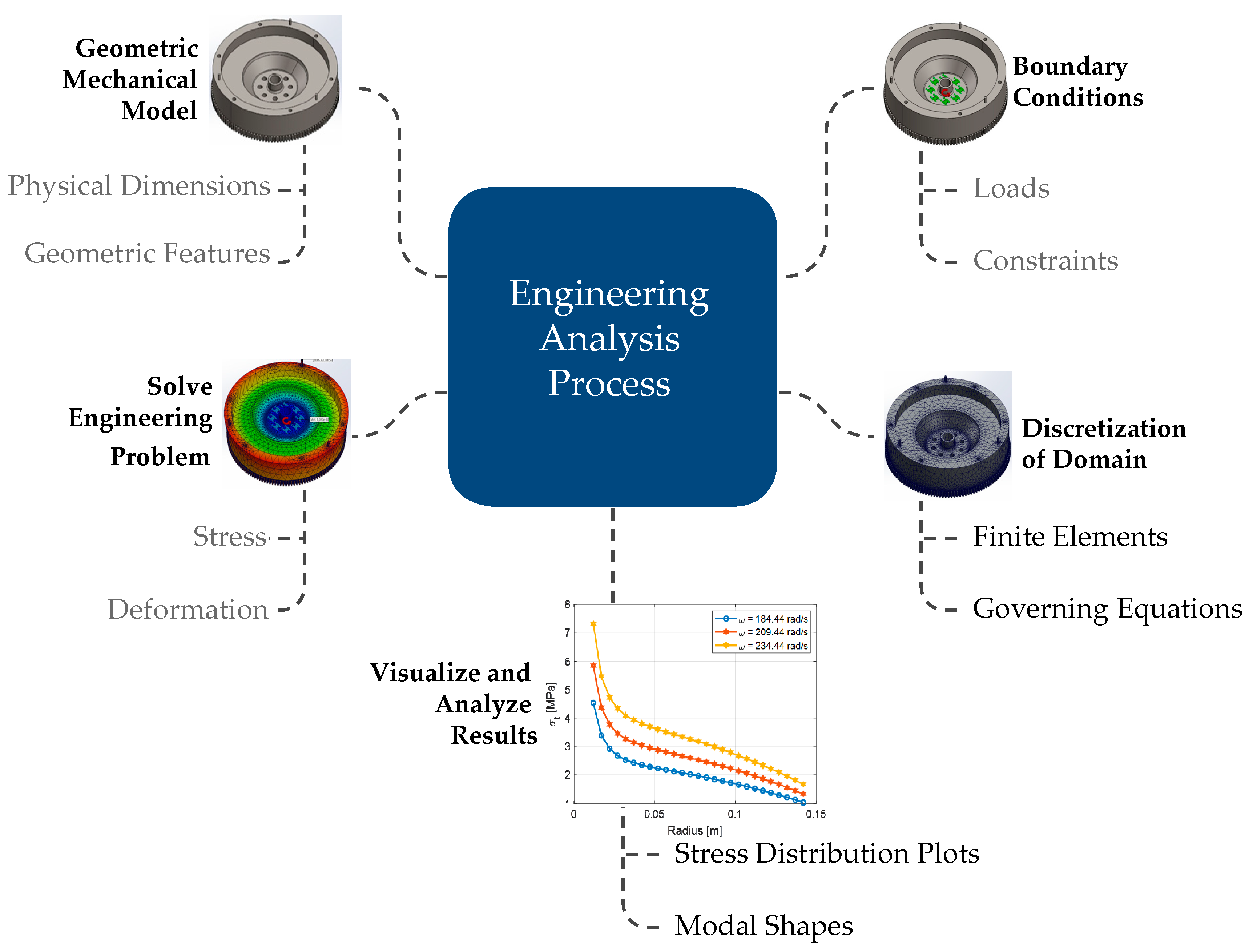
The FEA methodology offers a solid numerical model to assess the stress distribution and dynamic behavior of the flywheel where the limitations of the analytical formulations fail. Although the stress features are the main characteristics in the analytical model where idealized assumptions are made, the FEA model considers the real geometric features, boundary conditions and material heterogeneities that affect the structural responses of the flywheel. Figure 4 demonstrates the methodological flowchart that will be adopted when performing the FEA of the flywheel. It is designed in such a way that it would be systematic and model, simulate and interpret the results. The mechanical and geometric representation of the flywheel is formed as the first stage of the workflow, during which the size and characteristics of the physical aspects of the flywheel are formed. The step includes the rim, web and hub areas because they have a direct effect on the behavior of mass distribution and stress concentration. Boundary conditions are used to reproduce the real-world operational environment. The centrifugal body force defines loads and the hub constraint is taken to indicate the coupling interface with the shaft. During the discretization phase, the continuous flywheel space is subdivided into solid elements of a finite number. Each element is then governed by equations, which are then combined into a world system to be sure that geometry and material behavior are represented correctly. A blended mesh is use to provide a compromise between the cost of computation and precision of the solution as well as refining the mesh in areas that are likely to be sensitive to vibration. The solution stage will entail the use of a numerical solver to calculate deformation fields in the case of operational loading. The natural frequencies and mode shapes are also obtained through the process which is required to determine the risk of resonance. The stage of visualization and analysis transforms raw numerical data into understandable results. The modal shape charts give information on the pre-eminent distortions in each natural frequency.
Table 1 and Table 2 summarize the key inputs for the finite element model. The flywheel is modeled using carbon steel selected for its high stiffness, adequate strength and suitable ductility for rotational applications. The mesh employs a blended curvature-based approach refined in regions prone to high stress concentrations to ensure accurate representation of geometry and reliable deformation predictions.
In Table 3, the first four vibration modes appear with their corresponding normalized modal mass participation values. The values show how the structural mass contributes to each mode about three orthogonal directions. The first two modes show strong in-plane participation that reflects bending and in-plane deformation effects and the third mode presents a dominant out-of-plane response. The fourth mode combines multiple directional responses with smaller overall participation factors.
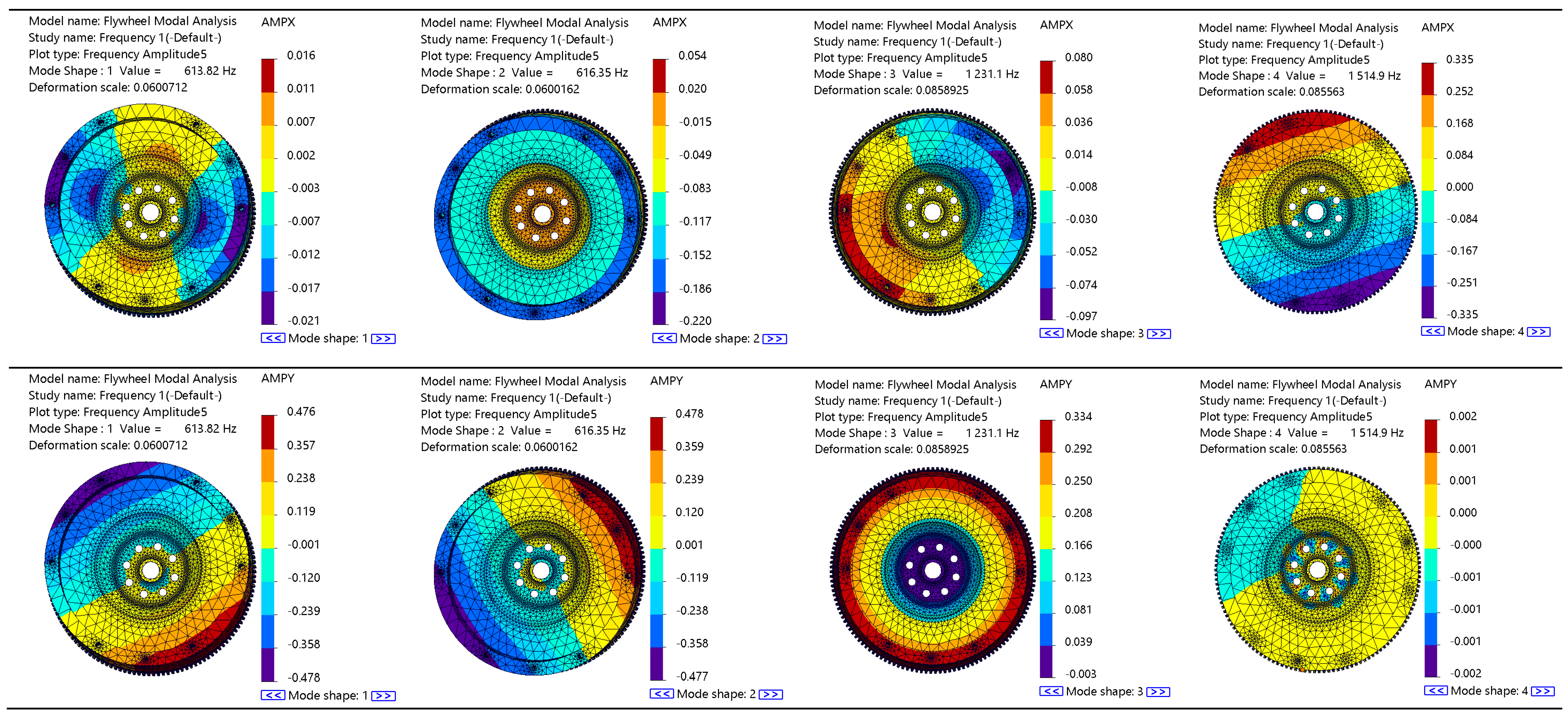
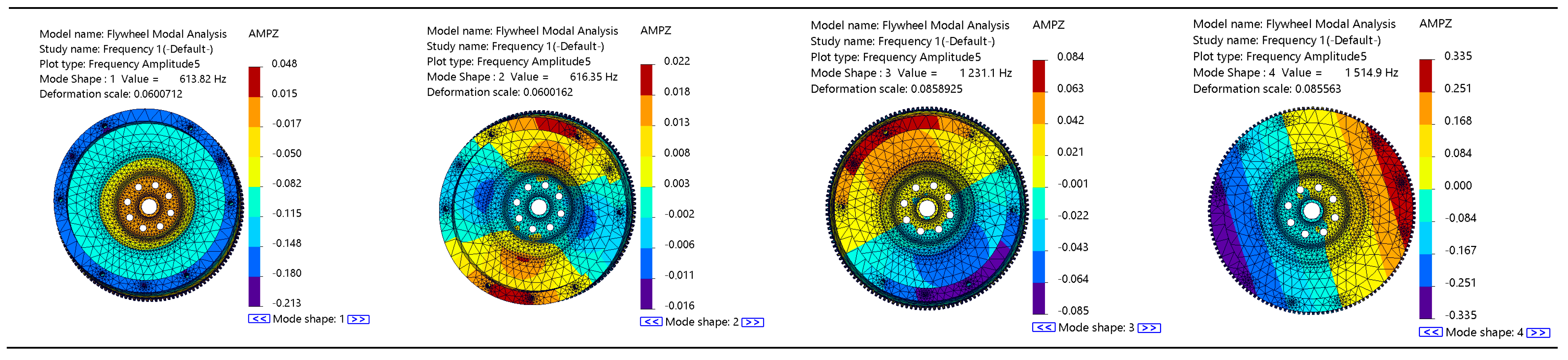
Figure 5 presents the vibration deformation modes of the flywheel at its first four natural frequencies. These frequencies are approximately 613.82 Hz, 616.35 Hz, 1231.1 Hz and 1514.9 Hz and are evaluated across the X-, Y- and Z-directions. In the X-direction shown in the first row, the first and second modes display simple in-plane bending with deformation amplitudes ranging from about 0.016 to 0.080. The Y-direction shown in the second row exhibits higher responses, with amplitudes reaching approximately 0.476 in the first mode and 0.478 in the second. The third mode in this direction shows stronger flexural behavior with an amplitude near 0.334. The Z-direction in the third row shows deformation amplitudes between 0.048 and 0.335, indicating the emergence of out-of-plane motion, more particularly in the third and fourth modes. Deformation evolves from basic in-plane bending at low frequencies to more complex radial, tangential and out-of-plane motions at higher modes. Larger amplitudes in the Y- and Z-directions at higher frequencies suggest more dynamic complexity. Identifying these deformation patterns and their associated frequencies is essential for preventing resonance and ensuring that the flywheel remains within a safe operating range.
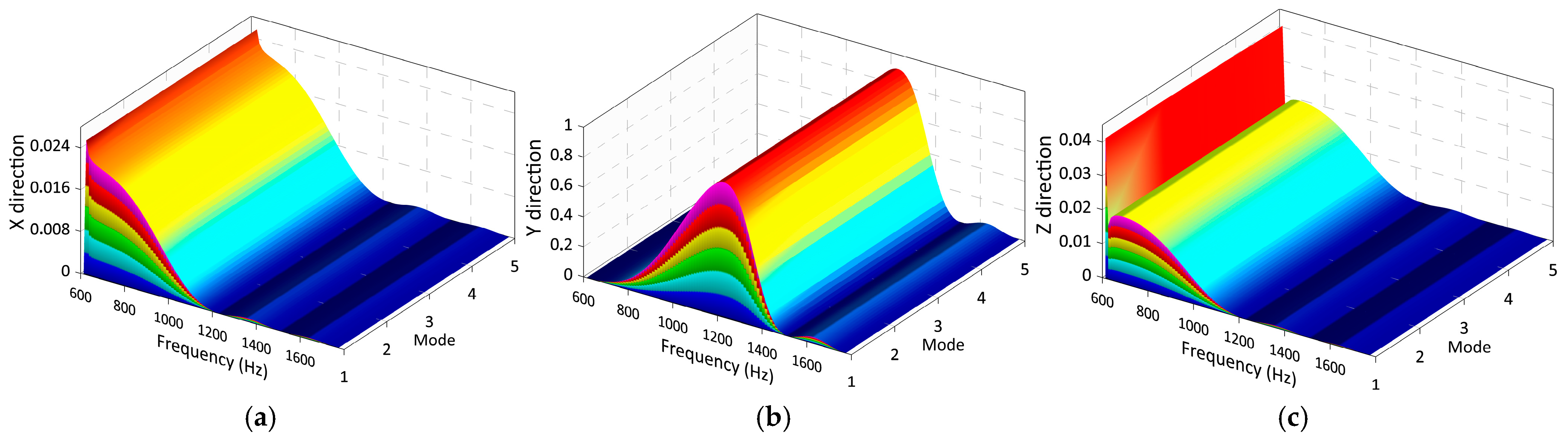
Figure 6 illustrates the waterfall response of the mass participation factor across the first four modes of the flywheel in the X-, Y-, and Z-directions. In the X-direction, the mass participation factor remains relatively low, with values peaking at around 0.0415 in the second mode near 616 Hz, while the first and higher modes contribute minimally as shown in Figure 6a. In Figure 6b, the participation in the Y-direction reaches its maximum at the third mode with a value near 0.904, indicating dominant dynamic action in that plane, especially around 1.231 Hz. The Z-direction presents lower contributions, with a pick at about 0.0413 in the first mode, and decrease gradually to higher frequencies, as illustrated in Figure 6c. The distribution reveals that motion along Y governs most of the dynamic behavior of the flywheel, and contributions from X and Z appear in specific modal bands. To ensure dynamic stability, it is essential to recognize these values and their associated frequencies to avoiding system resonance in order to refine the design.

4. Conclusions

This study integrated analytical formulations and finite element analysis was used to examine how stress fields and vibration responses evolve in flywheels operating near the linear elastic limit. Findings suggested that centrifugal loading together with geometric constraints and material properties produces uneven radial and hoop stress distributions that do not always follow the neat patterns usually expected. The outer rim appeared again as the most exposed region to potential failure, although small shifts in the stress gradient were occasionally observed. Natural frequencies and deformation modes indicated that vibration patterns along the Y-direction tended to dominate the system response and the modal analysis turned out to be a central tool for identifying resonance risks and enhancing operational safety. The results offer some direction for design optimization because they link material selection, geometry and operating conditions with the overall stress and vibration performance. Future study should move beyond the linear elastic limit to incorporate plasticity and time-dependent deformation, since creep and fatigue effects start forming as high-speed cyclic loading pushes the material near the edge of recoverable strain. Simulations in the multiphysics, thermal, electromagnetic, and structural fields are required to simulate flywheels more realistically in complicated conditions. Vibration control and structural safety can be enhanced further with the use of experimental validation through high-speed testing and the use of smart materials such as magnetorheological elastomers or composites.

Author Contributions

This study was a collaborative effort between multiple individuals. The topic was conceptualized and initially developed by K.K.L., D.F.S. and V.C.S.; methodology, K.K.L., D.F.S., V.C.S., B.X.T. and A.A.A.; software, D.F.S., B.X.T. and A.A.A.; formal analysis of the data was conducted by D.F.S.; the first version of the manuscript was prepared by K.K.L., D.F.S., V.C.S., B.X.T. and A.A.A.; the manuscript was reviewed and approved by all authors, including D.F.S., K.K.L., V.C.S., B.X.T. and A.A.A. It is also mentioned that the contributions of others were substantial, suggesting that other individuals were also involved in the study but not necessarily listed as authors. All authors have read and agreed to the published version of the manuscript.

Funding

This research received no external funding.

Institutional Review Board Statement

Not applicable.

Informed Consent Statement

Not applicable.

Data Availability Statement

The original contributions presented in the study are included in the article; further inquiries can be directed to the corresponding author.

Acknowledgments

This research study is supported by the Vaal University of Technology, Department of Industrial Engineering, Operations Management and Mechanical Engineering.

Conflicts of Interest

The authors declare no conflicts of interest.

Nomenclature

SymbolDescriptionUnit
rRadial coordinatem
R1, R2Inner and outer radii of the flywheelm
urRadial displacementm
σrrRadial stressPa
σθθHoop (circumferential) stressPa
εrrRadial strain
εθθHoop strain
EYoung’s modulusPa
νPoisson’s ratio
ρMaterial densityKg/m−3
ωAngular velocityRad/s
ωYCritical angular velocity at yieldingRad/s
σYYield strength of the materialPa
Φ(r,t)Stress perturbation function
Ψ(r,t)Displacement perturbation function
ηScaling factor for perturbation field
κPerturbation parameter in compatibility equation

References

  1. Li, G.; Ding, H.; Sun, M. Stress Distribution and Mechanical Modeling of Double-Layer Pipelines Coupled with Temperature Stress and Internal Pressure. Processes 2025, 13, 3193. [Google Scholar] [CrossRef]
  2. Ali, H.O.S.; Dedić, V.; Živković, J.; Todić, N.; Petrović, R. Application of the Finite Element Method in Stress and Strain Analysis of Spherical Tank for Fluid Storage. Symmetry 2025, 17, 1565. [Google Scholar] [CrossRef]
  3. Sozinando, D.F.; Leema, K.K.; Sigonde, V.C.; Tchomeni, B.X.; Alugongo, A.A. Stress Distribution and Transverse Vibration of Flywheel Within Linear Elastic Range. Vibration 2024, 7, 1248–1265. [Google Scholar] [CrossRef]
  4. Hu, D.; Dai, X.; Xie, B.; Li, W.; Yu, H.; Chen, H. Fatigue Life of Flywheel Energy Storage Rotors Composed of 30Cr2Ni4MoV Steel. Energies 2024, 17, 3730. [Google Scholar] [CrossRef]
  5. Kaup, P.S.; Kumar, S.; Kamath, N.; Mayya, S.; Kalluvalappi, G. Investigation of field dependent variations of torsional stiffness of magnetorheological elastomer. AIP Conf. Proc. 2024, 3060, 050007. [Google Scholar] [CrossRef]
  6. Rashid, M.M.; Salam, S.M. Controlling the Variable Inertia of Flywheel: A Scientific Review. Asian J. Electr. Electronic Eng. 2024, 4, 17–28. [Google Scholar] [CrossRef]
  7. Niu, H.; Zeng, L.; Wei, C.; Wan, Z. Electromagnetic Field and Variable Inertia Analysis of a Dual Mass Flywheel Based on Electromagnetic Control. Symmetry 2024, 16, 1234. [Google Scholar] [CrossRef]
  8. Wang, Y.; Wang, Z.; Lv, Y.; Liu, Y. Strength Analysis of Carbon Fiber Composite Flywheel Energy Storage Rotor Based on Progressive Damage Failure. Shock. Vib. 2024, 2024, 5587542. [Google Scholar] [CrossRef]
  9. Qu, W.; Wang, Z.; Song, S.; Teng, W.; Liu, Y. Simulation analysis of multi-ring interference assembly of large capacity composite flywheel rotor. Adv. Mech. Eng. 2024, 16, 16878132241254769. [Google Scholar] [CrossRef]
  10. Zhang, W.; Wang, J.; Li, A.; Xiang, Q. Multiphysics fields analysis and optimization design of a novel saucer-shaped magnetic suspension flywheel battery. IEEE Trans. Transp. Electrif. 2023, 10, 5473–5483. [Google Scholar] [CrossRef]
  11. Sun, M.; Xu, Y.; Zhang, W. Multiphysics analysis of flywheel energy storage system based on cup winding permanent magnet synchronous machine. IEEE Trans. Energy Convers. 2023, 38, 2684–2694. [Google Scholar] [CrossRef]
  12. Zhang, H.; Liu, Y.; Teng, W.; Song, S.; Wang, Y. Dynamic characteristics analysis of energy storage flywheel motor rotor with air-gap eccentricity fault. J. Energy Storage 2024, 89, 111684. [Google Scholar] [CrossRef]
  13. Tchomeni Kouejou, B.X.; Sozinando, D.F.; Anyika Alugongo, A. Modeling and Analysis of Drill String–Casing Collision under the Influence of Inviscid Fluid Forces. Appl. Sci. 2023, 13, 3557. [Google Scholar] [CrossRef]
  14. He, X.; Wang, S.; Zheng, Z.; Huang, X.; Wei, X.; Wang, Y.; Hua, H. Numerical and experimental investigations on a friction ring damper for a flywheel. Nonlinear Dyn. 2023, 111, 2327–2351. [Google Scholar] [CrossRef]
  15. Chen, C.; Deng, Z.; Wang, H.; He, T. Simulation of friction fault of lightly loaded flywheel bearing cage and its fault characteristics. Sensors 2022, 22, 8346. [Google Scholar] [CrossRef] [PubMed]
  16. Chu, W.; Wang, Y.Q. Three-dimensional vibration suppression of flexible beams via flywheel assembly. Aerosp. Sci. Technol. 2024, 151, 109251. [Google Scholar] [CrossRef]
  17. Lin, C.S.; Lin, G.L. Application of electromagnetic tuned mass damper with flywheels for controlling building structure vibration. Earthq. Eng. Struct. Dyn. 2023, 52, 3788–3810. [Google Scholar] [CrossRef]
  18. Zhang, W.; Cui, J. Dynamic performance analysis and control parameter adjustment algorithm for flywheel batteries considering vehicle direct action. Energies 2023, 16, 5882. [Google Scholar] [CrossRef]
  19. Zhang, T.; Cao, H.; Zhang, Z.; Kong, W.; Kong, L.; Liu, J.; Yan, J. A variable damping vibration energy harvester based on Half-Wave flywheeling effect for freight railways. Mech. Syst. Signal Process. 2023, 200, 110611. [Google Scholar] [CrossRef]
  20. Zhao, Y.; Liu, P.; Lv, Q.; Zhang, K.; Zhao, L. Stability Assessment of the High-Speed Flywheel with AMBs on a Rotating Platform. Energies 2024, 17, 2746. [Google Scholar] [CrossRef]
  21. Zhang, D.; Wu, D.; Han, Q.; Wang, H. Dynamic force transmissibility of flywheel rotor systems supported by angular contact ball bearings considering clearance fit. Eur. J. Mech.-A/Solids 2022, 92, 104457. [Google Scholar] [CrossRef]
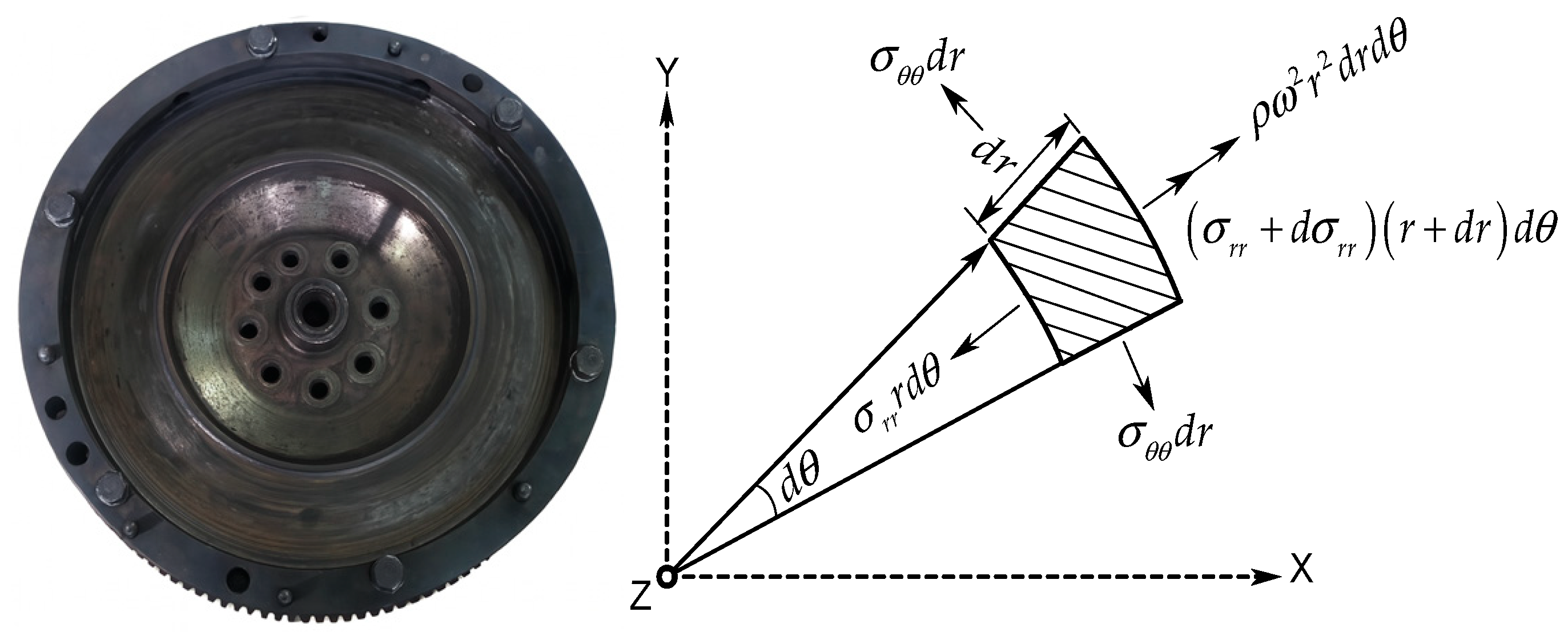
Figure 1. Physical system of rotating flywheel and its element.
Engproc 132 00004 g001
Figure 2. Variation in stresses across the flywheel: (a) radial stress; (b) hoop stress.
Engproc 132 00004 g002
Figure 3. Stress interaction and deformation in the flywheel: (a) tangential vs. radial stress variation; (b) radial displacement profile.
Engproc 132 00004 g003
Figure 4. Methodological flowchart for finite element analysis simulation.
Engproc 132 00004 g004
Figure 5. Vibration deformation modes of the structure under dynamic excitation.
Engproc 132 00004 g005aEngproc 132 00004 g005b
Figure 6. Waterfall response of mass participation factor: (a) X-direction; (b) Y-direction; (c) Z-direction.
Engproc 132 00004 g006
Table 1. Material properties of the FEA model.
MaterialYoung’s Modulus (GPa)Yield Strength (MPa)Density (kg/m3)Poisson’s Ratio
1023 Carbon Steel20528378580.29
Table 2. Meshing information of the FEA.
Mesh typeSolid mesh
Mesher typeBlended curvature-based mesh
High-quality mesh based on Jacobian points16 points
Maximum element size24.9591 mm
Minimum element size1.24796 mm
Maximum aspect ratio90.431
% of elements with aspect ratio < 398.6
% of elements with aspect ratio > 100.0609
Quality of meshHigh
Table 3. Normalized modal mass participation.
Mode NumberFrequency (Hz)X-DirectionY-DirectionZ-Direction
1613.827.66 × 10−52.07 × 10−60.041347
2616.350.0415471.60 × 10−67.72 × 10⁻⁵
31231.11.78 × 10−70.904353.77 × 10−7
41514.93.93 × 10−75.24 × 10−92.27 × 10−7
Disclaimer/Publisher’s Note: The statements, opinions and data contained in all publications are solely those of the individual author(s) and contributor(s) and not of MDPI and/or the editor(s). MDPI and/or the editor(s) disclaim responsibility for any injury to people or property resulting from any ideas, methods, instructions or products referred to in the content.