Proceeding Paper

Multiaxial Static and Fatigue Strength of LPBF-Manufactured AlSi10Mg in as-Built and T6 Conditions †

by
Francesco Lombardi
1,
Alessandro Pirondi
2,*,
Francesco Musiari
2 and
Federico Uriati
3
1
Department of Engineering “Enzo Ferrari”, University of Modena and Reggio Emilia, via Pietro Vivarelli 10, 41125 Modena, Italy
2
Department of Engineering for Industrial Systems and Technologies, University of Parma, Parco Area delle Scienze 181/A, 43124 Parma, Italy
3
BEAMIT, Strada Prinzera 17, 43045 Fornovo di Taro, Italy
*
Author to whom correspondence should be addressed.
Presented at the 54th Conference of the Italian Scientific Society of Mechanical Engineering Design (AIAS 2025), Florence, Italy, 3–6 September 2025.
Eng. Proc. 2026, 131(1), 24; https://doi.org/10.3390/engproc2026131024
Published: 31 March 2026

Abstract

Laser powder bed fusion (LPBF) technology has now reached a significant level of commercial maturity, offering some of the most reliable solutions in the additive manufacturing (AM) field. However, AM processes may introduce defects that result in high variability of mechanical properties and low reproducibility. This entails the need to thoroughly understand the behavior of the materials used, studying their response to the different types of stresses typical of real-world applications. The research activity presented consists of the analysis of the mechanical properties of the aluminum alloy AlSi10Mg, which is widely used due to its good strength-to-density ratio. Focus is put on the response to axial, torsional, and combined axial-torsional static and fatigue strength, comparing as-built T6 heat-treated conditions.

1. Introduction

The additive manufacturing (AM) process presents several advantages over the traditional subtractive manufacturing (SM), i.e., little material waste, complex geometries impossible or impractical to produce by SM and material properties grading or multimaterial fabrication without joining. From the supply chain standpoint, AM enables a make-to-order instead of make-to-stock fabrication, at least for parts in small numbers. These advantages have, therefore, made the AM process popular in many fields.
The use of AM to manufacture structural parts also subjected to fatigue loading, like SM counterparts, means that the assessment and understanding of AM metals becomes a fundamental step in part design. Mechanical properties, and among them fatigue strength, have been quite extensively studied in the literature; see, for example, the review paper [1].
However, in several cases, fatigue loading is multiaxial, either because a geometric feature induces a multiaxial stress state locally even if the loading is uniaxial or because there are multiple sources of loading, possibly also not synchronous and not in phase. Different from uniaxial fatigue (UF), multiaxial fatigue (MF) of AM metals has not yet been extensively studied. The first paper retrieved on this subject dates back to 2017 [2], which investigated the MF of a Ti-6Al-4V alloy made by PBF, comparing it with a wrought Ti-6Al-4V under axial, torsion, in-phase, and 90° out-of-phase axial-torsion loading. The surface roughness influence was also examined by considering both as-built and polished surfaces. Brittle fracture was detected for all loading conditions in the case of AM, with failure occurring on the maximum tensile plane. On the other hand, wrought specimens observed ductile fracture with shear failure as expected. Therefore, the correlation of fatigue results under the various loading conditions required the use of a shear-based critical plane (CP) model for the wrought alloy and the maximum principal stress criterion for the AM one, respectively. Some of the authors of [2] extended that study, looking for the effect of hot isostatic pressing (HIP) post-treatment for AM specimens and comparing it with annealed specimens [3]. A major outcome was that the AM annealed specimens (with a machined surface) experienced shear failure in the Low-Cycle Fatigue (LCF) regime, which changed to tensile at longer lives (High-Cycle Fatigue, HCF), indicating a dominant effect of internal defects in HCF. The HIPped specimens instead exhibited shear failure irrespective of the regime, due to improved ductility. Working on the same material and treatment conditions (annealed and HIPped), Ref. [4] investigated the surface roughness effect on uniaxial and multiaxial fatigue behavior. A life prediction model based on fracture mechanics using the maximum valley depth of the surface roughness profile as the crack length gave a good correlation of the results under different loading and surface conditions. The investigation done in [5] using IR thermography to control the fatigue failure initiation and evolution in Ti-6Al-4V specimens manufactured by Selective Laser Melting (SLM) highlighted that failure occurs close to the maximum shear plane for short cracks and to the maximum tensile stress direction for long cracks, respectively. An investigation on the effect of HIP and surface roughness, similarly to [3,4], was done in [6] on 17-4PH stainless steel. Fatigue cracks initiated in shear in the wrought and AM-machined un-HIPed and HIPed specimens. However, the crack deflected to mode-I in the HCF regime in the case of un-HIPped specimens, depending on the stress state and the applied stress level. In the case of the as-built specimen (vertical build direction), the network of surface defects resulting from the manufacturing process controlled the cracking orientation, regardless of the loading condition. The presence in AM parts of defects such as gas porosities and lack of fusion that are critical for fatigue was assessed in [7] for Ti-6Al-4V and 17-4PH, both in the annealed condition. A fracture mechanics (FM) framework was defined for crack growth under Mode I (tensile), Mode II (shear), or mixed-mode I/II. The FM lifetime prediction was in substantial agreement with the experimental data, confirming the major role of AM defects in determining the fatigue life. The size and shape of AM defects were evaluated by CT (computed tomography) in [8] in order to assess them as stress raisers in UF and MF of 316 L stainless steel. Stress concentration, evaluated using von Mises equivalent stress, was found to be higher in tension than in torsion and for non-proportional vs. proportional axial-torsional fatigue. The work done in [2,3,4,5,6,7] was extended in [9,10,11] to the effect of the presence of a notch. Some important conclusions could be drawn that are: (i) parts built with optimized process parameters and machined/polished surface (few defects) are proportionally more affected by the notch than their non-optimized or machined counterparts, where process defects and inherent AM surface roughness hinder the notch influence; (ii) under optimized process and surface conditions, the presence of a notch however hinders the influence of internal manufacturing defects, making notch effect similar to that of wrought alloy; and (iii) an AM notch yields a higher effect with respect to a machined one since it enable a synergy between notch and surface defects. In [11], Variable Amplitude (VA) multiaxial loading was introduced, and experimental data were correlated using both a crack initiation approach with a critical plane-based model and a crack growth approach with a fracture mechanics-based model. In the case of Ti-6Al-4V, FM worked better than CP, confirming the major role of defects, while for 17-4PH (only axial loading), CP and FM gave similar results except at the lowest stress level shown, where FM was closer to the experiments. As shown in [12], the failure of AM components is frequently initiated by tensile stresses acting on the surface. In situations where the loads are in phase with fixed principal directions, criteria based on principal stresses, and, in particular, on the maximum stress amplitude, tend to correlate very well with experimental data. This work laid the basis also for [13], where the effect of surface texture/defects was evaluated in terms of reduction in endurance limit due to the micro-notch effect; this latter was in turn evaluated starting from surface roughness statistical distribution parameters. The approach was applied to three different MF models, namely the Fatemi–Socie critical plane (FS), von Mises equivalent stress (vM), and maximum principal stress (MPS), where the first and the last gave a good correlation of experimental data under various loading conditions. Wire Arc AM (WAAM) 308L stainless steel was tested in [14] under axial, torsional, and axial–torsional multiaxial loadings for comparison with hot-rolled 308. Though WAAM 308L SS exhibited a distinct cyclic deformation, fatigue life, cracking mode, and fatigue failure mechanisms compared to hot-rolled material, fatigue life data of both manufacturing technologies could be effectively correlated using the Chen-Xu-Huang (CXH) critical plane criterion. All the references examined previously dealt with Ti-6Al-4V or stainless steel; none took into account AlSi10Mg, a very common AM alloy for lightweight components. One paper was retrieved on multiaxial fatigue of this alloy [15] that checked the correlation of four different failure criteria, namely Quadratic Critical Plane (QCP), Liu-Zenner, Dang Van, and Crossland, with fatigue experiments. The use of the QCP and Liu-Zenner criteria provides overall better results than the Dang Van and Crossland ones, but none of the four fit well with the two different multiaxial loading combinations tested.
Given the limited literature on MF of AM alloys, practically non-existent on AlSi10Mg, which does not allow for drawing definitive conclusions about failure modes and optimal failure criteria, the primary objective of this work is the characterization of the multiaxial static and fatigue behavior of AlSi10Mg. The MF test has been done by an application of axial, torsional and in-phase (IP) axial-torsional loads since, for this material, it was shown in [15] to yield lower durations than the out-of-phase (OP) case. However, OP loading is planned for future activities. A specimen geometry was devised for torsional and multiaxial tests, taking inspiration from [16]. A very common AM fabrication process of metallic parts is Powder Bed Fusion (PBF), where the powder layer is melted in selected regions using either a laser beam (L-PBF) or an electron beam (E-beam PBF). Therefore, specimens were built in the vertical direction using L-PBF; other build directions were also considered only in the case of static tensile tests to assess the possible induced anisotropy. The results were examined in terms of failure mode for the different loading conditions, and it turned out that the MPS effectively grouped together all the conditions tested.

2. Material and Methods

2.1. Material

AlSi10Mg is a cast alloy belonging to the 4XXX series, the one composed mainly of aluminum and silicon. It is characterized by excellent castability, which makes it easier to be manufactured by additive processes. Its melting point is lower with respect to ferrous materials, and this leads to a reduction in the laser power needed to melt the powder, meaning more energy savings. The typical chemical composition of the alloy is illustrated in Table 1.
Usually, parts made of AlSi10Mg are heat-treated in order to obtain the desired mechanical properties using, for instance, a T6 treatment, which consists of solution annealing, quenching, and age hardening. In this work, the static and fatigue strength of AlSi10Mg has been evaluated for both the as-built and T6 heat-treated conditions. This latter is characterized by the following steps:
(1)
Solution heat treatment, which dissolves the eutectic Si network and homogenizes the microstructure.
(2)
Quenching, which retains solute elements in a supersaturated state, maintaining a metastable structure.
(3)
Artificial aging, which facilitates the controlled precipitation of strengthening phases, enhancing mechanical properties.

2.2. Quasi-Static Tensile Test

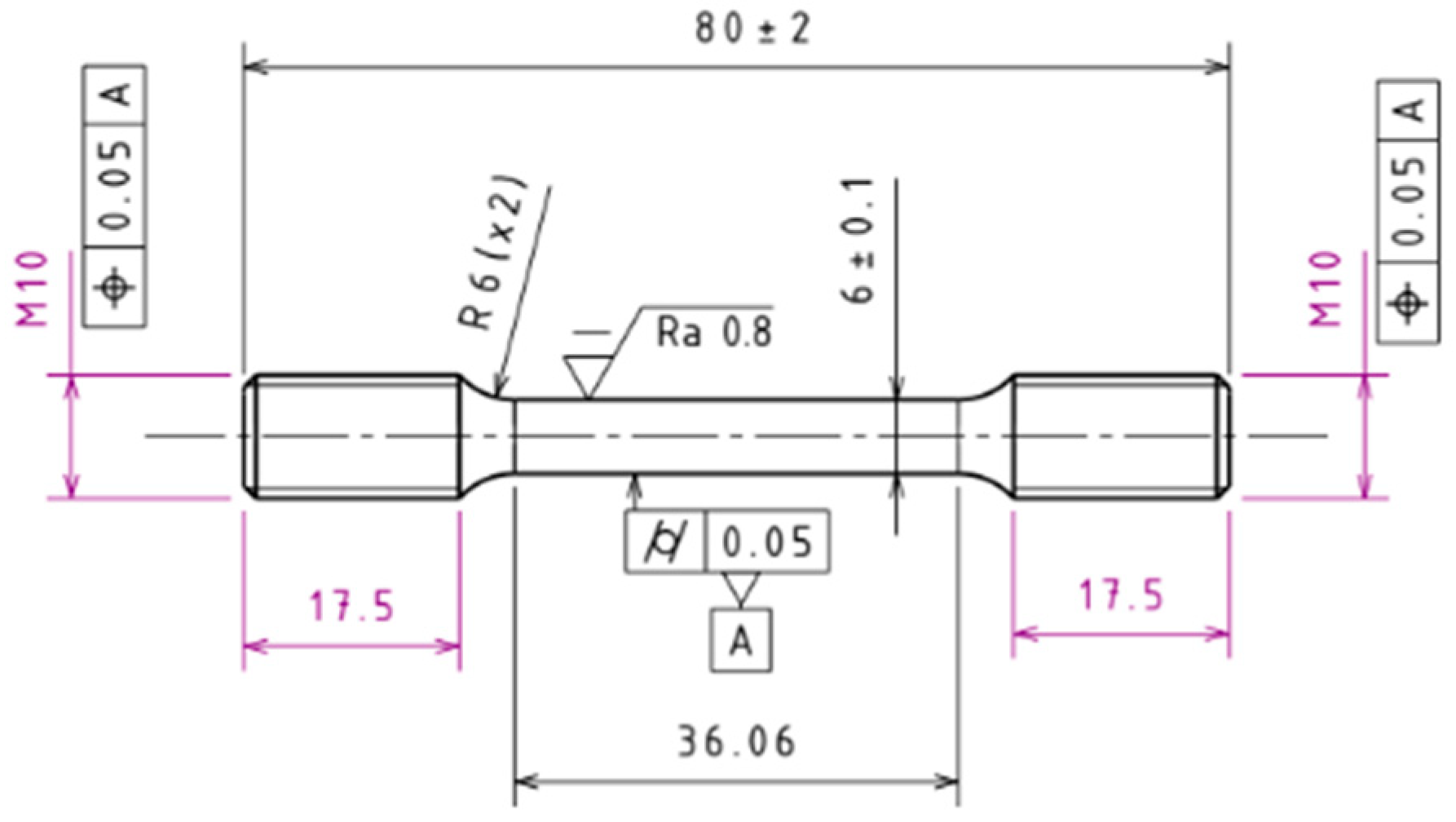
The test is conducted in compliance with the ASTM E8/E8M standard [17] on a ZwickRoell Z100 ProLine machine (ZwickRoell, Ulm, Germany) available at Beam-IT headquarters. Load is recorded via a load cell rated for 100 kN. The test is done at room temperature. The specimen for static tensile testing has been realized in compliance with the international ISO 6892-1 standard [18] regarding the tensile testing of metallic materials at room temperature. The technical drawing of Figure 1 shows all the specimen’s dimensions. Specimens have been machined out of cylinders printed in vertical (Z), horizontal (XY), and at a 45° inclination with respect to the printer platform, in order to test the effect of orientation on tensile behavior. Surface finishing and machining tolerances are therefore specified in Figure 1. Six repetitions were made for each orientation.

2.3. Tensile Fatigue Test

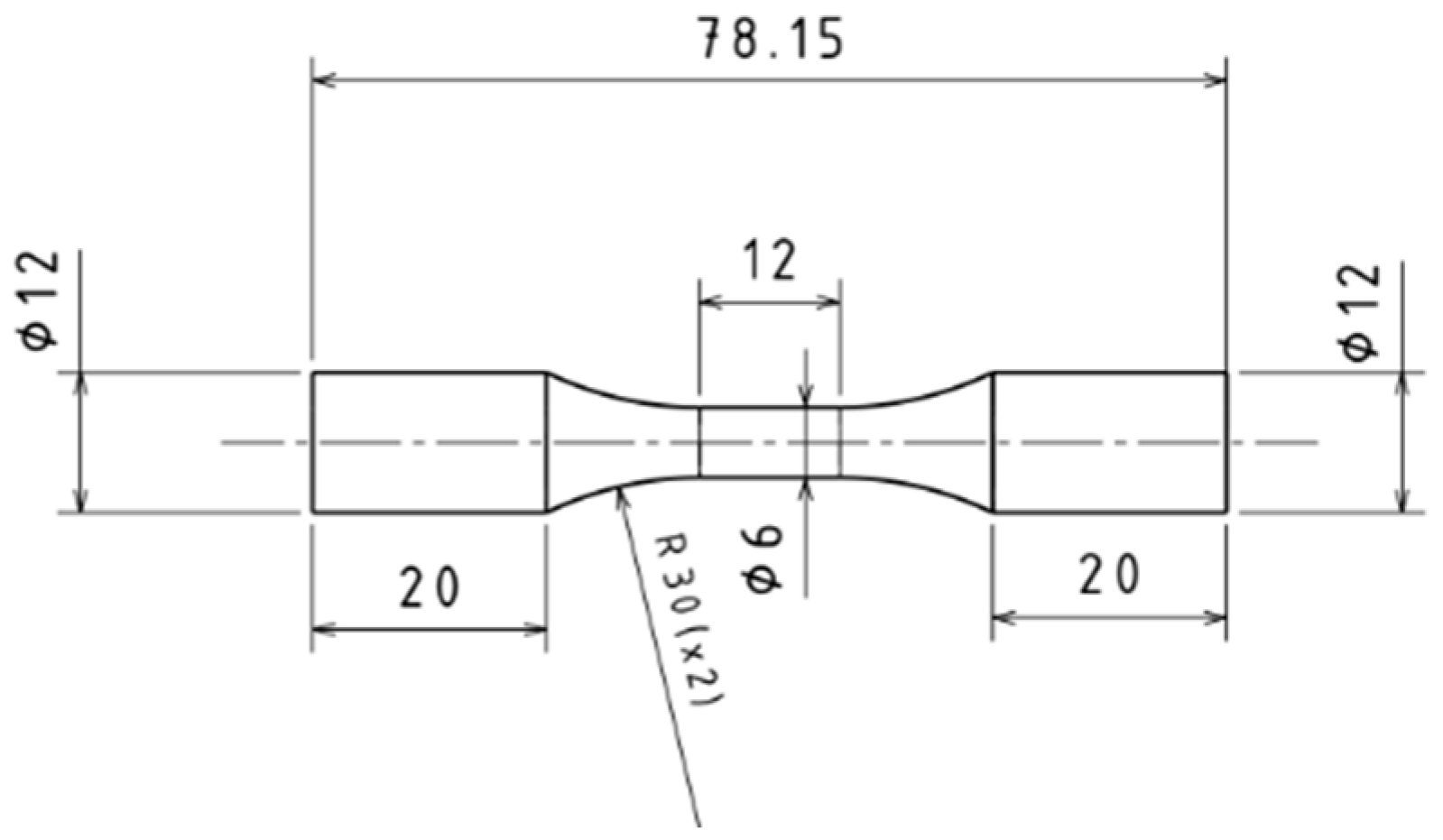
Tests were performed at the University of Parma on a STEP-Lab UD020 axial–torsional electrodynamic machine (Step Engineering, Resana, italy) delivering a maximum force of 20 kN and a torque up to 140 Nm. The specimen for tensile fatigue testing has been realized in compliance with the international ISO 1099 standard [19] for axial force-controlled fatigue testing of metallic materials. The dimensions (illustrated in Figure 2) are the minimum allowed in order to save material powder and to reduce the manufacturing time and cost. The specimen has been printed in the vertical direction, and the surface has been left in the as-built condition (no need for supports for the fillet region).
An alternate symmetric load cycle (i.e., load ratio R = −1, cyclic stress mean value σm = 0) was imposed, having a stress amplitude
σ a = F m a x A
where Fmax is the maximum load of the cycle, and A is the gauge section of the specimen. For the evaluation of the S/N curve in the finite life region, multiple stress levels must be chosen, and more than one specimen shall be tested at each level to increase the replication percentage, as prescribed by the standard ASTM E739 [20]. The number of specimens employed in this case was 8 (2 specimens × 4 levels), which corresponds to the minimum prescribed. The endurance limit has been determined with the reduced staircase method, which was tested (often referred to as the up-and-down method (7 specimens minimum)) at an imposed runout of 5 × 10⁶ cycles to speed up testing.

2.4. Quasi-Static Torsion, Torsional, and Multiaxial Fatigue Tests

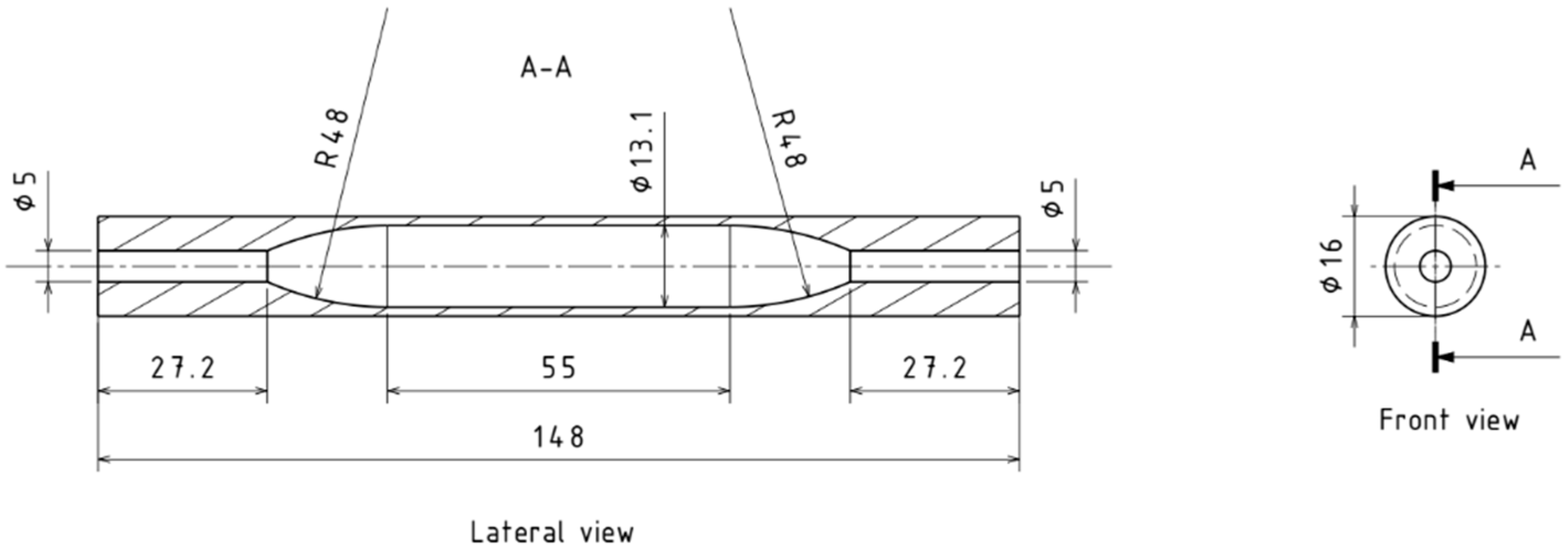
Tests were performed on the same axial-torsional electrodynamic machine used for axial fatigue. To simplify the manufacturing and set-up of the testing machine, a common geometry was adopted for both multi-axial and torsion fatigue specimens. For the dimensioning of the specimen, the maximum diameter that could be gripped by the testing machine grips (16 mm) had to be taken into consideration. With this premise, in our case, the ASTM E2207 standard [21] for multiaxial fatigue allowed for a test section thickness of 1.266 mm. Looking at the torsion test standard ASTM E143 [22], it indicates, for tubular specimens, a gauge length of at least four times the external diameter and a free length between the grip ends equal to the gauge length plus two to four external diameters. The final geometry chosen (let us call it “inner hourglass”) was adapted from [16] and is depicted in Figure 3. This geometry allowed, as validated by a Finite Element Analysis (FEA, not illustrated in this work for the sake of conciseness), a lower stress gradient in the radial direction with respect to the ASTM E2207 one (“outer hourglass”), maximizing the stress-gradient effect on fatigue strength. The grip ends were made as short as possible to lower the height of the print job (these specimens are built vertically), while the transition radius was chosen to be as high as possible to reduce the stress concentration.
As far as the quasi-static torsion test is concerned, six repetitions were done for statistics. The shear stress was evaluated as the value on the outer surface of the specimen, i.e.,
τ = T W p
where T is the applied torque, and Wp is the torsional strength modulus of the specimen cross-section. The shear strain could not be evaluated in the absence of a torsional clip-gage.
Torsional and multiaxial fatigue tests were performed following the same methodology as the tensile one, described in Section 2.3. In this case, the shear stress amplitude is
τ a = T m a x W p
and Tmax is the maximum torque of the cycle. The ratio τ a / σ a has been kept equal to 0.575 for all the test levels from finite life to endurance limit regions.

3. Results and Discussion

3.1. Quasi-Static Strength

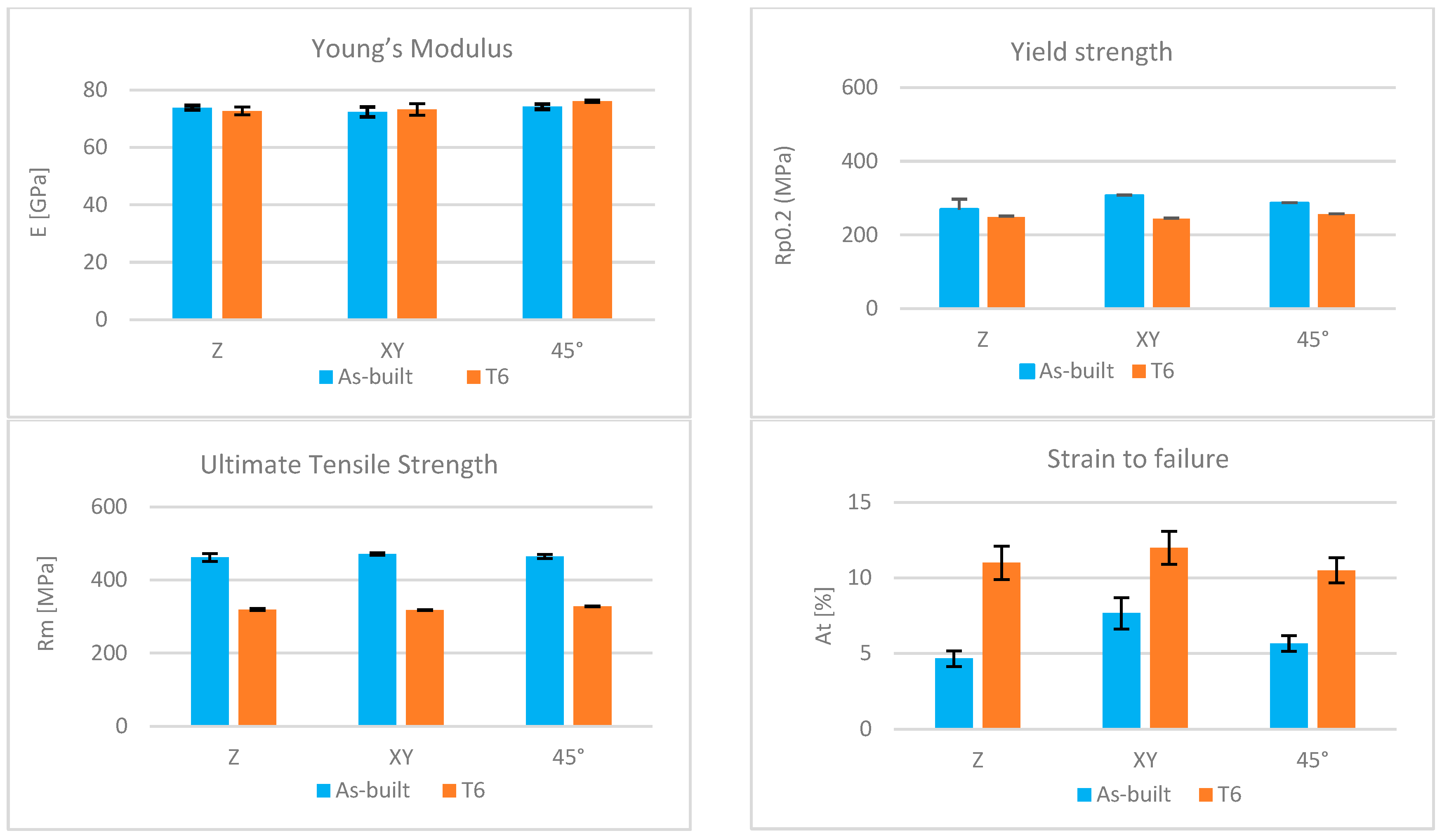
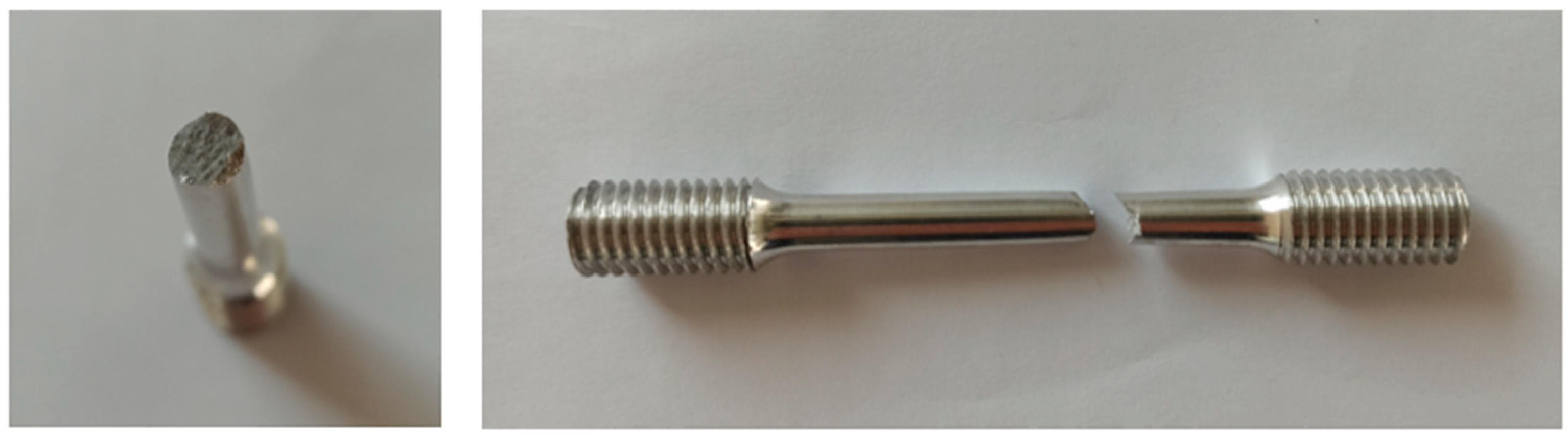
The results of the static tensile tests are visualized through histograms with error bars for an easier comparison of the three specimen build orientations (Z, XY, and 45°) evaluated, and, at the same time, the effect of the heat treatment. All the diagrams are grouped in Figure 4. The Young’s modulus, E, is around 70 GPa in any case, as expected for the type of alloy tested, and it is substantially unaffected by build orientation and heat treatment. On the other hand, both the yield, Rp0.2, and ultimate strength, Rm, are substantially affected by the heat treatment but quite indifferent to the build orientation. In particular, the T6 treatment softens the material due to aging; conversely, it greatly increases the ductility in terms of strain-to-failure. The picture of the overall failure mode in Figure 5 is consistent with a ductile failure with surface kinking towards the maximum shear stress direction.
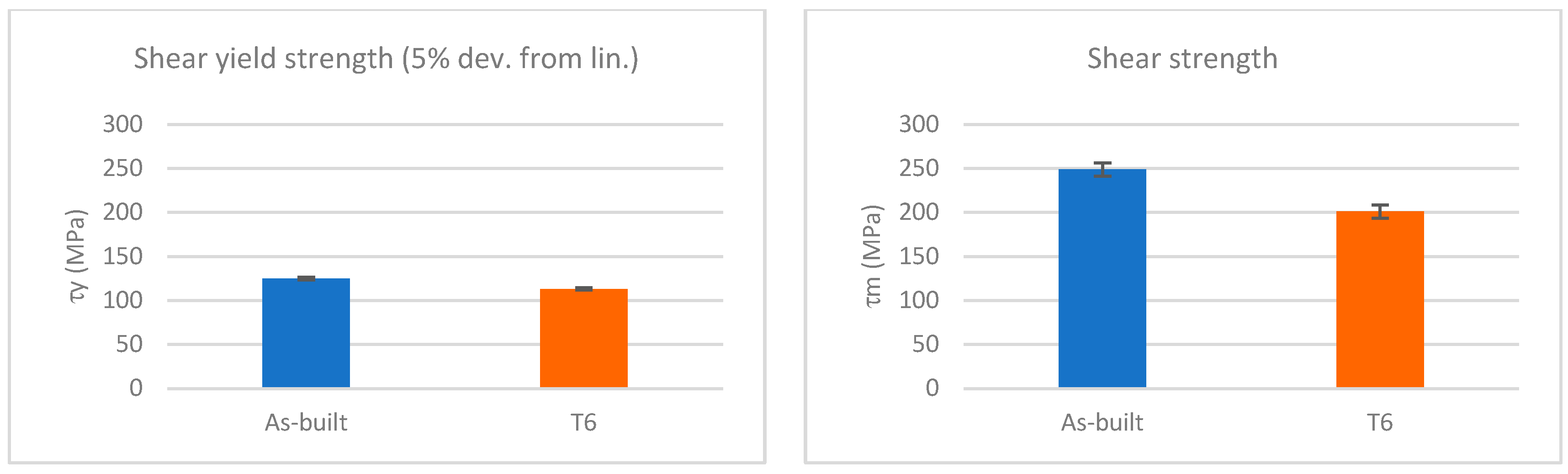
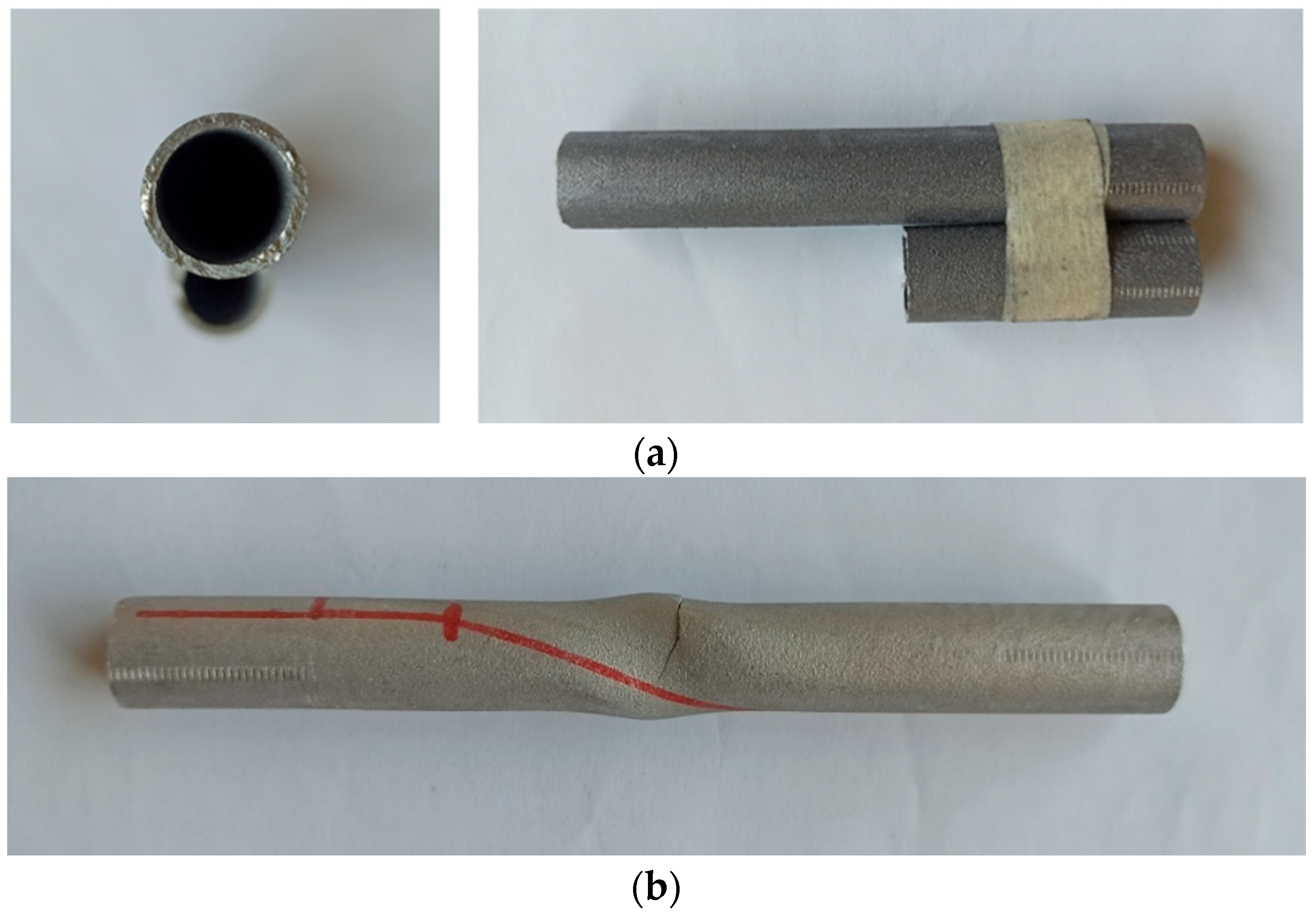
Concerning torsion, the results are not much different qualitatively from those of tensile tests, i.e., the T6 treatment decreases strength and increases ductility; see Figure 6. The comparison is limited in this case to yield and torsional strength, since the rotation angle was not evaluated on the specimen, and, therefore, the shear modulus could not be estimated correctly. For the same reason, the shear yield strength was evaluated as the stress at 5% of deviation from linearity. The shear strength in the case of T6 treatment did not correspond to a separation into two halves of the specimen but rather to an elastoplastic buckling, which did not occur in the case of the stronger and less ductile as-built condition; see Figure 7. It has to be remarked that the torsion specimens have been built in the vertical direction only, so the effect of the build orientation was not evaluated.
The ratio Rp0.2y ranges from 2.15 to 2.20 depending on heat treatment, while Rmm is a bit lower (1.59–1.85). Nevertheless, these values are in a range that can be expected for a ductile material, i.e., 2 according to the Tresca criterion, √3 = 1.732 according to von Mises.

3.2. Fatigue Strength

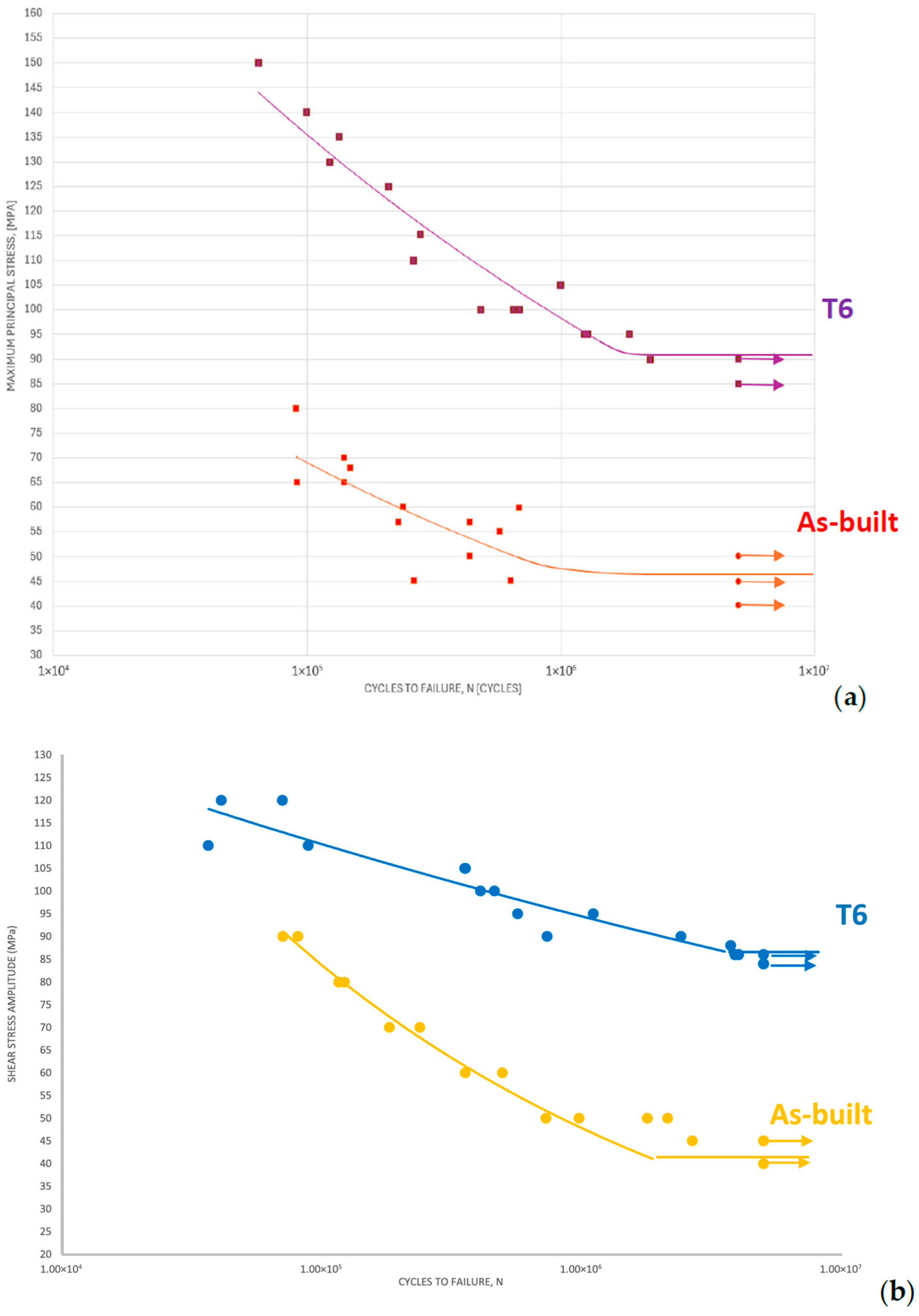
The results for axial and torsional fatigue are presented and analyzed in Figure 8. First of all, it is evident that the ranking of static strength, i.e., as-built stronger than T6, is completely reversed: now T6 outperforms as-built by about a factor of 2 on endurance limit, thanks to the more ductile behavior that delays crack initiation and propagation. On the other hand, a great sensitivity to fatigue is shown by the as-built condition, with the tensile endurance limit being about 1/10 of tensile strength (1/6 for the corresponding torsion values), though it has been noted that surface finish was not done on specimens.
Another remarkable finding is that the endurance limits in tension and torsion are close to each other, with the average values in torsion 5–10% lower than the tensile ones, a much different outcome with respect to static tests, where tensile values were close to twice the torsion ones.
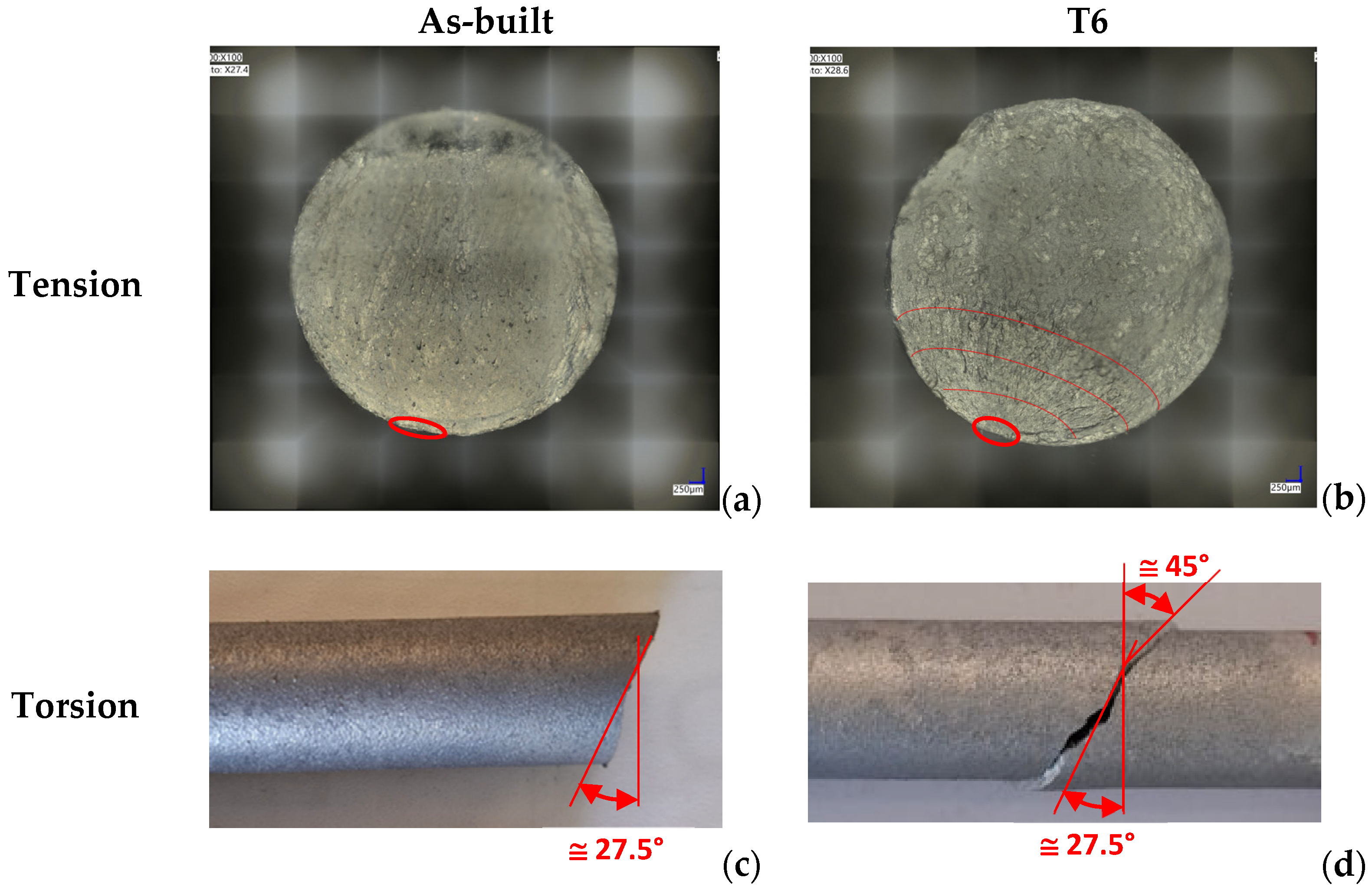
The analysis of the failure surface of tensile tests revealed the presence of manufacturing defects on the specimen surface, Figure 9a,b, from which the fatigue crack emanates. The tensile specimen presents, of course, a flat failure surface, while the torsion one is slanted at an angle that, roughly evaluated in Figure 9c,d, is 27.5° for both as-built and T6 conditions, this latter also showing a portion where the slanting angle attains about 45°, i.e., the direction of maximum principal stress. Even though it is known that fatigue crack propagation often occurs in a plane perpendicular to the maximum principal stress, the presence of manufacturing may induce this brittle-like propagation from the beginning, wiping off any possible initial ductile mechanism. In addition, the maximum principal stress (MPS) criterion predicts a strength in torsion equal to the strength in tension, which is incidentally what has been detected concerning the endurance limit. For these reasons, the multiaxial fatigue results have been elaborated according to MPS. First of all, a comparison of the slanting angle predicted by MPS with that experimentally detected was done.
The MPS predicts a slanting angle:
θ = 1 2 a r c t a n 2 τ a σ a
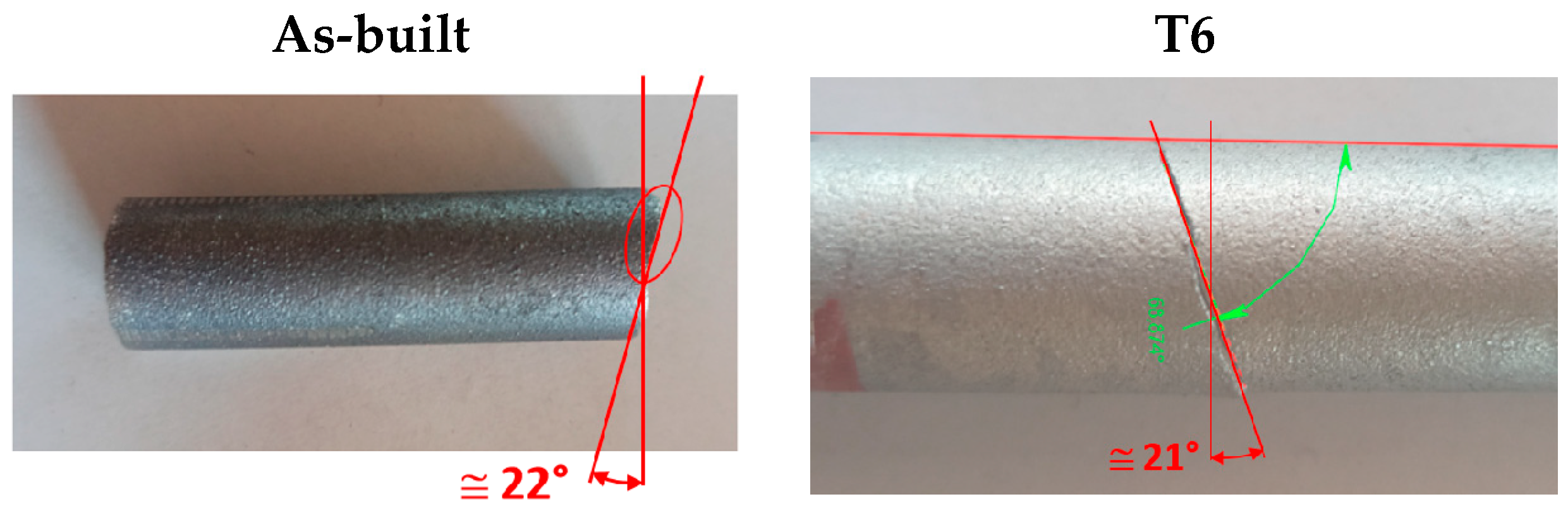
Being the ratio τ a / σ a equal to 0.575 for all the tests performed, the estimate is θ = 24.5°. The experimental slanting angle of multiaxial tests is illustrated in Figure 10, where the graphical estimate is 21–22° depending on heat treatment, which is very close to MPS, given also the rough estimation method. This result confirms the MPS as a good candidate to create a fatigue master curve for uniaxial and multiaxial tests.
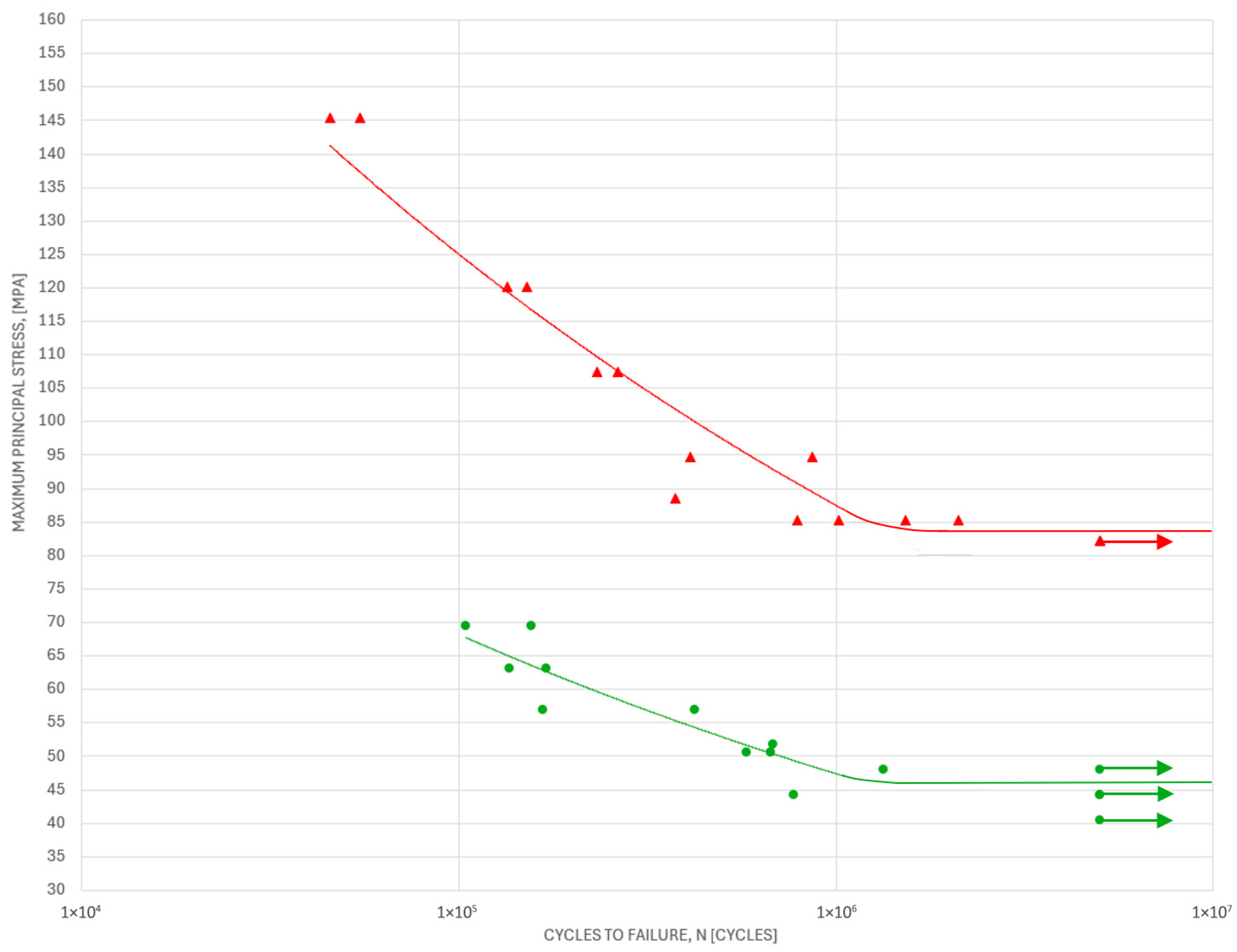
The fatigue tests expressed in terms of MPS are shown in Figure 11, expressed in terms of amplitude of the MPS, σ1a, and it is clearly visible that the multiaxial tests closely resemble the tensile one, especially the value of the endurance limit, which differs by 3% max in the case of the as-built condition and overlaps in the case of T6.
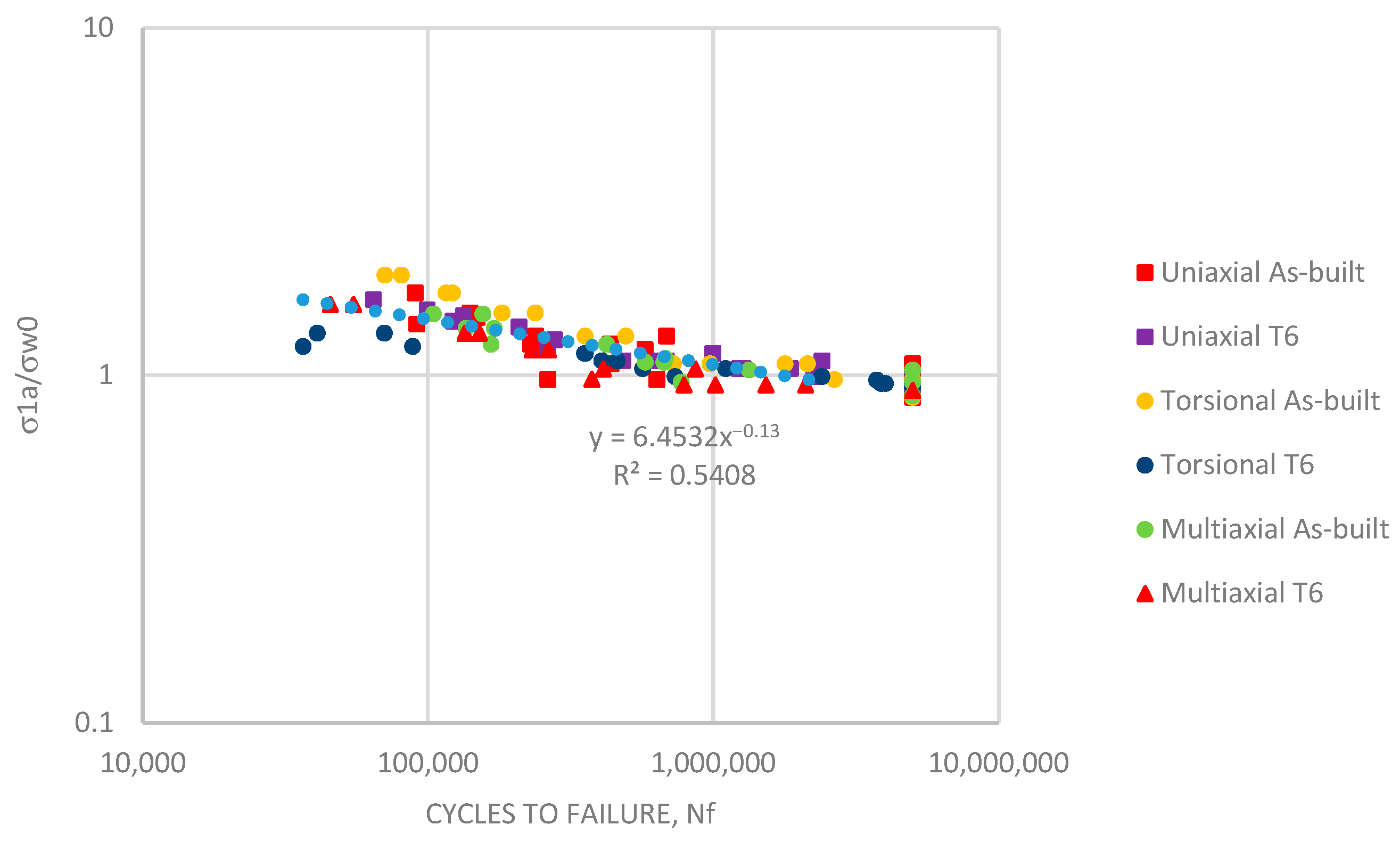
All the uniaxial and multiaxial data were then normalized with respect to the corresponding tensile endurance limit σw0, the latter being dependent on the heat treatment. The normalized data are approximated with the following master curve:
σ 1 a σ w 0 = A N f b
where Nf is the number of cycles to failure. Raw data and power-law approximation are presented in Figure 12, where it is evident how all the data collapse into a unique scatter band, and Equation (5) shows a fairly good correlation coefficient, testifying that, for the material and conditions tested, the MPS criterion is an effective framework for the definition of a fatigue master curve for uniaxial and multiaxial conditions.

4. Conclusions

The AlSi10Mg manufactured by SLM has been tested under uniaxial tensile and torsional quasi-static and fatigue loading, as well as multiaxial fatigue loading, considering as-built and T6 heat treatment. The following conclusions can be drawn:
  • The static tests showed that the T6 treatment leads to a lower strength but also a much higher ductility of the material with respect to the as-built state;
  • On the other hand, the T6 condition revealed a fatigue strength almost double that of the as-built tests under both uniaxial tensile, torsional, and multiaxial loading;
  • The MPS criterion gathers together all the tests with a rather good correlation; the presence of surface defects seems to promote this type of “brittle-like” fatigue behavior.

Author Contributions

Conceptualization, A.P. and F.L.; methodology, F.L. and F.M.; validation, A.P. and F.U.; formal analysis, F.L. and A.P.; investigation, F.L.; resources, A.P. and F.U.; data curation, F.L. and A.P.; writing—original draft preparation, A.P.; writing—review and editing, All except A.P.; supervision, A.P. All authors have read and agreed to the published version of the manuscript.

Funding

This research received no external funding.

Institutional Review Board Statement

Not applicable.

Informed Consent Statement

Not applicable.

Data Availability Statement

The raw data supporting the conclusions of this article will be made available by the authors on request.

Acknowledgments

The support of B. Pontremoli for the experimental campaign is greatly acknowledged.

Conflicts of Interest

Author Federico Uriati was employed by the company BEAMIT. The remaining authors declare that the research was conducted in the absence of any commercial or financial relationships that could be construed as a potential conflict of interest.

References

  1. Lewandowski, J.J.; Seifi, M. Metal Additive Manufacturing: A Review of Mechanical Properties. Annu. Rev. Mater. Res. 2016, 46, 151–186. [Google Scholar] [CrossRef]
  2. Fatemi, A.; Molaei, R.; Sharifimehr, S.; Phan, N.; Shamsaei, N. Multiaxial fatigue behavior of wrought and additive manufactured Ti-6Al-4V including surface finish effect. Int. J. Fatigue 2017, 100, 347–366. [Google Scholar] [CrossRef]
  3. Molaei, R.; Fatemi, A.; Phan, N. Significance of hot isostatic pressing (HIP) on multiaxial deformation and fatigue behaviors of additive manufactured Ti-6Al-4V including build orientation and surface roughness effects. Int. J. Fatigue 2018, 117, 352–370. [Google Scholar] [CrossRef]
  4. Zhang, J.; Fatemi, A. Surface roughness effect on multiaxial fatigue behavior of additive manufactured metals and its modeling. Theor. Appl. Fract. Mech. 2019, 103, 102260. [Google Scholar] [CrossRef]
  5. Renzo, D.A.; Sgambitterra, E.; Magarò, P.; Furgiuele, F.; Maletta, C.; Biffi, C.; Fiocchi, J.; Tuissi, A. Multiaxial fatigue behavior of additive manufactured Ti-6Al-4V under in-phase stresses. Procedia Stru. Int. 2019, 18, 914–920. [Google Scholar] [CrossRef]
  6. Molaei, R.; Fatemi, A.; Phan, N. Multiaxial fatigue of LB-PBF additive manufactured 17–4 PH stainless steel including the effects of surface roughness and HIP treatment and comparisons with the wrought alloy. Int. J. Fatigue 2020, 134, 105646. [Google Scholar] [CrossRef]
  7. Sanaei, N.; Fatemi, A. Defect-based multiaxial fatigue life prediction of L-PBF additive manufactured metals. Fat. Fract. Eng. Mat. Struct. 2021, 44, 1897–1915. [Google Scholar] [CrossRef]
  8. Wang, Y.; Su, Z. Effect of micro-defects on fatigue lifetime of additive manufactured 316L stainless steel under multiaxial loading. Theor. Appl. Fract. Mech. 2021, 111, 102849. [Google Scholar] [CrossRef]
  9. Molaei, R.; Fatemi, A.; Phan, N. Notched fatigue of additive manufactured metals under axial and multiaxial loadings, Part I: Effects of surface roughness and HIP and comparisons with their wrought alloys. Int. J. Fatigue 2021, 143, 106003. [Google Scholar] [CrossRef]
  10. Molaei, R.; Fatemi, A.; Phan, N. Notched fatigue of additive manufactured metals under axial and multiaxial loadings, part II: Data correlations and life estimations. Int. J. Fatigue 2022, 156, 106648. [Google Scholar] [CrossRef]
  11. Molaei, R.; Fatemi, A. Fatigue performance of additive manufactured metals under variable amplitude service loading conditions including multiaxial stresses and notch effects: Experiments and modelling. Int. J. Fatigue 2021, 145, 106002. [Google Scholar] [CrossRef]
  12. Carrion, P.E.; Sausto, F.; Beretta, S.; Shamsaei, N. Multiaxial fatigue behavior and modelling of additive manufactured Ti-6Al-4V parts: The effects of layer orientation and surface texture. Int. J. Fatigue 2023, 176, 107860. [Google Scholar] [CrossRef]
  13. Lee, S.; Molaei, R.; Carrion, P.E.; Shao, S.; Shamsaei, N. Multiaxial fatigue behavior and modelling for additive manufactured Ti-6Al-4V parts: The effects of surface texture. Int. J. Fatigue 2025, 201, 109205. [Google Scholar] [CrossRef]
  14. Li, Y.; Zhang, S.; Yu, W.; Li, B.; Xuan, F.; Chen, X. Multiaxial low cycle fatigue behavior and life prediction of wire arc additive manufactured 308L stainless steel. Int. J. Fatigue 2024, 183, 108241. [Google Scholar] [CrossRef]
  15. Papuga, J.; Reis, L.; Matušů, M.; da Costa, P.R.; Šimota, J.; Rosenthal, J.; Bumba, F. Multiaxial fatigue analysis of additively manufactured hollow specimens from AlSi10Mg. Procedia Struct. Integr. 2024, 57, 79–86. [Google Scholar] [CrossRef]
  16. Fatemi, A.; Molaei, R. Novel specimen geometries for fatigue testing of additive manufactured metals under axial, torsion, and combined axial-torsion loadings. Int. J. Fatigue 2020, 130, 105287. [Google Scholar] [CrossRef]
  17. ASTM E8/E8M-22; Standard Test Methods for Tension Testing of Metallic Materials. ASTM International: West Conshohocken, PA, USA, 2022.
  18. ISO 6892-1; Metallic Materials—Tensile Testing—Part 1: Method of Test at Room Temperature. ISO: Geneva, Switzerland, 2019.
  19. ISO 1099; Metallic Materials—Fatigue Testing—Axial Force-Controlled Method. ISO: Geneva, Switzerland, 2017.
  20. ASTM E739; Standard Practice for Statistical Analysis of Linear or Linearized Stress-Life (S-N) and Strain-Life (ε-N) Fatigue Data. ASTM International: West Conshohocken, PA, USA, 2015.
  21. ASTM E2207; Standard Practice for Strain-Controlled Axial-Torsional Fatigue Testing with Thin-Walled Tubular Specimens. ASTM International: West Conshohocken, PA, USA, 2021.
  22. ASTM E143; Standard Test Method for Shear Modulus at Room Temperature. ASTM International: West Conshohocken, PA, USA, 2021.
Figure 1. Tensile test specimen.
Engproc 131 00024 g001
Figure 2. Uniaxial fatigue specimen.
Engproc 131 00024 g002
Figure 3. Multiaxial fatigue and torsion tests specimen dimensions.
Engproc 131 00024 g003
Figure 4. Tensile test results.
Engproc 131 00024 g004
Figure 5. Failure mode in tension.
Engproc 131 00024 g005
Figure 6. Torsion test results.
Engproc 131 00024 g006
Figure 7. Failure mode in torsion: (a) as-built; (b) T6.
Engproc 131 00024 g007
Figure 8. Fatigue strength: (a) tension; (b) torsion.
Engproc 131 00024 g008
Figure 9. Fatigue failure mode of uniaxial tests (ad).
Engproc 131 00024 g009
Figure 10. Fatigue failure mode of multiaxial tests.
Engproc 131 00024 g010
Figure 11. Multiaxial fatigue strength expressed in terms of MPS.
Engproc 131 00024 g011
Figure 12. Multiaxial fatigue strength expressed in terms of MPS normalized to uniaxial endurance limit.
Engproc 131 00024 g012
Table 1. Typical AlSi10Mg chemical composition.
Element (wt%)AlSiFeCuMnMgZnTi
MinimumBalance9.00--0.200.20--
ActualBalance9.700.20<0.010.380.44<0.010.01
MaximumBalance11.000.550.050.450.450.100.15
Disclaimer/Publisher’s Note: The statements, opinions and data contained in all publications are solely those of the individual author(s) and contributor(s) and not of MDPI and/or the editor(s). MDPI and/or the editor(s) disclaim responsibility for any injury to people or property resulting from any ideas, methods, instructions or products referred to in the content.