Proceeding Paper

Modeling of a Development-Oriented Steering Actuator †

by
Luca Veneroso
1,*,
Alessio Anticaglia
1,2,
Leandro Ronchi
1,2,
Claudio Annicchiarico
2 and
Renzo Capitani
1,2
1
Dipartimento di Ingegneria Industriale (DIEF), Università degli Studi di Firenze, Via Santa Marta 3, 50139 Firenze, Italy
2
Meccanica 42 S.r.l., Via Ezio Tarantelli 15, 50019 Sesto Fiorentino, Italy
*
Author to whom correspondence should be addressed.
Presented at the 54th Conference of the Italian Scientific Society of Mechanical Engineering Design (AIAS 2025), Florence, Italy, 3–6 September 2025.
Eng. Proc. 2026, 131(1), 16; https://doi.org/10.3390/engproc2026131016
Published: 30 March 2026

Abstract

Active vehicle systems integrate electromechanical actuators and advanced control strategies to improve driving comfort and safety. Their development requires coordinated mechanical, electrical, and software design, supported by early evaluation of system performance and driver acceptance. The automotive industry accelerates the development process by adopting multi-stage simulation workflows, from Model-in-the-Loop to hardware-in-the-loop and track testing, progressively reducing the virtualization level. Final testing stages require actuators with programmable control units, often unavailable in commercial products. This paper proposes a research-oriented steering actuator based on the modification of an existing system by introducing an additional torque sensor after the steering wheel. Results indicate that the additional compliance significantly alters the passive steering response, while the impact on active EPS operation is negligible, confirming the suitability of the modified actuator for experimental research applications.

1. Introduction

Active vehicle systems are increasingly playing a fundamental role in modern automotive technology, enhancing vehicle comfort and safety [1]. The integration of electromechanical actuators with advanced control strategies supports the driver during simple driving tasks, improving ride comfort and reducing fuel consumption through systems like Adaptive Cruise Control (ACC), Lane Keeping Assist (LKA) or Park Assist, while also enabling the vehicle to actively intervene in critical situations to prevent accidents or mitigate their effects, as in the case of Autonomous Emergency Braking (AEB) [2,3] or Automatic Emergency Steering (AES) [4]. The development of these functionalities is highly complex, requiring significant efforts to integrate mechanical, electrical, and software components. A further critical aspect is the early assessment of both the effectiveness of the new functionality at the vehicle level and its acceptance by drivers and passengers [5]. A key aspect is to analyze how the function under development interacts with existing ones and to calibrate the control logic intervention accordingly. To achieve these objectives within competitive timelines, the automotive industry has adopted new development strategies aimed at reducing the time to market of advanced systems. A central element of this process is the extensive use of simulation. Offline simulation and driving simulators offer several key advantages. First, they guarantee repeatability of the test, which is essential to perform sensitivity analysis on different tuning parameters while maintaining identical boundary conditions. This allows the comparison of the reaction of different drivers exposed to the same exact driving scenarios. Another fundamental advantage is the possibility to reproduce limit handling conditions as well as imminent collision and emergency scenarios without exposing the driver to real danger. This capability is particularly critical for systems designed to intervene in hazardous situations, such as Electronic Stability Control (ESC) [6], Autonomous Emergency Braking (AEB) [7], or Automatic Emergency Steering (AES). Once the specifications and objectives of the new functionality have been defined, the testing process begins with a progressively decreasing level of virtualization until the final product is validated on track. The first tools employed are co-simulation architectures, which allow evaluation of the interaction between the control logic, the vehicle model, and the actuator model. In a subsequent step, static and dynamic driving simulators can be used to involve human drivers at an early stage, providing valuable feedback on the acceptability and perceived effectiveness of the new function [5]. At this stage, physical actuators are not required, as their behavior can be represented with the desired level of fidelity by simulation models. In the next phase, the control logic is tested with a real actuator by means of a Hardware-in-the-Loop (HiL) simulator [8]. Introducing the physical actuator enables fine-tuning of the control algorithms and facilitates debugging activities related to the integration of the various vehicle electronic control units (ECUs). Finally, during on-track testing, where all model uncertainties are removed, the final calibration of the control strategy is performed. However, both the HiL and track testing phases require actuators equipped with open and programmable electronic control units. This remains a significant limitation, as commercial actuators typically do not permit direct access to embedded software. Consequently, unless the study is carried out in collaboration with the original equipment manufacturer (OEM), the testing process cannot be fully completed. To overcome these constraints research-oriented electromechanical actuators that exhibit performance comparable to series-production systems, while offering open and flexible control architectures, have emerged. A notable example is the Corner Brake Actuator (CBA), which enables independent control of the pressures on the four vehicle corners and has been successfully used as a research tool in several studies [7,9]. The present work focuses on the modeling of a modified steering actuator designed for research applications. The system is based on an existing EPS parallel-axis steering system in which an additional torque sensor is introduced after the steering wheel to measure the driver’s input torque, steering angle and steering velocity. The modeling activity examines the impact of the additional torque sensor on steering dynamics, with the aim of determining whether the modified steering system can replicate the performance of the original steering system. Results show that the added compliance, represented by the additional torque sensor, significantly affects the passive steering dynamics (EPS off), whereas its impact on the active steering response (EPS on) remains negligible.

2. Simulation Model

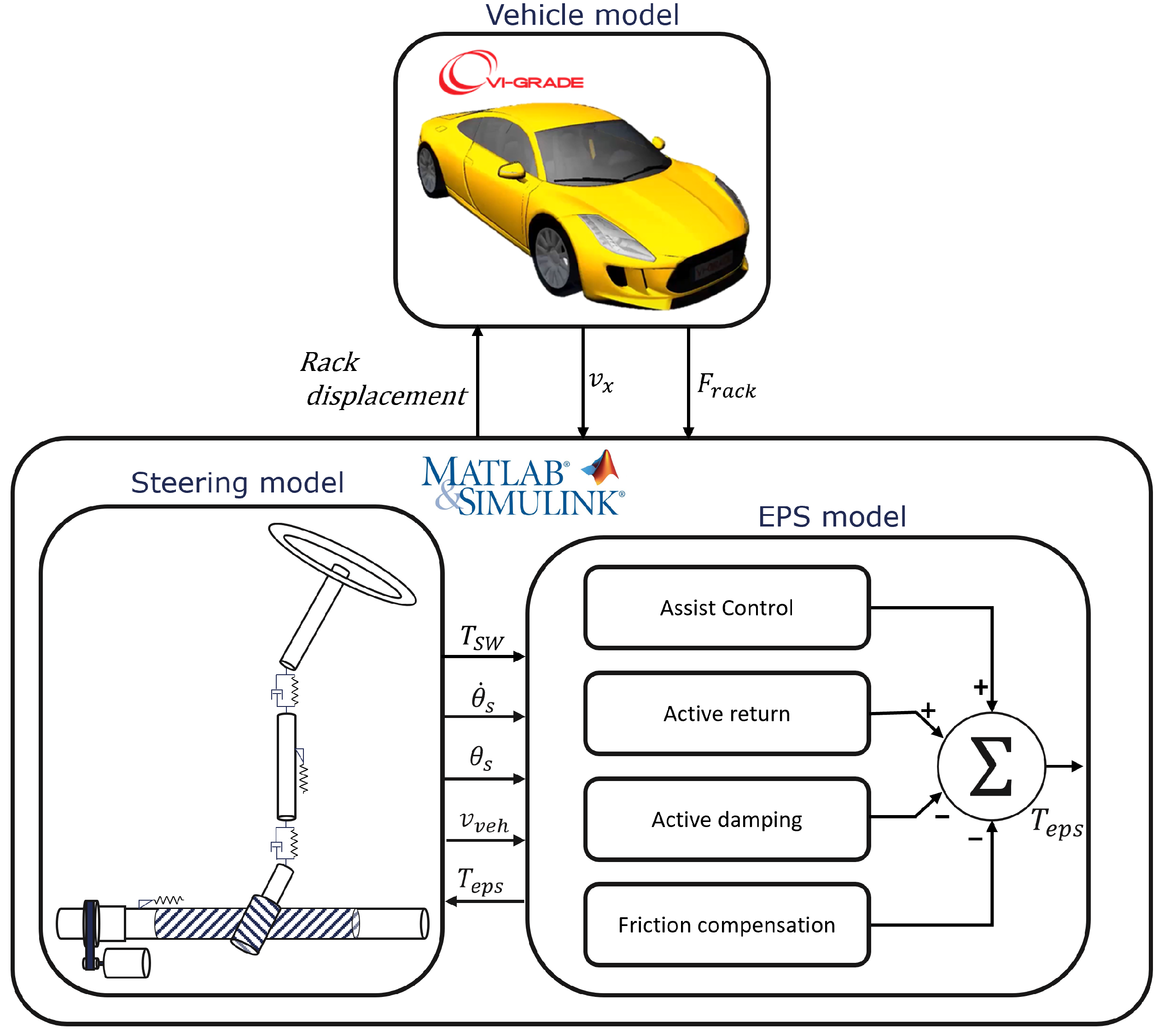
To investigate the dynamics of the modified steering actuator, a co-simulation architecture that combines two different simulation environments has been developed. In fact, the vehicle model is simulated with a 14-DOF CarRealTime model, while the steering system and its associated control logic are modeled in a MATLAB/Simulink 2024b environment. Figure 1 schematizes the model architecture and the signal exchanged between the different models. As shown in the next section, both the steering system and the EPS model are fully parametrized to facilitate model application to the other steering actuator. The co-simulation approach allows the use of different integration time steps, 0.001 s for the vehicle model and 0.0001 s for simulink, helping the numerical stability of the steering system subsystem. Different settings of torsion bar stiffness were used to investigate the effect of the introduction of an additional steering sensor mounted after the steering wheel during passive and active maneuvers.

2.1. Steering Mechanical Model

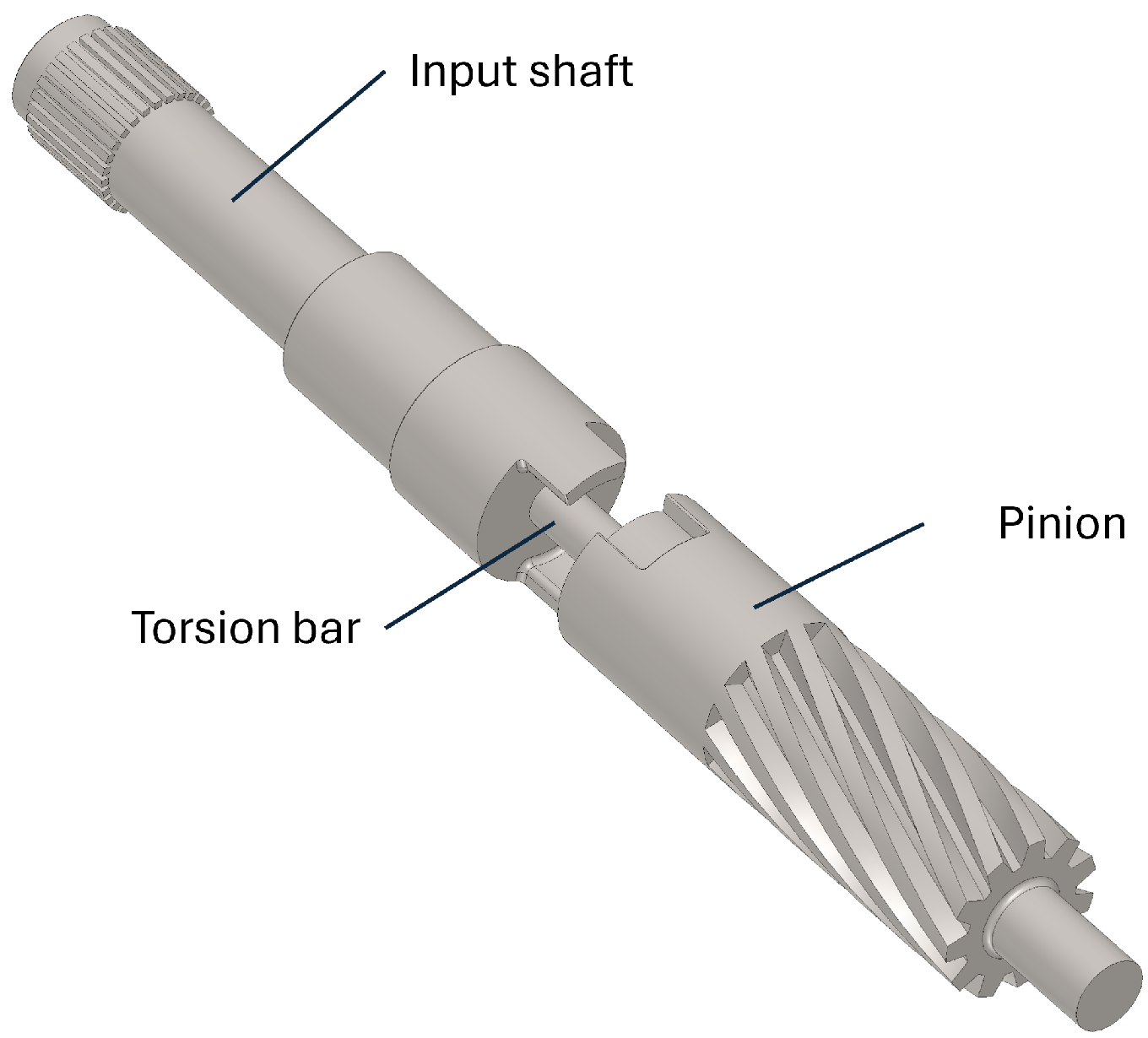
The steering system is equipped with a parallel-axis EPS and consists of three Degrees Of Freedom (DOF). The first DOF is composed of the steering wheel, half of the steering column inertia and, under the modified layout, the equivalent inertia associated with the added torque sensor. The second DOF includes the remaining steering column inertia and the steering pinion with the internal torsion bar. The last DOF represent the rack, including the EPS subsystem composed of the electric motor, pulley and ball screw. The second DOF includes the dynamics of the torque sensor [10], which is composed of three mechanical components [11], as shown in Figure 2.
  • The input shaft allows the connection between the last Cardan joint and one of the ends of the torsion bar, which is pressed inside a drilled hole.
  • The torsion bar works as a flexible connection between the input shaft and the pinion. The maximum twist angle is limited by a mechanical endstop.
  • The pinion represents the connection between the other end of the torsion bar, forced inside a drilled hole, and the rack.
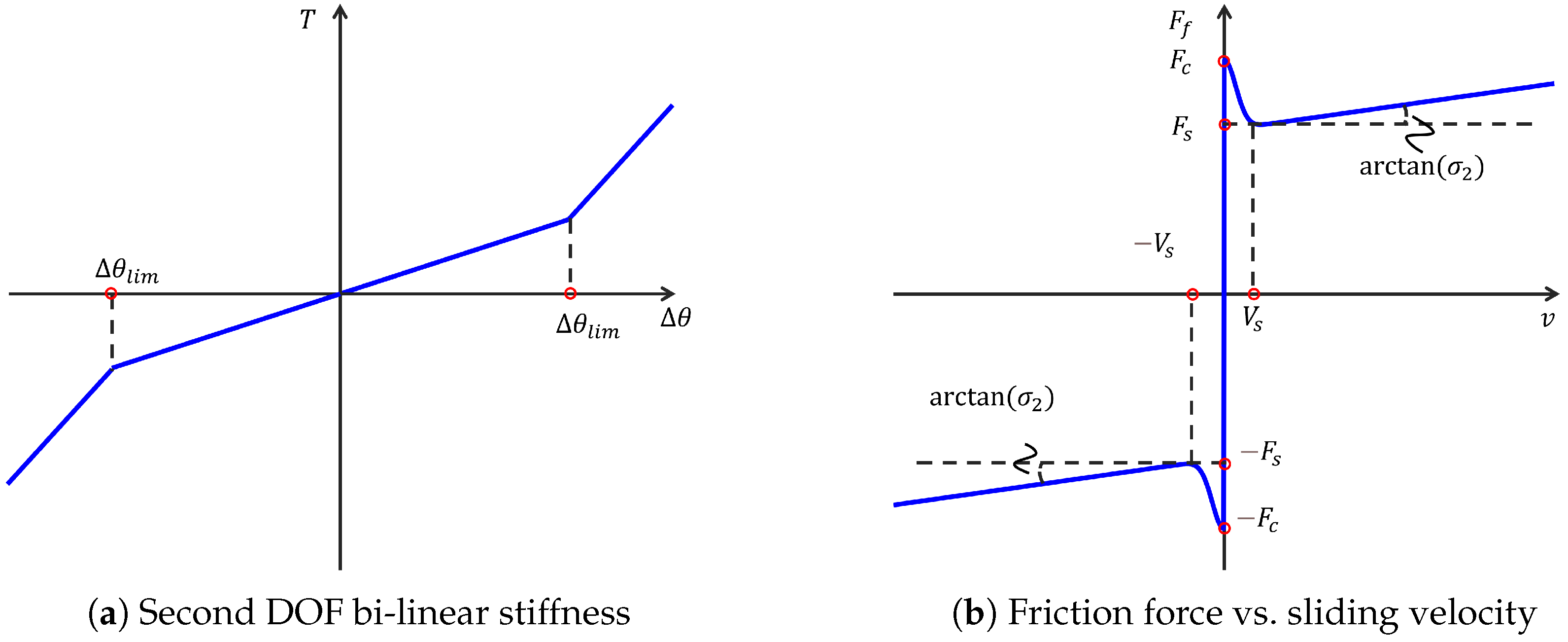
The entire assembly is characterized by a bi-linear stiffness, as shown in Figure 3a: the first part is defined by the torsion bar stiffness while the second one occurs when the maximum twist angle is reached. This effect is negligible during ordinary steering maneuvers and become relevant during emergency maneuvers in which high steering torque is applied. The frictional effect at each DOF is captured with a LuGre model, including dependence on the rack vertical load [12]. The LuGre friction model captures most of the friction behavior, including the Stribeck effect, hysteresis and a great representation of near-zero velocity friction effects [13,14]. The model is expressed in Equation (1), where z represents the bristle deflection, F c and F s are Coulomb and static friction forces, v s is the Stribeck velocity and σ 2 is the viscous damping coefficient. These quantities are referred to as static parameters, and their physical meaning and influence on the friction behavior are illustrated in Figure 3b. σ 0 and σ 1 represent respectively bristle stiffness and damping. To ensure numerical stability [14], the bristle deformation was limited to its steady-state value, as expressed in Equation (2).
z ˙ = v σ 0 | v | g ( v ) z F f = σ 0 z + σ 1 z ˙ + σ 2 v g ( v ) = F c + ( F s F c ) e v / v s 2
z s s = v | v | g ( v ) = g ( v ) s g n ( v )
The resulting equation of motion can be expressed in matrix form as in Equation (3), where J , D , K represent the inertia, damping, and stiffness matrices detailed in Equation (4). θ is the vector of angular displacements, and F is the generalized force vector, including driver torque, rack forces, and EPS motor torque, as in Equation (5). The presence of the additional torque sensor modifies the inertia distribution and introduces a new compliance in the system, requiring stiffness and damping matrices to be updated, according to Equations (9)–(11), while the parameters for the stock steering system are expressed in Equations (6)–(8).
J θ ¨ + D θ ˙ + K θ = F ,
J = J 1 0 0 0 J 2 0 0 0 J 3 , D = D 1 D 1 0 D 1 D 2 + D 3 D 2 0 D 2 D 2 + D 3 , K = K 1 K 1 0 K 1 K 2 + K 3 K 2 0 K 2 K 2 + K 3 ,
θ = θ 1 θ 2 θ 3 , F = T s w + T f , c o l u m n T f , c o l u m n T e p s + T r a c k + T f , r a c k
J 1 = J s w + J s c / 2 , J 2 = J s c / 2 + J t b , J 3 = J p n + ( m r a c k + m t i e r o d ) τ 2 + J b l d c ( 2 π h τ p ) 2
D 1 = D s c , D 2 = D t b , D 3 = D r a c k
K 1 = k s c , K 2 = k t b , K 3 = 0
J 1 = J s w + J s c / 2 + J t b n , J 2 = J s c / 2 + J t b , J 3 = J p n + ( m r a c k + m t i e r o d ) τ 2 + J b l d c ( 2 π h τ p ) 2
D 1 = D s c D t b n D s c + D t b n , D 2 = D t b , D 3 = D r a c k
K 1 = k s c k t b n k s c + k t b n , K 2 = k t b , K 3 = 0

2.2. EPS Model

The EPS aims to provide torque assistance while preserving stability and a realistic steering feel. The EPS control logic was implemented in Simulink and consists of four main functions: Figure 1 highlights the input and output of each simulation block. The input for the EPS control logic are the steering angle, the steering velocity and the steering torque, measured by the magnetic steering Torque and Angle sensor (TAS), plus the vehicle longitudinal velocity from the vehicle model. When the mechanical model of the stock steering system is used the input is the one in Equation (12).
θ s = θ 2 , θ s ˙ = θ 2 ˙ , T T A S = ( θ 2 θ 3 ) k t b
For the new steering layout the inputs for the EPS control logic are described by Equation (13).
θ s = θ 1 , θ ˙ s = θ 1 ˙ , T T A S = ( θ 1 θ 2 ) k t b n
The total torque applied by the EPS motor is the sum of the contributions of each function (14):
T e p s = T p a + T a r + T a d + T f c

2.3. Power Assist

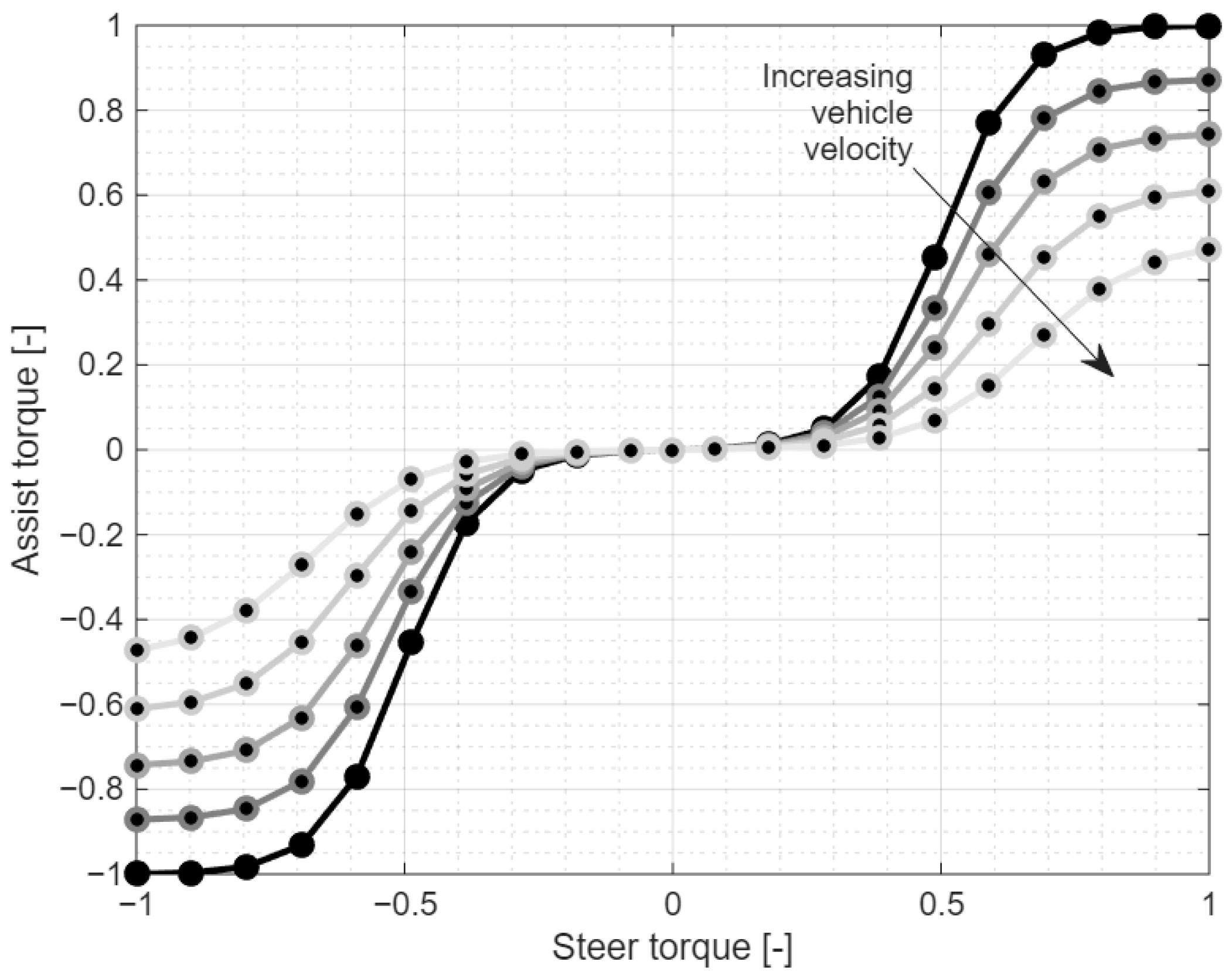
The task of power assistance is to reduce the steering effort, supporting the driver with additional torque [15]. The assist torque is defined by the boost curve, represented through the lookup table in Figure 4, which defines the assist torque provided by the motor as a function of the steering torque sensed by the torque sensor and the vehicle longitudinal velocity. As shown in Figure 4 the EPS motor provides high torque during low-speed maneuvers, such as parking operation, where the steering feedback is not important, while the assistance diminishes during high-speed maneuvers where the haptic feedback provided by the steering wheel is more important. For low driver torque input, the assist torque is very low to avoid excessive response from the steering system [11].
T p a = f ( T T A S , v v e h )

2.4. Active Return

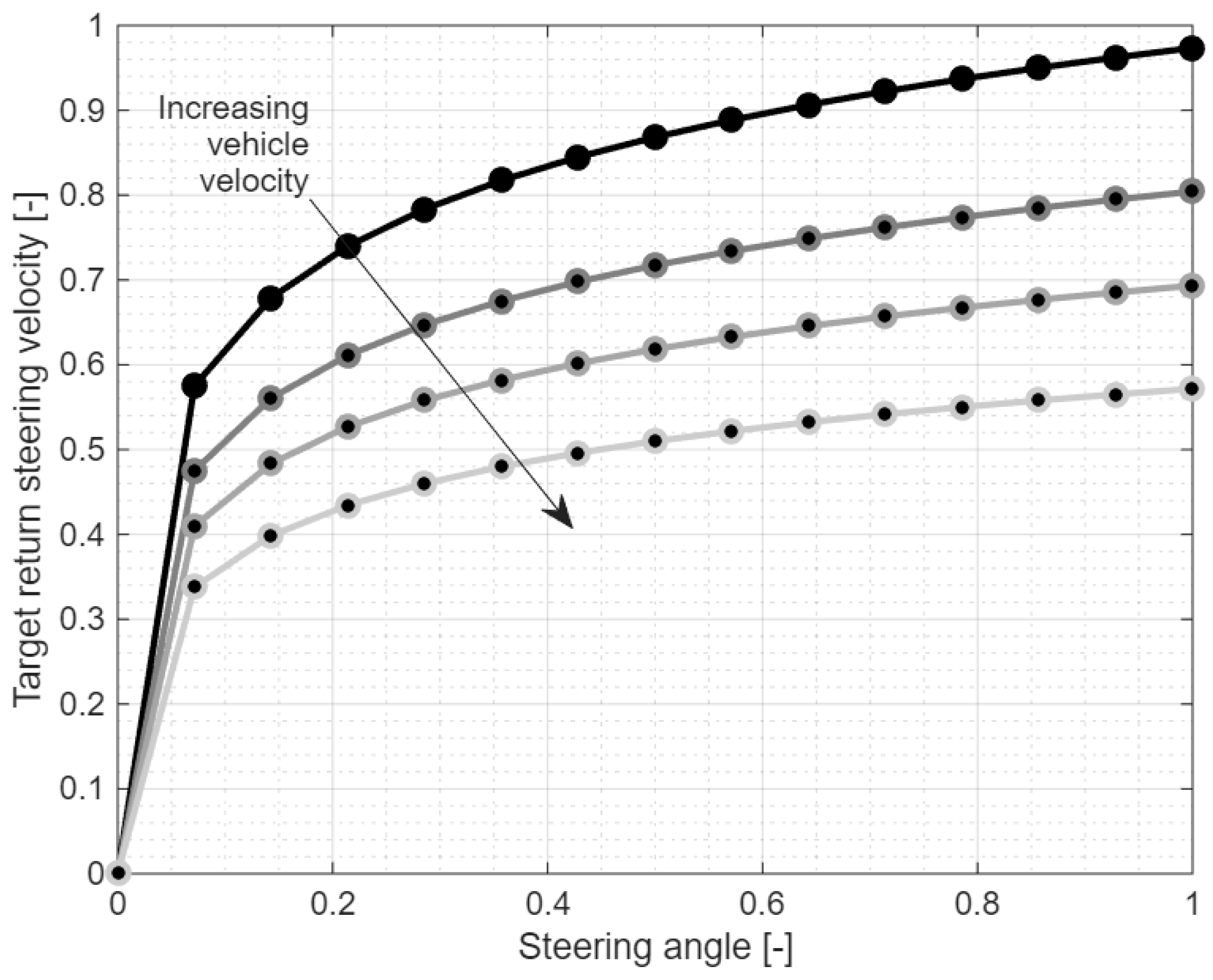
Active return generates a restoring torque, which is applied to guarantee a proper return of the steering wheel to the center position during hands-off or nearly hands-off maneuvers, maintaining vehicle stability. The target returning velocity is defined by the lookup table represented in Figure 5 as a function of the steering angle and vehicle velocity [16]. The target steering velocity is compared with the one measured by the TAS sensor and multiplied by a constant factor G a r . The contribution of the active return to center is attenuated as a function of the torque read by the TAS sensor. The resulting torque defined by the active return function is derived from Equation (16).
T a r = [ f ( θ S , θ s ˙ ) θ s ˙ ] G a r f ( T T A S )

2.5. Active Damping

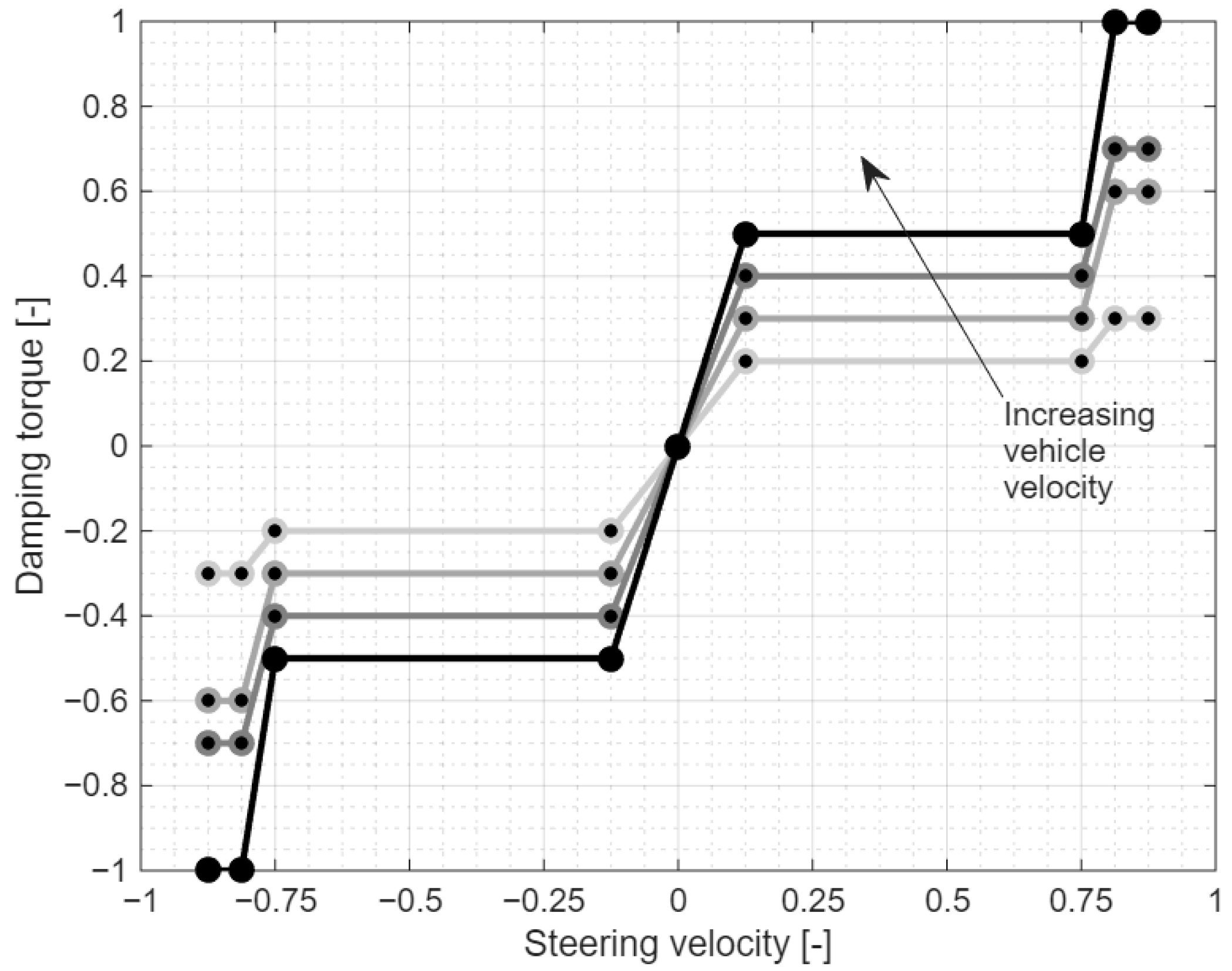
This function reduces overshoot caused by the power assist function contribution during high-steering-torque maneuvers such as step steer or emergency lane change maneuvers [17]. The damping torque is defined by the lookup table as a function of the steering velocity sensed by the TAS sensor, as shown in Figure 6. The damping torque defined by the lookup table is reduced by a scaling factor defined as a function of the vehicle velocity.
T a d = f ( θ s ˙ , v x )

2.6. Friction Compensation

The last module of the EPS control logic is a friction compensation block, which helps the drivers with an additional torque provided to mitigate the effect of the friction in the steering system. Friction forces are not completely compensated; otherwise the steering system will become too sensitive to low driver torque and unstable. The friction compensation module does not take into account the effect of the varying vertical load that acts on the rack, as this is not measurable with the standard sensor mounted on a steering system. Friction compensation plays a key role in the definition of the steering feel. The friction compensation torque is calculated with the previously defined Equation (1).

3. Track Test

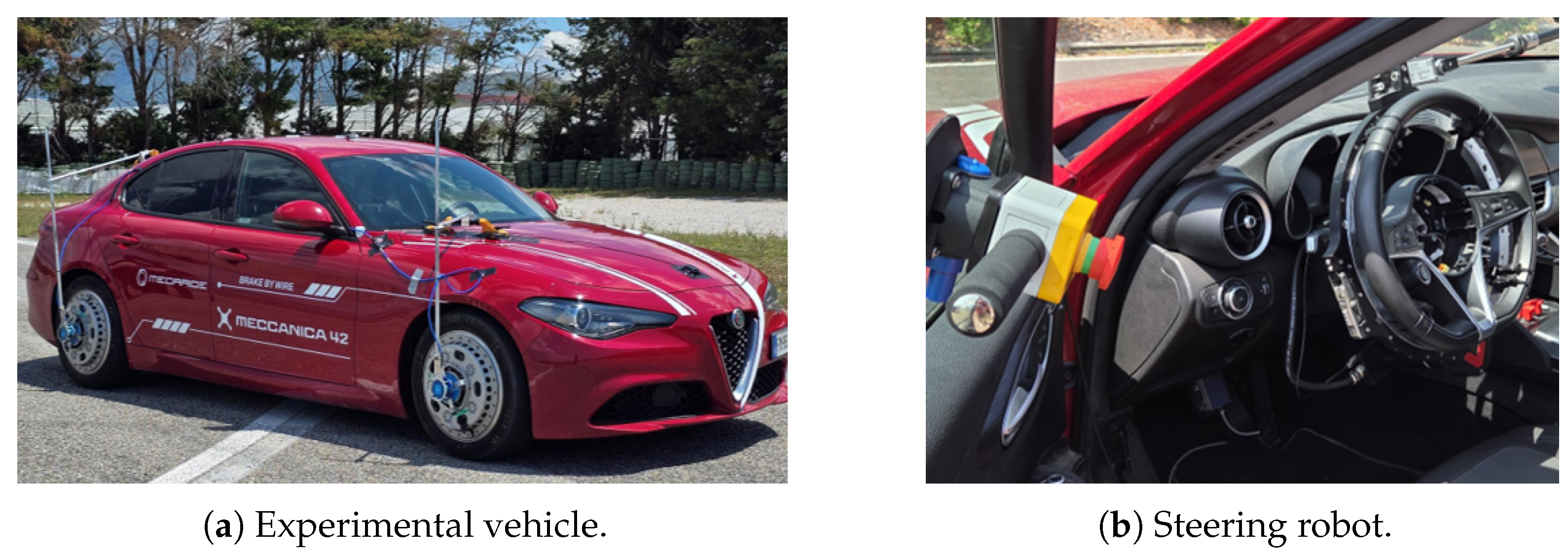
In order to validate the proposed steering system model, an experimental test campaign was carried out using the experimental vehicle, in Figure 7, provided by Meccanica 42 during the Seaside 2025 event. The aim was to collect high-quality data of the steering and vehicle responses under repeatable conditions for the validation of the simulation environment, which accounts for the combined uncertainties arising from the vehicle model, the steering system, and the control logic.

3.1. Test Vehicle Instrumentation

The steering system of the experimental vehicle was equipped with a universal measurement steering wheel by Kistler positioned between the steering wheel and the steering column. This sensor allows the measurement of the driver-applied torque, steering angle and steering velocity. Moreover, the original tie rods were replaced with custom tie rods integrating load cells, enabling the measurement of the overall forces acting on the rack. Finally, a linear potentiometer was installed between the rack case and the rack to measure rack displacement. Vehicle accelerations, yaw rate and orientation angle were measured with an Inertial Measurement Unit (IMU). A Correvit S-Motion sensor mounted on the front bumper of the vehicle allows the measurement of longitudinal, lateral velocity and sideslip angle. The main sensor specifications are summarized in Table 1. All sensor data were acquired using a SCADAS data acquisition system.
Table 1 summarizes the sensors used in the experimental campaign and their main characteristics.

3.2. Steering Robot and Test Protocol

A steering robot, mounted on the back of the steering wheel with a gear ring and moved by an electric motor, was used to apply repeatable steering input with precise amplitude and frequency control. This set-up enables standard maneuvers and facilitates data comparison with co-simulation model results. Tests included the ISO 7401 [18] weave test maneuver and the ISO 19365 [19] sine-with-dwell maneuver.

4. Model Validation

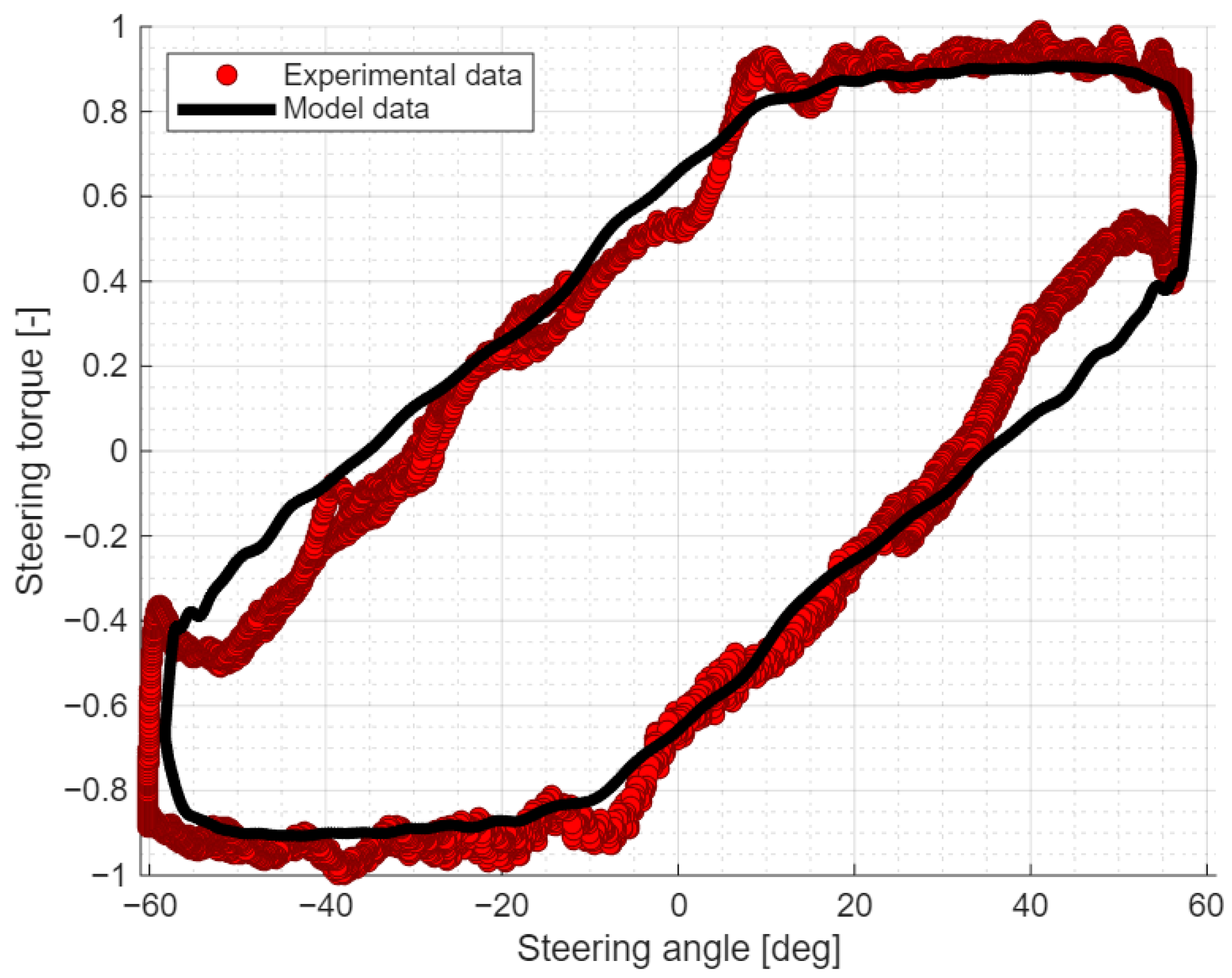
The validation aimed to verify that the co-simulation model accurately reproduces both the steering subsystem behavior and the vehicle response under standardized inputs. This was verified by performing the sine wave maneuver following the test protocol proposed in the ISO 7401 standard with a steering angle amplitude of 60° at a 0.5 Hz frequency. Figure 8 demonstrates the capability of the model to correctly reproduce the relation between the steering torque and the steering angle in terms of steering stiffness, steering stiffness at zero angle, steering friction and angle hysteresis.
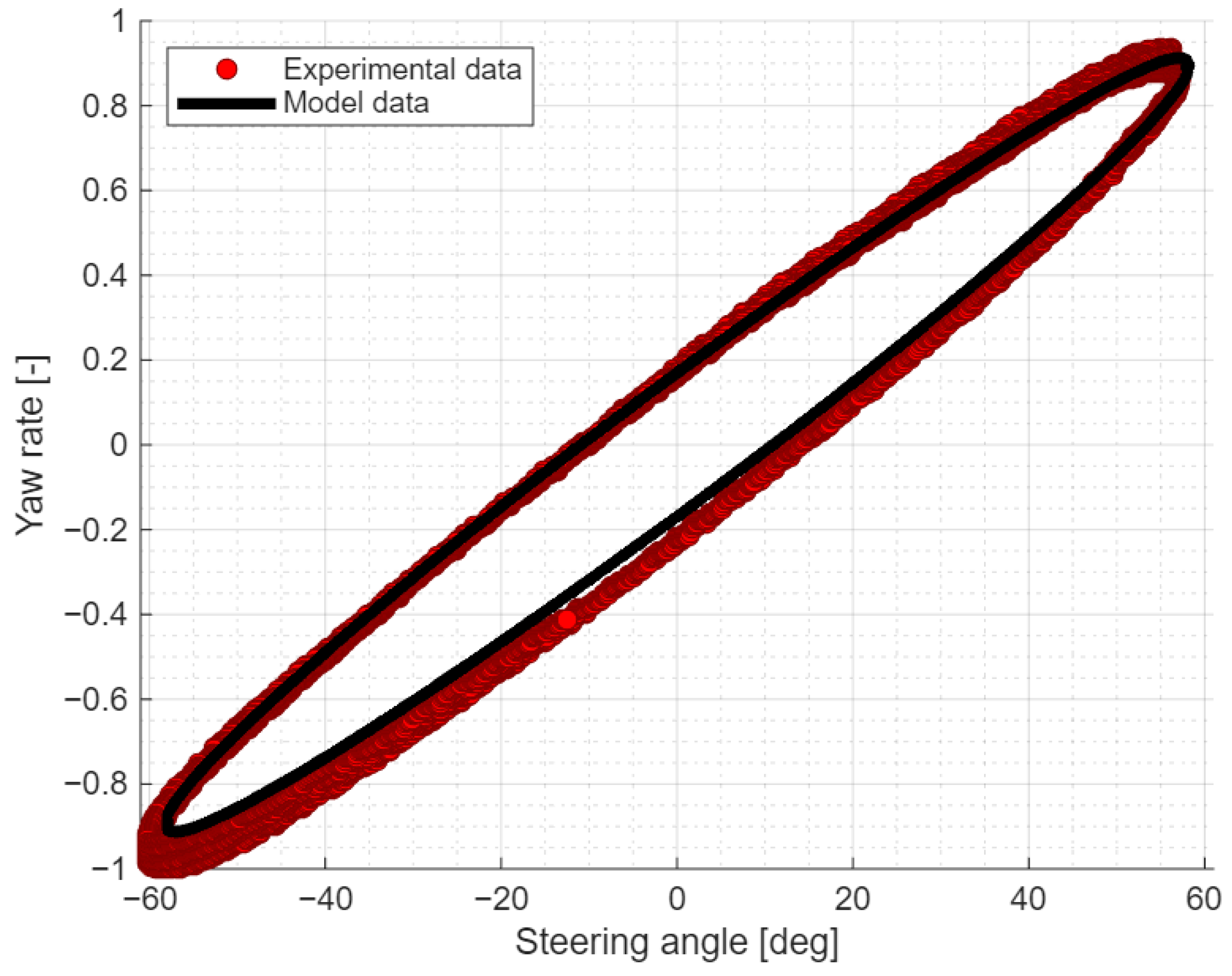
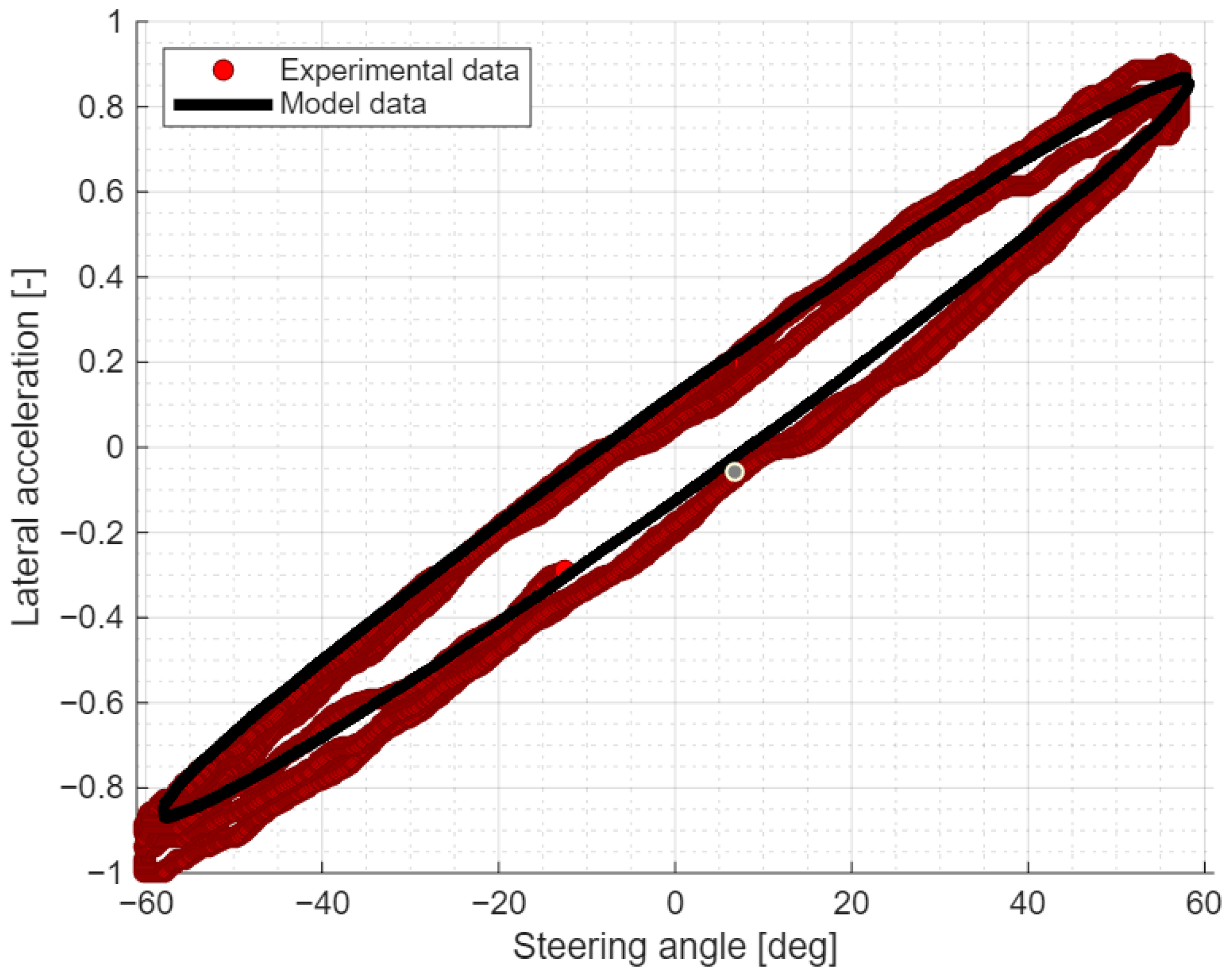
Figure 9 and Figure 10 show how the model also reproduces the relationship between the steering angle, yaw rate and lateral acceleration in terms of deadbands, maximum values and sensitivity at a 0° steering angle.
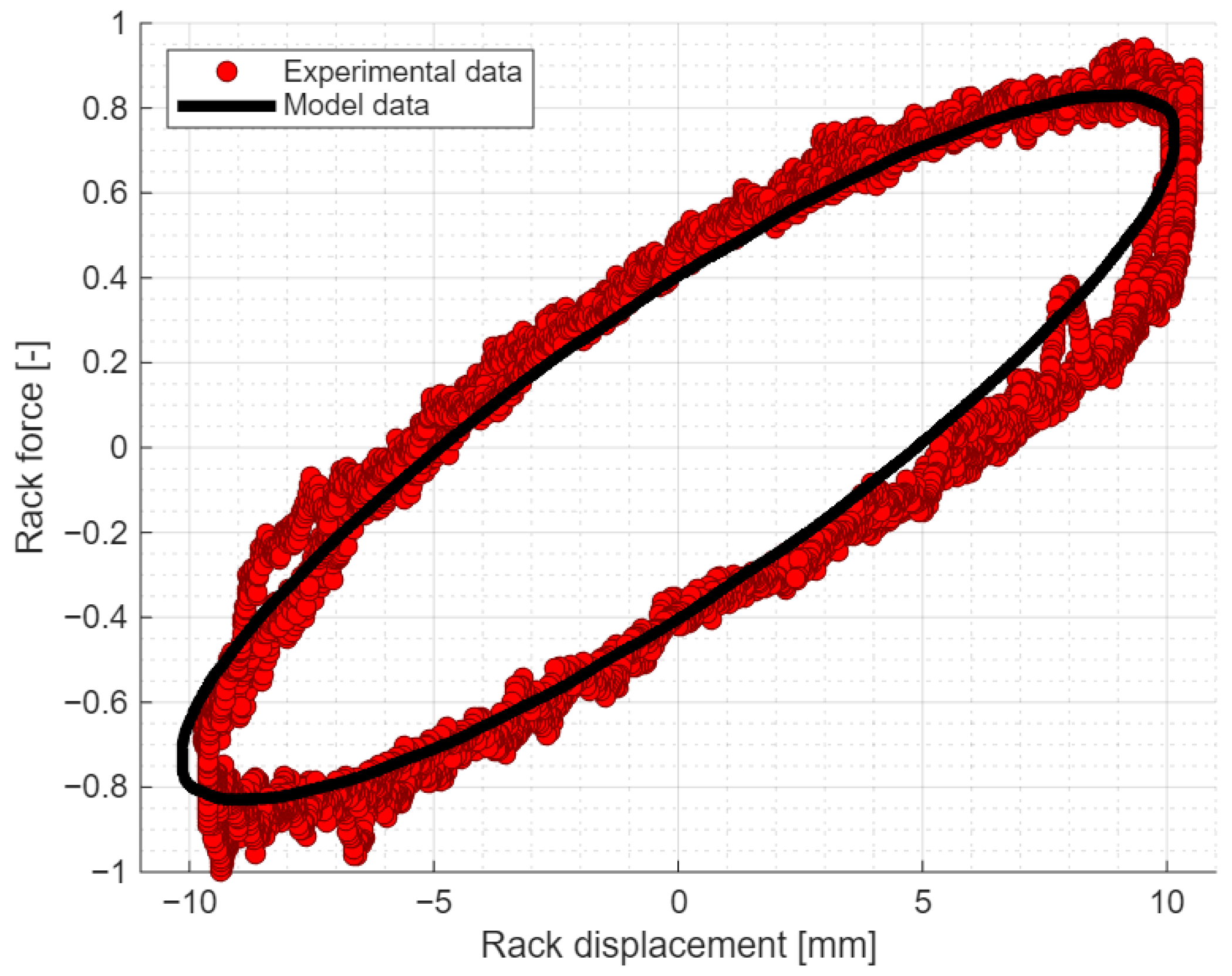
Figure 11 presents the relationship between rack displacement and rack force. It is important to respect the relationship between these two signals as they represent the main signals exchanged between the vehicle model and the steering model.

Impact of Additional Torque Sensor

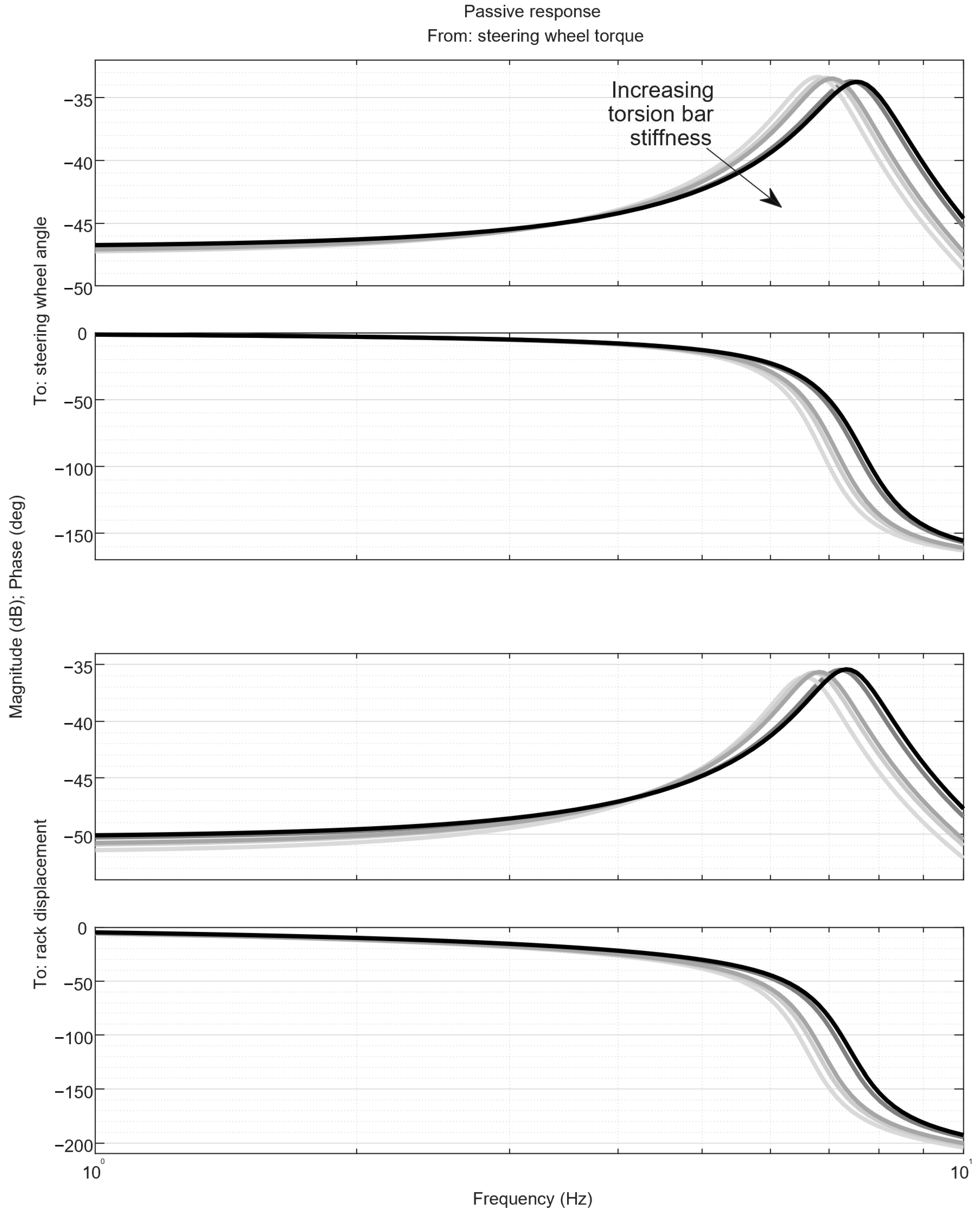
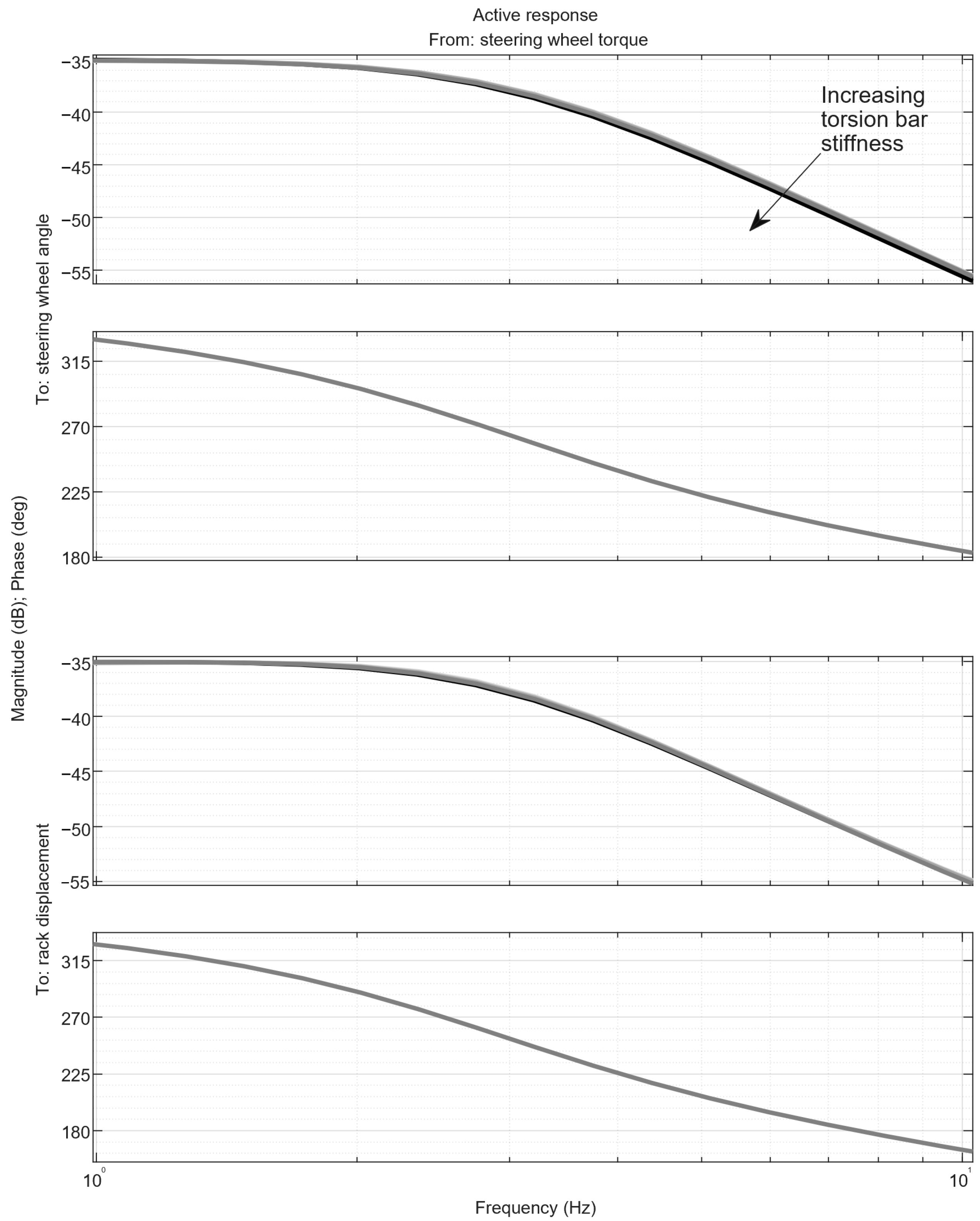
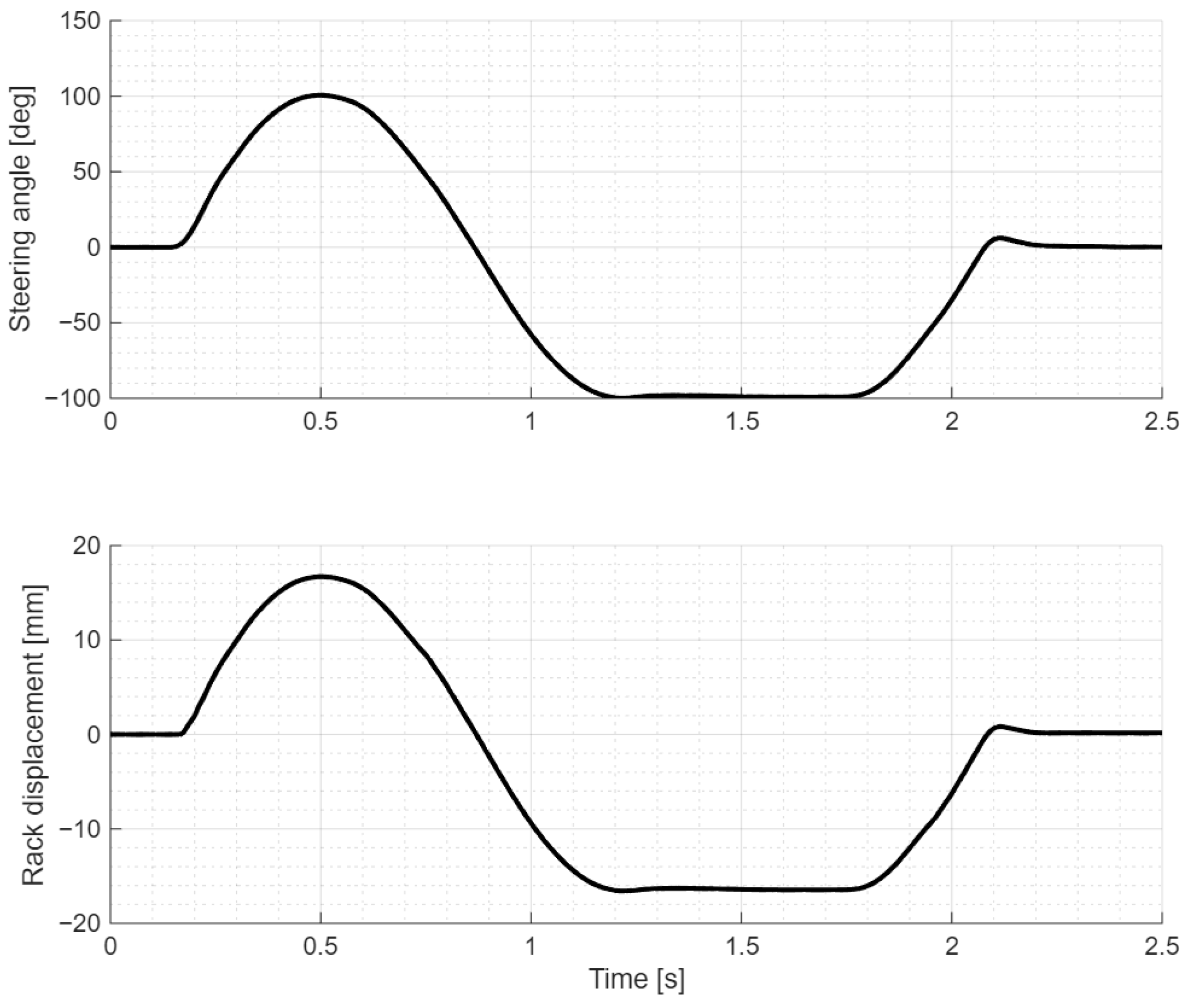
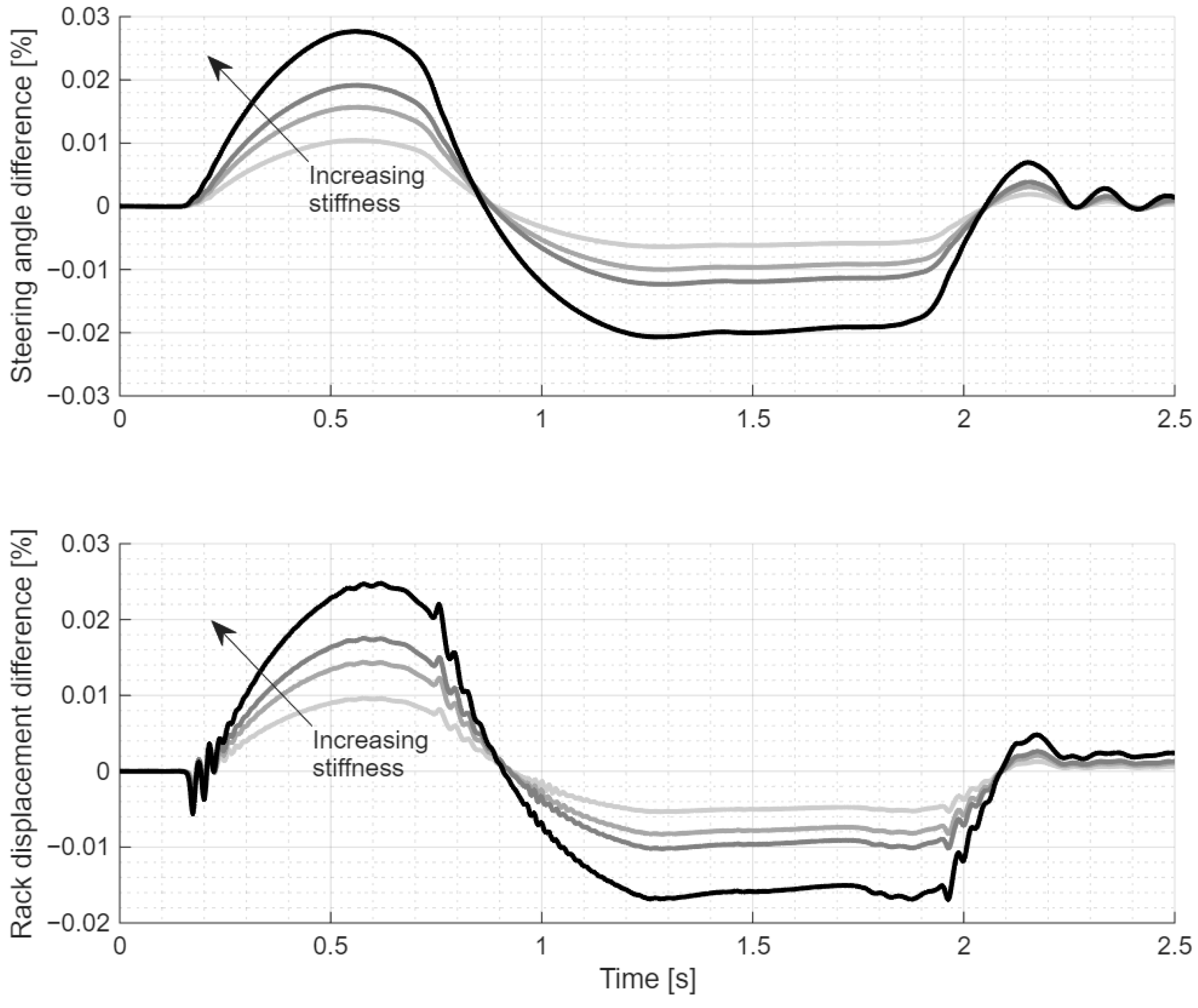
Once the simulation architecture was validated through experimental data the response of the new actuator equipped with the additional torque sensor was investigated. The main focus was to investigate how the introduction of the new steering system affects the steering system dynamics both during active and passive maneuvers. The first set of tests uses as input a steering torque sine sweep to estimate the frequency response function between the steering torque and the steering angle and between the steering torque and the rack displacement. A sensitivity study was carried out by varying the torsion bar stiffness associated with the sensor to highlight the effect of the added compliance on resonance placement and phase lag. As shown in Figure 12 the introduction of the new compliance reduces the effective column stiffness, shifting resonance toward lower frequencies and affecting the dynamics of the passive system. The lower the torsion bar stiffness, the higher the difference with the original system. Figure 13 instead shows that the introduction of the additional torque sensor does not affect the steering system response. The torque contribution given by the EPS suppresses the influence of the added compliance, preserving the baseline system response. The influence of the additional TAS was further investigated by simulating a sine-with-dwell maneuver, presented in Figure 14. Figure 15 shows the % difference between the steering angle and rack displacement profile and the response of the original system in time. This test highlights how low the impact of the new compliance is on the steering system also during emergency maneuvers.

5. Conclusions

The development of advanced vehicle functions demands long development timelines and requires dedicated development devices, including static and dynamic simulators, HiL test benches and testing vehicles. During the final testing stages represented by hardware-in-the-loop and in-vehicle testing, free programmable actuators, which are rarely commercially available, are often required. To address this limitation, this study investigates the effectiveness of a research-oriented steering actuator architecture derived from the modification of an existing system. A co-simulation architecture that couples a vehicle model with a 3-DOF steering model that includes a modular EPS control logic was validated, comparing simulation output against on-track measurement through standardized maneuvers executed with an instrumented vehicle. The model proves to be capable of accurately reproducing the steering behavior, reflecting the real steering angle–steering torque relationship and the relationship between steering system kinematics and vehicle response. This process demonstrates the accuracy of the co-simulation model, which constitutes a validated platform to investigate the influence of the new steering actuator layout. The new steering layout integrates an additional steering torque sensor mounted behind the steering wheel. To adapt the validated modeling architecture to the new layout the inertia J , damping D and stiffness K matrices were modified, and the measurement from the additional steering sensor was used as input for the EPS control logic block. The additional compliance introduced by the sensor significantly degrades the passive (EPS off) response by lowering the effective column stiffness and shifting resonance to lower frequencies. In contrast, its impact during EPS-on operation is negligible without affecting the steering system frequency response, as the steering dynamics is dominated by EPS torque intervention. This finding proves that this actuator architecture can be a valuable solution to create a development-oriented steering actuator.

Author Contributions

Conceptualization, L.V.; methodology, L.V., A.A. and L.R.; supervision, R.C. and C.A. All authors have read and agreed to the published version of the manuscript.

Funding

This research received no external funding. The study was developed as part of a joint laboratory project between Meccanica 42, the DINFO Department (Dipartimento di Ingegneria dell’Informazione) and the DIEF Department (Dipartimento di Ingegneria Industriale) at the University of Florence.

Institutional Review Board Statement

Not applicable.

Informed Consent Statement

Not applicable.

Data Availability Statement

Raw data and simulation results supporting the conclusions of this article will be made available by the authors upon request. Regarding the mathematical models used to generate the results, they cannot be shared as they are proprietary to Meccanica 42 S.r.l.

Conflicts of Interest

The authors declare no conflicts of interest.

Abbreviations

The following abbreviations are used in this manuscript:
ACCAdaptive Cruise Control
LKALane Keeping Assist
AEBAutonomous Emergency Braking
AESAutomatic Emergency Steering
ESCElectronic Stability Control
HiLHardware-in-the-Loop
ECUElectronic Control Unit
OEMOriginal Equipment Manufacturer
CBACorner Brake Actuator
EPSElectric Power Steering
DOFDegree(s) of Freedom
TASTorque and Angle Sensor
IMUInertial Measurement Unit
MSWMeasurement Steering Wheel
ISOInternational Organization for Standardization

References

  1. Aleksa, M.; Schaub, A.; Erdelean, I.; Wittmann, S.; Soteropoulos, A.; Fürdös, A. Impact analysis of Advanced Driver Assistance Systems (ADAS) regarding road safety—Computing reduction potentials. Eur. Transp. Res. Rev. 2024, 16, 39. [Google Scholar] [CrossRef]
  2. Cicchino, J.B. Effectiveness of forward collision warning and autonomous emergency braking systems in reducing front-to-rear crash rates. Accid. Anal. Prev. 2017, 99, 142–152. [Google Scholar] [CrossRef] [PubMed]
  3. Fildes, B.; Keall, M.; Bos, N.; Lie, A.; Page, Y.; Pastor, C.; Pennisi, L.; Rizzi, M.; Thomas, P.; Tingvall, C. Effectiveness of low speed autonomous emergency braking in real-world rear-end crashes. Accid. Anal. Prev. 2015, 81, 24–29. [Google Scholar] [CrossRef] [PubMed]
  4. Zhang, N.; Tian, R.; Fu, G. Design and application of automatic driving emergency collision avoidance control algorithm based on artificial intelligence technology. Meas. Sens. 2024, 33, 101248. [Google Scholar] [CrossRef]
  5. Winner, H.; Hakuli, S.; Lotz, F.; Singer, C. Handbook of Driver Assistance Systems; Springer International Publishing: Berlin/Heidelberg, Germany, 2016; pp. 1–1602. [Google Scholar] [CrossRef]
  6. Alfatti, F.; Montani, M.; Favilli, T.; Annicchiarico, C.; Berzi, L.; Pierini, M.; Pugi, L.; Capitani, R. Implementation and Performances Evaluation of Advanced Automotive Lateral Stability Controls on a Real-Time Hardware in the Loop Driving Simulator. Appl. Sci. 2023, 13, 6592. [Google Scholar] [CrossRef]
  7. Veneroso, L.; Alfatti, F.; Annicchiarico, C.; Capitani, R. Modelling, testing and validation of an innovative AEB control logic on a Hardware-in-the-loop test bench. IOP Conf. Ser. Mater. Sci. Eng. 2023, 1275, 012041. [Google Scholar] [CrossRef]
  8. Galko, C.; Rossi, R.; Savatier, X. Vehicle-Hardware-In-The-Loop system for ADAS prototyping and validation. In 2014 International Conference on Embedded Computer Systems: Architectures, Modeling, and Simulation (SAMOS XIV); IEEE: Piscataway, NJ, USA, 2014; pp. 329–334. [Google Scholar] [CrossRef]
  9. Montani, M.; Vitaliti, D.; Capitani, R.; Annicchiarico, C. Performance Review of Three Car Integrated ABS Types: Development of a Tire Independent Wheel Speed Control. Energies 2020, 13, 6183. [Google Scholar] [CrossRef]
  10. Fang, S.J.; Lv, Q.T. EPS Sensor Torsion Bar Design and Structure Analysis. MATEC Web Conf. 2018, 232, 04051. [Google Scholar] [CrossRef][Green Version]
  11. Harrer, M.; Pfeffer, P. Steering Handbook; Springer International Publishing: Berlin/Heidelberg, Germany, 2016; pp. 1–565. [Google Scholar] [CrossRef]
  12. Weiskircher, T.; Fankem, S.; Ayalew, B. Rack force estimation for electric power steering. Proc. ASME Des. Eng. Tech. Conf. 2015, 3, V003T01A007. [Google Scholar] [CrossRef]
  13. de Wit, C.C.; Olsson, H.; Astrom, K.; Lischinsky, P. A new model for control of systems with friction. IEEE Trans. Autom. Control 1995, 40, 419–425. [Google Scholar] [CrossRef]
  14. de Wit, C.C.; Lischinsky, P. Adaptive friction compensation with partially known dynamic friction model. Int. J. Adapt. Control Signal Process. 1997, 11, 65–80. [Google Scholar] [CrossRef]
  15. He, Z.; Gu, M. Dynamic Research on Control Strategy of Electric Power Steering System; SAE Technical Papers; SAE: Warrendale, PA, USA, 2012. [Google Scholar] [CrossRef]
  16. Fankem, S.; Müller, S. A new model to compute the desired steering torque for steer-by-wire vehicles and driving simulators. Veh. Syst. Dyn. 2014, 52, 251–271. [Google Scholar] [CrossRef]
  17. Brocker, M. New control algorithms for steering feel improvements of an electric powered steering system with belt drive. Veh. Syst. Dyn. 2006, 44, 759–769. [Google Scholar] [CrossRef]
  18. ISO 7401:2011; Road Vehicles—Lateral Transient Response Test Methods—Open-Loop Test Methods. International Organization for Standardization: Geneva, Switzerland, 2011.
  19. ISO 19365:2020; Passenger Cars—Validation of vEhicle Dynamic Simulation—Sine with Dwell Stability Control Testing. International Organization for Standardization: Geneva, Switzerland, 2020.
Figure 1. Co-simulation model architecture.
Engproc 131 00016 g001
Figure 2. Steering system input shaft, torsion bar and pinion assembly.
Engproc 131 00016 g002
Figure 3. LuGre friction model and 2-DOF stiffness characteristics.
Engproc 131 00016 g003
Figure 4. Assistance boost curve lookup table.
Engproc 131 00016 g004
Figure 5. Return to center target velocity lookup table.
Engproc 131 00016 g005
Figure 6. Damping torque lookup table.
Engproc 131 00016 g006
Figure 7. Instrumented vehicle and steering robot used for track tests.
Engproc 131 00016 g007
Figure 8. Comparison between experimental and model data: steering torque against steering angle (on-center feel plot).
Engproc 131 00016 g008
Figure 9. Comparison between experimental and model data: yaw rate against steering angle.
Engproc 131 00016 g009
Figure 10. Comparison between experimental and model data: lateral acceleration against steering angle.
Engproc 131 00016 g010
Figure 11. Comparison between experimental and model data: rack force against rack displacement.
Engproc 131 00016 g011
Figure 12. Steering torque-to-steering angle and steering torque-to-rack displacement frequency response with passive EPS.
Engproc 131 00016 g012
Figure 13. Steering torque-to-steering angle and steering torque-to-rack displacement frequency response with active EPS.
Engproc 131 00016 g013
Figure 14. Sine-with-dwell maneuver.
Engproc 131 00016 g014
Figure 15. Sine-with-dwell maneuver difference between original and modified actuator.
Engproc 131 00016 g015
Table 1. Measurement device and signals.
Measurement DeviceSignalRangeAccuracy
Steering wheel
measurement
(MSW)
Steering wheel torque±50 Nm±0.1 Nm
Steering wheel angle± 1250 ± 0.1
Steering wheel velocity< 2000 /s-
Linear
potentiometer
Rack displacement±190.5 mm0.48 mm
Load cellTie-rod force±20 kN±1%
Correvit
S-motion
Longitudinal velocity0–69.4 m/s±0.35 m/s
Lateral velocity±12 m/s±0.1 m/s
Slip angle± 30 0.1
Inertial
measurement
unit
(IMU)
Longitudinal acceleration±40.0 m/ s 2 ±0.04 m/ s 2
Lateral acceleration±40.0 m/ s 2 ±0.04 m/ s 2
Vertical acceleration±40.0 m/ s 2 ±0.04 m/ s 2
Roll angle 360 ± 0.1
Pitch angle 360 ± 0.1
Yaw angle 360 ± 0.8
Yaw velocity± 2000 /s± 0.1 /s
Disclaimer/Publisher’s Note: The statements, opinions and data contained in all publications are solely those of the individual author(s) and contributor(s) and not of MDPI and/or the editor(s). MDPI and/or the editor(s) disclaim responsibility for any injury to people or property resulting from any ideas, methods, instructions or products referred to in the content.