Modeling of a Development-Oriented Steering Actuator †
 , , , and
Abstract
1. Introduction
2. Simulation Model
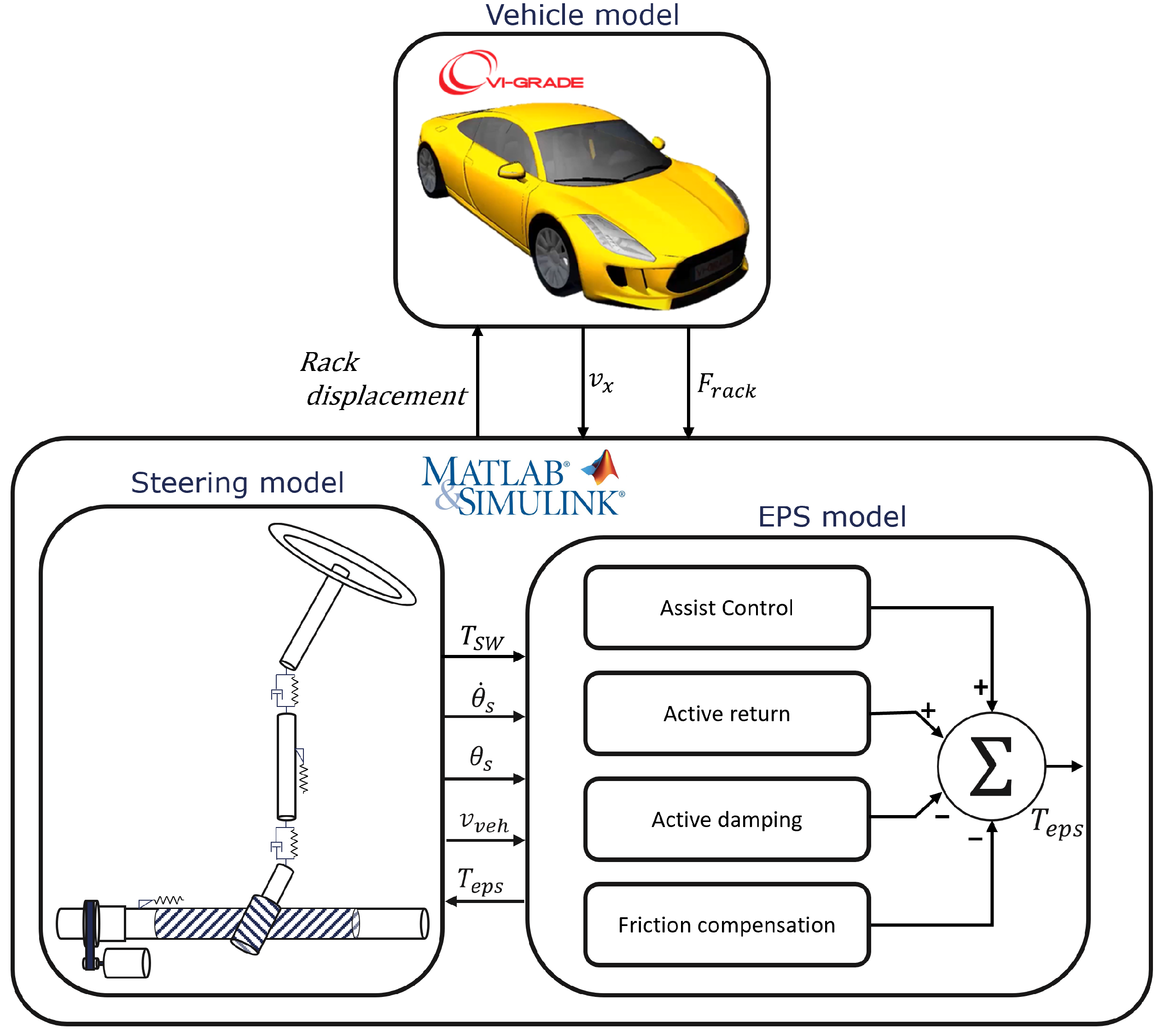
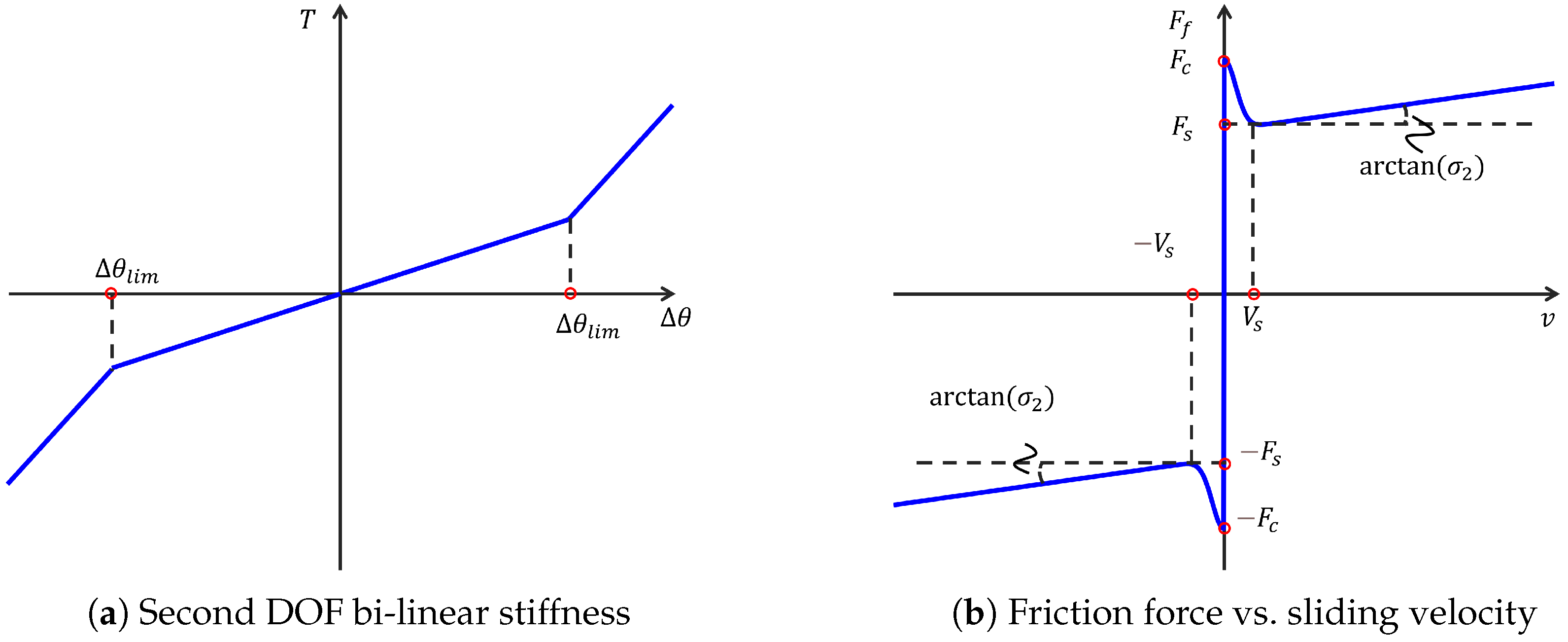
2.1. Steering Mechanical Model
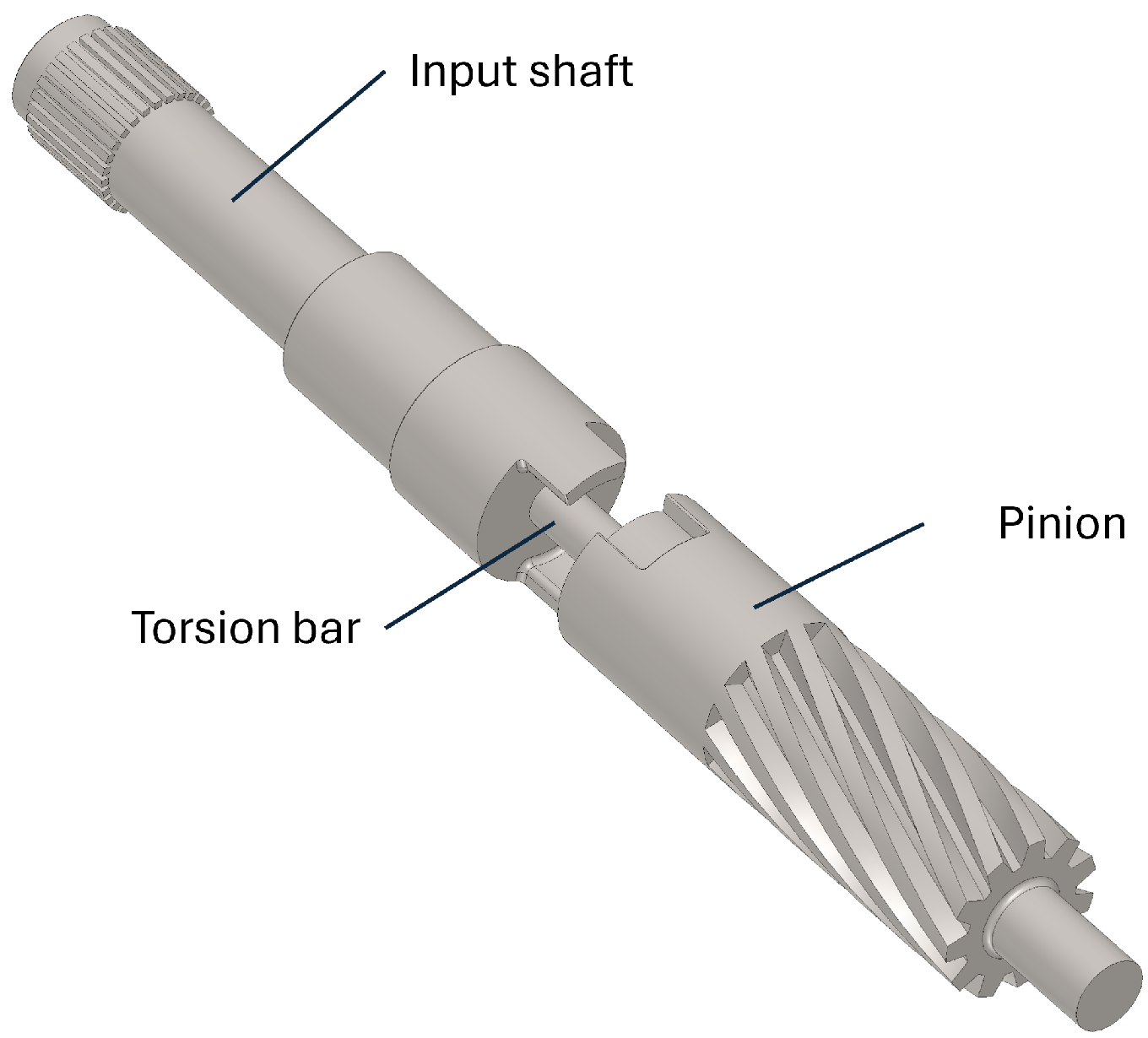
- The input shaft allows the connection between the last Cardan joint and one of the ends of the torsion bar, which is pressed inside a drilled hole.
- The torsion bar works as a flexible connection between the input shaft and the pinion. The maximum twist angle is limited by a mechanical endstop.
- The pinion represents the connection between the other end of the torsion bar, forced inside a drilled hole, and the rack.
2.2. EPS Model
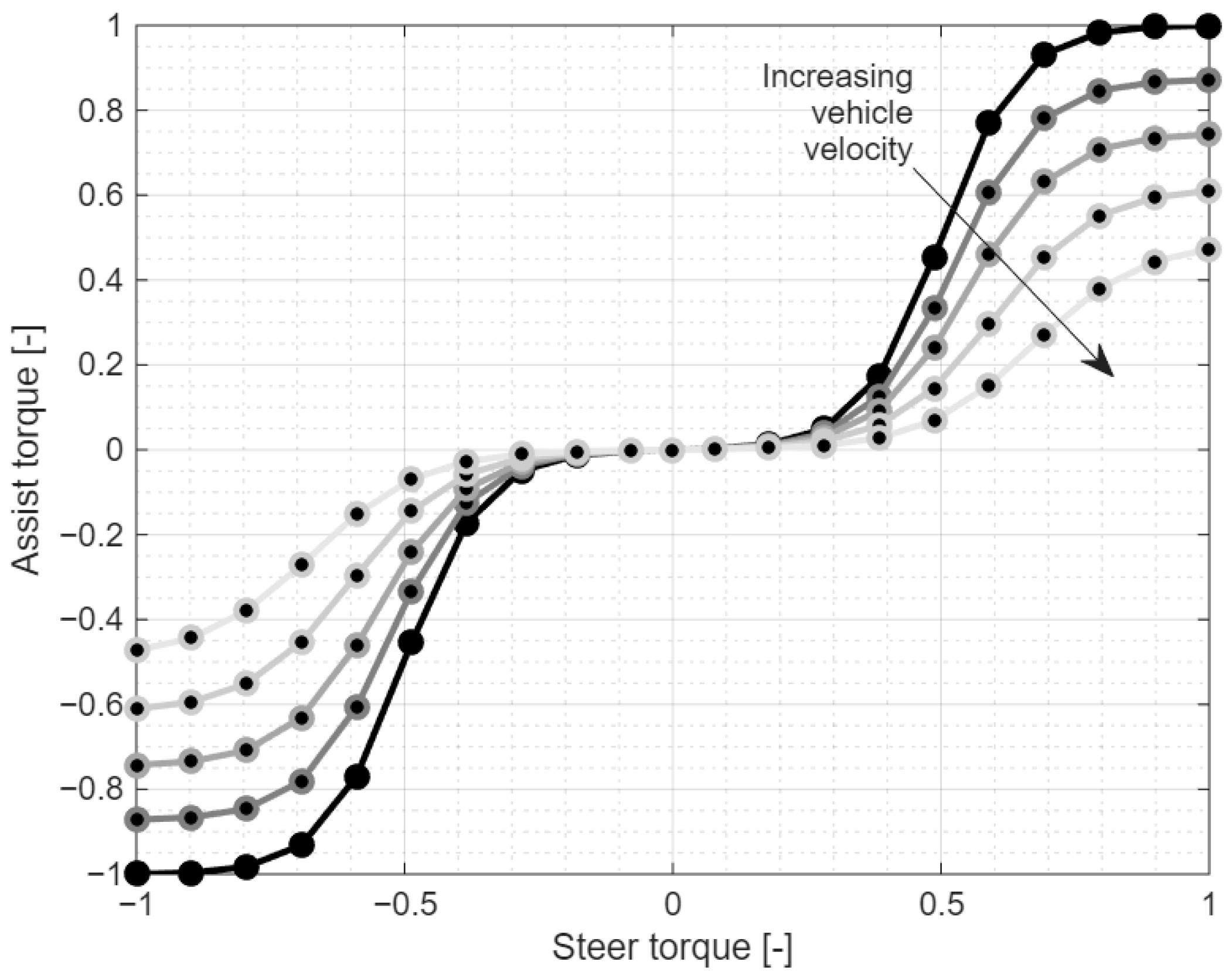
2.3. Power Assist
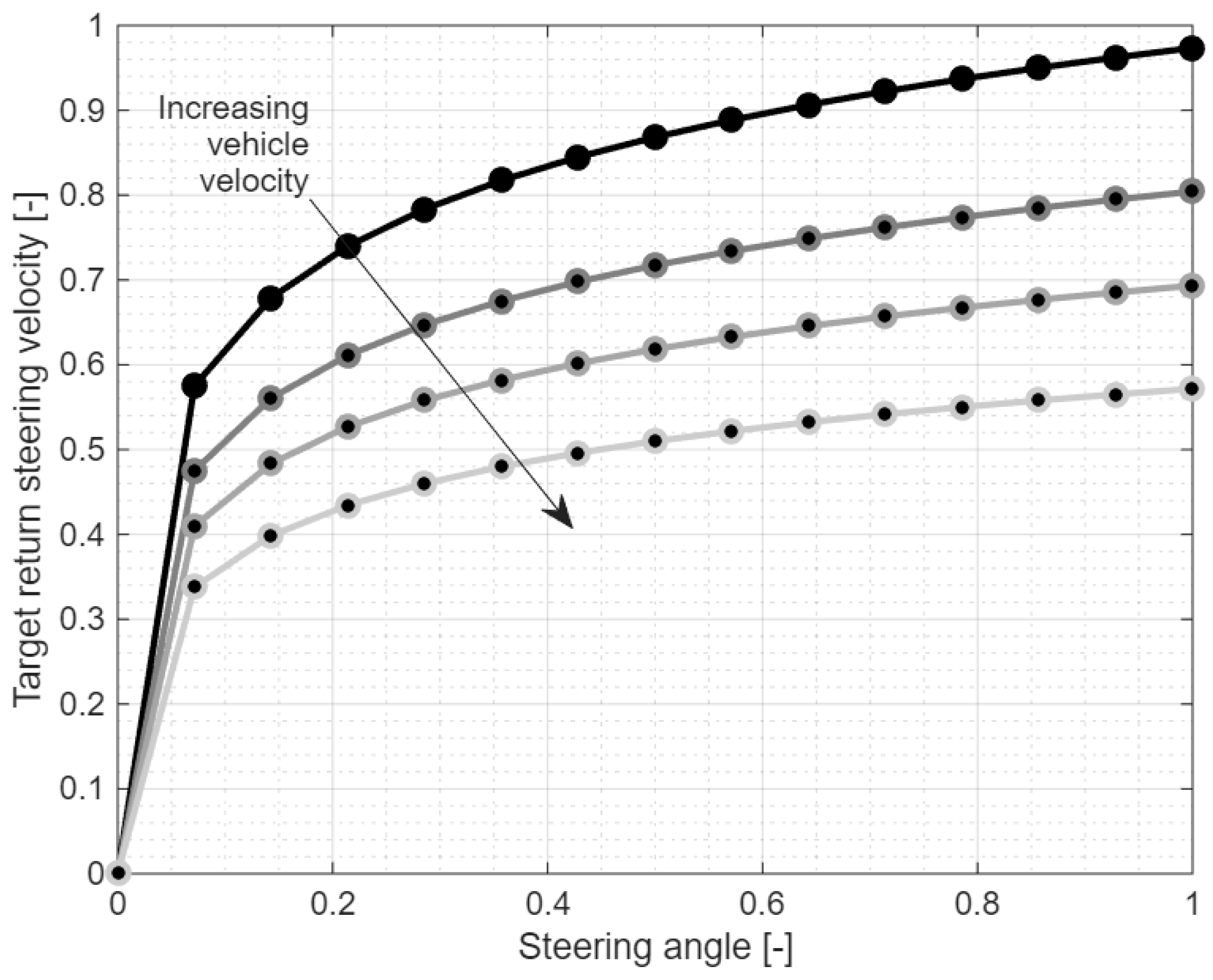
2.4. Active Return
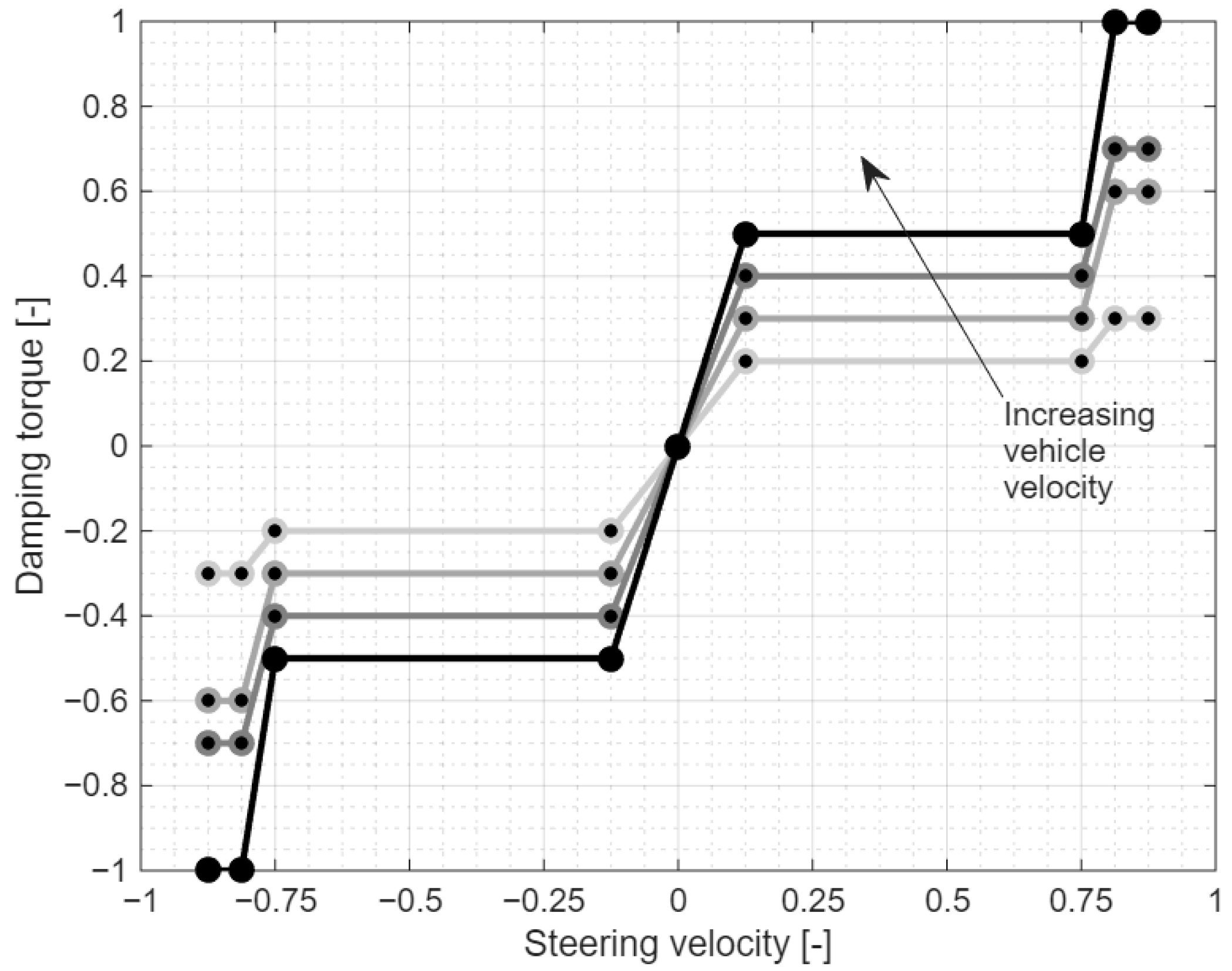
2.5. Active Damping
2.6. Friction Compensation
3. Track Test
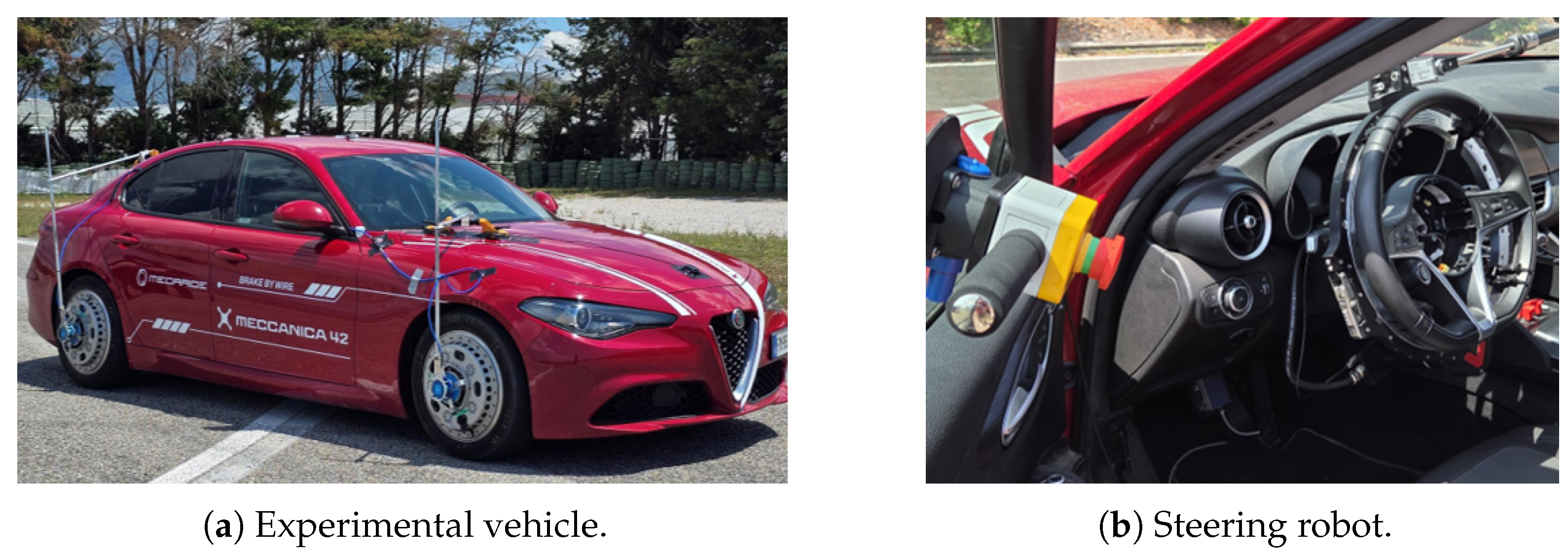
3.1. Test Vehicle Instrumentation
3.2. Steering Robot and Test Protocol
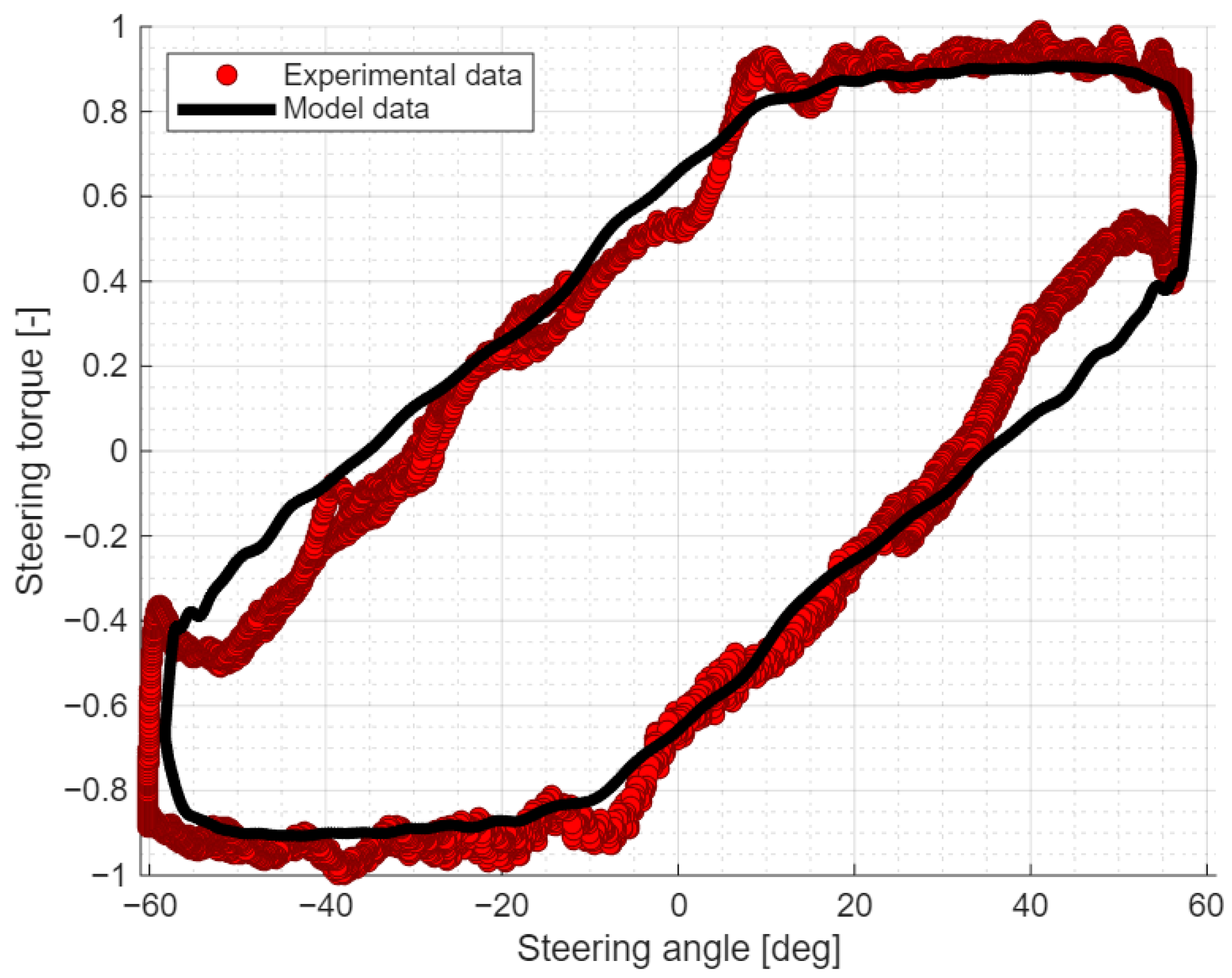
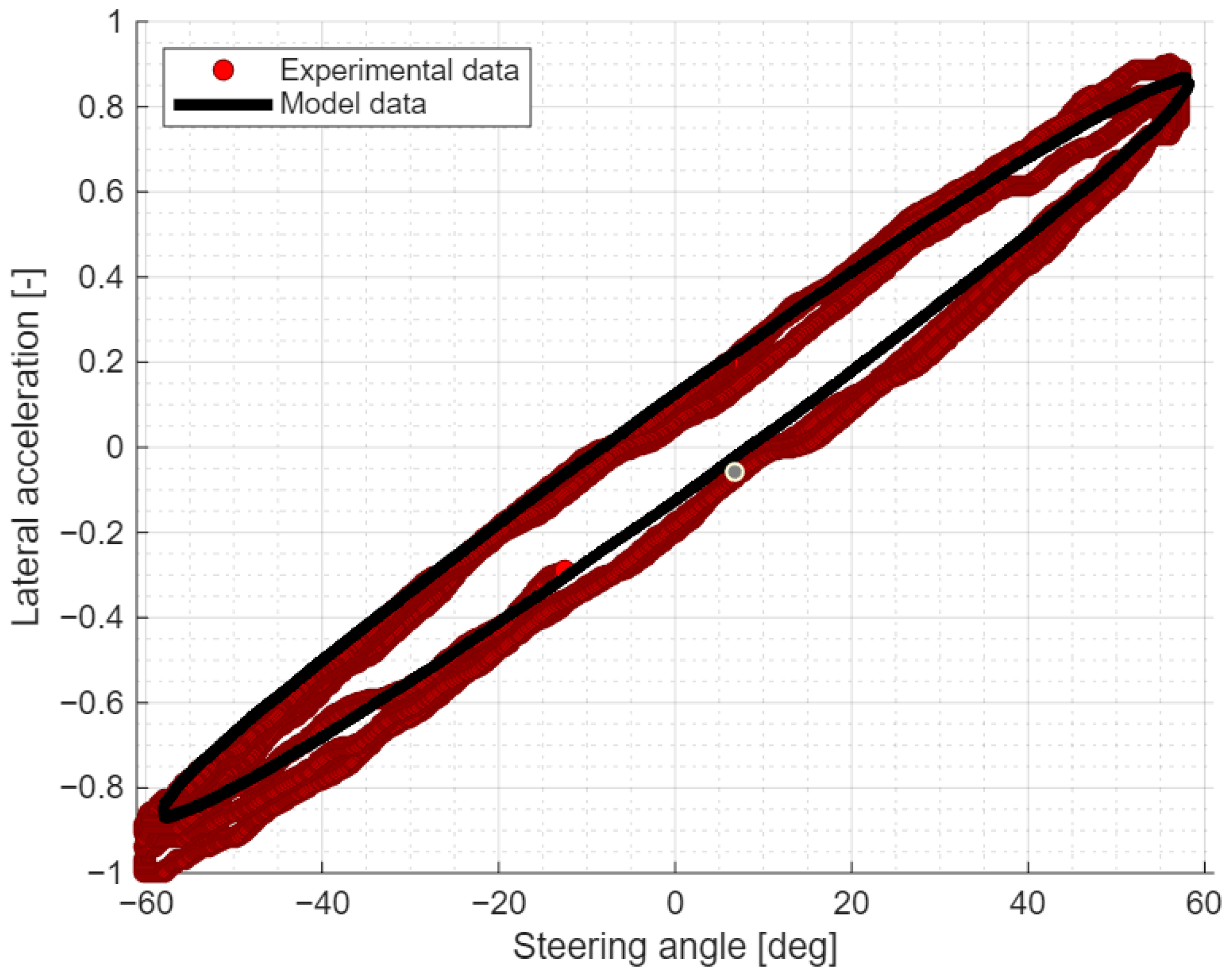
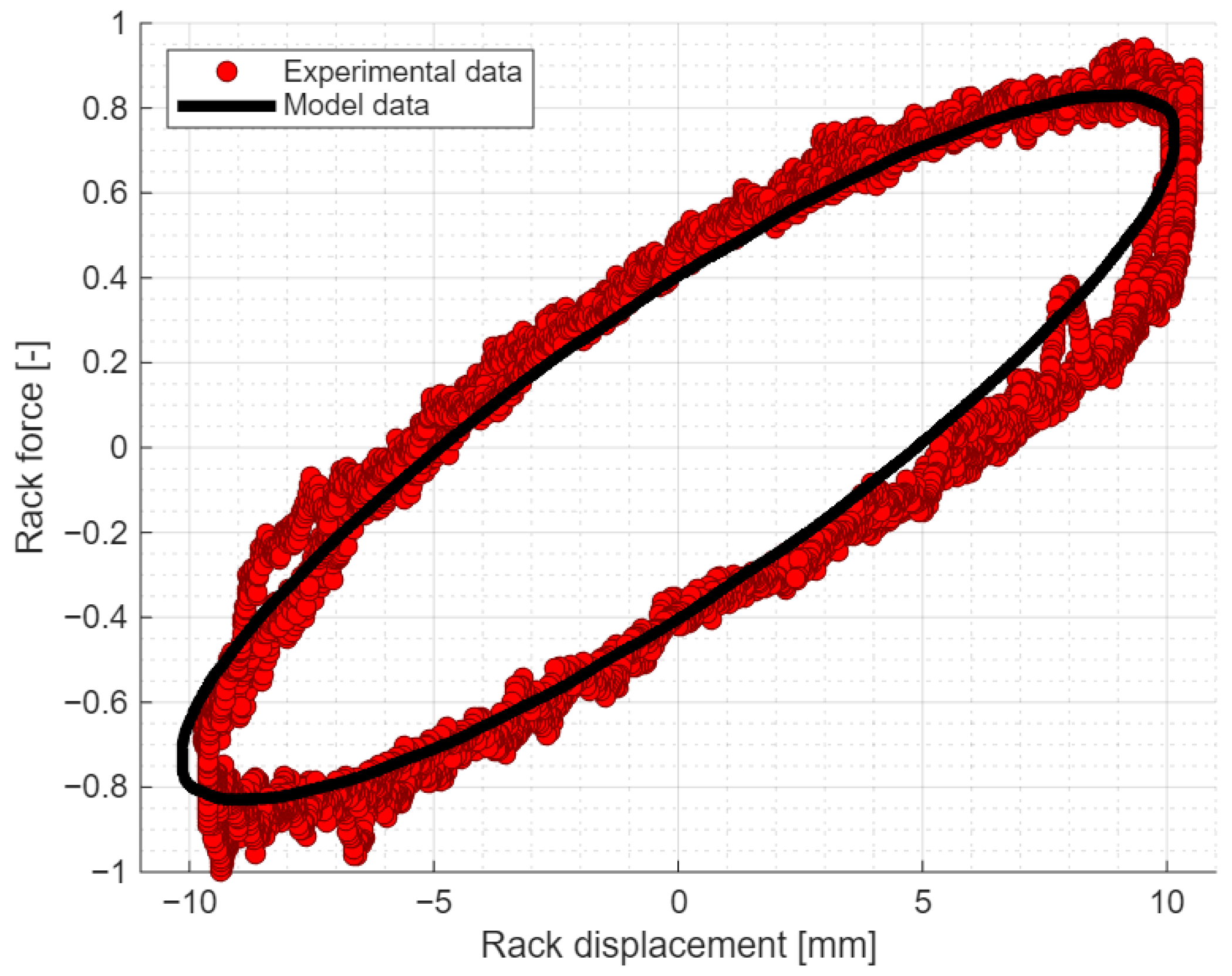
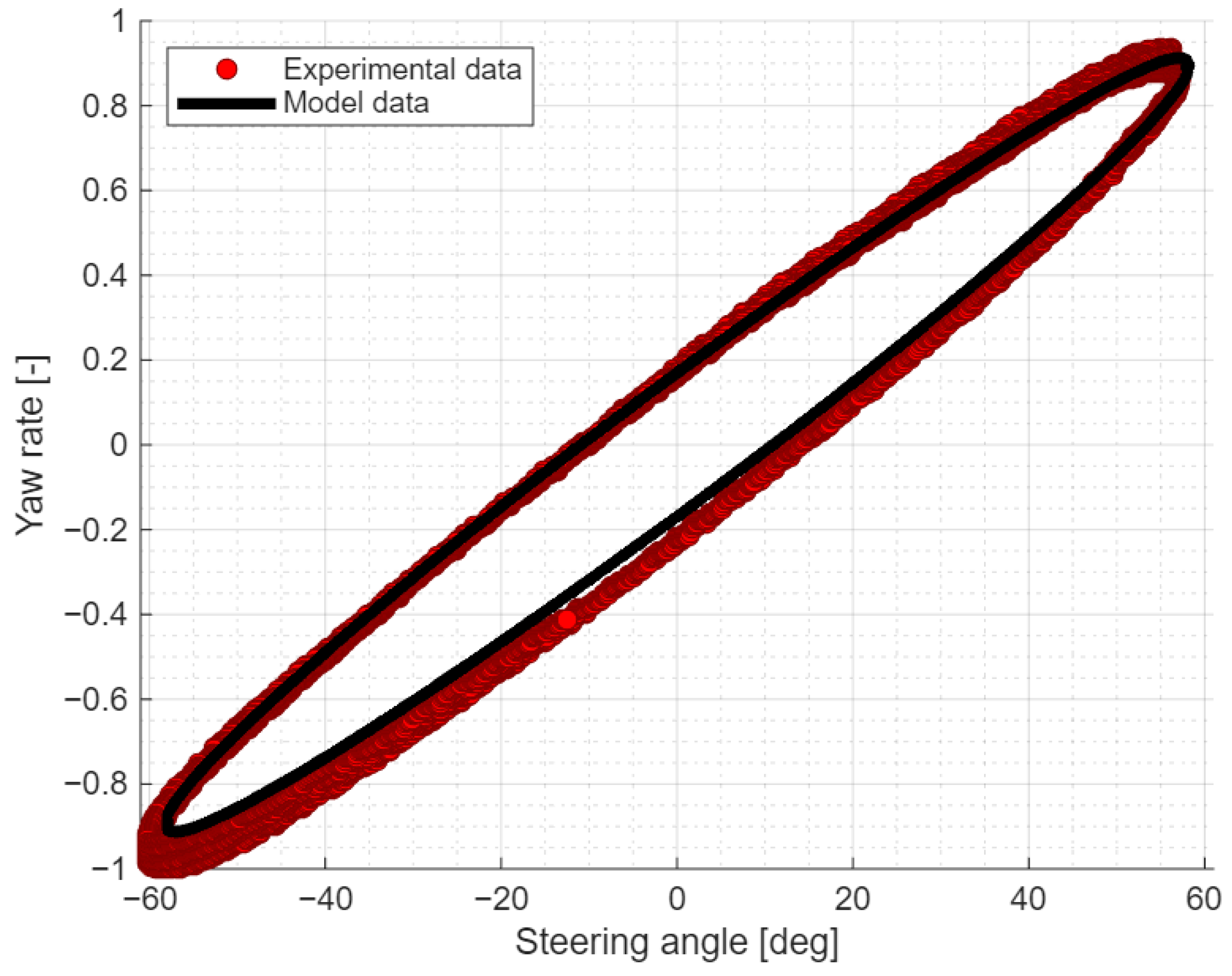
4. Model Validation
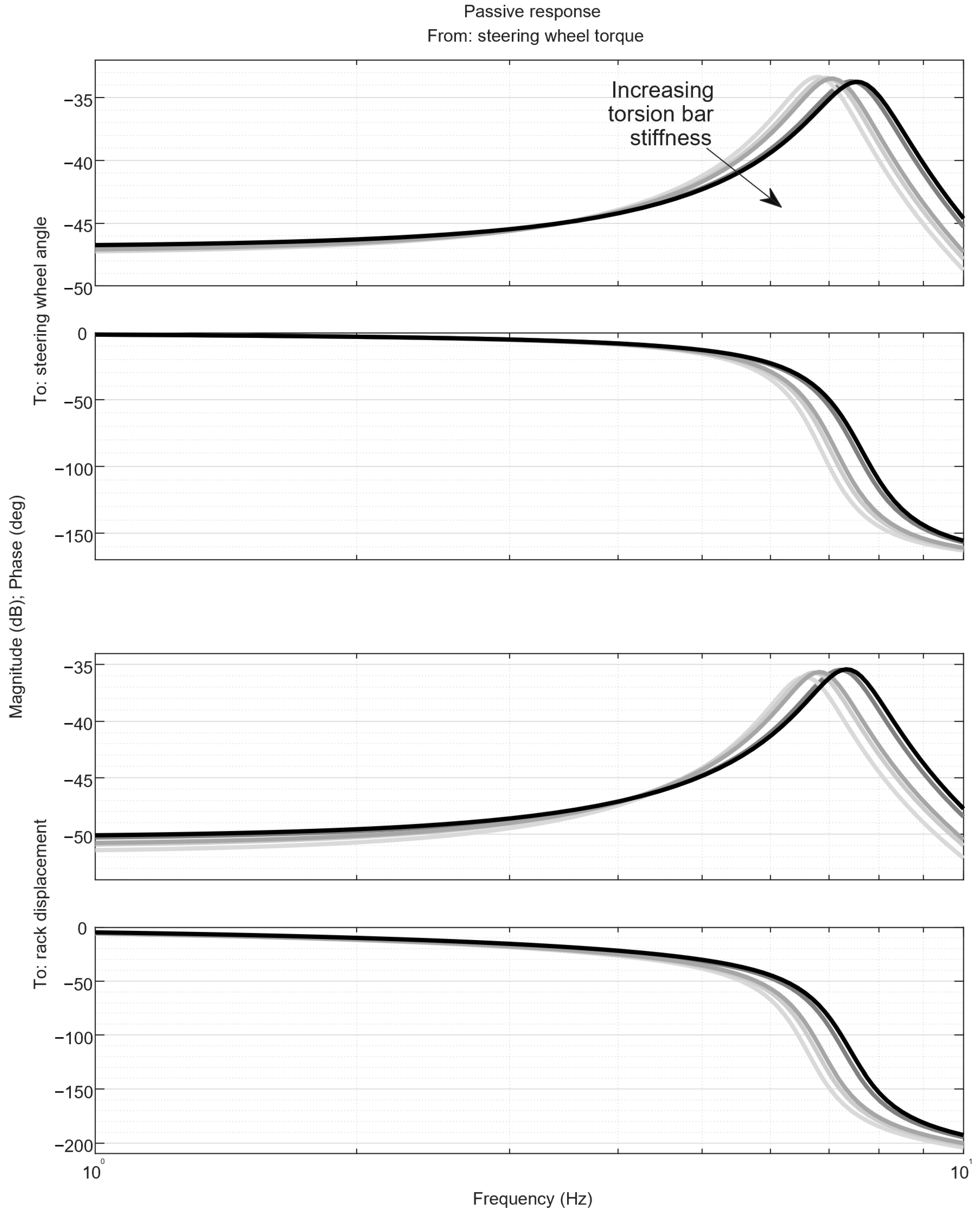
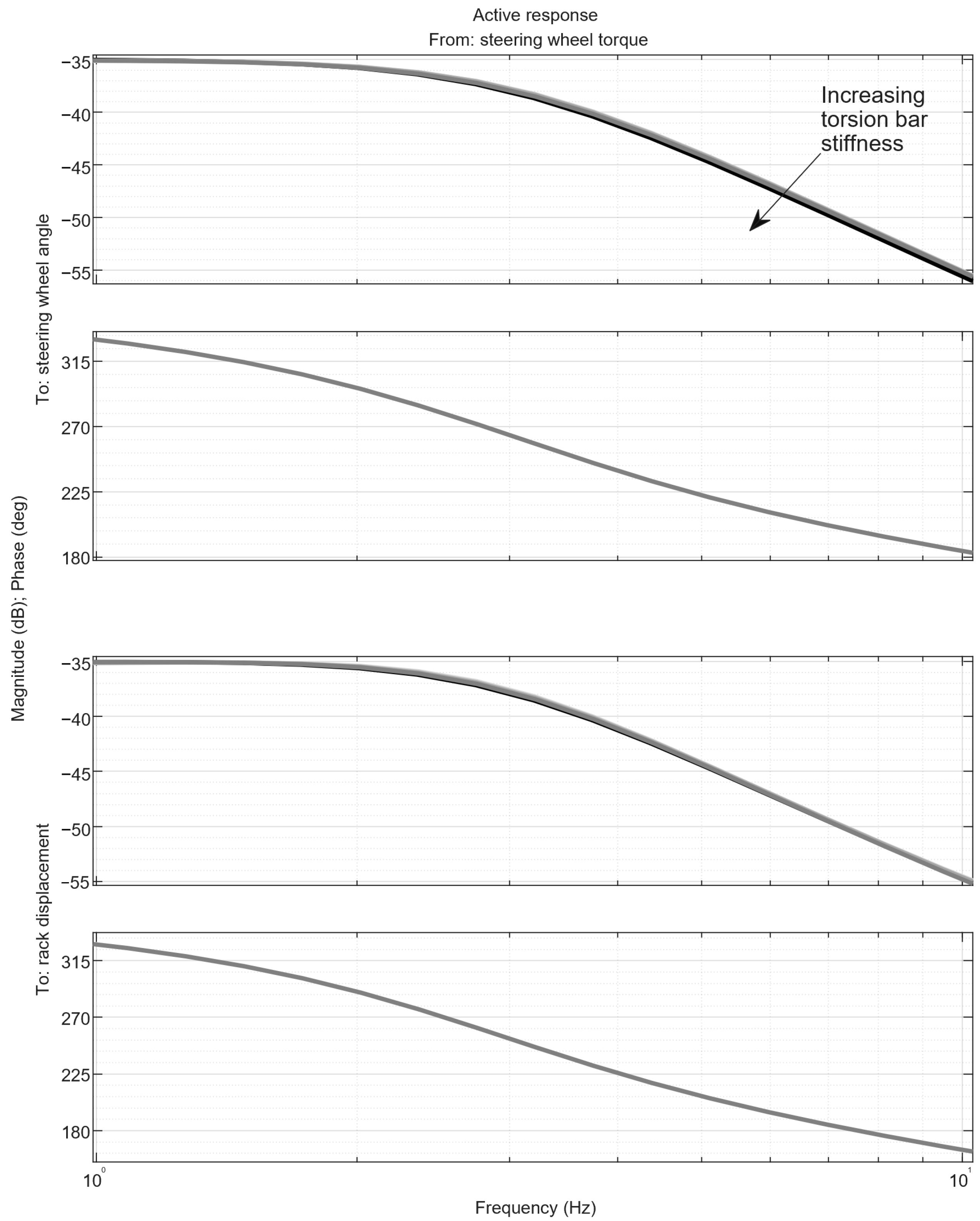
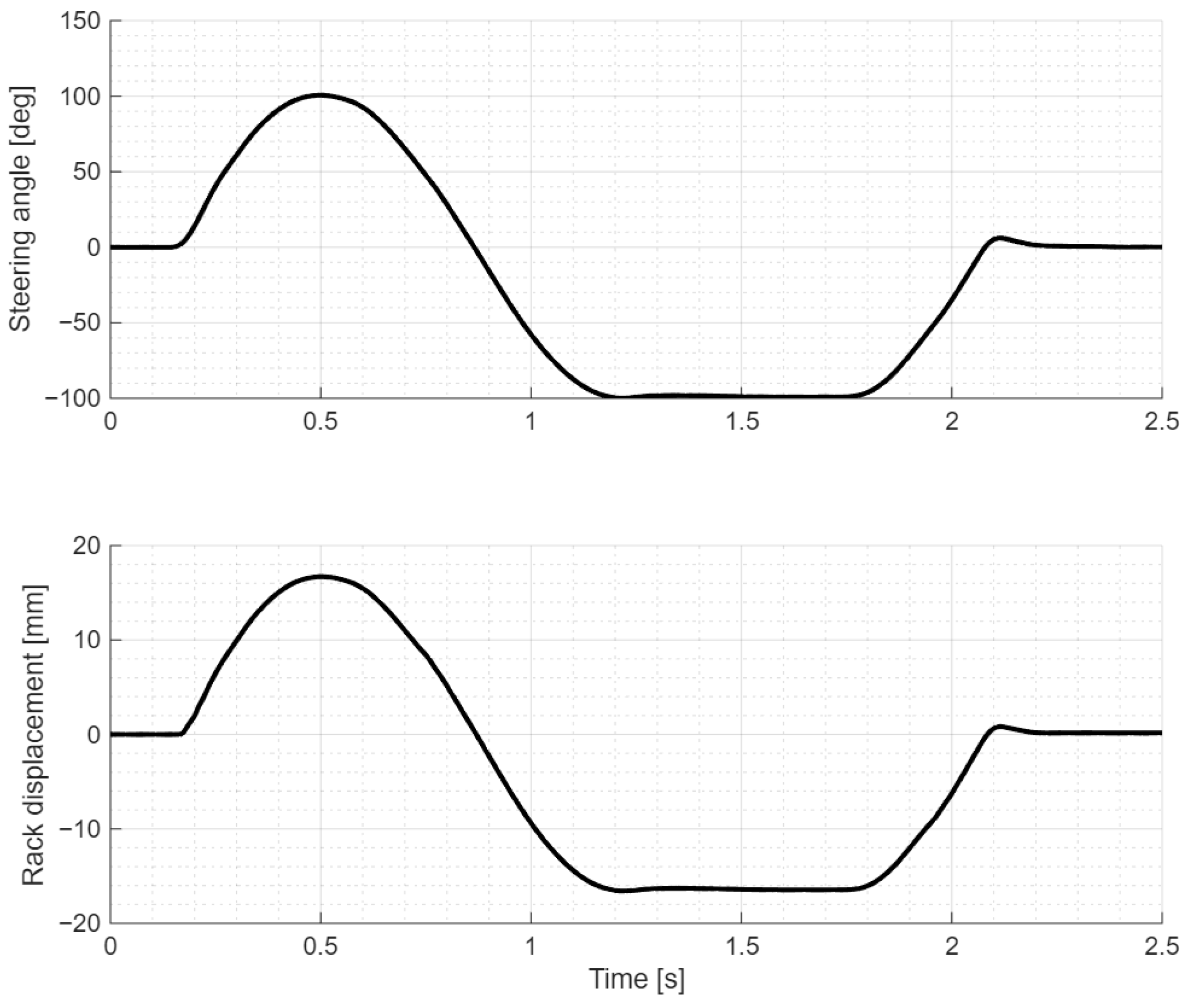
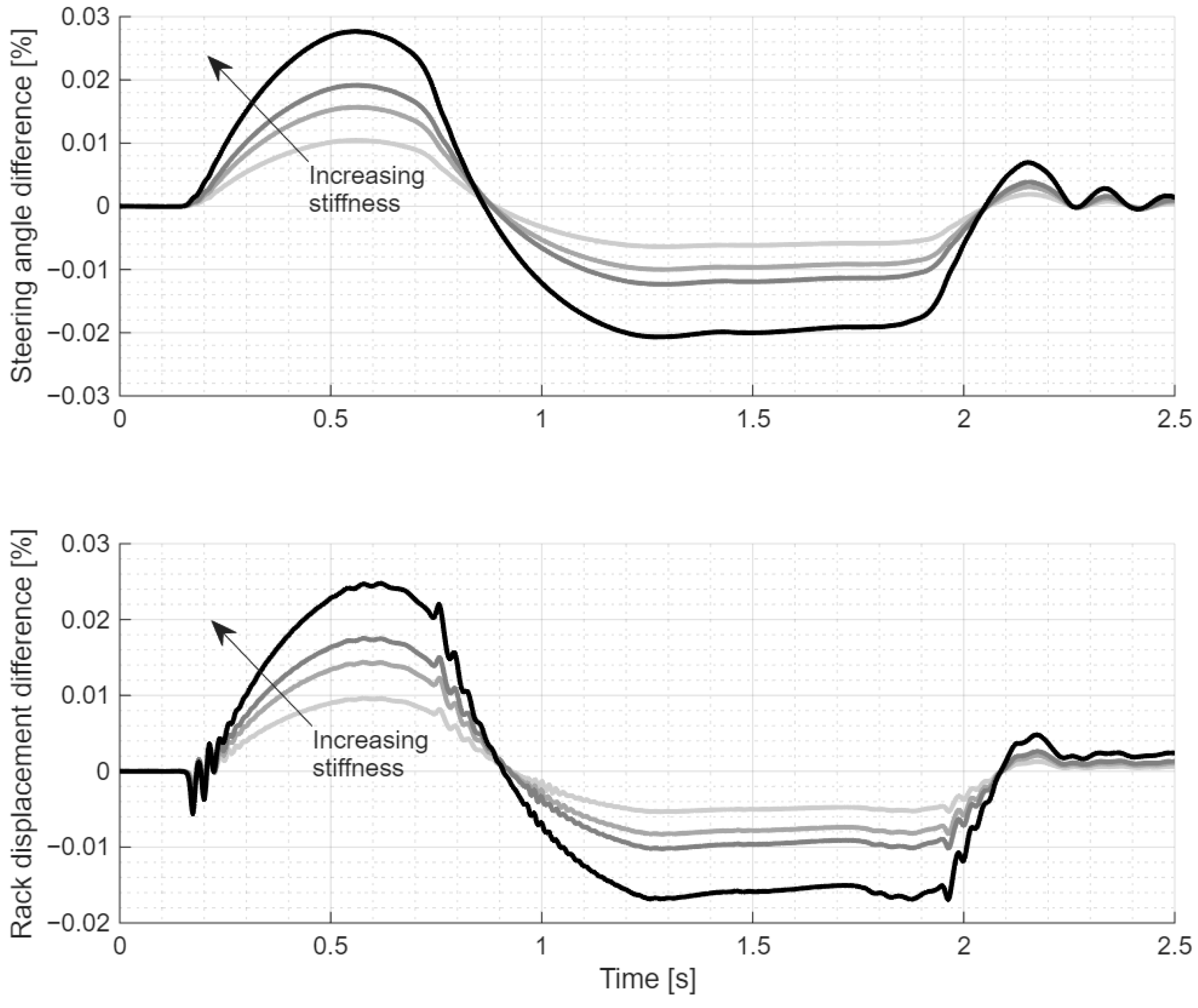
Impact of Additional Torque Sensor
5. Conclusions
Author Contributions
Funding
Institutional Review Board Statement
Informed Consent Statement
Data Availability Statement
Conflicts of Interest
Abbreviations
| ACC | Adaptive Cruise Control |
| LKA | Lane Keeping Assist |
| AEB | Autonomous Emergency Braking |
| AES | Automatic Emergency Steering |
| ESC | Electronic Stability Control |
| HiL | Hardware-in-the-Loop |
| ECU | Electronic Control Unit |
| OEM | Original Equipment Manufacturer |
| CBA | Corner Brake Actuator |
| EPS | Electric Power Steering |
| DOF | Degree(s) of Freedom |
| TAS | Torque and Angle Sensor |
| IMU | Inertial Measurement Unit |
| MSW | Measurement Steering Wheel |
| ISO | International Organization for Standardization |
References
- Aleksa, M.; Schaub, A.; Erdelean, I.; Wittmann, S.; Soteropoulos, A.; Fürdös, A. Impact analysis of Advanced Driver Assistance Systems (ADAS) regarding road safety—Computing reduction potentials. Eur. Transp. Res. Rev. 2024, 16, 39. [Google Scholar] [CrossRef]
- Cicchino, J.B. Effectiveness of forward collision warning and autonomous emergency braking systems in reducing front-to-rear crash rates. Accid. Anal. Prev. 2017, 99, 142–152. [Google Scholar] [CrossRef] [PubMed]
- Fildes, B.; Keall, M.; Bos, N.; Lie, A.; Page, Y.; Pastor, C.; Pennisi, L.; Rizzi, M.; Thomas, P.; Tingvall, C. Effectiveness of low speed autonomous emergency braking in real-world rear-end crashes. Accid. Anal. Prev. 2015, 81, 24–29. [Google Scholar] [CrossRef] [PubMed]
- Zhang, N.; Tian, R.; Fu, G. Design and application of automatic driving emergency collision avoidance control algorithm based on artificial intelligence technology. Meas. Sens. 2024, 33, 101248. [Google Scholar] [CrossRef]
- Winner, H.; Hakuli, S.; Lotz, F.; Singer, C. Handbook of Driver Assistance Systems; Springer International Publishing: Berlin/Heidelberg, Germany, 2016; pp. 1–1602. [Google Scholar] [CrossRef]
- Alfatti, F.; Montani, M.; Favilli, T.; Annicchiarico, C.; Berzi, L.; Pierini, M.; Pugi, L.; Capitani, R. Implementation and Performances Evaluation of Advanced Automotive Lateral Stability Controls on a Real-Time Hardware in the Loop Driving Simulator. Appl. Sci. 2023, 13, 6592. [Google Scholar] [CrossRef]
- Veneroso, L.; Alfatti, F.; Annicchiarico, C.; Capitani, R. Modelling, testing and validation of an innovative AEB control logic on a Hardware-in-the-loop test bench. IOP Conf. Ser. Mater. Sci. Eng. 2023, 1275, 012041. [Google Scholar] [CrossRef]
- Galko, C.; Rossi, R.; Savatier, X. Vehicle-Hardware-In-The-Loop system for ADAS prototyping and validation. In 2014 International Conference on Embedded Computer Systems: Architectures, Modeling, and Simulation (SAMOS XIV); IEEE: Piscataway, NJ, USA, 2014; pp. 329–334. [Google Scholar] [CrossRef]
- Montani, M.; Vitaliti, D.; Capitani, R.; Annicchiarico, C. Performance Review of Three Car Integrated ABS Types: Development of a Tire Independent Wheel Speed Control. Energies 2020, 13, 6183. [Google Scholar] [CrossRef]
- Fang, S.J.; Lv, Q.T. EPS Sensor Torsion Bar Design and Structure Analysis. MATEC Web Conf. 2018, 232, 04051. [Google Scholar] [CrossRef][Green Version]
- Harrer, M.; Pfeffer, P. Steering Handbook; Springer International Publishing: Berlin/Heidelberg, Germany, 2016; pp. 1–565. [Google Scholar] [CrossRef]
- Weiskircher, T.; Fankem, S.; Ayalew, B. Rack force estimation for electric power steering. Proc. ASME Des. Eng. Tech. Conf. 2015, 3, V003T01A007. [Google Scholar] [CrossRef]
- de Wit, C.C.; Olsson, H.; Astrom, K.; Lischinsky, P. A new model for control of systems with friction. IEEE Trans. Autom. Control 1995, 40, 419–425. [Google Scholar] [CrossRef]
- de Wit, C.C.; Lischinsky, P. Adaptive friction compensation with partially known dynamic friction model. Int. J. Adapt. Control Signal Process. 1997, 11, 65–80. [Google Scholar] [CrossRef]
- He, Z.; Gu, M. Dynamic Research on Control Strategy of Electric Power Steering System; SAE Technical Papers; SAE: Warrendale, PA, USA, 2012. [Google Scholar] [CrossRef]
- Fankem, S.; Müller, S. A new model to compute the desired steering torque for steer-by-wire vehicles and driving simulators. Veh. Syst. Dyn. 2014, 52, 251–271. [Google Scholar] [CrossRef]
- Brocker, M. New control algorithms for steering feel improvements of an electric powered steering system with belt drive. Veh. Syst. Dyn. 2006, 44, 759–769. [Google Scholar] [CrossRef]
- ISO 7401:2011; Road Vehicles—Lateral Transient Response Test Methods—Open-Loop Test Methods. International Organization for Standardization: Geneva, Switzerland, 2011.
- ISO 19365:2020; Passenger Cars—Validation of vEhicle Dynamic Simulation—Sine with Dwell Stability Control Testing. International Organization for Standardization: Geneva, Switzerland, 2020.








| Measurement Device | Signal | Range | Accuracy |
|---|---|---|---|
| Steering wheel measurement (MSW) | Steering wheel torque | ±50 Nm | ±0.1 Nm |
| Steering wheel angle | ± | ± | |
| Steering wheel velocity | </s | - | |
| Linear potentiometer | Rack displacement | ±190.5 mm | 0.48 mm |
| Load cell | Tie-rod force | ±20 kN | ±1% |
| Correvit S-motion | Longitudinal velocity | 0–69.4 m/s | ±0.35 m/s |
| Lateral velocity | ±12 m/s | ±0.1 m/s | |
| Slip angle | ± | <± | |
| Inertial measurement unit (IMU) | Longitudinal acceleration | ±40.0 m/ | ±0.04 m/ |
| Lateral acceleration | ±40.0 m/ | ±0.04 m/ | |
| Vertical acceleration | ±40.0 m/ | ±0.04 m/ | |
| Roll angle | ± | ||
| Pitch angle | ± | ||
| Yaw angle | ± | ||
| Yaw velocity | ±/s | ±/s |
Disclaimer/Publisher’s Note: The statements, opinions and data contained in all publications are solely those of the individual author(s) and contributor(s) and not of MDPI and/or the editor(s). MDPI and/or the editor(s) disclaim responsibility for any injury to people or property resulting from any ideas, methods, instructions or products referred to in the content. |
© 2026 by the authors. Licensee MDPI, Basel, Switzerland. This article is an open access article distributed under the terms and conditions of the Creative Commons Attribution (CC BY) license.
Share and Cite
Veneroso, L.; Anticaglia, A.; Ronchi, L.; Annicchiarico, C.; Capitani, R. Modeling of a Development-Oriented Steering Actuator. Eng. Proc. 2026, 131, 16. https://doi.org/10.3390/engproc2026131016
Veneroso L, Anticaglia A, Ronchi L, Annicchiarico C, Capitani R. Modeling of a Development-Oriented Steering Actuator. Engineering Proceedings. 2026; 131(1):16. https://doi.org/10.3390/engproc2026131016
Chicago/Turabian StyleVeneroso, Luca, Alessio Anticaglia, Leandro Ronchi, Claudio Annicchiarico, and Renzo Capitani. 2026. "Modeling of a Development-Oriented Steering Actuator" Engineering Proceedings 131, no. 1: 16. https://doi.org/10.3390/engproc2026131016
APA StyleVeneroso, L., Anticaglia, A., Ronchi, L., Annicchiarico, C., & Capitani, R. (2026). Modeling of a Development-Oriented Steering Actuator. Engineering Proceedings, 131(1), 16. https://doi.org/10.3390/engproc2026131016