Proceeding Paper

Towards a Rapid and Cost-Effective Estimation of Fluid–Structure Interaction in Blast-Loaded Plates †

Department of Mechanical Engineering, Politecnico di Milano, 20156 Milan, Italy
*
Author to whom correspondence should be addressed.
Presented at the 54th Conference of the Italian Scientific Society of Mechanical Engineering Design (AIAS 2025), Florence, Italy, 3–6 September 2025.
Eng. Proc. 2026, 131(1), 13; https://doi.org/10.3390/engproc2026131013
Published: 27 March 2026

Abstract

Fluid–structure interaction (FSI) effects may significantly influence the dynamic response of blast-loaded structures, particularly in lightweight configurations where the structural motion modifies the pressure loading. Despite their relevance, FSI phenomena are often neglected in engineering practice, mainly due to the computational cost of fully coupled simulations and the lack of simple predictive tools. This study presents a semi-analytical framework for estimating FSI effects in free-standing blast-loaded plates. The framework relies on one-dimensional theories accounting for non-linear gas compressibility and includes both coupled and uncoupled formulations. Their comparison provides a direct quantification of the FSI contribution to the structural response. The framework was applied to two case studies from the literature, involving different blast intensities and plate areal masses. They were selected to highlight conditions in which the reflected pressure exhibits significant temporal decay while the plate is in motion, indicating relevant FSI effects. In both cases, the coupled formulation achieves excellent agreement with the observed reference data, whereas the uncoupled solution overestimates the plate velocity. These results validate the governing equations of the coupled formulation and demonstrate that they can be reliably applied to blast-loading scenarios characterised by time-decaying pressure profiles. Thus, unlike other methods in the literature, the framework extends beyond simplified loading assumptions and offers a robust basis for rapid and cost-effective estimation of FSI effects in blast-loaded plates.

1. Introduction

The response of plates subjected to blast loading has long attracted research interest due to its relevance in protective design. A common challenge in this context is the role of fluid–structure interaction (FSI), which may significantly alter the effective loading and the resulting deformation, particularly in lightweight and flexible structures [1,2,3,4,5]. When a blast wave impinges on a structure, the fluid particles are initially brought to rest, generating high stagnation pressures. As the structure begins to move, its motion produces a rarefaction that propagates into the fluid domain, thereby reducing the pressure acting on its surface. This coupling mechanism modifies the effective loading and the impulse transfer, and is generally referred to as FSI.
Traditional design approaches often treat blast waves as external actions that are not influenced by structural motion [6,7]. Although this assumption provides computational efficiency, it may not capture essential coupling mechanisms, as demonstrated by analytical and numerical studies [8,9,10].
Several analytical and semi-analytical models have been developed to interpret the influence of FSI. The early theories, originally formulated for underwater explosions, were later adapted to air-blast conditions, where compressibility effects are more pronounced [1,3]. These models have contributed to the identification of key governing parameters, such as the plate areal mass and the intensity and duration of the blast load. More recent contributions have also shown that, in many cases, the discrepancy between coupled and uncoupled analyses can be traced back to the structural velocity relative to the flow behind the shock [8,11].
Although analytical approaches provide valuable insight into the governing mechanisms of FSI, their applicability to realistic blast scenarios is limited. Real-world problems often involve complex geometries, material nonlinearities, and non-ideal loading conditions, which cannot be captured by simplified formulations. In such cases, high-fidelity numerical simulations remain the only reliable option to accurately resolve both the blast loading and the structural response [5,12].
In this context, the principal difficulty is determining whether to employ a coupled or an uncoupled modelling framework. Since the outcome of the analysis strongly depends on this choice, several authors have attempted to provide criteria to guide the decision. In particular, Cloete and Nurick and later Marchesi et al. proposed dimensionless parameters to estimate the relevance of FSI effects [10,13], while Gauch and Montomoli developed non-dimensional maps to rapidly assess the role of FSI across several loading conditions [9]. Despite these contributions, many of the proposed methods rely on simplified assumptions about the pressure–time profile acting on the plate, most often idealised as either constant or linearly decaying, thereby limiting their applicability to more general loading conditions.
To address this limitation, this work explores the development of a novel analytical framework capable of quantifying FSI effects under time-decaying pressure histories. The analytical framework relies on one-dimensional theories accounting for non-linear gas compressibility and includes both coupled and uncoupled formulations. Its validity was tested against two benchmark cases from the literature involving free-standing plates. The results highlight the influence of FSI on the plate response, and provide evidence that the framework is applicable beyond constant loading conditions. These findings represent an initial step towards the development of practical and cost-effective criteria for rapid estimation of FSI effects in blast-loaded structures.
The paper is organised as follows. Section 2 introduces the analytical framework and describes the two benchmark case studies considered. Section 3 presents and discusses the results, emphasising the validity of the framework for predicting responses under time-decaying pressure histories. Finally, Section 4 summarises the main conclusions and outlines potential directions for future work.

2. Materials and Methods

2.1. Analytical Framework

The analytical framework adopted in this work builds upon the classical one-dimensional configuration of a free-standing plate subjected to a spatially and temporally uniform shock wave, following the approach commonly used in the literature [1,9,10,13,14]. In this formulation, the structural response is assumed to be governed exclusively by inertia, while the contributions of stiffness, boundary conditions, and damping are neglected. This simplified description is rigorously valid for unsupported plates; however, it also provides a good approximation of the behaviour of the central region of clamped plates up to the instant when plastic hinges, initiated at the boundary, meet at the plate centre [13,15,16].
In many blast-loading scenarios, the temporal evolution of pressure is described by the well-known Friedlander equation, originally proposed in 1946 [17]. The formulation assumes that the peak overpressure is reached instantaneously at t = 0 and decays exponentially during the positive phase of the pulse,
p ( t ) = Δ p 0 · 1 t t o · e b · t t o + p 0
where t is time, p ( t ) the absolute pressure, p 0 the initial pressure of the undisturbed fluid, Δ p 0 the peak overpressure, t o the positive-phase duration, and b a decay coefficient. Equation (1) can be used to describe both the incident and the reflected pressure, with appropriate parameter choice. The original Friedlander expression corresponds to b = 1 , but subsequent modifications introduced a shape parameter to improve agreement with experimental data up to incident peak overpressures of about 7 atm for solid explosives such as TNT, ANFO, and pentolite [18,19].
This waveform has been widely used to reproduce measured overpressure signals in both confined and unconfined blast scenarios [11,19]. It also provides a convenient link to simplified profiles, as the rectangular pressure-time history previously adopted in analytical treatments can be regarded as a limiting case of Equation (1) when the positive-phase duration tends to infinity ( t o ).
The simplest model of free-plate motion is obtained by assuming that the plate velocity does not affect the reflected pressure [20]. This represents an uncoupled analytical approach. The acceleration a U of the free plate is obtained from the momentum conservation equation as
a U ( t ) = p r ( t ) p back ( t ) ρ H = 1 ρ H Δ p r 0 · 1 t t o · e b t t o + p 0 p back ( t )
where p back ( t ) is the pressure acting on the rear surface of the plate. ρ and H are the density and thickness of the plate, respectively. The subscript “ r 0 ” is introduced in the Friedlander waveform to indicate the reflected overpressure. The acceleration is indicated with a “U” subscript as it refers to the acceleration computed from an uncoupled analytical approach. The velocity v U ( t ) and the displacement w U ( t ) of the free-standing plate can be obtained by integrating Equation (2) over time. This integration can be carried out analytically; however, the solution depends on the temporal evolution of the back pressure, which is not specified here as it is difficult to express in a general form.
In contrast to the uncoupled formulation, a coupled analytical framework explicitly accounts for the effect of the plate velocity on the pressure acting on its surface. In this case, the reflected pressure is no longer imposed independently of the structural motion, but is continuously modified by it. The interaction is described by the following relation:
p ( t ) = p r ( t ) 1 γ 1 2 · v ( t ) c r ( t ) 2 γ γ 1
where p ( t ) is the pressure acting on the plate, p r ( t ) the reflected pressure described by the Friedlander waveform in Equation (1), v ( t ) the plate velocity, γ the ratio of specific heats (equal to 1.4 for air), and c r ( t ) the local speed of sound. For an ideal gas, the latter is obtained as
c r ( t ) = γ R T r ( t )
with R the specific gas constant and T r ( t ) the reflected temperature.
Equation (3) originates from gas–dynamics considerations [21,22,23] and has been widely employed in analytical FSI models [8,9,10,13,14]. It captures the effect of rarefaction waves generated by the plate motion, which reduces the pressure exerted on its surface.
By combining Equation (3) with the momentum equilibrium equation, the coupled framework leads to the following non-linear first-order ordinary differential equation (ODE) for the plate velocity:
a ( t ) = p r ( t ) ρ H 1 γ 1 2 · v ( t ) c r ( t ) 2 γ γ 1 p back ( t ) ρ H
Following the approach proposed in Ref. [14], the speed of sound can be directly related to the reflected pressure through the polytropic transformation:
p r ( t ) ρ r γ ( t ) = p r 0 ρ r 0 γ = const
where ρ r ( t ) and ρ r 0 denote the instantaneous and initial reflected gas densities, respectively. Combining Equation (6) with the definition of the sound speed yields
c r 2 ( t ) = γ p r ( t ) ρ r ( t ) = γ p r 0 ρ r 0 γ 1 / γ p r γ 1 γ ( t )
As a result, the non-linear ODE can be rewritten as a function of the reflected pressure, namely,
a ( t ) = p r ( t ) ρ H 1 v ( t ) 2 γ γ 1 p r 0 ρ r 0 γ 1 / 2 γ p r γ 1 2 γ ( t ) 2 γ γ 1 p back ( t ) ρ H
This reformulation emphasises that the non-linear coupling between the structural velocity and the fluid response can be expressed solely in terms of the reflected pressure, making the framework directly applicable to scenarios where p r ( t ) is experimentally available or analytically represented by the Friedlander waveform.
When the reflected-state density ρ r 0 is not directly available, it can be computed such that the coupled formulation depends only on the reflected pressure input prescribed in the uncoupled description. To this end, the Rankine–Hugoniot jump relations for normal shocks can be exploited [24]. The reflection process may be idealised as two successive transitions: (i) the incident shock transforms the undisturbed state ( ρ 0 , p 0 ) into the post-incident state ( ρ i , p i ) ; (ii) a reflected shock further compresses ( ρ i , p i ) into the reflected state ( ρ r 0 , p r 0 ) that satisfies the zero-velocity condition at the wall. Combining the two transitions yields a closed-form mapping from the undisturbed to the reflected state:
ρ r 0 = ρ 0 ( γ + 1 ) p r 0 p i + ( γ 1 ) ( γ 1 ) p r 0 p i + ( γ + 1 ) · ( γ + 1 ) p i p 0 + ( γ 1 ) ( γ 1 ) p i p 0 + ( γ + 1 )
where ρ r 0 is the reflected density, ρ 0 and p 0 are the density and pressure of the undisturbed gas, and p i is the peak incident pressure. This formulation implicitly accounts for both shock transitions and enables the practical evaluation of ρ r 0 based on pressure ratios, thus closing Equation (8) in terms of the reflected pressure alone.
Equation (5) has no closed-form solution and must therefore be integrated numerically. It is important to note that it incorporates the reflected pressure p r ( t ) obtained from the uncoupled formulation. As a result, the initial peak pressure is identical in the coupled and uncoupled approaches, and in the former formulation, FSI effects modify the pressure history and thus the structural response only at later times. This assumption is consistent with blast-loading conditions, in which the transition from ambient pressure to the reflected peak is reasonably instantaneous.
The comparison between the accelerations a ( t ) and a U ( t ) predicted by the two analytical approaches, or equivalently between the velocity and displacement time-histories obtained through integration, allows quantifying FSI effects in a free-standing plate. These results can also be reasonably extended to the configuration of a clamped plate, as the central region typically exhibits the same governing mechanisms.

2.2. Case Study I: Brekken et al.

As a first case study, the shock-tube experiments conducted by Brekken et al. at the SIMLab Shock Tube Facility (SSTF), NTNU, are considered [11]. The facility is based on the classical principle of a compressed-gas-driven shock tube, in which a high-pressure chamber is separated from a low-pressure chamber by multiple diaphragms. Upon rupture, the diaphragms generate a shock wave that propagates along the tube into the low-pressure section. In the present configuration, both driver and driven sections are filled with air.
At the end of the driven section, a free-standing plate is positioned to interact with the shock wave. Tests were performed on plates made of steel, aluminium, and polycarbonate. The relevant material properties are reported in Table 1.
These experiments are particularly suited for the present analytical framework, as the reflected pressure was measured using a rigid plate, which corresponds to the uncoupled scenario. In addition, time histories of the plate velocity and displacement were reported, together with measurements of the back pressure.
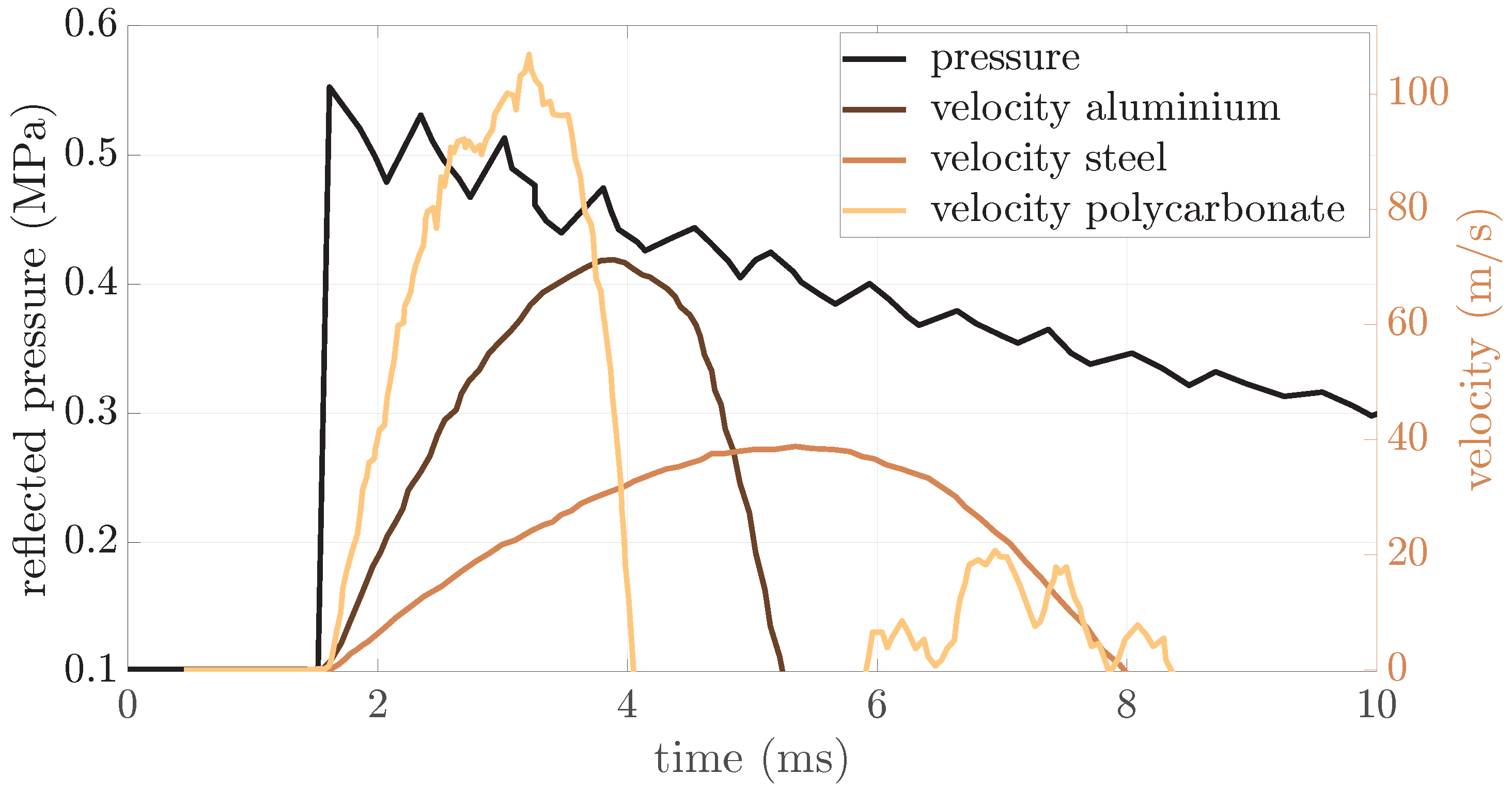
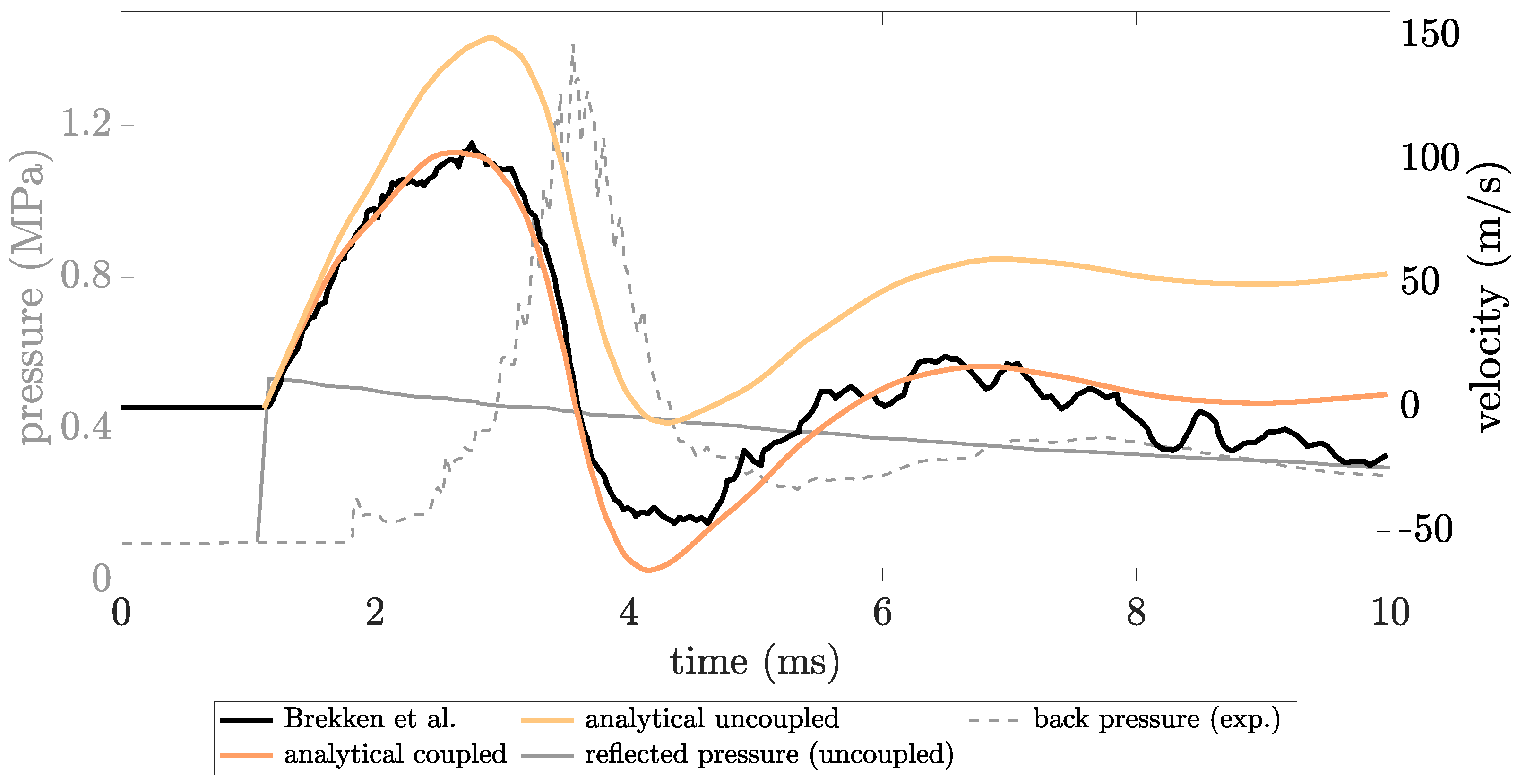
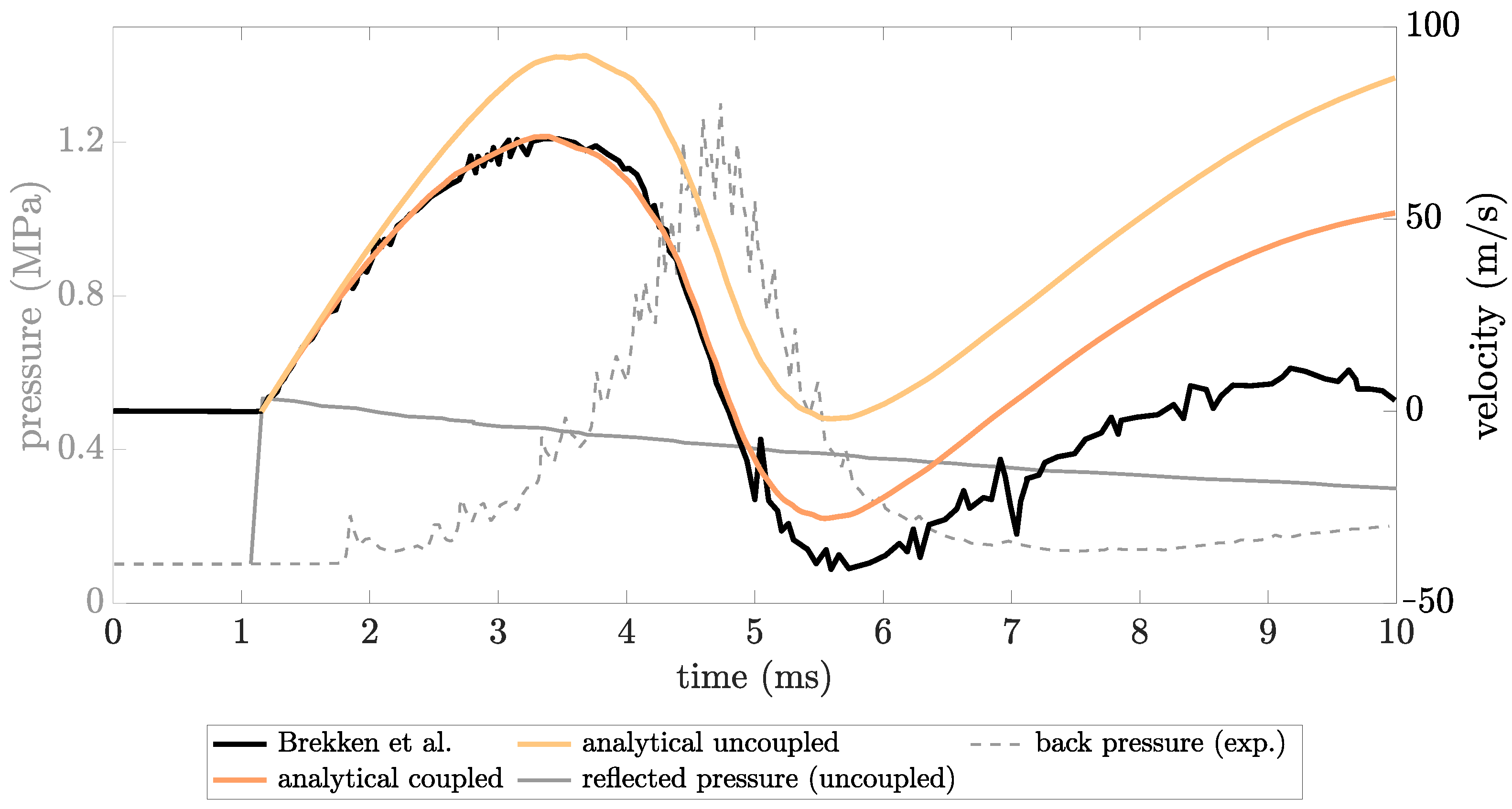
To evaluate the relevance of these experiments for the proposed framework, Figure 1 shows the velocity time history of the free-standing plates superimposed on the reflected pressure time history. The curves were obtained by digitising the experimental data from Ref. [11]. For clarity of comparison, the reflected pressure and the onset of the plate velocity transient were synchronised, since in the original dataset the two curves were shifted due to the relative positioning of the pressure sensor [11].
The comparison presented in the figure is of particular interest as it demonstrates how the decay of the pressure profile occurs while the plates are still in motion.
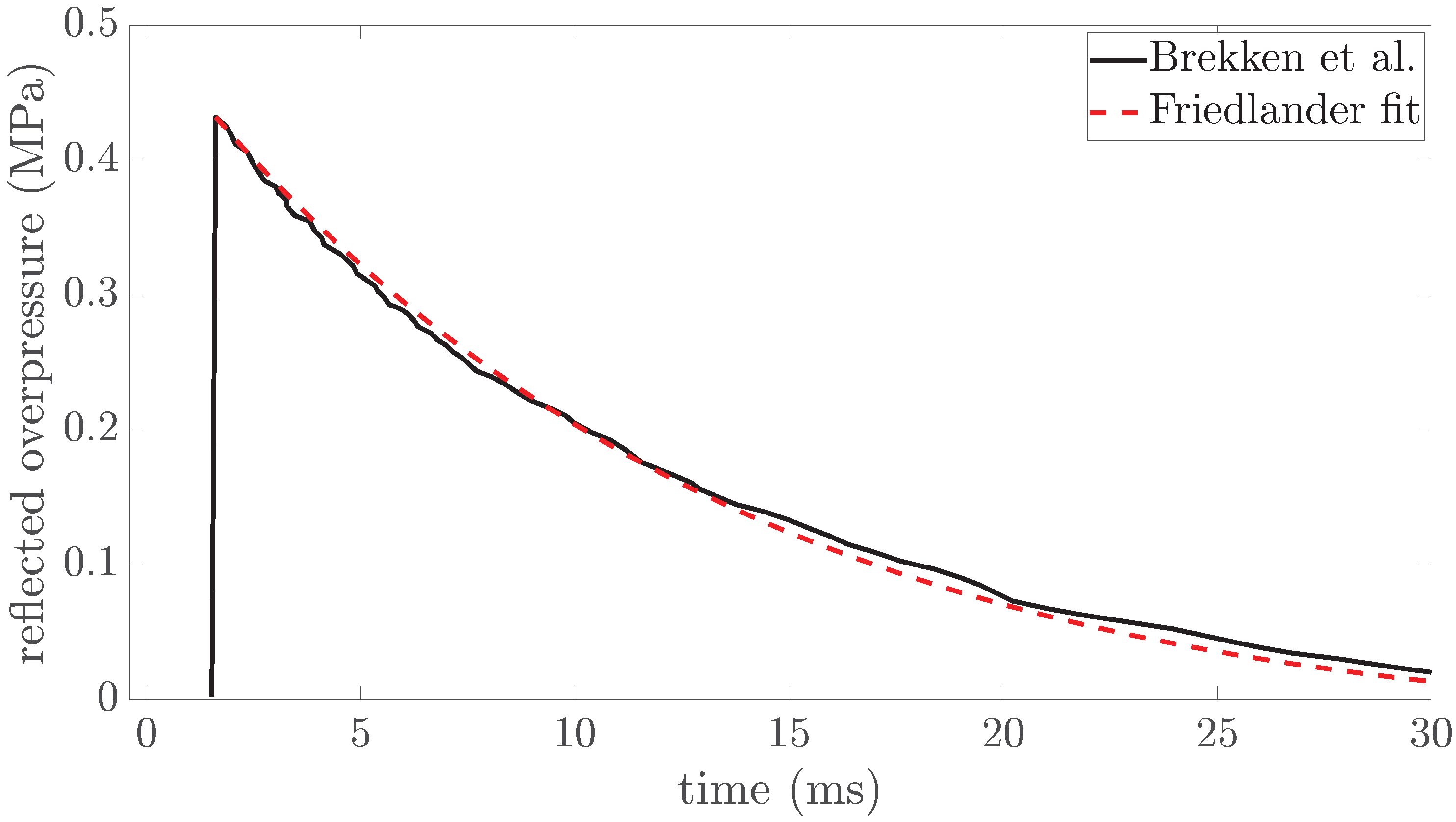
The reflected overpressure profile can be satisfactorily described over time by the Friedlander waveform. Figure 2 shows the experimental pressure signal after slight smoothing, overlaid with the fitted Friedlander waveform. Its parameters are t o = 33.2 ms , and the time decay b = 1.82 . The peak reflected overpressure is Δ p r 0 = 0.423 MPa.
Considering a peak reflected overpressure of p r 0 = 0.533 MPa, an unshocked pressure of p 0 = 0.1 MPa, a peak incident pressure of p i = 0.2597 MPa, an initial density of ρ 0 = 1.225 kg/m3, and a heat capacity ratio γ = 1.4 for air, the density at the onset of the reflection transient is found to be ρ r 0 = 3.544 kg/m3 according to Equation (9).
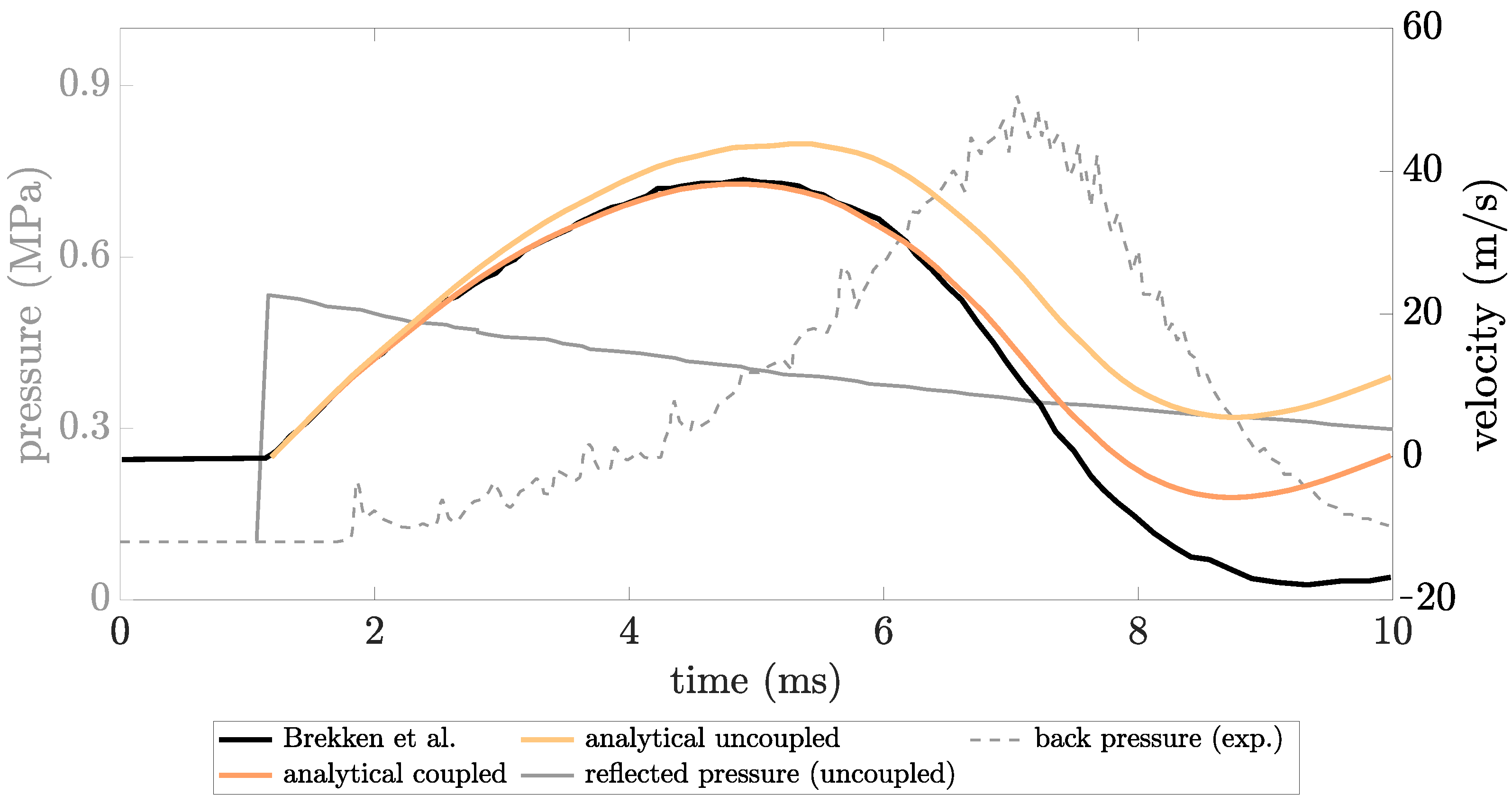
In the application of the semi-analytical framework, it is also necessary to account for the effect of back pressure. As observed in the experimental results [11], the pressure acting on the rear face of the plate reaches significant values due to the limited space available behind the specimen. For this reason, the back pressure contribution was explicitly included in the governing ODE of Equation (8).

2.3. Case Study II: Wang et al.

As a second case study for applying the analytical framework, the experiments on free-standing plates documented in the work of Wang et al. [25] are considered. As in Section 2.2, the experiments were conducted in a compressed-gas-driven shock tube. Some features of the facility can be inferred by consulting Refs. [26,27,28,29]. It should be noted that the experimental setups employed in the referenced works show some variations, and the study by Wang et al. does not provide a detailed description of the configuration. The shock tube includes a muzzle section where a free-standing plate is placed. The plate is circular, with a diameter of 0.0777 m and a thickness of 0.0064 m. The specimens were fabricated using 6061-T6 aluminium. The driven section was filled with atmospheric air, while helium was used in the driver section.
Experimentally, Wang et al. tested the free-standing plate under four different reflected pressure peaks, corresponding to different incident pressure values [25]. However, the experimental results are discussed in detail only for the scenario in which the incident pressure peak is 1.03 MPa. Consequently, this case is adopted as the reference for the investigations presented in this Section.
The available experimental data include (i) the time profile of the incident pressure, measured in the absence of the plate; (ii) the time profile of the reflected pressure, measured by a pressure transducer located 0.02 m upstream of the initial plate position; (iii) the time history of the plate velocity; and (iv) the time history of the plate displacement.
Based on this experimental configuration, a numerical model was developed in this work to further analyse the data and assess whether the analytical framework could be applied directly to the experimental scenario. It is worth noting that the data reported by Wang et al. are frequently used in the literature to validate analytical or semi-analytical models of FSI phenomena; see, for example, the work by Nartu et al. [14]. However, the experimental dataset exhibits several features that require careful consideration. In particular, the reflected pressure profile was measured during the tests with the moving plate, using a fixed pressure transducer. As a result, the measured signal reflects the actual pressure acting on the plate only when the plate is stationary. Consequently, the recorded pressure signal should not be interpreted directly as the reflected pressure acting on the plate and therefore cannot be used as input to the uncoupled analytical framework considered in this work. Furthermore, since the plate moves within a larger diameter than that of the shock tube’s internal bore, part of the gas pressure can vent laterally around the plate. This further limits the physical representativeness of the experimental reflected pressure profile. Lastly, the geometric details of the muzzle section are not provided. As a result, it is not possible to determine whether the shock transmitted into the fluid is affected by reflections from the rear wall of the muzzle section, which, as observed in Section 2.2, could contribute to decelerating the plate.
Given these limitations of the experimental setup, the direct use of the experimental data is deemed unsuitable. Instead, a numerical model of the shock tube is presented here to accurately capture the reflected pressure and the plate motion. The model can be validated using the experimentally measured incident pressure signal and the reflected pressure peak, since these two quantities are unaffected by the aforementioned limitations.
Analysing this case study in addition to that presented in Section 2.2 is both relevant and important, as the reflected overpressure is significantly higher than that observed in the facility described in Ref. [11] and the time decay of the reflected pressure profile is more pronounced, providing a complementary validation scenario under more severe blast loading conditions.

Numerical Modelling

The numerical models presented in this Subsection were developed with the primary objective of validating the analytical framework against the experimental data of Wang et al. [25]. Consequently, some numerical results are reported here, as they represent an integral part of the methodology rather than independent findings.
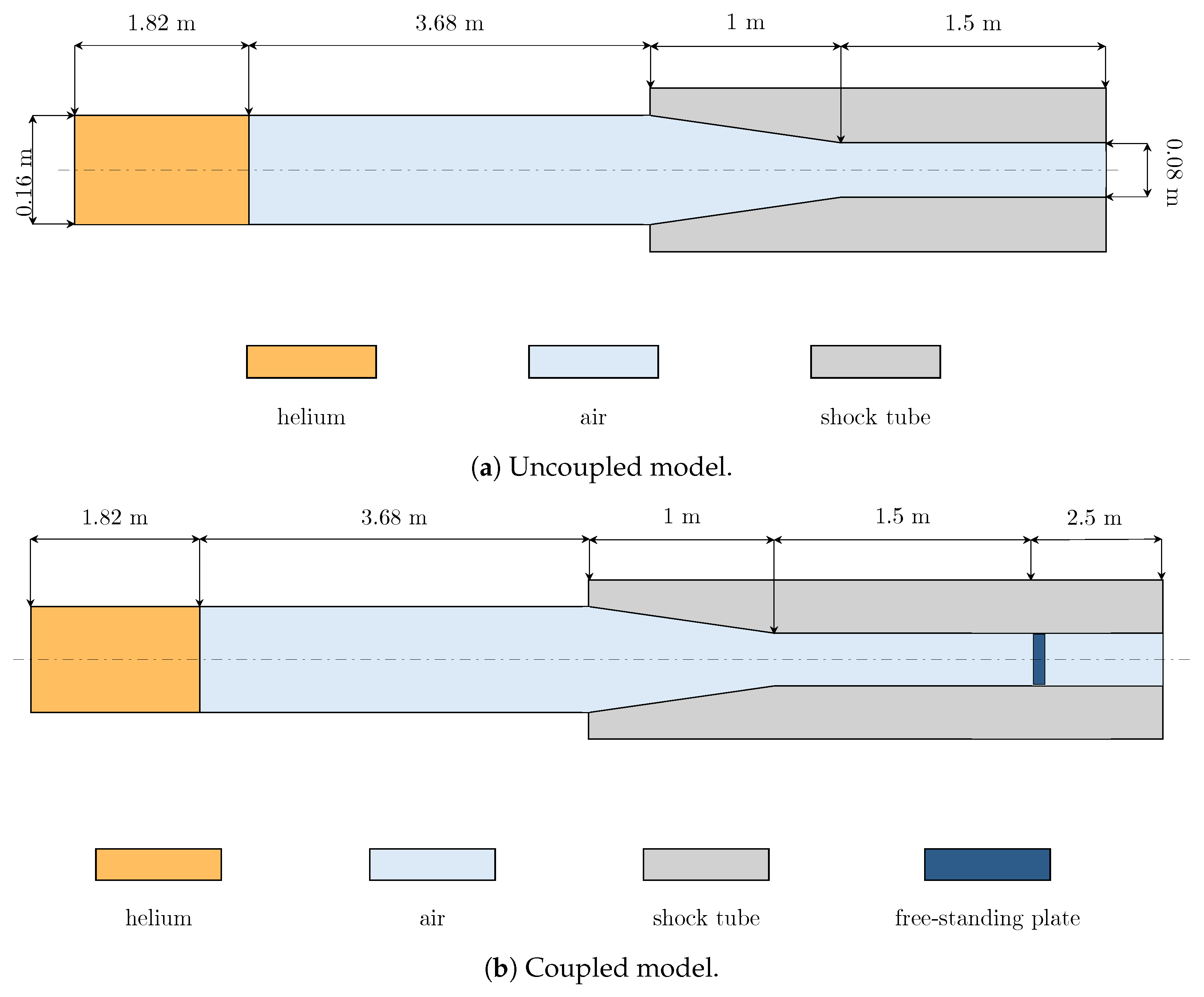
Two numerical models were implemented in AUTODYN (Ansys 2024 R1). The first corresponds to the uncoupled model schematically illustrated in Figure 3a. It consists of an axisymmetric model (Figure 3a shows a sectional view of the geometry for clarity) of the circular shock tube. The geometric details are defined based on Ref. [29], with minor modifications. The shock tube has a total length of 8 m, consisting of a 1.82 m helium-filled driver section with a 0.16 m diameter and a 6.18 m driven section containing air. The driven section is itself subdivided into three parts: a 3.68-m region with a constant diameter of 0.16 m; a conical transition region 1 m in length, where the tube diameter is halved from 0.16 m to 0.08 m; and a final region of 1.5 m with a constant diameter of 0.08 m.
The boundary conditions are defined such that all walls are reflective. In the conical region, this can only be achieved by explicitly modelling the conical wall of the shock tube as a rigid material with fully constrained motion. The reflective boundary condition imposed at the left end of the driver section is essential, as the reflected rarefaction wave recombines with the compression wave propagating to the right, forming the shock that impinges on the free-standing plate. The resulting numerical model allows the computation of the reflected pressure-time history while neglecting FSI effects. This pressure profile is then fitted using the Friedlander equation in order to apply the analytical framework presented in Section 2.1. To investigate the incident pressure profile and validate part of the implementation, the model was subsequently modified by applying a flow-out condition at the right end of the domain.
Figure 3b shows a schematic of the geometry from which the coupled model is constructed. In particular, the shock tube is extended by adding a 2.5-m-long section. The aluminium free-standing plate is included, and FSI effects are captured using the coupling capabilities available in AUTODYN.
In both models, air and helium are modelled as ideal gases. The parameters used for the two fluids are reported in Table 2. It should be noted that the initial air pressure corresponds to atmospheric conditions, while the initial helium pressure is calibrated to match the peak incident pressure. This calibration is necessary due to the lack of detailed information in the work by Wang et al. [25].
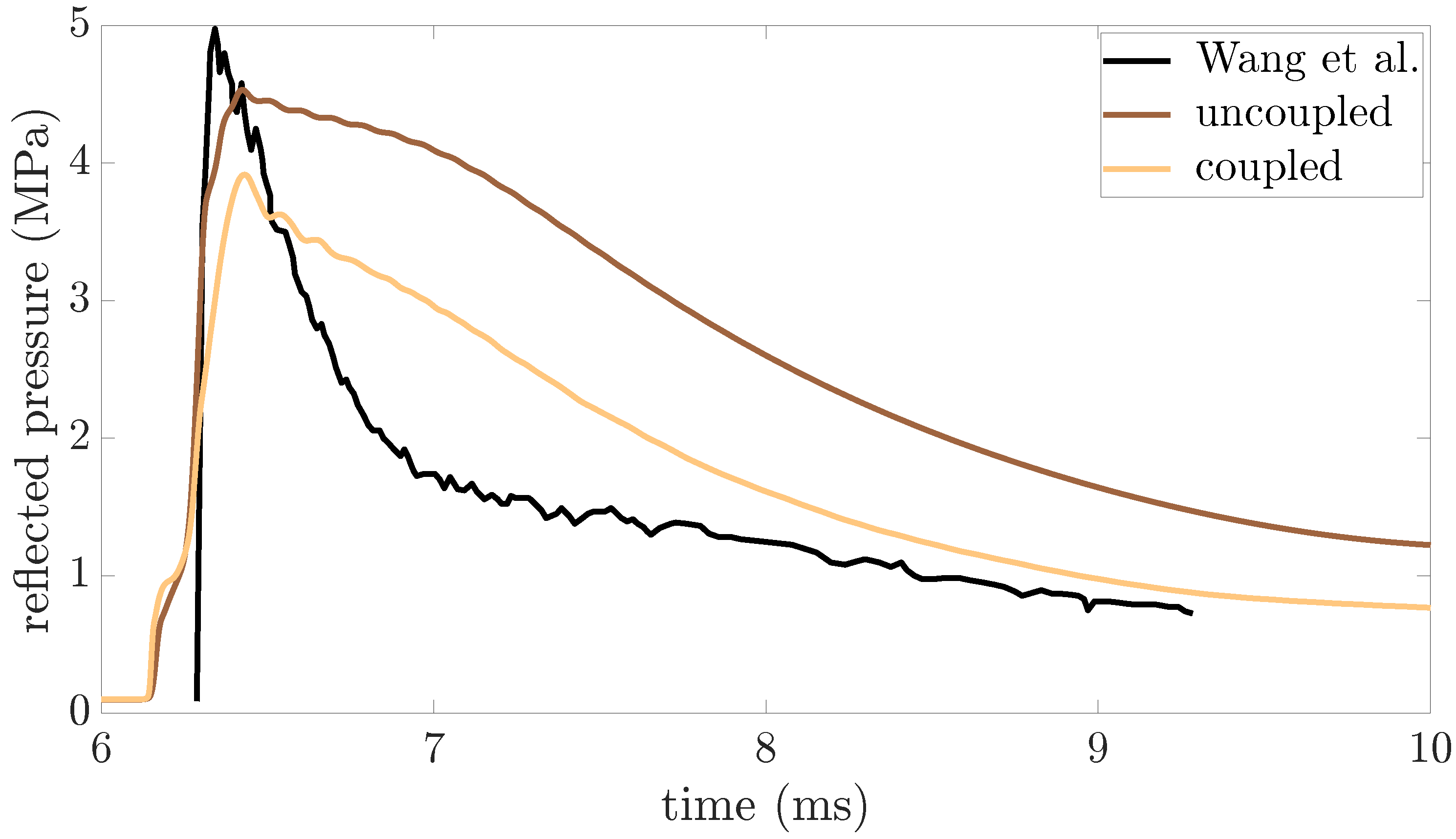
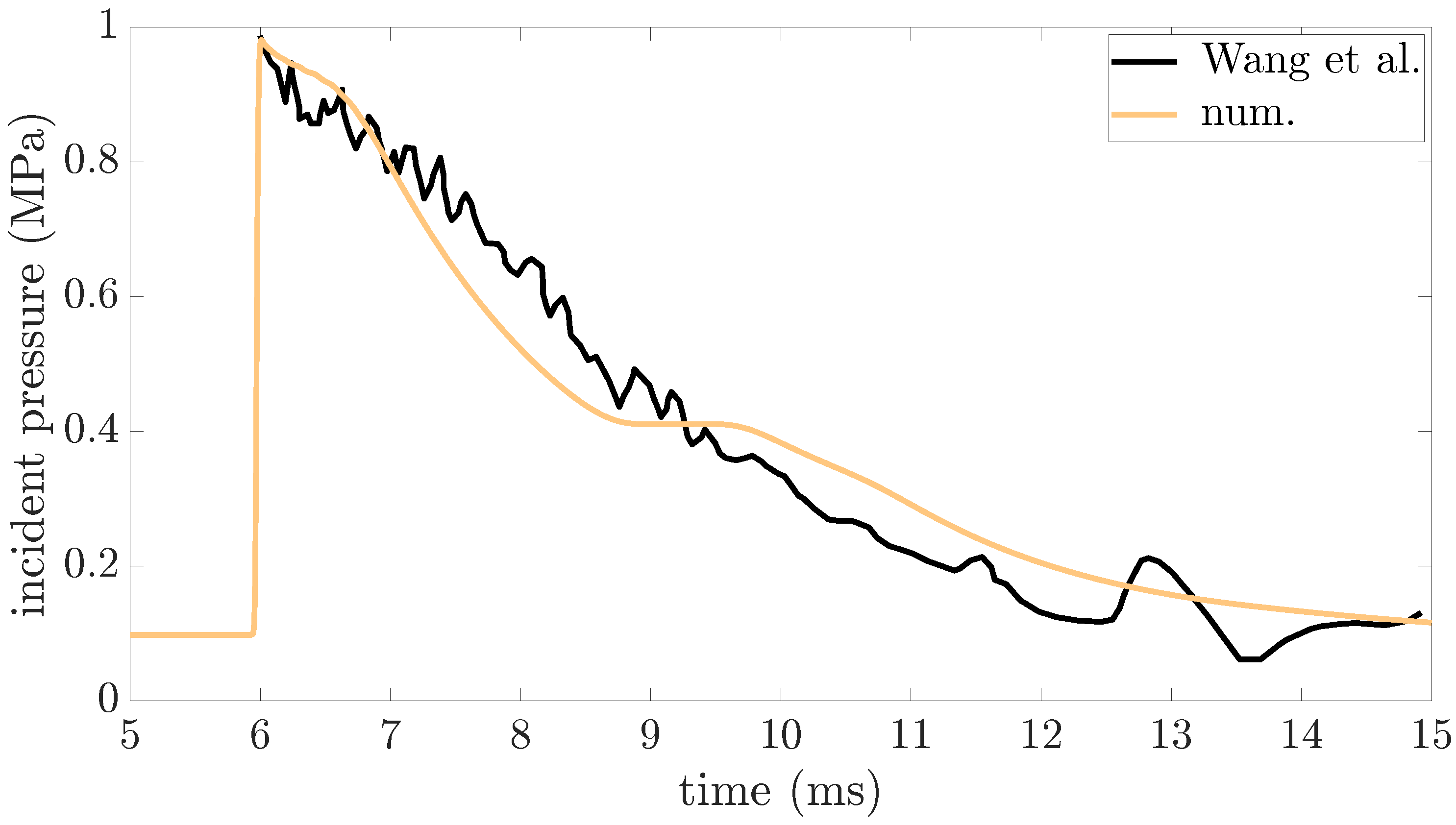
The experimental and numerical trends of the incident pressure measured by the pressure transducer placed 0.16 m from the right boundary of the uncoupled model domain are shown in Figure 4. The peak is accurately captured by the numerical solution, thanks to the calibration described earlier. The decay is also consistently represented by the numerical model. It should be noted that many geometric details of the shock tube were unknown; therefore, the results obtained for the incident pressure are considered satisfactory.
The experimental and numerical trends of the reflected pressure are shown in Figure 5. This corresponds to the pressure measured by the transducer positioned 0.02 m upstream of the plate. The numerical results were obtained using the uncoupled model (see Figure 3a), where the plate was assumed to be rigid and stationary, and a coupled model (see Figure 3b), where the plate is explicitly modelled and free to move. These results are again acceptable given the limited data available.
The reflected pressure peak is slightly underestimated by the uncoupled model, and a further reduction in the peak is observed when switching to the coupled solution.
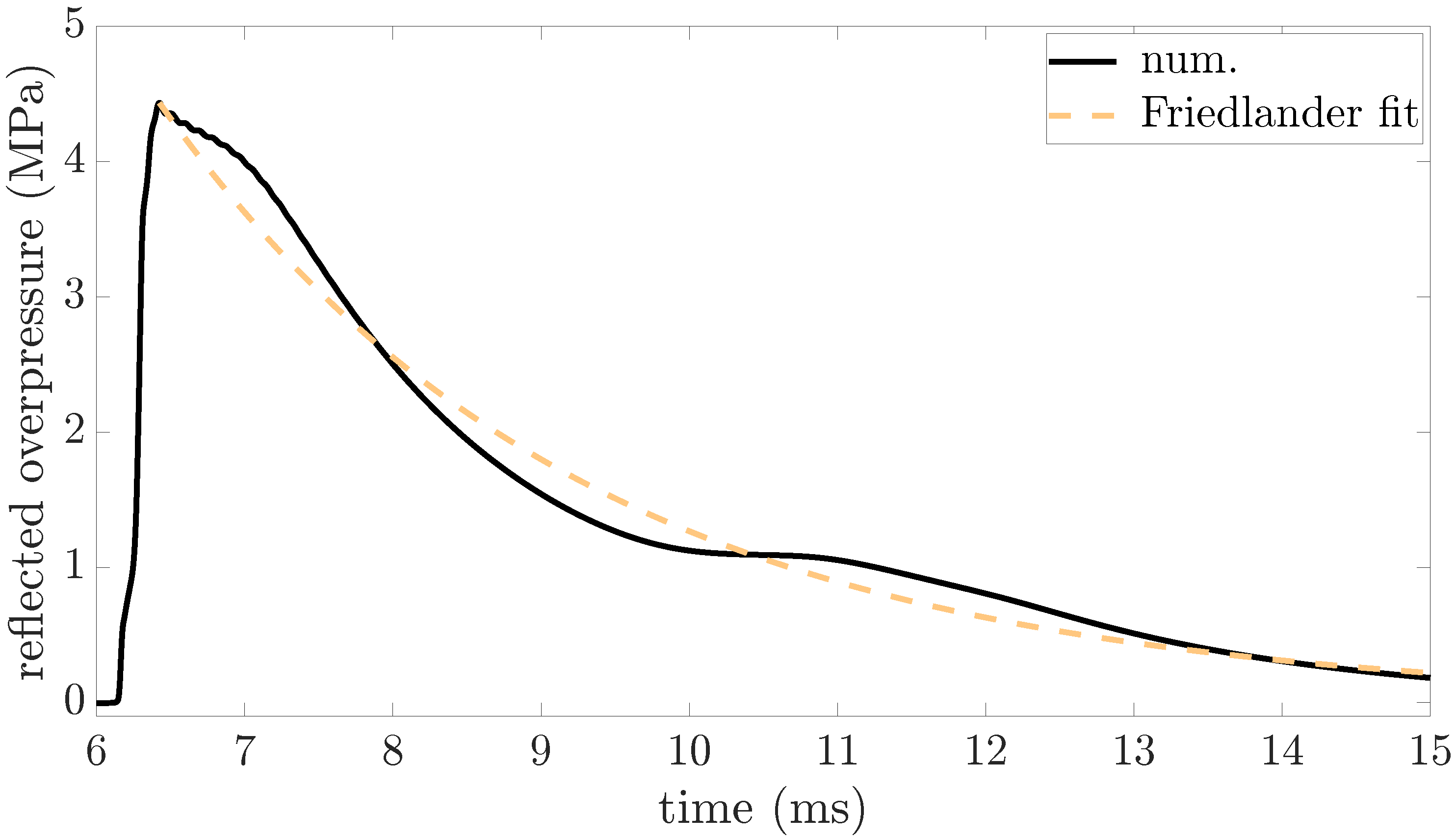
Figure 6 shows the fitting of the Friedlander waveform to the reflected uncoupled pressure profile.
Taken together, the two case studies represent a valuable dataset for assessing the validity of the semi-analytical framework presented in Section 2.1, as they cover different blast intensities and plate areal masses.

3. Results and Discussion

This section presents the application of the semi-analytical framework to the case studies introduced in Section 2. The objective is to evaluate the capability of the coupled and uncoupled formulations to reproduce the experimental and numerical references, and to quantify the influence of FSI under different blast intensities and plate areal masses. The discussion is organised into two subsections, each devoted to one of the case studies.

3.1. Case Study I: Brekken et al.

The first case study considers the shock-tube experiments reported by Brekken et al. [11], described in Section 2.2. Figure 7, Figure 8 and Figure 9 show the comparison between the experimental velocity-time histories and the predictions of the semi-analytical framework for the three tested materials: polycarbonate, aluminium, and steel. In each case, the results of both the coupled and uncoupled analytical formulations are reported. It is important to emphasise that the same experimental back-pressure-time history was applied to both formulations, since the aim here is to isolate and quantify only the FSI contribution associated with the front face of the plate.
For the polycarbonate plate (Figure 7), the uncoupled solution strongly overpredicts the peak velocity compared to the experiment, while the coupled model closely matches the experimental trend. The difference between coupled and uncoupled predictions highlights the significant role of FSI in mitigating the effective loading of lightweight structures.
A similar behaviour is observed for the aluminium plate (Figure 8). Also in this case, the uncoupled model overestimates the experimental response, whereas the coupled formulation provides good agreement with the measurements. The relative influence of FSI is lower than for the polycarbonate plate, consistent with the higher areal mass.
For the steel plate (Figure 9), the discrepancy between coupled and uncoupled solutions is less pronounced, reflecting the fact that the higher aerodynamic mass of the plate reduces the effect of FSI. This finding is important because the delayed response of the steel plate enhances the pressure decay’s influence, and the coupled model nevertheless captures the experimental behaviour with remarkable accuracy. This confirms the framework’s ability to remain valid even when pressure decay plays a strong role.
A quantitative summary of the results is provided in Table 3, which reports the velocity values at the time of the first experimental peak. This time instant was selected because back-pressure effectively constrains the plate, making its behaviour comparable to a clamped configuration, where the largest FSI effects occur at the velocity peak. In the table, v exp denotes the experimental velocity, while v U and v C represent the uncoupled and coupled semi-analytical velocities at the same instant. The relative FSI contribution is quantified as
% FSI = 100 · v U v C v U
which measures the reduction in plate velocity due to FSI effects.
The uncoupled formulation systematically overestimates the velocity, whereas the coupled solution provides an accurate representation of the measured peak across all materials. The agreement between the coupled model and the experimental results is excellent, confirming the reliability of the semi-analytical framework. Moreover, the relative importance of FSI decreases monotonically with the plate areal mass, with values of about 31% for polycarbonate, 23% for aluminium, and 13% for steel. This trend is fully consistent with physical expectations and with previous studies on the role of inertia in governing the relevance of FSI effects [2,5,8,10,12].

3.2. Case Study II: Wang et al.

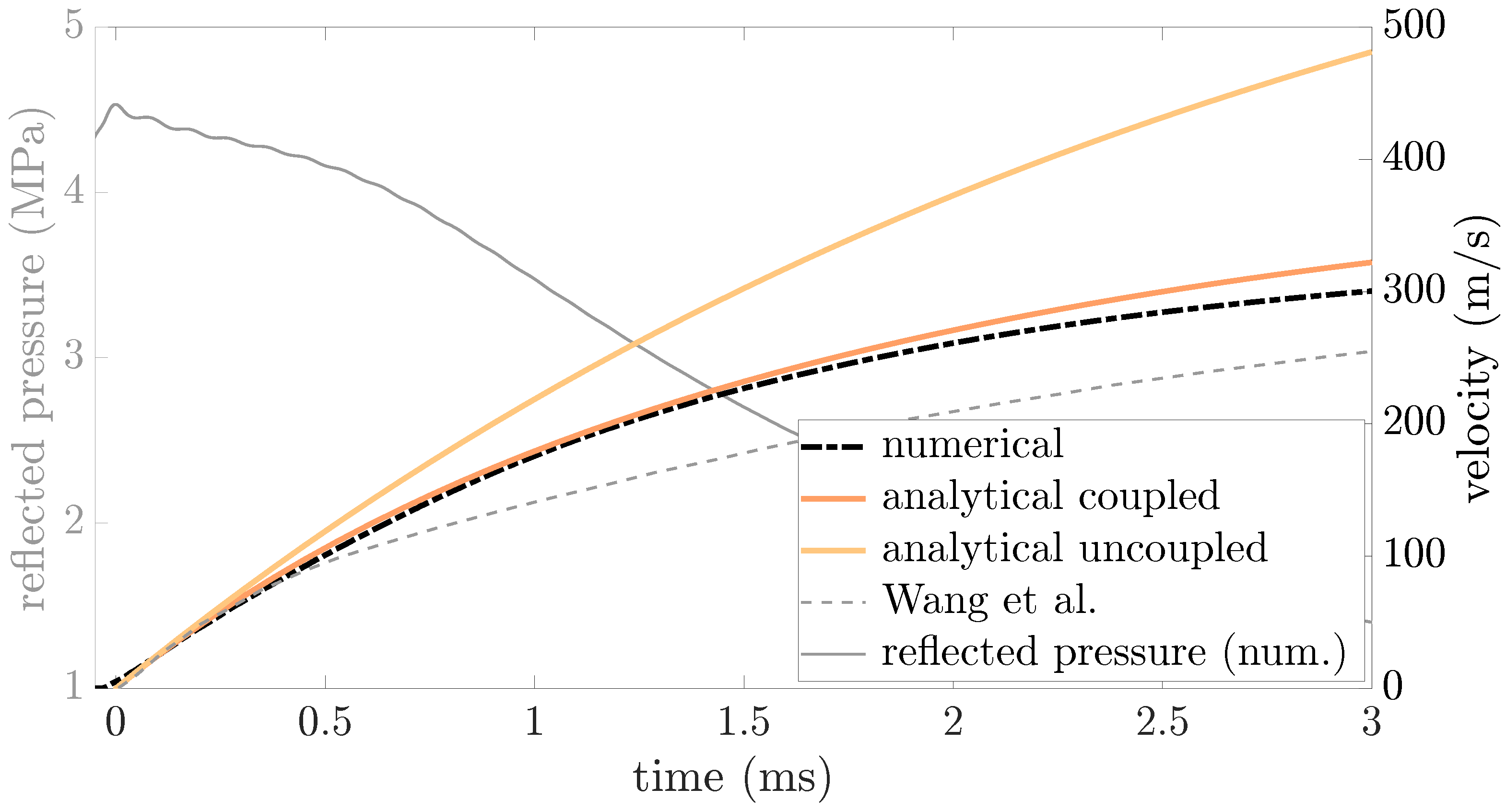
The second case study considers the experiments of Wang et al. [25], discussed in Section 2.3. Figure 10 shows the comparison between the experimental data, the supporting numerical model, and the predictions of the semi-analytical framework.
It can be observed that the numerical and experimental velocity curves diverge beyond a certain time. This behaviour originates from the incomplete information available on the experimental setup, which prevented the accurate modelling of the geometry behind the plate. In particular, the possible presence of back-pressure effects could not be captured numerically. Moreover, the experiments may have been affected by lateral venting of the flow, which would have reduced the effective pressure acting on the plate and partially explained the higher velocities observed in the numerical simulation. For these reasons, the numerical model was considered essential to provide a reliable benchmark for assessing the semi-analytical framework. This also applies to the reflected pressure, which is required by the uncoupled formulation and cannot be consistently extracted from the experimental measurements. The dataset generated in this work, therefore, represents a valuable reference that can be used by other researchers to test analytical or semi-analytical models of FSI.
The comparison further shows that the coupled semi-analytical solution follows the numerical benchmark with remarkable accuracy. This result demonstrates the capability of the framework to capture FSI effects even under blast-loading conditions characterised by higher reflected pressures and pronounced time decay. The agreement observed here is stronger than in Case Study I, where the presence of back-pressure complicated the interpretation of the results. In the present configuration, the absence of back-pressure makes the scenario complementary to the previous one and highlights the ability of the framework to reproduce the correct physics of the problem. These findings confirm that Equation (3) can be successfully applied also when the reflected pressure exhibits a significant time decay.
Finally, the difference between the uncoupled and coupled analytical formulations highlights the role of FSI. The uncoupled model systematically overpredicts the plate velocity, while the coupled model captures the mitigating effect of rarefaction waves generated by the plate motion. This comparison once again emphasises the importance of accounting for FSI effects in order to obtain accurate predictions of the dynamic response of blast-loaded plates.
In summary, the two case studies demonstrate that the proposed semi-analytical framework, despite its simplicity, consistently captures the main FSI effects in free-standing plates under different blast-loading scenarios. This confirms its potential as a rapid and cost-effective tool for preliminary assessments, providing reliable insights into the relevance of FSI without the need for high-fidelity coupled simulations.

4. Conclusions

This paper has presented a semi-analytical framework for capturing FSI effects, rigorously valid for free-standing blast-loaded plates. It relies on one-dimensional theories that account for non-linear gas compressibility and inertial effects. The framework includes both a coupled and an uncoupled formulation, whose comparison enables a direct estimation of FSI contributions to the structural response.
The proposed approach was applied to two case studies from the literature, covering different blast intensities and plate areal masses. In both cases, the coupled formulation provided an excellent agreement with experimental or numerical reference data, while the uncoupled solution systematically overestimated the plate velocity. These results confirm that the framework correctly reproduces the mitigating effect of FSI on the effective loading, particularly in lightweight plates.

The main outcome of this work is the validation of the coupled formulation, demonstrating that its governing equations can be reliably applied to blast-loading conditions characterised by a significant time decay. This extends the domain of validity of the framework beyond constant or simplified pressure loading and establishes a solid basis for its future exploitation as a rapid and cost-effective tool for estimating FSI effects in blast-loaded plates.

Author Contributions

Conceptualization, G.M. and L.L.; methodology, G.M.; software, G.M.; validation, G.M.; formal analysis, G.M.; investigation, G.M.; data curation, G.M.; writing—original draft preparation, G.M.; writing—review and editing, L.L. and A.M.; visualization, G.M.; supervision, L.L. and A.M.; project administration, A.M. All authors have read and agreed to the published version of the manuscript.

Funding

This research received no external funding.

Institutional Review Board Statement

Not applicable.

Informed Consent Statement

Not applicable.

Data Availability Statement

The original contributions presented in this study are included in the article. Further inquiries can be directed to the corresponding author.

Conflicts of Interest

The authors declare no conflicts of interest.

Abbreviations

The following abbreviations are used in this manuscript:
FSIFluid–Structure Interaction
ODEOrdinary Differential Equation
1DOne dimensional

References

  1. Taylor, G.I. The pressure and impulse of submarine explosion waves on plates. In The Scientific Papers of Sir G. I. Taylor; Batchelor, G.K., Ed.; Cambridge University Press: Cambridge, UK, 1963; Volume III, pp. 287–303. [Google Scholar]
  2. Kambouchev, N.; Noels, L.; Radovitzky, R. Nonlinear compressibility effects in fluid–structure interaction and their implications on the air-blast loading of structures. J. Appl. Phys. 2006, 100, 063519. [Google Scholar] [CrossRef]
  3. Kambouchev, N.; Radovitzky, R.; Noels, L. Fluid–Structure Interaction Effects in the Dynamic Response of Free-Standing Plates to Uniform Shock Loading. J. Appl. Mech. 2006, 74, 1042–1045. [Google Scholar] [CrossRef]
  4. Kambouchev, N.; Noels, L.; Radovitzky, R. Numerical simulation of the fluid–structure interaction between air blast waves and free-standing plates. Comput. Struct. 2007, 85, 923–931. [Google Scholar] [CrossRef]
  5. Aune, V.; Valsamos, G.; Casadei, F.; Langseth, M.; Børvik, T. fluid–structure interaction effects during the dynamic response of clamped thin steel plates exposed to blast loading. Int. J. Mech. Sci. 2021, 195, 106263. [Google Scholar] [CrossRef]
  6. US Department of Defense. UFC 3-340-02: Structures to Resist the Effects of Accidental Explosions; US Department of Defense: Washington, DC, USA, 2008. [Google Scholar]
  7. Børvik, T.; Hanssen, A.; Langseth, M.; Olovsson, L. Response of structures to planar blast loads–A finite element engineering approach. Comput. Struct. 2009, 87, 507–520. [Google Scholar] [CrossRef]
  8. Subramaniam, K.V.; Nian, W.; Andreopoulos, Y. Blast response simulation of an elastic structure: Evaluation of the fluid–structure interaction effect. Int. J. Impact Eng. 2009, 36, 965–974. [Google Scholar] [CrossRef]
  9. Gauch, H.L.; Montomoli, F.; Tagarielli, V.L. On the Role of Fluid–Structure Interaction on Structural Loading by Pressure Waves in Air. J. Appl. Mech. 2018, 85, 111007. [Google Scholar] [CrossRef]
  10. Cloete, T.J.; Nurick, G.N. A dimensionless number for shock-structure interaction. In Advances in Engineering Materials, Structures and Systems: Innovations, Mechanics and Applications; CRC Press: Boca Raton, FL, USA, 2019. [Google Scholar]
  11. Brekken, K.A.; Kaufmann, R.; Aune, V.; Langseth, M.; Børvik, T. An experimental facility for detailed studies on energy absorbing components subjected to blast loading. Strain 2023, 59, e12452. [Google Scholar] [CrossRef]
  12. Lomazzi, L.; Morin, D.; Cadini, F.; Manes, A.; Aune, V. Deep learning-based analysis to identify fluid–structure interaction effects during the response of blast-loaded plates. Int. J. Prot. Struct. 2023, 15, 722–752. [Google Scholar] [CrossRef]
  13. Marchesi, G.; Lomazzi, L.; Aune, V.; Nurick, G.; Cloete, T.J.; Manes, A. A dimensionless metric for quantifying fluid–structure interaction in blast-loaded plates. Int. J. Mech. Sci. 2026, 311, 111181. [Google Scholar] [CrossRef]
  14. Nartu, M.K.; Kumar, M. Blast Response of Single-Degree-of-Freedom Systems Including fluid–structure Interaction. J. Struct. Eng. 2021, 147, 04020296. [Google Scholar] [CrossRef]
  15. Yu, T.; Chen, F. The large deflection dynamic plastic response of rectangular plates. Int. J. Impact Eng. 1992, 12, 605–616. [Google Scholar] [CrossRef]
  16. Tian, L.; Zhu, L.; Yu, T.; Shim, V. Dynamic plastic response and impulse saturation of rectangular plates subjected to pressure pulse loading. Eng. Struct. 2023, 275, 115303. [Google Scholar] [CrossRef]
  17. Friedlander, F.G.; Taylor, G.I. The diffraction of sound pulses I. Diffraction by a semi-infinite plane. Proc. R. Soc. Lond. Ser. A Math. Phys. Sci. 1946, 186, 322–344. [Google Scholar] [CrossRef] [PubMed]
  18. Dewey, J. The Friedlander Equations; Springer International Publishing: Cham, Switzerland, 2018; pp. 37–55. [Google Scholar] [CrossRef]
  19. Karlos, V.; Larcher, M.; Solomos, G. Analysis of the Blast Wave Decay Coefficient in the Friedlander Equation Using the Kingery-Bulmash Data; European Commission, JRC: Ispra, Italy, 2015. [Google Scholar]
  20. Jones, N. A theoretical study of the dynamic plastic behavior of beams and plates with finite-deflections. Int. J. Solids Struct. 1971, 7, 1007–1029. [Google Scholar] [CrossRef]
  21. Seigel, A.E. The Theory of High Speed Guns; Technical Report; North Atlantic Treaty Organization Advisory Group for Aerospace Research and Development: Neuilly-sur-Seine, France, 1965. [Google Scholar]
  22. Courant, R.; Friedrichs, K.O. Supersonic Flow and Shock Waves; Springer: New York, NY, USA, 1976. [Google Scholar]
  23. Toro, E.F. Riemann Solvers and Numerical Methods for Fluid Dynamics, 3rd ed.; Springer: Berlin/Heidelberg, Germany, 2009. [Google Scholar]
  24. Kinney, G.F.; Graham, K.J. Explosive Shocks in Air; Springer Science & Business Media: New York, NY, USA, 1985. [Google Scholar]
  25. Wang, E.; Wright, J.; Shukla, A. Analytical and experimental study on the fluid structure interaction during air blast loading. J. Appl. Phys. 2011, 110, 114901. [Google Scholar] [CrossRef]
  26. LeBlanc, J.; Shukla, A.; Rousseau, C.E.; Bogdanovich, A.E. Shock loading of three-dimensional woven composite materials. Compos. Struct. 2007, 79, 344–355. [Google Scholar] [CrossRef]
  27. Wang, E.; Gardner, N.; Shukla, A. The blast resistance of sandwich composites with stepwise graded cores. Int. J. Solids Struct. 2009, 46, 3492–3502. [Google Scholar] [CrossRef]
  28. Wang, E.; Shukla, A. Analytical and experimental evaluation of energies during shock wave loading. Int. J. Impact Eng. 2010, 37, 1188–1196. [Google Scholar] [CrossRef]
  29. Tekalur, S.A.; Shukla, A. Failure of Polymer-Based Sandwich Composites Under Shock Loading. In Dynamic Failure of Materials and Structures; Shukla, A., Ravichandran, G., Rajapakse, Y.D., Eds.; Springer: Boston, MA, USA, 2010; pp. 235–268. [Google Scholar] [CrossRef]
Figure 1. Reflected pressure and velocity of the free-standing plates. Data taken from Ref. [11].
Engproc 131 00013 g001
Figure 2. Fitting of the smoothed reflected overpressure signal. Data taken from Ref. [11].
Engproc 131 00013 g002
Figure 3. Schematic representation of the geometries used in the implementation of the coupled and uncoupled numerical models. The illustrations are intentionally not to scale to enhance visual clarity.
Engproc 131 00013 g003
Figure 4. Comparison between the numerical and experimental incident pressure signals. Experimental data taken from Ref. [25].
Engproc 131 00013 g004
Figure 5. Comparison between the numerical and experimental reflected pressure signals. Experimental data taken from Ref. [25].
Engproc 131 00013 g005
Figure 6. Fitting of the Friedlander waveform to the numerically computed reflected overpressure history.
Engproc 131 00013 g006
Figure 7. Comparison of the experimental and semi-analytical velocity time histories for a polycarbonate free-standing plate. Data taken from Ref. [11].
Engproc 131 00013 g007
Figure 8. Comparison of the experimental and semi-analytical velocity time histories for an aluminium free-standing plate. Data taken from Ref. [11].
Engproc 131 00013 g008
Figure 9. Comparison of the experimental and semi-analytical velocity time histories for a steel free-standing plate. Data taken from Ref. [11].
Engproc 131 00013 g009
Figure 10. Comparison of the numerical and semi-analytical velocity time histories for the free-standing plate (case study II). Experimental data taken from Ref. [25].
Engproc 131 00013 g010
Table 1. Material properties of the tested plates from Ref. [11].
MaterialDensity (kg/m3)Thickness (mm)Areal Mass (kg/m2)
Polycarbonate (PC)12003.03.6
Aluminium (AL)27003.08.1
Steel (ST)78003.023.4
Table 2. Fluid properties for the shock tube simulations.
FluidDensity ( kg / m 3 ) γ ( ) Initial Pressure (MPa)
air1.2257/50.1
helium0.17865/31.6
Table 3. Peak-based quantification of FSI at the time of the first experimental velocity peak (case study I).
Material v exp (m/s) v C (m/s) v U (m/s) ρ H (kg/m2)% FSI (%)
Polycarbonate106.91103.06149.553.6031.09
Aluminium70.8871.4992.518.1022.72
Steel38.8338.2243.8523.4012.85
Disclaimer/Publisher’s Note: The statements, opinions and data contained in all publications are solely those of the individual author(s) and contributor(s) and not of MDPI and/or the editor(s). MDPI and/or the editor(s) disclaim responsibility for any injury to people or property resulting from any ideas, methods, instructions or products referred to in the content.