Handling Constrained Optimization Problems Using the “Re-Generation of Solutions” Strategy †

 ,
,  and
and 
Abstract
1. Introduction
2. Strategy Used
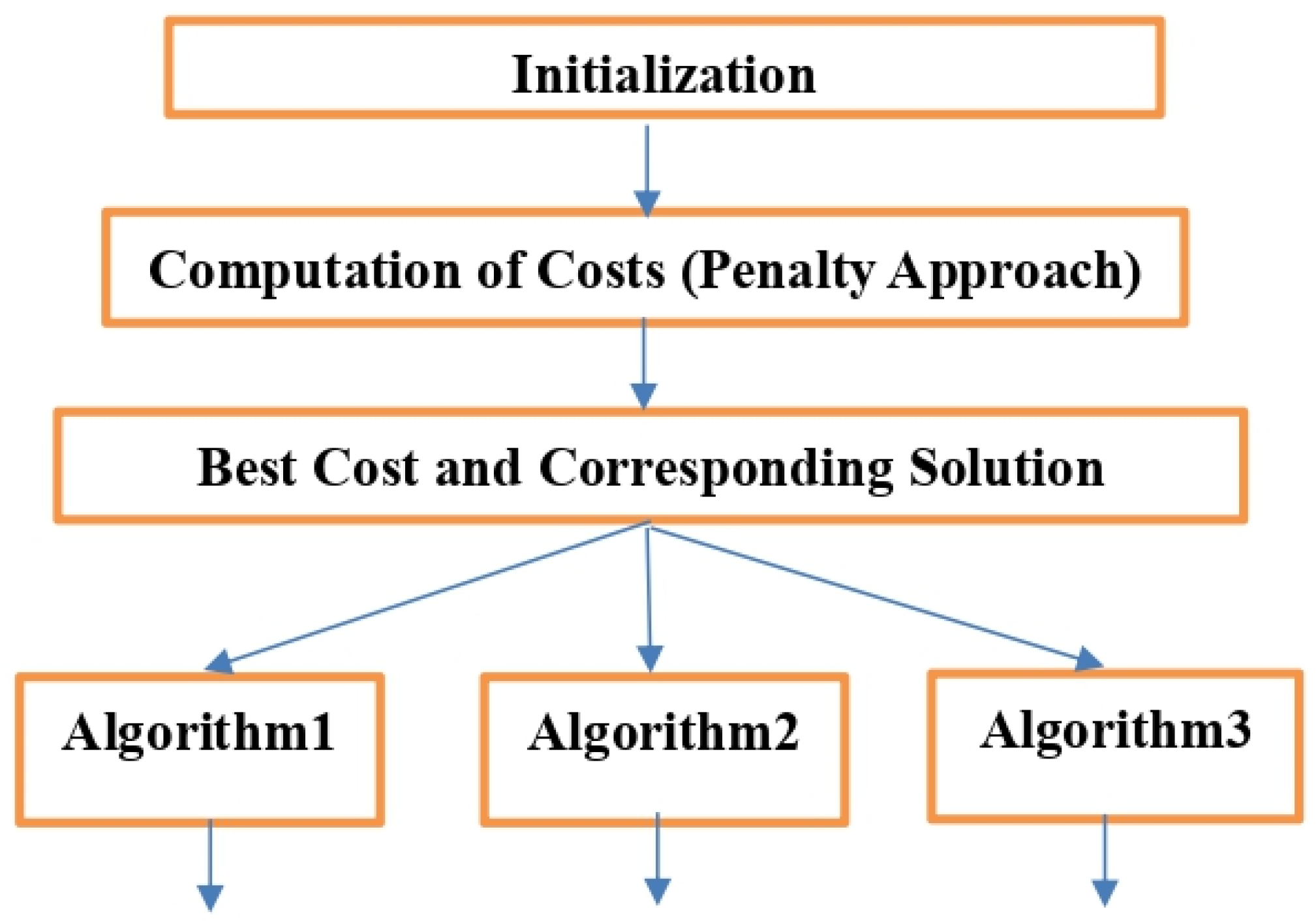
- During each trial, the same initialized candidate solution set is fed to all the algorithms (in our paper, three) under consideration (Figure 1). These are then individually and iteratively refined towards an acceptable solution. This ensures a fair comparison for all algorithms.
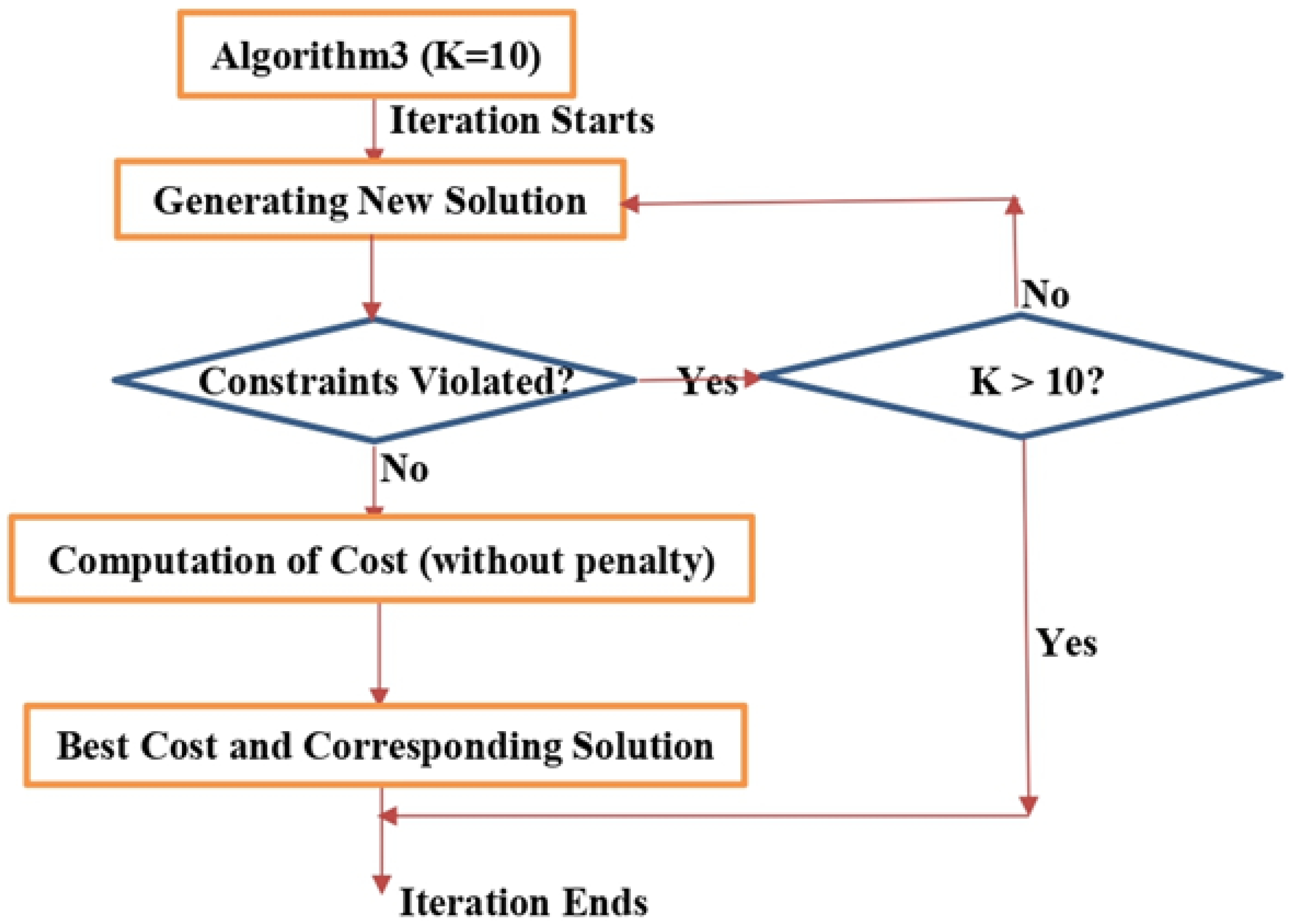
- If the constraints are not violated, the cost function is evaluated for a candidate solution. Otherwise, the candidate solution is regenerated a few times—in our paper, this happens once (strategy “K1”) in one case and a maximum of 10 times in the other case (strategy “K10”) or until the constraints are satisfied. If the constraints are satisfied and the computed cost is less than the existing cost for that solution, then only that population (solution) and the corresponding cost are updated. If the constraints are still violated, the present population is retained, and the iteration moves to the next candidate solution (Figure 2). The reason for this is that, in some problems, evaluating the objective function is relatively complex and may take much more time than checking for a violation of the constraints.
- If the cost is less than the best cost available until that moment, the best cost and the corresponding best solution are updated.
- Approximate solutions are initialized;
- A cost evaluation is conducted with penalty parameters;
- The best cost and best solution are determined;
- The same initial solution set is passed to all three algorithms (Figure 1);
- The iteration loop starts;
- A new solution is generated;
- A check for constraint violations is carried out;
- Function evaluations are conducted without penalty parameters;
- An update is carried out if required;
- The best cost and best solution are determined;
- The iteration loop ends (Figure 2).
3. Updating Expression (Using Levy Flight Strategy)
4. Results and Discussions
| function z = RCC_Beam (x) x1 = [6, 6.16, 6.32, 6.6, 7, 7.11, 7.2, 7.8, 7.9, 8, 8.4]; nx1 = numel(x1); x2 = 28:40; nx2 = numel(x2); % Beam Design Parameters As = x1(min(floor(x(1) × nx1 + 1),nx1)); b = x2(min(floor(x(2) × nx2 + 1),nx2)); h = x(3); % Objective Function z = 29.4 × As + 0.6 × b × h; end |
5. Conclusions and Future Work
Author Contributions
Funding
Institutional Review Board Statement
Informed Consent Statement
Data Availability Statement
Conflicts of Interest
References
- Baskar, A. New simple trigonometric algorithms for solving optimization problems. J. Appl. Sci. Eng. 2022, 25, 1257–1272. [Google Scholar]
- Baskar, A. Simple population-based algorithms for solving optimization problems. RAIRO-Oper. Res. 2024, 58, 253–280. [Google Scholar] [CrossRef]
- Baskar, A.; Xavior, M.A.; Jeyapandiarajan, P.; Batako, A.; Burduk, A. A novel two-phase trigonometric algorithm for solving global optimization problems. Ann. Oper. Res. 2024, 334, 1–51. [Google Scholar] [CrossRef]
- Amiri, M.H.; Mehrabi Hashjin, N.; Montazeri, M.; Mirjalili, S.; Khodadadi, N. Hippopotamus optimization algorithm: A novel nature-inspired optimization algorithm. Sci. Rep. 2024, 14, 5032. [Google Scholar] [CrossRef] [PubMed]
- Fu, Y.; Liu, D.; Chen, J.; He, L. Secretary bird optimization algorithm: A new metaheuristic for solving global optimization problems. Artif. Intell. Rev. 2024, 57, 123. [Google Scholar] [CrossRef]
- Sallam, K.M.; Alrashdi, I.; Mohamed, R.; Abdel-Basset, M. An enhanced LSHADE-based algorithm for global and constrained optimization in applied mechanics and power flow problems. Swarm Evol. Comput. 2025, 97, 102032. [Google Scholar] [CrossRef]
- Rahimi, I.; Gandomi, A.H.; Chen, F.; Mezura-Montes, E. A review on constraint handling techniques for population-based algorithms: From single-objective to multi-objective optimization. Arch. Comput. Methods Eng. 2023, 30, 2181–2209. [Google Scholar] [CrossRef]
- Deb, K. An efficient constraint handling method for genetic algorithms. Comput. Methods Appl. Mech. Eng. 2000, 186, 311–338. [Google Scholar] [CrossRef]
- Li, J.; An, Q.; Lei, H.; Deng, Q.; Wang, G.G. Survey of lévy flight-based metaheuristics for optimization. Mathematics 2022, 10, 2785. [Google Scholar] [CrossRef]
- Baskar, A. Improved TP-AB Trigonometric Algorithm Using Levy Flight Strategy. 2024. Available online: https://papers.ssrn.com/sol3/papers.cfm?abstract_id=4807266 (accessed on 11 November 2022).
- Chawla, M.; Duhan, M. Levy flights in metaheuristics optimization algorithms—A review. Appl. Artif. Intell. 2018, 32, 802–821. [Google Scholar] [CrossRef]
- Anescu, G. Scalable test functions for multidimensional continuous optimization. UPB Sci. Bull. Ser. C 2017, 79, 27–42. [Google Scholar] [CrossRef]
- Himmelblau, D.M. Applied Nonlinear Programming; McGraw-Hill: New York, NY, USA, 2018. [Google Scholar]
- Deb, K.; Goyal, M. Optimizing Engineering Designs Using a Combined Genetic Search. In Proceedings of the ICGA, East Lansing, MI, USA, 19–23 July 1997; pp. 521–528. [Google Scholar]
- Solve a Mixed-Integer Engineering Design Problem Using the Genetic Algorithm. Available online: https://in.mathworks.com/help/gads/solving-a-mixed-integer-engineering-design-problem-using-the-genetic-algorithm.html (accessed on 11 November 2022).
- Bayzidi, H.; Talatahari, S.; Saraee, M.; Lamarche, C.P. Social network search for solving engineering optimization problems. Comput. Intell. Neurosci. 2021, 2021, 8548639. [Google Scholar] [CrossRef] [PubMed]



| S.No. | Problem | Characteristic | No. of Constraints | Bounds | Optimal Value |
|---|---|---|---|---|---|
| 1. | F1 | Multimodal | 1 Inequality | [0, 5] | 4 |
| 2. | F4 | Unimodal | 1 Inequality | [0.001, 2] | 0 |
| 3. | F15 | Unimodal | 1 Inequality | [0.001, 2] | 1 |
| 4. | F19 | Multimodal | 1 Inequality | [0, 1] | 1.8 |
| S.No. | Problem | No. of Variables | No. of Constraints | Optimal Value |
|---|---|---|---|---|
| 1. | Himmelblau’s Function | 5 | 6 | −30,665.5 |
| 2. | Speed Reducer | 7 | 11 | 2994.424466 |
| 3. | Helical Spring (Continuous) | 3 | 4 | 0.01266051 |
| 4. | Three-Bar Truss | 2 | 3 | 263.8958434 |
| 5. | Welded Beam | 4 | 7 | 1.7248523 |
| 6. | Car Side Impact | 11 | 10 | 22.8429695 |
| 7. | Piston Lever | 4 | 4 | 8.4126983 |
| 8. | Pressure Vessel | 4 | 4 | 6059.7143350 |
| 9. | I-shaped Beam | 4 | 2 | 0.0130741 |
| 10. | RCC Beam | 3 | 2 | 359.2080 |
| 11. | Cantilever Stepped Beam (Continuous) | 10 | 11 | 63,408.9 |
| 12. | Tubular Column | 2 | 6 | 26.4863615 |
| 13. | Corrugated Bulkhead | 4 | 6 | 6.8429580 |
| 14. | Helical Spring (Discrete) | 3 | 8 | 2.6585592 |
| Problem | Optimal Value | Min | Mean | SD |
|---|---|---|---|---|
| F1: Regular | 4.0 | 4.9366707 | 7.7976277 | 1.2864387 |
| K1 | 6.1580119 | 8.3346652 | 1.4332139 | |
| K10 | 4.8932043 | 8.3361816 | 2.1063807 | |
| F4: Regular | 0 | 0.5792942 | 1.2246958 | 0.4669716 |
| K1 | 0.4926308 | 1.1226469 | 0.3590086 | |
| K10 | 0.3677987 | 0.7755602 | 0.2605655 | |
| F15: Regular | 1.0 | 1.0011398 | 1.0037043 | 0.0016193 |
| K1 | 1.0015624 | 1.0036164 | 0.0014540 | |
| K10 | 1.0005868 | 1.0020976 | 0.0009990 | |
| F19: Regular | 1.8 | 1.8992905 | 2.8110932 | 0.6328919 |
| K1 | 1.9383421 | 2.8363200 | 0.7562850 | |
| K10 | 1.8464927 | 2.6629982 | 0.6749263 |
| Problem | Min | Mean | SD |
|---|---|---|---|
| Himmelblau: Regular | −30,657.9674780 | −30,614.6671935 | 46.7047285 |
| K1 | −30,661.6926538 | −30,617.3556259 | 41.0359641 |
| K10 | −30,664.7063796 | −30,632.6070263 | 37.8750887 |
| Speed Reducer: Regular | 3001.0626050 | 3017.7170651 | 15.8469398 |
| K1 | 3007.3394980 | ||
| K10 | 2995.8899061 | 3022.6586688 | 17.3112739 |
| Helical Spring (Continuous): Regular | 0.0128217 | 0.0137514 | 0.0024751 |
| K1 | 0.0128348 | ||
| K10 | 0.0127191 | 0.0130895 | 0.0004680 |
| Three-Bar Truss: Regular | 263.8964592 | 263.9010257 | 0.0045371 |
| K1 | 263.8993757 | ||
| K10 | 263.8958559 | 263.9016936 | 0.0142651 |
| Welded Beam: Regular | 1.7877069 | 1.9412587 | 0.1396002 |
| K1 | 1.8468012 | 2.4978728 | 0.6138675 |
| K10 | 1.7267594 | 1.8433164 | 0.1386996 |
| Car Side Impact: Regular | 23.1909253 | 23.7333314 | 0.3408969 |
| K1 | 23.0061082 | 24.0275379 | 0.9740723 |
| K10 | 23.0063521 | 23.5621429 | 0.3670337 |
| Piston Lever: Regular | 11.6042840 | 158.7909856 | 140.7437185 |
| K1 | 10.7263761 | 288.6032338 | 372.5353723 |
| K10 | 8.8328989 | 147.0207044 | 148.6049030 |
| Pressure Vessel: Regular | 6192.8564472 | 6961.1577255 | 586.5114785 |
| K1 | 6116.4369864 | 7778.6237699 | 1403.6690382 |
| K10 | 6064.1829642 | 6245.8480922 | 219.3360143 |
| I-Beam Deflection: Regular | 0.0130743 | 0.0131431 | 0.0001068 |
| K1 | 0.0130810 | ||
| K10 | 0.0130741 | 0.0130890 | 0.0000172 |
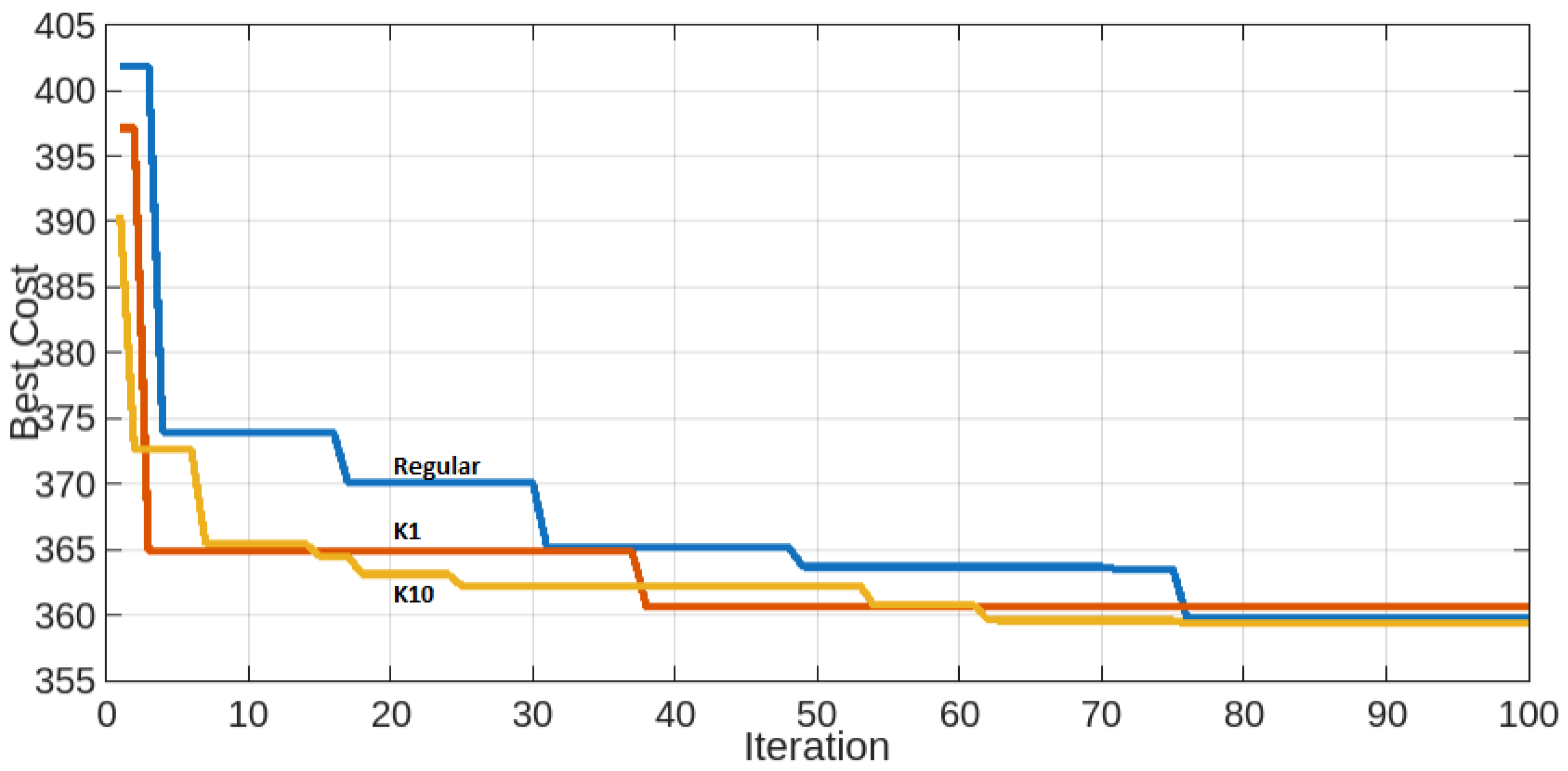
| RCC Beam: Regular | 359.2080576 | 359.7354269 | 1.0471172 |
| K1 | 359.2081085 | 360.7671037 | 1.8385462 |
| K10 | 359.2080000 | 359.2455595 | 0.1067344 |
| Cantilever Stepped Beam (Continuous): Regular | 66,137.0891994 | 68,785.1731999 | 1724.2742879 |
| K1 | 71,300.4482711 | ||
| K10 | 65,003.3343667 | 68,694.2597915 | 2743.8691191 |
| Tubular Column: Regular | 26.4863894 | 26.4927486 | 0.0158673 |
| K1 | 26.4864146 | 26.5707110 | 0.1419728 |
| K10 | 26.4863615 | 26.4868792 | 0.0014304 |
| Corrugated Bulkhead: Regular | 6.8510643 | 6.9412326 | 0.2375057 |
| K1 | 6.8477011 | 7.0067943 | 0.2877396 |
| K10 | 6.8431122 | 6.8539581 | 0.0137809 |
| Spring (Discrete): Regular | 2.6588350 | 3.0571963 | 0.4861107 |
| K1 | 3.0174411 | ||
| K10 | 2.6587265 | 3.0993425 | 0.4300373 |
| Algorithm | Minimum | Mean | Standard Deviation | Total |
|---|---|---|---|---|
| Regular | 0 | 1 | 2 | 3 |
| K1 | 0 | 0 | 0 | 0 |
| K10 | 4 | 3 | 2 | 9 |
| Algorithm | Minimum | Mean | Standard Deviation | Total |
|---|---|---|---|---|
| Regular | 0 | 3 | 5 | 8 |
| K1 | 1 | 0 | 0 | 1 |
| K10 | 13 | 11 | 9 | 33 |
Disclaimer/Publisher’s Note: The statements, opinions and data contained in all publications are solely those of the individual author(s) and contributor(s) and not of MDPI and/or the editor(s). MDPI and/or the editor(s) disclaim responsibility for any injury to people or property resulting from any ideas, methods, instructions or products referred to in the content. |
© 2026 by the authors. Licensee MDPI, Basel, Switzerland. This article is an open access article distributed under the terms and conditions of the Creative Commons Attribution (CC BY) license.
Share and Cite
Amaladosan, B.; Michael, A.X.; Yasappan, J.; Burduk, A.; Antosz, K. Handling Constrained Optimization Problems Using the “Re-Generation of Solutions” Strategy. Eng. Proc. 2026, 130, 2. https://doi.org/10.3390/engproc2026130002
Amaladosan B, Michael AX, Yasappan J, Burduk A, Antosz K. Handling Constrained Optimization Problems Using the “Re-Generation of Solutions” Strategy. Engineering Proceedings. 2026; 130(1):2. https://doi.org/10.3390/engproc2026130002
Chicago/Turabian StyleAmaladosan, Baskar, Anthony Xavior Michael, Justine Yasappan, Anna Burduk, and Katarzyna Antosz. 2026. "Handling Constrained Optimization Problems Using the “Re-Generation of Solutions” Strategy" Engineering Proceedings 130, no. 1: 2. https://doi.org/10.3390/engproc2026130002
APA StyleAmaladosan, B., Michael, A. X., Yasappan, J., Burduk, A., & Antosz, K. (2026). Handling Constrained Optimization Problems Using the “Re-Generation of Solutions” Strategy. Engineering Proceedings, 130(1), 2. https://doi.org/10.3390/engproc2026130002