1. Introduction
Indonesia’s mining sector plays a vital role in the national economy, with coal serving as one of its primary export commodities. However, the country’s archipelagic structure—comprising over 17,000 islands—poses significant logistical challenges. Poor multimodal integration significantly increases Indonesia’s logistics costs [
1].
PT XYZ, a mining company based in South Sumatra, currently employs a single-mode distribution system. Coal is transported from the mining pit to a stockpile at KM 36, then hauled via dump truck to Port SDJ. From there, it is shipped by barge to the anchorage point at Muara Tanjung Kampeh.
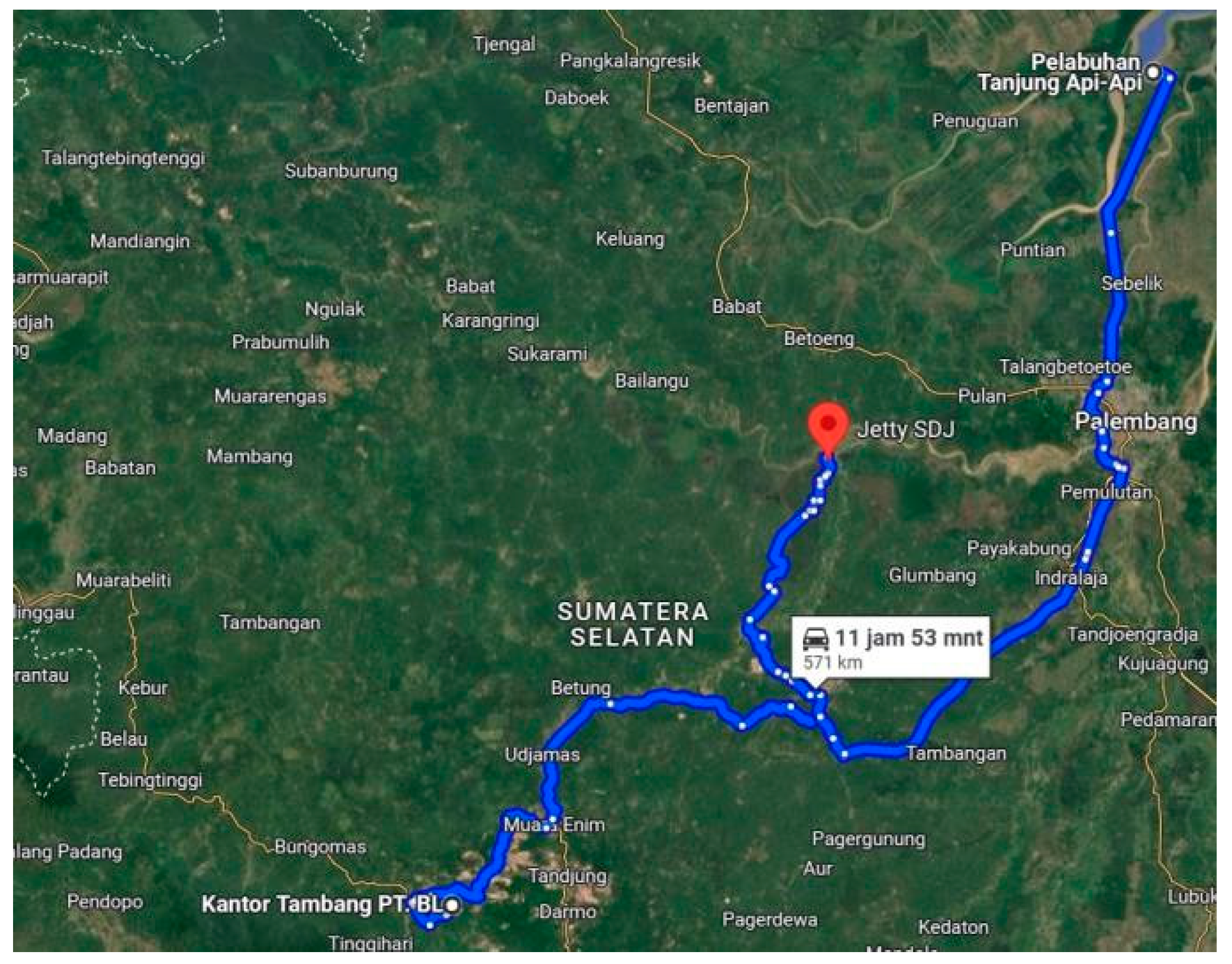
Figure 1 shows the geographic layout of the coal logistics network, including the mining pit, the stockpile, and both ports (SDJ and TAA). The distances and travel paths between the origin and each port are compared to demonstrate the potential time advantage of using Port TAA due to its closer proximity to the anchorage.
The total transportation time includes approximately 18 h of sailing time, which is a problem because a lengthy route often results in shipment delays, port congestion, and financial penalties due to missed delivery deadlines [
2].
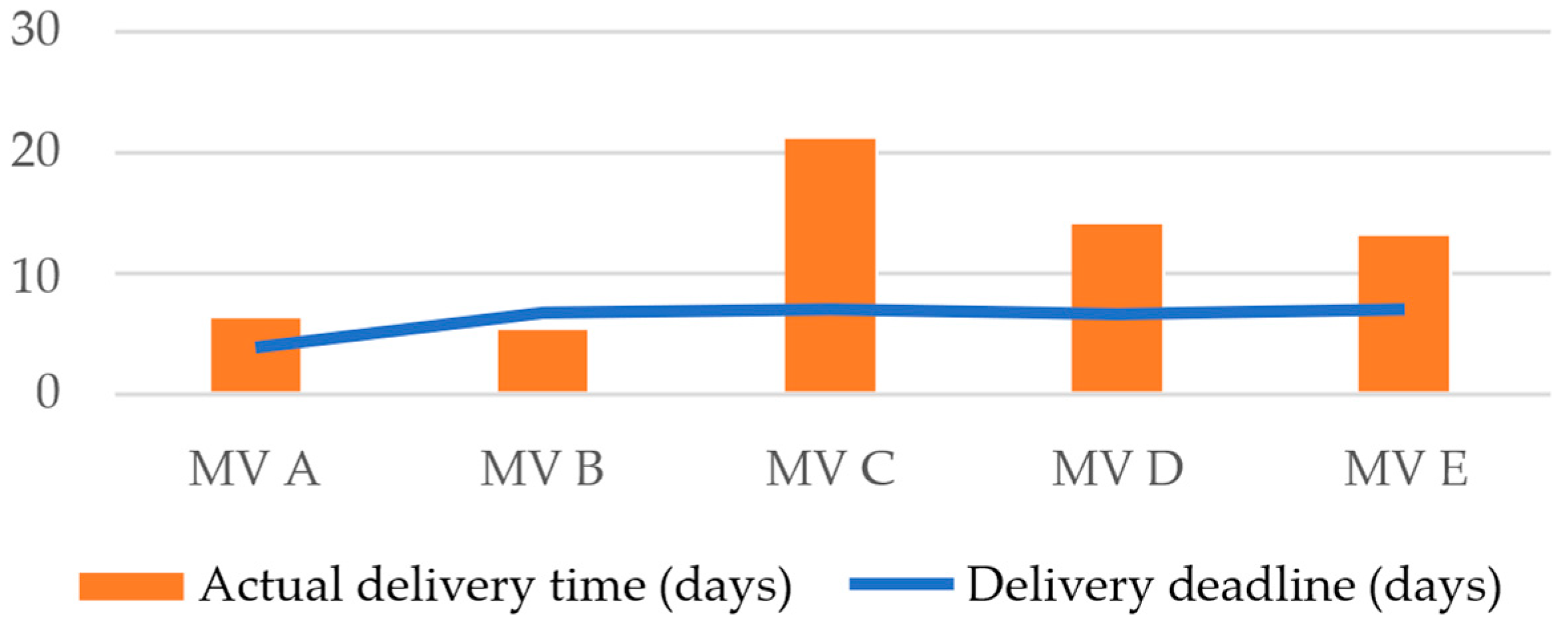
Figure 2 illustrates several trips during a specific month in 2025. To address these issues, we developed a multimodal distribution strategy by integrating railway transport from the stockpile to Port TAA, which is closer to the anchorage point. The redesigned system is expected to improve efficiency, reduce total shipment time, and minimize the risk of late deliveries [
3].
Figure 2 also illustrates the diagram of delays for the actual delivery time from the delivery deadline.
We developed a mixed integer linear programming (MILP) model that optimally allocates coal volumes between the two transport routes and evaluates the benefits of the proposed dual-mode distribution approach in achieving timely exports.
2. Literature Review
Wicaksono et al. [
4] explored the use of MILP in optimizing power generation schedules, showing relevance for coal logistics planning. Cao [
5] and Wang and Han [
6] discussed transportation algorithms using AI and ant colony optimization. Gao [
7] and Bodhi et al. [
8] supported the importance of optimization algorithms in improving routing decisions, especially in dynamic environments. Hevlie et al. [
9] developed a route optimization model using linear programming for coal transportation in Indonesia. Prasetyo et al. [
3] assessed productivity factors of heavy equipment used in coal mining, showing that transportation modes impact operational efficiency.
Chopra and Meindl [
10] emphasized the strategic role of supply chain planning and its alignment with logistical execution. Suseno [
11] analyzed internal and external delay factors in coal transportation, aligning with the operational issues faced by PT XYZ. Sariguna and Kennedy [
12] explained that high logistics costs in Indonesia are strongly tied to long dwelling times and infrastructure issues. Nisa et al. [
2] found that industrial concentration and high input costs decrease coal efficiency. Iskandar and Arifin [
13] emphasized the importance of data-driven analysis for improving logistics performance across regions in Indonesia. Rafi [
14] further supports the need for a structured multimodal model in archipelagic nations like Indonesia.
While previous studies focused on general optimization methods, infrastructure limitations, or transportation cost efficiency, this research aims to address shipment timeliness by integrating multiple transport modes—truck and railway—into a dual-port dispatching system. The novelty lies in combining operational scheduling and port selection under MILP formulation to minimize total shipment duration, especially in the context of export readiness for coal logistics.
3. Problem Identification
The coal distribution problem at PT XYZ is modeled as an MILP optimization problem, which enables the selection of the most efficient transport mode combination (trucks and trains) for each shipment request. The solution helps minimize the total delivery time to the mother vessel by considering transport capacities, travel duration, number of vehicles, loading time, and sailing time to the anchorage point.
In this model, the main decision variables include the volume of coal allocated for delivery to Port SDJ using trucks and to Port TAA using trains, as well as the number of barges used from each port. The objective function was formulated to minimize the total delivery time, subject to constraints such as vehicle capacity, barge limits, delivery deadlines, and total demand fulfilment. This model supports efficient and timely routing decisions that help avoid delays and reduce penalty costs.
Table 1 shows the sets, parameters, and variables defined in this study.
The objective function of this model (Equations (1)–(8)) is used to minimize the total shipment time. The objective function in this model, as formulated in Equation (1), minimizes the total coal shipment time to the mother vessel through two main transportation modes, namely dump trucks and trains. This function considers eight main constraints. The first constraint in Equation (2) ensures that the coal shipped via trucks and trains must be equal to the total demand of the mother vessel. The second constraint in Equation (3) limits the number of truck trips based on the mode capacity and the maximum number of units available during the deadline time. The third constraint in Equation (4) has the same function as the second constraint, but it applies to the rail transportation mode. The fourth constraint in Equation (5) ensures that the number of barges from Port SDJ is sufficient to transport the volume of coal shipped. The fifth constraint is in Equation (6), which has the same function as the fourth constraint but applies to Port TTA. The sixth constraint in Equation (7) has the function of ensuring that the barge units at SDJ and Port TTA do not exceed the total barge limit. The seventh constraint in Equation (8) has the function of ensuring that the total time (sailing and loading) does not exceed the given deadline.
4. Experiment
The data set used in this study was obtained from PT XYZ’s historical shipment records, including shipment volumes, delivery deadlines, sailing duration, and penalty costs. These data were used to define parameters for the MILP model. The model was input into Gurobi Solver, translating the mathematical formulation into code using decision variables, constraints, and an objective function. After solving, the tonnage allocation results for each buyer were obtained. Based on these results, further scheduling was conducted to divide the shipments into delivery shifts using trucks for Port SDJ and trains for Port TAA, ensuring all deliveries align with operational capacity and time constraints. Using the Gurobi Solver, we simulated five scenarios as follows.
4.1. Mother Vessel A
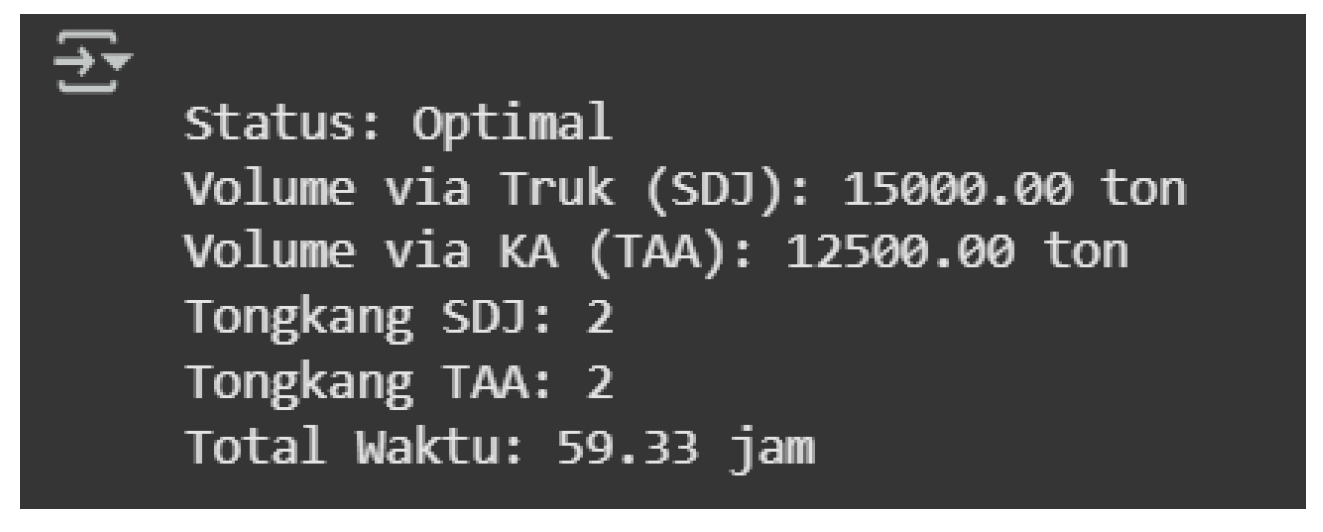
The modeling results showed that the coal volume of 27,500 tons was divided into two distribution channels. A total of 15,000 tons was sent using truck mode to Port SDJ, while 12,500 tons was sent by train mode to Port TTA. The number of barges used at each port is two units. Based on the result in
Figure 3, the export shipment process from Ports SDJ and TTA to the anchorage point where the mother vessel docks takes 59.33 h. This duration encompasses the transportation and loading of coal onto the barge, as well as the sailing time to the anchorage point. The total time remains within the buyer’s export shipment deadline of 3.5 days (84 h), ensuring that PT XYZ avoids further delays in export operations. The transportation details for each mode are outlined in
Table 2.
4.2. Mother Vessel B
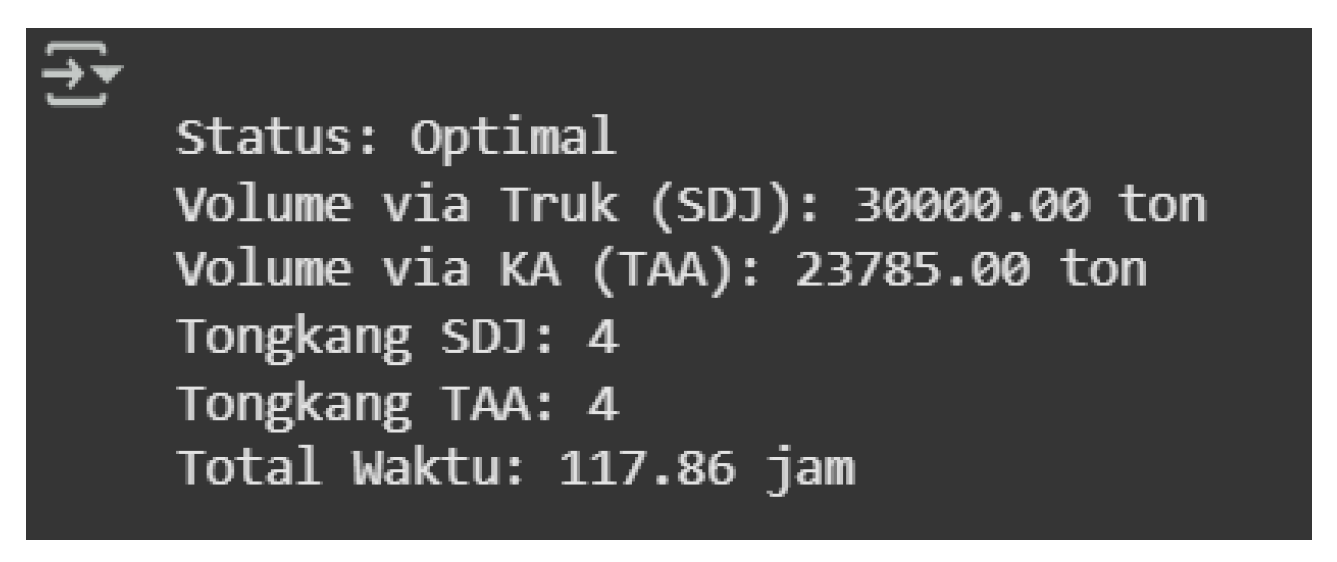
The model calculations in
Figure 4, showed that coal volumes were distributed through two channels: truck transport to Port SDJ and rail transport to Port TTA. A total of 53,785 tons was allocated, with 30,000 tons delivered by truck to Port SDJ and 23,785 tons by train to Port TTA. Four barges are employed at each port to transport coal to the anchorage point, where the buyer’s mother vessel docks. Based on the results in
Table 3, the combined loading and sailing process requires 117.86 h, remaining within the buyer’s shipment deadline of 6.6 days (158.4 h). Consequently, PT XYZ avoids delays in export operations.
4.3. Mother Vessel C
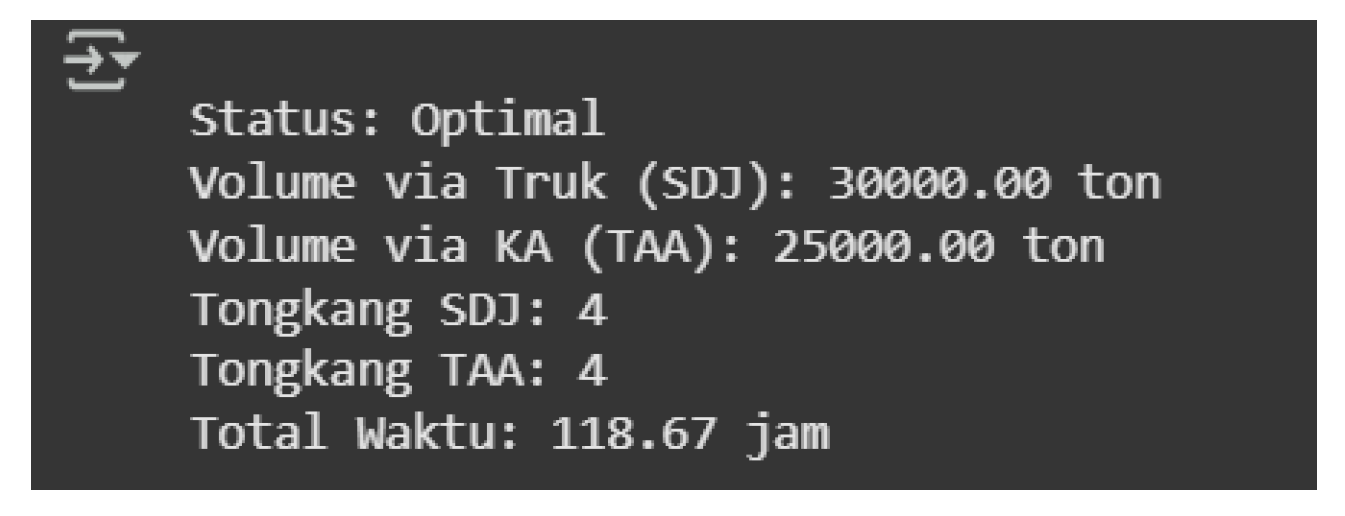
The coal volume totals 55,000 tons, divided into 30,000 tons by truck to Port SDJ and 25,000 tons by train to Port TTA. Again, four barges were used at each port. Based on the calculation in
Figure 5, the shipping process to the anchorage point took 118.67 h, which is below the buyer’s deadline of 6.9 days (165.6 h), ensuring timely delivery. Overall results for each transportation mode are outlined in
Table 4.
4.4. Mother Vessel D
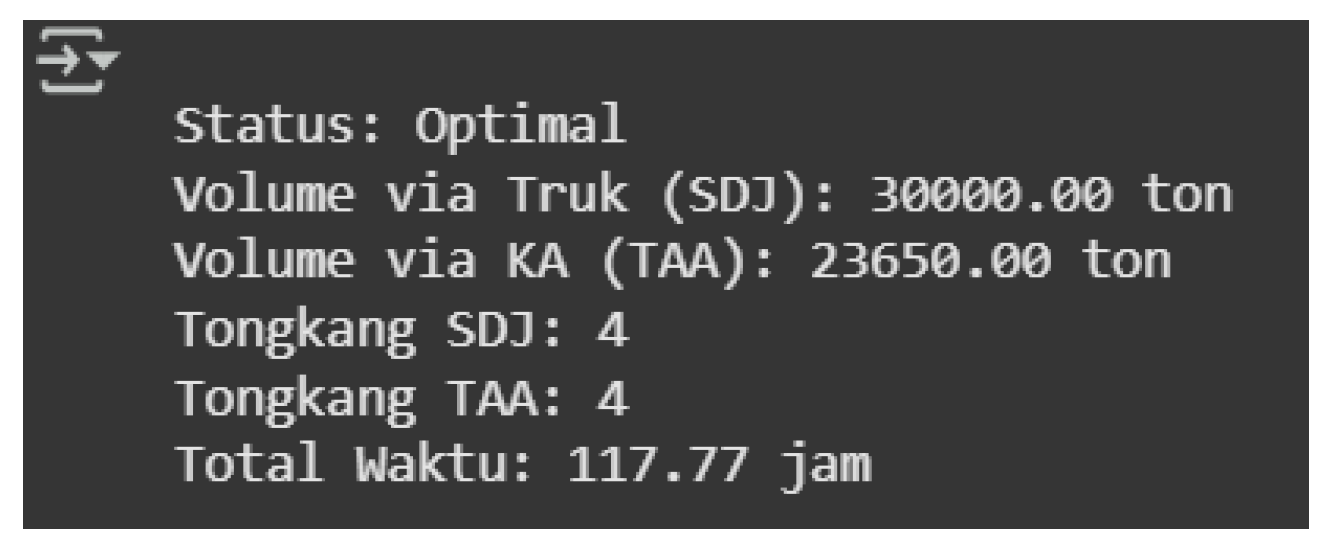
This scenario involved 53,650 tons, with 30,000 tons transported by truck to Port SDJ and 23,650 tons by train to Port TTA in
Table 5. Based on the calculations in
Figure 6, Four barges were utilized at each port, and the shipping process requires 117.77 h. This duration remained within the buyer’s deadline of 6.5 days (156 h), preventing delays in export.
4.5. Mother Vessel E
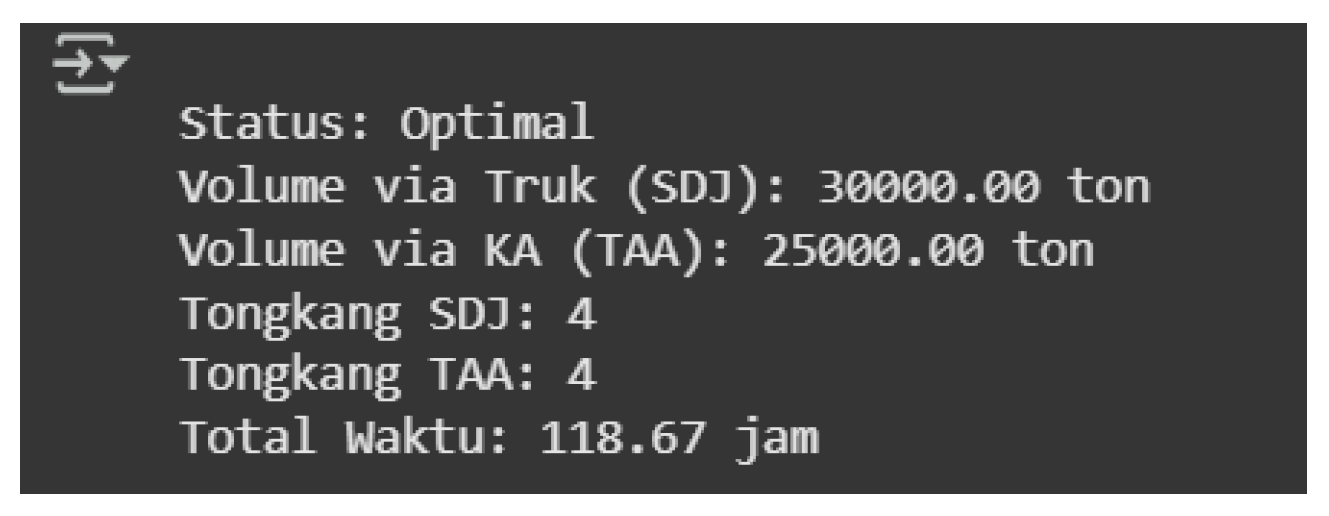
In the 55,000-ton scenario presented in
Table 6, 30,000 tons were sent by truck to Port SDJ and 25,000 tons by train to TTA. Four barges were employed at each port. The shipping process took 118.67 h, which is below the buyer’s deadline of 6.9 days (165.6 h) shown in
Figure 7, thereby ensuring compliance with export schedules.
5. Discussion and Analysis
Simulation results for five shipments to MV A through MV E demonstrated that all distribution scenarios achieved delivery times within the deadlines specified by each buyer. Under the developed system, no delays occurred, in contrast to the existing system, where PT XYZ experienced significant lateness, such as the 13-day delay recorded for MV C. These findings confirm that the developed MILP model effectively mitigates the risk of delays and enhances scheduling reliability for international buyers.
The MILP model enables optimized scheduling and load allocation across two transport modes. Compared with the current truck-only system, its dual-mode approach reduces sailing time, alleviates port congestion, and addresses truck operating constraints. Rail transport to Port TAA substantially decreases barge travel, thereby supporting timely deliveries and lowering costs. Results further indicate that the new routing scheme reduces total logistics expenses and operational risks associated with late penalties.
Table 7 presents a comparison of distribution costs between the existing system and the proposed dual-mode system for each buyer.
6. Conclusions
The developed MILP model for the effective coal distribution of PT XYZ minimizes delivery delays and optimizes transport costs. The integration of trucks and trains facilitates efficient shipment allocation, yielding significant cost savings and eliminating penalty risks. Overall, the model provides an effective decision-support tool for enhancing coal export performance under multimodal transport constraints.
Author Contributions
Conceptualization, A.N.P.A., N.I.S., and M.N.A.; methodology, A.N.P.A., N.I.S., and W.T.; software, A.N.P.A. and M.N.A.; validation, N.I.S. and M.N.A.; formal analysis, A.N.P.A. and M.N.A.; data curation, A.N.P.A. and M.N.A.; writing—original draft preparation, A.N.P.A.; writing—review and editing, A.N.P.A., N.I.S., M.N.A., and W.T.; visualization, A.N.P.A. and M.N.A. All authors have read and agreed to the published version of the manuscript.
Funding
This research received no external funding.
Institutional Review Board Statement
Not applicable.
Informed Consent Statement
Not applicable.
Data Availability Statement
The data presented in this research are available on request from the corresponding author.
Conflicts of Interest
The authors declare no conflict of interest.
References
- Rachman, I.N.A.; Alexander, S.W.; Latjandu, L.D. Analisis Break Even Point sebagai Alat Perencanaan Laba pada CV Angin Mamiri Bitung. Manaj. Bisnis Dan Keuang. Korporat 2024, 2, 236–247. [Google Scholar] [CrossRef]
- Nisa, A.K.; Robiani, B.; Mukhlis, M.; Teguh, M. Pengaruh Konsentrasi Industri dan Biaya Input Terhadap Efisiensi di Industri Produk dari Batu Bara (KBLI 19100). J. Èkon. dan Bisnis Dharma Andalas 2024, 26, 235–244. [Google Scholar] [CrossRef]
- Prasetyo, Y.T.; Paradise, M.; Mukarrom, F. Productivity Assessment of Digging and Loading Equipment (Cat 330D2L) and Hauling Equipment (Fuso 220PS) in Coal Mining at PT. Bhumi Sriwijaya Perdana Coal, Musi Banyuasin Regency, South Sumatra. Indones. J. Earth Sci. 2024, 4, A1226. [Google Scholar] [CrossRef]
- Wicaksono, A.; Wibowo, R.S.; Negara, I.M.Y. Optimasi Perencanaan Operasi Pembangkit Listrik Berbasis Mixed Integer Linear Programming (MILP) Pada Sistem Isolated Selayar. INTECOMS J. Inf. Technol. Comput. Sci. 2024, 7, 727–737. [Google Scholar] [CrossRef]
- Cao, J. Mathematical Model and Algorithm of Multi-Index Transportation Problem in the Background of Artificial Intelligence. J. Adv. Transp. 2022, 2022, 3664105. [Google Scholar] [CrossRef]
- Wang, Y.; Han, Z. Ant colony optimization for traveling salesman problem based on parameters optimization. Appl. Soft Comput. 2021, 107, 107439. [Google Scholar] [CrossRef]
- Gao, W. New Ant Colony Optimization Algorithm for the Traveling Salesman Problem. Int. J. Comput. Intell. Syst. 2020, 13, 44. [Google Scholar] [CrossRef]
- Bodhi, G.; Charleen; Fitrianah, D. Ant Colony Optimization for Jakarta Historical Tours: A Comparative Analysis of GPS and Map Image Approaches. J. RESTI (Rekayasa Sist. dan Teknol. Inf.) 2025, 9, 153–165. [Google Scholar] [CrossRef]
- Nazry, H.W.N.S.; Riza, F.; Rizky, F.; Gultom, Z.A.; Haris, M.; Barus, M.D.B. Model Optimasi Model Optimasi Rute Transportasi Berbasis Pemrograman Linear. J. Sist. Inf. Triguna Dharma (JURSI TGD) 2025, 4, 75–81. [Google Scholar] [CrossRef]
- Chopra, S.; Meindl, P. Supply Chain Management: Strategy, Planning, and Operation; Pearson: London, UK, 2016; [Online]; Available online: https://books.google.co.id/books?id=m1XFoQEACAAJ (accessed on 3 February 2024).
- Suseno, T. Analisis pola distribusi logistik dan infrastruktur batubara untuk PLTU skala kecil. J. Teknol. Miner. dan Batubara 2017, 13, 53–72. [Google Scholar] [CrossRef][Green Version]
- Kennedy, P.S.J. ANALISIS TINGGINYA BIAYA LOGISTIK DI INDONESIA DITINJAU DARI DWELLING TIME. J. Econ. Resour. 2019, 1, 136–145. [Google Scholar] [CrossRef]
- Iskandar, T.; Arifin, R. NAVIGATING INDONESIA’S LOGISTICS AND SUPPLY CHAIN CHALLENGES: A DATA-DRIVEN ANALYSIS OF LOGISTICS PERFORMANCE INDEX. J. BPPK Badan Pendidik. dan Pelatih. Keuang. 2023, 16, 110–123. Available online: https://api.semanticscholar.org/CorpusID:266355010 (accessed on 3 February 2024). [CrossRef]
- Rafi, S. Preliminary model development for archipelago country logistic system. J. Manaj. Strat. dan Apl. Bisnis 2024, 7, 161–172. [Google Scholar] [CrossRef]
| Disclaimer/Publisher’s Note: The statements, opinions and data contained in all publications are solely those of the individual author(s) and contributor(s) and not of MDPI and/or the editor(s). MDPI and/or the editor(s) disclaim responsibility for any injury to people or property resulting from any ideas, methods, instructions or products referred to in the content. |



 ,
,