Proceeding Paper

Simulation and Real-Time Testing of Photoplethysmogram Signal-Based Biometric Recognition System †
Evelyn D. Ang—Institute of Biomedical Engineering and Health Technologies, De La Salle University, 2401 Taft Avenue, Manila 0922, Philippines
*
Author to whom correspondence should be addressed.
Presented at 2025 IEEE International Conference on Computation, Big-Data and Engineering (ICCBE), Penang, Malaysia, 27–29 June 2025.
Eng. Proc. 2026, 128(1), 47; https://doi.org/10.3390/engproc2026128047
Published: 3 April 2026

Abstract

This study aims to develop a biometric recognition system based on photoplethysmogram (PPG) signals. Two testing approaches were employed: simulation and real-time evaluation. The simulations utilized both publicly available data from the IEEE Transactions on Biomedical Engineering database and locally collected data from volunteers. The best-performing simulation model was subsequently applied in real-time testing with the same volunteer group. The results indicate that PPG signals provide a reliable foundation for biometric recognition systems, and further reveal that the use of raw PPG data enhances accuracy.

1. Introduction

As security threats continue to evolve, the technologies designed to counter them must advance accordingly. In this context, human recognition and identification technologies have struggled to keep pace with other security innovations. Biometric recognition can rely on both physiological and behavioral characteristics [1,2]. However, physiological inputs such as facial features, fingerprints, and voice, while convenient, are relatively easy to bypass despite their simplicity [3]. Consequently, researchers have increasingly turned to one-dimensional physiological signals, including electrocardiograms (ECGs), photoplethysmograms, electroencephalograms, and phonocardiograms.
These physiological signals are well-suited to biometric identification and recognition because they are inherently difficult to replicate [4]. Among them, ECG has been the most widely studied, though interest in PPG has grown substantially. PPG is particularly promising as a biometric signal due to its relative simplicity and uniqueness across individuals. It is collected through various methods, most commonly from the finger, the earlobe, or the web between the thumb and forefinger. A notable limitation, however, is its sensitivity to noise introduced by factors such as age, posture, and physical activity [5]. To address these challenges, a biometric recognition system utilizing the empirical mode decomposition of PPG signals has been developed. The objective of this research is to validate its accuracy and practicality through both simulation and testing [6].

2. Literature Review

2.1. Biometrics

Biometrics refers to the measurement and analysis of unique physical or behavioral characteristics, especially as a means of verifying personal identity [7]. Different human characteristics may be suitable for this sort of purpose, but the characteristic must fulfill a certain set of criteria. These are universality, uniqueness, collectability, permanence, accuracy in performance, high throughput, usability, scalability, and acceptability. Biometrics have long been ubiquitous in ensuring security and are widely used in government, various industries, and individual homes [8].

2.2. PPG

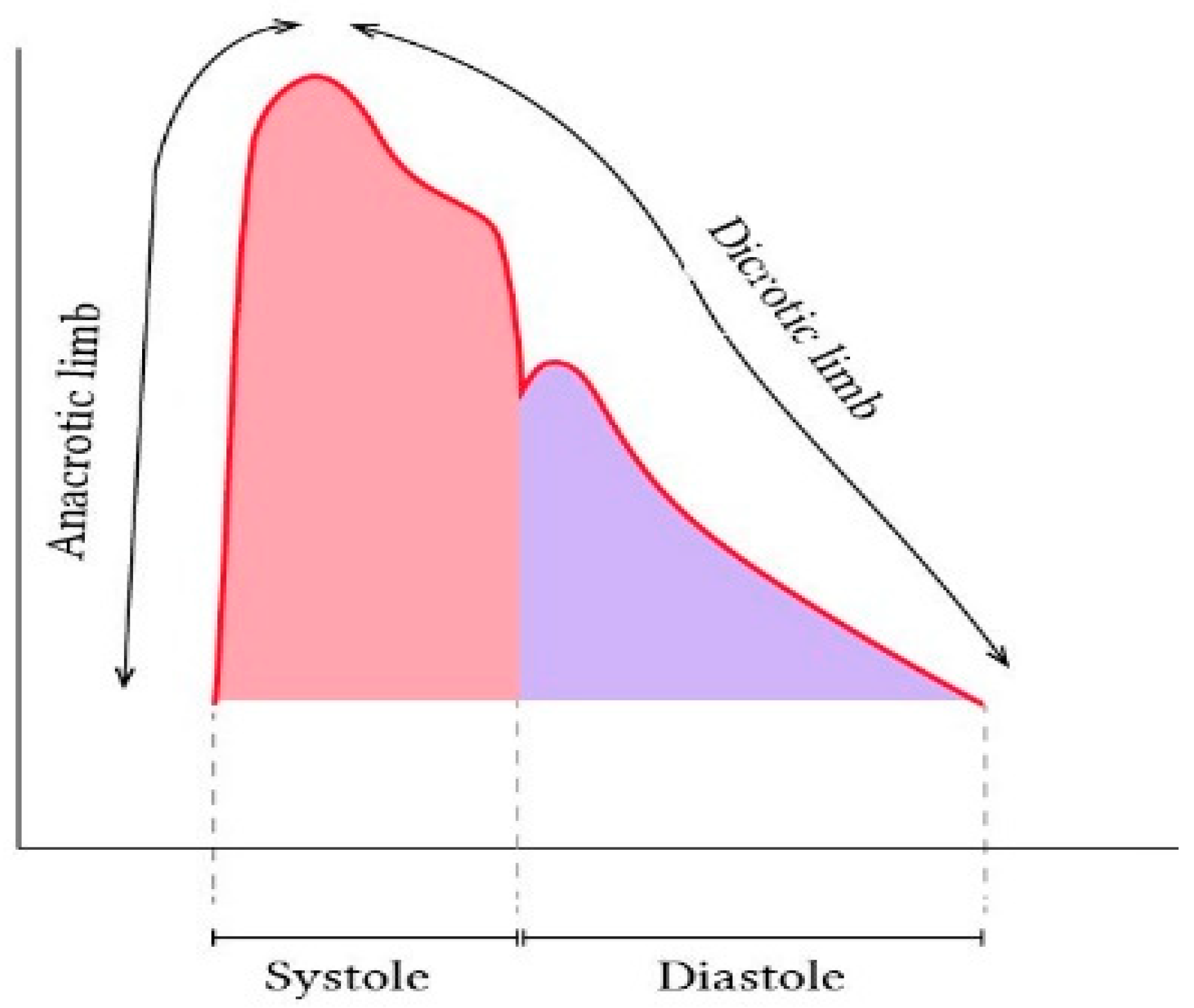
PPG enables a non-invasive method for measuring blood volume pulse through the use of an optical sensor, typically implemented in a pulse oximeter. As illustrated in Figure 1, the PPG signal is divided into anacrotic and catacrotic phases, which correspond to the heart’s systolic and diastolic states, respectively [9].

2.3. Machine Learning Algorithm

We evaluated K-nearest neighbors (KNN), support vector machines (SVM), and random forests (RF). KNN, one of the most widely used and simplest algorithms, constructs its classifier during classification by measuring the Euclidean distance between training and testing instances [10,11,12]. SVM generates one or more hyperplanes in a high-dimensional space, with the optimal hyperplane defined as the one that maximizes the separation between two classes. RF achieves high performance by aggregating multiple decision trees. From the training dataset, subsets are randomly selected to build individual trees, where each node chooses a random index and classifies based on the best feature identified. This process is repeated across numerous trees, collectively forming the “random forest” [13].

3. Methodology

Testing was conducted through both computer-based simulations using previously acquired data and real-time evaluations. Four types of tests were performed: parameter tuning using public data (the Institute of Electrical and Electronics Engineers Transactions on Biomedical Engineering database), authentication and identification performance testing with public data, authentication and identification performance testing with locally acquired data, and real-time identification performance testing.

3.1. Simulation

Simulations using the IEEE TBME dataset were carried out to evaluate algorithm performance under clean conditions, where data acquisition was not affected by noise, as these datasets were collected in prior studies using standardized PPG acquisition devices [5,11,14]. In addition, locally acquired data from four participants were used to assess classifier performance. Data were collected from each subject on three separate days to account for potential waveform variations caused by prior activities. These locally acquired datasets were applied to simulate multiple biometric recognition models, and the best-performing models were subsequently selected for real-time testing.

3.2. Real-Time Testing

System performance was measured when implemented on hardware. Although the use of larger sample sizes generally improves accuracy, practical constraints such as volunteer recruitment and processor capacity limited testing to four participants. Subjects remained in a relaxed position during data collection. The confidence level was 95%, the margin of error was 5%, and the response distribution was 50%. The sample size was 39. For each biometric recognition model, PPG signals consisting of 900 sampling points were collected 25 times per participant, yielding a total of 100 instances for testing. Data were stored in Microsoft Excel (Version 2402). Processing and machine learning were performed using Python (Version 3.11) with the Scikit-learn (v1.3.0) and Pandas (v2.1.0) libraries.

4. Results and Discussion

4.1. Authentication

Using data from four participants, the developed algorithm was evaluated. As shown in Table 1, KNN achieved the highest overall accuracy and sensitivity. For participants 1 and 2, SVC yielded superior accuracy and sensitivity, whereas for participants 3 and 4, KNN remained the most effective. Across all cases, RF consistently produced the highest specificity.

4.2. Identification

In terms of identification, Table 2 shows the accuracy and run-time performance of the different classifiers. SVC produced the highest accuracy of 90.783%. However, the run-time used by SVC is evidently higher than those of both KNN and RF.

4.3. Testing of the Biometric Recognition System

Table 3 presents the confusion matrix summarizing the accuracy of user identification for participants 1–4. In real-time testing, only the KNN classifier was evaluated, as it achieved the highest authentication accuracy for two users in Table 1. KNN was selected over SVC and RF because, during preliminary real-time trials with a single user and four instances, neither SVC nor RF successfully identified the test subject, whereas KNN achieved partial success. Accordingly, Table 3 compares three models that differ only in the training data used.
Table 3 demonstrates that the accuracies achieved in real-time testing are lower than those obtained in simulations. Among the participants, only User 3 was consistently identified with high accuracy across all three KNN models, achieving an accuracy of 96%. Participant 1 attained a relatively higher accuracy of 80% with KNN Model 2, while Participant 4 was identified by Models 1 and 3 at a rate of 52%. In contrast, Participant 2 was recognized with low accuracy across all models. These results suggest that certain individuals, such as Participant 3, possess distinguishable PPG signals that are reliably identified regardless of the model, whereas others, such as Participant 2, are more difficult to recognize as their signal features resemble those of multiple users. Furthermore, models exhibit greater sensitivity in identifying particular individuals, as evidenced by User 1’s higher recognition rate with KNN Model 2 compared with other models. The overall decline in real-time accuracy relative to simulations may be attributed to variations in PPG waveforms caused by participants’ prior activities on the day of testing, which differed from the conditions during initial data collection.

5. Conclusions

The biometric recognition system utilizing PPG data is a viable and sustainable approach. However, the results reveal that models accurately identify specific individuals while failing to recognize others. For instance, one participant was consistently identified with high accuracy (96%) across all models, whereas another achieved low accuracy (no higher than 20%) regardless of the model applied. To enhance the performance of similar systems, the dataset must be expanded by increasing the number of participants and collecting data across multiple time points. Larger and more diverse testing groups are also required to improve system robustness and generalizability.

Author Contributions

Conceptualization, F.E.M.III, C.S.S., H.C., and E.A.; methodology, F.E.M.III; software, E.A., L.A., and S.L.J.; validation, F.E.M.III, N.B., H.C., and E.A.; formal analysis, N.B. and C.S.S.; investigation, F.E.M.III, H.C.; resources, N.B.; data curation, N.B.; writing—original draft preparation, E.A., L.A., and S.L.J.; writing—review and editing, F.E.M.III; visualization, E.A., L.A., and S.L.J.; supervision, F.E.M.III; project administration, F.E.M.III; funding acquisition, N.B. All authors have read and agreed to the published version of the manuscript.

Funding

This research did not receive any external funding.

Institutional Review Board Statement

Not applicable.

Informed Consent Statement

Not applicable.

Data Availability Statement

Data will be available on request.

Acknowledgments

The authors would like to acknowledge the support provided by the Evelyn D. Ang—Institute of Biomedical Engineering and Health Technologies (EDA-IBEHT) for this research. The institute’s resources and assistance have been instrumental in facilitating our investigations and achieving the milestones of this study.

Conflicts of Interest

The authors declare no conflicts of interest.

References

  1. González-Manzano, L.; Fuentes, J.M.D.; Peris-Lopez, P.; Camara, C. Encryption by Heart (EbH)—Using ECG for time-invariant symmetric key generation. Future Gener. Comput. Syst. 2017, 77, 136–148. [Google Scholar] [CrossRef]
  2. Zhao, Z.; Yang, L.; Chen, D.; Luo, Y. A Human ECG Identification System Based on Ensemble Empirical Mode Decomposition. Sensors 2013, 13, 6832–6864. [Google Scholar] [CrossRef] [PubMed]
  3. Ramli, D.; Hooi, M.; Chee, K. Development of Heartbeat Detection Kit for Biometric Authentication System. Procedia Comput. Sci. 2016, 96, 305–314. [Google Scholar] [CrossRef][Green Version]
  4. Labati, R.D.; Sassi, R.; Scotti, F. ECG biometric recognition: Permanence analysis of QRS signals for 24 hours continuous authentication. In Proceedings of the 2013 IEEE International Workshop on Information Forensics and Security (WIFS), Guangzhou, China, 18–21 November 2013. [Google Scholar]
  5. Sadrawi, M.; Shieh, J.-S.; Haraikawa, K.; Chien, J.C.; Lin, C.H.; Abbod, M.F. Ensemble empirical mode decomposition applied for PPG motion artifact. In Proceedings of the 2016 IEEE EMBS Conference on Biomedical Engineering and Sciences (IECBES), Kuala Lumpur, Malaysia, 4–8 December 2016. [Google Scholar]
  6. Alonzo, L.; Co, H. Ensemble Empirical Mode Decomposition of Photoplethysmogram Signals in Biometric Recognition. In Proceedings of the 2019 4th Asia-Pacific Conference on Intelligent Robot Systems (ACIRS), Nagoya, Japan, 13–15 July 2019. [Google Scholar]
  7. Biometrics. Available online: https://www.merriam-webster.com/dictionary/biometrics (accessed on 17 July 2018).
  8. Modi, S.K. Biometrics in Identity Management: Concepts to Applications; Artech House: Boston, MA, USA, 2011. [Google Scholar]
  9. Sarkar, A.; Abbott, A.L.; Doerzaph, Z. Biometric authentication using photoplethysmography signals. In Proceedings of the 2016 IEEE 8th International Conference on Biometrics Theory, Applications and Systems (BTAS), Niagara Falls, NY, USA, 6–9 September 2016. [Google Scholar]
  10. Krapf, D.; Marinari, E.; Metzler, R.; Oshanin, G.; Xu, X.; Squarcini, A. Power spectral density of a single Brownian trajectory: What one can and cannot learn from it. New J. Phys. 2018, 20, 023029. [Google Scholar] [CrossRef]
  11. Karthikeyan, P.; Murugappan, M.; Yaacob, S. ECG Signal Denoising Using Wavelet Thresholding Techniques in Human Stress Assessment. Int. J. Electr. Eng. Inform. 2012, 4, 306–319. [Google Scholar] [CrossRef]
  12. Taneja, S.; Gupta, C.; Aggarwal, S.; Jindal, V. MFZ-KNN—A modified fuzzy based K nearest neighbor algorithm. In Proceedings of the 2015 International Conference on Cognitive Computing and Information Processing (CCIP), Noida, India, 3–5 March 2015. [Google Scholar]
  13. 1.6. Nearest Neighbors. Available online: https://scikit-learn.org/stable/modules/neighbors.html (accessed on 30 March 2019).
  14. Liu, Y.; Wu, H. Water bloom warning model based on random forest. In Proceedings of the 2017 International Conference on Intelligent Informatics and Biomedical Sciences (ICIIBMS), Okinawa, Japan, 24–26 November 2017. [Google Scholar]
Figure 1. PPG signal morphology [9].
Engproc 128 00047 g001
Table 1. Results using PPG from the database.
AlgorithmKNNSVCRFKNNSVCRF
Participant12
Accuracy (%)94.14293.30888.21794.55891.80084.600
Sensitivity (%)89.86782.56757.30087.23377.33040.900
Specificity (%)95.56796.95698.52297.00096.62299.167
Run time (s)534.0951030.943506.031516.6251551.125732.297
AlgorithmKNNSVCRFKNNSVCRF
Participant34
Accuracy (%)95.93397.60897.00093.00097.22592.592
Sensitivity (%)88.56794.16789.36790.93398.57870.367
Specificity (%)98.38998.75699.54493.68993.167100.000
Run time (s)784.7451456.107875.560616.4671030.048591.494
Table 2. Identification results obtained using raw PPG from the database.
MetricKNNSVCRF
Accuracy (%)88.98390.78389.091
Run time (s)924.7831638.576781.750
Table 3. Confusion matrices of identification results using raw PPG from real-time testing.
KNN Model 1 (Accuracy = 47%)
Predicted
User 1User 2User 3User 4
ResultUser 124%32%4%40%
User 224%16%12%48%
User 30%0%96%4%
User 424%20%4%52%
KNN Model 1 (Accuracy = 56%)
Predicted
User 1User 2User 3User 4
ResultUser 180%4%4%12%
User 260%20%4%16%
User 30%0%96%4%
User 452%20%0%28%
KNN Model 1 (Accuracy = 49%)
Predicted
User 1User 2User 3User 4
ResultUser 140%28%4%28%
User 212%8%20%60%
User 30%0%96%4%
User 48%12%28%52%
Disclaimer/Publisher’s Note: The statements, opinions and data contained in all publications are solely those of the individual author(s) and contributor(s) and not of MDPI and/or the editor(s). MDPI and/or the editor(s) disclaim responsibility for any injury to people or property resulting from any ideas, methods, instructions or products referred to in the content.