Proceeding Paper

Scenario-Based Simulation for Evaluating Trade-Offs Among Efficiency, Effectiveness, and Equity in Emergency Response Routing: A Monte Carlo Approach and MATLAB †
by
Charmine Sheena Saflor
1,2,*,
Anton Luis Martin Espina
1,
Marlon Era
2,
Samantha Louise Jarder
2,
Francisco Emmanuel Munsayac Jr. III
2 and
Ronnel Agulto
2
1
Department of Industrial and Systems Engineering, De La Salle University Manila, Manila 1004, Philippines
2
School of Innovation and Sustainability, De La Salle University Laguna, Manila 4024, Philippines
*
Author to whom correspondence should be addressed.
Presented at the 2025 IEEE International Conference on Computation, Big-Data and Engineering (ICCBE), Penang, Malaysia, 27–29 June 2025.
Eng. Proc. 2026, 128(1), 40; https://doi.org/10.3390/engproc2026128040
Published: 17 March 2026

Abstract

In disaster response logistics, it is critical to evaluate strategies for operational speed and efficiency and fairness in aid distribution. Therefore, we developed a simulation-based framework for assessing emergency delivery performance using the efficiency, effectiveness, and equity (3E) model under uncertainty. Using the Monte Carlo simulation v4.4.9 and MATLAB v4.4.9, the model tests a greedy resource allocation strategy across 100 randomized scenarios involving variable regional demand and travel times. Each scenario is evaluated based on total fulfillment, distribution balance, and delivery effort. The results indicate that under ideal conditions with sufficient supply and no logistical constraints, the strategy achieves full effectiveness and perfect equity, with consistent efficiency outcomes. While the system performs optimally in the base case, the model also highlights the importance of testing strategies under more constrained or disrupted environments. The proposed approach enables planners to assess performance trade-offs, providing a robust foundation for future extensions involving optimization, real-time data integration, or prioritization schemes.

1. Introduction

Disaster events are inherently unpredictable, posing immense challenges to emergency logistics systems. The success of response strategies depends not only on how fast resources are deployed but also on how fairly and completely they meet community needs. While traditional optimization models are effective in generating optimal delivery plans, they often operate under static assumptions and do not fully capture system behavior under real-world variability.
In previous studies, mixed integer nonlinear programming models were developed using the general algebraic modeling system and other software to optimize emergency deliveries under uncertainty, integrating efficiency, effectiveness, and equity as key performance indicators. Although effective in producing structured and theoretically optimal routes, the model required a high level of data precision and did not provide dynamic feedback on how strategies perform across a variety of plausible emergency scenarios.
Monte Carlo simulations are used to examine how different response strategies perform under varying conditions of demand, travel time, and supply limitations. It is necessary to evaluate how well logistics plans hold up in terms of the 3E framework under multiple simulated scenarios, offering valuable insights into the robustness, adaptability, and fairness of emergency response strategies.
Emergency response logistics face mounting challenges due to the unpredictable nature of disasters, with variability in demand, transportation conditions, and resource constraints significantly affecting operational outcomes. While prior research has focused on optimization techniques for logistics planning, many of these models prioritize deterministic efficiency without accounting for real-world uncertainty and the dynamic trade-offs that emerge under pressure. Furthermore, there is a lack of practical tools to evaluate how delivery strategies perform in fluctuating environments, particularly in terms of fairness and adaptability.
Existing models often overlook equity or assume perfect information, resulting in decisions that may underperform when subjected to real-world variability. Therefore, to address the need for a dynamic approach, we developed a simulation model that integrates the 3E framework using scenario-based evaluation of emergency response strategies. The specific objectives of this study are threefold. First, we developed a simulation model that captures the variability inherent in emergency logistics conditions, particularly focusing on stochastic demand and travel time. Second, we evaluated the performance of last-mile aid delivery strategies using key indicators aligned with the 3E framework. Third, we analyzed the trade-offs among these three dimensions across multiple simulated emergency scenarios, providing insights into the robustness and adaptability of various delivery strategies.
We simulated the last-mile delivery operations of emergency supplies from central depots to multiple affected areas. We identified variables such as regional demand, vehicle travel times, and stock availability to evaluate how different allocation strategies perform in terms of the 3E framework. The model operates at a tactical planning level, assuming that primary resources have already been prepositioned at designated depots and that the focus is on how those resources are distributed when an emergency event occurs.
The simulation model adopts assumptions to maintain clarity and focus in the analysis. First, it assumes full control over delivery resources and does not consider real-time communication challenges, coordination delays, or infrastructure damage, aside from variability in travel time. Second, regional demand is treated as independent and randomly generated for each scenario, without accounting for spatial correlations or specific demographic needs. Third, the model excludes complex delivery dynamics such as rerouting, refueling, or multi-trip vehicle operations. Fourth, equity is assessed solely based on the standard deviation of fulfillment ratios, which may overlook deeper issues like socio-economic disparities or the prioritization of vulnerable populations. Lastly, the simulation operates under synthetic conditions, meaning real-world implementation would require integration with actual data and coordination systems.
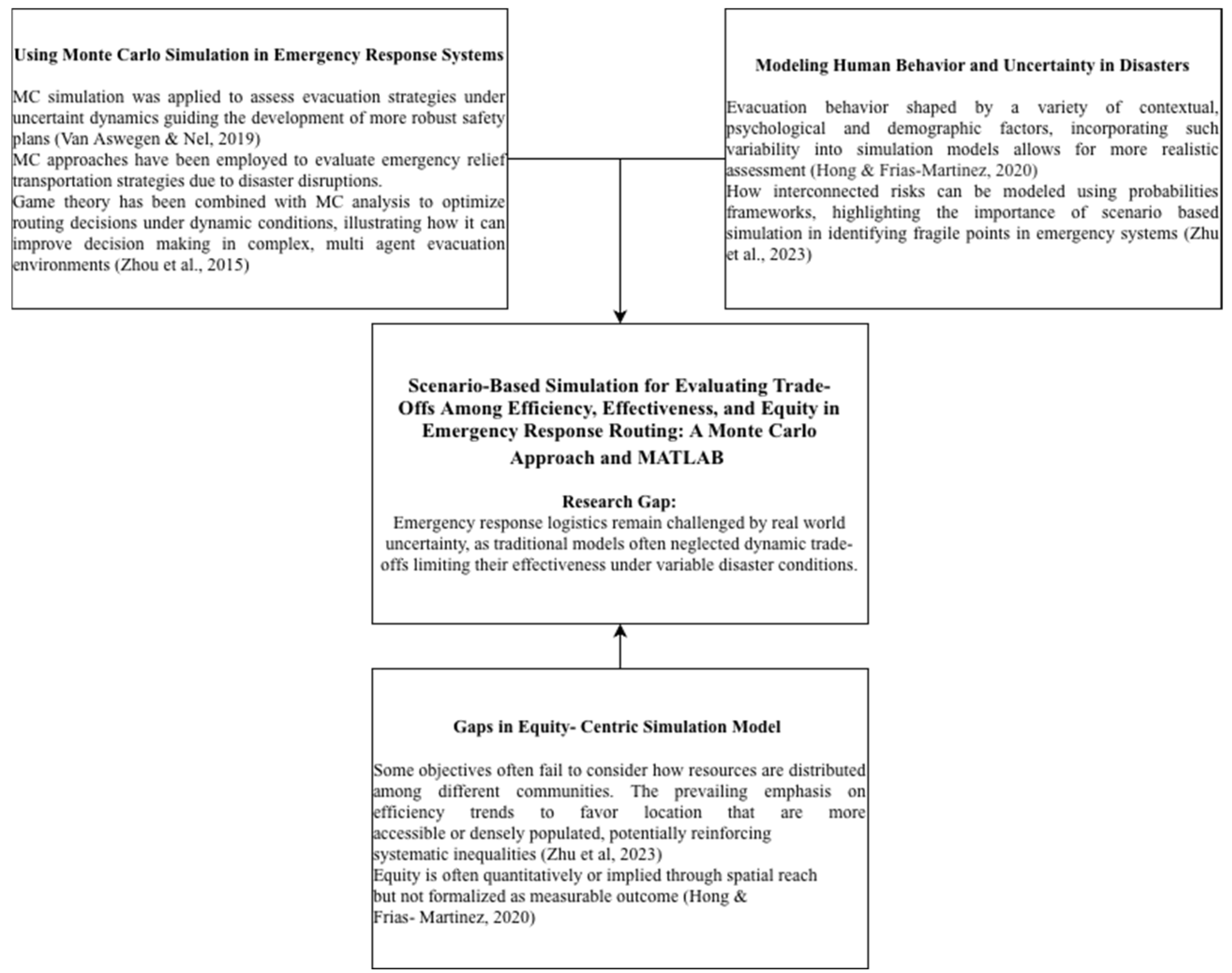
Figure 1 presents the theoretical framework of this study. Monte Carlo simulation techniques, behavioral modeling under uncertainty, and equity considerations were applied to emergency logistics. Based on prior applications of Monte Carlo analysis in evacuation planning and disaster response, the role of stochastic scenario generation is emphasized to reflect real-world unpredictability [1,2]. The model integrates human behavior modeling and probabilistic risk assessment to represent the complexity of disaster environments [3,4]. By addressing equity-centric gaps, where traditional models often overlook how resource allocation disparities, systemic inequalities were examined [3,4]. In a simulation-based approach, we evaluated the trade-offs between effectiveness, efficiency, and equity in emergency response logistics using MATLAB v4.4.9.

2. Literature Review

2.1. Monte Carlo Simulations in Emergency Response

Monte Carlo simulation has become widely adopted for modeling uncertainty and variability in emergency logistics and evacuation scenarios. It enables researchers to evaluate system performance under diverse stochastic conditions, providing critical insights into resilience and risk. For example, in underground mine fires, Monte Carlo simulation has been applied to assess evacuation strategies under uncertain fire dynamics, variable travel speeds, and decision-making delays, thereby informing the development of more robust safety plans [5]. Similarly, in humanitarian logistics, Monte Carlo approaches have been used to evaluate emergency relief transportation strategies where road access and travel times are disrupted by disasters [6]. These studies highlight the flexibility of simulation-based analysis in testing response effectiveness across numerous plausible scenarios. In evacuation planning, Monte Carlo analysis has also been combined with game theory to optimize routing decisions under chaotic and dynamic conditions, demonstrating how probabilistic evaluation can enhance decision-making in complex, multi-agent environments [7]. Beyond technical optimization, simulation supports emergency planners in anticipating real-world complications such as congestion, hesitation, and route competition. The adaptability of Monte Carlo simulation across diverse domains of disaster response underscores its value as a tool for evaluating strategy performance, particularly when integrated with multidimensional frameworks that incorporate equity and social resilience.

2.2. Modeling Human Behavior and Uncertainty in Disasters

Accurately modeling human behavior during disasters is critical for realistic simulation outcomes, especially as individual and group decisions introduce stochasticity that significantly impacts system performance. A review by Bakhshian and Martinez-Pastor [8] emphasized that evacuation behavior is shaped by a variety of contextual, psychological, and demographic factors, including hesitation, the influence of peer groups, and access to information. These factors can dramatically alter the flow and timing of emergency responses. Incorporating such variability into simulation models allows for a more realistic assessment of bottlenecks, delays, and uneven service coverage.
Emergency response systems must account for cascading disaster scenarios, where one event triggers another (e.g., an earthquake followed by flooding). Ricci et al. [9] examined how these interconnected risks can be modeled using probabilistic frameworks, highlighting the importance of scenario-based simulation in identifying fragile points in emergency systems. They emphasize the need for adaptable planning methods that respond not only to single-event uncertainty but also to compound, evolving crises. This aligns with the present study’s objective to develop a simulation model capable of testing logistics strategies under a variety of uncertain conditions and performance pressures.

2.3. Gaps in Equity-Centric Simulation Models

Previous research on emergency logistics emphasizes performance indicators such as delivery time, cost efficiency, and route reliability, while often neglecting the equitable distribution of resources across communities [6,9]. This efficiency-driven research prioritizes easily accessible or densely populated areas, potentially exacerbating inequalities, particularly in disaster contexts where equitable access to aid is critical [5]. Although stochastic and simulation-based approaches are increasingly employed, equity has not been integrated into evaluation frameworks, instead treating it qualitatively or through implied spatial coverage [8]. To address this gap, equity metrics are employed in simulation models, such as the standard deviation of fulfillment ratios across regions. This approach enables planners to assess fairness alongside efficiency and effectiveness, offering a more comprehensive and inclusive framework for evaluating emergency response strategies.

3. Methodology

We adopted a simulation-based research methodology to evaluate emergency logistics performance under uncertainty using the 3E framework. A total of 100 emergency scenarios were generated using a Monte Carlo simulation with a student license of the MATLAB software, each representing a unique combination of regional demand and travel time variation. The model focuses on last-mile delivery from two central depots to five affected areas, with delivery logic based on greedy allocation constrained by available stock. Each scenario consists of randomly generated demand per area and stochastic travel times from each depot, mimicking the uncertain nature of real-world emergencies. The simulation process involves allocating supplies from depots to regions, calculating performance metrics for each run, and aggregating the results to evaluate systemic trends and trade-offs. MATLAB was chosen for its capability to simulate random processes and generate visual outputs for scenario evaluation.

4. Model Construction

4.1. Assumption

To establish a structural foundation for the model, assumptions were made. The emergency network comprises two supply depots and five demand regions. Each depot holds a fixed inventory of supplies designated to meet the needs of the respective regions. The demand in each region, along with the travel time from each depot, is treated as stochastic and independently generated for every scenario. Supplies are allocated through a one-time distribution per scenario, following a greedy First-In–First-Out strategy. Each region is considered independently, with no interdependencies among them, and is served individually. Deliveries to each region are completed in a single batch, meaning no partial shipments or multiple delivery trips are permitted. Additionally, the model does not account for vehicle routing, traffic congestion, or real-time dispatch in its simulation.

4.2. Notations in Model

The model involves indices for demand regions ii (A–E), depots jj (D1 and D2), and scenarios ss (1–100). The parameters include the mean expected demand in each region, denoted as base demand (i), and the total stock available at each depot, denoted as stock (j). Other parameters include vehicle capacity, representing the maximum number of units deliverable in a single batch, travel time (j, i, s) indicating the stochastic travel time from depot jj to region ii in scenario ss, and demand (i, s) representing the stochastic demand in region ii for scenario ss. The main variable in the model is delivery (j, i, s), which indicates the number of units delivered from depot jj to region ii under scenario ss.

5. Results and Discussion

5.1. Simulation

A simulation model was developed in MATLAB and tested across 100 randomly generated emergency scenarios using a Monte Carlo approach. It featured two central depots (D1 and D2) and five demand regions (A to E). Regional demand in each scenario was normally distributed based on predefined values ranging from 80 to 150 units, with a standard deviation of ±20 units, and any negative values were set to zero. Travel times from depots to regions varied randomly between 70 and 130% of a baseline matrix. Each depot had a total stock of 400 units, and the model assumed ideal conditions with no vehicle routing or capacity constraints. A greedy allocation strategy was used, allowing each depot to fulfill as much regional demand as possible until its stock was depleted.

5.2. Key Performance

Across all 100 simulation runs, the model achieved 100% effectiveness, with demand fully satisfied in every scenario. Efficiency was recorded at 2847.28, calculated as the sum of delivery quantities multiplied by their respective travel times. Equity was measured at 0.0000, indicating identical fulfillment ratios across all regions. These results confirm that, under the current conditions, the delivery system operated optimally, meeting all demands with perfect fairness. The greedy allocation method ensured that each region received its full request without deviation, supported by sufficient stock and the absence of delivery constraints. The effectiveness histogram displayed a tight distribution centered at 1.0 (100%), confirming consistent demand fulfillment across all scenarios. The efficiency histogram revealed moderate variability in total delivery time, attributable to stochastic differences in travel distances and assignments. The equity histogram was concentrated at zero, reflecting perfectly uniform supply allocation across all demand nodes, with no imbalance in fulfillment levels among regions.

6. Conclusions and Recommendations

We employed a simulation-based approach to evaluate emergency response logistics using the 3E Framework under uncertainty. Monte Carlo simulation in MATLAB was applied across 100 scenarios to assess the performance of a resource allocation strategy in fulfilling demand, ensuring equitable distribution, and maintaining delivery efficiency. The results of this study demonstrated that, under ideal conditions, a greedy delivery strategy achieved perfect effectiveness, equity, and efficiency. These findings highlight the model’s capacity to simulate realistic emergency conditions and emphasize the importance of equity as a core performance metric alongside efficiency and cost.
It is necessary to incorporate resource constraints to simulate bottlenecks, integrating vulnerability-based equity models, combining simulation with optimization techniques to develop hybrid strategies, and validating the framework with real-world data. Overall, the developed framework provides a flexible and scalable tool for enhancing emergency preparedness and ensuring fair, timely distribution of aid.

Author Contributions

Conceptualization, C.S.S. and A.L.M.E.; methodology, C.S.S., A.L.M.E., R.A., M.E., S.L.J. and F.E.M.J.III; software, C.S.S., A.L.M.E., R.A., M.E., S.L.J. and F.E.M.J.III; validation, C.S.S., A.L.M.E., R.A., M.E., S.L.J. and F.E.M.J.III; formal analysis, C.S.S., A.L.M.E., R.A., M.E., S.L.J. and F.E.M.J.III; investigation, C.S.S. and A.L.M.E.; resources, C.S.S., A.L.M.E., R.A., M.E., S.L.J. and F.E.M.J.III; data curation, C.S.S., A.L.M.E., R.A., M.E., S.L.J. and F.E.M.J.III; writing—original draft preparation, C.S.S. and A.L.M.E.; writing—review and editing, C.S.S., A.L.M.E., R.A., M.E., S.L.J. and F.E.M.J.III; visualization, C.S.S., A.L.M.E., R.A., M.E., S.L.J. and F.E.M.J.III; supervision, C.S.S. and A.L.M.E.; project administration, C.S.S.; funding acquisition, C.S.S., A.L.M.E., R.A., M.E., S.L.J. and F.E.M.J.III. All authors have read and agreed to the published version of the manuscript.

Funding

This research received no external funding.

Institutional Review Board Statement

Not applicable. The study did not involve humans.

Informed Consent Statement

Not applicable. The study did not involve humans.

Data Availability Statement

The raw data supporting the conclusions of this article will be made available by the authors on request.

Conflicts of Interest

The authors declare no conflicts of interest.

References

  1. Van Aswegen, J.D.; Nel, L.; Strydom, N.A.; Minnaar, K.; Kylin, H.; Bouwman, H. Comparing the metallic elemental compositions of Kelp Gull Larus dominicanus eggs and eggshells from the Swartkops Estuary, Port Elizabeth, South Africa. Chemosphere 2019, 221, 533–542. [Google Scholar] [CrossRef] [PubMed]
  2. Zhou, Y.; Huang, G.; Wang, S.; Zhai, Y.; Xin, X. Water resources management under dual uncertainties: A factorial fuzzy two-stage stochastic programming approach. Stoch. Environ. Res. Risk Assess. 2016, 30, 795–811. [Google Scholar] [CrossRef]
  3. Hong, L.; Frias-Martinez, V. Modeling and predicting evacuation flows during hurricane Irma. EPJ Data Sci. 2020, 9, 29. [Google Scholar] [CrossRef]
  4. Zhu, R.; Becerik-Gerber, B.; Lin, J.; Li, N. Behavioral, data-driven, agent-based evacuation simulation for building safety design using machine learning and discrete choice models. Adv. Eng. Inform. 2023, 55, 101827. [Google Scholar] [CrossRef]
  5. Adjiski, V.; Zubicek, V.; Despodov, Z. Monte Carlo simulation of uncertain parameters to evaluate the evacuation process in an underground mine fire emergency. J. S. Afr. Inst. Min. Metall. 2019, 119, 907–917. [Google Scholar] [CrossRef] [PubMed]
  6. Namatovu, A.; Karunasena, G. Emergency Relief Goods Transportation Strategies—A Monte Carlo Simulation Approach. Available online: https://australasiantransportresearchforum.org.au/emergency-relief-goods-transportation-strategies-a-monte-carlo-approach/ (accessed on 1 August 2024).
  7. Li, W.; Zhu, J.; Li, H.; Wu, Q.; Zhang, L. A game theory based on Monte Carlo analysis for optimizing evacuation routing in complex scenes. Math. Probl. Eng. 2015, 2015, 292093. [Google Scholar] [CrossRef]
  8. Bakhshian, E.; Martinez-Pastor, B. Evaluating human behaviour during a disaster evacuation process: A literature review. J. Traffic Transp. Eng. 2023, 10, 485–507. [Google Scholar] [CrossRef]
  9. Ricci, F.; Yang, M.; Reniers, G.; Cozzani, V. Emergency response in cascading scenarios triggered by natural events. Reliab. Eng. Syst. Saf. 2024, 243, 109820. [Google Scholar] [CrossRef]
Figure 1. Workflow of this research [1,2,3,4].
Engproc 128 00040 g001
Disclaimer/Publisher’s Note: The statements, opinions and data contained in all publications are solely those of the individual author(s) and contributor(s) and not of MDPI and/or the editor(s). MDPI and/or the editor(s) disclaim responsibility for any injury to people or property resulting from any ideas, methods, instructions or products referred to in the content.