1. Introduction
With the rapid development of space telescopes and large-scale optical systems, the demand for high-quality large-aperture optical mirrors has increased significantly [
1,
2]. Quartz glass, microcrystalline glass, and silicon carbide are widely used in space optical components due to their excellent thermal stability, low thermal expansion coefficient, and high stiffness [
3,
4]. However, these materials are typically hard and brittle, making them extremely difficult to process efficiently while maintaining high surface integrity [
5,
6]. Grinding remains a critical process in the manufacturing chain of optical mirrors, especially in the generation of surface shape and the removal of subsurface damage caused by previous processes [
7,
8]. Conventional grinding methods often suffer from low material removal rates, non-uniform abrasive trajectories, and severe surface or subsurface damage, which restrict their application in high-precision optical manufacturing [
9].
Cup wheel grinding has attracted increasing attention due to its large end-face contact area and strong material removal capability [
10,
11]. It is widely applied due to its high stiffness, strong material removal capability, and suitability for processing complex surfaces. Numerous studies have examined the grinding force and thermal behavior in cup wheel grinding, recognizing their decisive roles in process stability, surface integrity, and tool wear [
12]. Grinding force arises from the combined effects of friction, plowing, and chip formation at the abrasive–workpiece interface, and its evolution has been modeled through empirical, energy-based, and micro-mechanical approaches over several decades [
13,
14]. Owing to the distinct geometry of cup wheels, the grinding kinematics differ fundamentally from those of conventional parallel wheels, leading to radial variations in tangential speed, grain penetration depth, and undeformed chip thickness across the end face [
15,
16]. Meanwhile, research on the heat generated during cup-shaped grinding wheel grinding was proposed and established using discrete abrasive particles as the modeling method [
17,
18]. However, the motion trajectory of abrasive grains on the cup wheel is complex and strongly influenced by process parameters. Abrasive interference and non-uniform trajectories can lead to surface scratches, crack propagation, and edge chipping, particularly when grinding quartz glass [
19,
20].
In this study, a trochoidal trajectory model is proposed by considering the actual motion of discrete consolidated abrasive grains on a cup grinding wheel. A process parameter–mathematical model is established to describe the multi-grain coupled motion trajectory. By optimizing the trajectory uniformity, the material removal rate is improved while surface damage is effectively reduced. Experimental verification is conducted using an optical curve-grinding machine to evaluate the effectiveness of the proposed model in improving the surface quality of quartz glass.
2. Cup Wheel Grinding Trochoidal Trajectory Model
During cup wheel grinding, abrasive grains on the end face of the wheel participate simultaneously in rotational and translational motions. The relative motion between the abrasive grains and the workpiece surface forms a complex trochoidal trajectory, which plays a decisive role in material removal behavior and surface formation. Assuming the grinding wheel rotates at an angular velocity ω and the workpiece feeds at a constant linear speed
v, the trajectory of a single abrasive grain on the cup wheel end face can be described as a trochoidal curve. The radius r of the base circle can be expressed as follows:
The trajectory of a single abrasive grain under this motion can be expressed analytically by the trochoid equation:
where
θr is the angular position of the abrasive grain on the base circle during its rotational motion. The radial distance
R between an abrasive grain and the wheel center defines the rolling radius of the moving circle. By considering the discrete distribution of abrasive grains and their actual engagement conditions, the trochoidal trajectory model reflects the realistic grinding process more accurately than conventional simplified kinematic models.
In cup wheel grinding, the relative motion between abrasive grains and the workpiece surface is primarily governed by the grinding feed speed and the rotational speed of the grinding wheel. When grinding depth and abrasive distribution are fixed, the trajectory characteristics of abrasive grains are dominated by the coupling between the wheel rotation and the linear feed motion. To quantitatively describe this relationship, the ratio between the workpiece feed speed and the circumferential speed of the grinding wheel is defined as a dimensionless parameter .
Under this definition,
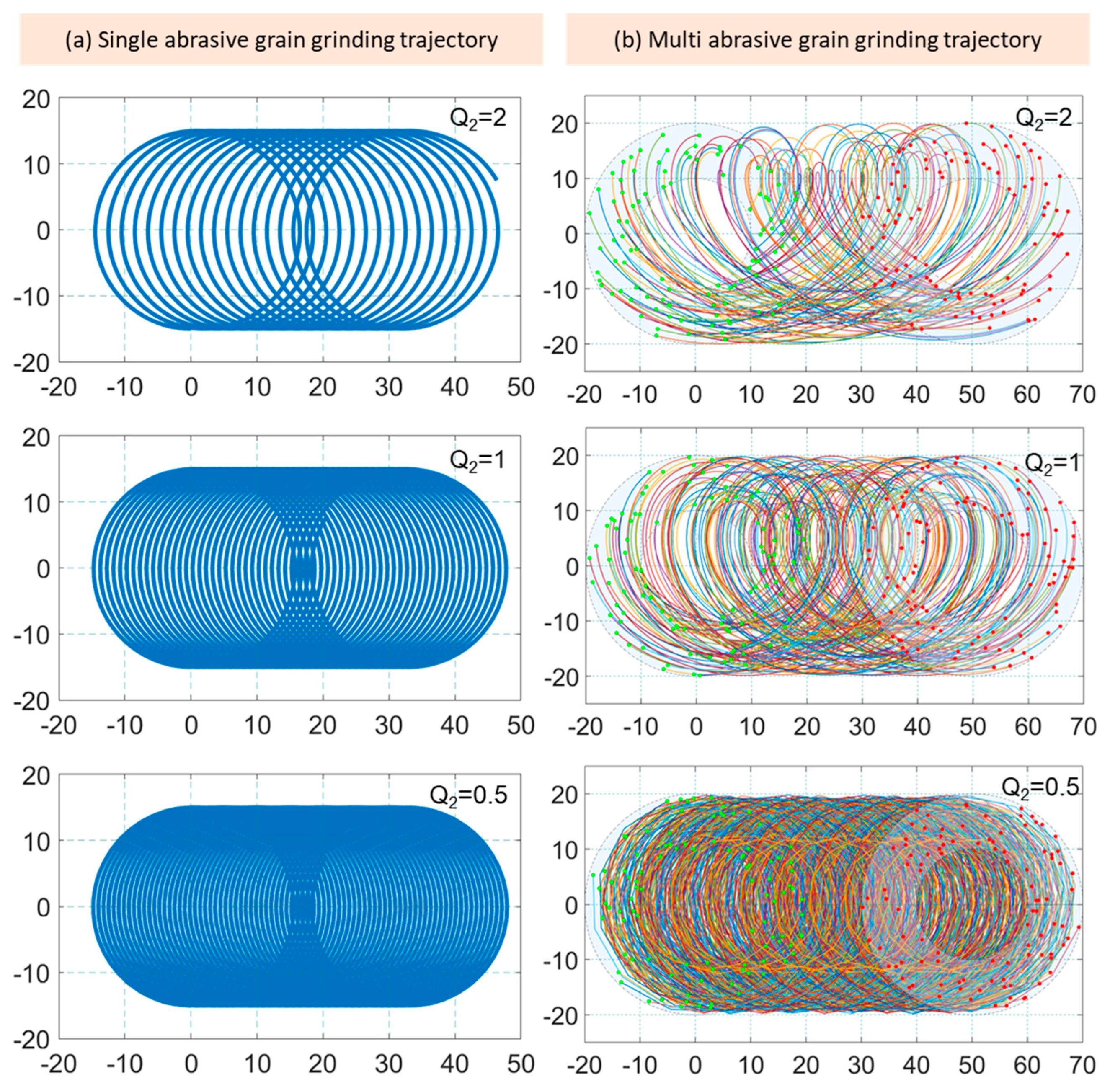
directly determines the shape, spacing, and overlap characteristics of the trochoidal trajectories generated by individual abrasive grains on the workpiece surface. As shown in
Figure 1a, when
decreases, the trajectories become denser and the overlap between adjacent abrasive paths increases, leading to a higher number of effective cutting engagements per unit area. As a result, the material removal load shared by a single abrasive particle is reduced, which decreases the maximum cutting depth of a single abrasive grain. In contrast, a larger
produces a sparser trajectory distribution with fewer effective abrasive interactions, so each abrasive grain undertakes a higher removal load and thus exhibits a larger maximum cutting depth.
From a multi-grain perspective,
controls the trajectory uniformity of the abrasive population on the end face of the cup wheel. As shown in
Figure 1b, an excessively small
leads to redundant cutting paths and inefficient utilization of abrasive grains, while an excessively large
causes sparse trajectory coverage, increasing the risk of surface waviness and localized damage. Therefore, an intermediate range of
exists in which the trochoidal trajectories of multiple abrasive grains are uniformly distributed, achieving a balance between material removal efficiency and surface quality. By regulating
, the coupled motion behavior of multiple grains can be effectively controlled without altering wheel structure or abrasive characteristics, providing a straightforward and physically meaningful parameter for trajectory optimization in cup wheel grinding.
3. Experimental Setup and Methodology
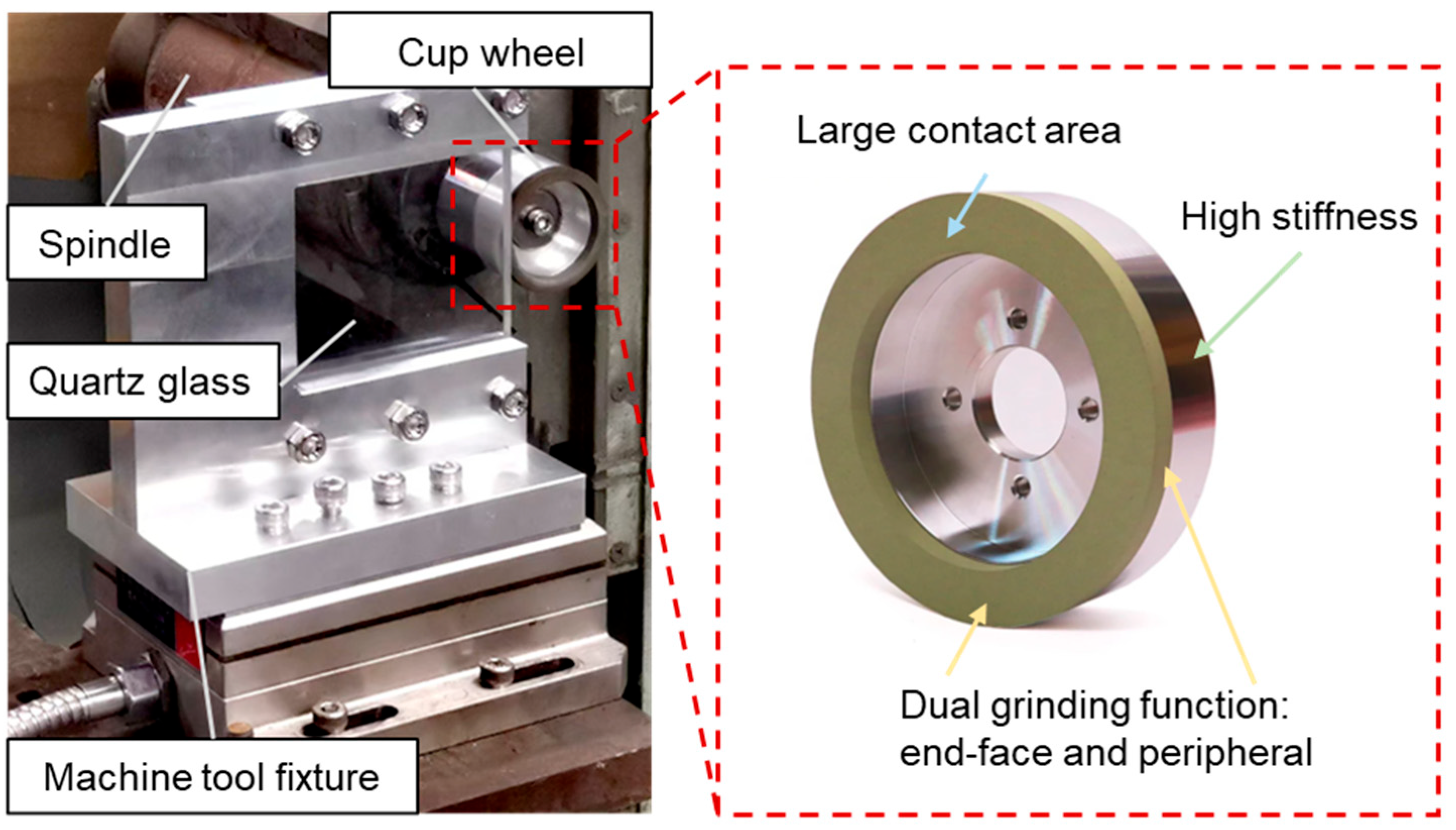
As shown in
Figure 2, the experiments were conducted on an optical curve-grinding machine equipped with a cup wheel spindle system. Optical-grade quartz glass specimens were selected as the workpiece material. The workpiece material used was fused quartz glass (SiO
2-based quartz glass). The typical material properties of fused quartz glass are summarized in
Table 1. The specimens were machined into rectangular plates with dimensions of 200 mm × 200 mm × 10 mm. A vitrified-bond cup grinding wheel with uniformly distributed abrasive grains on the end face was employed. Careful alignment and calibration were performed during wheel installation to minimize end-face runout and angular misalignment.
Based on the previously established trajectory model, different combinations of workpiece feed speed and wheel rotational speed were applied to generate a range of values for the dimensionless parameter . During the experiments, grinding depth, coolant conditions, and abrasive specifications were kept constant in order to isolate the effects of feed speed and wheel speed on abrasive grain trajectories and surface formation mechanisms. For each parameter set, stable grinding was performed, and the process was stopped after an identical grinding length for subsequent surface characterization.
After grinding, the surface roughness of the quartz glass specimens was quantitatively measured using a surface profilometer to evaluate the influence of different values on surface quality. In addition, the ground surface morphology and subsurface damage characteristics were examined using a super-depth-of-field microscope, with particular attention given to grinding marks, crack distribution, and material removal features. Furthermore, the edge regions of the specimens were observed under magnification, thereby assessing the effects of grinding stress and trajectory uniformity on edge integrity.
4. Results and Discussion
4.1. Trajectory Uniformity Regulated by
The proposed trochoidal trajectory framework indicates that the relative spacing and overlap of abrasive tracks are primarily controlled by the coupling between workpiece feed speed and wheel circumferential speed , represented by the dimensionless ratio . In the experiments, varying produced clearly distinguishable grinding mark patterns on quartz glass. When was small (high and/or low ), the scratch trajectories became densely overlapped. The ground surface exhibited fine, closely packed grinding marks, suggesting repeated engagement of multiple grains over the same surface region. As increased, the spacing between adjacent trochoidal traces widened, and the track coverage became less redundant. At excessively high , discontinuous coverage appeared in some regions, characterized by more pronounced individual grooves and locally non-uniform textures. This confirms that varying significantly changes the trajectory coverage characteristics.
Mechanistically, the multi-grain trajectory uniformity can be interpreted as a balance between two competing effects. A small enhances the probability that successive grains pass through the same area, which promotes surface smoothing through repeated micro-cutting and micro-plowing, but simultaneously increases abrasive interference and frictional contact. Conversely, a large reduces interference and encourages more distinct material removal events per grain track, yet the reduced overlap weakens the averaging effect on surface topography, making the final surface more sensitive to occasional large protruding grains or localized wheel wear. Therefore, an intermediate range exists where trajectories are sufficiently overlapped to homogenize topography while not so dense as to cause severe interference, providing the most favorable condition for stable surface formation.
4.2. Surface Quality Response to from Overlap Smoothing to Sparse Scratching
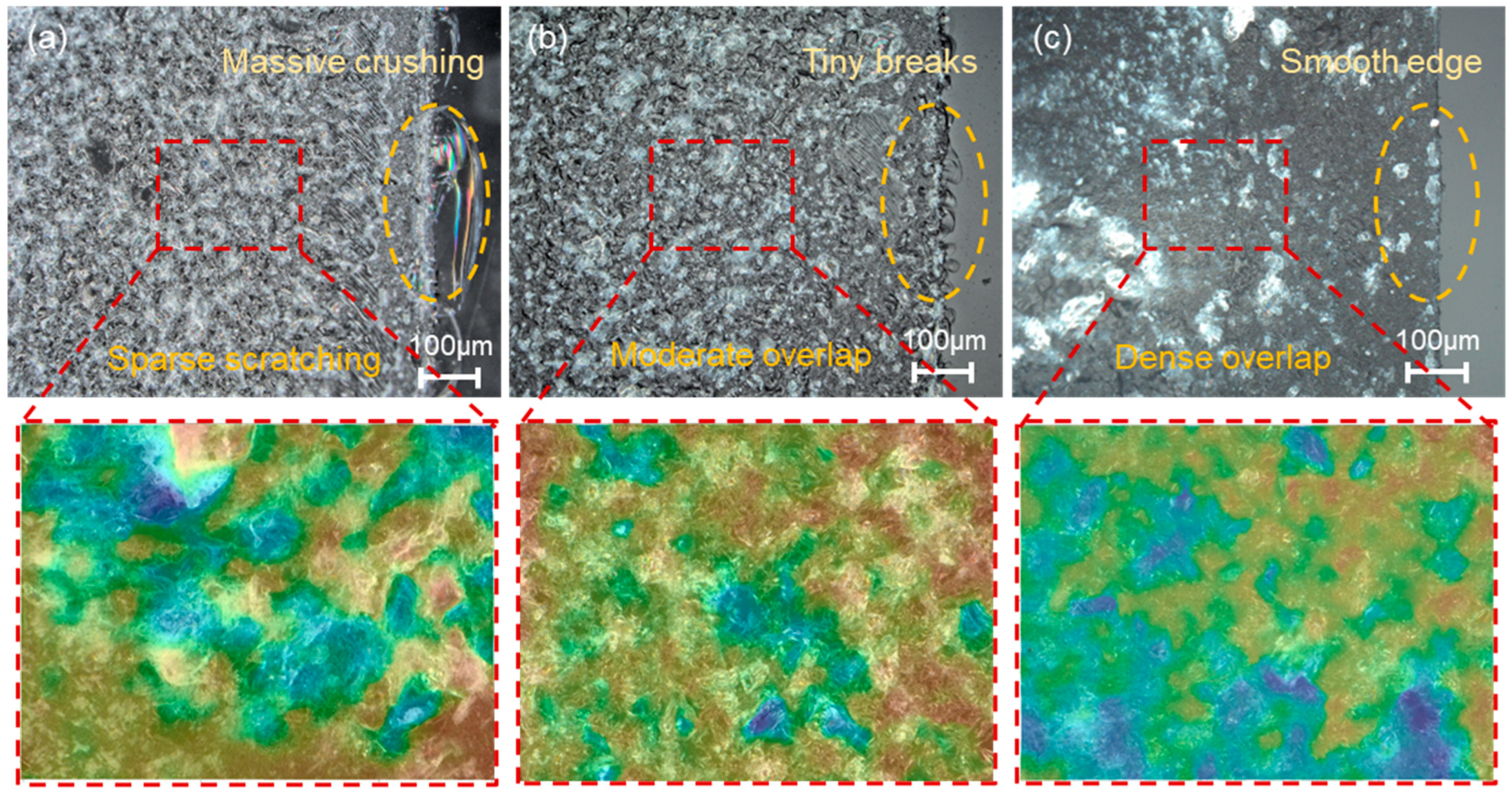
As shown in
Figure 3, Surface topography measurements show a monotonic dependence on
. At relatively small
, the roughness decreases compared with conventional parameter settings, which is consistent with the observed dense and uniform grinding marks. This reduction can be attributed to the enhanced overlap of trochoidal tracks: repeated engagement increases the likelihood that surface asperities generated by one grain are subsequently removed or flattened by following grains, resulting in a “self-averaging” surface generation process. In addition, denser trajectories distribute the removal load across more grains per unit area, lowering the effective undeformed chip thickness per grain and reducing the formation of deep grooves.
Edge integrity is a critical quality metric for optical components because edge chipping can propagate during subsequent handling or polishing. For hard–brittle materials such as fused quartz, edge chipping is mainly induced by crack initiation and propagation under high local stress near the free edge, where the material lacks lateral support. When is excessively large and the track coverage becomes sparse, some abrasive grains may intermittently engage the edge region with a relatively large instantaneous penetration depth, generating local overload events and promoting the formation of lateral/median cracks that can extend toward the boundary and cause edge breakout. In contrast, when is tuned to provide denser and more uniform trajectory overlap, the edge region experiences a more continuous and distributed removal process. This reduces load fluctuations and stress concentration near the free boundary, thereby suppressing crack growth and decreasing the occurrence of edge chipping. Therefore, the observed reduction in edge fracture area under the optimized condition provides evidence that trajectory-based regulation improves not only surface topography but also edge failure resistance.
4.3. Balancing Efficiency and Integrity via
The results collectively indicate that the optimal parameter design is not tied to a single “best” feed speed or wheel speed independently, but rather to maintaining a favorable ratio . This is advantageous for process planning because productivity (increasing ) can be improved while preserving surface integrity by proportionally increasing to keep within the optimal window. Once an acceptable range of is identified experimentally for a given wheel–workpiece combination, productivity can be increased by raising the feed speed while simultaneously increasing the wheel speed to maintain within the optimal band. In other words, instead of searching for a “best” feed speed or a “best” wheel speed separately, the process engineer can design parameter sets along lines of constant , treating as a constraint that guarantees surface integrity, and using absolute values of and mainly to adjust the material removal rate and thermal loading within machine and cooling limits.
For large-aperture optical mirrors, where both throughput and subsurface integrity are critical, this constant- design concept is particularly valuable. It allows the grinding system to operate closer to its capacity in terms of material removal rate, while the risk of overcutting, crack propagation, and edge chipping is controlled via the trajectory uniformity encoded by . In this sense, serves as a compact, mechanism-based process index that bridges kinematic conditions, trajectory formation, and damage evolution, and provides a systematic basis for balancing grinding efficiency against surface and subsurface quality in cup wheel grinding of brittle optical materials.
5. Conclusions
This study developed a trochoidal trajectory model for cup wheel grinding and demonstrated that the relative kinematic parameter governs the fundamental behavior of abrasive motion and surface formation in quartz glass grinding. The model reveals that directly controls the spacing, overlap, and uniformity of multi-grain trajectories, thereby determining whether the material removal process is dominated by smoothing through dense, overlapping tracks or by sparse scratching under insufficient trajectory coverage.
Experimental results show that surface roughness, subsurface crack depth, and edge chipping all exhibit a strong dependence on . A small leads to overly dense trajectories and abrasive interference, whereas a large induces localized stress peaks and brittle fracture. An optimal range of exists where the trajectories are uniformly distributed, resulting in minimized roughness, reduced subsurface damage, and improved edge integrity. These findings indicate that maintaining a proper value offers a practical and physically meaningful strategy for balancing grinding efficiency and surface integrity. Instead of optimizing feed speed or wheel speed independently, process parameters can be selected along lines of constant to achieve both high material removal rates and low-damage grinding. The proposed trajectory model and the identified -based control principle provide valuable guidance for high-precision, high-efficiency machining of brittle optical materials, particularly large-aperture quartz glass optics.
Although the proposed trochoidal trajectory model can effectively describe the kinematic distribution and overlap characteristics of discrete abrasive grain trajectories, several limitations should be noted. First, the model primarily focuses on the geometric–kinematic behavior of abrasive motion and does not explicitly consider the stochastic variations in abrasive grain properties, such as grain size distribution, grain shape, protrusion height, and bond-related constraints, which may influence the actual single-grain cutting depth and the local material removal behavior. Second, the grinding wheel condition is assumed to be constant during the process. In practical grinding, wheel wear, grain fracture, pull-out, and wheel loading can change the effective abrasive density, cutting sharpness, and the contact state, thereby affecting the surface integrity and potentially altering the trajectory uniformity over time.
Future studies will extend the proposed trochoidal trajectory model to other typical hard–brittle optical materials, such as silicon carbide (SiC), sapphire, optical glass, and glass ceramics, where surface integrity and subsurface damage are also critical. In addition, the model will incorporate wheel wear evolution and abrasive property randomness into the trajectory-based model to improve prediction accuracy under long-duration and industrial grinding conditions.
Author Contributions
P.Z.: Methodology, Validation, Investigation, Data curation, Visualization, Writing—original draft. B.L.: Conceptualization, Supervision, Funding acquisition, Writing—review & editing. J.Z.: Visualization, Investigation, Data curation. T.S.: Formal analysis, Funding acquisition, Writing—review and editing. All authors have read and agreed to the published version of the manuscript.
Funding
This work was supported by the National Natural Science Foundation of China (Grant Nos. 52275458, 52275207), the National Key Research and Development Program of China (Grant No. 2023YFB3711100), and the Natural Science Foundation of Tianjin (Grant No. 22JCZDJC00050).
Institutional Review Board Statement
Not applicable.
Informed Consent Statement
Not applicable.
Data Availability Statement
No new data were created or analyzed in this study.
Conflicts of Interest
The authors declare no competing interests.
References
- Comley, P.; Morantz, P.; Shore, P.; Tonnellier, X. Grinding metre scale mirror segments for the E-ELT ground based telescope. CIRP Ann. Manuf. Technol. 2011, 60, 379–382. [Google Scholar] [CrossRef]
- Zhao, P.; Lin, B.; Zhou, J.; Lv, B.; Li, J.; Zhang, J.; Wang, L.; Sui, T. Review of grinding temperature theory and measurement for the needs of the times: Promoting the development of advanced manufacturing. J. Mater. Process. Technol. 2025, 337, 118744. [Google Scholar] [CrossRef]
- Xie, J.; Deng, Z.J.; Liao, J.Y.; Li, N.; Zhou, H.; Ban, W.X. Study on a 5-axis precision and mirror grinding of glass freeform surface without on-machine wheel-profile truing. Int. J. Mach. Tools Manuf. 2016, 109, 65–73. [Google Scholar] [CrossRef]
- Zhao, P.; Lin, B.; Zhou, J.; Lv, B.; Sui, T. Finite Element Research of Cup Wheel Grinding Heat Based on Trochoid Scratch Model. Machines 2025, 13, 53. [Google Scholar] [CrossRef]
- Lv, B.; Lin, B.; Sui, T.; Liu, C. Crack extension mechanism and scratch stress field model of hard and brittle materials caused by curvature effect. J. Mater. Process. Technol. 2023, 319, 118058. [Google Scholar] [CrossRef]
- Zhao, P.; Lin, B.; Zhou, J.; Zhao, F.; Sui, T. Grinding heat theory based on trochoid scratch model: Establishment and verification of grinding heat model of trochoid cross-point. Int. J. Adv. Manuf. Technol. 2024, 133, 4617–4632. [Google Scholar] [CrossRef]
- Guo, D. High-performance manufacturing. Int. J. Extrem. Manuf. 2024, 6, 060201. [Google Scholar] [CrossRef]
- Dogra, M.; Sharma, V.S.; Dureja, J.S.; Gill, S.S. Environment-friendly technological advancements to enhance the sustainability in surface grinding—A review. J. Clean. Prod. 2018, 197, 218–231. [Google Scholar] [CrossRef]
- Malkin, S.; Guo, C. Grinding Technology: Theory and Application of Machining with Abrasives; Industrial Press Inc.: South Norwalk, CT, USA, 2008. [Google Scholar]
- Feng, G.; Liu, Q.; Guo, W.; Xin, Y.; Liang, Q. Experimental investigations on nanogrinding of RB-SiC wafers. Mater. Manuf. Process. 2018, 33, 1030–1035. [Google Scholar] [CrossRef]
- Zhao, P.; Lin, B.; Zhou, J.; Lv, B.; Li, J.; Xu, X.; Hou, H.; Wang, L.; Cui, Y.; Ilolovd, M.; et al. Cup wheel grinding in high-precision manufacturing: Multiscale modeling, process innovation and sustainable practices. Int. J. Extrem. Manuf. 2026, 8, 022004. [Google Scholar] [CrossRef]
- Malkin, S.; Cook, N.H. The wear of grinding wheels: Part 2-fracture wear. J. Manuf. Sci. Eng. Trans. ASME 1971, 93, 1129–1133. [Google Scholar] [CrossRef]
- Malkin, S. Thermal aspects of grinding part 2 surface temperatures and workpiece burn. J. Manuf. Sci. Eng. Trans. ASME 1974, 96, 1184–1191. [Google Scholar] [CrossRef]
- Malkin, S.; Anderson, R.B. Thermal aspects of grinding part 1 energy partition. J. Manuf. Sci. Eng. Trans. ASME 1974, 96, 1177–1183. [Google Scholar] [CrossRef]
- Fujiwara, T.; Komatsubara, R.; Horiguchi, S.; Ohashi, K.; Kodama, H.; Onishi, T.; Maeda, T. Effect of grinding wheel tooth thickness on grinding force distributions in face grinding of cemented carbide with constant processing efficiency. In Proceedings of the 2021 JSPE Autumn Conference, Online, 21–27 September 2021; pp. 441–442. [Google Scholar] [CrossRef]
- Wakabayashi, T.; Fujiwara, T.; Harada, Y.; Onishi, T.; Ohashi, K.; Tsukamoto, S. Grinding Force Distribution on Working Surface of Cup Type Grinding Wheel in Face Grinding. In Proceedings of the 2012 JSPE Spring Conference, Tokyo, Japan, 14–16 March 2012; pp. 585–586. [Google Scholar] [CrossRef]
- Zhao, P.; Lin, B.; Zhou, J.; Lv, B.; Sui, T. Trochoid-based cup wheel grinding heat model with stochastic grains distribution. Int. J. Mech. Sci. 2025, 301, 110556. [Google Scholar] [CrossRef]
- Zhao, P.; Lin, B.; Zhou, J.; Lv, B.; Sui, T. Grinding heat theory for cup wheel based on trochoid model. Int. J. Mech. Sci. 2025, 287, 109980. [Google Scholar] [CrossRef]
- Zhao, F.; Lin, B.; He, Y.; Sui, T. Cross-point effect of high-speed cross scratch on hard brittle materials. Ceram. Int. 2021, 47, 9317–9324. [Google Scholar] [CrossRef]
- Zhao, F.; Lin, B.; He, Y.; Sui, T.; Li, H.; Zhao, P. Curvature effect induced cutting stress field offset and its influence on the damage of hard and brittle materials. J. Mater. Process. Technol. 2022, 303, 117526. [Google Scholar] [CrossRef]
| Disclaimer/Publisher’s Note: The statements, opinions and data contained in all publications are solely those of the individual author(s) and contributor(s) and not of MDPI and/or the editor(s). MDPI and/or the editor(s) disclaim responsibility for any injury to people or property resulting from any ideas, methods, instructions or products referred to in the content. |