1. Introduction
PocketQubes represent a significant advancement in the field of small satellites due to their ultra-compact format. Their small size, often standardized at 5 cm per side, allows for greater modularity and increased cost-effectiveness during their development and deployment, as documented by Muhammad Idriss Ishaq in “
The Rise of PocketQube: An In-Depth Look at Mission Trends and Attitude Determination and Control Systems Technologies”, published in July 2025 [
1].
The swarm concept, where several PocketQubes operate in concert, amplifies their capabilities beyond those of a single satellite. For example, a swarm of PocketQubes equipped with various sensors could provide more comprehensive and frequent data collection over a target area than a single satellite—even a larger one. The potential for collaborative swarm technologies is a key driver of their development, as highlighted in the recent academic literature, such as
Small Satellites: Revolutionizing Space Exploration and Earth Observation (2024, 11(3):118–124) [
2], which emphasizes the transformative impact of these distributed systems on space exploration and Earth observation.
Our article presents a simulation-based analysis of attitude control in PocketQube nanosatellite swarms within the Matlab/Simulink environment, highlighting the current relevance of integrating linear quadratic regulator (LQR) techniques for trajectory analysis. The fundamental concepts of attitude control and linear quadratic regulators (LQRs), while already known (as illustrated in a 2013 publication on
NASA’s Technical Reporting Server) [
3], are applied to the specific challenges posed by the dynamics of nanosatellite swarms. Our study aims to demonstrate their application in optimizing the collective behavior and maintaining the desired spatial orientations for large constellations of nanosatellites.
In addition, advances in distributed control algorithms are being explored to further improve the autonomy and resilience of PocketQube swarms, enabling them to adapt to unforeseen circumstances and continue to operate with minimal human intervention, as detailed in “
Autonomous and Distributed Motion Planning for Satellite Swarm”, published in the
Aerospace Research Journal on 23 May 2012 [
4].
2. Materials and Methods
2.1. Derivation and Assumptions of Hill–Clohessy–Wiltshire Relative Motion Equations
The control algorithm for a constellation of 20 PocketQube nanosatellites operating in quasi-circular orbits within a central gravitational field was developed using the Hill–Clohessy–Wiltshire relative motion equations. This development was detailed by Danil Ivanov and Uliana Monakhova in their publication, “
Decentralized Control of Nanosatellites Tetrahedral Formation Flying Using Aerodynamics Forces”, which appeared in
Aerospace on 25 July 2021 [
5]. The Hill–Clohessy–Wiltshire equations are fundamental in relative orbital mechanics and provide a linearized model of the relative motion of two nearby spacecraft, assuming that one of them is on a circular reference orbit.
In the local–vertical local–horizontal (LVLH) frame, where
is radial,
is along-track, and
is cross-track, the linearized Hill–Clohessy–Wiltshire equations of relative motion are given by
,
, and
. Here,
,
, and
represent the relative positions of the deputy nanosatellite.
,
, and
represent the relative velocities.
,
, and
represent the relative acceleration.
represents the mean motion of the chief nanosatellite, calculated as
, where
is the gravitational parameter of the central body and
is the semi-major axis of the chief’s circular orbit [
5].
The general solutions to these differential equations provide the relative position and velocity of the chaser spacecraft as a function of time. The relative position is given by [
5]
,
,
. Meanwhile, the relative velocity is given by
,
,
, where
are constants determined by the initial relative position and velocity conditions at
.
These constants can be expressed in terms of initial conditions
and given by [
5]
,
,
,
,
,
.
However, a more common and simplified set of constants is often used, leading to the following forms [
5]:
,
,
.
The equations developed by Rakisheva, Sukhenko et al., in their 2024 publication “
Evaluation of the applicability of some algorithms for controlling the motion of satellites in formation” [
6], describe the relative motion of six small satellites. Our research extended this framework to a larger formation of 20 nanosatellites, specifically PocketQubes, to model the relative motion of each deputy PocketQube with respect to a chief PocketQube. These equations could be applied for each of the 19 deputy PocketQubes relative to the designated chief satellite. For example, each deputy PocketQube had its own set of initial conditions
for
.
This application relied on their initial relative positions and velocities, under the specific condition in which the chief satellite maintained a circular orbit and that the relative distances between the satellites were small [
6].
2.2. Collision Avoidance and Proximity Operations
For a group of 20 PocketQubes, the relative positions and distances are crucial in maintaining formation flight, avoiding collisions, and achieving mission objectives, as detailed by Jasper Bouwmeester in “
Utility and constraints of PocketQubes” (2020) [
7]. The conditions typically require that the distance between any two PocketQubes must always be greater than a predefined minimum safety distance. Let
and
be two PocketQubes in the group. We designate
as the chief and
as the deputy. The relative position vector from
to
is
. These equations then describe the evolution of
as a function of the initial relative state.
The relative position vector between PocketQubes and PocketQubes at time is given by , where , , and are calculated using the Hill–Clohessy–Wiltshire solutions with the initial relative conditions between and .
The Euclidean distance between PocketQubes and PocketQubes at time is . Maintaining the maximum separation distance is given by the condition for all . Meanwhile, maintaining the minimum separation distance is given by the condition for all . The relative positions of the PocketQubes remain within a specified tolerance around the desired training geometry and is expressed as , where is the actual relative position vector of PocketQubes , is its desired relative position vector, and is the position tolerance.
2.3. State-Space Representation and LQR Formulations
The linear quadratic regulator is an optimal control method designed to minimize a quadratic cost function, which typically quantifies state deviations and control effort. This approach is widely described in various control theory texts and applications. For instance, Darren DE Battista’s “
PocketQube Pico-Satellite Attitude Control: Implementation and Testing” (July 2020) [
8] specifically applies an LQR to attitude control systems, highlighting its utility in minimizing errors and control strategies for small satellites. To control the relative navigation of the PocketQube, the Hill–Clohessy–Wiltshire equations were supplemented with control inputs.
The Hill–Clohessy–Wiltshire equations can be converted into a state-space representation to apply the linear quadratic regulator, as explained by Kumardip Basak and Dipak Kumar Giri in their 2022 paper titled “
LQR-based optimal control design for formation flight of satellites in geometric circular orbit” [
9]. For each deputy
, the state vector is
, and the control input is
. The state-space model is given by
, where
is the system matrix derived from the Hill–Clohessy–Wiltshire equations, and
is the input matrix. By integrating the modified Hill–Clohessy–Wiltshire equations with the parameters for the PocketQube nanosatellites used in the simulation, the system matrix
and the input matrix
are given as
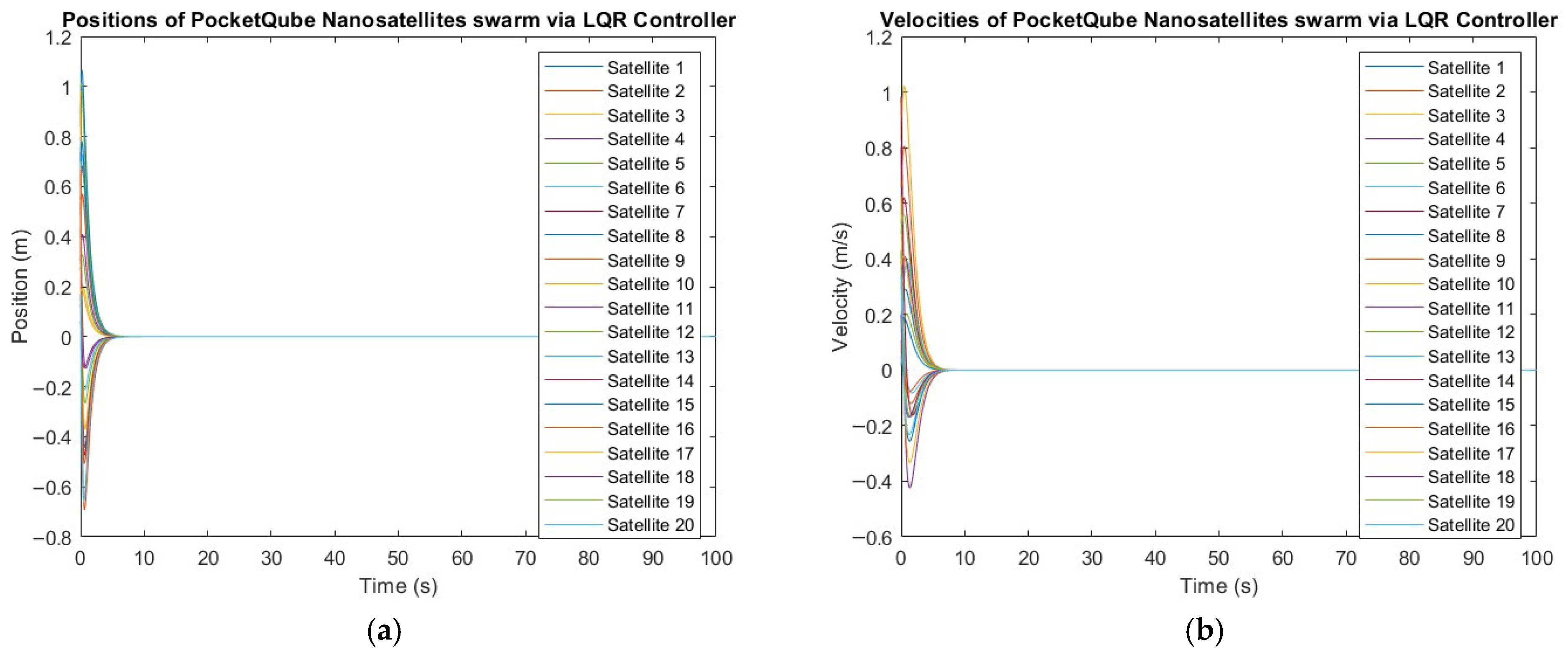
The LQR controller aims to find a control law that minimizes a quadratic cost function and is given by , where is a positive semi-definite state weighting matrix and it is given by , where penalize relative position errors and penalize relative velocity errors. is a positive definite control weighting matrix and it is given by , where penalize the control inputs in each axis. In the simulation, we noticed that a large value of strongly penalized any deviations from the desired relative positions, ensuring that the satellites maintained their separation. Moreover, a value of penalized the relative velocities, promoting smoother trajectories and reducing oscillations. By inserting a moderate value of , it allowed for sufficient control authority to correct position errors and prevent collisions without being overly aggressive regarding fuel consumption. Additionally, the optimal gain matrix is given by , where is the unique positive definite solution to the algebraic Riccati equation (ARE) and is given by .
It is crucial to add that the Hill–Clohessy–Wiltshire equations do not directly incorporate the gravitational constant and the mass of the PocketQubes and in their explicit form for relative motion. This is because the Hill–Clohessy–Wiltshire equations are derived assuming that the gravitational force of the central body is the dominant force acting on both the chief and deputy PocketQubes and that the relative motion is small. The gravitational parameter , where is the mass of the central body, is used to calculate the mean motion and it is given by . In this case, is the gravitational constant, and is the orbital radius of the chief PocketQube. However, it is crucial to understand that the masses of the individual PocketQubes are not a direct input to the Hill–Clohessy–Wiltshire equations, as their mutual gravitational attraction is considered negligible.
3. Simulation Results
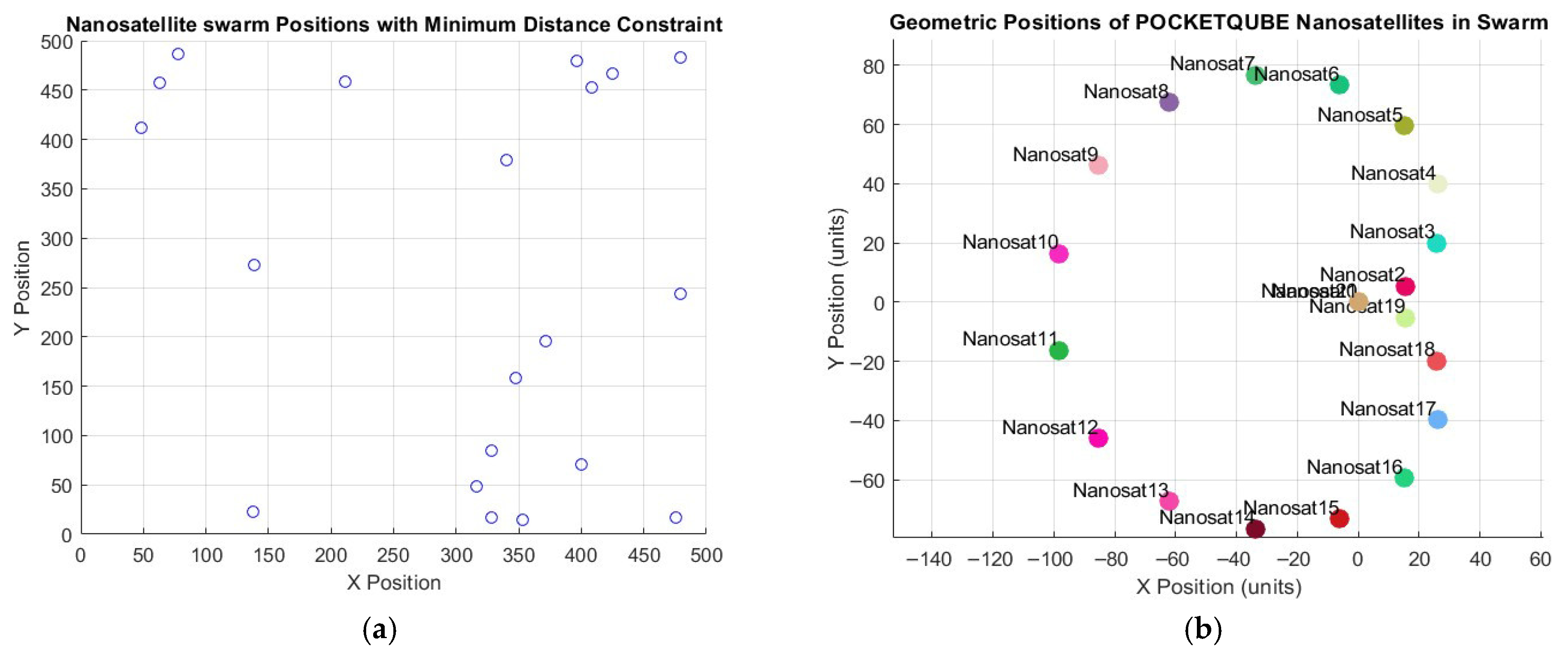
Our research focuses on the attitude stabilization of a PocketQube nanosatellite swarm using an LQR controller. A crucial aspect of simulating such a swarm is the rigorous consideration of the distance between the nanosatellites in order to avoid collisions. To ensure operational success and a realistic simulation, a minimum safety distance is essential. In our model, a swarm of 20 PocketQubes nanosatellites was simulated. A minimum separation distance of 20 m was established and maintained between each nanosatellite. By using two different operational areas, we were able to confirm the absence of collisions between the nanosatellites during the simulation.
Table 1 presents a complete overview of the key parameters of the PocketQube nanosatellites used in the simulation.
The initial step in constructing a reliable relative navigation system involves establishing a minimum distance constraint between PocketQubes. However, simply defining this minimum distance is insufficient to achieve accurate navigation. To improve the accuracy, it is crucial to incorporate angular information, particularly by using relative rotation angles that describe the orientation of one PocketQube relative to another, as described by Ivan Ostroumov in “
Relative Navigation for Vehicle Formation Movement”, published in 2022 in the
3rd KhPI Week on Advanced Technology [
10]. Furthermore, the noise and uncertainties inherent in sensor readings must be carefully taken into account in the navigation algorithm in order to mitigate significant errors in the calculated positions.
The minimum safety distance of 20 m between nanosatellites is determined by taking into account the inertial properties of the satellites, including their mass, moment of inertia, and center of mass. It is modeled using the Hill–Clohessy–Wiltshire equations to predict the relative motion and prevent collisions in defined operational areas. This distance ensures collision avoidance during simulations by establishing a buffer zone that accounts for potential deviations and uncertainties in nanosatellite trajectories. The dynamic response mechanism to avoid collisions involves the continuous monitoring of the positions and velocities of the PocketQube nanosatellites. Thus, when the expected relative distance approaches the 20 m threshold, collision avoidance is initiated. The method for evaluating boundary conditions for collision avoidance is based on defined operational zones, such as [xMin: 0; xMax: 500; yMin: 0; yMax: 500].
Visual representations, shown in
Figure 1, illustrate the nanosatellite swarm positions, demonstrating both the minimum distance constraint and their geometric arrangement. Meanwhile,
Figure 2 visually represents the positions and velocities of the PocketQube nanosatellites operating in a swarm with trajectories managed by a linear quadratic regulator.
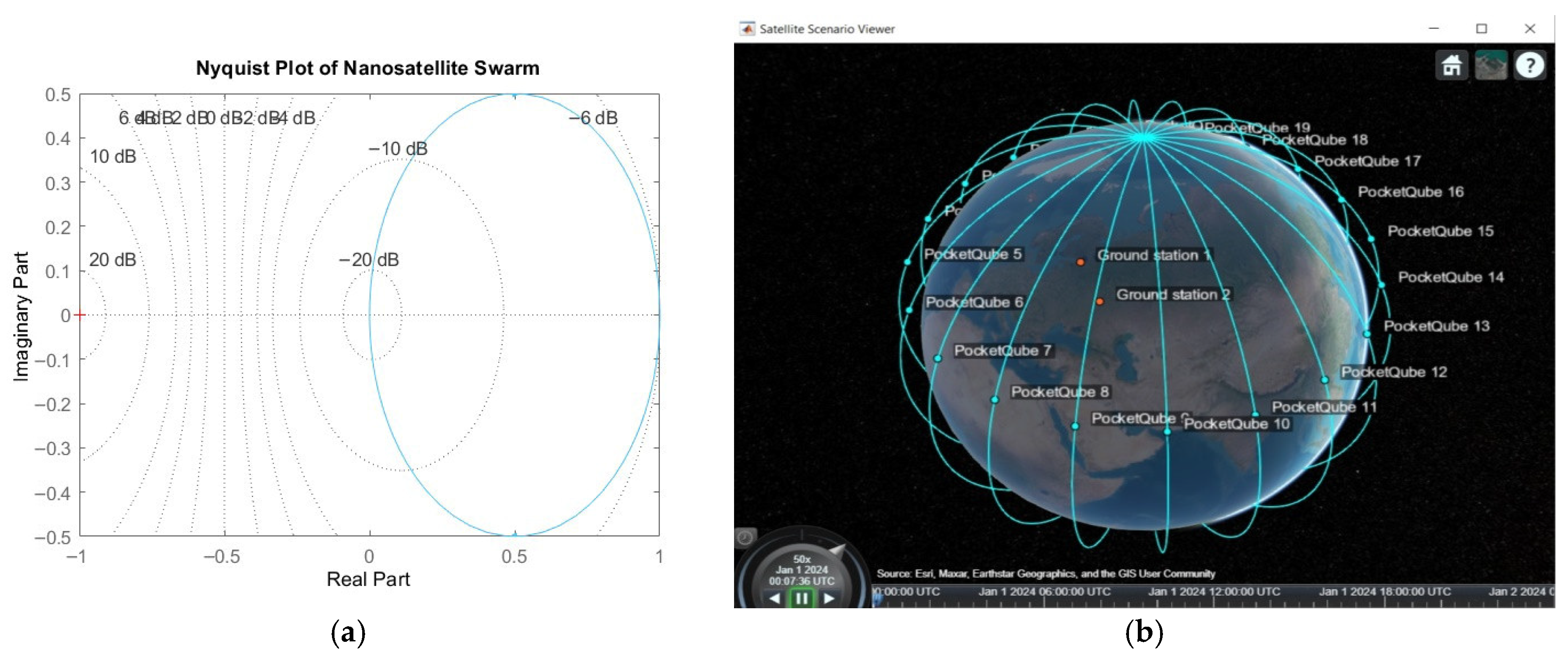
The stability of our nanosatellite swarm is paramount to its operational success. The Nyquist stability criterion provides a powerful graphical method for determining the stability of a closed-loop control system based on its open-loop frequency response. In this specific analysis, the generation of a Nyquist diagram was the method chosen to assess the stability of the swarm. To conduct this analysis, specific parameters were selected, such as a gain value of and a time constant of . These values are crucial because they define the operating conditions under which stability is evaluated. The resulting Nyquist diagram visually confirms the closed-loop stability of the nanosatellite swarm.
The plot presents several Important features. The concentric circles on It represent different amplitude levels, measured in decibels. These circles help to understand the amplitude of the system’s response at different frequencies. Furthermore, the plot effectively illustrates how the system’s poles, which are fundamental to its dynamic behavior, influence its response across the entire frequency spectrum.
Figure 3 provides a visual representation of the Nyquist plot for the PocketQube nanosatellite swarm, alongside its scenario viewer, which can be seen in the
Supplementary Materials, offering a comprehensive view of the system’s stability characteristics.
The blue trajectory on the Nyquist plot represents the frequency response of the open-loop system. The most critical aspect of the Nyquist criterion for stability lies in the relationship between this trajectory and the critical point in the complex plane. In this case, the blue trajectory does not encircle the critical point . This observation is a definite indicator that the system is stable under the chosen parameters . If the trajectory were to encircle the critical point, it would imply instability. The trajectory characteristics, including its symmetry and overall dimensions, are directly influenced by the complex interactions that occur between individual PocketQube nanosatellites within the swarm.
4. Conclusions
Our research demonstrates the development and simulation of a coordinated nanosatellite swarm control system. We developed a mathematical model describing the relative positions and velocities of the nanosatellites within the swarm, which is a crucial step in predicting and managing their interactions.
The attitude control system of the PocketQube nanosatellite swarm was subjected to extensive testing using Matlab/Simulink simulations. These simulations, using Aerospace Blockset for dynamic visualization, provided crucial data demonstrating the stability of the system under various operational conditions.
Visualizations within the simulation environment clearly demonstrated the independent orbital paths of each nanosatellite, critically adhering to minimum safe separation distances. The minimum distance constraint, seen as a crucial safety and operational parameter, was paramount in the development of a robust relative navigation algorithm. This algorithm is applied to others within the constellation. It is essential for autonomous operation and in coordinating maneuvers. Increasing the values allow for a faster response, smaller state deviations, and better collision prevention, but this may require greater control effort. Moreover, increasing values lead to a reduction in control effort but can result in a slower response and larger state deviations.
Furthermore, simulating the stability of a PocketQube nanosatellite swarm presented a significant challenge. The simulations considered not only the individual nanosatellites’ attitude control systems but also the complex interactions between multiple nanosatellites. The simulation video clearly shows the nanosatellites’ attitude trajectories, accurately reflecting their predicted movement within the Earth-centered inertial coordinate system.
Author Contributions
Simulation and performance evaluation of the LQR-based swarm control system, writing of the article, J.B.N.N.A.; design and tuning of the linear quadratic regulator, writing and editing, D.A.K.; general supervision of the project, editing of the article, V.K.O. All authors have read and agreed to the published version of the manuscript.
Funding
This research received no external finding.
Institutional Review Board Statement
Not applicable.
Informed Consent Statement
Not applicable.
Data Availability Statement
Data will be available on request.
Conflicts of Interest
The authors declare no conflicts of interest.
References
- Idriss, M.I.; Ismail, N.A. The Rise of PocketQube: An In-depth Look at Mission Trends and Attitude Determination and Control Systems Technologies. TechRxiv 2025. [Google Scholar] [CrossRef]
- Siddique, I. Small Satellites: Revolutionizing Space Exploration and Earth Observation. Eur. J. Adv. Eng. Technol. 2024, 11, 118–124. [Google Scholar] [CrossRef]
- Nelson, M.L.; Gottlich, G.L.; Bianco, D.J.; Paulson, S.S.; Binkley, R.L.; Kellogg, Y.D.; Beaumont, C.J.; Schmunk, R.B.; Kurtz, M.J.; Accomazzi, A.; et al. The NASA technical report server. Internet Res. 1995, 5, 25–36. [Google Scholar] [CrossRef]
- Izzo, D.; Pettazzi, L. Autonomous and Distributed Motion Planning for Satellite Swarm. J. Guid. Control. Dyn. 2007, 30, 449–459. [Google Scholar] [CrossRef]
- Ivanov, D.; Monakhova, U.; Guerman, A.; Ovchinnikov, M. Decentralized Control of Nanosatellite Tetrahedral Formation Flying Using Aerodynamic Forces. Aerospace 2021, 8, 199. [Google Scholar] [CrossRef]
- Rakisheva, Z.; Sukhenko, A.; Doszhan, N.; Ibrayev, G.G.A.; Kaliyeva, I.; Nakasuka, S.; Shabdan, Y. Evaluation of Applicability of Some Algorithms for Controlling the Motion of Satellites in a Formation. Eng. Sci. 2024, 27, 1025. [Google Scholar] [CrossRef]
- Bouwmeester, J.; Radu, S.; Uludag, M.S.; Chronas, N.; Speretta, S.; Menicucci, A.; Gill, E.K.A. Utility and constraints of PocketQubes. CEAS Space J. 2020, 12, 573–586. [Google Scholar] [CrossRef]
- De Battista, D.; Fabri, S.G.; Bugeja, M.K.; Azzopardi, M.A. PocketQube Pico-Satellite Attitude Control: Implementation and Testing. IEEE J. Miniaturization Air Space Syst. 2020, 1, 90–102. [Google Scholar] [CrossRef]
- Basak, K.; Giri, D.K. LQR based Optimal Control Design of Satellite Formation Flight in Earth-centered Circular Orbit. In Proceedings of the AIAA SCITECH 2022 Forum, San Diego, CA, USA, 3–7 January 2022. [Google Scholar] [CrossRef]
- Ostroumov, I.; Kuzmenko, N.; Bezkorovainyi, Y.; Averyanova, Y.; Larin, V.; Sushchenko, O.; Zaliskyi, M.; Solomentsev, O. Relative Navigation for Vehicle Formation Movement. In Proceedings of the 2022 IEEE 3rd KhPI Week on Advanced Technology (KhPIWeek), Kharkiv, Ukraine, 3–7 October 2022. [Google Scholar] [CrossRef]
| Disclaimer/Publisher’s Note: The statements, opinions and data contained in all publications are solely those of the individual author(s) and contributor(s) and not of MDPI and/or the editor(s). MDPI and/or the editor(s) disclaim responsibility for any injury to people or property resulting from any ideas, methods, instructions or products referred to in the content. |