1. Introduction
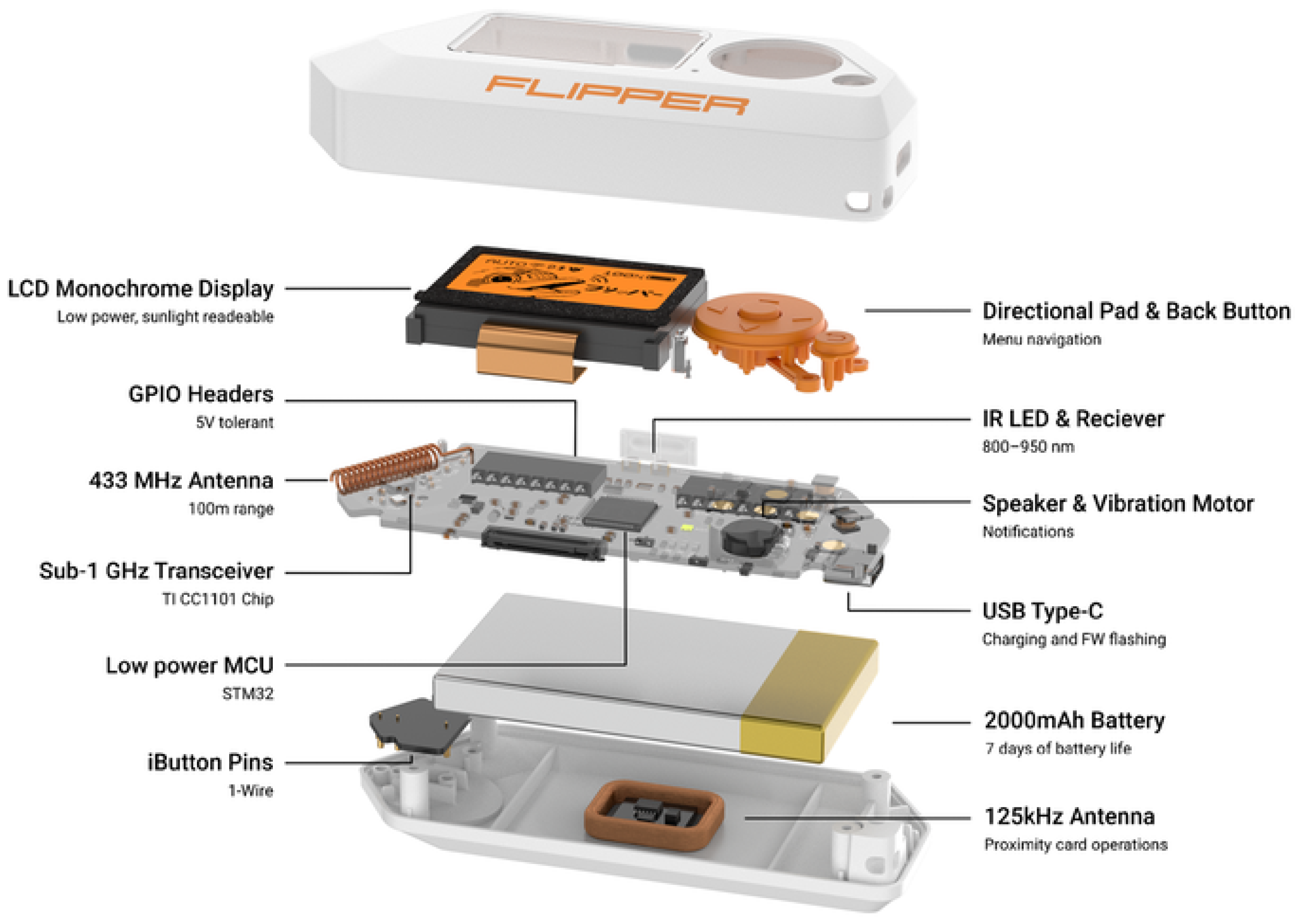
Today, inexpensive and easy-to-use wireless devices are increasingly common, which has made it easier to attempt to manipulate devices in homes and organizations. Flipper Zero condenses into a portable form factor capabilities across IR, RFID/NFC, sub-GHz, USB, and Bluetooth (
Figure 1), enabling faithful reproduction of everyday attack vectors while also validating countermeasures within a responsible auditing framework [
1].
In this work, within the field of cybersecurity, we present empirical tests that cover cloning and editing of MIFARE Classic 1K cards by exploiting the weakness of the CRYPTO1 scheme via the Nested Attack; evaluation of openings in sub-GHz systems with fixed codes (e.g., CAME 12-bit at 433 MHz) and the limitations posed by rolling-code; USB HID automation with JavaScript scripts capable of exfiltrating information from Windows to an emulated mass-storage device; and availability degradation via BLE Spam through massive advertising, randomized addresses, and the appearance of pop-ups/resets in certain iOS environments—all conducted in controlled auditing scenarios.
This work provides a clear, practical view of what a Flipper Zero can and cannot do in real-world situations. Our methodology is designed to facilitate the replication of experimental results under a controlled and stable configuration. The study provides an example-driven comparative analysis, highlighting the relative effectiveness of different attacks—for instance, when fixed codes are used versus systems with changing codes. We also provide scripts and supporting materials that help measure the impact on a Windows host in a controlled manner. Finally, the paper concludes by presenting straightforward recommendations to improve security and train users.
The literature and public debate underscore the dual nature of these tools (educational/defensive value versus potential for misuse) and their open, dynamic ecosystem [
2,
3,
4,
5,
6,
7].
To assess the real capabilities of the Flipper Zero to compromise (or help protect) common wireless systems through emulation, cloning, scripting, and exhaustion attacks, identifying both risks and effective technical barriers in current deployments.
2. Device Configuration and Initialization
A Flipper Zero with a high-capacity microSD card was used to record readings, dumps, and artifacts, managed with the official desktop and mobile apps and supported by community repositories for maintenance [
1,
8].
After comparing firmwares, Momentum was selected for its stability, interface improvements, and integrated utilities (e.g., USB image management, JS scripting engine, BLE Spam), avoiding reliance on external components [
9]. Initialization included flashing the release version, preparing the microSD card, performing integrity checks, and enabling modules. Enabled profiles and applications are:
IR: catalogs of universal remotes and learning (Learn) for emulation.
RFID/NFC: reading, writing, and emulation, focusing on MIFARE Classic 1K and attack/editing tools (Nested, Classic Editor, Fuzzer).
Sub-GHz: capture/replay of signals, Frequency Analyzer, Read/RAW, and Sub-GHz Bruteforcer to assess fixed codes.
USB + scripts: keyboard HID, Mass Storage, and execution of JavaScript (automation/controlled exfiltration on Windows).
Bluetooth (BLE): BLE Spam with identifier randomization and different aggressive advertising profiles.
No GPIO accessories (antennas/Wi-Fi boards) were added due to material constraints; their potential impact on range and attack surface was analyzed at a theoretical level.
3. Experimental Evidence and Analysis of the Execution of Communication Protocols
A test battery was designed for each family of protocols, prioritizing common risk scenarios in auditing. The following summarizes the observed behavior, its offensive–defensive applicability, and the limitations identified.
Infrared (IR). Remote emulation/automation was consistent on common equipment. Its direct impact on cybersecurity is limited; however, it can be used for operational disruptions (e.g., power-offs or input changes as a distraction).
RFID/NFC/iButton. With MIFARE Classic 1K, the ease of cloning was evident when the system depends on CRYPTO1: the Nested Attack recovered keys and enabled reading/editing with Classic Editor. The Fuzzer facilitated robustness testing in readers. Although iButton was not validated due to lack of material, cloning/manipulation risks by design are documented.
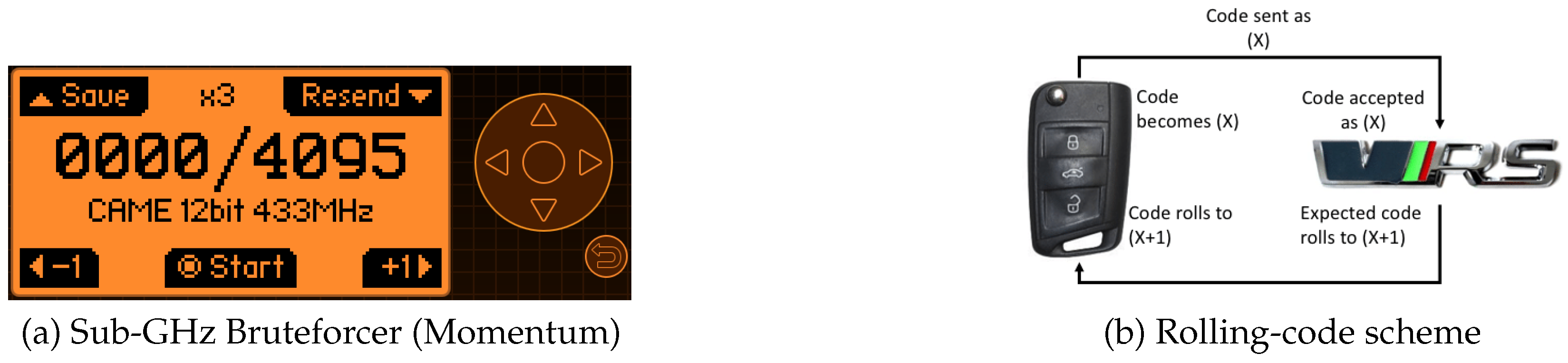
Sub-GHz. Openings were confirmed in access systems with fixed codes using Sub-GHz Bruteforcer (e.g., CAME 12-bit at 433 MHz), whereas the presence of rolling-code clearly blocked replay/brute-force attacks (
Figure 2).
USB and scripts. Keyboard HID emulation and Momentum’s JavaScript engine enabled a payload that launches PowerShell, collects environment variables, IP, Wi-Fi profiles and passwords (via netsh), and dumps them to a disk image mounted as Mass Storage, all in an automated and traceable way.
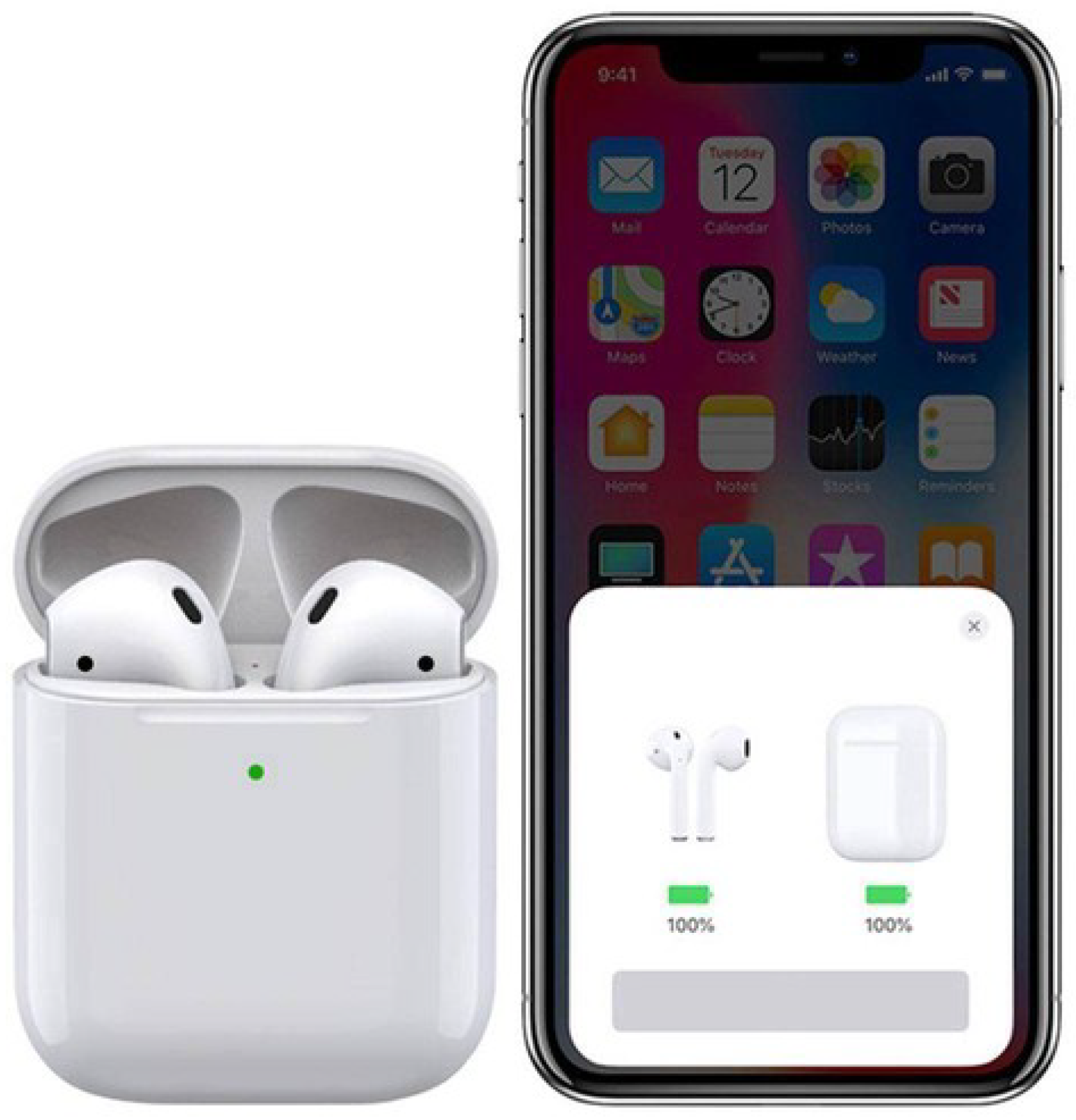
Bluetooth (BLE). BLE Spam generated high volumes of advertising/requests with randomized MAC addresses and multiple pop-ups (
Figure 3); in certain scenarios, iOS showed restarts/modals, affecting availability at short range.
GPIO and extensions. No devboards or external antennas were tested; community evidence suggests that they extend range and attack surface, making them priority lines for future validation.
Overall analysis. The device showed high versatility to emulate, clone, and automate interactions, with clear limits in the presence of rolling-code, well-configured deployments, and the absence of specific accessories. The findings support migrating legacy credentials (e.g., MIFARE Classic → DESFire), hardening wireless configurations, and improving security hygiene.
4. Conclusions
The experimental evidence shows that the Flipper Zero is effective for auditing common wireless systems: cloning/editing MIFARE Classic 1K via Nested Attack; opening systems with fixed codes in sub-GHz; automation/exfiltration in Windows via USB HID+Mass Storage; and availability degradation with BLE Spam. These capabilities coexist with effective barriers (e.g., rolling-code) and with the need for accessories to extend range.
Recommendations for defenders. Replacement of MIFARE Classic with DESFire or options with robust cryptography; systematic use of rolling-code and secure pairing management; surface reduction (e.g., disable BLE visibility when not necessary) and rate-limiting on exposed devices; controls against HID injection and adoption of U2F as a hardware second factor; and targeted awareness and training for non-technical personnel.
As future work, we propose empirical validation of GPIO/Wi-Fi devboards (e.g., Evil Portal, Wi-Fi Marauder), exploration of dedicated sub-GHz antennas, and deeper analysis of dense-interference scenarios, extending range and resilience metrics.
Author Contributions
Conceptualization, F.J.M.-R. and A.J.D.-B.; methodology, F.J.M.-R.; software, F.B.-M. and B.M.R.-G.; validation, F.J.M.-R., M.Á., and B.M.R.-G.; formal analysis, B.M.R.-G.; investigation, A.J.D.-B.; resources, F.B.-M.; writing—original draft preparation, F.J.M.-R.; writing—review and editing, F.J.M.-R., A.J.D.-B., F.B.-M., B.M.R.-G., and M.Á.; supervision, F.J.M.-R.; project administration, F.J.M.-R.; funding acquisition, M.Á. All authors have read and agreed to the published version of the manuscript.
Funding
This research is carried out within the framework of the funds of the Recovery, Transformation and Resilience Plan, financed by the European Union (Next Generation)—National Cybersecurity Institute (INCIBE) in the project C109/23 “Strategic Project UEx (Polytechnic School of Cáceres)—INCIBE”.
Institutional Review Board Statement
Not applicable.
Informed Consent Statement
Not applicable.
Data Availability Statement
The datasets generated and analyzed during this study are not publicly available due to security and ethical considerations, as they could be misused if disclosed. Requests for further information should be directed to the corresponding author.
Conflicts of Interest
The authors declare no conflicts of interest.
References
- Flipper Zero Links. Available online: https://cdn.flipperzero.one/flipperzero-links.html (accessed on 20 February 2025).
- Cass, S. A Hacker’s Delight > You’ll Either Love or Hate the Flipper Zero. IEEE Spectr. 2023, 60, 18–20. [Google Scholar] [CrossRef]
- Mata-Hernandez, R.; Cardenas-Juarez, M.; Simón, J.; Stevens-Navarro, E.; Rizzardi, A. Exploring the Path Loss of a Hacking Tool for Security Matters in the Internet of Things. In Proceedings of the 2023 IEEE International Autumn Meeting on Power, Electronics and Computing (ROPEC), Ixtapa, Mexico, 18–20 October 2023; pp. 1–6. [Google Scholar] [CrossRef]
- MonstaTek—Monstatek.com. Available online: https://www.monstatek.com/ (accessed on 20 February 2025).
- Flipper Zero Prohibido Por Amazon Por Ser Un ‘Dispositivo de Robo de Tarjetas’—Osint.com.ar—Osint.com.ar. Available online: https://osint.com.ar/flipper-zero-prohibido-por-amazon-por-ser-un-dispositivo-de-robo-de-tarjetas/ (accessed on 20 February 2025).
- Pacheco, C. Primer País del Mundo en Prohibir la Venta, Uso e Importación de Flipper Zero—Computerhoy.20minutos.es. Available online: https://computerhoy.20minutos.es/tecnologia/flipper-zero-prohibido-hackers-robar-coches-1364224 (accessed on 20 February 2025).
- El robo electrónico que tiene en pánico a Francia y puede llegar a España: Así es Flipper Zero. Available online: https://okdiario.com/curiosidades/robo-electronico-que-tiene-panico-francia-puede-llegar-espana-asi-flipper-zero-14133346 (accessed on 20 February 2025).
- MicroSD Card Setup—Flipper Zero—Documentation—Docs.Flipper.Net. Available online: https://docs.flipper.net/basics/sd-card (accessed on 25 February 2025).
- Momentum FW for Flipper Zero—Momentum-fw.dev. Available online: https://momentum-fw.dev/ (accessed on 20 February 2025).
| Disclaimer/Publisher’s Note: The statements, opinions and data contained in all publications are solely those of the individual author(s) and contributor(s) and not of MDPI and/or the editor(s). MDPI and/or the editor(s) disclaim responsibility for any injury to people or property resulting from any ideas, methods, instructions or products referred to in the content. |



 ,
,