Maturity Models in Information Security Audits †

Abstract
1. Introduction
2. Methods
- 1.
- Capability Maturity Model Integration (CMMI): Selected for providing a framework and common language to guide process improvement across an organization, and its widespread recognition.
- 2.
- Cybersecurity Capability Maturity Model (C2M2): Chosen for its focus on cybersecurity within critical infrastructures, including Information Technology (IT) and Operational Technology (OT).
- 3.
- Cybersecurity Maturity Model Certification (CMMC): Selected for its regulatory nature and mandatory compliance requirements. Unlike process improvement models, CMMC is designed to audit and verify the cybersecurity capabilities within the Defense Industrial Base (DIB) of the United State Department of Defense.
- Flexibility and Adaptability: The ability of the maturity level structure to be applied to different types of organizations, industries, and security processes.
- Reliability: The consistency and objectivity of the assessment results produced by applying the maturity levels.
- Track Record and Recognition: The proven track record and its acceptance within the industry as a standard for improvement.
3. Results
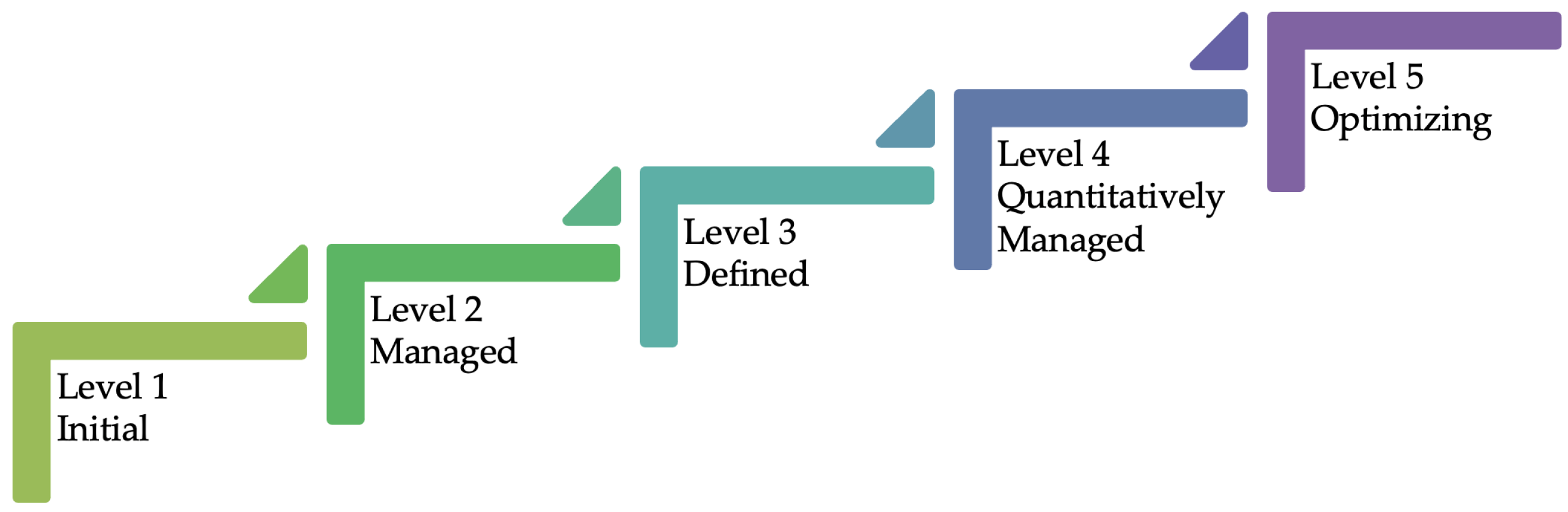
- CMMI Maturity Levels: Defines five levels (Initial, Managed, Defined, Quantitatively Managed, Optimized) for continuous process improvement, as shown in Figure 1. The focus is on tracking process maturity levels, from ad hoc and unpredictable processes (Level 1) to a state of continuous improvement (Level 5). Its structure is flexible, offering both staged (a predefined path) and continuous representations (allowing for organizations to focus on specific process areas). It is one of the most internationally recognized models, with applications in multiple industries and support from institutions such as ISACA and SEI [4].
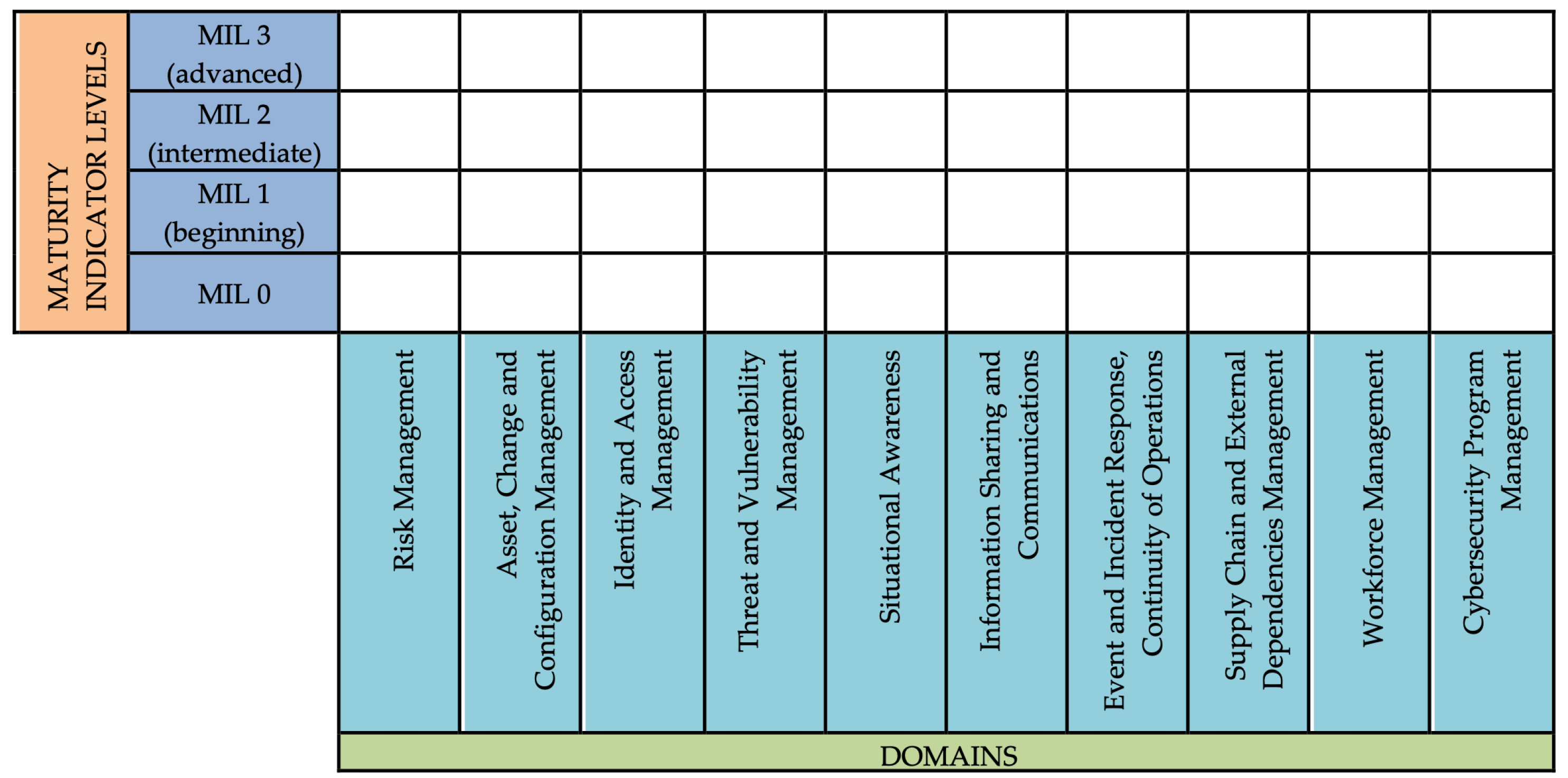
- C2M2 Maturity Levels: Defines four levels (MIL0-Incomplete, MIL1-Initial, MIL2-Managed, MIL3-Defined) that measure dual progression: focus and management. It includes more than 350 practices assigned to specific MILs in ten cybersecurity domains, as shown in Figure 2. It is primarily designed for self-assessment, which gives it moderate objectivity in a formal audit context [5].
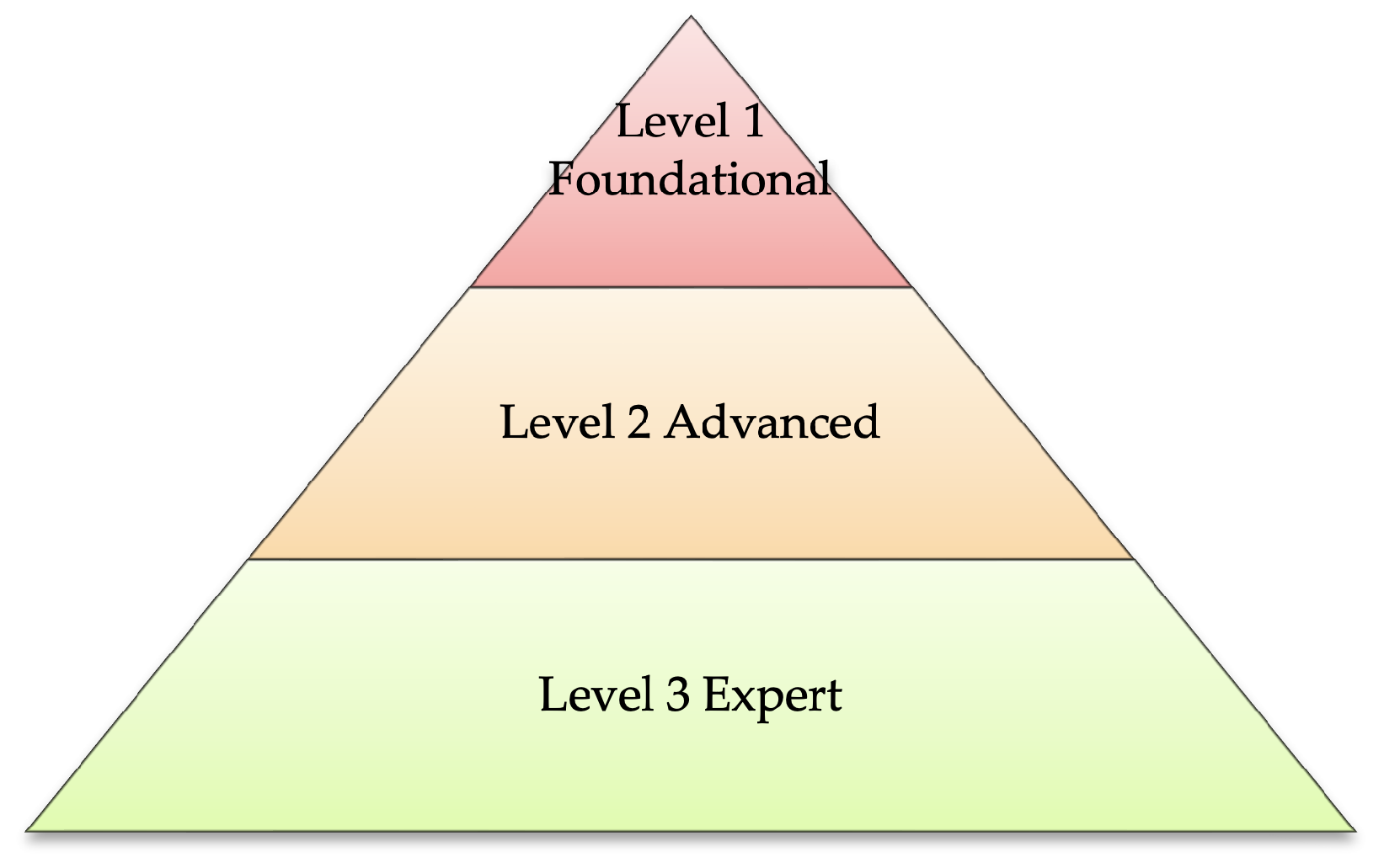
- CMMC Maturity Levels: Defines three cumulative levels (Level 1-Foundational, Level 2-Advanced, Level 3-Expert), which are sets of compliance requirements, as shown in Figure 3. Its structure is based on controls from NIST SP 800-171 [6] and NIST SP 800-172 [7], organized into domains. This model is also a certification standard. The assessment requires third-party certification (for Levels 2 and 3), which gives it high reliability for compliance purposes, but its rigidity and specific focus on the DoD supply chain limit its overall flexibility [8].
4. Discussion
- Flexibility and Adaptability: The main advantage of CMMI is its flexibility. It allows an organization to focus on improving specific process areas that are critical for information security. CMMI has proven its applicability beyond software development in many industries and integrates effectively with modern methodologies such as Agile.
- Reliability: The reliability of an audit depends on the consistency of its results. The CMMI assessment method offers a framework with well-documented methodologies and practices, and structured processes that allow consistent assessments in different contexts with guaranteed results.
- Track Record and Recognition: With a track record of over 30 years and now under the leadership of ISACA, CMMI is a proven and continuously evolving global standard.
5. Conclusions
Author Contributions
Funding
Institutional Review Board Statement
Informed Consent Statement
Data Availability Statement
Conflicts of Interest
References
- Cooke, I. IS Audit Basics: Innovation in the IT Audit Process. Available online: https://www.isaca.org/es-es/resources/isaca-journal/issues/2018/volume-2/is-audit-basics-innovation-in-the-it-audit-process (accessed on 25 January 2025).
- Auliani, A.S.; Candiwan. Information Security Assessment On Court Tracking Information System: A Case Study from Mataram District Court. In Proceedings of the 2021 IEEE 12th Annual Ubiquitous Computing, Electronics & Mobile Communication Conference (UEMCON), New York, NY, USA, 1–4 December 2021; pp. 0226–0230. [Google Scholar] [CrossRef]
- Cobos, S.; Garayar, A.; Mauricio, D. Cybersecurity Maturity Model Against Ransomware Attacks for the Financial Sector. In Proceedings of the 2024 IEEE ANDESCON, Cusco, Peru, 11–13 September 2024; pp. 1–6. [Google Scholar] [CrossRef]
- CMMI Institute. Appraisals. 2025. Available online: https://cmmiinstitute.com/learning/appraisals/levels (accessed on 25 January 2025).
- U.S. Department of Energy. Office of Cybersecurity, Energy Security, and Emergency Response, Cybersecurity Capability Maturity Model (C2M2), Version 2.1; U.S. DOE: Washington, DC, USA, 2022. Available online: https://www.energy.gov/ceser/cybersecurity-capability-maturity-model-c2m2 (accessed on 25 January 2025).
- NIST SP 800-171r3; Protecting Controlled Unclassified Information in Nonfederal Systems and Organizations. National Institute of Standards and Technology: Gaithersburg, ML, USA, 2024.
- NIST SP 800-172r3; Enhanced Security Requirements for Protecting Controlled Unclassified Information. National Institute of Standards and Technology: Gaithersburg, ML, USA, 2024.
- U.S. Department of Defense. Cybersecurity Maturity Model Certification (CMMC), Model Overview Version 2.0; U.S. Department of Defense: Washington, DC, USA, 2021. Available online: https://dodcio.defense.gov/Portals/0/Documents/CMMC/ModelOverview_V2.0_FINAL2_20211202_508.pdf (accessed on 25 January 2025).



| Feature | CMMI (Capability Maturity Model Integration) | C2M2 (Cybersecurity Capability Maturity Model) | CMMC (Cybersecurity Maturity Model Certification) |
|---|---|---|---|
| Purpose | Evaluate and improve process efficiency and capabilities in organizations across any industry. | Evaluate and enhance cybersecurity capabilities in critical infrastructure, both IT and OT. | Ensure the implementation of good cybersecurity practices in organizations working with the U.S. DoD. |
| Maturity Levels | 5 levels of maturity. | 10 domains and 4 maturity levels. | 3 levels of maturity (Foundational, Advanced, and Expert). |
| Flexibility and Adaptability | It is very flexible. It allows an organization to focus on specific areas, it is applicable in various industries, and integrates well with methodologies such as Agile. | Designed for the energy sector, but adaptable to other critical infrastructure. Flexible in its application as a self-assessment tool. | It lacks flexibility. It is a regulatory compliance requirement with prescriptive practices that organizations must follow to obtain certification. |
| Reliability | High. It offers a framework with well-documented methodologies and practices that allow for consistent evaluations across different contexts, with guaranteed results. | Consistency may vary as this is a self-assessment model, although its structured framework provides a reliable basis for internal improvement. | High. Reliability is ensured through mandatory audits and certifications performed by accredited third-party assessment organizations (C3PAOs). |
| Track Record and Recognition | With over 30 years of history, it is a proven and continuously evolving global standard, currently managed by ISACA. | Developed by the U.S. DOE, it is a recognized model primarily used in the energy sector and other critical infrastructure areas. | It is mandated by the U.S. DoD. It is a mandatory and recognized compliance standard within the DIB. |
Disclaimer/Publisher’s Note: The statements, opinions and data contained in all publications are solely those of the individual author(s) and contributor(s) and not of MDPI and/or the editor(s). MDPI and/or the editor(s) disclaim responsibility for any injury to people or property resulting from any ideas, methods, instructions or products referred to in the content. |
© 2026 by the authors. Licensee MDPI, Basel, Switzerland. This article is an open access article distributed under the terms and conditions of the Creative Commons Attribution (CC BY) license.
Share and Cite
Zamora-Jimenez, D.; Prudente-Tixteco, L.; Mercado-Hernandez, P.R. Maturity Models in Information Security Audits. Eng. Proc. 2026, 123, 14. https://doi.org/10.3390/engproc2026123014
Zamora-Jimenez D, Prudente-Tixteco L, Mercado-Hernandez PR. Maturity Models in Information Security Audits. Engineering Proceedings. 2026; 123(1):14. https://doi.org/10.3390/engproc2026123014
Chicago/Turabian StyleZamora-Jimenez, Daniel, Lidia Prudente-Tixteco, and Pablo Ramon Mercado-Hernandez. 2026. "Maturity Models in Information Security Audits" Engineering Proceedings 123, no. 1: 14. https://doi.org/10.3390/engproc2026123014
APA StyleZamora-Jimenez, D., Prudente-Tixteco, L., & Mercado-Hernandez, P. R. (2026). Maturity Models in Information Security Audits. Engineering Proceedings, 123(1), 14. https://doi.org/10.3390/engproc2026123014