Proceeding Paper

Precision Localization of Autonomous Vehicles in Urban Environments: An Experimental Study with RFID Markers †
by
Svetozar Stefanov
1,
Valentina Markova
1,* and
Miroslav Markov
2
1
Department of Communication Engineering and Technologies, Technical University Varna, Varna 9000, Bulgaria
2
Department of Software and Internet Technologies, Technical University Varna, Varna 9000, Bulgaria
*
Author to whom correspondence should be addressed.
Presented at the 6th International Conference on Communications, Information, Electronic and Energy Systems, Ruse, Bulgaria, 26–28 November 2025.
Eng. Proc. 2026, 122(1), 7; https://doi.org/10.3390/engproc2026122007
Published: 14 January 2026

Abstract

This paper presents an experimental study validating the feasibility of Radio Frequency Identification (RFID) marker systems as a complementary solution for autonomous vehicle (AV) localization in Global Navigation Satellite System (GNSS)-degraded urban environments. A novel synchronized dynamic testbed featuring hardware-level integration with wheel revolution tracking enables precise correlation of RFID marker reads with vehicle angular position. Experimental results demonstrate that multi-antenna configurations achieve consistently high read success rates (up to 99.6% at 0.5 m distance), sub-meter localization accuracy (~55 cm marker spacing), and reliable performance at average urban speeds (36 km/h simulated velocity). Spatial diversity from four strategically positioned antennas overcomes multipath interference and orientation challenges inherent to high-speed RFID reading. Processing latency remains well within the 58 ms time budget critical for autonomous navigation. These findings validate RFID’s potential for smart road infrastructure integration and demonstrate a scalable, cost-effective solution for enhancing AV safety and decision-making capabilities through contextual information transmission.

1. Introduction

Autonomous vehicles (AVs) face significant localization challenges in urban environments where Global Navigation Satellite System (GNSS) signals are degraded or unavailable due to signal blockage, reflection from buildings, and multipath propagation. While GNSS remains the primary localization method for AVs, it exhibits considerable limitations in dense urban canyons, tunnels, and indoor environments, with potential lateral position errors exceeding several meters [1]. This necessitates complementary or alternative localization technologies [2].
Radio Frequency Identification (RFID) technology offers a promising solution such as a localization aid and contextual information channel for AVs. Unlike GNSS, RFID operates independently of external satellite signals [3] and can function reliably indoors and in obstructed environments [4]. Existing research demonstrates that RFID can provide localization accuracy comparable to or exceeding GNSS in challenging scenarios [5]. However, the transition from passive RFID applications (access control, inventory management) to active automotive localization at vehicle speeds requires rigorous validation of reading reliability, processing latency, and accuracy under dynamic conditions [6]. This paper addresses a critical research gap by introducing a synchronized dynamic testbed that enables high-fidelity experimental validation of UHF RFID marker systems under realistic operational parameters. The key novelty of this work is the hardware-level synchronization between RFID reads and wheel revolution tracking, eliminating timing discrepancies and providing precise spatial correlation [7]. Additionally, this study demonstrates that multi-antenna configurations significantly enhance system robustness, achieving near-ideal read success rates through spatial diversity and orientation agnosticism.
The objectives of this research are as follows:
  • Validation of UHF RFID feasibility for urban speed AV localization;
  • To quantify the impact of multi-antenna configurations on read success and processing latency;
  • Assessment of sub-meter localization accuracy and real-time processing capability;
  • To identify limiting factors and practical deployment considerations.

2. Materials and Methods

The technical equipment required to conduct this test analysis comprises two integrated parts: a hardware platform for RFID signal acquisition and rotational sensing and software modules for temporal correlation and data validation. Together with the measurement parameters defined in Section 2.3, these components form the complete experimental system.

2.1. Hardware Architecture

UHF RFID Reader: A high-performance reader (Impinj R2000, Hopeland Technologies Co, Ltd., Shenzhen, China) [8] capable of autonomous operation with USB interface connectivity. Configured to operate at 865–867.6 MHz (ETSI European regulation). Supports multiple antenna connections with integrated anti-collision protocol (EPC Gen2).
UHF RFID Antennas: Four circularly polarized UHF RFID antennas with SMA connectors, providing omnidirectional coverage and reduced orientation sensitivity [9].
RFID Markers: Ten weather-resistant UHF RFID markers (ISO 18000-6C passive tags) [10]. Four were deployed in each experiment with the remainder serving as spares.
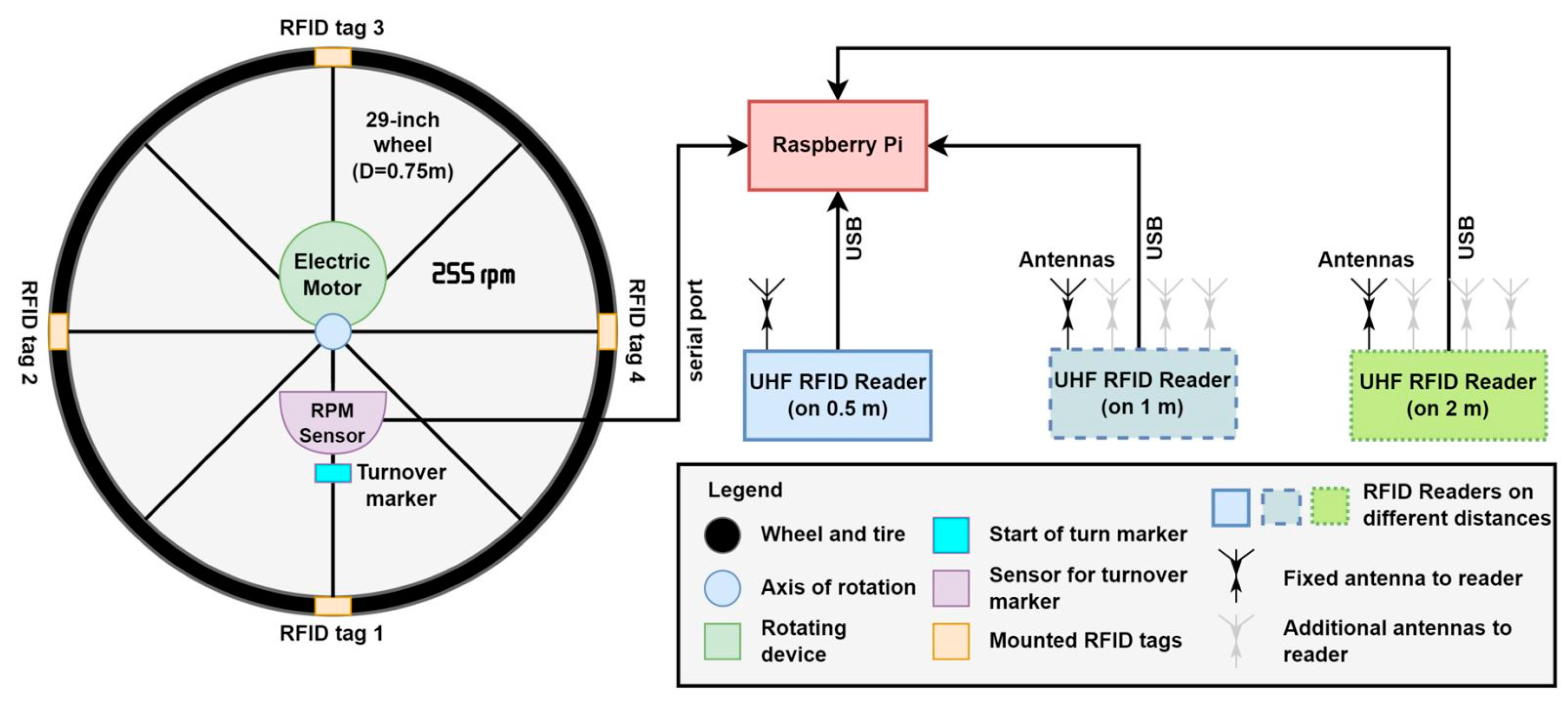
Urban Speed Simulator: A 29-inch mountain bike wheel (diameter ≈ 0.75 m, perimeter ≈ 2.356 m) mounted on an electric motor with precise RPM control. Four RFID markers fixed at 90 degrees intervals around the tire’s periphery. By rotating at controlled speeds, the wheel simulates a vehicle traveling at 36 km/h over RFID markers positioned on the ground.
Revolution Trigger Sensor: The RPM sensor is a Hall-effect sensor detecting a magnet affixed to the wheel rim, generating timestamped pulses at each complete revolution. Connected to Raspberry Pi, it records timestamps and revolution numbers. This allowed precise correlation between the start time of each new revolution and the timestamp of each marker reading from the reader module, eliminating the need for separate time synchronization, as both measurements were linked to a hardware device with a common timer.
Data Acquisition Unit: A Raspberry Pi 4 (2 GB RAM, the Sony UK Technology Centre, Pencoed, UK) with USB and serial interfaces was used for receiving reader and sensor data. Python-based 3.12 data logging modules executed parallel processes for RPM monitoring and RFID read timestamping.
Figure 1 presents the complete experimental apparatus, consisting of a 29-inch wheel equipped with four circularly polarized UHF RFID tags rotating at controlled speed to deliver markers systematically to multiple RFID readers. An electric motor provides precise rotation control, while an RPM sensor ensures synchronization with the data acquisition system. Multiple RFID readers are positioned at distances of 0.5 m, 1 m, and 2 m from the marker zone, enabling systematic evaluation of reader sensitivity degradation and validation of multi-antenna performance enhancement strategies. The dashed lines denote distinct measurement configurations, representing two independent experimental protocols executed at varying operational distances. This controlled test environment enables rigorous assessment of RFID reading accuracy—a capability fundamental to autonomous vehicle localization applications requiring three essential functions: local navigation relative to infrastructure, precise trajectory planning, and reliable collision avoidance. Figure 1 also depicts a schematic representation of an urban deployment scenario with strategically positioned RFID markers. The East-North-Up (ENU) coordinate system, established locally at each marker position, provides a reference frame wherein static RFID markers function as known spatial reference points, enabling precise vehicle localization and path planning in GNSS-denied environments.

2.2. Software Components

Software modules were installed on the Raspberry Pi 4 Rev 1.5, consisting of Python scripts and libraries for serial and USB port communication, which recorded the timestamp of each read and the data read. One application was launched, simultaneously executing two processes: the first monitored RPMs and recorded a timestamp in a text file at each new revolution, while the second monitored the time interval from the start of each new revolution to the expected new data from the reader, also recording it with a timestamp in the text file. If the reader did not provide data within this time window, the marker was considered not successfully read.

2.3. Parameters for Measurement in Each Test

To ensure a thorough and consistent evaluation of the system, the following critical parameters were meticulously defined for measurement in each test:
Reaction and Processing Time: The system was designed to operate within the following time budget for reaction and processing [11]: Marker reading: ~5 ms; data processing: ~5 ms; decision-making: ~5 ms; execution of process based on data: ~10 ms; total: ~25 ms. Possible reading omissions at high speeds can be compensated by duplicating the same RFID marker at a close distance [12], as well as by placing other control RFID markers nearby. The switching time of the RFID readers transmit/receive mode (Tx-to-Rx and Rx-to-Tx) is in order of a few microseconds, as modern readers must adhere to the strict timing requirements of the EPC Gen2 protocol, which defines communication intervals in the microsecond range, and no delay is expected from this component [13].
Number of Markers: If, in real conditions, markers are spaced 50 cm apart and a vehicle passes over them at 36 km/h, then 20 markers should be successfully read sequentially per second. In the experimental setup, a similar accuracy, corresponding to approximately 55 cm distance between markers, was sought. A high success rate was defined as reading 17 markers within 1 s, which would indicate precise positioning. If tests confirm this is possible, localization with an approximate accuracy of 0.5 m would be achieved [7]. This number of markers corresponds to a time window of ~58 ms per marker.
Sensitivity of the Marked Zone: The distance from which markers are successfully read is particularly important for accurate UHF RFID readings. Test values for this distance were 0.5 m, 1 m, and 2 m. The reader’s power was not changed during the tests. To improve sensitivity for the more distant reader, the addition of antennas was evaluated in a second series of experiments.

2.4. Tests Specifications for Hardware and Software Setup

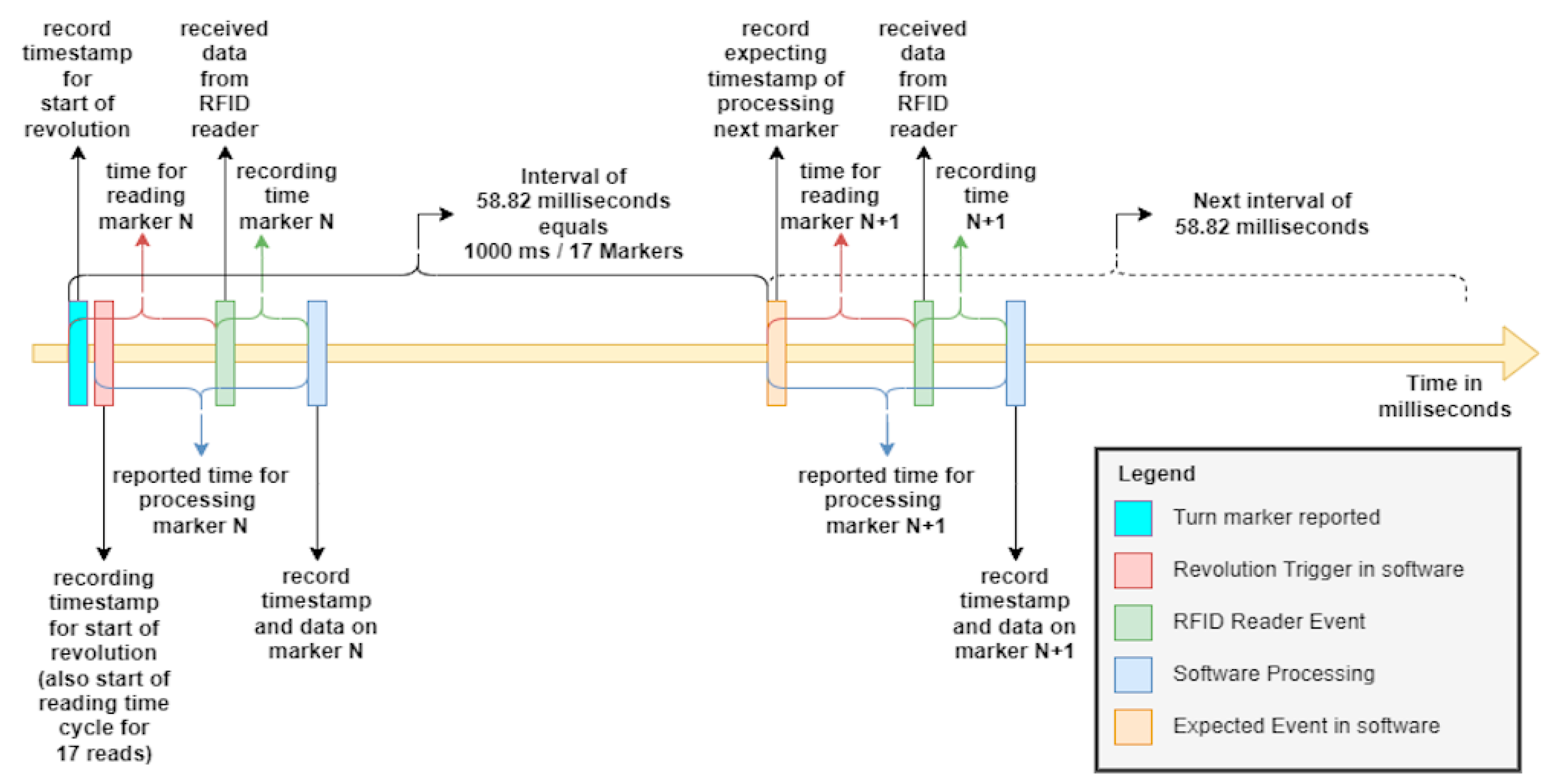
The software applications were started after the tachometer readings reached 255 revolutions, which took an average of 10 to 15 s. For each specific setup of the experimental rig with the reader at a fixed distance from the wheel’s periphery (0.5 m, 1 m, and 2 m), three analogous tests were conducted to confirm the data, especially for calculating the average data processing time. After each individual test, the text files were renamed for the specific scenario. All data from the text files were analyzed with the hardware test environment and application stopped. Figure 2 shows the timing diagram for data processing. A unique aspect of the timing diagram is the initiation of a time cycle of 17 equal intervals of 58.82 ms at each new revolution reading. This time constant is calculated based on the presumption that 4 readings are made within 1 revolution, and 4.25 revolutions are made within 1 s. That is, for a unit time of 1 s, 17 readings are expected at equal intervals of 58.82 ms, which are monitored from the start of each new revolution (marked with a red rectangle in the diagram).
This temporal synchronization diagram shows hardware-level timing correlation. The timeline should show sequence of events during the whole wheel revolution divided into 17 equal intervals of 58.82 ms, but after the first two cycles, the rest are equal, that is why not all of them are shown. Revolutionary trigger events (red), RFID reader responses (blue), and software processing windows (green) are precisely time-correlated, enabling accurate marker position determination.
It is observed that the processing time decreases with greater deviation (i.e., with a larger number of missed markers), which is a predictable consequence of fewer processing operations by the reader and the Raspberry Pi processor. Crucially, however, the processing time consistently remained well within the allocated 58 ms time window.
To mitigate the reduced system sensitivity observed at greater reader distances, a series of additional tests were conducted. These involved progressively adding 2, 3, and finally all 4 available antennas at distances of 1 and 2 m, consistently yielding significant improvements in reading results. Although the RFID reader was intrinsically configured with an algorithm to prevent re-reading the same marker, experiments utilizing multiple antennas revealed instances of data duplication in the raw output files.
To effectively manage this data turnover and ensure accurate measurement despite potential redundant reads, a specialized software mechanism was implemented. This mechanism functioned as a logical “data turnover marker,” ensuring that each physical marker was counted only once, irrespective of detection by multiple antennas. The software was modified to consider the timestamp from the first antenna to successfully read a specific marker as the definitive event. Subsequent detections of the same marker by other antennas within a defined timeframe were effectively filtered out. This was achieved through a time-based software buffer, specifically a FIFO (First-In, First-Out) queue, which stored unique read markers within the last 200 ms, thereby efficiently identifying and discarding duplicate reads. In all multi-antenna experiments, the antennas were initially mounted in a flat plane, equidistant from the markers. Subsequent experiments, however, explored configurations where some antennas were moved out of this plane and positioned closer to the wheel, achieving even higher success rates. While these advanced configurations are not reflected in the current tables, they highlight promising avenues for further investigation.

3. Results

3.1. Single-Antenna Configuration Performance

Table 1 presents the test data from the experiments conducted with a single-antenna configuration, together with read success rates and processing times across three reader distances. The performance at 0.5 m returned success rates ranging from 98.9% to 99.6%, which is an excellent result. However, some omissions still occurred. This is likely due to the high peripheral speed of the markers. Although 0.5 m is a proficient reading distance, the time the marker spends in the optimal “golden” reading zone of the antenna is noticeably short (only a few milliseconds) [6]. The reader must successfully power the marker, receive a response, and decode it within this brief time window.
At optimal distance (0.5 m), success rates exceed 99%, indicating excellent system performance. However, at 2.0 m, performance degrades significantly to ~51%, demonstrating the critical importance of reader-to-tag distance in UHF RFID systems.

3.2. Multi-Antenna Configuration Performance

Table 2 shows the results of using multiple antennas during the tests. The addition of a second antenna at 2.0 m distance increased the success rate from 50.7% to 78.4%, a 54.6% relative improvement [14]. With four antennas, performance reaches 94.2%, nearly matching the single-antenna performance at 0.5 m distance.

3.3. Spatial Diversity and Orientation Agnosticism

Analysis of read failures reveals that multi-antenna spatial diversity effectively mitigates multipath induced “dead zones” in the radio frequency field. At any given moment, at least one of the four strategically positioned antennas maintains optimal polarization alignment with the rotating markers.

3.4. Processing Latency and Time Budget Compliance

Despite the increased processing load from multi-antenna inputs, processing times remain well within the critical 58 ms time window. At 2.0 m with four antennas, the mean processing time was 19.6 ± 2.0 ms, representing only 34% of the allocated time budget.

4. Discussion

4.1. Multi-Antenna Configuration as a Critical Design Parameter

The experimental results unambiguously demonstrate that the number and placement of antennas constitute the single most influential design parameter for UHF RFID-based AV localization systems. The 85.8% improvement in success rate at 2.0 m. distance through the addition of three antennas provides compelling evidence that spatial diversity directly addresses the fundamental limitations of single-antenna systems in high-speed, high-dynamic environments.
This finding has profound implications for smart road infrastructure design. Rather than relying on a single powerful reader with expensive amplification, deploying multiple economical antennas provides superior performance at lower cost and complexity [15].

4.2. Root Causes of Remaining Read Failures

Even with an optimal antenna configuration, ~5.8% of reads fail at 2.0 m distance. Analysis identifies several contributing factors:
High-Speed Dynamics: At 255 RPM and 0.75 m diameter, markers transit the optimal “golden reading zone” in only a few milliseconds. The reader must energize the tag, receive modulated backscatter response, and decode the message within this brief window.
Multipath Propagation: Metal surfaces (wheel frame, facility walls) create constructive and destructive interference patterns. Although circular polarization mitigates this, deep nulls remain unavoidable in uncontrolled environments [9].
Tag Collision Resolution: With four tags and 17 theoretical reads per second, the EPC Gen2 anti-collision protocol must resolve tag responses within microsecond time windows [12]. Occasional frame collisions remain inevitable despite the protocol’s efficiency.
System Latency Accumulation: While individual component latencies are minimal (marker: <1 ms, reader Tx-Rx switching microseconds, processor: <5 ms), accumulated jitter can occasionally exceed the time window when a tag occupies the optimal reading zone.

4.3. Practical Deployment Considerations

Road Marker Spacing and Installation: At 36 km/h, markers should be placed at 50–55 cm intervals. In actual deployment, this requirement is achievable using embedded road markers or surface-mounted tags within painted road markings.
Reader Mounting Strategy: Single-point mounting is insufficient. Multi-reader redundancy with overlapping coverage zones provides both localization accuracy and fault tolerance. Vehicle-mounted antennas positioned around the perimeter [16] (as simulated in this work) optimize orientation diversity.
Environmental Robustness: The present work used weather-resistant markers; however, their long-term durability in automotive environments (thermal cycling, road salt, mechanical vibration) requires further validation. Marker mounting technique significantly influenced antenna efficiency in preliminary trials.
Cost–Benefit Analysis: Multi-antenna passive RFID systems cost approximately 5–10 times less than automotive-grade GNSS + INS hybrid systems [15], while providing complementary localization in GNSS-denied environments.

4.4. Limitations and Future Validation Requirements

Current Study Limitations:
  • Controlled Laboratory Environment: Experiments were conducted indoors without realistic road materials (asphalt) or multi-story building interference.
  • Simplified Vehicle Dynamics: The tire-based simulator provides longitudinal velocity profile but does not capture lateral dynamics, acceleration, or realistic urban driving patterns.
  • Static Infrastructure: Road markers were fixed on the test platform; real-world deployment requires weatherized, permanently installed markers.
  • Single-Speed Testing: Validation was conducted at 36 km/h only; higher-speed performance (highway scenarios > 100 km/h) requires additional testing.
Critical Future Research Directions:
  • Validation with embedded road markers in asphalt and plastic roadway materials.
  • Real-world testing in actual urban environments with multipath-rich scenarios.
  • Integration with vehicular-grade GNSS and INS to demonstrate hybrid localization performance.
  • Evaluation of active RFID tags (self-powered, extended range, higher data rates);
  • Comprehensive cost–benefit analysis comparing RFID + GNSS hybrid versus standalone GNSS + INS systems.

5. Conclusions

This experimental study rigorously validates the technical feasibility of UHF RFID marker systems for autonomous vehicle localization in GNSS-degraded urban environments. The novel synchronized dynamic testbed enables precise correlation of RFID reads with vehicle position, demonstrating consistently high success rates (>94% at 2 m distance with multi-antenna configuration), sub-meter accuracy capability, and compliant real-time processing latency.
The critical finding—that multi-antenna spatial diversity provides disproportionate performance gains—establishes a clear design principle for RFID-based localization systems. Four strategically positioned antennas overcome multipath interference and tag orientation challenges inherent to high-speed automotive environments.
Beyond localization, RFID systems provide a robust vehicle-to-infrastructure (V2I) communication channel for transmitting contextual data (speed limits, traffic signals, road conditions) directly to autonomous vehicles, enhancing safety and decision-making capabilities.
Primary limitations of the present work include controlled laboratory conditions, simplified vehicle dynamics, and operation at a single speed (36 km/h). Real-world deployment requires validation in actual urban environments, integration with deployed road infrastructure, and evaluation across the full operational speed range of autonomous vehicles.
This work establishes the technical foundation for RFID-based smart road infrastructure and demonstrates a cost-effective, complementary localization solution scalable to large-scale autonomous transportation systems.

Author Contributions

Conceptualization, S.S. and V.M.; methodology, V.M.; formal analysis, S.S. and M.M.; investigation, S.S.; resources, M.M. and S.S.; data curation, S.S.; writing—original draft preparation, S.S.; writing—review and editing, V.M. and M.M.; visualization, S.S.; supervision, V.M. and M.M. All authors have read and agreed to the published version of the manuscript.

Funding

This research received no external funding.

Institutional Review Board Statement

Not applicable.

Informed Consent Statement

Not applicable.

Data Availability Statement

Raw experimental data including timestamped RFID read logs, wheel revolution events, and processed success rate calculations are available upon request from the corresponding author.

Acknowledgments

The authors acknowledge the technical support provided by the laboratory staff in equipment configuration and data acquisition.

Conflicts of Interest

The authors declare no conflicts of interest.

Abbreviations

The following abbreviations are used in this manuscript:
AVAutonomous Vehicle
GNSSGlobal Navigation Satellite System
RFIDRadio Frequency Identification
UHFUltra-High Frequency
EPCElectronic Product Code
ETSIEuropean Telecommunications Standards Institute
SMASubminiature version A
RPMRevolutions Per Minute
FIFOFirst-In-First-Out
V2IVehicle-to-Infrastructure
INSInertial Navigation System
ENUEast-North-Up (coordinate system)

References

  1. Groves, P.D. Shadow matching: A new GNSS positioning technique for urban canyon navigation. J. Navig. 2011, 64, 417–430. [Google Scholar] [CrossRef]
  2. Dissanayake, M.W.M.G.; Newman, P.; Clark, S.; Durrant-Whyte, H.F.; Csobra, M.M. A solution to the simultaneous localization and map building (SLAM) problem. IEEE Trans. Robot. Autom. 2001, 17, 229–241. [Google Scholar] [CrossRef]
  3. Costa, F.; Genovesi, S.; Borgese, M.; Michel, A.; Dicandia, F.A.; Manara, G. A Review of RFID Sensors, the New Frontier of Internet of Things. Sensors 2021, 21, 3138. [Google Scholar] [CrossRef] [PubMed]
  4. Finkenzeller, K. RFID Handbook: Fundamentals and Applications in Contactless Smart Cards, Radio Frequency Identification and Near-Field Communication, 3rd ed.; John Wiley & Sons: Hoboken, NJ, USA, 2010. [Google Scholar] [CrossRef]
  5. Ni, L.M.; Liu, Y.; Lau, Y.C.; Patil, A.P. LANDMARC: Indoor location sensing using active RFID. In Proceedings of the 1st IEEE International Conference on Pervasive Computing and Communications (PerCom 2003), Fort Worth, TX, USA, 26 March 2003; pp. 407–415. [Google Scholar] [CrossRef]
  6. Dobkin, D.M. The RF in RFID: Passive UHF RFID in Practice; Newnes: Oxford, UK, 2007; ISBN 978-0750682091. [Google Scholar]
  7. Deshmukh, R.A.; Hasamnis, M.A.; Kulkarni, M.B.; Bhaiyya, M. Advancing indoor positioning systems: Innovations, challenges, and applications in mobile robotics. Robotica 2025, 43, 2710–2750. [Google Scholar] [CrossRef]
  8. Wang, Y.; Zhang, N.; Jin, L. The hardware design and implementation of four-channel UHF RFID reader based on Impinj R2000. In Proceedings of the 2015 6th IEEE International Conference on Software Engineering and Service Science (ICSESS), Beijing, China, 23–25 September 2015; pp. 565–568. [Google Scholar] [CrossRef]
  9. Kaplan, E.D.; Hegarty, C.J. (Eds.) Understanding GPS/GNSS: Principles and Applications, 3rd ed.; Artech House: Boston, MA, USA, 2017; ISBN 978-1-63081-050-1. [Google Scholar]
  10. ISO-IEC-18000-6; Information Technology—Radio Frequency Identification for Item Management—Part 6: Parameters for Air Interface Communications at 860 MHz to 960 MHz. ISO: Geneva, Switzerland, 2004.
  11. Campbell, M.; Egerstedt, M.; How, J.P.; Murray, R.M. Autonomous driving in urban environments: Approaches, lessons and challenges. Philos. Trans. A Math. Phys. Eng. Sci. 2010, 368, 4649–4672. [Google Scholar] [CrossRef] [PubMed]
  12. Savage, P.G. Strapdown Inertial Navigation Integration Strategy and Computations; Strapdown Associates Inc.: Maple Plain, MN, USA, 2007; ISBN 978-0-9765070-0-9. [Google Scholar]
  13. Luh, Y.-P.; Liu, Y.-C. Reading Rate Improvement for UHF RFID Systems with Massive Tags by the Q Parameter. Wireless Pers. Commun. 2011, 59, 147–157. [Google Scholar] [CrossRef]
  14. Choi, J.W.; Lee, J.H.; Lee, G.H. Broadband RFID tag antenna with quasi-isotropic radiation pattern. Electron. Lett. 2005, 41, 1091–1092. [Google Scholar] [CrossRef]
  15. EPCglobal. Class-1 Generation-2 UHF Air Interface Protocol Standard; Version 2.0.1; EPCglobal Inc.: Brussels, Belgium, 2015; Available online: https://www.gs1.org/sites/default/files/docs/epc/Gen2_Protocol_Standard.pdf (accessed on 14 September 2025).
  16. Gezici, S.; Tian, Z.; Giannakis, G.B.; Kobayashi, H.; Molisch, A.F.; Poor, H.V.; Sahinoglu, Z. Localization via ultra-wideband radios. IEEE Signal Process. Mag. 2005, 22, 70–84. [Google Scholar] [CrossRef]
Figure 1. Rotating wheel platform for testing UHF RFID tag reading performance across variable distances at constant speed (36 km/h equivalent).
Engproc 122 00007 g001
Figure 2. Timing diagram for monitoring successfully read markers.
Engproc 122 00007 g002
Table 1. Experimental data of RFID markers reading from three different distances.
Test
No.
Parameters 1
Read Markers (Count)Difference (Count)Avg Deviation (%)Avg Success Rate (%)Avg Reading Time (ms)
Reader at 0.5 m distance
11690100.699.421.1
21681191.198.921.3
3169370.499.620.7
Reader at 1 m. distance
4150817011.388.719.3
515841166.8293.1820.1
61641593.4796.5320.5
Reader at 2 m. distance
787982148.351.715.6
8106663437.362.717.3
9120949128.971.118.9
1 The reader is equipped with only one antenna.
Table 2. Data from additional experiments for improving accuracy at greater reader distances.
Num of AntennasParameters
Read Markers (Count) 1Difference (Count)Avg Deviation (%)Avg Success Rate (%)Avg Reading Time (ms)
Reader at 1 m. distance
21678221.2998.7126.1
31690100.5999.4125.7
4169550.2999.7128.8
Reader at 2 m. distance
2133536521.4778.5325.2
3151618410.8289.1827.5
41601995.8294.1829.75
1 Only unique identification numbers of markers (no duplicates).
Disclaimer/Publisher’s Note: The statements, opinions and data contained in all publications are solely those of the individual author(s) and contributor(s) and not of MDPI and/or the editor(s). MDPI and/or the editor(s) disclaim responsibility for any injury to people or property resulting from any ideas, methods, instructions or products referred to in the content.