

Polarization-Based (f,k,n)-Threshold Two-Level Visual Secret Sharing Scheme †


Abstract
1. Introduction
2. Preliminaries
2.1. Definition
2.2. Related Algorithms
| Algorithm 1. (k,n) P-VSS [4] |
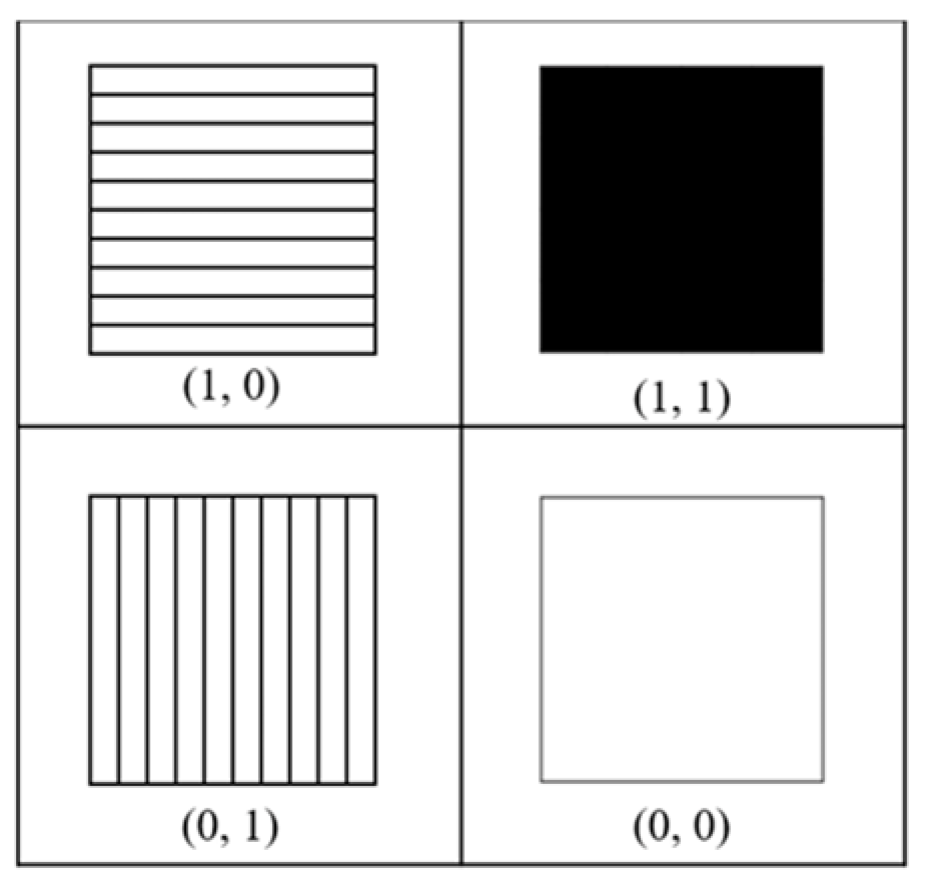
| Input: A w × h binary secret image S, the threshold parameters (k,n). Output: n shares G1, …, Gn. Step 1. For each position (i, j) ∈ {(i, j)|1 ≤ i ≤ w, 1 ≤ j ≤ h}, repeat Steps 2–7. Step 2. If S [i, j] = 0, then s = (0, 0); else s = (1, 1). Step 3. Randomly generate g1 as (0, 1) or (1, 0) Step 4. Randomly generate g2, g3, …, gk–1 as (0, 0), (1, 0), (0, 1), (1, 1). Step 5. gk = s ⊕ g1 ⊕ g2 … ⊕ gk–1. Step 6. gk+1 = g1, gk+2 = g2, …, g2k = gk, g2k+1 = g1, …, if n mod k = 0, gn = gk; else gn = g(n mod k). Step 7. Randomly rearrange g1, g2, …, gn to G1[i, j], G2[i, j], …, Gn[i, j]. Step 8. Output the n shares G1, G2, …, Gn. |
3. Result and Discussion
3.1. Algorithm Functions
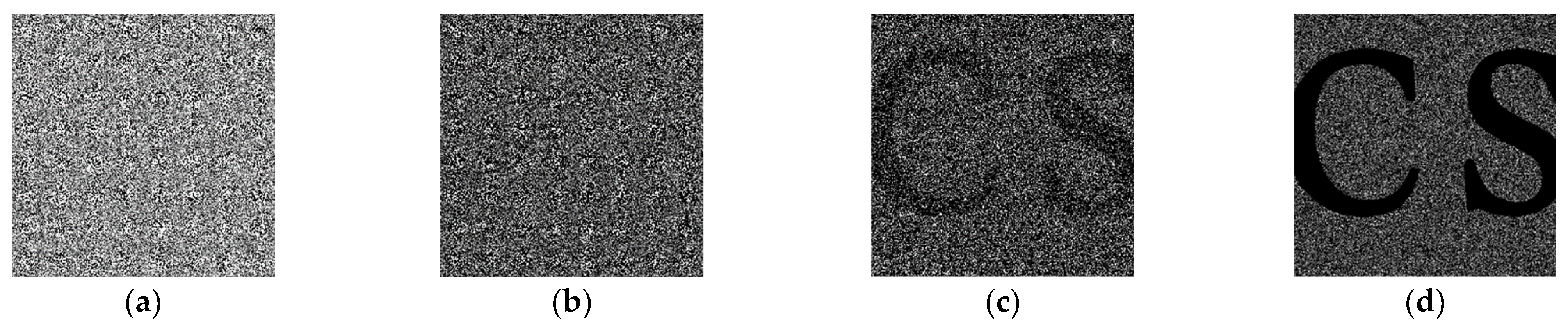
- The first algorithm is designed to generate share patterns corresponding to a fake secret. When f ≤ t < k shares are stacked, the reconstruction reveals a misleading image to unauthorized users. When stacking more than k − 1 shares, it becomes a completely black image. This scheme is the (f,k,n) interval threshold P-VSS ((f,k,n) P-IVSS for short) scheme. This mechanism provides a decoy effect to enhance information hiding and defense against partial collusion attacks.
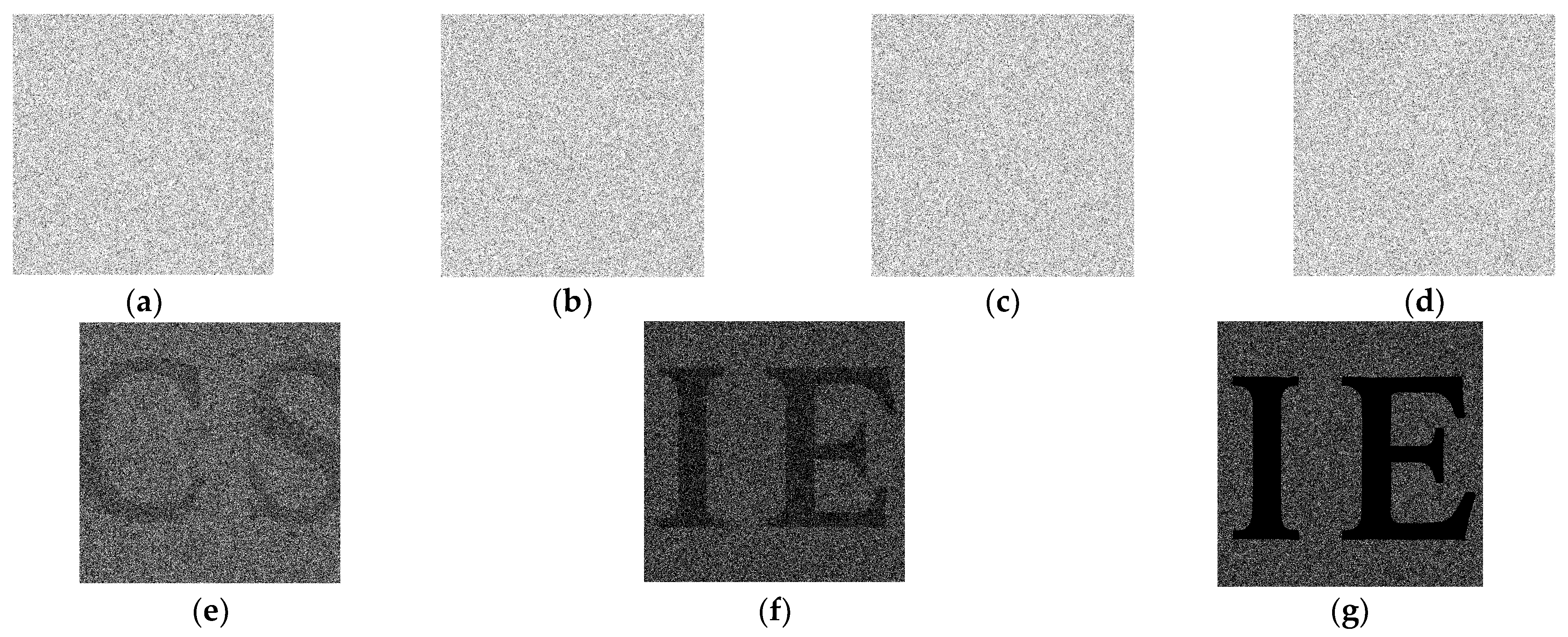
- The second algorithm is an enhanced version of Algorithm 1 [4], which improves the contrast of the restored image. This algorithm constructs a sharing mode that supports reconstruction of the true secret only when t ≥ k. It ensures that no meaningful information about the true secret can be derived from fewer than k shares.
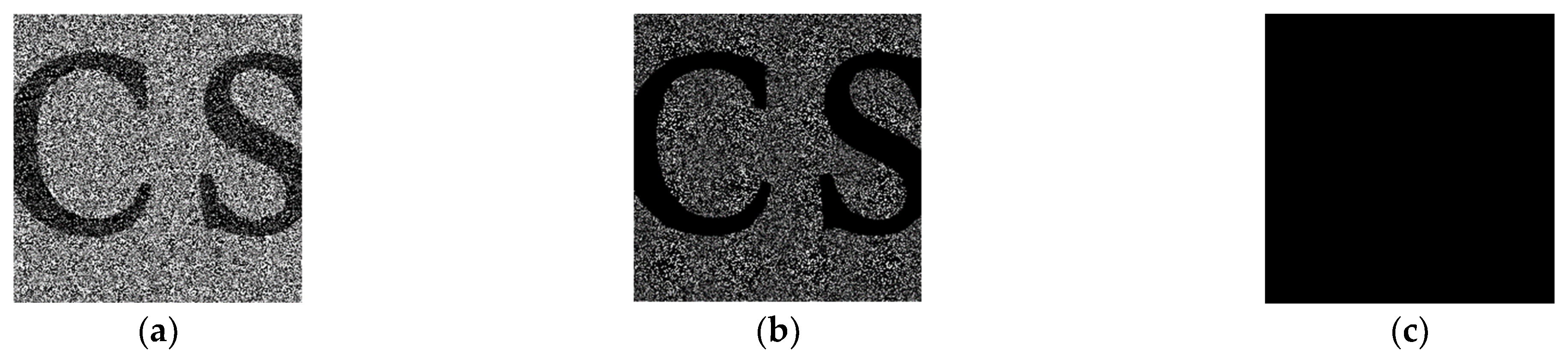
- The third algorithm introduces a pixel-wise randomization strategy. For each pixel, the algorithm randomly decides whether to apply the first or second algorithm during encoding. This random selection increases the unpredictability of the share generation process and strengthens the scheme’s resistance to reverse engineering or statistical analysis.
3.2. Share Construction Procedure
| Algorithm 2. (f,k,n) P-IVSS |
| Input: A w × h binary secret image S, the threshold parameters (f,k,n) for 1 < f < k ≤ n. Output: n shares G1, …, Gn. Step 1. For each position (i, j) ∈ {(i, j)|1 ≤ i ≤ w, 1 ≤ j ≤ h}, repeat Steps 2–7. Step 2. If S [i, j] = 0, then s = (0, 0); else s = (1, 1). Step 3. Randomly generate g1, g2, …, gf−1 as (0, 1), (1, 0). Step 4. gf = s ⊕ g1⊕ g2 … ⊕ gf–1. Step 5. gf+1 = g1, gf+2 = g2, …, g2f = gf, g2f+1 = g1, …, if (k − 1) mod f = 0, gk–1 = gf; else gk–1 = g(k–1 mod f). Step 6. For i from k to n, gi = (1, 1). Step 7. Randomly rearrange g1, g2, …, gn to G1 [i, j], G2 [i, j], …, Gn [i, j]. Step 8. Output the n shares G1, G2, …, Gn. |
| Algorithm 3. New (k,n) P-VSS for k > 2 |
| Input: A w × h binary secret image S, the threshold parameters (k,n) for 1 < k ≤ n. Output: n shares G1, …, Gn. Step 1. For each position (i, j) ∈ {(i, j)|1 ≤ i ≤ w, 1 ≤ j ≤ h}, repeat Steps 2–6. Step 2. If S[i, j] = 0, then s = (0, 0); else s = (1, 1). Step 3. Randomly generate g1, g2, …, gk–1 as (0, 1), (1, 0). Step 4. gk = s ⊕ g1⊕ g2 … ⊕ gk−1. Step 5. gk+1 = g1, gk+2 = g2, …, g2k = gk, g2k+1 = g1, …, if (n mod k) = 0, gn = gk; else gn = g(n mod k). Step 6. Randomly rearrange g1, g2, …, gn to G1[i, j], G2[i, j], …, Gn[i, j]. Step 7. Output the n shares G1, G2, …, Gn. |
| Algorithm 4. (f,k,n) P-2VSS |
| Input: A w × h binary secret image S, the threshold parameters (f,k,n) for 1 < f < k ≤ n. Output: n shares G1, …, Gn. Step 1. For each position (i, j) ∈ {(i, j)|1 ≤ i ≤ w, 1 ≤ j ≤ h}, repeat Step 2–3. Step 2. Randomly select a value num ∈ {0, 1}. Step 3. If (num = 0), generate the corresponding share pixels according to Steps 2–7 of Algorithm 2; else (num = 1), generate them according to Steps 2–6 of Algorithm 3. Step 4. Output the n shares G1, G2, …, Gn. |
3.3. Visual Results and Data Analysis
3.3.1. Experimental Results of (2, 4, 4) P-IVSS
3.3.2. Experimental Results of New (4, 5) P-VSS
3.3.3. Experimental Results of (2, 3, 4) P-2VSS
4. Conclusions
Author Contributions
Funding
Institutional Review Board Statement
Informed Consent Statement
Data Availability Statement
Conflicts of Interest
References
- Naor, M.; Shamir, A. Visual cryptography. In Advances in Cryptology—EUROCRYPT’94, Proceedings of the Workshop on the Theory and Application of of Cryptographic Techniques, Perugia, Italy, 9–12 May 1994; Lecture Notes in Computer Science; Springer: Berlin/Heidelberg, Germany, 1995; Volume 950, pp. 1–12. [Google Scholar]
- Kafri, O.; Keren, E. Encryption of pictures and shapes by random grids. Opt. Lett. 1987, 12, 377–379. [Google Scholar] [CrossRef] [PubMed]
- Biham, E.; Itzkovitz, A. Visual Cryptography with Polarization. In the Dagstuhl Seminar on Cryptography, September 1997, and in the RUMP Session of CRYPTO’98, 1997. Available online: https://core.ac.uk/outputs/24679780/ (accessed on 25 January 2026).
- Huang, C.W.; Juan, J.S. A (t, n)-threshold visual secret sharing scheme based on polarization. In Proceedings of the 2023 IEEE 6th International Conference on Knowledge Innovation and Invention (ICKII), Hokkaido, Japan, 11–13 August 2023; pp. 172–176. [Google Scholar] [CrossRef]
- Chen, T.-H.; Tsao, K.-H. Threshold visual secret sharing by random grids. J. Syst. Softw. 2011, 84, 1197–1208. [Google Scholar] [CrossRef]





| t = 1 | t = 2 | t = 3 | t = 4 | |
| α | 0.0000 | 0.2857 | 0.2500 | 0.0000 |
| T0 | 0.7500 | 0.5000 | 0.2500 | 0.0000 |
| T1 | 0.7500 | 0.1667 | 0.0000 | 0.0000 |
| t = 1 | t = 2 | t = 3 | t = 4 | t = 5 | |
| α | 0 | −0.0001 | 0.0002 | 0.0867 | 0.2495 |
| T0 | 1 | 0.5497 | 0.5000 | 0.2495 | 0.2495 |
| T1 | 1 | 0.5499 | 0.1667 | 0.2495 | 0.0000 |
| t = 1 | t = 2 | t = 3 | t = 4 | ||
| α | (Fake) (True) | 0.0002 0.0001 | 0.0652 −0.0054 | −0.0084 0.1109 | −0.0178 0.2496 |
Disclaimer/Publisher’s Note: The statements, opinions and data contained in all publications are solely those of the individual author(s) and contributor(s) and not of MDPI and/or the editor(s). MDPI and/or the editor(s) disclaim responsibility for any injury to people or property resulting from any ideas, methods, instructions or products referred to in the content. |
© 2026 by the authors. Licensee MDPI, Basel, Switzerland. This article is an open access article distributed under the terms and conditions of the Creative Commons Attribution (CC BY) license.
Share and Cite
Chuang, W.T.-W.; Juan, J.S.-T.; Lee, W.-T. Polarization-Based (f,k,n)-Threshold Two-Level Visual Secret Sharing Scheme. Eng. Proc. 2025, 120, 60. https://doi.org/10.3390/engproc2025120060
Chuang WT-W, Juan JS-T, Lee W-T. Polarization-Based (f,k,n)-Threshold Two-Level Visual Secret Sharing Scheme. Engineering Proceedings. 2025; 120(1):60. https://doi.org/10.3390/engproc2025120060
Chicago/Turabian StyleChuang, Wilson Tsai-Wei, Justie Su-Tzu Juan, and Wen-Ting Lee. 2025. "Polarization-Based (f,k,n)-Threshold Two-Level Visual Secret Sharing Scheme" Engineering Proceedings 120, no. 1: 60. https://doi.org/10.3390/engproc2025120060
APA StyleChuang, W. T.-W., Juan, J. S.-T., & Lee, W.-T. (2025). Polarization-Based (f,k,n)-Threshold Two-Level Visual Secret Sharing Scheme. Engineering Proceedings, 120(1), 60. https://doi.org/10.3390/engproc2025120060