



Subchannel Allocation in Massive Multiple-Input Multiple-Output Orthogonal Frequency-Division Multiple Access and Hybrid Beamforming Systems with Deep Reinforcement Learning †

Abstract
1. Introduction
2. System Model
3. Dynamic Subchannel Allocation with DRL-Based Method
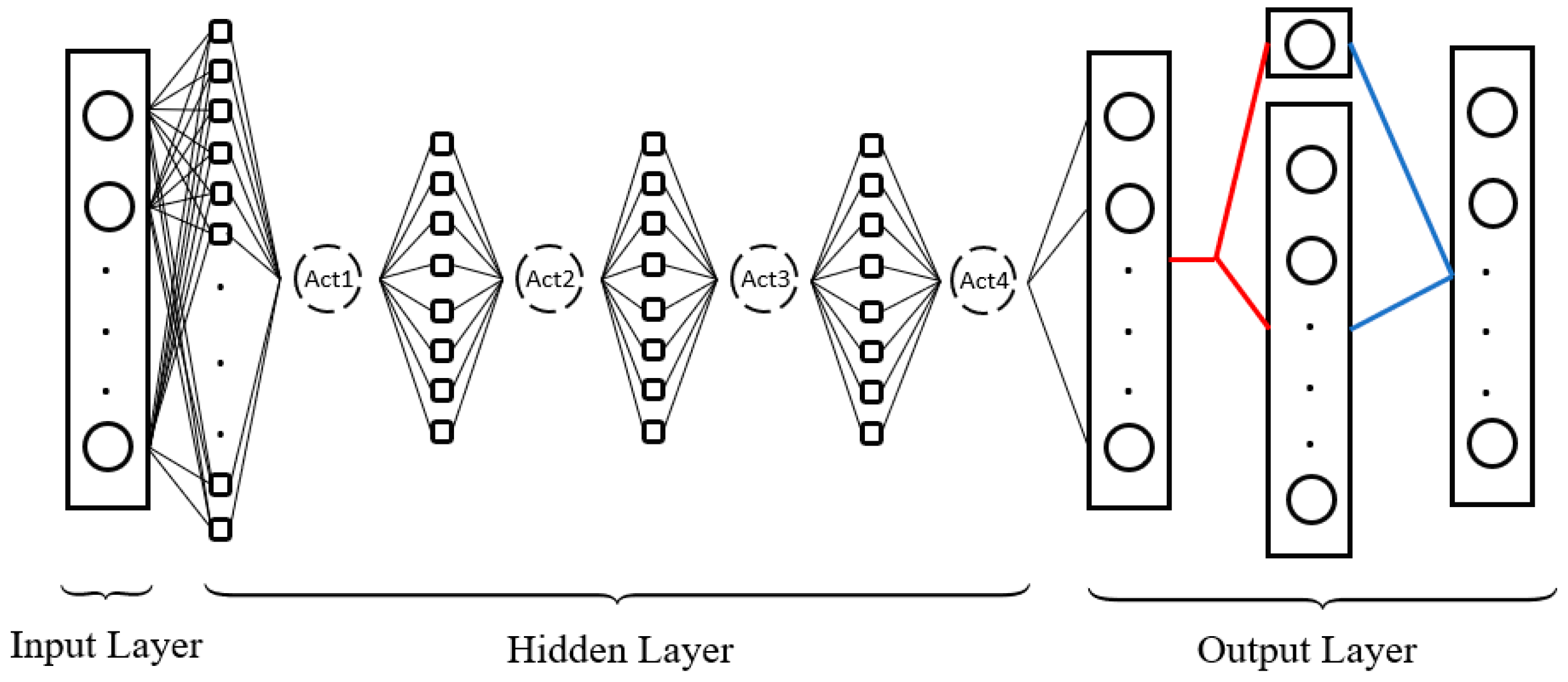
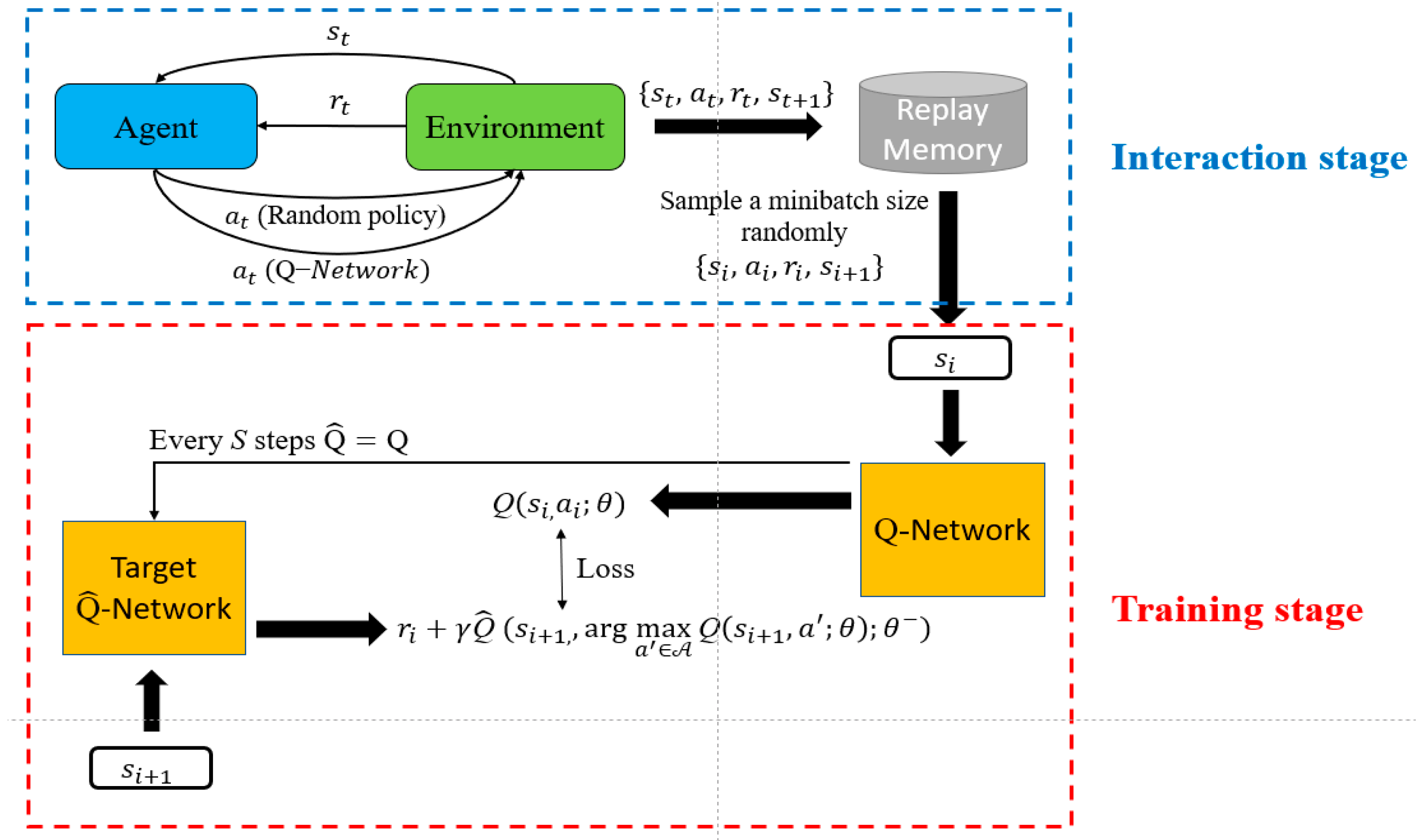
- States (): In the proposed algorithm, is a set that combines different meaningful vectors or scalars, with time-variant feature data as the input to the network. We define , where , and represents the path loss of the user at the time slot. Here, we assume that the path loss does not change at all time slots at an episode for each user, and each user’s path loss is only updated at the beginning of the next episode. Next, is the vector representing each user’s channel state, where . We preprocess channel gain for all subcarriers of each user before inputting them into the neural network. is computed by the following equation
- Actions (): We treat each possible subchannel assignment as an action and implement the allocation at each time slot. For partial allocation, we randomly generate some allocation cases as an action set, without considering all possible subchannel allocations. For full allocation, the action set includes all possible subchannel allocation solutions. According to [13], RB consists of 12 consecutive subcarriers in the frequency domain. For simplicity in this simulation, we assume that each RB group (RBG) contains only one RB, rather than multiple RBs, as defined in the specification. We assume that each user in the set is served at least one RB in each time slot. Therefore, we eliminate the options where a user is not allocated any RBs. In summary, we represent as a number corresponding to a bitmap that indicates the subchannel allocation, and the agent selects based on the current at each time slot .
- Rewards (): We define a reward function to guide the agent, rewarding correct actions and penalizing irregular ones. The agent’s goal is to maximize the long-term expected cumulative reward. The reward function is expressed as:
Dueling-DDQN Algorithm and Network Structure
4. Simulation Results
5. Conclusions
Author Contributions
Funding
Institutional Review Board Statement
Informed Consent Statement
Data Availability Statement
Conflicts of Interest
References
- Andrews, J.G.; Buzzi, S.; Choi, W.; Hanly, S.V.; Lozano, A.; Soong, A.C.K. What Will 5G Be? IEEE J. Sel. Areas Commun. 2014, 32, 1065–1082. [Google Scholar] [CrossRef]
- Rappaport, T.S.; Sun, S.; Mayzus, R.; Zhao, H.; Azar, Y.; Wang, K. Millimeter Wave Mobile Communications for 5G Cellular: It Will Work! IEEE Access 2013, 1, 335–349. [Google Scholar] [CrossRef]
- Hoseini, S.A.; Ding, M.; Hassan, M. Massive MIMO performance comparison of beamforming and multiplexing in the Terahertz band. In Proceedings of the 2017 IEEE Globecom Workshops (GC Wkshps), Singapore, 4–8 December 2017; pp. 1–6. [Google Scholar]
- Swindlehurst, A.; Ayanoglu, E.; Heydari, P.; Capolino, F. Millimeter-wave massive MIMO: The next wireless revolution? IEEE Commun. Mag. 2014, 52, 56–62. [Google Scholar] [CrossRef]
- Lu, L.; Li, G.Y.; Swindlehurst, A.L.; Ashikhmin, A.; Zhang, R. An Overview of Massive MIMO: Benefits and Challenges. IEEE J. Sel. Top. Signal Process. 2014, 8, 742–758. [Google Scholar] [CrossRef]
- Bogale, T.E.; Le, L.B.; Haghighat, A.; Vandendorpe, L. On the number of RF chains and phase shifters, and scheduling design with hybrid analog–digital beamforming. IEEE Trans. Wirel. Commun. 2016, 15, 3311–3326. [Google Scholar] [CrossRef]
- Zhang, J.; Yu, X.; Letaief, K.B. Hybrid Beamforming for 5G and Beyond Millimeter-Wave Systems: A Holistic View. IEEE Open J. Commun. Soc. 2020, 1, 77–91. [Google Scholar] [CrossRef]
- Molisch, A.F.; Ratnam, V.V.; Han, S.; Li, Z.; Le Hong Nguyen, S.; Li, L. Hybrid beamforming for massive MIMO: A survey. IEEE Commun. Mag. 2017, 55, 134–141. [Google Scholar] [CrossRef]
- Maciel, T.F.; Klein, A. A resource allocation strategy for SDMA/OFDMA systems. In Proceedings of the 2007 16th IST Mobile and Wireless Communications Summit, Budapest, Hungary, 1–5 July 2007. [Google Scholar]
- Tseng, H.-H.; Chen, Y.F.; Tseng, S.-M. Hybrid Beamforming and Resource Allocation Designs for mmWave Multi-User Massive MIMO-OFDM Systems on Uplink. IEEE Access 2023, 11, 133070–133085. [Google Scholar] [CrossRef]
- Chen, B.Y.; Chen, Y.F.; Tseng, S.M. Hybrid Beamforming and Data Stream Allocation Algorithms for Power Minimization in Multi-User Massive MIMO-OFDM Systems. IEEE Access 2022, 10, 101898–101912. [Google Scholar] [CrossRef]
- Ha, V.N.; Nguyen, D.H.N.; Frigon, J. Subchannel allocation and hybrid precoding in millimeter-wave OFDMA systems. IEEE Trans. Wirel. Commun. 2018, 17, 5900–5914. [Google Scholar] [CrossRef]
- 3GPP Technical Specification 38.211 v15.2.0, Physical channels and modulation (Release 15), 2018. Available online: https://www.3gpp.org/ftp/Specs/archive/38_series/38.211/. (accessed on 1 May 2024).
- 3GPP Technical Specification 38.104 v16.5.0, Base Station (BS) radio transmission and reception (Release 16), 2020. Available online: https://www.3gpp.org/ftp/Specs/archive/38_series/38.104 (accessed on 1 May 2024).
- 3GPP Technical Report 38.901 v16.1.0, Study on channel model for frequencies from 0.5 to 100 GHz (Release 16), 2020. Available online: https://www.3gpp.org/ftp/Specs/archive/38_series/38.901 (accessed on 1 May 2024).
Disclaimer/Publisher’s Note: The statements, opinions and data contained in all publications are solely those of the individual author(s) and contributor(s) and not of MDPI and/or the editor(s). MDPI and/or the editor(s) disclaim responsibility for any injury to people or property resulting from any ideas, methods, instructions or products referred to in the content. |
© 2026 by the authors. Licensee MDPI, Basel, Switzerland. This article is an open access article distributed under the terms and conditions of the Creative Commons Attribution (CC BY) license.
Share and Cite
Lee, J.-W.; Chen, Y.-F. Subchannel Allocation in Massive Multiple-Input Multiple-Output Orthogonal Frequency-Division Multiple Access and Hybrid Beamforming Systems with Deep Reinforcement Learning. Eng. Proc. 2025, 120, 55. https://doi.org/10.3390/engproc2025120055
Lee J-W, Chen Y-F. Subchannel Allocation in Massive Multiple-Input Multiple-Output Orthogonal Frequency-Division Multiple Access and Hybrid Beamforming Systems with Deep Reinforcement Learning. Engineering Proceedings. 2025; 120(1):55. https://doi.org/10.3390/engproc2025120055
Chicago/Turabian StyleLee, Jih-Wei, and Yung-Fang Chen. 2025. "Subchannel Allocation in Massive Multiple-Input Multiple-Output Orthogonal Frequency-Division Multiple Access and Hybrid Beamforming Systems with Deep Reinforcement Learning" Engineering Proceedings 120, no. 1: 55. https://doi.org/10.3390/engproc2025120055
APA StyleLee, J.-W., & Chen, Y.-F. (2025). Subchannel Allocation in Massive Multiple-Input Multiple-Output Orthogonal Frequency-Division Multiple Access and Hybrid Beamforming Systems with Deep Reinforcement Learning. Engineering Proceedings, 120(1), 55. https://doi.org/10.3390/engproc2025120055

