Abstract
Filament winding (FW) is a widely used automated manufacturing method for cylindrical composite structures. However, conventional modeling approaches often rely on oversimplified geometries, neglecting essential features such as fiber overlaps and gaps, which can affect the accuracy of subsequent mechanical analysis. In this work, we present a computational methodology for the accurate geometric reconstruction of FW components, based on the numerical calculation of fiber trajectories and their automated integration into CAD models. The proposed approach provides realistic geometrical representations that capture the actual fiber paths, enabling more reliable finite element simulations. Comparative results between the proposed method and traditional modeling techniques highlight key differences in stiffness prediction, demonstrating the importance of realistic geometric input for the mechanical analysis of filament-wound structures.
1. Introduction
Composite materials are increasingly being utilized by industries worldwide due to the numerous benefits they offer. The military industry was among the first to adopt these materials, particularly during World War II [1]. Marine products manufactured from composites include pipes [2,3], shafts [4], closed vessels [5,6], torque shafts [7,8], and Autonomous Underwater Vehicles (AUVs) [9]. The primary reasons for the widespread use of composite materials are their ability to reduce weight and their excellent mechanical and corrosion resistance properties [10]. There are various techniques used in the manufacturing of these components, including manual, semi-automated, and fully automated methods. A comprehensive study conducted by Jürgen Fleischer et al. [11] presents the most commonly used manufacturing techniques for composite structures, including the filament winding (FW) method. FW is an automated manufacturing method primarily used to produce closed geometries such as pressure vessels and pipes. Numerous studies [12,13,14,15] have been published on the mechanical behavior of components manufactured using the FW method. These studies aim to understand how various parameters such as winding angle, winding pattern, fiber band width, etc. affect the mechanical behavior of the components. Two primary approaches are employed in the study of mechanical behavior: the conventional experimental method, which is generally regarded as more accurate, and the more recent computational approach based on the Finite Element Method (FEM), as exemplified in the works of Guo et al. [16] and Liu et al. [17] where both analytical modelling is used. Toh et al. [18] combined both experimental and FEM analyses on the same component; while this approach is highly effective, it is not always feasible.
Composite pipes are highly useful and have numerous applications, which is why many studies have focused on understanding their behavior. Ortenzi et al. [19] compared the elastic properties of filament-wound composite pipes using theoretical, computational, and experimental methods. Colombo and Vergani [20] aimed to minimize the wall thickness of composite pipes. Krishnan et al. [21] investigated the effects of winding angle on the behavior of glass/epoxy composite tubes under multiaxial cyclic loading. Natsuki et al. [22] studied the bending strength of filament-wound composite pipes. Gunasegaran et al. [23] conducted an experimental investigation and FEM analysis of FW glass reinforced plastic (GRP) pipes for underground applications. The axial and hoop strength of the pipes was evaluated through a combination of experimental and FEM analyses in this study.
The optimization of structures manufactured through the FW method is a subject of growing relevance, particularly in light of the increasing demand for high-performance composite materials. FEM analysis is commonly used to optimize the structure of such components. However, the effective use of FEM requires the accurate input of the component’s geometry, which presents a significant challenge. Specifically, the generation of realistic geometries in FW-manufactured parts necessitates the computation of fiber paths, governed by differential equations and principles of differential geometry. Currently, only a limited number of software tools are capable of producing such geometrically accurate models, while the majority of existing studies rely on simplified representations that often neglect the actual fiber trajectories. To address this gap, we developed a computational method that accurately calculates the fiber paths and subsequently generates detailed CAD models compatible with a wide range of FEM software packages. This approach offers a precise, fast, and fully automated workflow that significantly reduces geometry preparation time while minimizing user-induced errors and modeling inconsistencies.
2. Theory
2.1. Filament Winding Method
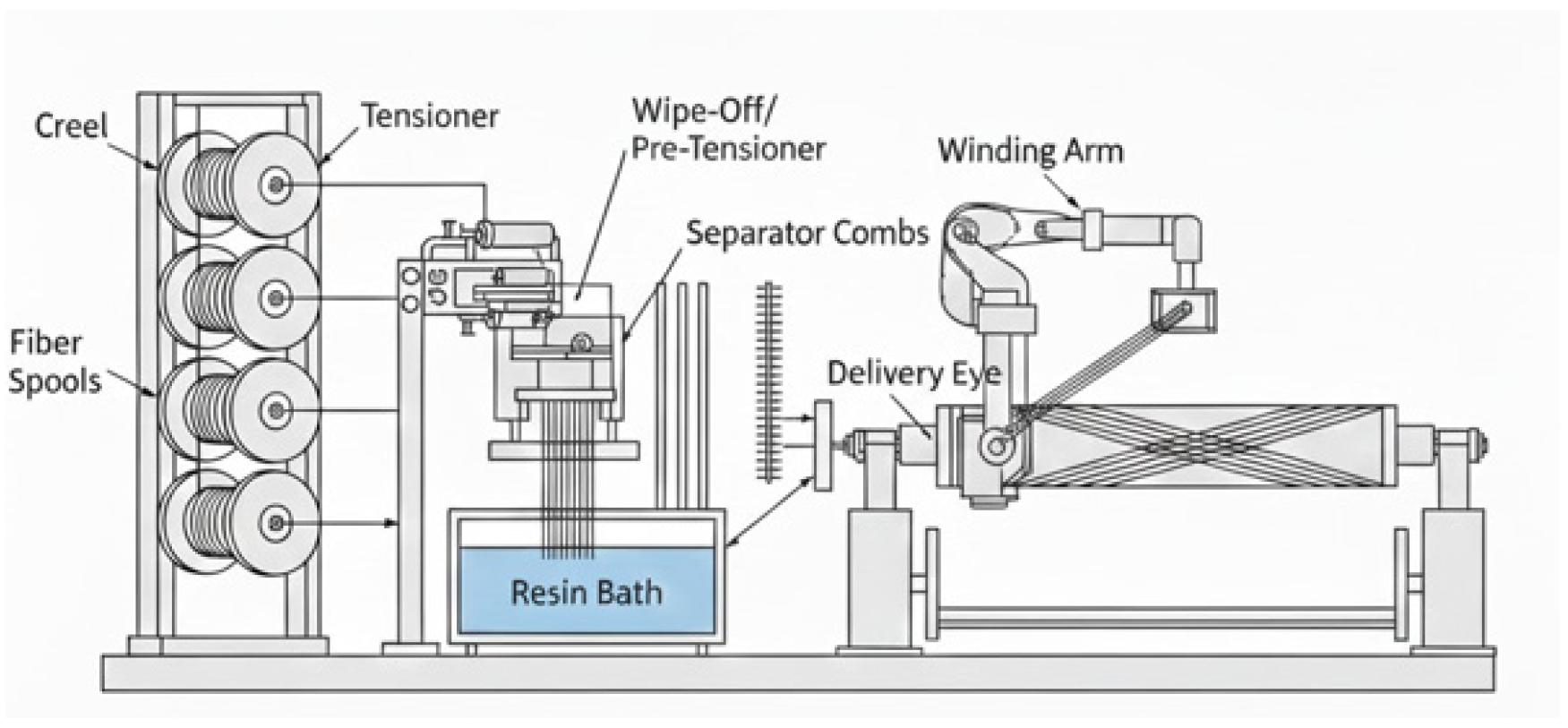
In FW (Figure 1), fibers are wrapped at specific angles. Angle is a critical parameter that influences the mechanical performance of the final component, considering the anisotropy of composite materials. The fibers are drawn from spools, pass through a tensioning device, and then pass through a resin bath where they are soaked. Finally, the wet fibers are wrapped around a cylindrical mandrel at a specified angle. The winding angle in filament winding governs the resulting lay-up pattern and, consequently, the mechanical response of the composite structure. Among the three principal winding configurations hoop, polar, and helical winding [24], the present study specifically investigates helical winding. In this configuration, the mandrel rotates at a constant angular velocity, while the winding angle is systematically varied within the typical range of 5° to 85°, in order to assess its influence on the mechanical performance of the composite structure.
Figure 1.
Typical filament winding arrangement [23].
2.2. Geodetic Representation of FW
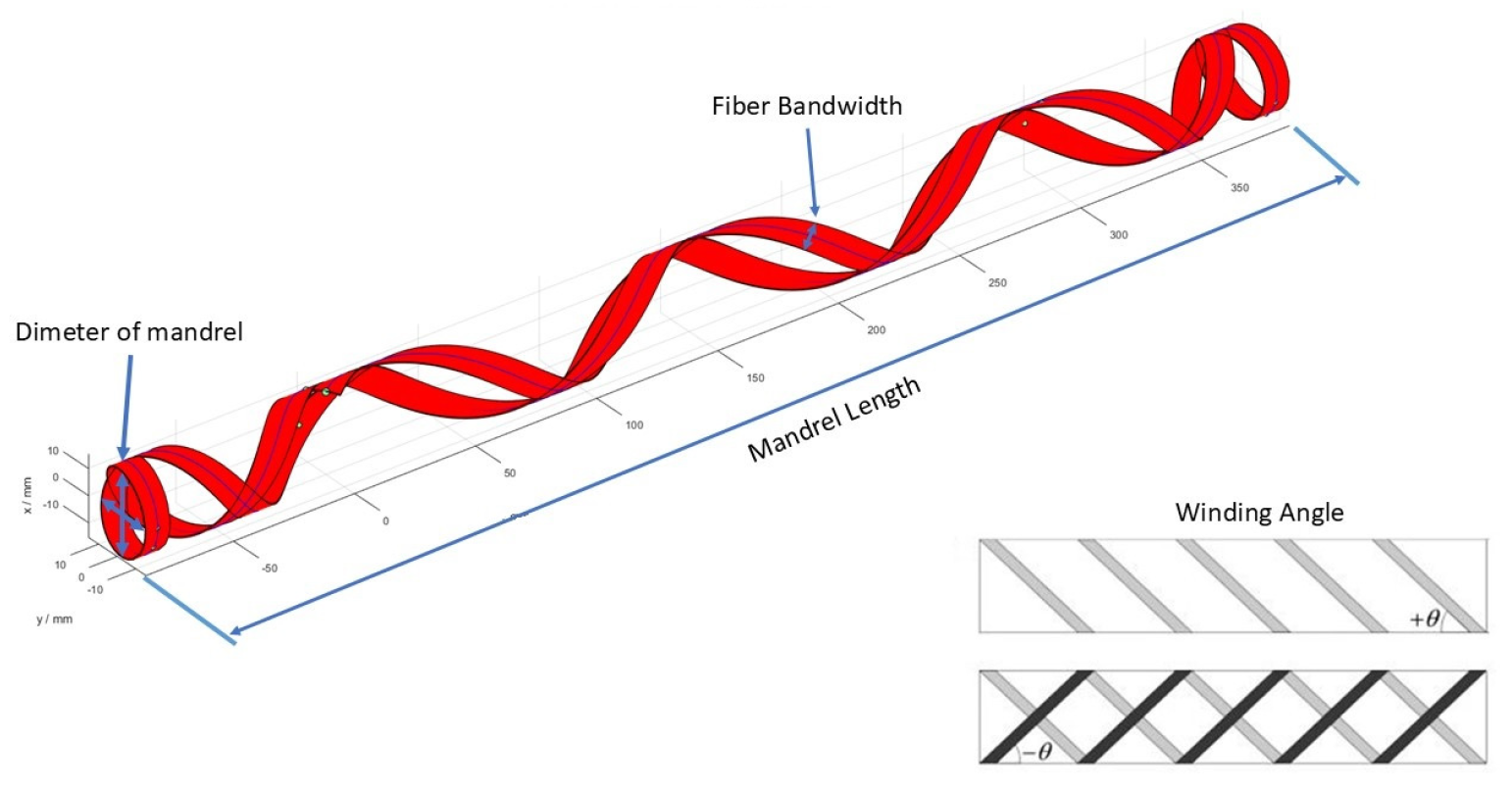
The primary challenge in modeling the FW process is accurately determining the fiber trajectories as they are wrapped around the mandrel. Improved precision enables solutions to various problems, such as optimization and resolving defects that may arise during manufacturing. The key parameters influencing these trajectories are: (i) bandwidth of fiber, (ii) winding angle, (iii) length and (iv) radius of the mandrel.
As mentioned earlier, this study focuses on helical winding, where the pattern follows a similar configuration (Figure 2). The formulation, based on Differential Geometry [25], that describes the helical winding (S) is the following:
Figure 2.
First layer.
Here, R denotes the mandrel radius, ϕ represents the angle along the z axis and is the parallel parameter, and θ represents the meridional parameter. Helical winding patterns refer to the geodesic curves on a cylinder around which a fiber is wrapped.
The term ‘geodesic’ refers to the shortest path a fiber needs to travel between two points on a surface. The transition from mathematical modeling to code modeling for fiber trajectories was carried out by Furtado [26]. The fundamental differential equation governing the process is as follows:
The parameters kp and kg represent the parallel and meridian curvatures, respectively. In the case of geodesic curvature, kg is equal to zero, so Equation (5) simplifies as follows:
Equation (3) describes the relationship between the winding angle α(θ), curvatures and coefficient of friction for a fibre placed on a surface; it also describes the distribution of the winding angle along the fibre path. The second term accounts for the friction between the fiber and the mandrel. The λ is the static coefficient of friction. Equation (3) describes the variation of the angle a as function of the coorndinate θ in spherical coordinates [27]. The differential equation is expressed in spherical coordinates. It describes how the angle α varies with respect to the angle θ of the main coordinate system. The first term addresses the geodesic problem, while the second term accounts for the static friction generated during the winding process. This equation is solved using the Euler method.
3. Visual Representation of FW Process
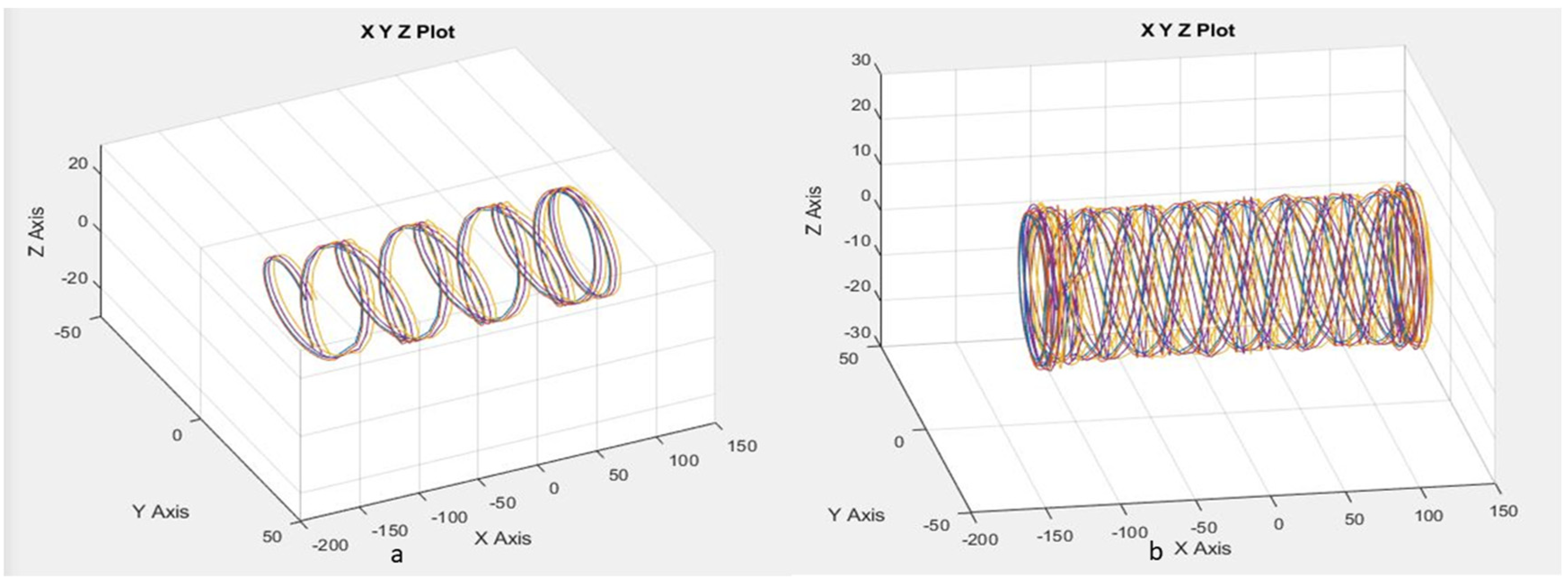
Simulink [28] was employed in this study as a modeling environment for the intuitive design and development of simulation systems through block-based modeling. Specifically, Simulink was used to construct a visually progressive representation of the FW process, capturing its temporal evolution and enabling detailed visualization of fiber trajectories, as illustrated in Figure 2. The model was driven by xx, yy, and zz coordinates derived from the differential Equation (3) introduced in a previous section. The mandrel is covered incrementally, layer by layer, reflecting the actual manufacturing sequence. A 3D block from the Simulink library was configured to accept the computed coordinates and render the fiber paths in three-dimensional space. These simulations can be integrated with physical filament winding equipment, allowing for real-time synchronization and monitoring of the fiber’s exact position. Additionally, the model supports defect prediction by identifying potential flaws during the winding process, thereby contributing to enhanced process predictability and quality assurance. Figure 3 presents the progression of the fiber deposition in the real-time simulation.
Figure 3.
Simulink GUI, (a) trajectory of the first layer; (b) trajectories of the full-cover mandrel.
4. Methodology to Extract the CAD File
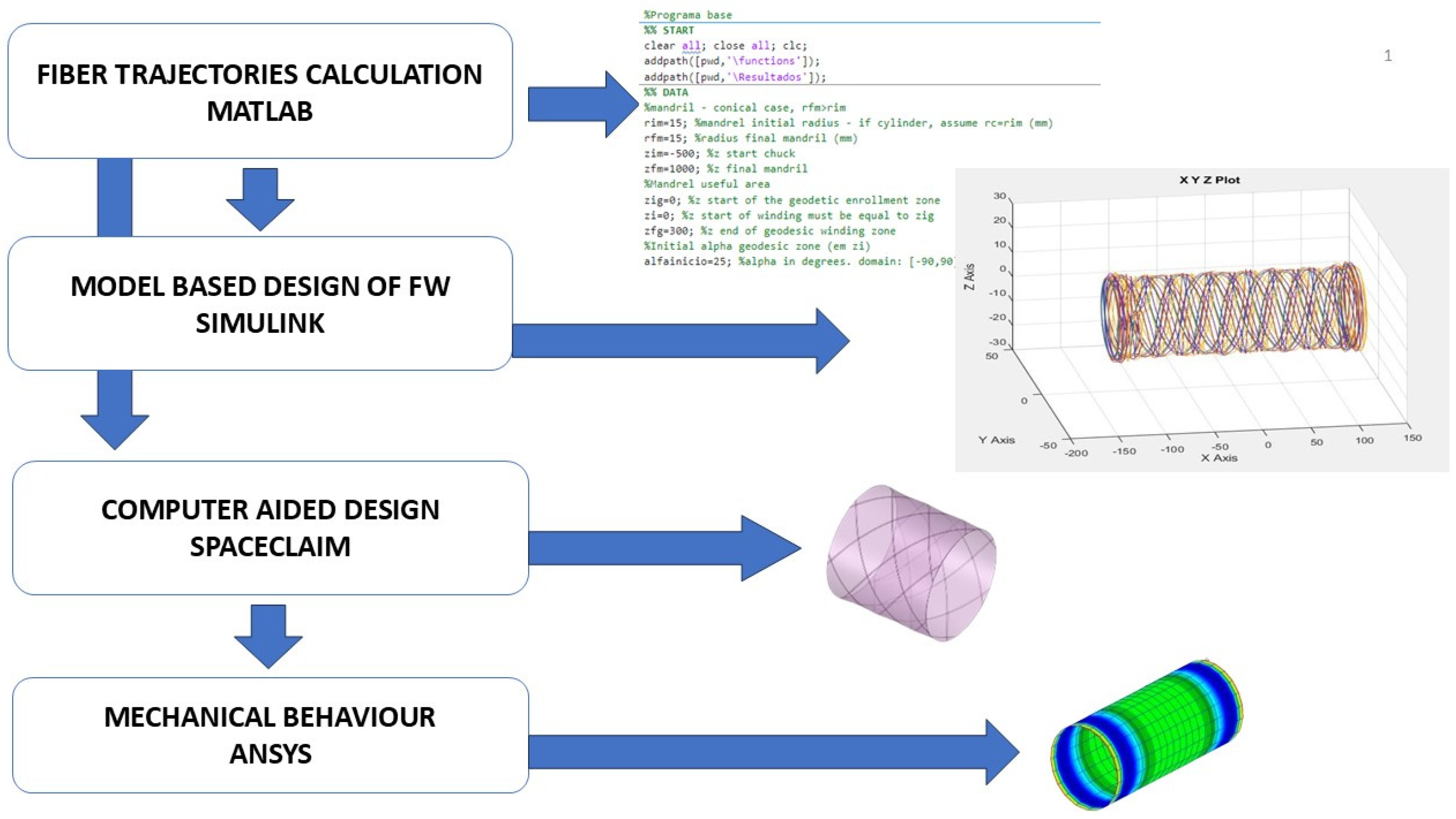
The methodology followed for the accurate reconstruction of the component’s geometry is presented in Figure 4. This approach is based on the numerical computation of Equations (1)–(3), implemented through custom code. By solving the fundamental differential Equation (3), the coordinates of the fiber path trajectories are derived. These coordinates are then imported into the Ansys SpaceClaim (V.2025, R1) [29] design environment, where a Python-based script is employed to generate the realistic geometry rapidly and accurately. Finally, the generated geometry can be exported in any standard CAD file format, making it compatible with a wide range of FEM software tools for subsequent mechanical analysis.
Figure 4.
Flow chart of the process.
4.1. Code Development
According to Furtado [25] the initial stage of the methodology involves introducing the key parameters that define the composite part. These parameters include the length (L) and radius (R) of the mandrel, the initial (S) and final (E) points of geodesic curve, winding angle (θ), number of rovings (NT), fiber bandwidth (wt), linear density of fiber (TEX), resin density (ρ), fiber volume fraction (Vf) and resin volume fraction (Vresin). An optimal combination of these parameters minimizes the number of necessary layers, required to fully cover the mandrel, thereby reducing the total number of layers and ultimately leading to a lighter and more efficient structure. For each layer, the fiber trajectory is initially computed in spherical coordinates and subsequently converted to Cartesian coordinates to facilitate further processing. The resulting data are arranged in matrix form and exported for use in the subsequent steps of geometry generation (Figure 2) and simulation (Figure 3). The data generated by the custom-developed code and subsequently imported for geometry creation are sufficient to achieve a complete coverage of the mandrel. The trajectories of the minimum number of layers (in Cartesian coordinates), required to fully cover the mandrel, are obtained through the following function:
4.2. CAD Generation
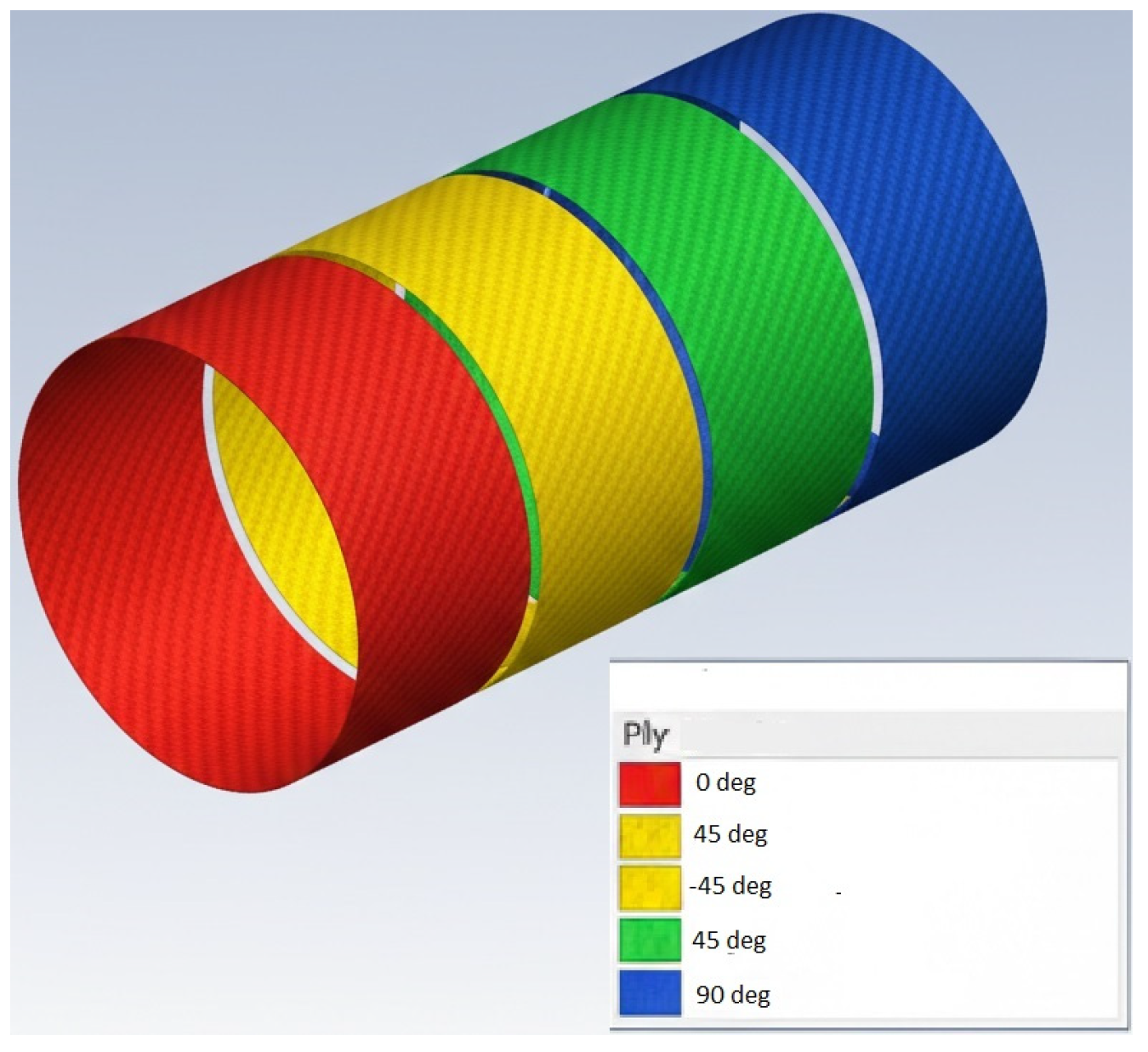
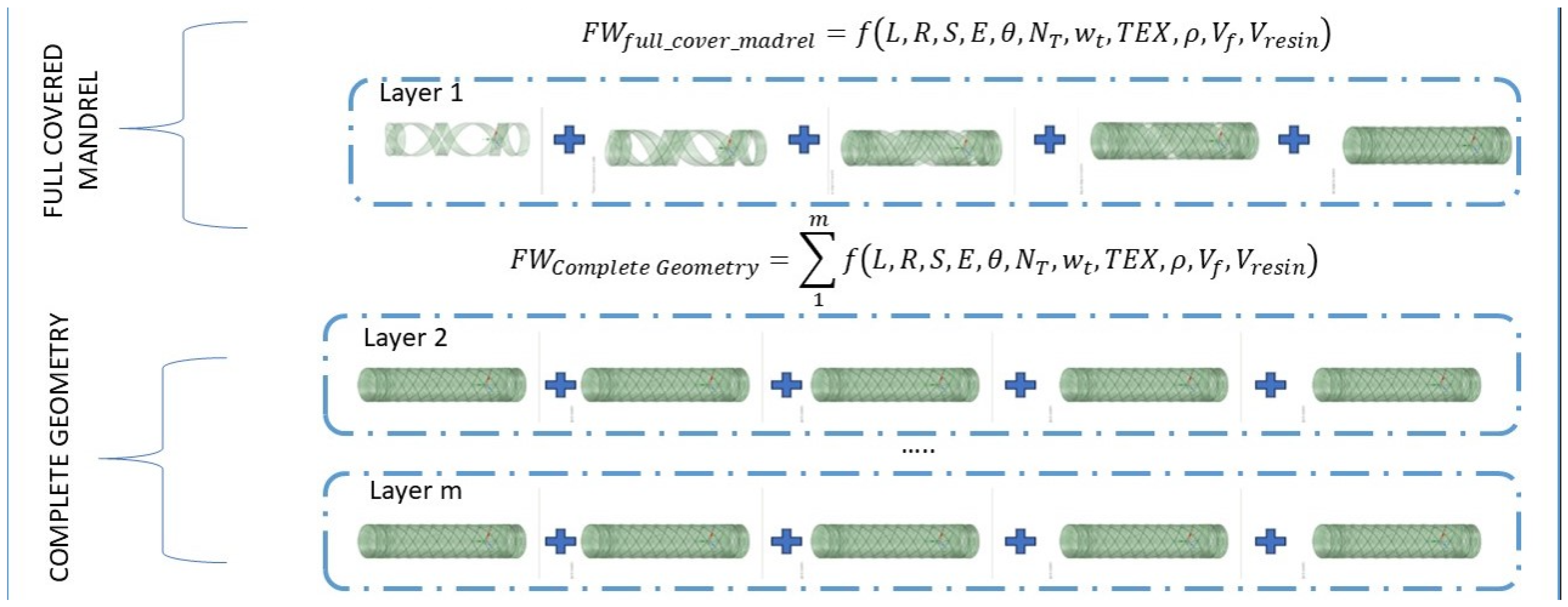
The next step in the proposed methodology involves the CAD generation of the actual part geometry. After the fiber trajectories have been computed and transformed in Cartesian coordinates, they are imported into the SpaceClaim design environment, where a custom Python script is utilized to automate the modeling process. The use of scripting is essential for ensuring speed, precision, and repeatability, particularly since each individual layer consists of several thousand coordinate points in order to achieve a high level of geometric accuracy. Manual modeling of such layers would not only be extremely time-consuming but also prone to human error—especially considering that a complete mandrel coverage may require dozens of layers. This automated method enables the designer to fully visualize, inspect, and, if necessary, modify each individual layer of the structure. It also provides the ability to detect potential defects in the winding pattern, such as under-coverage or fiber overlaps, and to evaluate the structural uniformity of the design. The result is a highly realistic digital model that captures all critical geometrical features of the filament winding process. This approach addresses a major limitation found in many commercial software tools, which typically do not generate realistic fiber-based geometries but instead rely on idealized laminate representations [30]. These conventional models (Figure 5) assume uniform thickness, neglecting overlaps, gaps, or process-induced inconsistencies; these simplifications may fail to capture the accurate representation of components manufactured via filament winding, where fibers are individually deposited in a non-uniform and highly process-dependent manner. While these simplified methods may be suitable for other composite manufacturing processes, they fail to capture the specific complexities inherent to filament winding. Although the current research is still under development, we have been able to extract some initial, yet meaningful, comparative results between the traditional approach and the method proposed in this study. Specifically, for a filament-wound cylindrical specimen with a length of 200 mm, a diameter of 200 mm, and a winding angle of 55°, which was subjected to tensile testing, the elastic modulus obtained using the layer-by-layer method was found to be 34.1 GPa, while our method resulted in a value of 28.3 GPa. This corresponds to a difference of approximately 20.5%, indicating that the proposed model is less rigid compared to one of the commonly used conventional methods. Figure 6 presents the complete workflow for generating a fully detailed geometric representation.
Figure 5.
Conventional method for idealized laminate representation.
Figure 6.
New introduced method for realistic laminate representation.
Initially, it can be observed that the conventional method requires two passes (±θ) to achieve full coverage of the mandrel. In contrast, the proposed methodology determines the full coverage of the mandrel by computing the minimum number of layers and their corresponding trajectories using the function in Equation (7), Equation (7), which depends on several parameters discussed in Section 4.2. This equation yields both the coordinates and the number of fibers required for complete single-pass coverage of the mandrel. In cases where a fully analytical geometry of a specified thickness (t) is required, the total number of layers must be summed to achieve the desired composite thickness. Consequently, the final geometry will consist of m layers, as derived from Equation (7). Therefore, to construct a fully developed geometry with the prescribed thickness (t), Equation (8) has to be evaluated.
5. Conclusions
This study presented an innovative method for generating cylindrical geometries that accurately represent the configuration of filament-wound structures. The proposed methodology addresses a significant gap in the literature by enabling a more realistic and accurate representation of the as manufactured geometry of such composite structures, which has been largely overlooked to date. The integration of SpaceClaim with a custom-developed Python script enables a highly efficient workflow, combining geometric precision with substantial reductions in geometry-creation time. The method enables the parametric generation of geometries over a range of winding angles and independently defined dimensions, thereby offering high versatility. It was developed to improve the accuracy of finite element based analyses of the mechanical behavior of composite components, thereby contributing meaningfully to the advancement of simulation and modeling practices in the field.
Author Contributions
Conceptualization, D.A.D. and P.C.C.; methodology, D.A.D.; software, P.C.C.; validation, D.A.D. and P.C.C.; formal analysis, D.A.D. and P.C.C.; investigation, D.A.D. and P.C.C.; resources, D.A.D.; data curation, P.C.C.; writing—original draft preparation, D.A.D. and P.C.C.; writing—review and editing, D.A.D. and P.C.C.; visualization, P.C.C.; supervision, D.A.D.; project administration, D.A.D.; funding acquisition, D.A.D. All authors have read and agreed to the published version of the manuscript.
Funding
This research received no external funding.
Institutional Review Board Statement
Not applicable.
Informed Consent Statement
Not applicable.
Data Availability Statement
Dataset is available on request from the authors.
Conflicts of Interest
The authors declare no conflicts of interest.
References
- Nagavally, R.R. Composite materials-history, types, fabrication techniques, advantages, and applications. Int. J. Mech. Prod. Eng. 2017, 5, 82–87. [Google Scholar]
- Wijewickrama, L.; Jeewantha, J.; Perera, G.I.P.; Alajarmeh, O.; Epaarachchi, J. Fiber-Reinforced Composites Used in the Manufacture of Marine Decks: A Review. Polymers 2025, 17, 2345. [Google Scholar] [CrossRef] [PubMed]
- Yoo, D.-H.; Jang, B.-S.; Yun, R.-H. A simplified multi-layered finite element model for flexible pipes. Mar. Struct. 2019, 63, 117–137. [Google Scholar] [CrossRef]
- Bilalis, E.; Keramidis, M.; Tsouvalis, N. Structural design optimization of composite materials drive shafts. Mar. Struct. 2022, 84, 103194. [Google Scholar] [CrossRef]
- Geng, P.; Xing, J.Z.; Chen, X.X. Winding angle optimization of filament-wound cylindrical vessel under internal pressure. Arch. Appl. Mech. 2017, 87, 365–384. [Google Scholar] [CrossRef]
- Ma, Q.; Rejab, M.; Azeem, M.; Abu Hassan, S.; Yang, B.; Kumar, A.P. Opportunities and challenges on composite pressure vessels (CPVs) from advanced filament winding machinery: A short communication. Int. J. Hydrogen Energy 2024, 57, 1364–1372. [Google Scholar] [CrossRef]
- Halilbeşe, A.N. Investigating the Torsional Vibration Behaviour of Composite Drive Shafts in Marine Propulsion Shaft Systems. J. Nav. Arch. Mar. Technol. 2025, 227, 43–51. [Google Scholar] [CrossRef]
- Tariq, M.; Nisar, S.; Shah, A.; Mairaj, T.; Akbar, S.; Khan, M.A.; Khan, S.Z. Effect of carbon fiber winding layer on torsional characteristics of filament wound composite shafts. J. Braz. Soc. Mech. Sci. Eng. 2018, 40, 198. [Google Scholar] [CrossRef]
- Moon, C.-J.; Kim, I.-H.; Choi, B.-H.; Kweon, J.-H.; Choi, J.-H. Buckling of filament-wound composite cylinders subjected to hydrostatic pressure for underwater vehicle applications. Compos. Struct. 2010, 92, 2241–2251. [Google Scholar] [CrossRef]
- Azeem, M.; Ya, H.H.; Alam, M.A.; Kumar, M.; Stabla, P.; Smolnicki, M.; Gemi, L.; Khan, R.; Ahmed, T.; Ma, Q.; et al. Application of filament winding technology in composite pressure vessels and challenges: A review. J. Energy Storage 2022, 49, 103468. [Google Scholar] [CrossRef]
- Fleischer, J.; Teti, R.; Lanza, G.; Mativenga, P.; Möhring, H.C.; Caggiano, A. Composite materials parts manufacturing. CIRP Ann. 2018, 67, 603–626. [Google Scholar] [CrossRef]
- Liang, J.; Liu, L.; Qin, Z.; Zhao, X.; Li, Z.; Emmanuel, U.; Feng, J. Experimental study of curing temperature effect on mechanical performance of carbon fiber composites with application to filament winding pressure vessel design. Polymers 2023, 15, 982. [Google Scholar] [CrossRef] [PubMed]
- Cohen, D. Influence of filament winding parameters on composite vessel quality and strength. Compos. Part A Appl. Sci. Manuf. 1997, 28, 1035–1047. [Google Scholar] [CrossRef]
- Mertiny, P.; Ellyin, F.; Hothan, A. An experimental investigation on the effect of multi-angle filament winding on the strength of tubular composite structures. Compos. Sci. Technol. 2004, 64, 1–9. [Google Scholar] [CrossRef]
- Soden, P.; Kitching, R.; Tse, P.; Tsavalas, Y.; Hinton, M. Influence of winding angle on the strength and deformation of filament-wound composite tubes subjected to uniaxial and biaxial loads. Compos. Sci. Technol. 1993, 46, 363–378. [Google Scholar] [CrossRef]
- Guo, Z.; Li, Z.; Cui, J.; Li, Y.; Luan, Y. The effect of winding patterns on the mechanical behavior of filament-wound cylinder shells. Multidiscip. Model. Mater. Struct. 2019, 16, 508–518. [Google Scholar] [CrossRef]
- Liu, C.; Shi, Y. Analytical model for the winding process-induced residual stresses of the multilayered filament wound cylindrical composite parts. Mater. Res. Express 2019, 6, 105354. [Google Scholar] [CrossRef]
- Toh, W.; Bin Tan, L.; Tse, K.M.; Giam, A.; Raju, K.; Lee, H.P.; Tan, V.B.C. Material characterization of filament-wound composite pipes. Compos. Struct. 2018, 206, 474–483. [Google Scholar] [CrossRef]
- Ortenzi, A.; Carvalho, J.; Corvi, A. Comparison between elastic properties of theoretical, computational method and experimental results for filament wound composite pipes. J. Braz. Soc. Mech. Sci. Eng. 2016, 39, 1375–1390. [Google Scholar] [CrossRef]
- Colombo, C.; Vergani, L. Optimization of filament winding parameters for the design of a composite pipe. Compos. Part B Eng. 2018, 148, 207–216. [Google Scholar] [CrossRef]
- Krishnan, P.; Majid, M.A.; Afendi, M.; Gibson, A.; Marzuki, H. Effects of winding angle on the behaviour of glass/epoxy pipes under multiaxial cyclic loading. Mater. Des. 2015, 88, 196–206. [Google Scholar] [CrossRef]
- Natsuki, T.; Takayanagi, H.; Tsuda, H.; Kemmochi, K. Prediction of Bending Strength for Filament-Wound Composite Pipes. J. Reinf. Plast. Compos. 2003, 22, 695–710. [Google Scholar] [CrossRef]
- Gunasegaran, V.; Prashanth, R.; Narayanan, M. Experimental Investigation and Finite Element Analysis of Filament Wound GRP Pipes for Underground Applications. Procedia Eng. 2013, 64, 1293–1301. [Google Scholar] [CrossRef]
- Callister, W.D., Jr.; Rethwisch, D.G. Materials Science and Engineering: An Introduction; John Wiley & Sons: Hoboken, NJ, USA, 2020. [Google Scholar]
- Koussios, S. Filament Winding: A Unified Approach. Ph.D. Thesis, Delft University of Technology, Delft, The Netherlands, December 2004. [Google Scholar]
- Furtado, R.D.L.A. Filament Winding Simulation. Master’s Thesis, Universidade do Porto, Porto, Portugal, March 2016. [Google Scholar]
- De Carvalho, J.; Lossie, M.; Vandepitte, D.; Van Brussel, H. Optimization of filament-wound parts based on non-geodesic winding. Compos. Manuf. 1995, 6, 79–84. [Google Scholar] [CrossRef]
- MATLAB; R2025a; The MathWorks: Natick, MA, USA, 2025.
- ANSYS Mechanical User’s Guide; Release 25.0, R1; ANSYS: Canonsburg, PA, USA, 2025.
- Wang, C.; Shankar, K.; Morozov, E.V. Tailored design of top-tensioned composite risers for deep-water applications using three different approaches. Adv. Mech. Eng. 2017, 9. [Google Scholar] [CrossRef]
Disclaimer/Publisher’s Note: The statements, opinions and data contained in all publications are solely those of the individual author(s) and contributor(s) and not of MDPI and/or the editor(s). MDPI and/or the editor(s) disclaim responsibility for any injury to people or property resulting from any ideas, methods, instructions or products referred to in the content. |
© 2026 by the authors. Licensee MDPI, Basel, Switzerland. This article is an open access article distributed under the terms and conditions of the Creative Commons Attribution (CC BY) license.