1. Introduction
The ultrasonic guided wave (UGW) method is successfully used for structural health monitoring (SHM) of aircraft structures utilizing PZT (lead zirconate titanate) sensors for guided wave generation and detection [
1,
2]. Many aircraft structural parts are plate-like waveguides; therefore, Lamb and shear waves propagate in those structures. Guided wave frequency-dependent behavior is described by dispersion curves. At lower frequencies, only two Lamb wave modes (the fundamental symmetric (S0) and asymmetric (A0) modes) and the fundamental shear mode (SH0) propagate [
3]. The multiple-mode propagation at different velocities may cause difficulties in wave identification and signal processing.
The measurement principle of PZT transducers is based on the direct and inverse piezoelectric effect, causing the conversion of electrical to mechanical energy and vice versa. Applied electrical current leads to the PZT element deformation, resulting in guided wave generation. The same PZT is exploited in both ways, as an actuator and sensor. Dominant vibrational mode and ability to actuate specific guided waves are dependent on the sensor properties, such as shape, dimensions, and piezoelectrical properties, especially the polarization direction, the charge coefficient, and electrode placement. Usually, the sensors are surface-mounted, which makes them, without any other protection, vulnerable to mechanical and environmental degradation. PZT sensor integration into the structure may be a solution to increase the mechanical and environmental durability and sensor protection in general. A comprehensive study on manufacturing, integration, and wiring can be found here [
4,
5]. Piezoelectric properties of embedded and surface-mounted PZT sensors are addressed in [
6]. Also, the influence of placing the positions of transducers on the guided waves was investigated regarding amplitude and time of flight [
7]. A comparative study of integrated PZT wafers with surface-mounted ones was performed in [
8]. It was found that sensors integrated in the midplane of the composite structure thickness generated S0 mode selectively, which was in good agreement with the theory. Another paper [
9] discusses the selective generation of A0 mode by the integrated d15 shear sensor and its bondline monitoring capabilities in comparison with the surface-mounted d31 PZT sensor. Apart from the advantages provided by integration, influence on the mechanical properties of the monitored structure shall be considered before using it in service [
5].
This paper is focused on the sensor integration into the G/PMMA composite structure and the demonstration of its suitability for impact damage detection. Two types of PZT sensors were used in this study—radial mode disc and square thickness shear sensors. A comprehensive analysis of integration in different layers and the sensitivity to impact damage detection was performed. Based on the previous studies, it was found that for impact damage detection, the A0 mode is much more sensitive than the S0 mode. The purpose of this work was to integrate the sensors and selectively actuate the A0 mode. Different approaches for selective actuation were exploited. Lamb wave frequency tuning for disc sensors and specific vibrational properties for integrated shear sensors were used for dominant A0 generation.
2. Materials and Methods
2.1. Manufacturing Process
Thermoplastic composite plates were manufactured from E-glass fiber fabric (300 g/m
2) with a PMMA matrix using the vacuum infusion process (VIP). The test specimens consisted of 12 layers with the layup of [(0, 90), (45, −45), (0, 90), (45, −45), (0, 90), (45, −45)]
S, and the thickness of ~2.85 mm. Initial curing was performed at 21 °C for 24 h, and the post-curing was performed at 80 °C for 3 h. The important condition for PZT integration is the applied temperature. PZT materials naturally lose the piezoelectric properties when reaching the Curie temperature; in fact, this may occur when the practical operating temperature is much lower than the Curie temperature [
10]. Two types of PZT sensors were used in this study—disc PZT–5A and shear PZT–5H, with the Curie temperatures of 320 and 250 °C, respectively. The characteristics are listed in
Table 1. Disc sensors manufactured by StemInc (Davenport, FL, USA) [
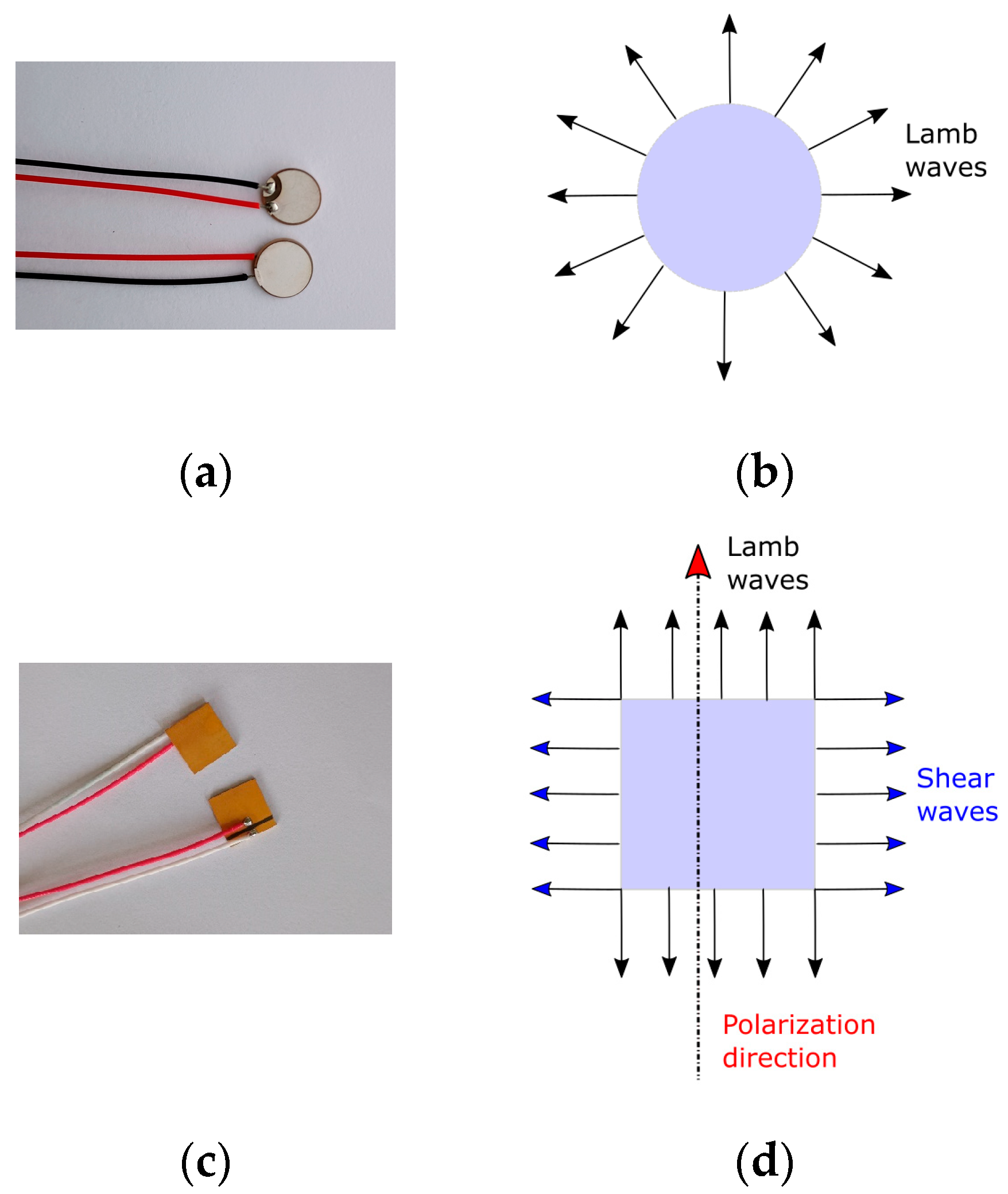
11] with radial vibrational mode generate Lamb waves omnidirectionally, whereas shear sensors manufactured by PiezoNova (Prague, Czech Republic) [
12] generate Lamb waves in the ceramic polarization direction and shear waves in the perpendicular direction. The schematics are depicted in
Figure 1. However, these characteristics are valid for the surface-mounted sensors.
2.2. Configurations
The objective of several test configurations was to determine the suitable sensor position within the layup and to determine the guided wave mode and frequency sensitive to impact damage. Both types of PZT sensors were integrated in the midplane of the structure thickness (between the 6th and 7th layer) under the last layer (between the 11th and 12th layer), and for comparison, the surface-mounted sensors were exploited.
2.3. Imaging Algorithm for Damage Detection
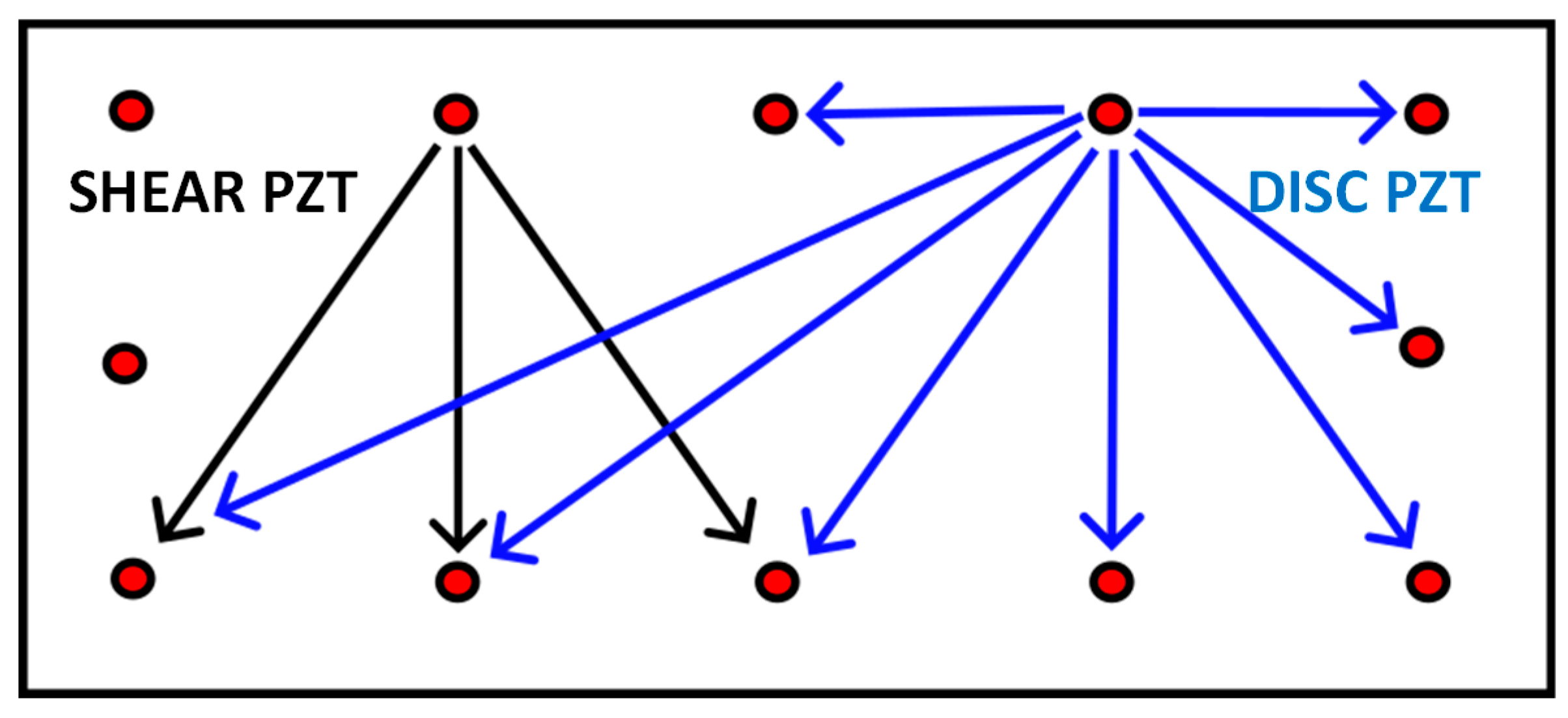
The RAPID algorithm was used for damage imaging. This algorithm utilizes information from all meaningful actuator–sensor paths. For disk sensors, these paths are all combinations except the borderlines. Bi-directional generation of Lamb/shear waves using shear sensors leads to a significant reduction in the number of usable actuator–sensor paths. Directivity is given by the relation of sensor dimensions and wavelength of the generated waves [
13]. The situation is indicated in
Figure 2. The specific steps of signal processing are described in our previous work [
14].
3. Preliminary Measurements
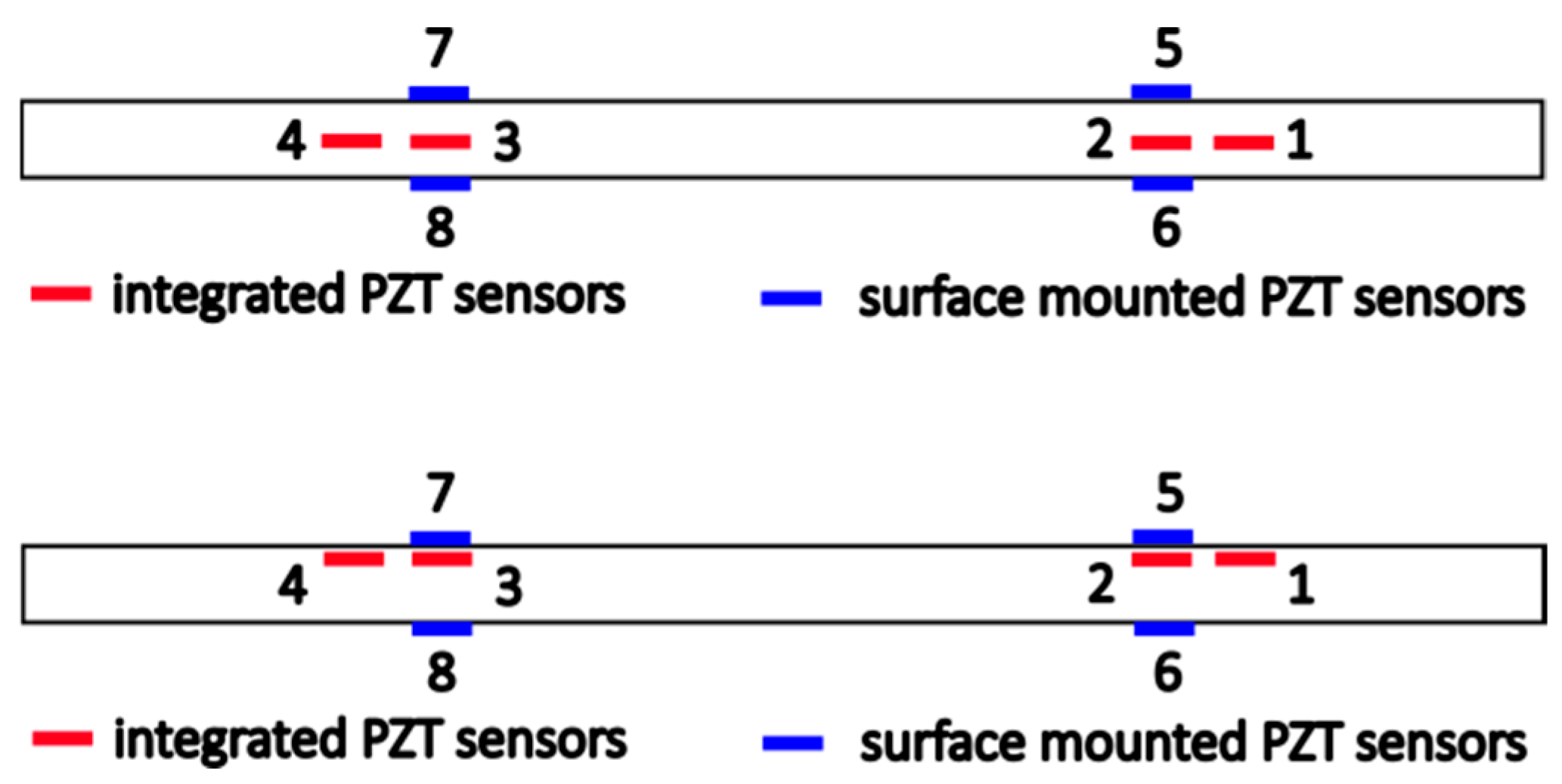
Large plates with dimensions of 680 × 350 mm were used for preliminary measurements. Eight PZT sensors in total were used for evaluation—four sensors were integrated, and four sensors were mounted on the surface for comparison. The sensors were placed in the central line of the plate, further from the edges, to eliminate the wave reflections. The schematic of the cross-section can be seen in
Figure 3. Sensors mounted on the surface were placed symmetrically on both sides of the plate to enable identification of the specific mode. In-phase wavepackets indicate symmetrical mode, while wavepackets with a phase difference of 180 degrees indicate asymmetrical mode.
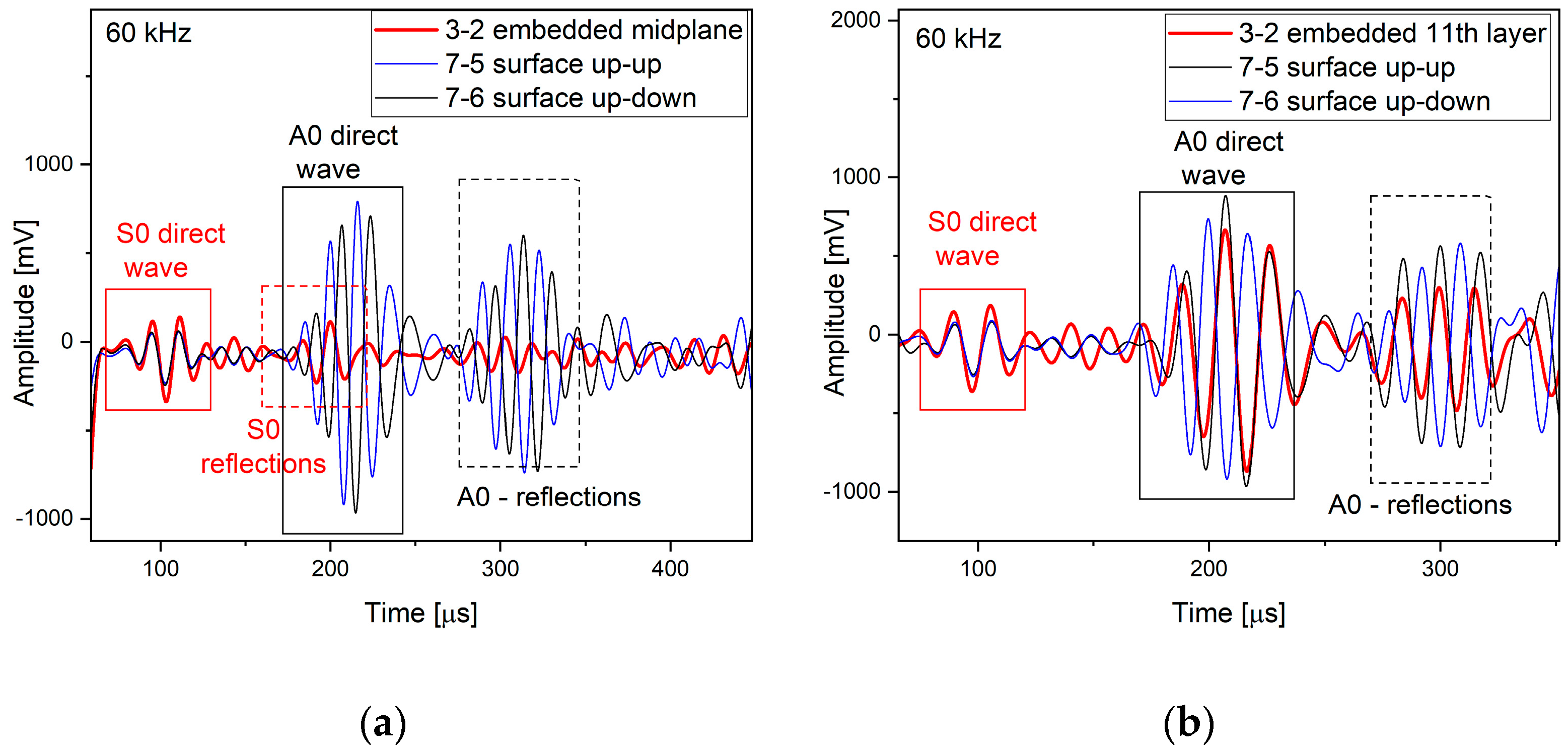
These analyses showed that PZT disk sensors embedded in the midplane of the structure (between the 6th and 7th layer) do not generate or detect the asymmetrical mode (
Figure 4a). This configuration exhibits selective S0 mode generation. Both A0 and S0 modes are generated by sensors integrated between the 11th and the 12th layer, as seen in
Figure 4b. Generation and sensing of Lamb waves is similar to the surface-mounted configuration. Lamb wave frequency tuning is utilized to define the frequency range where the A0 mode is dominantly generated.
Integrated shear sensors exhibit different vibrational behavior due to the shear-type deformation. Integration in the midplane of the structure and utilization of an actuator–sensor layout in the polarization direction ensures selective A0 propagation. At the same time, propagation of other modes (S0, SH0) is eliminated. In comparison, Lamb waves and shear waves propagate perpendicularly using the surface-mounted actuator. Therefore, sensor data are difficult to analyze since the shear wave is mixed with reflected Lamb waves.
Preliminary measurements also included impact damage induced between the sensors, and the sensitivity of the A0 mode was confirmed. For the following test campaign, disk sensors integrated between the 11th and the 12th layer and shear sensors integrated in the midplane were chosen. The suitable frequencies for A0 mode actuation were identified as follows: 30–90 kHz for disk sensors and 60 kHz for shear sensors.
4. Results
4.1. Test Campaign
Large plates with dimensions of 680 × 350 mm were used for the impact damage test campaign. The first configuration included 12 PZT disk sensors integrated between the 11th and the 12th layer. In the second configuration, 12 PZT shear sensors were integrated in the midplane (between the 6th and 7th layer) in a precise orientation, enabling Lamb wave generation and detection. Each plate was subjected to 13 impact damages with the energy of 10 J. Locations of impacts were identical for both plates.
Impact damage imaging was performed using RAPID. Pseudo-images were created for each impact separately, analyzing data before and after the specific impact. All actuator–sensor paths were exploited for evaluation using disk sensors, while a reduced number of actuator–sensor paths were used for the plate with shear sensors due to the generation directivity. Frequencies in the range of 30–90 kHz with a step of 10 kHz were included in the RAPID for the disk sensor configuration. At these frequencies, the high-amplitude A0 mode propagates dominantly. This so-called multifrequency approach presented in [
14] was utilized since information based on multiple frequencies improves the reliability of the detection method. However, for the shear sensors, measurements only around the frequency of 60 kHz were suitable for evaluation.
4.2. Comparative Impact Damage Detection
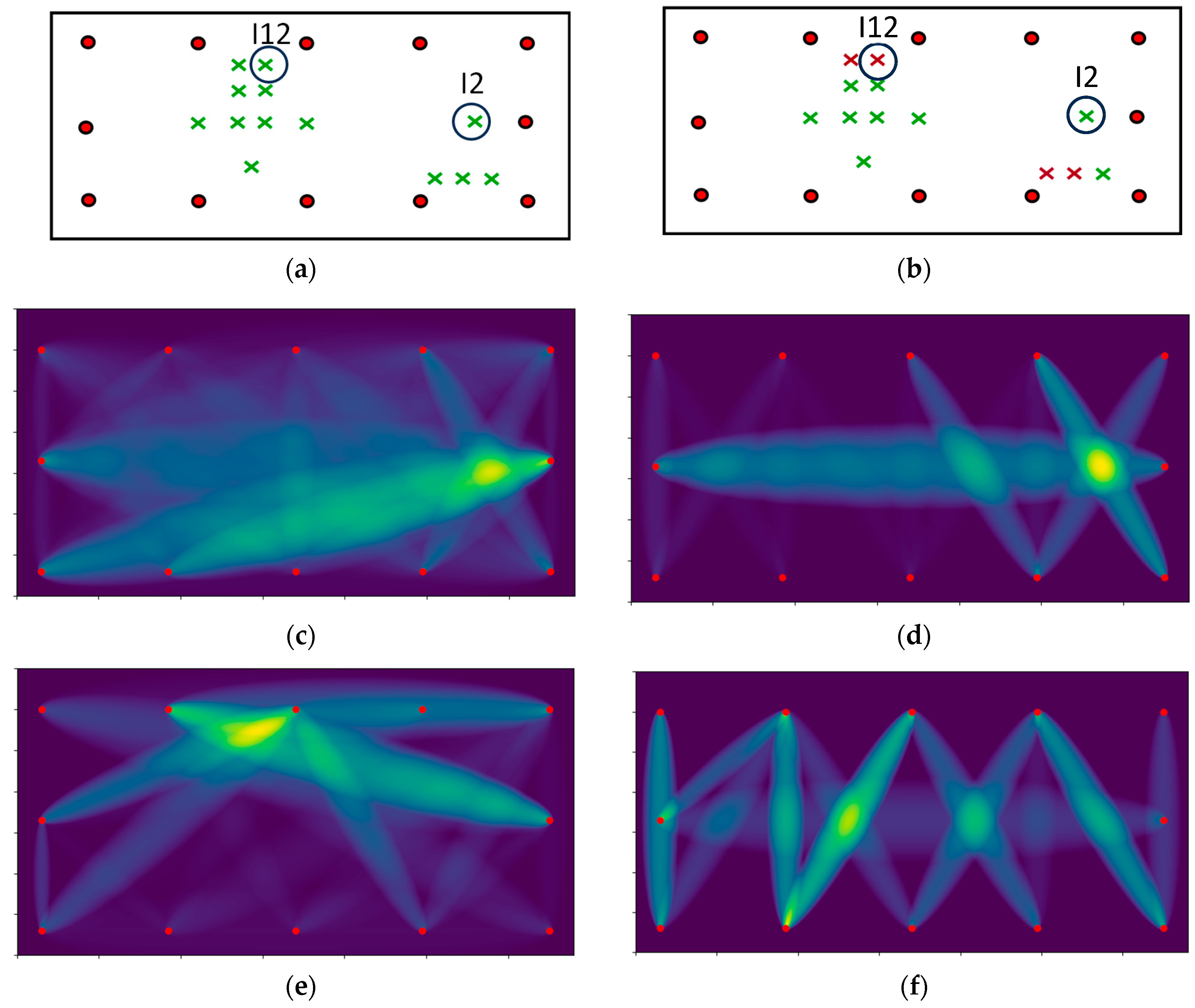
All 13 impact damages were successfully detected for the disk sensor configuration, while only 9 impact damages were detected using the shear sensor configuration. Graphical visualization of locations of impacts and detectability is shown in
Figure 5a,b for disk and shear sensors, respectively. An example of the image of impact located on the central axis is shown in
Figure 5c,d. An example of the image located in the vicinity of the sensors near the edge of the plate is shown in
Figure 5e,f.
5. Discussion
The purpose of this paper is to verify the suitability of the integration of disc and shear sensors into the composite structure for impact damage detection, with the focus on the selective actuation of A0 mode. The methodology for impact damage assessment presented in [
14] is utilized. Particular attention is paid to the determination of which layers the sensors are embedded in, since integrated PZT sensors show different actuation characteristics compared to the surface-mounted ones. It was experimentally proved that disc sensors integrated in the midplane do not generate the asymmetrical mode. The most suitable configuration is integration under the last layer. Generation and sensing of Lamb waves is similar to the surface-mounted sensor configuration, and Lamb wave frequency tuning is utilized for dominant A0 generation. Impact damage detection is considered as successful as with a surface-mounted configuration.
Shear sensors mounted on the surface exhibit both Lamb wave mode propagation in the polarization direction and shear wave propagation in the perpendicular direction. Different propagation velocities cause difficulties in data interpretation. If the actuator–sensor configuration is in the direction of Lamb wave propagation, the reflected SH0 mode is also detected, and vice versa. The solution is integration in the midplane of the structure thickness, where the A0 mode is selectively actuated in the polarization direction. Impact damage detection ability is reduced due to the reduced number of actuator–sensor paths caused by the actuation directivity of shear sensors.
After selecting the suitable layer for integration and actuation frequency, the test specimens were subjected to the impact damage test campaign. All 13 impact damages were detected successfully by disc sensors, while only 9 impact damages were detected successfully by shear sensors. All four incorrectly localized impact damages were located near the plate edge and thus near the sensors. The limited number of actuator–sensor paths and the actuation directivity of shear sensors prevent accurate damage localization.
6. Conclusions
This paper is focused on the sensor integration into the G/PMMA composite structure and its exploitation for impact damage detection. Based on the results, it can be concluded that disc sensors integrated under the last layer are suitable for impact damage detection in large plates. Shear sensors exhibit great potential for damage detection. Integration in the midplane enables selective actuation of the A0 mode, which is sensitive to impact damage detection. Due to the directivity of the wave generation, the applicability for large plates is limited, and the reliability of the method is reduced. However, this approach can be successfully used for damage detection in structures with a geometry with one dominant dimension, where omnidirectional generation of disc sensors makes signal interpretation difficult.
It can be concluded that the integration layer and actuation frequency were determined for both types of sensors to actuate the A0 mode dominantly. Also, the suitable type of structure was identified for both sensors. The next stage of our research will be focused on damage detection in such structures, where shear sensors will prove the advantage over the disk sensors. The topic of wiring technologies and overall influence on the mechanical properties of the host structure will be of interest.
Author Contributions
Signal processing, data evaluation, writing—original draft preparation, L.Š.; measurement, data evaluation, writing—review and editing, O.V.; manufacturing, writing—review and editing, M.K. All authors have read and agreed to the published version of the manuscript.
Funding
This research was funded by the Ministry of Industry and Trade of the Czech Republic in the DKRVO program dedicated to the development of research organizations.
Institutional Review Board Statement
Not applicable.
Informed Consent Statement
Not applicable.
Data Availability Statement
The data presented in this study are available on request from the corresponding author due to privacy reasons.
Conflicts of Interest
The authors declare no conflicts of interest.
Abbreviations
The following abbreviations are used in this manuscript:
| PZT | Lead Zirconate Titanate |
| G/PMMA | Glass/Polymethylene Methacrylate |
| RAPID | Reconstruction Algorithm for Probabilistic Identification of Damage |
| SHM | Structural Health Monitoring |
| UGW | Ultrasonic Guided Waves |
References
- Giurgiutiu, V. Introduction. In Structural Health Monitoring with Piezoelectric Wafer Active Sensors; Academic Press: Cambridge, MA, USA, 2014; pp. 1–19. [Google Scholar] [CrossRef][Green Version]
- Lammering, R.; Duczek, S.; Gabbert, U. Motivation. In Lamb-Wave Based Structural Health Monitoring in Polymer Composites; Springer: Cham, Switherland, 2017; pp. 3–9. [Google Scholar] [CrossRef]
- Rauter, N.; Hennings, B.; Neumann, M.N.; Asmus, A.; Lammering, R. Wave Propagation in Elastic Solids: An Analytical Approach. In Lamb-Wave Based Structural Health Monitoring in Polymer Composites; Springer: Cham, Switherland, 2017; pp. 17–62. [Google Scholar] [CrossRef]
- Tuloup, C.; Harizi, W.; Aboura, Z.; Meyer, Y.; Khellil, K.; Lachat, R. On the manufacturing, integration, and wiring techniques of in situ piezoelectric devices for the manufacturing and structural health monitoring of polymer–matrix composites: A literature review. J. Intell. Mater. Syst. Struct. 2019, 30, 2351–2381. [Google Scholar] [CrossRef]
- Tuloup, C.; Harizi, W.; Aboura, Z.; Meyer, Y.; Khellil, K.; Lachat, R. On the use of in-situ piezoelectric sensors for the manufacturing and structural health monitoring of polymer-matrix composites: A literature review. Compos. Struct. 2019, 215, 127–149. [Google Scholar] [CrossRef]
- Dziendzikowski, M.; Kurnyta, A.; Dragan, K.; Klysz, S.; Leski, A. In situ Barely Visible Impact Damage detection and localization for composite structures using surface mounted and embedded PZT transducers: A comparative study. Mech. Syst. Signal Process. 2016, 78, 91–106. [Google Scholar] [CrossRef]
- Feng, T.; Aliabadi, M.F. Influence of Placing Positions of PZT Transducers in Thick Composites on Ultrasonic Guided Waves. Preprints 2023, 2023071495. [Google Scholar] [CrossRef]
- Yang, B.; Xuan, F.-Z.; Jin, P.; Hu, C.; Xiao, B.; Li, D.; Xiang, Y.; Lei, H. Damage Localization in Composite Laminates by Building in PZT Wafer Transducers: A Comparative Study with Surface-Bonded PZT Strategy. Adv. Eng. Mater. 2018, 21, 1801040. [Google Scholar] [CrossRef]
- Altammar, H.; Dhingra, A.; Salowitz, N. Damage Detection Using d15 Piezoelectric Sensors in a Laminate Beam Undergoing Three-Point Bending. Actuators 2019, 8, 70. [Google Scholar] [CrossRef]
- Meng, Y.; Chen, G.; Huang, M. Piezoelectric Materials: Properties, Advancements, and Design Strategies for High-Temperature Applications. Nanomaterials 2022, 12, 1171. [Google Scholar] [CrossRef] [PubMed]
- StemInc. Available online: https://www.steminc.com/PZT/en/piezo-7x-02mm-wire-lead-300-khz (accessed on 10 September 2025).
- PiezoNova. Available online: https://www.piezonova.com/piezo-elements/ (accessed on 10 September 2025).
- Boivin, G.; Viens, M.; Belanger, P. Plane Wave SH0 Piezoceramic Transduction Optimized Using Geometrical Parameters. Sensors 2018, 18, 542. [Google Scholar] [CrossRef] [PubMed]
- Šedek, J.; Šedková, L.; Vích, O. Frequency-integral method for impact damage detection in carbon fibre reinforced thermoplastic composites by Lamb waves. Ultrasonics 2025, 154, 107697. [Google Scholar] [CrossRef] [PubMed]
| Disclaimer/Publisher’s Note: The statements, opinions and data contained in all publications are solely those of the individual author(s) and contributor(s) and not of MDPI and/or the editor(s). MDPI and/or the editor(s) disclaim responsibility for any injury to people or property resulting from any ideas, methods, instructions or products referred to in the content. |
© 2026 by the authors. Licensee MDPI, Basel, Switzerland. This article is an open access article distributed under the terms and conditions of the Creative Commons Attribution (CC BY) license (https://creativecommons.org/licenses/by/4.0/).