1. Introduction
In modern aircraft design, proactively managing fatigue to prevent delamination is essential to ensuring structural integrity and safety [
1]. Central to this approach is the damage tolerance framework, which evaluates a structure’s ability to endure defects, such as delamination, without compromising performance. However, damage tolerance assessment is highly complex, with the simulation of fatigue-induced delamination of carbon-fibre reinforced polymer (CFRP) laminates posing a particularly challenging task that relies on sophisticated numerical methods.
Since laminated composite materials are increasingly used in aircraft structures, experimental results are needed for different element configurations, such as corners, with varying stacking sequences and thicknesses [
2]. Several modelling approaches have been developed to accurately capture their interlaminar behaviour [
3]. Together, these procedures highlight the importance of characterizing and integrating detailed material modelling for reliable composite structural analysis.
The use of fracture mechanics-based methods, relying on the strain energy release rate (
) to study delamination propagation in composites, has become standard practice [
4]. Therefore, some method must be used to obtain
—for instance, finite element method (FEM)-based models. The most used FEM procedure is the virtual crack closure technique (VCCT) [
5] based on linear elastic fracture mechanics (LEFM).
To reduce the reliance on experimental testing at the component or element level, numerous research efforts have focused on developing simulation models at the coupon scale, including those that account for mixed-mode fracture conditions [
6,
7]. Although these models are extensively validated through experimental campaigns, they often fail to fully capture delamination phenomena occurring in structural regions exposed to out-of-plane loading, such as corners bending, which induces interlaminar stresses and promotes mixed-mode delamination. As a result, modelling delamination behaviour at the element level remains necessary and must be complemented by experiments. Despite extensive research on composites, significant gaps remain in the accurate delamination simulation, particularly under complex loading conditions. Moreover, fatigue-driven delamination under non-constant mixed-mode conditions usually requires custom implementation in commercial FEM software, as built-in tools often lack the necessary capabilities.
This paper presents the simulation framework developed to investigate fatigue delamination behaviour under non-constant mixed-mode conditions. For that, the fatigue delamination growth is based on a Paris’ law [
8] variant in terms of the strain energy release rate. The non-monotonic model integrating the effect to mode mix is implemented as a user-defined subroutine, UMIXMODEFATIGUE, for Abaqus, taking advantage of the mode separation provided by VCCT. The methodology is validated at element level using an experimental delamination case, caused by the unfolding of a corner composite laminate. This scenario is reproduced through a four-point bending test applied to an L-shaped CFRP curved beam specimen with a unidirectional layup, incorporating a non-adhesive Teflon foil insert to initiate delamination. The present methodology is significant since it enables the simulation of fatigue-driven delamination propagation under varying mixed-mode conditions. Damage tolerance research for composites components susceptible to mixed-mode fatigue delamination can benefit from the methods provided.
2. Fatigue Delamination Growth Methodology
To predict delamination growth under fatigue, it is considered that the propagation follows a power law relationship, commonly referred to as Paris–Erdogan-based expression. The general form of the Paris equation, expressed in terms of the
as shown in Equation (1), serves as the foundation for fracture mechanics-based delamination growth.
where
is the delamination propagation rate,
is the number of applied cycles,
is the delamination length,
is the function of strain energy release rate
, and
and
are material empirically derived constants. For a more detailed description refer to [
9].
2.1. Fatigue Delamination Under Non-Constant Mixed-Mode
To model fatigue delamination under non-constant mixed-mode conditions, i.e., varying mode mixity, the fatigue delamination rate can be generalized to account for the mode mix. The exponent, , and coefficient, , can be considered mode-dependent parameters determined by a non-monotonic model with respect to the mode mix.
Non-monotonic behaviour refers to a change that does not occur in a single, consistent direction. The values do not simply increase or decrease but may rise initially, then fall, or exhibit other complex trends. For this non-monotonic variation, generalised expressions with experimentally adjusted factors are used [
10]. A set of parabolic equations is used to model the propagation parameters
and
as shown in Equations (2) and (3).
Considering pure mode I, it is found that
and
. Including the mode II and mixed-mode parameters, the parabolic equations become Equations (4) and (5).
where
and
are the Paris coefficient and exponent for the local mode-mixity
,
and
are the Paris coefficients for pure mode I and mode II, respectively,
and
are the Paris exponents for pure mode I and mode II, respectively, and
and
are the extra mixed-mode parameters that must be determined by curve fitting. The delamination propagation rate for a given load ratio
is expressed in Equation (6).
where the exponent,
, and coefficient,
, are mode-dependent parameters determined as explained.
is the energy release rate threshold below which no propagation occurs, also known as fatigue threshold or
lower limit, and
is the upper limit, critical equivalent strain energy release rate, or fracture toughness, above which propagation will grow at an accelerated rate. The delamination propagation rate is bounded by these limits.
In addition, a variation of
and
depending on the local mode mix can be introduced. Analogous to Benzeggagh–Kenane expressions [
11], a function depending on the mode mix can be formulated.
dependence with the mode mixity is assumed to follow a Benzeggagh–Kenane-based expression as in Equation (7).
where subscripts
and
denote the pure mode I and II threshold values, respectively, and
is an experimentally determined mode interaction parameter. If mode-mixity data for
is not available, mode interpolation cannot be performed, as this data is required to determine the mode interaction parameter
. Instead, a linear interpolation can be used, where
is interpolated between given pure mode values of
.
In the case of the critical equivalent strain energy release rate
, or
upper limit, the same considerations as in static apply, as presented in Equation (8).
The strength of the presented fatigue methodology lies in the fact that, since it uses a phenomenological delamination growth rate, any experimental data on the effects of load ratio and/or mode mixity can be easily incorporated into the simulation, provided that the method used for characterizing the load can compute and mode mixity .
2.2. Implementation of the Non-Monotonic Model in UMIXMODEFATIGUE
The formulation described in the previous section is implemented as a user-defined subroutine in the commercial finite element code Abaqus. The Fortran user subroutine UMIXMODEFATIGUE can be used to specify a user-defined fatigue delamination propagation rate, enhancing the software’s capabilities in predicting complex fatigue behaviour. UMIXMODEFATIGUE can be used in conjunction with the VCCT, which determines the energy release rates, , to simulate fatigue delamination propagation. It can be defined in strain energy release rate-based form as presented in Equation (1).
To implement and use the UMIXMODEFATIGUE, the following steps are followed:
Definition of the fatigue delamination growth model within the subroutine.
Specification of parameters such as material empirically derived constants.
Integration of the subroutine with the main Abaqus simulation.
The main aim of the subroutine is to compute the fatigue delamination growth rate, , based on the material data, load ratio, and mode mixity for the relevant node in the delamination front. This is the key element, and the outcome of the fatigue formulation described. The computed delamination growth rate variable is then returned to the Abaqus solver for further analysis and simulation.
The mode mix ratio can be determined using the values of the fracture mechanics parameters
, which represent the maximum and minimum values of strain energy release rate for the opening mode, sliding mode, and tearing mode, respectively. It indicates the relative contribution of the shear modes compared to the total crack driving force. These variables provide the mode separation necessary for applying a mixed-mode fatigue law. They enable the characterization of the load ratio
and the mode mixity
. Therefore, they make possible the implementation of the fatigue formulation approach described in this work to compute the fatigue delamination growth rate,
. The subroutine computation process integrated in the Abaqus simulation is presented in
Figure 1.
2.3. Finite Element Modelling Overview
To calculate , FEMs based on the Virtual Crack Closure Technique (VCCT), which provides mode separation, are employed. This technique is particularly suitable for problems involving brittle crack propagation along predefined paths and surfaces. The VCCT is implemented in the general-purpose finite element software Abaqus.
Starting with a FEM configuration that includes a delamination, its propagation is modelled by releasing node pairs at the crack front. The propagation begins when a specific fracture mechanics criterion is met.
In VCCT analyses, the delamination plane is modelled using the crack propagation feature in Abaqus, which is based on the contact pair capability. No additional element definitions are needed, and the original mesh remains unchanged. The delamination plane is modelled as a discrete discontinuity at the centre of the specimen. To introduce this discontinuity, the models are constructed from separate meshes for the upper and lower sub-laminates adjacent to the delamination plane, ensuring that the nodal coordinates in the delamination plane are identical. Two surfaces are defined to identify the contact area in the delamination plane, the top surface of the lower sub-laminate and the bottom of the upper sub-laminate. These surfaces are the main and secondary contact surfaces, respectively. Additionally, a node set is created to define the intact region, consisting of the bonded nodes in the secondary surface, that is, in the bottom of the upper sub-laminate. A general delamination front, the surfaces of the contact, the intact region of bonded nodes, and the element length at the delamination tip,
, are shown in
Figure 2.
3. Case Study Results and Discussion
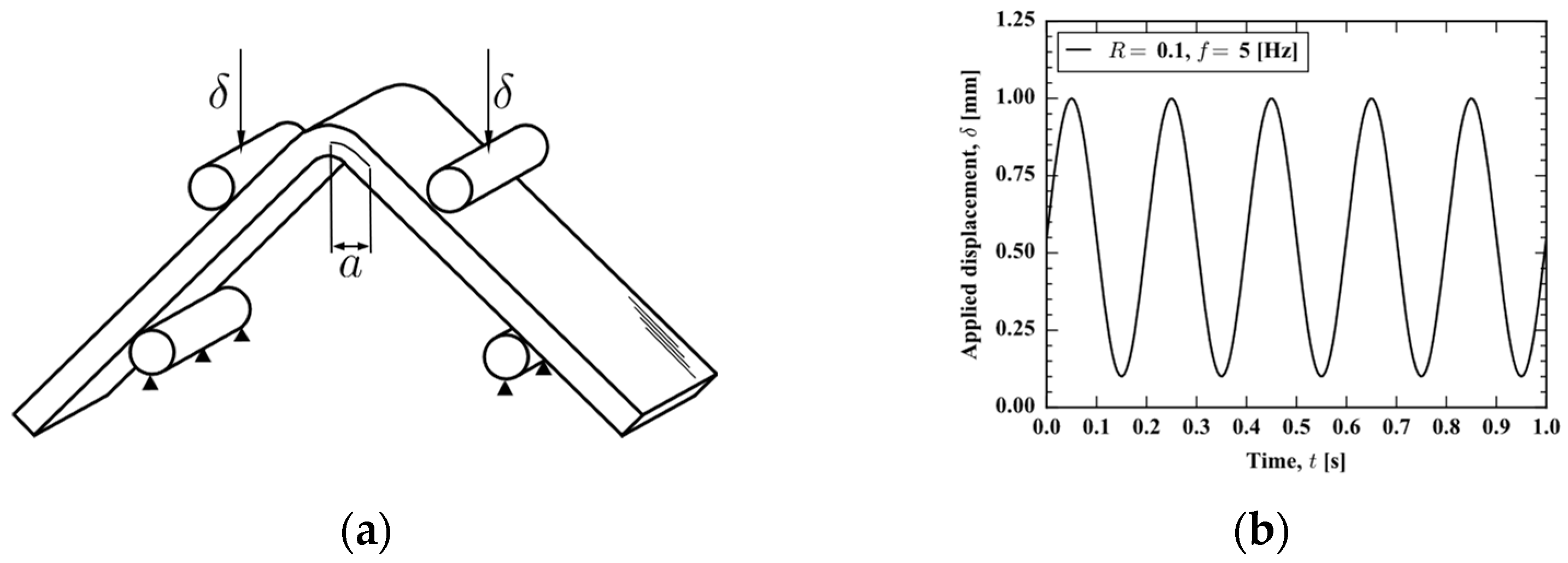
The L-angle specimen for the mixed-mode I/II fatigue tests, as shown in
Figure 3a, consists of two straight legs connected by a 90° bend with a 10.0 mm inner radius. It is a uniformly thick, unidirectional laminated composite with a non-adhesive Teflon foil insert at the midplane, serving as a delamination initiator. The L-angle specimens are designed according to the standard ASTM D6415-99. Differing from the standard configuration, the proposed test campaign introduces a non-adhesive Teflon foil insert at the bend, placed within the mid-plane layers, representing a manufacturing defect. The Teflon foil is 15 mm long and is placed off-centre, with one end at the centre of the bend and the other extending towards one of the legs. The specimen has a width of 25.0 mm, a thickness of 3.66 mm, and leg lengths of 100 mm.
The material considered is a unidirectional (UD) prepreg, Hexply™ M21/34%/UD194/IMA-12k, manufactured by Hexcel, with IMA carbon fibres as reinforcement, embedded in an M21 epoxy resin matrix. This material is used for certain parts of the Airbus A350 and provided by AERNNOVA as representative material. The stacking consists of 20 UD plies, and a thin Teflon insert on the midplane [(0)10/T/(0)10].
The curved beam specimens are loaded in four-point bending (4PB) to apply a constant bending moment across the curved section. This loading induces mode I interlaminar tension and mode II interlaminar sliding shear, leading to delamination propagation.
The boundary conditions for testing the L-angle specimens under mixed mode I/II fatigue loading are depicted in
Figure 3a and involve applying a cyclic displacement
to the upper rollers, as illustrated in
Figure 3b, while fixing the lower rollers. As a result, the specimens undergo flexural opening. The fatigue 4PB tests are performed under displacement control, with a maximum displacement of 1 mm at a frequency of 5 Hz following a sinusoidal waveform, and a displacement ratio
of 0.1.
The reaction load and the delamination length are recorded continuously, synchronized with the applied displacement values . The number of applied cycles is also recorded. The load is measured by a load cell, the delamination length is measured via Digital Image Correlation (DIC), and the displacement is measured redundantly, both through the crosshead and using DIC, to avoid errors from kinematic chain differences.
The following examines the FEM simulation of the delamination propagation in fatigue loading under non-constant mixed-mode conditions on the L-angle specimen. For the arithmetic-based
variant, the values of the factor
, exponent
and the additional mixed-mode interpolation parameters,
,
, used in the non-monotonic fatigue model are obtained from experimental tests conducted at ITA and summarized in
Table 1.
The initial delamination front shape
equal to 490 cycles, along with three different delamination propagation stages, 22,511, 108,731 and 300,000 cycles, are shown in
Figure 4. The initial delamination is included in all of them to ease interpretation.
The fatigue delamination propagation simulation yields a computed delamination front shape that is representative of the actual failure. In the contours, the delaminated section is shown in blue, the intact section in red, and the green transition between them indicates the location of the delamination front. Starting from the two initial straight delamination fronts formed at the edges of the Teflon insert, the delamination occurs only at the front in the centre of the bend. It starts to grow at the specimen’s centre and then extends toward the edges, spreading almost uniformly across the width. The front is slightly jagged, suggesting that growth occurs in one location, stops, and then continues at another across the width. On average, however, the front remains approximately straight. This overall behaviour results from a combination of the thumbnail-shaped front observed in double cantilever beam (DCB) fatigue tests for mode I, and the jagged front seen in End-Notched Flexure (ENF) fatigue tests for mode II, as delamination propagates in mixed mode in this case. The fracture surfaces of the test specimens will be analysed and compared with the simulation results after being pried open.
The maximum and minimum force-cycles and the delamination-N curves provided by the experiment (Exp.) and by the finite element model (FEM), as well as the maximum strain energy release rates
curves from the FEM, are compared in
Figure 5. Recall that the test was in displacement control, with
equal to 1 mm.
In the max. and min. force–cycles curve, there is a decrease in both due to delamination growth during cycling with constant displacement. In the delamination length–cycles curve, the measurements are taken from the initial straight crack front at the centre of the bend. From this point, it can be observed that the delamination length grows steadily up to the end of the test. The crack growth predictions show close correspondence with the experimental results. The error in the simulation is less than 14% at every crack depth, fluctuating because of the staircase experimental shape. In the maximum strain energy release rates–cycles curves obtained numerically, decreases steadily from the initial point, as the force decreases and the delamination length increases, as shown. , increases from the initial point, but it soon stabilizes and remains almost constant. Regarding the equivalent energy release rate at maximum load, , which is the sum of and , it decreases steadily from the initial point, initially due to the dominant contribution of , and later because the rate of decrease of exceeds the rate of increase of . Consequently, this test configuration, under displacement control, naturally tends to arrest delamination growth by inducing a decreasing , leading to a reduction in over time, i.e., over cycles. The energy release rate is higher at the beginning of the tests compared to the final stages, and the same holds true for .
The model validation objective for the varying mode mix 4PB on L-angle under fatigue loading is achieved, with the implemented non-monotonic model successfully reproducing the intended variation in a non-monotonic manner as the mixed-mode ratio changes.



 ,
,