

Proceeding Paper

Design of Novel HS/HC/HT Twitch Aluminum Alloys †
by
Maria-Ioanna T. Tzini
* and
Gregory B. Olson
Department of Materials Science and Engineering, Massachusetts Institute of Technology, Cambridge, MA 02139, USA
*
Author to whom correspondence should be addressed.
Presented at the 8th International Conference of Engineering Against Failure (ICEAF VIII), Kalamata, Greece, 22–25 June 2025.
Eng. Proc. 2025, 119(1), 28; https://doi.org/10.3390/engproc2025119028
Published: 18 December 2025
(This article belongs to the Proceedings of The 8th International Conference of Engineering Against Failure)

Abstract

The design of novel high-strength (HS), high-electrical-conductivity (HC) and high-thermostability (HT) aluminum alloys is presented utilizing recycled automotive aluminum twitch for cable conductor applications. Calculation of phase diagrams (CALPHAD)-based tools are employed for the design, with key objectives being the enhancement of electrical conductivity through the complete gettering of impurity elements and the optimization of precipitation strengthening through the promotion of Q phase and the suppression of Si phase. The experimental data suggests that thermodynamic equilibrium conditions have not been reached yet under the tested annealing conditions, and models show that Si has the largest impact on electrical resistivity sensitivity.

1. Introduction

Recycling aluminum alloys represents one of the most effective strategies for reducing the carbon footprint of automotive aluminum products, as it requires significantly less energy compared to primary production from raw materials. End-of-life vehicles serve as a major source of recyclable aluminum, which is typically recovered through shredding and sorting processes. The fragmented aluminum obtained, known as “twitch,” often contains high levels of silicon (Si) and iron (Fe) impurities [1]. The advanced techniques required to refine and purify this scrap are costly, limiting its use. As a result, most aluminum twitch is currently utilized in secondary castings, primarily for internal combustion engine powertrain components. However, the growing demand for sustainable materials is driving the need for high-performance alloys capable of incorporating greater proportions of recycled content. A promising solution lies in the development of novel aluminum alloys specifically engineered to tolerate high levels of twitch while maintaining the mechanical performance required for high-volume applications.
In parallel, the U.S. electricity delivery system is undergoing a significant transformation as grid reliability and resilience become increasingly critical in the face of emerging threats such as extreme weather events. At the same time, state and local policies are driving greater integration of renewable energy and distributed energy resources. To meet the demands of a more reliable and secure future grid, advancements in the materials used to transport electricity are essential. Aluminum remains the primary material for overhead transmission lines due to its high conductivity, lightweight nature, and cost-effectiveness. The most commonly used aluminum-based conductor is the steel-reinforced aluminum conductor (ACSR), while high-temperature conductors include the composite-core aluminum conductor (ACCC), the composite-reinforced aluminum conductor (ACCR), and the steel-supported aluminum conductor (ACSS) [2]. The target properties of aluminum-based conductors are high strength, high electrical conductivity, high strength thermostability, and low sag levels. The ACCR conductors, consisting of layers of an aluminum-reinforced oxide matrix core with coarsening resistant Al-Zr alloy outer strands, present the best balance across all target properties. The Al-Zr outer strands exhibit an ultimate tensile strength (UTS) of 158–179 MPa and an electrical conductivity of 60% IACS at 20 °C. Therefore, aluminum alloys with better properties than the Al-Zr strands are sought.
Automotive twitch aluminum contains a high number of impurity elements such as Fe, Si, Mg, Cu, Mn, and Zn. Due to the low solubility of Fe and Si in aluminum, conventional solidification processes typically result in the formation of Al-Fe-Si intermetallic phases and Si-rich particles, which can degrade mechanical and electrical properties. To suppress the formation of coarse eutectic phases rich in Fe and Si during solidification, rapid solidification techniques, such as melt spinning, are considered promising alternatives. Melt spinning [3] achieves extremely high cooling rates on the order of 105–107 °C/s, enabling the formation of a refined microstructure (~1 μm) with nanoscale dispersoids and a supersaturated solid solution. Subsequent heat treatment and aging after rapid solidification in the temperature range of 250–300 °C can promote the formation of a fine distribution of strengthening and grain-refining phases, such as the α-Al(FeMn)Si and β-AlFeSi phases. In Al-Mg-Si-Cu systems, the Q phase with a hexagonal structure, which has also been found in twitch compositions, has been reported to demonstrate an excellent combination of strength and coarsening resistance even after prolonged thermal exposure at 200 °C for up to 1000 h [4,5]. Therefore, to obtain the desired properties, the target is to suppress the phases during rapid solidification, maximize precipitation strengthening, and obtain a lean matrix to enhance electrical conductivity during aging.
The present study employs CALPHAD-based integrated computational materials engineering (ICME) tools for the design of an aluminum cable conductor for medium-to-long-distance transmission lines, with high strength, high electrical conductivity, and high thermostability utilizing aluminum automotive twitch via rapid solidification and high-temperature aging. The material design is based on a hierarchical system approach integrating the interrelation of processing, structure, properties, and performance. Thermodynamic calculations using CALPHAD databases are performed. The main design objectives are to maximize the electrical conductivity through complete gettering of the impurity elements and maximize the precipitation strengthening through the formation of the Q phase and the elimination of the Si phase. Three compositions that meet the requirements were selected, and aluminum specimens that utilize twitch were prepared via rapid solidification. Electrical resistivity measurements, using a four-point probe method, and microhardness measurements were carried out at room temperature.

2. Experimental Procedure

Aluminum alloys with the compositions given in Table 1 were cast in a wedge-shaped mold by Constellium. High solidification cooling rates, estimated to be in the range of 103–104 °C s−1, were achieved near the tip of the wedge. After casting, specimens were sectioned from regions close to the tip, with dimensions of 34 mm in length, 5 mm in width, and 5 mm in thickness. After casting, the specimens were annealed at 250 °C, 280 °C, and 300 °C for 7 days. The specimens’ surfaces were ground with 1200-grit silicon carbide paper, and electrical resistivity measurements at 20 °C were performed on the as-cast and annealed specimens using the 4-point probe method with a Keithley Microvolt Meter (Keithley Instruments, Cleveland, OH, USA). A current of 1 A was applied and the drop of the voltage was measured over a 20 mm distance between the inner probes. Vickers hardness (HV1 kg) measurements were also carried out on both as-cast and annealed specimens.

3. Computational Procedure

3.1. Thermodynamic Calculations

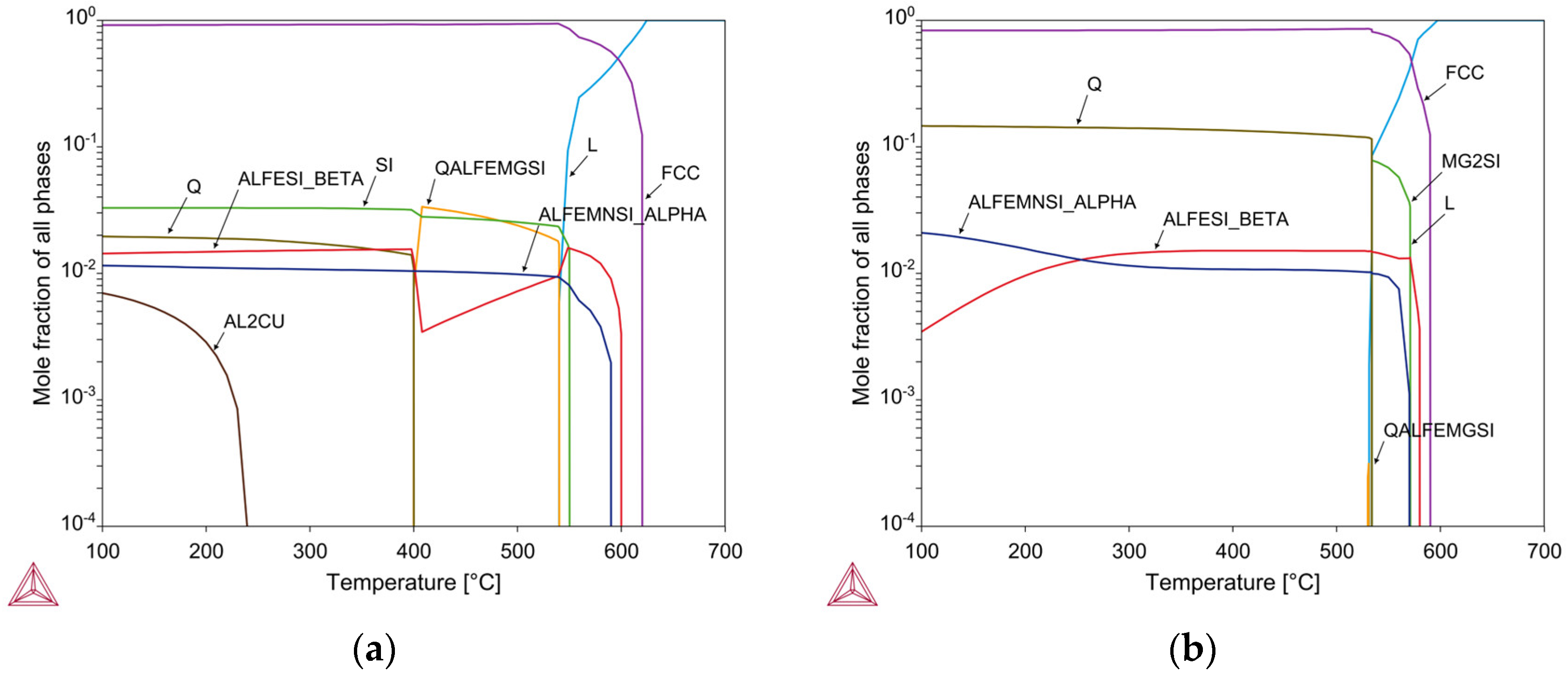
The main precipitation phases in aluminum alloys that utilize automotive twitch are the Q phase with stoichiometry Al4(Mg,Cu)3Mg8Si5.5 and the θ-Al2Cu, β-Mg2Si, and Si (diamond cubic) phases. In addition, intermetallic compounds such as the Al(Fe,Mn)Si-alpha and AlFeSi-beta phases, as well as the quaternary QAlFeMgS phase, are observed. The QAlFeMgS phase is also referred to as the π phase and has a stoichiometry of Al18Fe2Mg7Si10. The thermodynamic database QT2 for aluminum alloys is employed in the present study. This database provides a more accurate description of the Q phase, since it is based on atom probe tomography (APT) data reported by Bobel and coworkers [4,5]. A step diagram of the average twitch composition (Al-4.149Si-0.295Fe-0.79Mg-0.539Cu-0.125Mn-0.252Zn at%) using the QT2 database is given in Figure 1a.
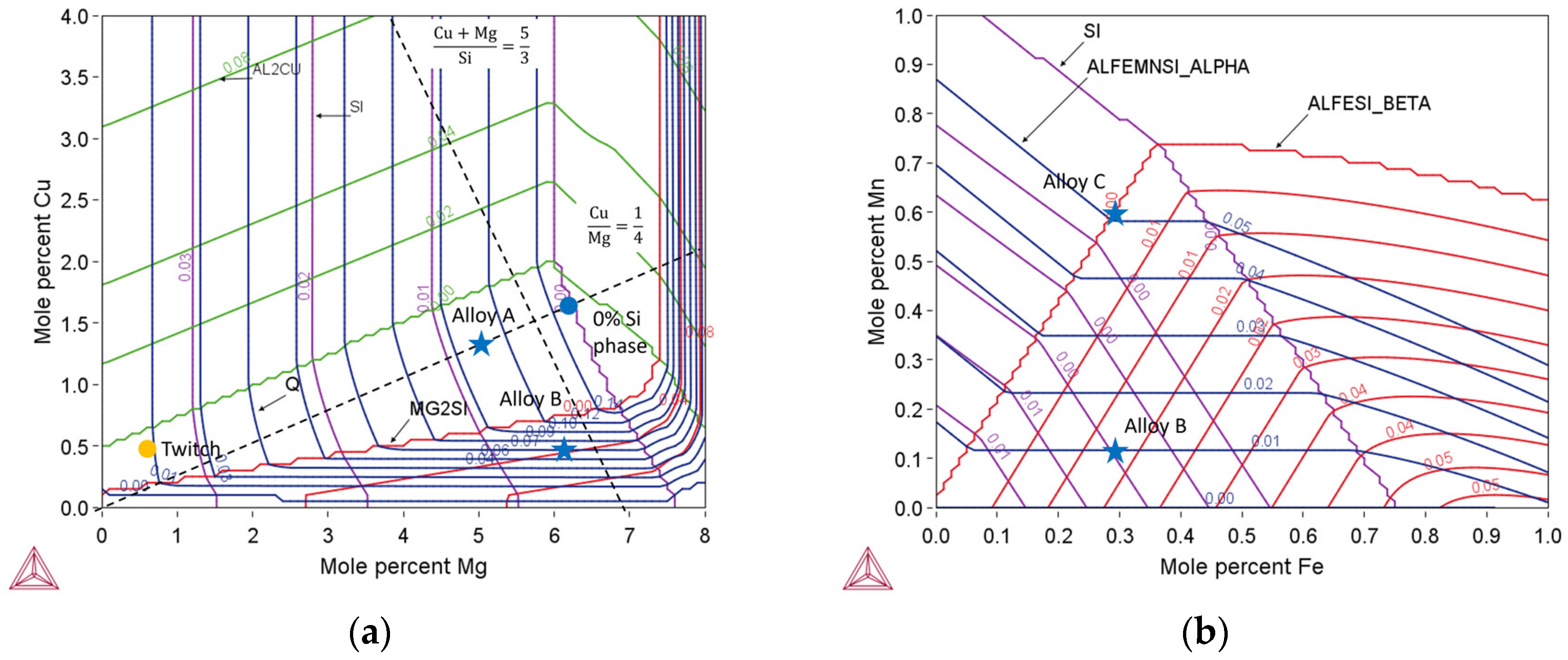
Thermodynamic equilibrium calculations are performed at 300 °C after assuming the complete suppression of all solidified phases due to rapid cooling. Keeping the twitch composition fixed at 300 °C and varying the Mg and Cu additions, the contour plot of the mole fraction of Q, θ-Al2Cu, β-Mg2Si, and Si (diamond cubic) is depicted in Figure 2a. Aiming to maximize the formation of the coarsening resistant Q phase during aging at 300 °C and suppress the formation of the detrimental Si (diamond cubic) phase, alloy “A” is selected with 5.0 at% Mg and 1.25 at% Cu. Note that alloy A follows a Cu/Mg ratio of 1/4, which is close to the stoichiometric ratio of the Q phase. To completely suppress the Si phase, the composition should be 6.3 at% Mg and 1.57 at% Cu, and a step diagram of this alloy is given in Figure 1b. In addition, for a fixed Cu content, such as a twitch composition of 0.53 at% Cu, alloy “B” with 6.3 at% Mg is selected to maximize the Q phase fraction while maintaining a low electrical resistivity, as shown in Figure 2a.
The Al(Fe,Mn)Si-alpha phase, due to its cubic structure and the presence of Mn, exhibits a lower coarsening rate compared to the monoclinic AlFeSi-beta phase, which is known to be more detrimental for ductility. Moreover, Mn addition enhances resistance to localized corrosion. Keeping the composition of alloy B fixed at 300 °C and varying the Fe and Mn additions, the contour plot of the mole fraction of the Al(Fe,Mn)Si-alpha, AlFeSi-beta, QAlFeMgSi, and Si phases is depicted in Figure 2b. It is observed that adding Mn helps transform the AlFeSi-beta phase into the more favorable Al(Fe,Mn)Si-alpha phase. Alloy “C”, with 0.29 at% Fe and 0.60 at% Mn, is selected.

3.2. Strengthening Model

The total yield strength σ y in the present study can be expressed as a linear superposition of the solid solution strengthening σ s s , grain boundary strengthening σ g b , and precipitation strengthening σ p p t , while work hardening σ d i s is not considered. The solid solution strengthening is given as
σ s s = M T i K i C s o l i n
where M T is the Taylor factor and is taken as equal to 3.06, C s o l i is the concentration of solute element i , while K i and n are constants. Based on literature values [6,7], the K i and n constants for the selected substitutional elements are K S i = 40   M P a   a t % 1 / 2 , n S i = 0.5 ,   K M g = 3.8   M P a   a t % 1 / 2 , n M g = 0.5 , K M n = 34.8   M P a   a t % 0.9 , n M n = 0.9 ,   K C u = 5.66   M P a   a t % 1 / 2 , n C u = 0.5 , K F e = 2.95   M P a   a t % 1 / 2 , n F e = 0.5 , K Z n = 3.09   M P a   a t % 1 / 2 , and n Z n = 0.066 .
This effect of grain boundary strengthening is captured in the Hall–Petch relation, in which the yield strength is
σ y = σ i + K y d 1 / 2
where σ i is the lattice resistance, K y is the Hall–Petch coefficient, representing the potential for grain boundary strengthening, and d is the mean grain diameter. In pure Al alloys, the lattice resistance is 16 MPa and the Hall–Petch coefficient is 0.07 MPa m1/2 [7]. A diameter of 2 μm was used in this study.
The increase in yield strength due to Orowan strengthening of multiple precipitates is described by
σ y = M T i = 1 n τ o i q 1 q  
where M T is the Taylor factor, τ o is the critically resolved shear stress increment in the phase i , n is the total number of precipitation strengthening phases that contribute to the Orowan strengthening, and q is the superposition exponent, which depends on the relative strength of the precipitates and takes values in the range of 1–2. A value of q = 2 is used in this study, indicating that all obstacles have similar strength [5]. According to Nie and Muddle [8], the critical resolved shear stress increment due to Orowan strengthening is given by
τ p = G b 2 π 1 v 1 λ p l n R r o
where G is the shear modulus of the aluminum matrix (26 GPa), b is the magnitude of the Burgers vector (0.286 nm), ν is Poisson’s ratio (1/3), λ p denotes the planar (center-to-center) spacing between obstacles in the slip plane, R and r o are the outer and inner cutoff radii for the calculation of the dislocation line tension. For a triangular array of spherical particles, the particle spacing is determined to be [8] λ p = 0.779 f 0.785 D s , where f is the volume fraction of the particles and D s is the diameter of the spherical particles. The inner cutoff radius is taken to be the magnitude of the Burgers vector, while the outer cutoff radius is taken as the harmonic mean [5] between the effective diameter D e f f of the precipitates and the particle spacing λ p , such that R = ( D e f f 1 + λ p 1 ) 1 , where D e f f = D s .
For rod-like particles with diameter D r and length L r , the particle spacing is given as λ p = 1.075 D r 0.433 π ( 1 D r L r ) 1 f 1.732 D r , while the effective diameter is D e f f = 1.732 D r . For plate-like particles with diameter D p and length T p , the particle spacing is given as λ p = 0.931 0.306 π D p T p 1 f π D p 8 1.061 T p , while the effective diameter is D e f f = D p T p . In the present study, Q rod-like particles are considered for the calculations, with a fixed diameter of 964 nm and length of 34.4 nm [5], and θ-Al2Cu plate-like particles, with a fixed diameter of 300 nm and thickness of 18 nm [5], while the rest of the phases are considered spherical with a diameter of 300 nm.

3.3. Electrical Conductivity Model

The total electric resistivity ρ of aluminum alloys can be quantified using Matthiessen’s rule [9]:
ρ = ρ P A + i C s o l i ρ s o l i + C v ρ v + L d i s ρ d i s + S g b ρ g b + L p p t ρ p p t
where ρ P A is the electric resistivity of pure aluminum (2.65 μΩ cm at 20 °C), C s o l i and ρ s o l i are the concentration (at%) and electrical resistivity sensitivity (μΩ cm at%−1) of solute element i , C v is the vacancy concentration (at%), ρ v is the vacancy electrical resistivity sensitivity (0.026 μΩ cm at%−1) [9], L d i s is the dislocation density (cm−1), ρ d i s is the dislocation density electrical resistivity sensitivity (2.7 × 10⁻³ μΩ cm2), S g b is the interface fraction per unit volume (cm−1), ρ g b is the grain boundary electrical resistivity sensitivity (2.6 × 10⁻⁶ μΩ cm2) [9], L p p t is the interparticle distance, and ρ p p t is the precipitate electrical resistivity sensitivity. For thermodynamic calculations in equilibrium conditions, the effect of vacancies and dislocations on electrical resistivity is not considered. Additionally, if the interparticle distance is larger than 100 nm, the effect of precipitates on the electrical resistivity is negligible [10]. The electrical resistivities of solutes Mg, Si, Cu, Fe, Mn, and Zn are obtained from reported values [11] and listed in Table 2. The electrical conductivity c , expressed as a percentage of the International Annealed Copper Standard (%IACS), is derived from electrical resistivity ρ as follows: c   ( % I A C S ) = 1 ρ 100 58.1 × 100 .

4. Results

4.1. Strengthening and Electrical Resistivity Model Results

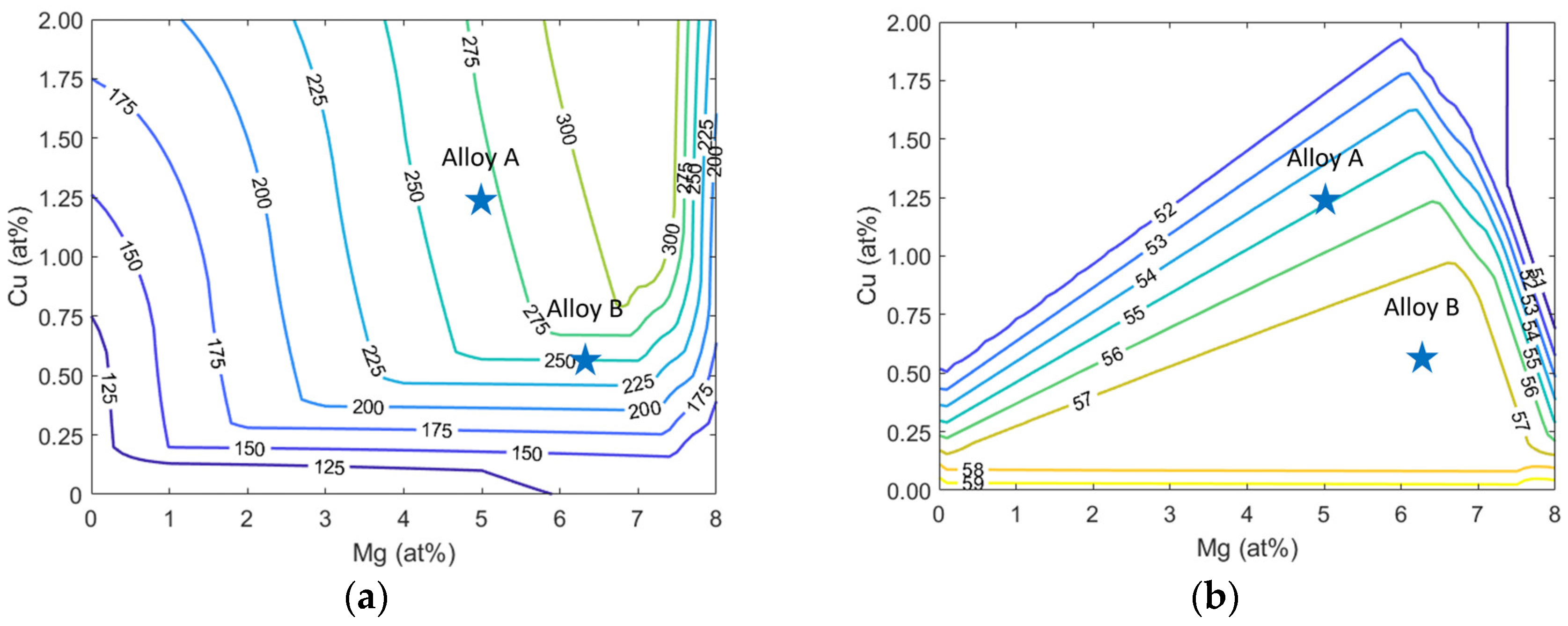
The predicted yield strength (MPa) and the electrical conductivity (%IACS) with respect to Mg and Cu in the Al-4.14Si-0.29Fe-xMg-yCu-0.12Mn-0.25Zn at% alloy at 300 °C are depicted in Figure 3a and Figure 3b, respectively. The predicted yield strength and electrical conductivity of alloy A at 300 °C are 270 MPa and 54.8% IACS, while the predicted yield strength and electrical conductivity of alloy B at 300 °C are 243 MPa and 57.6% IACS.
The predicted yield strength and electrical conductivity of alloy C at 300 °C are 245 MPa and 57.6% IACS. The yield strength and electrical conductivity were also predicted at 280 °C and 250 °C. For alloy A, these properties are 269 MPa and 55.8% IACS at 280 °C and 268 MPa and 57.1% IACS at 250 °C. For alloy B, the yield strength and electrical conductivity are 249 MPa and 58.4% IACS at 280 °C and 259 MPa and 59.4% IACS at 250 °C. Accordingly, for alloy C, these properties are 251 MPa and 58.4% IACS at 280 °C and 260 MPa and 59.4% IACS at 250 °C. Therefore, it is observed that electrical conductivity increases with the decrease in temperature and that alloy B and C are closer to satisfying the goal of 60% IACS at thermodynamic conditions.

4.2. Experimental Results

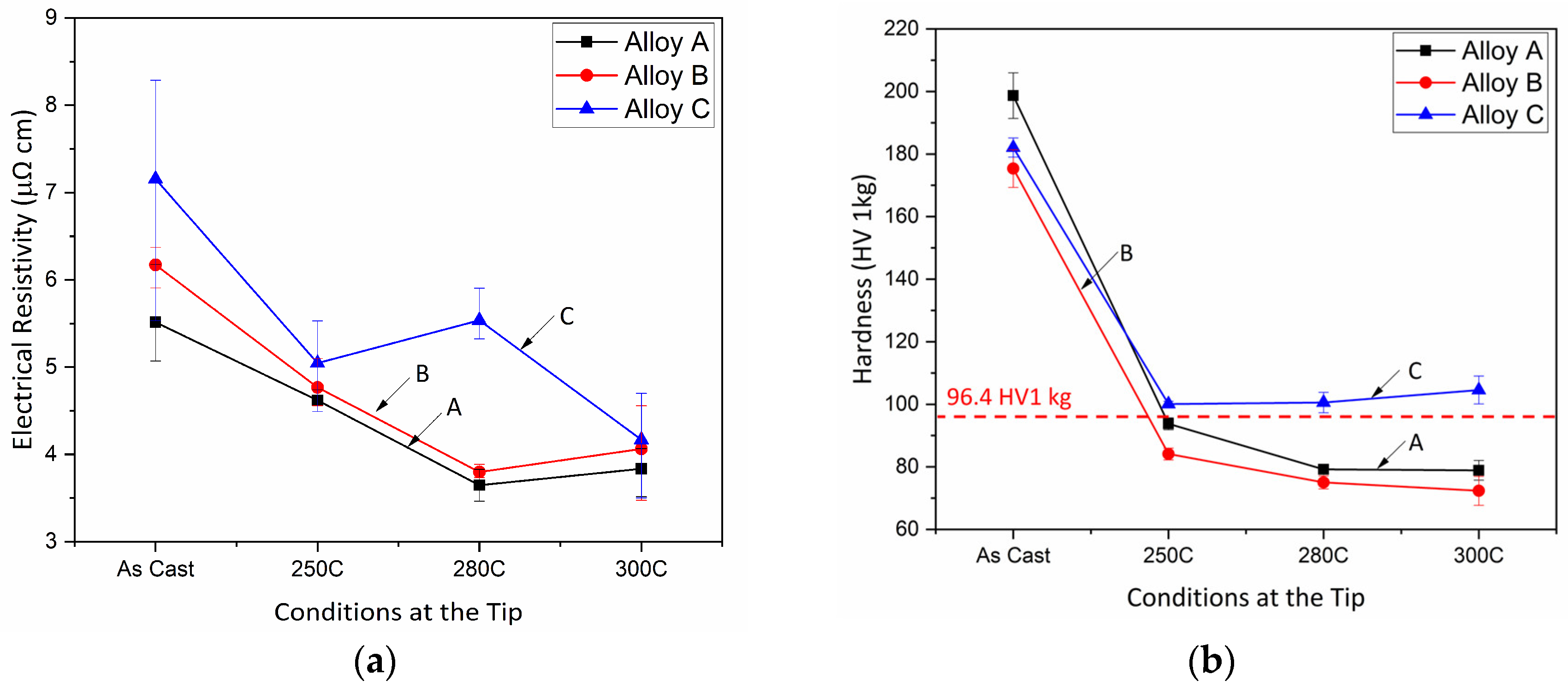
The electrical resistivity and hardness measurements of the as-cast and annealed specimens for alloys A, B, and C, conducted in a region close to the tip, are depicted in Figure 4a,b, respectively. The vertical line in Figure 4b corresponds to the strength target of 180 MPa. A conductivity of 60% IACS corresponds to an electrical resistivity of 2.86 μΩ cm.
Alloy A annealed at 280 °C presents the lowest electrical resistivity (3.64 μΩ cm or 47.2% IACS), followed by alloy B. The relatively high resistivity values at 250 °C suggest that equilibrium conditions have not been reached due to slower diffusion kinetics at this temperature. Although alloys B and C were expected to exhibit higher electrical conductivity than alloy A under equilibrium conditions, the experimental measurements indicate the opposite. Alloy C consistently shows the highest electrical resistivity under all tested conditions. This behavior is attributed to the addition of Mn, a known slow-diffusing element, which hinders the attainment of equilibrium. This interpretation is supported by the hardness measurements shown in Figure 4b, where alloy C exhibits the highest hardness values, satisfying the strength requirement of 180 MPa (96.4 HV1 kg). Furthermore, alloy A shows lower electrical resistivity in the as-cast condition compared to alloys B and C. This suggests that during solidification, the matrix of alloys B and C became more enriched in solute elements, likely due to rapid cooling and solute trapping. In contrast, alloy A may have undergone faster precipitation, particularly of the Q phase, towards the end of solidification, leading to a less solute-rich matrix. As shown in Table 2, Si has the highest electrical resistivity sensitivity. It is therefore plausible that Si partitions into the Q phase or other Si-rich phases during solidification, especially in alloy A, which was specifically designed to maximize Q phase formation. Further investigation is required and non-equilibrium Scheil solidification simulations considering solute trapping effects are recommended to better understand the observed trends.

5. Conclusions

The following conclusions may be drawn:
  • Experimental electrical resistivity and hardness measurements suggest that thermodynamic equilibrium conditions have not been reached yet for any of the alloys annealed at 250 °C, 280 °C, and 300 °C for 7 days. Among the tested conditions, alloy A shows the lowest electrical resistivity at 280 °C, while alloy C meets the strength requirement of 180 MPa.
  • Alloy C presents the highest electrical resistivity under all tested conditions. This is attributed to the addition of Mn, a slow-diffusing element, as supported by alloy C’s elevated hardness measurements.
  • Si has the highest electrical resistivity sensitivity according to the electrical resistivity model. Alloy A exhibits the lowest electrical resistivity in as-cast conditions, possible due to the formation of Si-rich phases, such as the Q phase during solidification.

Author Contributions

Conceptualization, G.B.O.; methodology, G.B.O. and M.-I.T.T.; software, M.-I.T.T.; validation, M.-I.T.T.; formal analysis, M.-I.T.T.; investigation, M.-I.T.T.; resources, G.B.O.; data curation, M.-I.T.T.; writing—original draft preparation, M.-I.T.T.; writing—review and editing, M.-I.T.T.; visualization, M.-I.T.T.; supervision, G.B.O.; project administration, G.B.O.; funding acquisition, G.B.O. All authors have read and agreed to the published version of the manuscript.

Funding

This research received no external funding.

Institutional Review Board Statement

Not applicable.

Informed Consent Statement

Not applicable.

Data Availability Statement

The data presented in this study are available on request from the corresponding author due to privacy restrictions.

Acknowledgments

This research was supported by a gift from Constellium. The authors would like to thank Laurent Boissonnet for his valuable assistance with the computational design and the casting of the aluminum alloys.

Conflicts of Interest

The authors declare no conflicts of interest.

References

  1. Shankar, S.; Gois, N.; Molstad, E.; Söderhjelm, C.; Apelian, D. Upcycling of Low Quality Aluminum Automotive Scrap: The DNA of Twitch. Inter Met. 2024, 19, 2544–2555. [Google Scholar] [CrossRef]
  2. Alawar, A.; Bosze, E.J.; Nutt, S.R. A Composite Core Conductor for Low Sag at High Temperatures. IEEE Trans. Power Deliv. 2005, 20, 2193–2199. [Google Scholar] [CrossRef]
  3. Alshmri, F. Rapid Solidification Processing: Melt Spinning of Al-High Si Alloys. AMR 2011, 383–390, 1740–1746. [Google Scholar] [CrossRef]
  4. Kim, K.; Bobel, A.; Baik, S.-I.; Walker, M.; Voorhees, P.W.; Olson, G.B. Enhanced Coarsening Resistance of Q-phase in Aluminum alloys by the addition of Slow Diffusing Solutes. Mater. Sci. Eng. A 2018, 735, 318–323. [Google Scholar] [CrossRef]
  5. Bobel, A.C. High-Temperature Cast Aluminum for Efficient Engines. Doctoral Thesis, Nortwesten University, Evanston, IL, USA, 2017. [Google Scholar]
  6. Ryen, Ø.; Holmedal, B.; Nijs, O.; Nes, E.; Sjölander, E.; Ekström, H.-E. Strengthening mechanisms in solid solution aluminum alloys. Met. Mater Trans A 2006, 37, 1999–2006. [Google Scholar] [CrossRef]
  7. Dixit, M.; Mishra, R.S.; Sankaran, K.K. Structure—Property correlations in Al 7050 and Al 7055 high-strength aluminum alloys. Mater. Sci. Eng. A 2008, 478, 163–172. [Google Scholar] [CrossRef]
  8. Nie, J.F.; Muddle, B.C. Strengthening of an Al–Cu–Sn alloy by deformation-resistant precipitate plates. Acta Mater. 2008, 56, 3490–3501. [Google Scholar] [CrossRef]
  9. Wang, Y.; Zhu, L.; Niu, G.; Mao, J. Conductive Al Alloys: The Contradiction between Strength and Electrical Conductivity. Adv Eng Mater 2021, 23, 2001249. [Google Scholar] [CrossRef]
  10. Eivani, A.R.; Valipour, S.; Ahmed, H.; Zhou, J.; Duszczyk, J. Effect of the size distribution of nanoscale dispersed particles on the Zener drag pressure. Metall. Mater. Trans. A Phys. Metall. Mater. Sci. 2011, 42, 1109–1116. [Google Scholar] [CrossRef]
  11. Aluminum Company of America. Aluminum: Properties, Physical Metallurgy and Phase Diagrams; Van Horn, K.R., Ed.; ASM: Metals Park, OH, USA, 1967. [Google Scholar]
Figure 1. Step diagram with respect to temperature and mole fraction of phases for (a) the Al-4.14Si-0.29Fe-0.79Mg-0.53Cu-0.12Mn-0.25Zn at% alloy and (b) the Al-4.14Si-0.29Fe-6.3Mg-1.57Cu-0.12Mn-0.25Zn at% alloy. The QT2 thermodynamic database was employed for the calculations.
Engproc 119 00028 g001
Figure 2. (a) Contour plot with respect to Mg and Cu, showing the mole fraction of phases for the Al-4.14Si-0.29Fe-xMg-yCu-0.12Mn-0.25Zn at% alloy. (b) Contour plot with respect to Fe and Mn, showing the mole fraction of phases for the Al-4.14Si-xFe-6.3Mg-0.53Cu-yMn-0.25Zn at% alloy. Calculations were performed at 300 °C, and the QT2 thermodynamic database was employed. Asterisks denote alloys A, B, and C.
Engproc 119 00028 g002
Figure 3. Contour plots with respect to Mg and Cu, showing (a) the yield strength (MPa) and (b) the electrical conductivity (%IACS) in the Al-4.14Si-0.29Fe-xMg-yCu-0.12Mn-0.25Zn at% alloy at 300 °C. Asterisks denote alloys A and B.
Engproc 119 00028 g003
Figure 4. (a) Electrical resistivity and (b) hardness measurements on as-cast and annealed specimens at 250 °C, 280 °C, and 300 °C for alloys A, B, and C. The vertical line corresponds to the strength target.
Engproc 119 00028 g004
Table 1. Composition of aluminum alloys (wt%) measured with ICP-OES.
AlloysAlMgSiCuFeMnZn
ABal.4.424.212.880.590.250.60
BBal.5.614.261.260.590.250.60
CBal.5.584.241.250.591.210.60
Table 2. Electrical resistivity sensitivity of solute elements in aluminum (wt%).
Electrical Resistivity SensitivityMgSiCuFeMnZn
ρ μΩ cm wt%−1 at 20 °C0.541.020.3440.0522.940.09
Disclaimer/Publisher’s Note: The statements, opinions and data contained in all publications are solely those of the individual author(s) and contributor(s) and not of MDPI and/or the editor(s). MDPI and/or the editor(s) disclaim responsibility for any injury to people or property resulting from any ideas, methods, instructions or products referred to in the content.