


Hyperdimensional Computing for Lightweight Modal-Based Damage Classification in Concrete Structures †


Abstract
1. Introduction
2. Methods
2.1. Signal Processing and Feature Extraction
2.1.1. Data-Processing Workflow
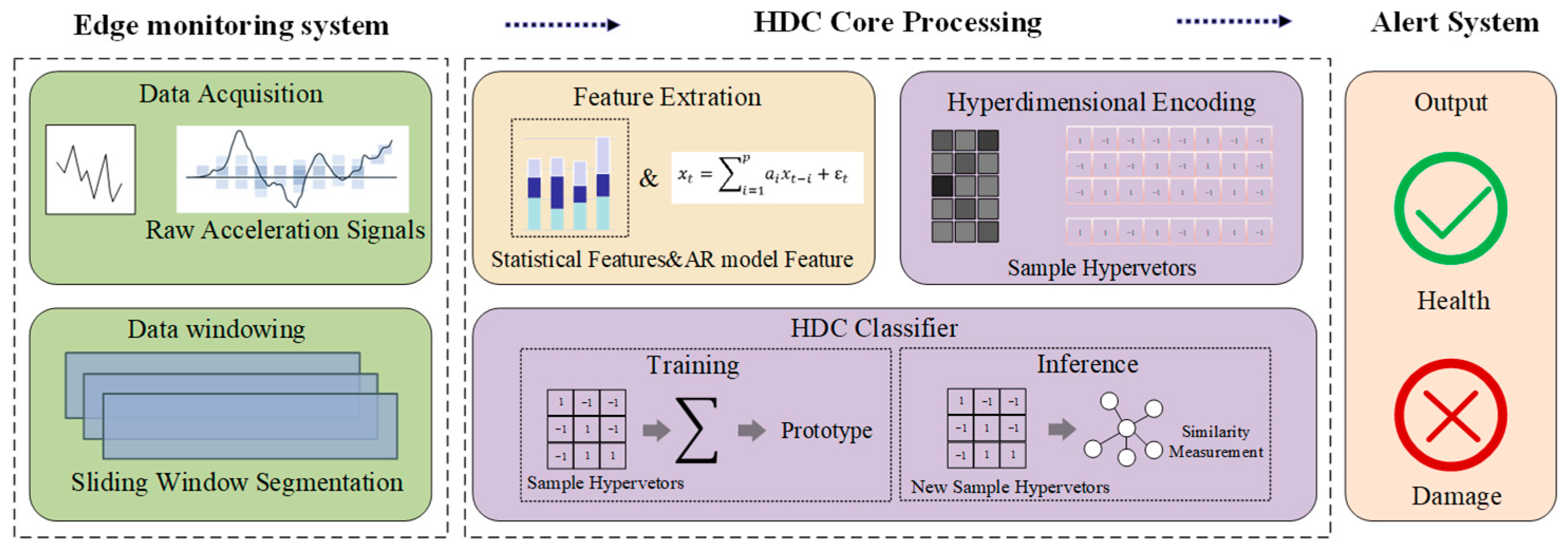
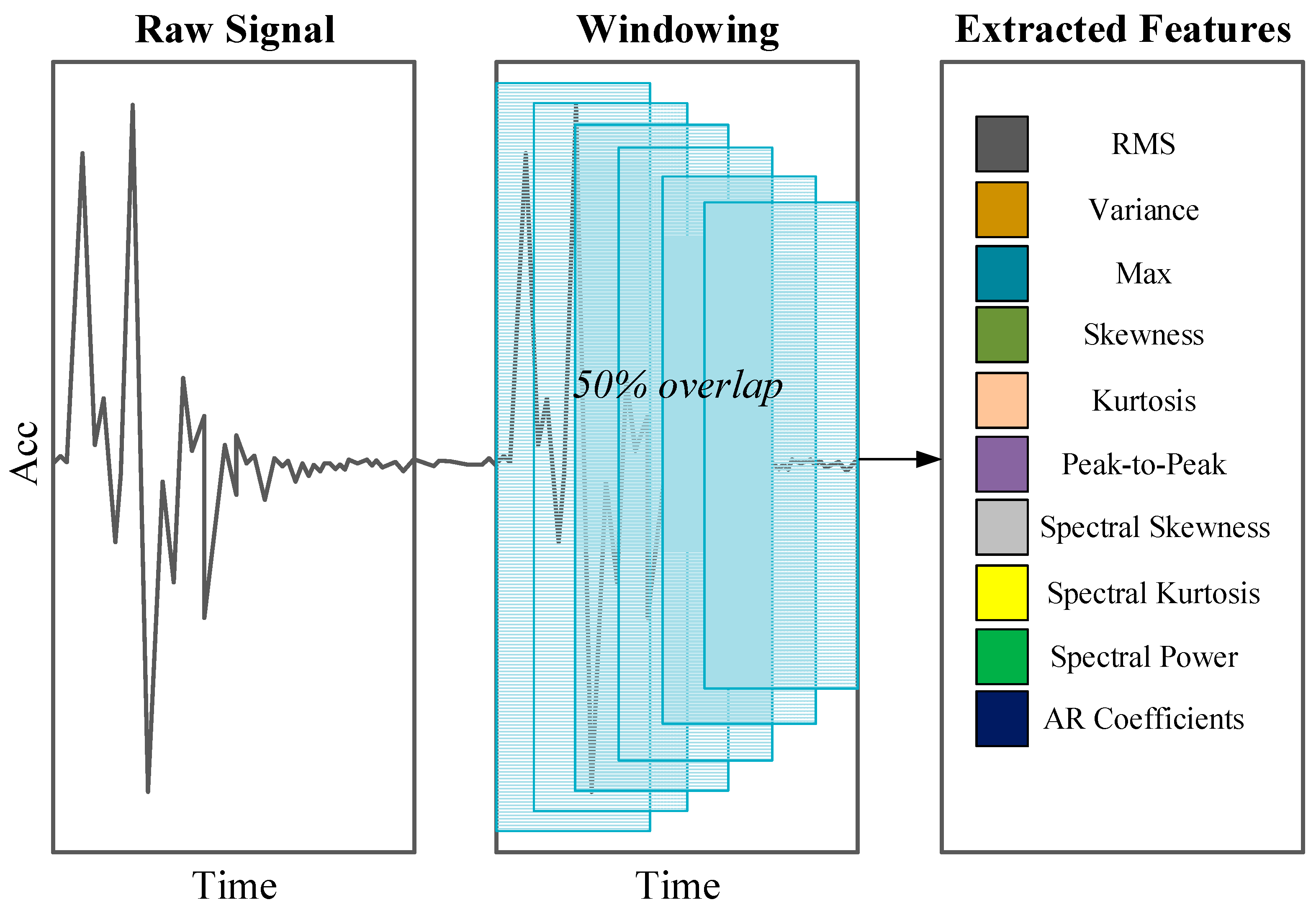
- Windowing: A fixed-length window of 2048 data points slides across the original signal with a 50% overlap. This segmentation converts long time-series signals into overlapping short-term samples suitable for analysis.
- Feature computation: For each windowed sample, two types of features are extracted. First, the sample is divided into T equal-length sub-segments, from which 9 local time–frequency statistical metrics are calculated to characterize short-term variations. In addition, a p-order AR model is fitted to each sample, and its coefficients are extracted.
- Feature vector construction: Features from all sub-segments are concatenated, and vectors across sensors are combined into a final high-dimensional feature representation for HDC encoding. The hyperparameters T and p are optimized through grid search with cross-validation.
2.1.2. Feature Computation and Its Physical Significance
- Root Mean Square (RMS) and Variance: Indicators of vibration energy; damage (e.g., cracks) that modifies stiffness and damping, altering the energy dissipation patterns.
- Maximum and Peak-to-Peak: Sensitive to transient impacts and suitable for capturing sharp responses caused by external or internal damage.
- Skewness: Measure of the asymmetry in signal distribution. Healthy linear structures typically produce symmetric responses, while damage can introduce nonlinearities, leading to skewed distributions.
- Kurtosis: Sensitive to impulsive components, with high values indicating sharp transient impacts associated with damage initiation.
- Spectral Skewness and Spectral Kurtosis: Describe symmetry and peakedness of the power spectrum. Damage-induced nonlinearities can redistribute energy across frequency bands or generate harmonics.
- Spectral Power: A weighted spectral power measure emphasizes high-frequency components, which are often excited by micro-cracks and friction, making them effective indicators of damage.
- AR Coefficients: Capture temporal correlations within signals and serve as a compact “mathematical fingerprint” of structural dynamics [7]. Changes in system properties (mass, stiffness, damping) due to damage alter these coefficients. The Levinson–Durbin algorithm is employed for efficient estimation.
2.2. Hyperdimensional Encoding
- Base Hypervector Generation: Two sets of base hypervectors are initialized randomly:
- Binding: Given a sample feature vector , each feature is mapped to a quantized level . The corresponding position and value hypervectors are bound through element-wise multiplication (i.e., the XOR operation for bipolar vectors):
- Bundling: The resulting feature hypervectors are aggregated into a single sample hypervector . This aggregation is achieved via element-wise summation followed by a sign function:
2.3. HDC Classifier Training and Inference
2.4. Model Evaluation and Hyperparameter Tuning
3. Experiments and Results
3.1. Experiment Setup and Data Acquisition
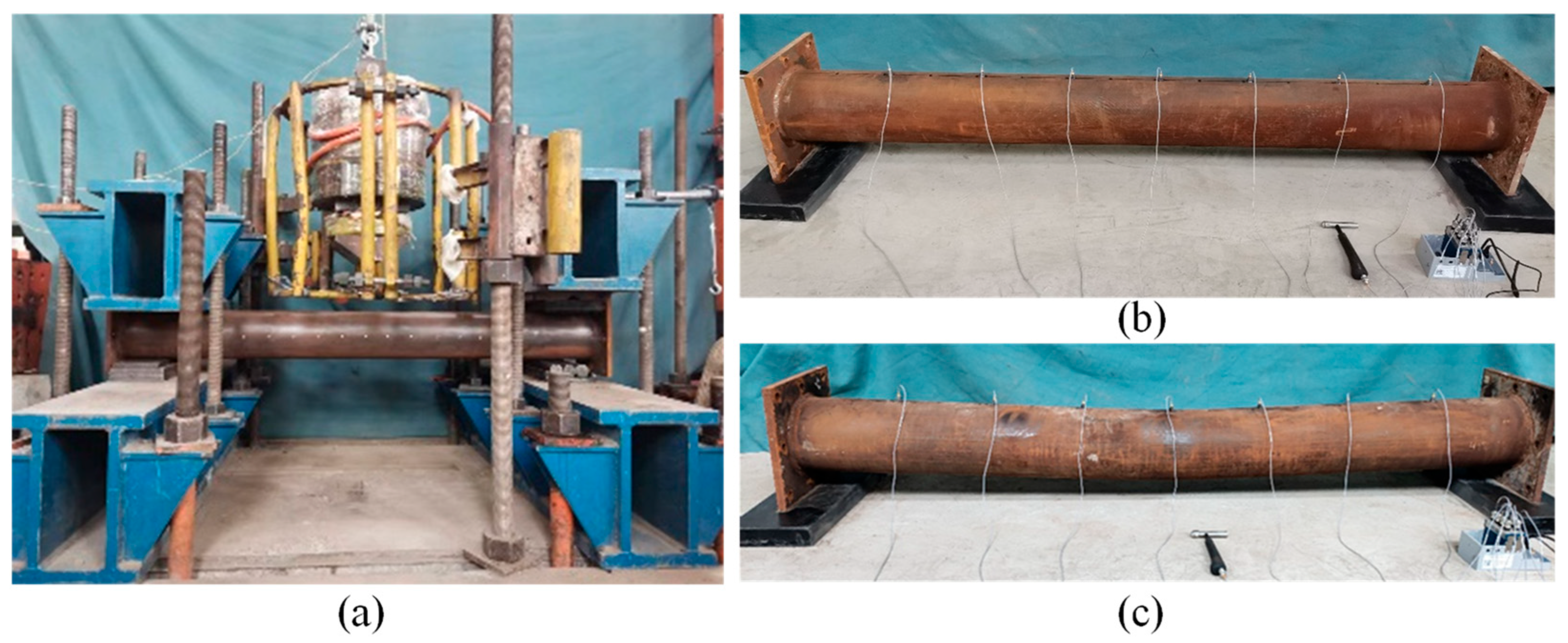
- Intact-State Data Acquisition: The undamaged specimen was placed on rubber pads to simulate free-free boundary conditions. An instrumented hammer struck 15 predefined points on the steel tube, and acceleration and force signals were recorded using the deployed HBK 4508-B-003 piezoelectric accelerometers [8] and a hammer force sensor. Each point was struck five times to reduce random error.
- Impact Damage Application: The specimen was then subjected to a single lateral impact using an impact testing apparatus to induce internal damage.
- Damaged-State Data Acquisition: Post-impact vibration responses were collected following the same procedure as the intact-state testing. All signals were sampled at 25,000 Hz to ensure accurate capture of high-frequency vibration components.
- Dataset Construction. Signal data collected before the impact were labeled as “Healthy” (label 0), and post-impact data as “Damaged” (label 1). Using the sliding-window procedure described in Section 2.1, a series of labeled samples was generated to form the dataset for training and evaluation.
3.2. Implementation and Evaluation
3.3. Results and Analysis
3.3.1. Classification Performance
3.3.2. Comparative Analysis
4. Discussion and Conclusions
Author Contributions
Funding
Institutional Review Board Statement
Informed Consent Statement
Data Availability Statement
Conflicts of Interest
References
- Zhang, B.; Ren, Y.; He, S.; Gao, Z.; Li, B.; Song, J. A review of methods and applications in structural health monitoring (SHM) for bridges. Measurement 2025, 245, 116575. [Google Scholar] [CrossRef]
- Krishnan, M.; Bhowmik, B.; Hazra, B.; Pakrashi, V. Real time damage detection using recursive principal components and time varying auto-regressive modeling. Mech. Syst. Signal Process. 2018, 101, 549–574. [Google Scholar] [CrossRef]
- Magalhães, F.; Cunha, Á.; Caetano, E. Vibration based structural health monitoring of an arch bridge: From automated OMA to damage detection. Mech. Syst. Signal Process. 2012, 28, 212–228. [Google Scholar] [CrossRef]
- Tavares, A.; Di Lorenzo, E.; Peeters, B.; Coppotelli, G.; Silvestre, N. Damage Detection in Lightweight Structures Using Artificial Intelligence Techniques. Exp. Tech. 2021, 45, 389–410. [Google Scholar] [CrossRef]
- Peng, Z.; Li, J.; Hao, H.; Zhong, Y. Smart structural health monitoring using computer vision and edge computing. Eng. Struct. 2024, 319, 118809. [Google Scholar] [CrossRef]
- Kanerva, P. Hyperdimensional Computing: An Introduction to Computing in Distributed Representation with High-Dimensional Random Vectors. Cogn. Comput. 2009, 1, 139–159. [Google Scholar] [CrossRef]
- Entezami, A.; Mariani, S.; Shariatmadar, H. Damage Detection in Largely Unobserved Structures under Varying Environmental Conditions: An AutoRegressive Spectrum and Multi-Level Machine Learning Methodology. Sensors 2022, 22, 1400. [Google Scholar] [CrossRef]
- HBK. Piezoelectric Accelerometer Types 4507 and 4508 Datasheet. 2025. Available online: https://www.bksv.com/doc/bp1841.pdf (accessed on 26 September 2025).

| Feature Type | Feature Computation | Formulas |
|---|---|---|
| Time domain | RMS | |
| Variance | ||
| Max | ||
| Skewness | ||
| Kurtosis | ||
| Peak-to-Peak | ||
| Frequency domain | Spectral Skewness | |
| Spectral Kurtosis | ||
| Spectral Power | ||
| AR model | AR Coefficients |
| Model | F1-Score | AUC | Precision | Recall |
|---|---|---|---|---|
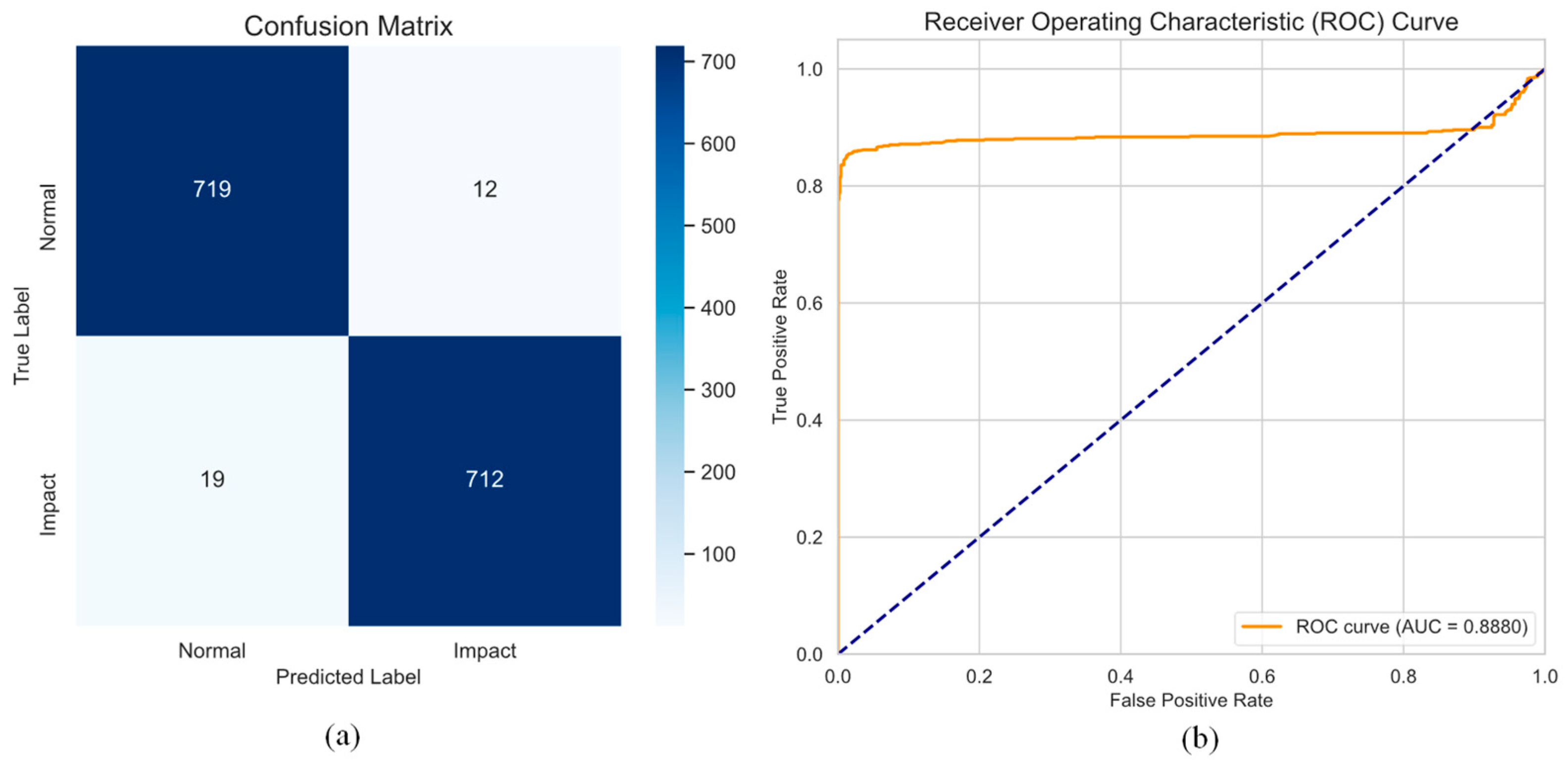
| HDC | 0.9808 | 0.8812 | 0.9810 | 0.9808 |
| SVM | 0.9903 | 0.9998 | 0.9904 | 0.9903 |
| Random Forest | 0.9988 | 1.0000 | 0.9988 | 0.9988 |
Disclaimer/Publisher’s Note: The statements, opinions and data contained in all publications are solely those of the individual author(s) and contributor(s) and not of MDPI and/or the editor(s). MDPI and/or the editor(s) disclaim responsibility for any injury to people or property resulting from any ideas, methods, instructions or products referred to in the content. |
© 2025 by the authors. Licensee MDPI, Basel, Switzerland. This article is an open access article distributed under the terms and conditions of the Creative Commons Attribution (CC BY) license (https://creativecommons.org/licenses/by/4.0/).
Share and Cite
Lin, X.-L.; Mariani, S. Hyperdimensional Computing for Lightweight Modal-Based Damage Classification in Concrete Structures. Eng. Proc. 2025, 118, 47. https://doi.org/10.3390/ECSA-12-26588
Lin X-L, Mariani S. Hyperdimensional Computing for Lightweight Modal-Based Damage Classification in Concrete Structures. Engineering Proceedings. 2025; 118(1):47. https://doi.org/10.3390/ECSA-12-26588
Chicago/Turabian StyleLin, Xiao-Ling, and Stefano Mariani. 2025. "Hyperdimensional Computing for Lightweight Modal-Based Damage Classification in Concrete Structures" Engineering Proceedings 118, no. 1: 47. https://doi.org/10.3390/ECSA-12-26588
APA StyleLin, X.-L., & Mariani, S. (2025). Hyperdimensional Computing for Lightweight Modal-Based Damage Classification in Concrete Structures. Engineering Proceedings, 118(1), 47. https://doi.org/10.3390/ECSA-12-26588



