
Proceeding Paper

A PSO-Driven Hyperparameter Optimization Approach for GRU-Based Traffic Flow Prediction †
1
LERMA Laboratory, Mohammadia School of Engineering, Mohammed V University, Rabat 10090, Morocco
2
AIRA Laboratory, Artificial Intelligence and Research Applications, Hassan First University, Settat 26000, Morocco
*
Author to whom correspondence should be addressed.
Presented at the 7th edition of the International Conference on Advanced Technologies for Humanity (ICATH 2025), Kenitra, Morocco, 9–11 July 2025.
Eng. Proc. 2025, 112(1), 78; https://doi.org/10.3390/engproc2025112078
Published: 12 December 2025

Abstract

Smart cities increasingly rely on intelligent technologies to improve urban infrastructure, sustainability, and quality of life. Traffic flow prediction is essential for the optimization of the transportation system, reducing congestion and improving mobility. However, real-world traffic data are often noisy, limited in size, and lack sufficient features to capture the flow dynamics and temporal dependencies, making accurate prediction a significant challenge. Previous studies have shown that recurrent neural network (RNN) variants, such as LSTM and GRU, are well-suited for time series forecasting tasks, but their performance is highly sensitive to hyperparameter settings. This study proposes a hybrid approach that integrates GRU with a metaheuristic optimization algorithm to address this challenge. After effective preprocessing steps and a sliding time window are applied to structure the data, particle swarm optimization (PSO) is utilized to optimize the hyperparameters of the GRU. The model’s performance is evaluated using RMSE, MAE, and R 2 , and compared against several baseline approaches, including LSTM, CNN-LSTM, and a manually configured GRU. According to the experimental findings, the GRU model that was manually adjusted performed the best overall. However, the PSO-GRU model demonstrated competitive results, confirming that metaheuristics offer a promising alternative when manual tuning is not feasible despite the higher computational costs.

1. Introduction

The evolution of smart cities hinges on advancing traffic management systems, with traffic flow prediction emerging as a critical component. This predictive task leverages historical time series datasets, such as vehicle counts, speed, and occupancy, to forecast near-future conditions, enabling optimized signal control, adaptive route guidance, and infrastructure planning. However, the inherent complexity of traffic dynamics poses significant challenges: temporal dependencies reflect how congestion propagates through networks, while periodicity reveals recurring patterns like rush-hour peaks or weekly fluctuations. These patterns are further complicated by nonlinear disruptions (e.g., accidents, construction) and spatial correlations, where traffic behavior on one segment influences adjacent links, necessitating sophisticated spatiotemporal modeling. Traditional statistical methods like ARIMA (AutoRegressive Integrated Moving Average) and exponential smoothing often struggle to capture these interdependencies, prompting a shift toward machine learning and deep learning approaches like LSTMs, GRUs, and transformers, which better handle high-dimensional, noisy data. However, real-world deployment faces hurdles, such as sensor unreliability, computational latency, and the unpredictable nature of human behavior, underscoring the need for robust adaptive frameworks that balance accuracy with real-time applicability. Generally, sequentially data are being treated with RNNs, making them naturally suited for time series forecasting. Unlike traditional feedforward networks, RNNs maintain an internal hidden state that captures temporal dependencies by recursively passing information from one time step to the next [1]. For this matter, LSTMs or GRUs were introduced with gating mechanisms to regulate information flow. In this paper, we will use GRUs to predict traffic flow, striking a balance between the accuracy of LSTM and the simplicity of vanilla RNNs. Although GRUs offer an efficient architecture for traffic flow prediction, their reliance on large-scale high-quality data exposes critical limitations: small datasets lead to overfitting and poor generalization, while big data introduces computational inefficiencies and redundant learning, highlighting the need for adaptive regularization, transfer learning, or hybrid modeling to minimize the gap between the abundance and shortage of data. This study addresses the challenge of small data regimes in traffic flow prediction by systematically optimizing gated recurrent unit (GRU) hyperparameters to mitigate overfitting while preserving model generalizability using metaheuristics. As we know, conventional grid search methods are computationally prohibitive and empirically inadequate for high-dimensional hyperparameter spaces [2]. Using PSO integration with a GRU, we aim to automate the discovery of parsimonious yet expressive models that resist overfitting without sacrificing temporal fidelity. Recurrent neural networks (RNNs) such as CNN-LSTM, Bi-LSTM, and GRU variants are commonly employed for temporal feature extraction in traffic flow prediction; their uncritical selection often overlooks fundamental limitations, particularly their data hunger, computational complexity, and frequent failure to generalize beyond idealized datasets, making them useful to perform and compare our solution. The remainder of the document is structured as follows: Section 2 reviews related works, Section 3 details the methodology, Section 4 presents the experimental data, evaluation methods, and results analysis, and Section 5 concludes with final remarks and future research directions.

2. Related Work

Traffic flow prediction is a critical task in urban intelligence, focusing on forecasting vehicle movement patterns. Gated recurrent units (GRUs) have gained popularity thanks to their capacity to recognize temporal dependencies, with recent studies developing enhanced GRU-based architectures. The dynamic graph convolutional network with attention fusion [3] combines a GRU with dynamic graph learning and spatial-temporal attention modules. Similarly, the attention-based spatial-temporal convolution GRU (ASTCG) [4] employs a multi-input module and STA-ConvGru component. Other variants include a GRU with self-attention mechanisms (Asaki, 2023), the GRU- and Transformer-based periodicity fusion network (GTPFN) [5], and the global awareness enhanced spatial-temporal graph recurrent network (GA-STGRN) [6] that integrates global awareness layers. Additional approaches comprise traffic-gated neural networks [7], the hybrid T-LGGCN model [8], spatial-temporal graph attention networks (GAGRU), an improved bi-GRU [9] with bidirectional feedback, and the KNN-GRU model [10] combining KNN spatial analysis with GRU temporal processing. These innovations collectively advance spatial-temporal correlation modeling in traffic prediction. Early feature-learning architectures like [11]’s SAE and [12]’s SDA established unsupervised pretraining for spatio-temporal patterns, though their shallow benchmarks (BPNN and SVM) now appear outdated. Subsequent hybrid models addressed specific gaps: ref. [13] incorporated vehicle-type dynamics via LSTM preprocessing, while [14] fused ARIMA’s linearity with LSTM periodicity, albeit with static ensemble limitations. The field’s turn toward specialized architectures yielded three divergent paths: (1) ref. [15]’s Conv-BiLSTM demonstrated the power of 3D spatio-temporal representations but restricted validation to Shanghai workdays; (2) ref. [16]’s NSDNN showed neighbor-selection benefits (5% RMSE gains) while overclaiming scalability; and (3) ref. [17]’s DRL framework excelled in special events but ignored computational costs. Meanwhile, ref. [18]’s GRU hyperparameter optimization and [19]’s multimodal fusion (26.5% error reduction) highlighted data engineering’s role, though both neglected transformer baselines. Most recently, ref. [20]’s GIS-CNN hybrid introduced structured spatial learning but maintained the field’s persistent weakness, such as over-reliance on localized validation, lacking cross-city benchmarks.

3. Methodology

This investigation confronts the epistemological challenge of deriving reliable traffic flow predictions from limited datasets, where conventional deep learning approaches typically fail due to their inherent data hunger. Our methodological innovation centers on developing a hyperparameter optimization framework specifically adapted for GRU networks operating under small-data constraints, while maintaining theoretical rigor about the limits of predictability in sparse temporal systems. The built Figure 1 describes the proposed algorithm (Algorithm 1).

3.1. Dataset Preprocessing

To prepare the dataset for training the GRU model, we applied several preprocessing steps. We extracted time-related features, such as the hour, minute, day of the week, and weekend flag, from the timestamp. The categorical traffic situation was encoded as low, normal, and high conditions. Our final set of characteristics combined vehicle counts, time-based variables, and traffic condition indicators. All features, including the target total, were normalized using MinMax scaling to standardize input values. We then applied a fixed-size L-sliding window to create input sequences for the GRU model, and each sequence was used to predict the next total value. In order to maintain the temporal structure for forecasting, we lastly partitioned the data into training and testing subsets based on chronological order.
Algorithm 1 PSO-GRU for traffic flow prediction
 1:
Initialize: Define hyperparameter vector x = [ u , η , δ , b ] , where:
 2:
   u: GRU units, η : learning rate, δ : dropout rate, b: batch size
 3:
Initialize a swarm of N particles { x 1 , , x N } randomly within bounds
 4:
Initialize velocities { v 1 , , v N }
 5:
Set personal bests p i x i , global best g arg min i f ( p i )
 6:
for each iteration t = 1 to T do
 7:
   for each particle i = 1 to N do
 8:
       Update velocity v i
 9:
       Update position x i
10:
      Clip x i within bounds
11:
      Extract hyperparameters from x i
12:
      Train GRU model and compute objective f i
13:
      Update p i and g if improvement is found
14:
  end for
15:
end for
16:
Return best hyperparameter vector x g
17:
Train final GRU model with x g
18:
Evaluate model on test set using MSE, MAE, RMSE, and R 2

3.2. Hyperparamteter

In the context of optimizing the GRU model for traffic flow prediction, PSO is able to fine-tune key hyperparameters that significantly influence model performance. A finite search space was defined for each parameter to guide the optimization process effectively. The optimized parameters include the number of GRU units, the learning rate of the optimizer, the dropout rate applied during training to prevent overfitting, and the batch size used in mini-batch training. Additionally, the size of the time-lag window L, which determines how many past time steps are used as input for the prediction, is essential for identifying temporal dependencies in traffic data. In our case, L was manually set to 10 based on empirical analysis and model stability considerations. The search space for each parameter was carefully bounded to ensure efficient convergence and balance model complexity with generalization ability, as described in Table 1.

3.3. Problem Formulation

We commenced with the traffic flow time series data indicated by X, representing the vehicle count sequences collected on urban roads. The data were preprocessed and normalized, and then segmented into training and testing sets: X t and X v , respectively. A sliding window of length L was applied to capture temporal dependencies, where each sequence was used to predict future traffic conditions. The particle swarm optimization (PSO) algorithm was used to optimize the key hyperparameters of the GRU model. These include the number of GRU units u, the learning rate η , the dropout rate δ , and the batch size b, all drawn from a finite bounded set. The goal of the algorithm is dual: to minimize validation errors and improve model generalization by selecting the optimal configuration of the GRU network. Each particle in the swarm represents a candidate solution encoding a specific set of GRU parameters. The GRU was trained on X t and evaluated on X v for each particle. Loss values guide the search for a global optimum. The final output was a GRU model that was trained with the hyperparameters corresponding to the best-performing particle, yielding improved predictive performance on traffic flow forecasting tasks.

3.4. Training and Evaluation

Using the PSO-optimized hyperparameters, we retrained the GRU model on the full training set with early stopping to prevent overfitting. Model performance was evaluated using the following: Mean Absolute Error (MAE) for robust deviation measurement, Root Mean Squared Error (RMSE) to penalize large prediction errors, Mean Absolute Percentage Error (MAPE) for scale-relative assessment, and R 2 to quantify variance explained against a baseline.

4. Experiment

4.1. Data

Kaggle was adopted for collecting the experimental data for the suggested deep architecture model, recorded at 15-min intervals, encompassing four vehicle categories (passenger cars, motorcycles, buses, and freight trucks), aggregated into a total vehicle count, and annotated with a categorical traffic situation indicator. In this paper, data on the flow of internet traffic collected for three months were used for the experiments. The complete case data contained no missing values and exhibited a hierarchical structure that is suitable for multivariate time-series analysis, with the datetime index enabling precise temporal modeling of traffic flow patterns and congestion dynamics. The numerical nature of all predictive variables and the continuous temporal coverage (Dtype: datetime64[ns]) facilitate a direct application of sequential neural architectures.

4.2. Reference Models

To evaluate how well our approach performs, we benchmarked it against a set of four established models: GRU (manual), GRU-MFOA, LSTM, and CNN-LSTM.
GRU-MFOA: integrates gated recurrent units with the modified firefly optimization algorithm to automatically tune critical hyperparameters, namely the count of hidden neurons, the learning rate, and the dropout rate. MFOA’s dynamic attraction mechanism and adaptive inertia weights enable more efficient exploration of the hyperparameter space, improving convergence rates and helping avoid local minima in time-series modeling tasks [21].
Long short-term memory (LSTM) networks are a specialized form of recurrent neural network built to address vanishing-gradient issues. Using three gates, input, forget, and output, LSTMs can regulate what information is kept or discarded, allowing them to capture dependencies over long temporal sequences.
CNN-LSTM is a hybrid architecture that combines convolutional neural networks (CNN) for spatial or local pattern extraction with LSTM networks for modeling long-term temporal dependencies. This combination enables the model to learn both spatial [22].

4.3. Result

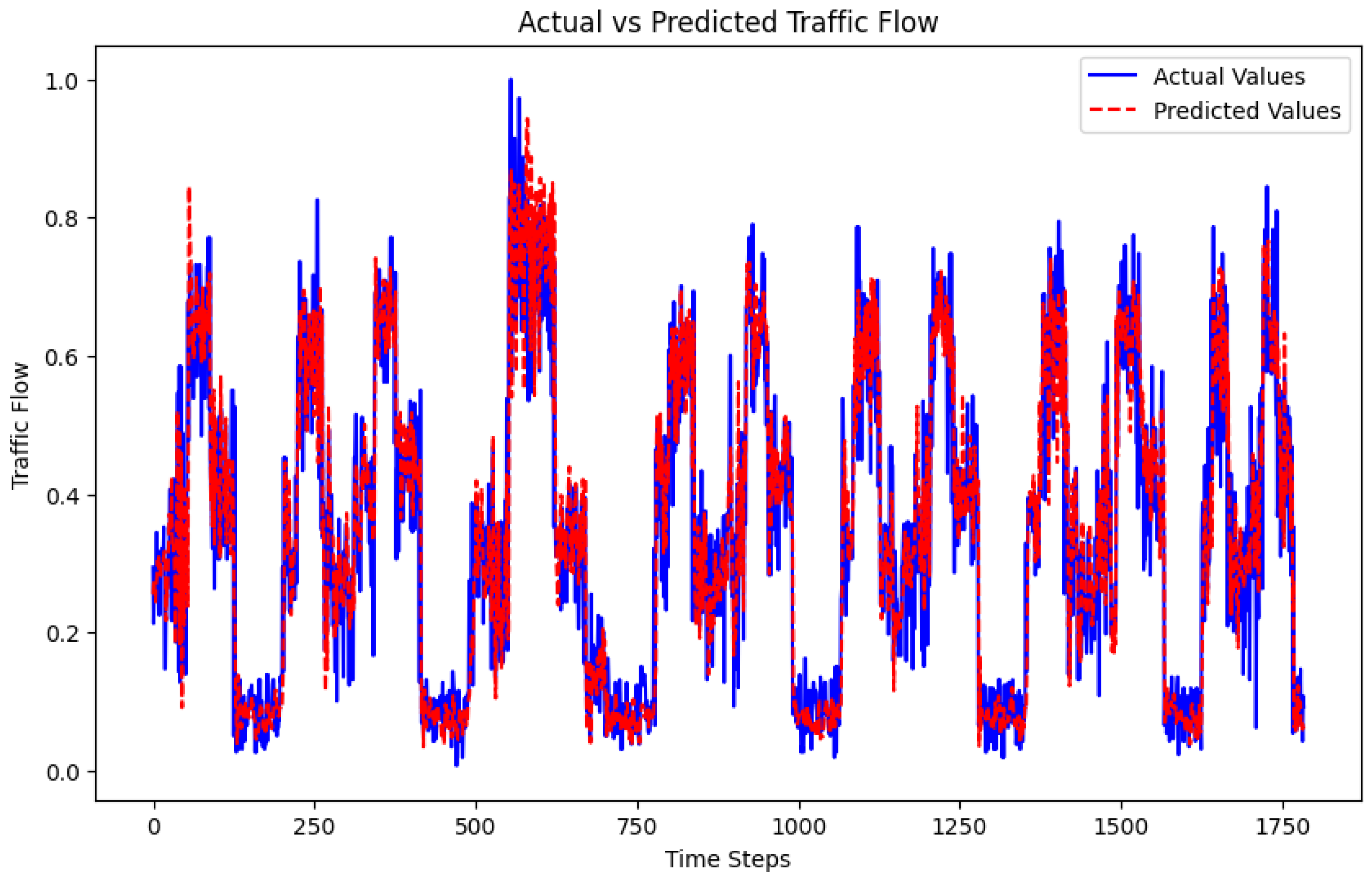
The performance value shown in Table 2 reveals that the manually configured GRU model achieved superior performance compared to both metaheuristic optimized variants and alternative architectures, achieving an R2 of 0.8762 and an RMSE of 0.0779. In particular, this outperformed the GRU-MFOA (R2 = 0.818) and GRU-PSO (R2 = 0.815), as well as the LSTM (R2 = 0.794) and CNN-LSTM (R2 = 0.832) models. This unexpected outcome suggests that, while metaheuristic optimization can produce competitive results, hand-tuning the hyperparameters can allow the model to more precisely capture the nuanced temporal dependencies in traffic flow data. The GRU’s simpler gating mechanism appears more effective than the LSTM’s more complex architecture for this prediction task, and the marginal gains from CNN-LSTM’s hybrid approach did not justify its additional computational complexity. The effectiveness of the GRU model is illustrated through its comparison with the actual values in Figure 2. Furthermore, the meta-heuristic-based tuning process required a significantly higher computational cost, with optimization procedures running for several hours to evaluate and train hundreds of candidate models. In our experiments, manual tuning of the GRU model required approximately 5 min to achieve satisfactory performance, whereas PSO-based hyperparameter optimization required approximately 2 h of CPU runtime. This substantial increase in computational cost reflects the iterative population-based nature of PSO, highlighting a trade-off between automated search thoroughness and resource/time efficiency. This suggests that in certain settings, expert-informed configurations can offer not only more effective results but also a much more efficient development process than automated tuning, particularly when the hyperparameter search space is large, noisy, or sensitive to training variability. Although the computational cost is a significant limitation of PSO and other metaheuristics, several factors influence their effectiveness. For example, proper feature selection and a careful adjustment of the metaheuristic parameters require a certain level of expertise to avoid suboptimal configurations. Additionally, metaheuristics can sometimes suffer from convergence issues, such as premature convergence or difficulty escaping local minima, which may prevent them from reaching the global optimum. However, PSO remains a valuable tool. In this study, the problem at hand is relatively low in complexity and does not involve numerous constraints. Therefore, good pre-processing and thoughtful model design can yield competitive results without a heavy reliance on metaheuristic tuning. That said, the inherent strength of metaheuristic algorithms lies in their versatility and robustness in addressing diverse problem types and constraints, including nonconvex, noncontinuous, and multimodal search spaces [23]. This capability makes them particularly attractive and, in many cases, indispensable for solving complex optimization problems that are beyond the reach of traditional tuning methods.

5. Conclusions

This work bridges gated recurrent unit (GRU) theory with practical optimization by introducing an automated hyperparameter tuning framework for enhanced time-series prediction. To mitigate challenges such as noise and limited data, we implemented targeted preprocessing steps that improved the model’s robustness. These included engineering features that were based on time to provide a temporal context and applying a sliding-window technique to help the GRU model effectively capture sequential dependencies. To optimize GRU performance, we performed a hyperparameter search using the particle swarm optimization algorithm (PSO) and compared the results with several baseline models, such as the manually configured GRU, GRU optimized via MFOA, LSTM, and the hybrid CNN-LSTM model.
Our evaluation demonstrated that the manually configured GRU model outperformed all baseline methods in all metrics (MAE, MSE, RMSE, and R 2 ), closely followed by the GRU model optimized with PSO. These results suggest that metaheuristic-based tuning does not always guarantee superior performance, as its effectiveness can be highly sensitive to several parameters. In contrast, manual configuration, when guided by domain knowledge, can often yield strong and competitive results. For future work, we plan to explore and compare different metaheuristic algorithms to identify those that offer the best trade-offs in terms of accuracy, memory consumption, and execution time. We also aim to establish guidelines on when and how metaheuristic optimization is necessary and effective, recognizing that the performance of predictive models is influenced by multiple factors, including preprocessing, model architecture, and hyperparameter configuration.

Author Contributions

I.B. contributed to conceptualization, methodology, and writing—original draft. R.E. and M.A.C. were responsible for validation and supervision. All authors contributed to review and editing. All authors have read and agreed to the published version of the manuscript.

Funding

This research received no external funding.

Institutional Review Board Statement

Not applicable.

Informed Consent Statement

Not applicable.

Data Availability Statement

The datasets analyzed during the current study are available from the corresponding author on reasonable request.

Conflicts of Interest

The authors declare no conflicts of interest.

References

  1. Das, S.; Tariq, A.; Santos, T.; Kantareddy, S.S.; Banerjee, I. Recurrent neural networks (RNNs): Architectures, training tricks, and introduction to influential research. Mach. Learn. Brain Disord. 2023, 117–138. [Google Scholar]
  2. Stoean, C.; Zivkovic, M.; Bozovic, A.; Bacanin, N.; Strulak-Wójcikiewicz, R.; Antonijevic, M.; Stoean, R. Metaheuristic-based hyperparameter tuning for recurrent deep learning: Application to the prediction of solar energy generation. Axioms 2023, 12, 266. [Google Scholar] [CrossRef]
  3. Luo, X.; Zhu, C.; Zhang, D.; Li, Q. Dynamic graph convolutional network with attention fusion for traffic flow prediction. In Proceedings of the ECAI 2023, Kraków, Poland, 30 September–4 October 2023; pp. 1633–1640. [Google Scholar]
  4. Zhang, Q.; Chang, W.; Yin, C.; Xiao, P.; Li, K.; Tan, M. Attention-based spatial–temporal convolution gated recurrent unit for traffic flow forecasting. Entropy 2023, 25, 938. [Google Scholar] [CrossRef] [PubMed]
  5. Zhang, Y.; Liu, S.; Zhang, P.; Li, B. GRU-and Transformer-based periodicity fusion network for traffic forecasting. Electronics 2023, 12, 4988. [Google Scholar] [CrossRef]
  6. Liu, H.; Zhu, C.; Zhang, D. Global-aware enhanced spatial-temporal graph recurrent networks: A new framework for traffic flow prediction. arXiv 2024, arXiv:2401.04135. [Google Scholar]
  7. Feng, S.; Huang, J.; Shen, Q.; Shi, Q.; Shi, Z. A hybrid model integrating local and global spatial correlation for traffic prediction. IEEE Access 2021, 10, 2170–2181. [Google Scholar] [CrossRef]
  8. Zhao, Y.; Xu, Y.; He, X.; Zhang, D. Spatiotemporal graph attention networks for urban traffic flow prediction. In Proceedings of the 2022 IEEE PIMRC, Virtual, 12–15 September 2022; pp. 340–345. [Google Scholar]
  9. Shu, W.; Cai, K.; Xiong, N.N. A short-term traffic flow prediction model based on an improved gate recurrent unit neural network. IEEE Trans. Intell. Transp. Syst. 2021, 23, 16654–16665. [Google Scholar] [CrossRef]
  10. Zhou, L.; Zhang, Q.; Yin, C.; Ye, W. Research on short-term traffic flow prediction based on KNN-GRU. In Proceedings of the 2022 China Automation Congress (CAC), Xiamen, China, 25–27 November 2022; pp. 1924–1928. [Google Scholar]
  11. Lv, Y.; Duan, Y.; Kang, W.; Li, Z.; Wang, F.-Y. Traffic flow prediction with big data: A deep learning approach. IEEE Trans. Intell. Transp. Syst. 2014, 16, 865–873. [Google Scholar] [CrossRef]
  12. Wang, W.; Bai, Y.; Yu, C.; Gu, Y.; Feng, P.; Wang, X.; Wang, R. A network traffic flow prediction with deep learning approach for large-scale metropolitan area network. In Proceedings of the IEEE/IFIP NOMS 2018, Taipei, Taiwan, 23–27 April 2018; pp. 1–9. [Google Scholar]
  13. Hsueh, Y.-L.; Yang, Y.-R. A short-term traffic speed prediction model based on LSTM networks. Int. J. Intell. Transp. Syst. Res. 2021, 19, 510–524. [Google Scholar] [CrossRef]
  14. Zheng, G.; Chai, W.K.; Katos, V.; Walton, M. A joint temporal-spatial ensemble model for short-term traffic prediction. Neurocomputing 2021, 457, 26–39. [Google Scholar] [CrossRef]
  15. Li, T.; Ni, A.; Zhang, C.; Xiao, G.; Gao, L. Short-term traffic congestion prediction with Conv–BiLSTM considering spatio-temporal features. IET Intell. Transp. Syst. 2020, 14, 1978–1986. [Google Scholar] [CrossRef]
  16. Tang, W.M.; Yiu, K.F.C.; Chan, K.Y.; Zhang, K. Conjoining congestion speed-cycle patterns and deep learning neural network for short-term traffic speed forecasting. Appl. Soft Comput. 2023, 138, 110154. [Google Scholar] [CrossRef]
  17. Ren, Y.; Jiang, H.; Ji, N.; Yu, H. TBSM: A traffic burst-sensitive model for short-term prediction under special events. Knowl.-Based Syst. 2022, 240, 108120. [Google Scholar] [CrossRef]
  18. Hussain, B.; Afzal, M.K.; Ahmad, S.; Mostafa, A.M. Intelligent traffic flow prediction using optimized GRU model. IEEE Access 2021, 9, 100736–100746. [Google Scholar] [CrossRef]
  19. Yu, Y.; Sun, W.; Liu, J.; Zhang, C. Traffic flow prediction based on depthwise separable convolution fusion network. J. Big Data 2022, 9, 83. [Google Scholar] [CrossRef]
  20. Tanaka, H.; Kasamatsu, D. A traffic flow prediction method using road network data. In Proceedings of the 2023 IEEE GCCE, Osaka, Japan, 10–13 October 2023; pp. 1192–1193. [Google Scholar]
  21. Naheliya, B.; Redhu, P.; Kumar, K. MFOA-Bi-LSTM: An Optimized Bidirectional Long Short-Term Memory Model for Short-Term Traffic Flow Prediction. Phys. A 2024, 634, 129448. [Google Scholar] [CrossRef]
  22. Narmadha, S.; Vijayakumar, V. Spatio-Temporal Vehicle Traffic Flow Prediction Using Multivariate CNN and LSTM Model. Mater. Today Proc. 2023, 81, 826–833. [Google Scholar] [CrossRef]
  23. Zhang, R.; Wang, J.; Liu, C.; Su, K.; Ishibuchi, H.; Jin, Y. Synergistic Integration of Metaheuristics and Machine Learning: Latest Advances and Emerging Trends. Artif. Intell. Rev. 2025, 58, 1–64. [Google Scholar] [CrossRef]
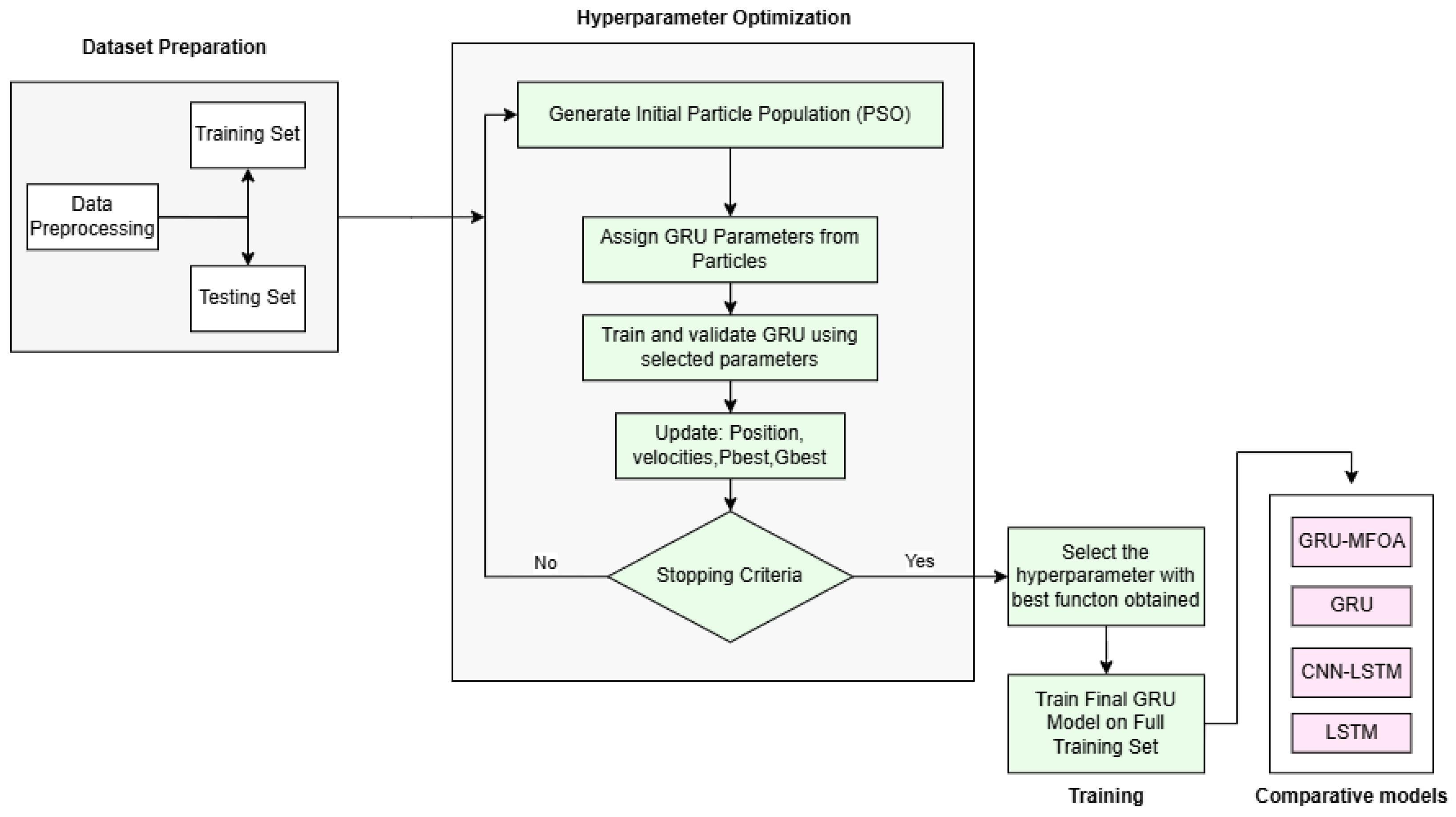
Figure 1. Architecture of the proposed GRU-based PSO model.
Engproc 112 00078 g001
Figure 2. Comparison of the GRU model’s predicted and actual traffic flow values.
Engproc 112 00078 g002
Table 1. PSO search space for GRU hyperparameter optimization.
SymbolParameterSearch RangeType
uNumber of GRU units[32, 256]Integer
η Learning rate[0.0001, 0.01]Continuous
δ Dropout rate[0.1, 0.5]Continuous
bBatch size[16, 128]Integer
LTime-lag window sizeFixed = 10Integer
Table 2. Performance comparison of GRU-based models against baseline methods.
ModelMSEMAERMSER2
GRU (manual)0.00610.05680.07800.8762
GRU-PSO0.00800.06650.08950.8371
GRU-MFOA0.00890.06960.09450.8183
LSTM0.00920.07110.09590.8130
CNN-LSTM0.00910.07060.09540.8150
Disclaimer/Publisher’s Note: The statements, opinions and data contained in all publications are solely those of the individual author(s) and contributor(s) and not of MDPI and/or the editor(s). MDPI and/or the editor(s) disclaim responsibility for any injury to people or property resulting from any ideas, methods, instructions or products referred to in the content.