You are currently viewing a new version of our website. To view the old version click .
Engineering Proceedings
  • Proceeding Paper
  • Open Access

7 November 2025

Optical Chemosensory Studies of Novel Amphiphilic D-A-π-A Benzothiadiazoles for Cyanide Detection †

,
and
Centre of Chemistry, University of Minho, Campus de Gualtar, 4710-057 Braga, Portugal
*
Author to whom correspondence should be addressed.
Presented at the 12th International Electronic Conference on Sensors and Applications, 12–14 November 2025; Available online: https://sciforum.net/event/ECSA-12.
This article belongs to the Proceedings The 12th International Electronic Conference on Sensors and Applications

Abstract

Two positively charged amphiphilic benzothiadiazoles (23), functionalized with 2,3-dimethylbenzo[d]thiazol-3-ium and 2,3-dimethylnaphtho[2,1-d]thiazol-3-ium acceptor moieties, synthesized earlier in our research group, from 7-(4-methoxyphenyl)benzo[c][1,2,5]thiadiazole-4-carbaldehyde (1), were evaluated concerning their optical chemosensory capabilities towards different anions in DMSO and in a DMSO/water (75:25) solution. Spectrophotometric and spectrofluorimetric titrations were performed, demonstrating that both compounds were highly sensitive to cyanide in DMSO. Compound 2 showed fluorescence quenching at 657 nm with 5 equivalents of CN, while compound 3 displayed a decrease in absorption at 480 nm and emission at 666 nm with seven equivalents of CN in DMSO solution. Nevertheless, in the DMSO/water mixture, the sensitivity decreased, requiring 50–70 equivalents of cyanide for fluorescence quenching.

1. Introduction

In recent years, “push-pull” heterocyclic molecules, like donor–π–acceptor (D-π-A) benzothiadiazole derivatives, have drawn significant attention due to their tunable optical and electronic properties. These benzothiadiazoles are particularly interesting in the fields of optoelectronics, optical chemosensing, and bioimaging due to their easy functionalization, high photostability, and biocompatibility [1,2,3,4].
Cyanide ions are highly toxic to humans and the environment, as they interfere with oxygen use. This can lead to cellular death and negatively impacts multiple physiological systems such as the vascular, cardiac, and nervous systems. Symptoms of cyanide poisoning include vomiting, convulsions and, in severe cases, death. Despite its toxicity, cyanide salts remain in use across several industries, such as plastic manufacturing and gold mining [5,6,7].
Considering this, we report the study of the optical chemosensory ability of two “push-pull” benzothiadiazole derivatives, reported recently by us [8], towards different anions in DMSO and in DMSO/water (75:25), demonstrating highly sensitive cyanide detection in DMSO.

2. Materials and Methods

The solvents were of spectroscopic grade and used as received. The ultraviolet and visible absorption spectra (UV/vis) were carried out on a Shimadzu UV-2100 spectrophotometer (Shimadzu Europa GmbH, Duisburg, Germany). The fluorescence emission spectra were obtained on FluoroMax- 4 (HORIBA, Europe GmbH, Darmstadt, Germany). All the fluorescence emission spectra were corrected for the wavelength response of the system. The measurements in solution were obtained using a 1 cm quartz cuvette.

2.1. Synthesis and Photophysical Characterization of Benzothiadiazole Derivatives 1–3

The synthesis and photophysical characterization of precursor 1 and benzothiadiazole derivatives 2 and 3 (Figure 1) have been reported recently by our research group [8].
Figure 1. Chemical structures of precursor 1 and benzothiadiazoles 2 and 3.

2.2. Experimental Procedure for the Chemosensory Studies of Benzothiadiazoles 2 and 3

The evaluation of the chemosensing properties of compounds 2 and 3 was carried out in the presence of several anions (H2PO4, CH3CO2, NO3, ClO4, HSO4, BzO, Br, CN, I, and F) with environmental and biomedical relevance. The solutions of the benzothiadiazole derivatives were prepared in DMSO at a final concentration of 1 × 10⁻⁵ M, and the solutions of anions were prepared in DMSO at a concentration of 1 × 10⁻² M.
The preliminary study was performed, involving the addition of 50 equivalents of each anion to the solution of the compounds.
Considering the results obtained in DMSO solutions, a new test was performed in an aqueous solution. Therefore, solutions of compounds 2 and 3 were prepared from a dilution of the stock solution, with a final concentration of 7.5 × 10⁻⁶ M in a DMSO/water mixture (75:25). The ion solutions used were the same and, similarly, 50 equivalents of each ion were added to the solution of each compound.
The spectrophotometric and spectrofluorimetric titrations were performed according to the results obtained in the preliminary study in both DMSO and a DMSO/water mixture. The compounds and anion solutions were prepared as in the previous study. After successive additions of anion equivalents, the absorption and emission graphics of the compounds were obtained.

3. Results and Discussion

3.1. Photophysical Characterization of Benzothiadiazole Derivatives 1–3

Table 1 presents the photophysical characterization of compounds 13 (Figure 1) in DMSO [8].
Table 1. Spectroscopic data (maximum wavelength of absorption and fluorescence, Stokes’ shift, ∆SS, fluorescence quantum yield, ϕF, and logarithm of the molar absorption coefficient, log ε) for the benzothiadiazole derivatives in DMSO at 293 K.

3.2. Chemosensory Studies of Benzothiadiazoles 2 and 3

3.2.1. Compound 2

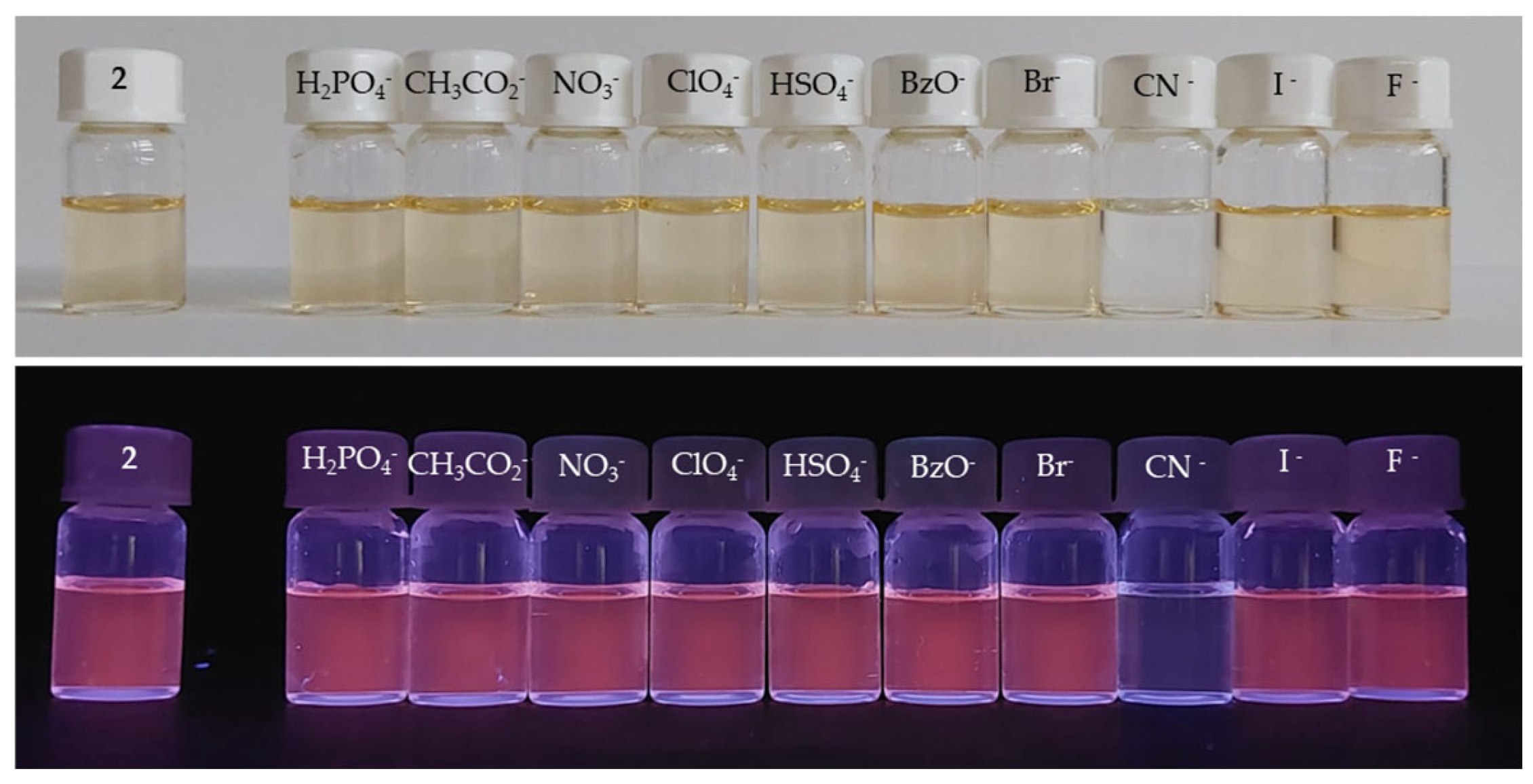
Preliminary chemosensory studies for compound 2 showed a colorimetric and fluorometric response upon addition of 50 equivalents of the anions CH3CO2, CN, and F. Therefore, the solution of the compound changed from orange to colorless and a fluorescence quenching occurred, as can be seen in Figure 2.
Figure 2. Solutions of compound 2 in DMSO under (top) natural light and (bottom) UV radiation at λmax = 312 nm upon addition of 50 equivalents of various anion solutions.
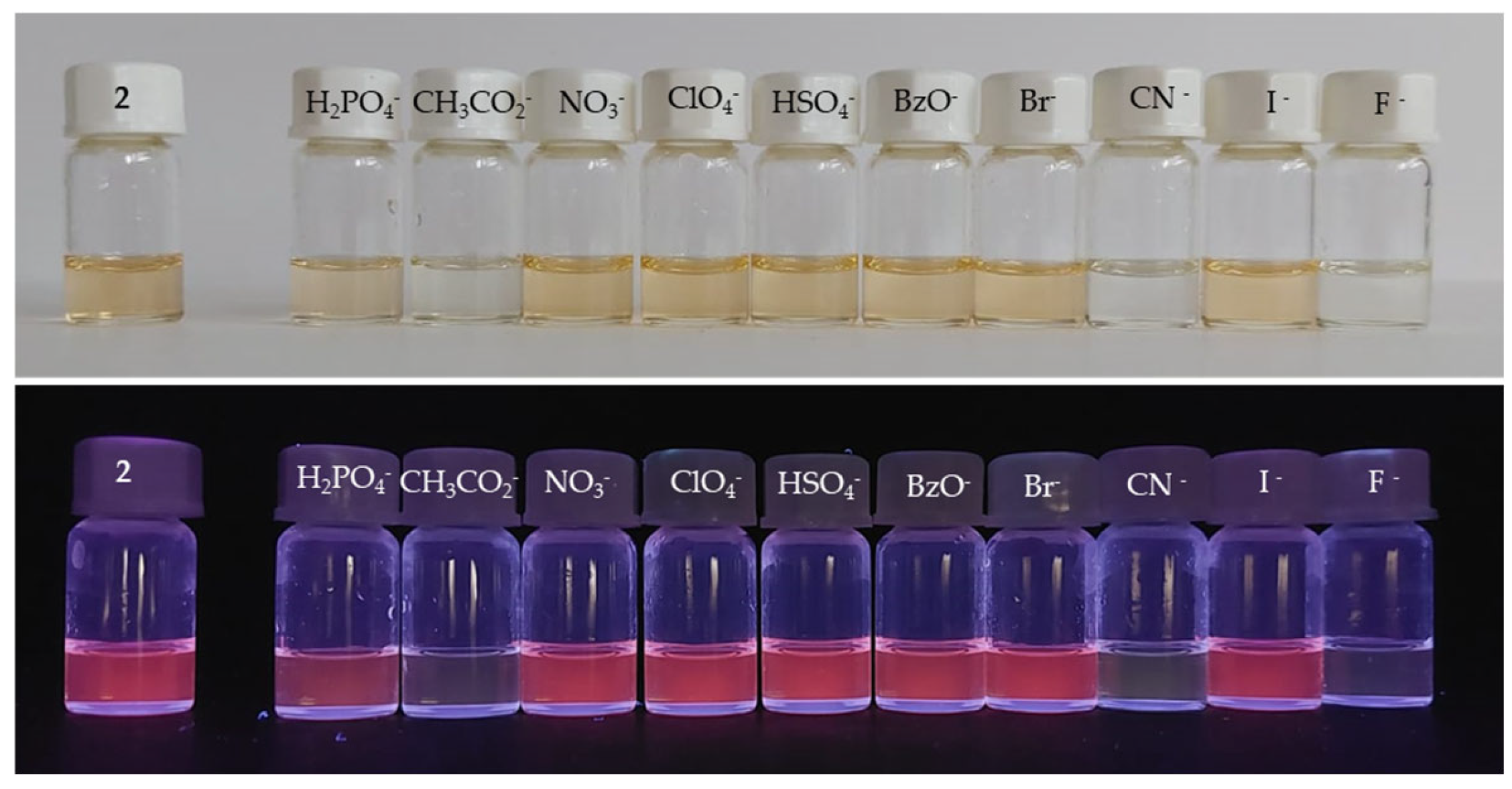
Considering these results, and having in mind potential practical applications, a second preliminary study was performed in a mixture of DMSO/water (75:25). Under these conditions, the interaction of CN with the solution of compound 2 showed a color change from yellow to colorless and under UV light, and additionally, a quenching of fluorescence was also observed (Figure 3).
Figure 3. Solutions of compound 2 in DMSO/water (75:25) under (top) natural light and (bottom) UV radiation at λmax = 312 nm upon addition of 50 equivalents of various anions solutions.
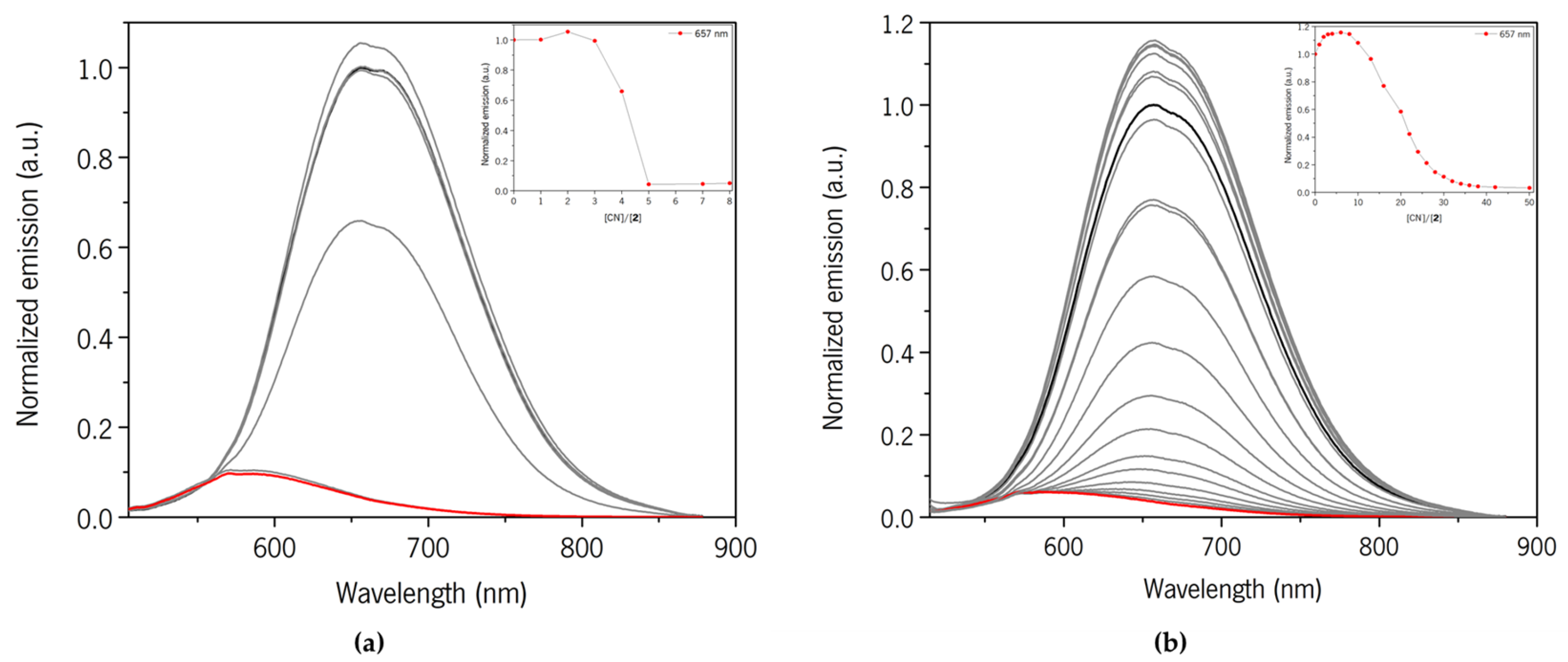
Therefore, spectrophotometric and spectrofluorimetric titrations were performed in DMSO solution with CN. In both cases, after addition of only 5 equivalents of CN, a total decrease in the absorbance values at 465 nm and in the fluorescence intensity at 657 nm was observed. Figure 4a presents a representative example of the spectrofluorimetric titration. In this case, it appears that a displacement of the emission band occurs; however, its intensity does not change with the addition of more equivalents. Subsequently, the spectrofluorimetric titration was performed in DMSO/water (75:25). As can be seen in Figure 4b, the fluorescence intensity decreased with the successive additions of CN, although 50 equivalents were necessary to reach a minimum intensity value. However, at first, the emission intensity increased with the addition of up to 8 equivalents and began to decrease after the addition of 10 equivalents.
Figure 4. (a) Spectrofluorimetric titration of compound 2 with increasing equivalents of CN in DMSO. The inset represents the normalized emission at 657 nm as a function of [CN]/[2]. ([2] = 1 × 10⁻⁵ M, [CN] = 1 × 10⁻² M, λexc = 465 nm, T = 293 K). (b) Spectrofluorimetric titration of compound 2 with increasing equivalents of CN in DMSO/water (75:25). The inset represents the normalized emission at 657 nm as a function of [CN]/[2]. ([2] = 7.5 × 10⁻⁶ M, [CN] = 1 × 10⁻² M, λexc = 465 nm, T = 293 K).

3.2.2. Compound 3

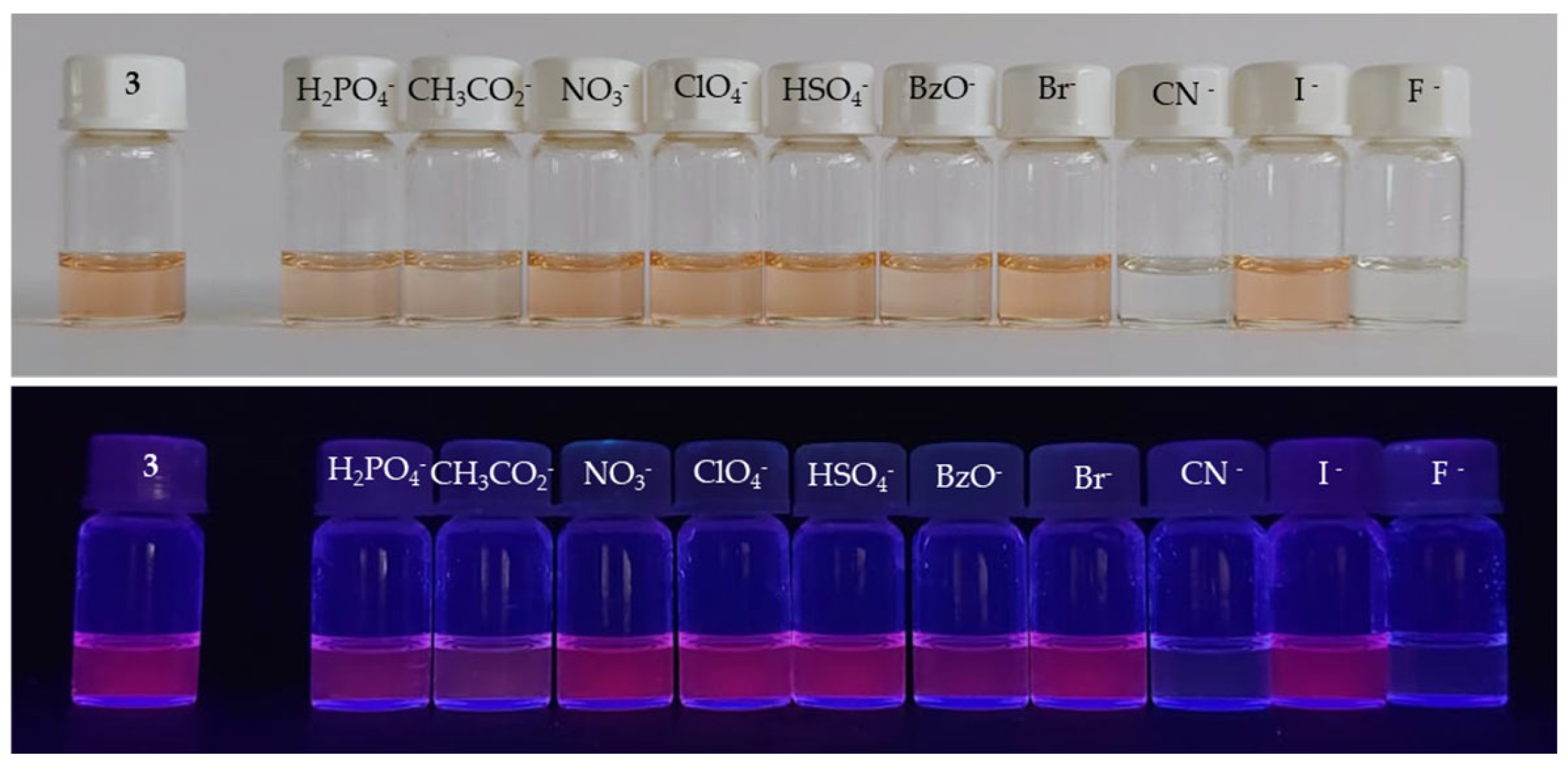
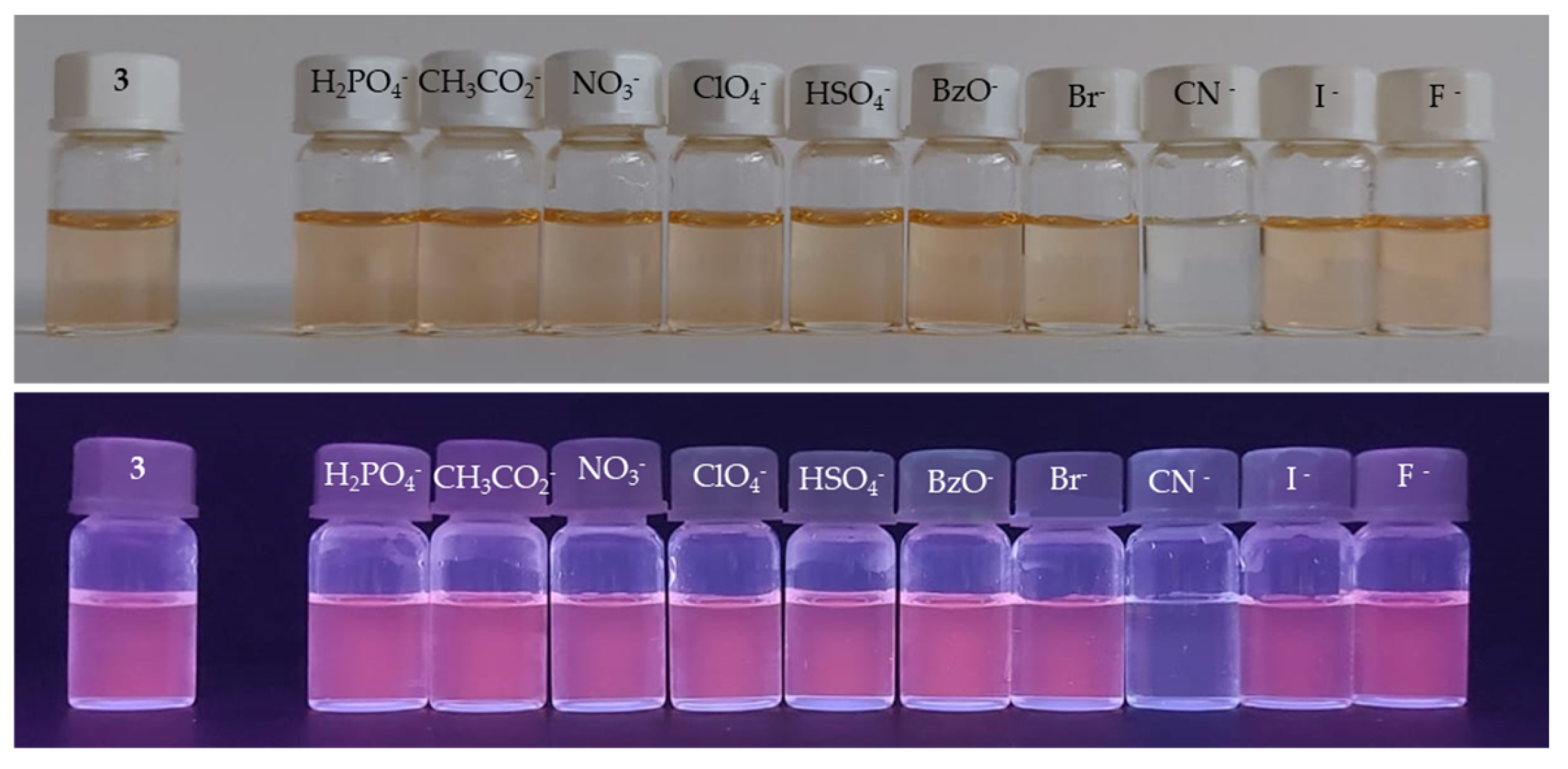
The preliminary chemosensory studies for compound 3 (Figure 5), showed a slight decrease in color and fluorescence of the solution of compound 3 after interaction with CH3CO2. Therefore, upon addition of 50 equivalents of CN and F, the solution of 3 changed from orange to colorless and a fluorescence quenching was also observed.
Figure 5. Solutions of compound 3 in DMSO under (top) natural light and (bottom) UV radiation at λmax = 312 nm upon addition of 50 equivalents of various anions solutions.
Having in mind the potential practical applications, the interaction of compound 3 with the same anion solutions was also performed in DMSO/water (75:25). In this aqueous mixture, the compound only interacts with CN, changing the solution’s color from yellow to colorless, and a decrease in the fluorescence was also observed (Figure 6).
Figure 6. Solutions of compound 3 in DMSO/water (75:25) under (top) natural light and (bottom) UV radiation at λmax = 312 nm upon addition of 50 equivalents of various anion solutions.
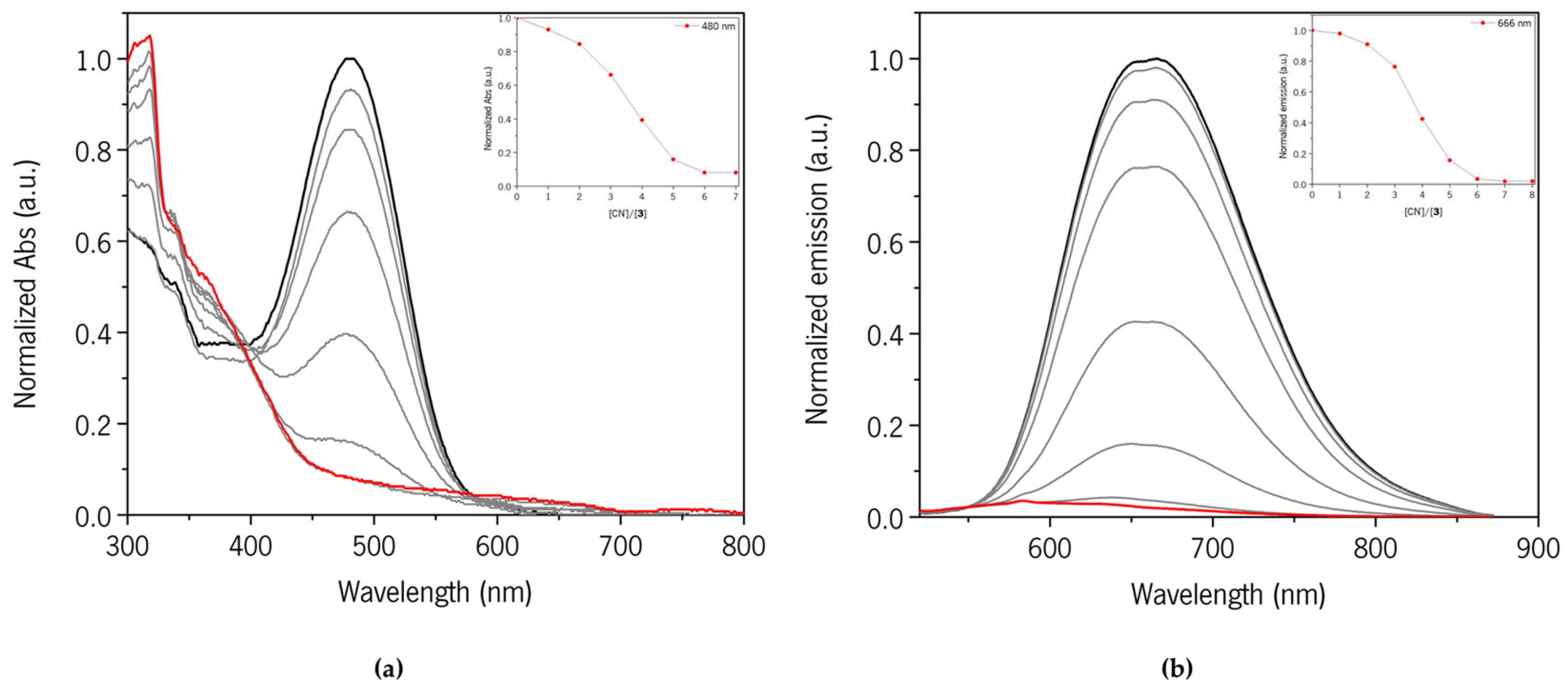
Therefore, spectrophotometric and spectrofluorimetric titrations were also performed in DMSO for CN. In both titrations, upon the successive addition of equivalents, the intensity of each band decreased at 480 nm (Figure 7a) and 666 nm (Figure 7b), respectively, reaching the lowest intensity with only 7 equivalents of CN. A spectrofluorimetric titration was also conducted in DMSO/water (75:25) with the same anion. As for benzothiadiazole derivative 2, in the DMSO/water mixture, compound 3 was also less sensitive to CN additions, with an increase in emission intensity up to around 40 equivalents, and only then was a decrease to the minimum emission value observed with 76 equivalents of CN. This phenomenon may be attributed to the aqueous environment acting as a competitive medium, which inhibits the interaction between the compound and the analyte.
Figure 7. Spectrophotometric (a) and spectrofluorimetric (b) titrations for compound 3 with increasing equivalents of CN in DMSO. The insets represent the normalized absorbance and normalized emission at 480 nm and 666 nm as a function of [CN]/[3], respectively. ([3] = 1 × 10⁻⁵ M, [CN] = 1 × 10⁻² M, λabs = 480 nm, λexc = 480 nm, T = 293 K).

4. Conclusions

This work reports the optical chemosensory studies of two positively charged D-π-A amphiphilic benzothiadiazoles, 2 and 3. The recognition behavior of these compounds was investigated in the presence of different anions in DMSO and in DMSO/water (75:25). The results from the spectrophotometric and spectrofluorimetric titrations in organic media for compounds 2 and 3 demonstrated a high sensitivity towards cyanide, with minimum absorption and fluorescence values being reached with only 5 and 7 equivalents, respectively. In the aqueous media, this sensitivity decreased for both compounds, with an initial increase in fluorescence intensity, followed by a decrease after the addition of more equivalents of CN.

Author Contributions

Conceptualization, M.M.M.R. and M.L.B.; methodology, M.M.M.R. and M.L.B.; validation, M.M.M.R., M.L.B. and S.P.G.C.; formal analysis, M.M.M.R., M.L.B. and S.P.G.C.; investigation, M.L.B.; resources, M.M.M.R. and S.P.G.C. data curation, M.L.B. and M.M.M.R.; writing—original draft preparation, M.L.B.; writing—review and editing, M.M.M.R., M.L.B. and S.P.G.C.; visualization, M.L.B.; supervision, M.M.M.R. and S.P.G.C.; project administration, M.M.M.R. and S.P.G.C.; funding acquisition, M.M.M.R. and S.P.G.C.; All authors have read and agreed to the published version of the manuscript.

Funding

This research was funded by the Portuguese Foundation for Science and Technology (FCT) in the framework of the Strategic Funding to Centro de Química da Universidade do Minho (CQ-UM, UID/00686/2025).

Institutional Review Board Statement

Not applicable.

Data Availability Statement

Data is contained within the article.

Conflicts of Interest

The authors declare no conflicts of interest.

References

  1. Chua, M.H.; Zhu, Q.; Tang, T.; Shah, K.W.; Xu, J. Diversity of Electron Acceptor Groups in Donor–Acceptor Type Electrochromic Conjugated Polymers. Sol. Energy Mater. Sol. Cells 2019, 197, 32–75. [Google Scholar] [CrossRef]
  2. Ersoy, G.; Henary, M. Roadmap for Designing Donor-π-Acceptor Fluorophores in UV-Vis and NIR Regions: Synthesis, Optical Properties and Applications. Biomolecules 2025, 15, 119. [Google Scholar] [CrossRef] [PubMed]
  3. He, H.; Meng, X.; Deng, L.; Sun, Q.; Huang, X.; Lan, N.; Zhao, F. A Novel Benzothiadiazole-Based and NIR-Emissive Fluorescent Sensor for Detection of Hg2+ and Its Application in Living Cell and Zebrafish Imaging. Org. Biomol. Chem. 2020, 18, 6357–6363. [Google Scholar] [CrossRef] [PubMed]
  4. Sun, Y.T.; Zhang, C.; Gao, L.X.; Liu, M.M.; Yang, Y.; Shao, A.; Zhou, Y.B.; Zhu, Y.L.; Li, J.; Wang, W.L. Design, Synthesis and Evaluation of Fluorescent Properties of Benzothiazole Derivatives. ChemPhysChem 2023, 24, e202300159. [Google Scholar] [CrossRef] [PubMed]
  5. Chao, J.; Li, Z.; Zhang, Y.; Huo, F.; Yin, C.; Liu, Y.; Li, Y.; Wang, J. A Single Fluorescent Probe for Multiple Analyte Sensing: Efficient and Selective Detection of CN, HSO3 and Extremely Alkaline pH. J. Mater. Chem. B 2016, 4, 3703–3712. [Google Scholar] [CrossRef] [PubMed]
  6. Gwon, S.Y.; Rao, B.A.; Kim, H.S.; Son, Y.A.; Kim, S.H. Novel Styrylbenzothiazolium Dye-Based Sensor for Mercury, Cyanide and Hydroxide Ions. Spectrochim. Acta—Part A Mol. Biomol. Spectrosc. 2015, 144, 226–234. [Google Scholar] [CrossRef] [PubMed]
  7. Zhai, B.; Hu, Z.; Peng, C.; Liu, B.; Li, W.; Gao, C. Rational Design of a Colorimetric and Fluorescence Turn-on Chemosensor with Benzothiazolium Moiety for Cyanide Detection in Aqueous Solution. Spectrochim. Acta—Part A Mol. Biomol. Spectrosc. 2020, 224, 117409. [Google Scholar] [CrossRef] [PubMed]
  8. Boland, M.; Pinto, S.; Gomes-da-Silva, L.C.; Pina, J.; Costa, S.P.G.; Raposo, M.M.M. Synthesis, Photophysical and Spectroscopic Characterization of Amphiphilic D-A-π-A Benzothiadiazoles. Dyes Pigm. 2025, 240, 112825. [Google Scholar] [CrossRef]
Disclaimer/Publisher’s Note: The statements, opinions and data contained in all publications are solely those of the individual author(s) and contributor(s) and not of MDPI and/or the editor(s). MDPI and/or the editor(s) disclaim responsibility for any injury to people or property resulting from any ideas, methods, instructions or products referred to in the content.

Article Metrics

Citations

Article Access Statistics

Multiple requests from the same IP address are counted as one view.