


Abstract
The need for an accurate, rapid, and affordable method for determining nitrite ions arises from their toxic effects on humans at elevated levels in wastewater and drinking water. The electrochemical determination is faster, cheaper, and less labor-intensive. It is based on the study of the electrochemical oxidation of NO2− ions at different carbon electrodes. In this work, it was established that the cyclic voltammograms for the ISEM-3 graphite electrode have an excellent limit of detection for nitrite ions: 5 × 10⁻⁶ M at pH 3, which makes it possible to determine the NO2− content below the maximum permissible concentration (6.5 × 10⁻⁵ M) in water.
1. Introduction
Nitrite, an important intermediate in the nitrogen cycle in ecosystems, performs many functions in various industries: It is used in agriculture as fertilizer and in various food products as a preservative in the production and processing of pickled meat and fish products; it is also found in tap water and biological samples [1,2]. Excessive nitrite content harms the environment and has a negative impact on human health [1]. As a result of the interaction of nitrites with amine compounds in the human body, the content of carcinogenic nitrosamines increases, which causes serious health problems, including cancer of the stomach and esophagus, and congenital disabilities of the central nervous system [2]. NO2− ions also promote the conversion of hemoglobin into methemoglobin, which can lead to a serious illness [3].
Therefore, in recent decades, the determination of nitrites by quantitative analysis has been of considerable interest. The World Health Organization has established that the limit value for nitrite concentration in drinking water is only 3.0 mg L−1, and for fisheries and reservoirs the norm is 0.08 mg L−1 [1]. However, most determination methods have limitations, such as the use of hazardous reagents, the need for a time-consuming sample preparation procedure that requires technical personnel and expensive equipment [3]. Electrochemical methods (cyclic voltammetry, amperometry, coulometry, potentiometry) offer significant advantages over traditional analytical methods, including cost-effectiveness, speed, and ease of operation [2,4]. The electrochemical sensors show high selectivity to NO2− in the presence of the interference of some common ions (e.g., NO3−, CO32−, SO42−, Cl−, Ca2+, and Mg2+) and oxidizable compounds, including sodium sulfite and ascorbic acid [5]
In the electrochemical detection of nitrite ions, the most sensitive mechanism is based on the direct electrocatalytic oxidation of the nitrite ion at the electrode surface, resulting in the formation of nitrate [2]. The rate of the oxidation reaction and the oxidation potential depend on the kinetics of electron transfer and the electroactive ability of the electrode materials [6]. The oxidation of nitrite ions is shown by the following reaction in acidic and alkaline environments:
HNO2 + H2O − 2e− = NO3− + 3H+ E0 = 0.94 V vs. RHE
NO2− + 2OH− − 2e− = NO3− + H2O E0 = 0.01 V vs. RHE
The recent developments for electrochemical detection of nitrate, nitrite, and ammonium are discussed, and the critical examination of current nitrate, nitrite, and ammonium studies as realistic monitoring processes is presented in the short modern review [7].
Due to the use of various functional nanomaterials in electrochemical sensors, the sensitivity and accuracy of electrochemical measurements are significantly increased, which is of great importance for the field of analytical chemistry [6,8,9]. Carbon materials as a nitrite ion sensor have a number of advantages: Good electrical conductivity, low cost, ease of use, wear resistance, and stability in various environmental conditions. Various carbon-based electrodes for the determination of nitrite ions have been extensively studied in recent years: glassy carbon [10], glassy carbon modified with polyvinylimidazole [11], and multi-walled carbon nanotubes [12].
In most studies, the nitrite ion determination reaction was carried out on glassy carbon-based materials, but the oxidation of nitrite on a bare graphite electrode has been less studied. In addition, there is little data on a full-fledged study of graphite across a wide range of nitrite ion concentrations and electrolyte pH.
Thus, the aim of this work is the electrochemical determination of nitrite ions on a graphite electrode, and the tasks included: screening of carbon electrodes (graphite and glassy carbon and graphite modified with Ag particles) using cyclic voltammetry to determine nitrite ions; determination of the detection limit of nitrite ions in solutions; determination of the area of linear dependence of current-concentration at concentrations of nitrite ions in the maximum concentration range.
2. Materials and Methods
The ISEM-3 graphite was used as the main working electrode. The oxidation of nitrite ion was studied by cyclic voltammetry. The synthesis of an additional graphite electrode with electrodeposited Ag particles was carried out at constant potential, and the electrode was characterized by SEM. All reagents (AgNO3, NaNO2) used were of analytical grade, unless otherwise indicated. Distilled water was used to prepare all reagents and solutions.
The Autolab 302N potentiostat–galvanostat equipped with Nova 2.1.7 (Metrohm, Herisau City, Netherlands-Switzerland) software was used for all electrochemical experiments. The silver chloride electrode (Ag/AgCl) served as a reference electrode, and the auxiliary electrode was a platinum plate (S = 2 cm2). A three-electrode standard electrochemical cell was filled with 50 mL of electrolyte and degassed with Ar (99.999%) for 30 min. The polarization curves were recorded by cyclic voltammetry (CV) with a scanning rate specified in the following sections. Cyclic voltammograms were measured without mixing.
The carbon-containing materials under study were the working electrode. The geometric surface area (in the form of a disk) was as follows: 0.198 cm2 (ISEM-3 graphite), 0.097 cm2 (glassy carbon), 0.18 cm2 (graphite coated with electrodeposited Ag particles). ISEM-3 graphite and glassy carbon electrodes were used as is, and graphite coated with electrodeposited Ag particles was prepared according to the original technique: Ag particles were deposited potentiostatically (−0.6 V vs. Ag/AgCl) from a solution containing 5 mM AgNO3 in 0.1 M KNO3 for 300 s.
3. Results and Discussion
3.1. Determination of Nitrite Ions on Various Types of Carbon Electrodes
This study demonstrates that a graphite electrode is well-suited for the determination of nitrite ion in aqueous solutions using cyclic voltammetry at different pH levels of electrolytes, and the limit of detection (LOD) was 5 µM. The oxidation of nitrite ion is compared with the electrodes: glassy carbon (GC), ISEM-3 graphite, and graphite coated with electrodeposited Ag-particles. The studies showed that the graphite electrode exhibited high sensitivity over a wide range of solution pH (1−10). The best results and the minimum NO2− detection concentration were achieved at pH 3.
Figure 1 shows the voltammograms for the determination of nitrite ions for three electrode samples at the test boundary concentrations. For both high and low concentrations of nitrite ions, the ISEM-3 graphite sample shows the most pronounced peak. The graphite coated with electrodeposited Ag-particles shows the highest sensitivity at high concentrations but is inferior at low concentrations. For the GC sample, the peaks are not clearly pronounced at any of the concentrations studied.
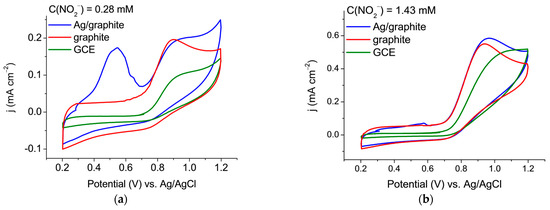
Figure 1.
(a,b) Cyclic voltammograms of graphite, modified Ag-particles, ISEM-3 graphite, and glassy-carbon electrode (GCE) in the presence of 0.28 mM and 1.43 mM nitrite (buffer system at pH 3 with 50 mV s−1 scan rate).
3.2. Determination of Nitrite Ions on ISEM-3 Graphite Electrode Sensor
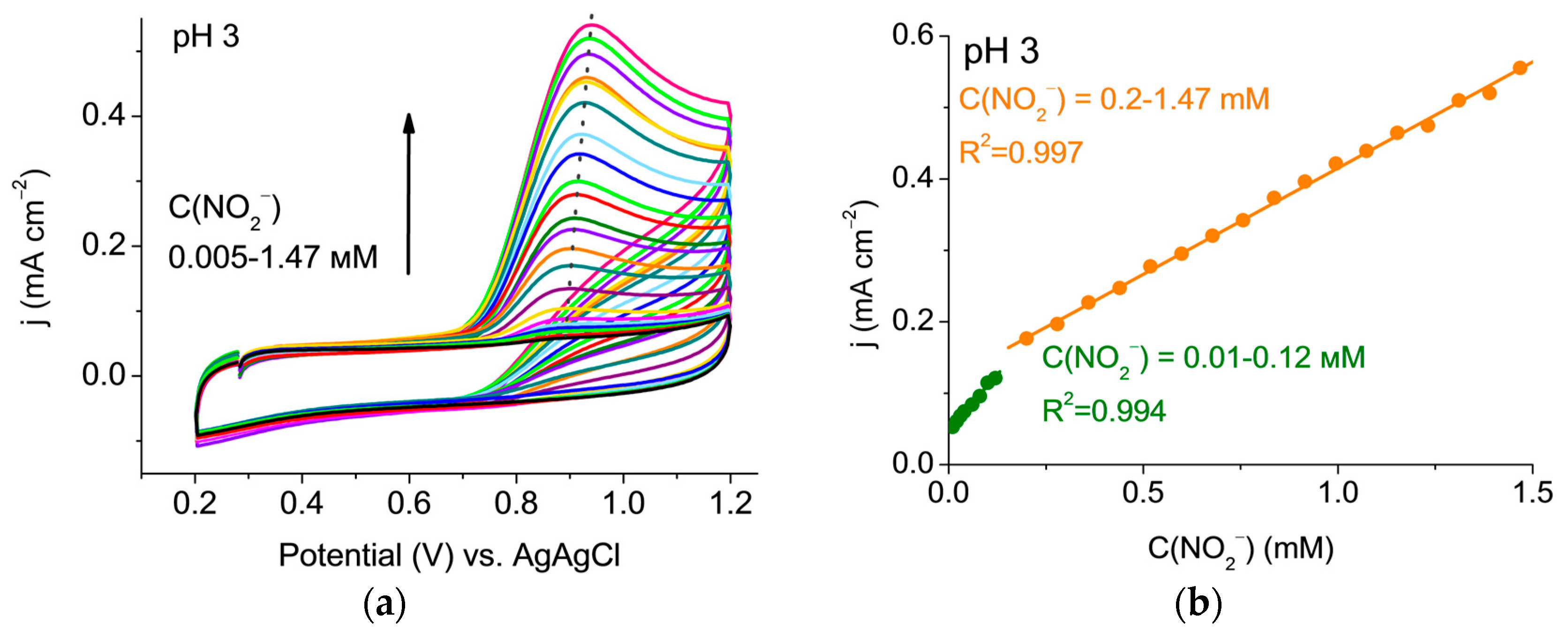
An excellent, pronounced peak for nitrite ion oxidation when using the ISEM-3 graphite electrode is shown in Figure 2a. With increasing concentrations, only a slight potential shift occurs, and the clearly linear dependence of the peak current density on an increase in nitrite ion concentrations, which is illustrated in Figure 2b.
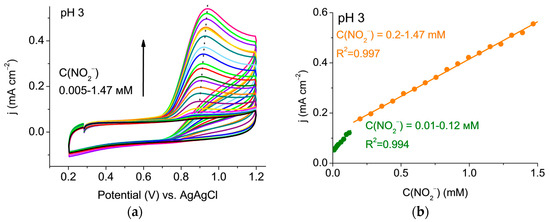
Figure 2.
(a) Cyclic voltammograms of ISEM-3 graphite electrode sensor at different concentrations of nitrite at 50 mV s−1 scan rate in buffer system at pH 3; (b) corresponding fitting curves for the oxidation peak current vs. concentration of nitrite ions.
3.3. Scan Rate Study
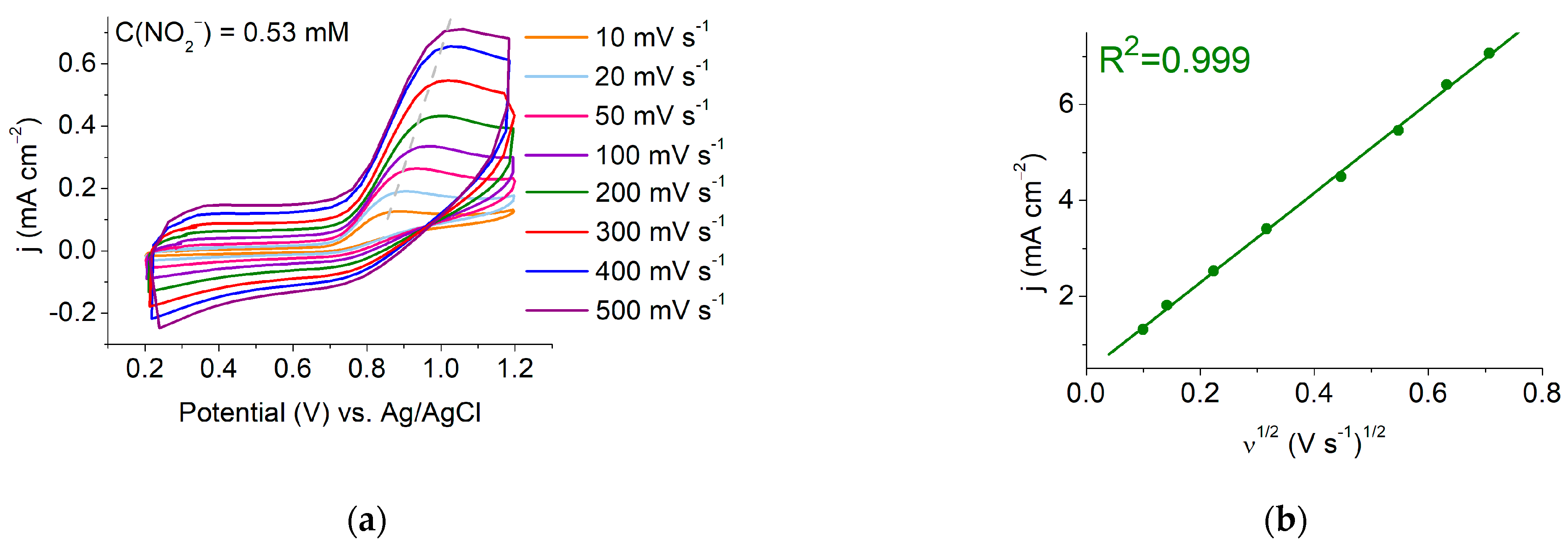
In the final part of our study, cyclic voltammogram measurements were carried out over a wide range of potential scan rates (Figure 3a). The linear dependence of the peak current density on the square root of the potential scanning rate is proof of a diffusion-controlled process (Figure 3a).
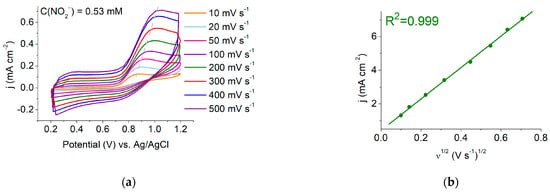
Figure 3.
(a) Cyclic voltammograms of ISEM-3 graphite electrode sensor at different scan rates in the presence of 0.53 mM concentration of nitrite in the buffer system at pH 3; (b) corresponding fitting curve for the oxidation peak current vs. the square root of scan rate.
The interference of potentially interfering ions in real water is NO3−, CO32−, SO42−, Cl−. Based on the study of the electrooxidation of nitrite in solutions with different pH, it can be concluded that 100-fold Ca2+, SO42−, K+, PO43−, CO32−, NO3−, Cl−, and plenty of Ac− and Na+ do not affect the accuracy of nitrite ion determination. An application to a water sample in this work was not carried out.
4. Conclusions
By using the CV method, it was found that the ISEM-3 graphite electrode has excellent sensitivity to nitrite ions in aqueous solution, and its use for the determination of nitrite ions in solutions is possible in a wide range of pH values (1–10), the best of which was pH 3. The LOD for a graphite electrode is 5 × 10⁻⁶ M at pH 3, which makes it possible to determine the NO2− content below the maximum permissible concentration (6.5 × 10⁻⁵ M) in water.
As a perspective for our future work, it can be assumed that graphite- and glassy-carbon-based electrodes can be optimized by modifying with carbon nanotubes, which, according to literature data and preliminary experiments, can further enhance sensitivity to nitrite ions.
Author Contributions
Conceptualization, D.K., O.L., I.K., and L.K.; methodology, D.K., I.K., and O.L.; investigation, I.K., O.P., and D.K.; writing—original draft preparation, O.L., I.K., D.K., and O.L.; writing—review and editing, D.K. and I.K.; supervision, L.K. All authors have read and agreed to the published version of the manuscript.
Funding
The authors express their acknowledgements to the Russian National Research Projects No. AAAA-A21–122040600057-3 and No. AAAA-A21-121011590083-9.
Institutional Review Board Statement
Not applicable.
Informed Consent Statement
Not applicable.
Data Availability Statement
The original contributions presented in this study are included in the article. Further inquiries can be directed to the corresponding author.
Conflicts of Interest
The authors declare no conflicts of interest.
References
- Sheikh, T.; Nagendran, V.; Vasant, K.S.; Mallya, U.; Mutalik, S.; Khan, F.; Nayak, S.; Sudhakara, S.M. Acacia Auriculiformis Mediated Synthesis of Silver Nanoparticles for the Sensitive and Rapid Electrochemical Sensing of Nitrite in Water Sample. Microchem. J. 2025, 211, 113162. [Google Scholar] [CrossRef]
- Li, G.; Xia, Y.; Tian, Y.; Wu, Y.; Liu, J.; He, Q.; Chen, D. Review—Recent Developments on Graphene-Based Electrochemical Sensors toward Nitrite. J. Electrochem. Soc. 2019, 166, B881–B895. [Google Scholar] [CrossRef]
- Hefnawy, M.A.; Abdel-Gaber, R.; Gomha, S.M.; Zaki, M.E.A.; Medany, S.S. Green Synthesis of Cobalt Oxide Decorated Chitosan Substrates for Electrochemical Detection of Nitrite and Hydrogen Evolution Reactions. Electrocatalysis 2024, 15, 496–506. [Google Scholar] [CrossRef]
- Gajdár, J.; Rodrigues Gaspar, S.; Almeida, M.G. Trends in Nitrite Detection: Recent Advances in Electrochemical Sensor Technologies. TrAC Trends Anal. Chem. 2025, 183, 118105. [Google Scholar] [CrossRef]
- Mo, R.; Wang, X.; Yuan, Q.; Yan, X.; Su, T.; Feng, Y.; Lv, L.; Zhou, C.; Hong, P.; Sun, S.; et al. Electrochemical Determination of Nitrite by Au Nanoparticle/Graphene-Chitosan Modified Electrode. Sensors 2018, 18, 1986. [Google Scholar] [CrossRef] [PubMed]
- Li, X.; Ping, J.; Ying, Y. Recent Developments in Carbon Nanomaterial-Enabled Electrochemical Sensors for Nitrite Detection. TrAC Trends Anal. Chem. 2019, 113, 1–12. [Google Scholar] [CrossRef]
- Tan, J.F.; Anastasi, A.; Chandra, S. Electrochemical Detection of Nitrate, Nitrite and Ammonium for on-Site Water Quality Monitoring. Curr. Opin. Electrochem. 2022, 32, 100926. [Google Scholar] [CrossRef]
- Ramesh, A.; Sahu, P.K.; Duvvuri, S.; Subrahmanyam, C. MnCo2O4 Spinel Nanorods for Highly Sensitive Electrochemical Detection of Nitrite. Inorg. Chem. 2024, 63, 9941–9952. [Google Scholar] [CrossRef] [PubMed]
- Nethravathi, P.C.; Suresh, D.; Manjula, M.V.; Devaraja, S.; Mohan, S. Ag-Cu2O Decorated Reduced Graphene Oxide Nanocomposite for Photocatalytic Water Splitting, Methylene Blue Dye Degradation, Electrochemical Nitrite Sensing, Photoluminescence and Selected Biological Applications. Biomass Convers. Biorefinery 2024, 14, 5711–5734. [Google Scholar] [CrossRef]
- Kozub, B.R.; Rees, N.V.; Compton, R.G. Electrochemical Determination of Nitrite at a Bare Glassy Carbon Electrode; Why Chemically Modify Electrodes? Sens. Actuators B 2010, 143, 539–546. [Google Scholar] [CrossRef]
- Yildiz, G.; Oztekin, N.; Orbay, A.; Senkal, F. Voltammetric Determination of Nitrite in Meat Products Using Polyvinylimidazole Modified Carbon Paste Electrode. Food Chem. 2014, 152, 245–250. [Google Scholar] [CrossRef] [PubMed]
- Kuralay, F.; Dumangöz, M.; Tunç, S. Polymer/Carbon Nanotubes Coated Graphite Surfaces for Highly Sensitive Nitrite Detection. Talanta 2015, 144, 1133–1138. [Google Scholar] [CrossRef] [PubMed]
Disclaimer/Publisher’s Note: The statements, opinions and data contained in all publications are solely those of the individual author(s) and contributor(s) and not of MDPI and/or the editor(s). MDPI and/or the editor(s) disclaim responsibility for any injury to people or property resulting from any ideas, methods, instructions or products referred to in the content. |
© 2025 by the authors. Licensee MDPI, Basel, Switzerland. This article is an open access article distributed under the terms and conditions of the Creative Commons Attribution (CC BY) license (https://creativecommons.org/licenses/by/4.0/).