1. Introduction
Heap leaching is a hydrometallurgical process for recovering metals such as copper from mined orebody by stacking crushed material on an impermeable pad and percolating it with a chosen lixiviant that dissolves target species for downstream recovery such as Solvent Extraction-Electrowinning (SX–EW). Its appeal stems from comparatively low capital and operating costs and its suitability for low-grade resources that are uneconomic for conventional milling and smelting [
1]. Consequently, the process is inherently complex because overall performance reflects the interplay between physico-chemical factors such as ore mineralogy and texture, solution chemistry and lixiviant concentration, pH, hydraulic motion permeability, irrigation rate, and operational conditions, which are not limited to leaching residence time and reaction temperature. Maintaining a suitably acidic environment often in a pH approximately between 1.5 and 1.8 range for copper systems is essential to keep copper in solution while controlling gangue dissolution and acid consumption [
2].
Among the controllable operating conditions, the crush size, which includes the particle size of the stacked orebody, is very influential in this pre-conditioning reaction step. Finer particles increase specific surface areas and shorten diffusion paths, which can accelerate dissolution kinetics and raise extraction; however, they also elevate comminution consumption energy, may reduce heap permeability, and can increase acid consumption through enhanced gangue attack [
3,
4]. In addition, coarser material preserves permeability and lowers comminution operating costs, but can limit copper exposure and slow kinetics. Consequently, an economic optimum rather than the finest possible size usually exists. Previously conducted studies reported improved copper extraction as crusher product size decreased, while supporting the contention that the overall amenability of the copper dissolution process is primarily dependent on the nature of the orebody [
5].
Optimization of comminution product particle size is further complicated by ore-specific characteristics and often attributed to the degree of liberation, alteration, high-refractory, and semi-refractory copper minerals, and by lixiviant ion interactions with other operating parameters such as lixiviant solution irrigation rate, solution leaching residence time, and pH control. For instance, changing crusher product size results in the pore size distribution and increased surface area of the particles of the orebody of the heap, which in turn affects acid distribution lixiviant accessibility and the balance between reaction-controlled and diffusion-controlled leaching stages. As easily accessible copper dissolves faster in the absence of pregnant solution robbers and their weaker potential, leaching can transition to slower intra-particle diffusion regimes, making sustained pH control and acid consumption critical to maintain extraction without excessive reagent use, which is sometimes attributed to the presence of pregnant solution robbers. These couplings mean that identifying the optimal crusher product particle size requires an integrated assessment of leaching kinetics, permeability, and reagent efficiency rather than single-factor optimization [
6].
Consequently, this study focuses on quantifying how varying crusher product size influences copper extraction efficiency, acid consumption, and leach solution chemistry using bottle roll leaching tests and 2 m heap column leaching experiments under controlled pH and lixiviant irrigation rate. The main objective was to evaluate copper extraction relationships, determine an optimal crusher product particle size for the tested orebodies, which in turn will highlight operational implications, and research endeavours needed for industrial heap leaching practice [
7].
2. Materials and Methods
Two copper ore samples were screened at 25 mm, 12.5 mm, and 8 mm. Upon receipt sub-samples were crushed to −1.8 mm for head chemical analysis. Each particle size fraction was subjected to bottle roll and column leach tests. Further screening and grading were achieved via screening through particle size fractions from 16 mm down to 1.18 mm. Each particle size was analysed for copper content to assess mineral distribution. Bottle roll leaching test work was conducted in 5 kg aliquots rolled with acidified water (pH 1.5–1.8). Solutions were sampled daily for copper and free acid analysis. Column heap leaching test works were conducted in 2 m columns of 150 mm diameter, 40 kg ore per test. Acid pre-treatment, curing, and lixiviant irrigation rate was kept at 10 L/h/m2. Copper tenor, pH, acid consumption, and slump monitored were closely monitored over 45 days. Intensive leaching was also done where finer grind size of 80% passing −300 µm was subjected to 8 h leaching at pH 1.5. Residues and filtrates were analysed for multi-element composition using X-Ray Flourescence (XRF) and Atomic Absorption Spectrometry (AAS) characterization techniques.
3. Results and Discussion
3.1. Copper Recovery Trends in Various Ore Samples and Leaching Times
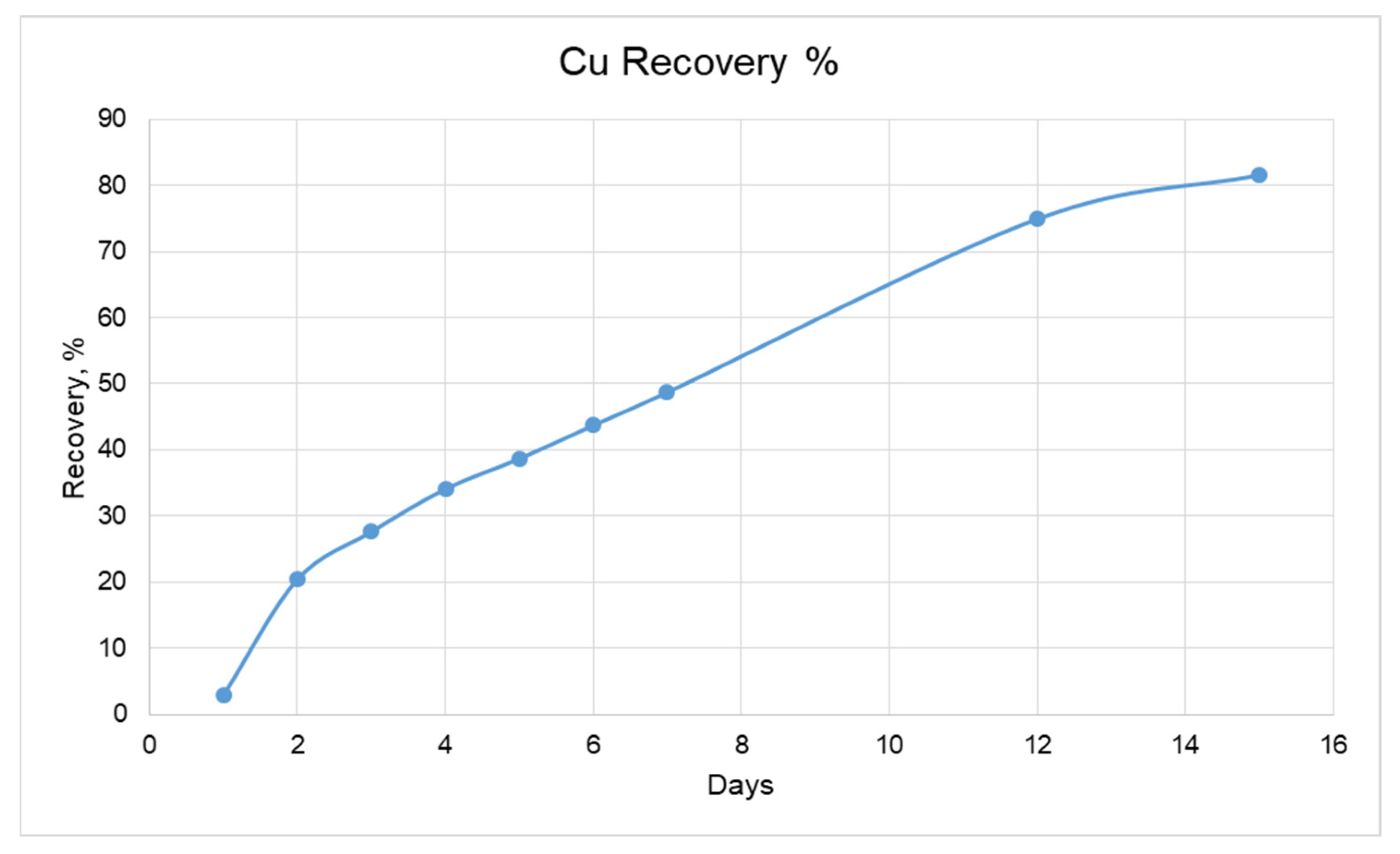
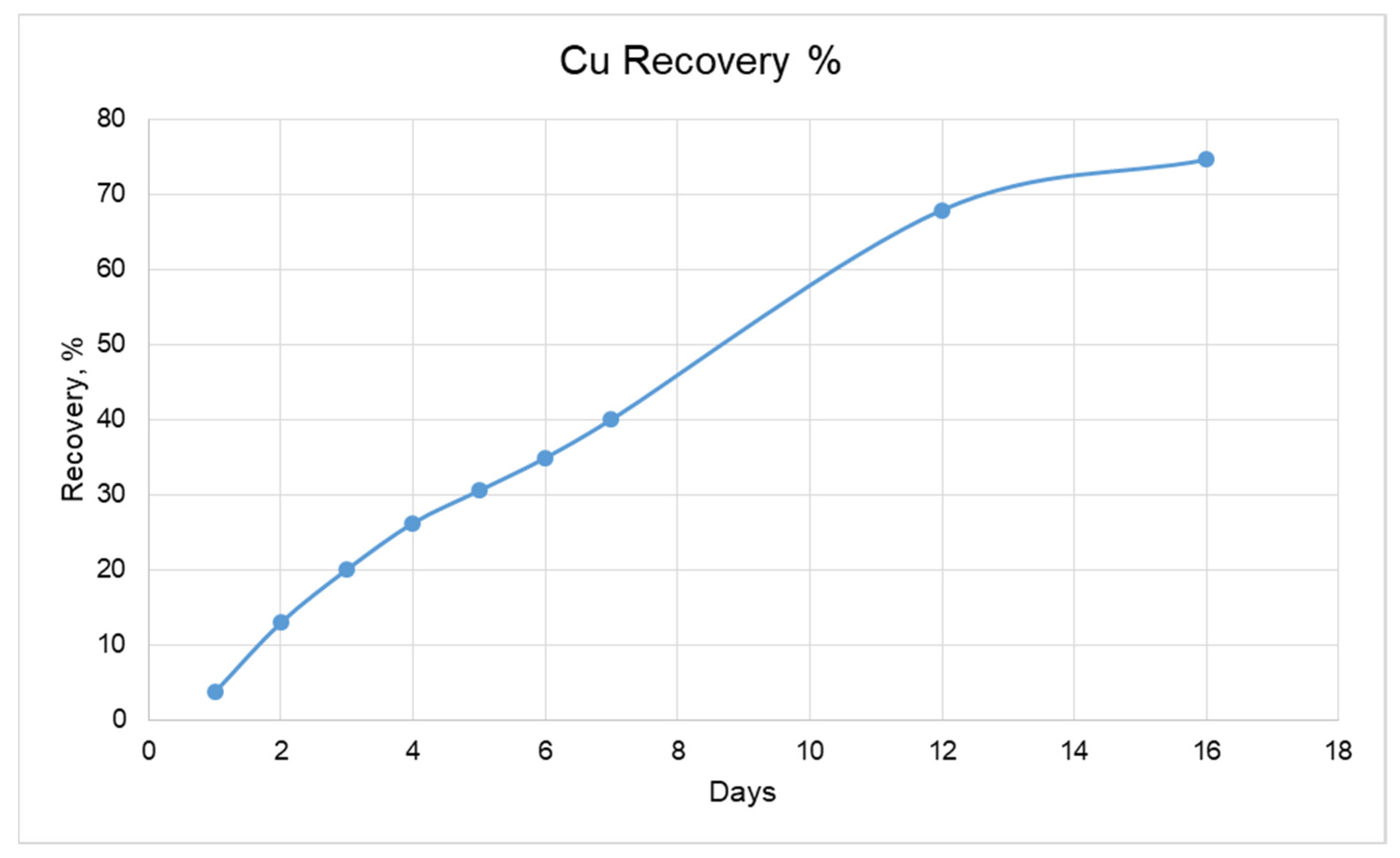
Figure 1 and
Figure 2 represent copper recovery in a leaching campaign of 15 and 16 days respectively using different ore types. It was observed that both ores have similar exponential increase in copper recoveries of up to 74% and 82%, respectively.
In
Figure 1 and
Figure 2 copper recovery from the low-grade ore climbs rapidly to 44% by day 6 before significantly increasing toward 82% by day 15. Such two-stage curves are characteristic of heap/column leaching, which is an initial reaction-controlled phase where abundant strong acid penetrates fresh mineral particle surfaces [
8]. The positive linkage between higher acid consumption and higher recovery is attributed to neutralization of acid by unwanted gangue minerals such as calcite/dolomite, clays such as aluminosilicates, Fe–Mg solid solutions, and secondary side reactions that consume the lixiviant but enable further copper dissolution [
9]. Additionally, the 82% copper recovery indicates diminishing returns unless critical operating conditions are adjusted where options include pre-conditioning acid addition and agglomeration to pre-arrest unwanted gangue, while optimizing particle-size distribution (PSD) to reduce diffusion barriers, managing aeration and oxidation to sustain ferric ions and acid supply, and this is usually achieved by bio-augmentation or temperature control to sustain kinetics [
10].
3.2. Acid Consumption Rates by Different Ore Samples and Leaching Times
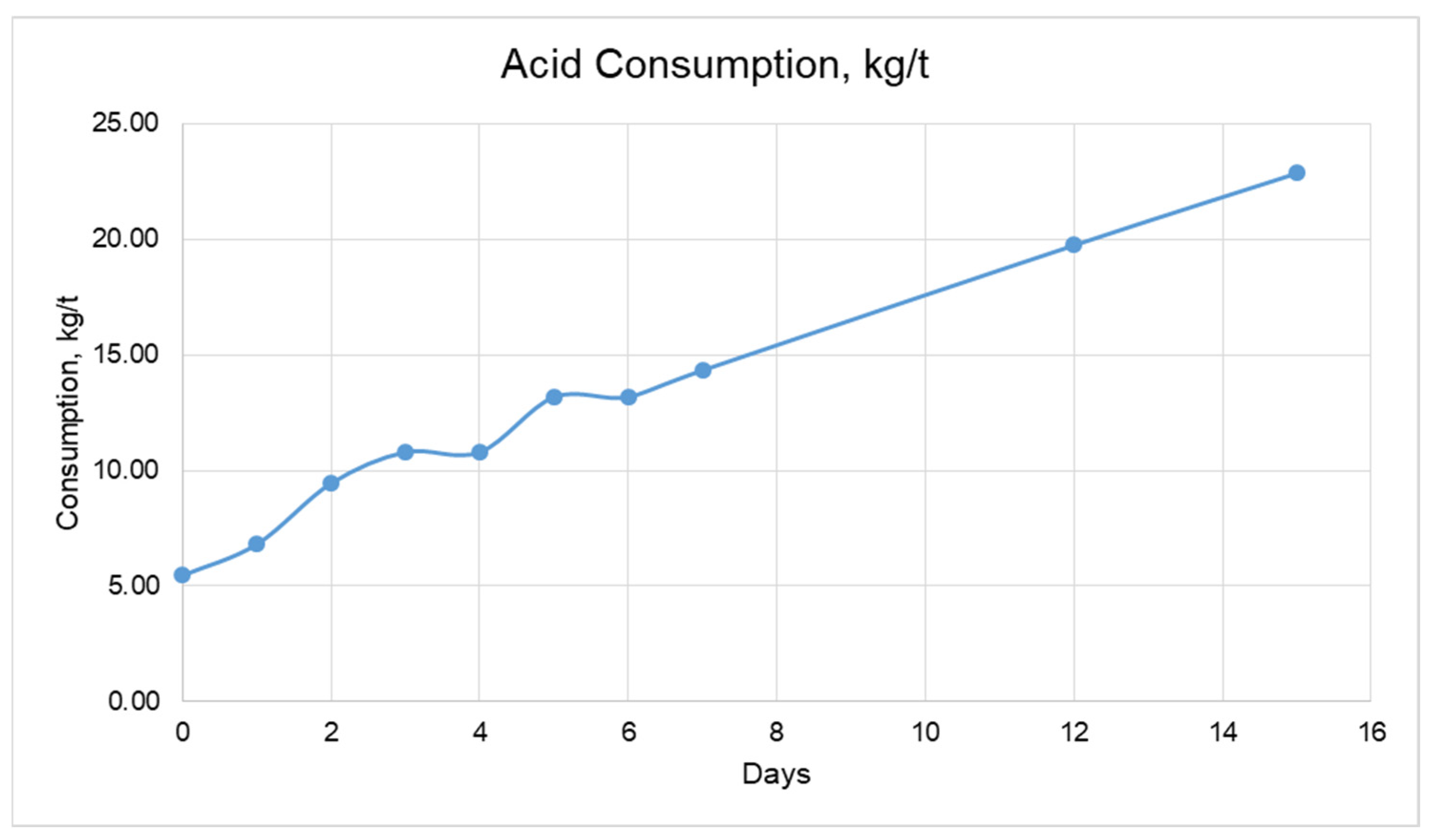
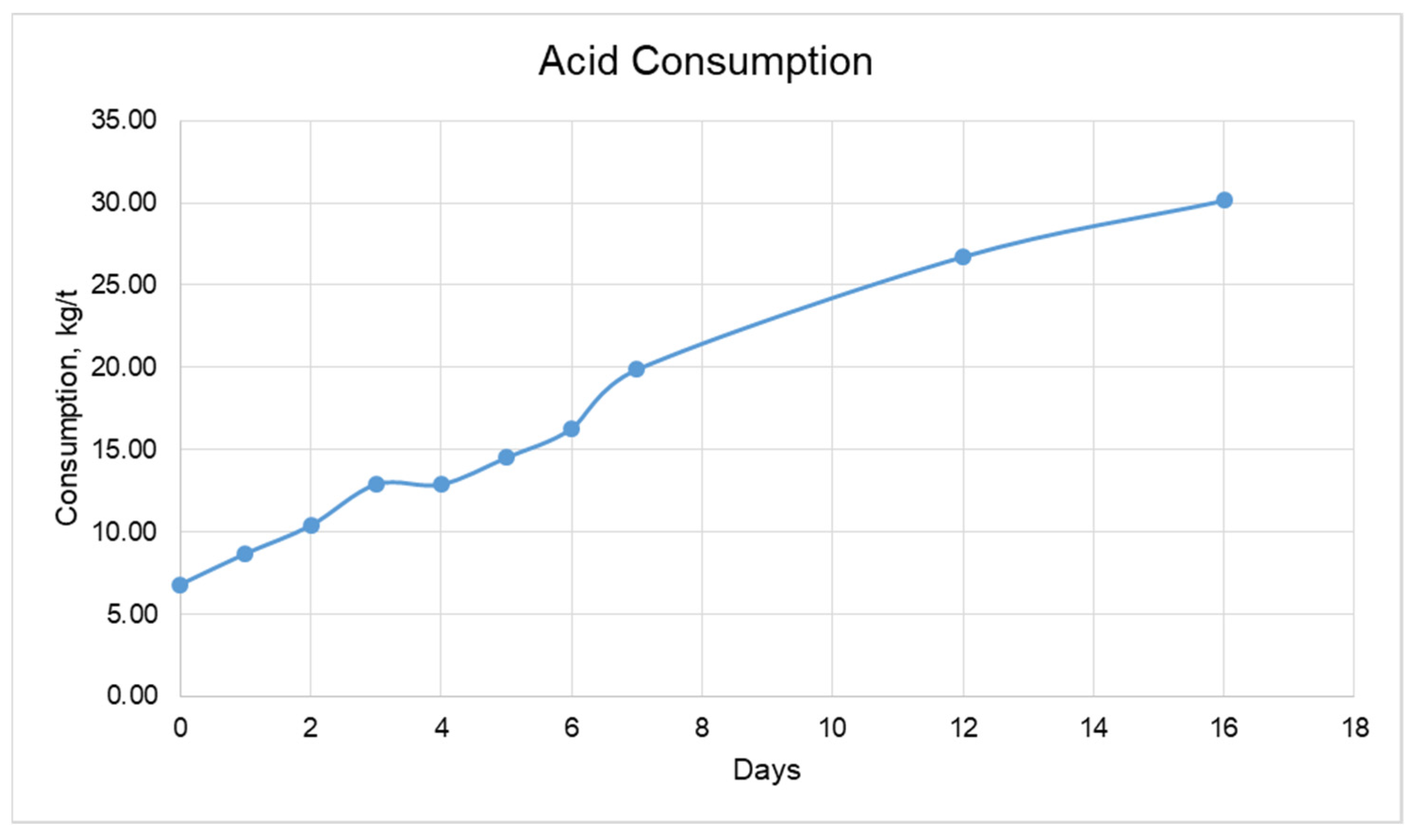
Figure 3 and
Figure 4 represent acid consumption rates by different ore types in a leaching test work of 15 and 16 days, respectively. The lixiviant that was used is sulphuric acid (H
2SO
4) for both column heap and bottle roll leaching test works. Acid pre-treatment, curing, and lixiviant irrigation rate was kept at 10 L/h/m
2. Copper tenor, pH, acid consumption, and slump monitored were closely monitored over 45 days. Intensive leaching was also done where finer grind size of 80% passing −300 µm was subjected to 8 h leaching at pH 1.5. Both solid residues and leach liquor filtrates were analysed for multi-element composition.
Acid consumption in leaching low-grade copper ores is typically front-loaded: demand spikes during curing and the early irrigation period as protons react not only with readily leachable copper oxides such as malachite but also with acid-consuming gangue impurities such as carbonates, clay minerals such as aluminosilicates, and Fe–Mg solid solutions. Precipitation of secondary sulphates such as gypsum or jarosite occurs, and surface conditioning; as a rule of thumb, carbonate alone can require roughly ~1 t H
2SO
4 per tonne of CaCO
3 present. After this initial drawdown, acid demand tends to rise more steadily as the leach front penetrates deeper and slower gangue reactions proceed, with the trajectory shaped by the mineralogy of carbonate and clay content, acid strength, and the curing or agglomeration process. Additionally, strong-acid curing can decrease longer-term gangue reactivity by dehydrating polymeric silica, helping to temper the slope of acid consumption later even though it intensifies consumption up front [
11].
Process efficiency commonly declines after the initial rapid copper extraction because the controlling mechanism shifts from reaction-controlled dissolution to diffusion-limited kinetics as the reactive surface area drops and product layers or precipitates thicken. In this second regime, mass-transfer resistances through passivating films and within partially saturated, fine-rich pore networks are often attributed to the presence of clays that play a pivotal role in slowing down protons and oxidants’ ease of transport, so each incremental gain in copper recovery requires proportionally more acid over time. This behaviour is well denoted by shrinking-core and reaction–diffusion models used for heap/column leach analysis and aligns with field observations that acid consumption continues to creep upward while extraction rates taper [
12].
3.3. Column Batch Heap Leaching Test Work Observations on Different Ore Samples
A representative sub-sample from the crushed material was pulverized, and the powder was submitted for head chemical analysis.
Table 1 represents the results for chemical head analysis assays.
Across the three batches, the differences in head grade and soluble copper indicate meaningfully different leaching responses. Converting the soluble copper values from ppm to wt% (10,000 ppm = 1 wt%), Batch #MOX-CHV2 (0.50% Cu, ~0.34% acid-soluble) has ~68% of its copper in readily leachable form, #MOX-CMN (1.18% Cu, ~0.70% acid-soluble) ~59%, and #MOX-MR6 (1.27% Cu, >1.00% acid-soluble) > 79%. A higher acid-soluble fraction typically translates to faster early extraction and a higher practical recovery under comparable conditions, because acid-soluble assays are a decent proxy for the fraction of oxides and other readily leached species; in practice, many groups sum acid-soluble and CN-soluble copper to estimate leachable copper for heap column design [
13]. On this basis, MR6 indeed shows the strongest recovery potential of the three column boxes [
14].
However, recovery potential is controlled by gangue content and the acid dosage. The presence of carbonates such as calcite or dolomite tend to neutralize acid directly, and common silicates that are mainly clay minerals such as biotite, chlorite, and smectites consume acid through slower and sustained reactions; both effects raise gangue acid consumption (GAC) and can diminish copper extraction per unit acid added [
15]. Even within a single orebody, modest shifts in gangue modal abundance can swing GAC and thereby the economics from one material grade to the next [
16]. Thus, while MR6’s higher soluble copper suggests better kinetics and higher ultimate recovery, it could also carry a higher acid dosage if its gangue is more reactive to verify with standardized GAC tests and mineralogical phases [
17].
Additionally, batches with larger oxide and acid-soluble fractions typically show a rapid, reaction-controlled phase followed by a slower, diffusion-limited regime as precipitates such as gypsum or jarosite and clays thicken the product layer and constrict pore networks. This transition reduces extraction efficiency over time and increases the marginal acid needed for each extra percent of recovery [
18]. If CHV2 and CMN contain more clay or form more precipitates than MR6, they may enter the diffusion-limited regime earlier, which would widen the performance gap beyond what the head-grade numbers alone suggest [
19].
Consequently, you can narrow inter-batch variability by (i) matching acid addition to measured GAC, front-loaded curing versus staged dosing, (ii) improving percolation and contact with robust agglomeration and, where justified, HPGR to increase micro-fracturing and exposure of copper minerals, and (iii) managing permeability with binders or surfactants where fines and clays are problematic [
20]. These steps tend to help CHV2/CMN-type materials close the gap with MR6 by boosting early kinetics and delaying the onset of diffusion limitations [
21,
22,
23].
4. Conclusions
The leaching test work on these low-grade copper ores shows a clear two-stage kinetic profile with important acid-demand implications and meaningful variability across material types and it is hypothetically concluded with more detailed future experimental work to be done, which will better conform to the activation energy of the chemical reaction. Copper recovery rises quickly at the outset of approximately 44% by day 6 and then tapers toward a significant 82% by day 15 and this inclined increase could be attributed to the longer residence time. Acid usage mirrors this chemical reaction behaviour; demand is front-loaded during curing and early irrigation lixiviant is consumed by both readily leachable copper minerals and acid-reactive gangue and then increases more steadily as the leaching process progresses. Since recovery and acid consumption are positively correlated, the marginal acid required per additional percent of copper recovered climbs in the late stage, which surpassed 80% recovery.
Inter-batch differences reinforce that head grade and acid-soluble copper govern both the early kinetics and the ultimate recovery highest point. Out of the three materials, #MOX-MR6 (≈1.27% Cu; soluble Cu > 10,000 ppm) exhibits the strongest intrinsic recovery potential, consistent with its larger readily leachable fraction. #MOX-CMN (≈1.18% Cu; ~7000 ppm soluble) is intermediate, while #MOX-CHV2 (≈0.50% Cu; ~3400 ppm soluble) is expected to leach more slowly and level off sooner. That said, actual performance will hinge on gangue acid consumption by carbonates, clays, reactive silicates, permeability, and solution chemistry. A batch with high soluble copper can still incur a heavy acid bill or stall kinetically if gangue neutralization, fines migration, or precipitate formation choke percolation and transport.
Practically, the data point to two complementary levers: (1) acid stewardship right-sizing the front-end dose via GAC testing, agglomeration, or curing to pre-react the most reactive gangue, and then staging acid according to solution pH/ORP and (2) mass-transfer management ensuring robust agglomerates and permeability, considering HPGR or tighter top-size to expose minerals without generating problematic fines, and using aeration or oxidants to maintain driving forces deeper into the heap/column. Economically, establish a cut-off recovery where the incremental acid cost outweighs the value of extra copper; for the current material set, that cut-off likely sits close to the observed 82% unless the above interventions shift the late-stage kinetics.
Author Contributions
Conceptualization, J.L.; methodology, J.L.; writing—original draft preparation, I.C.K.; writing—review and editing, I.C.K.; supervision. All authors have read and agreed to the published version of the manuscript.
Funding
This research received no external funding.
Institutional Review Board Statement
Not applicable.
Informed Consent Statement
Not applicable.
Data Availability Statement
The data presented in this study are available from the corresponding author upon reasonable request.
Acknowledgments
The authors would like to express their gratitude to the Vaal University of Technology for providing their facilities to conduct this project.
Conflicts of Interest
The authors declare no conflicts of interest.
References
- Bartlett, R.W. Heap leaching of copper ores. J. Min. Eng. 1998, 50, 25–32. [Google Scholar]
- Kappes, D.W. Heap leaching of copper ores—A review. Miner. Eng. 2002, 15, 831–839. [Google Scholar]
- Dreisinger, D.B. Copper leaching from ore. Hydrometallurgy 2006, 83, 89–96. [Google Scholar] [CrossRef]
- McNulty, T. Heap leaching—A review of the current state of the art. Miner. Eng. 2001, 14, 1129–1138. [Google Scholar]
- Bustos, S. Effect of crush size on copper extraction from ore. Miner. Eng. 2014, 69, 143–148. [Google Scholar]
- Lizama, H.M. Effect of crush size and mineralogy on copper extraction from ore. J. Min. Eng. 2017, 69, 25–32. [Google Scholar]
- Dixon, D. Heap Leach Modeling—The Current State of the Art. Hydrometallurgy 2003, 1, 289–314. [Google Scholar]
- de Andrade Lima, L.R.P.; Hodouin, D. A Mathematical Model for Isothermal Heap and Column Leaching. Braz. J. Chem. Eng. 2004, 21, 435–447. [Google Scholar] [CrossRef]
- Saldaña, M.; Gálvez, E.; Robles, P.; Castillo, J.; Toro, N. Copper Mineral Leaching Mathematical Models—A Review. Minerals 2022, 15, 1757. [Google Scholar] [CrossRef] [PubMed]
- Pritzker, M.D. Shrinking-core model for systems with facile homogeneous and heterogeneous reactions. Chem. Eng. Sci. 1996, 51, 3631–3645. [Google Scholar] [CrossRef]
- Free, M.L. Understanding Acid Consumption and Its Relationship with Copper Recovery. In Proceedings of the SME Annual Meeting, Phoenix, AZ, USA, 28 February–3 March 2010. Preprint 10-017. [Google Scholar]
- Tanda, B.C.; Eksteen, J.J.; Oraby, E.A. An investigation into the leaching behaviour of copper ores with different gangue minerals. Hydrometallurgy 2017, 167, 153–162. [Google Scholar] [CrossRef]
- Chetty, D. Acid–Gangue Interactions in Heap Leach Operations. Minerals 2004, 8, 47. [Google Scholar] [CrossRef]
- Wang, J.; Hu, M.-H.; Zhao, H.-B.; Tao, L.; Gan, X.-W.; Qin, W.-Q.; Qiu, G.-Z. Well-controlled column bioleaching of a low-grade copper ore. J. Cent. South Univ. 2015, 22, 3318–3325. [Google Scholar] [CrossRef]
- Petersen, J. Thermophilic Heap Leaching of a Chalcopyrite Concentrate. Ph.D. Thesis, University of Cape Town, Cape Town, South Africa, 2002. [Google Scholar]
- Toro, N.; Ghorbani, Y.; Turan, M.D.; Robles, P.; Gálvez, E. Gangues and Clays Minerals as Rate-Limiting Factors in Copper Heap Leaching: A Review. Metals 2021, 11, 1539. [Google Scholar] [CrossRef]
- Liddell, K.C. Shrinking core models in hydrometallurgy: What students are not being taught. Chem. Eng. Sci. 2005, 60, 5808–5826. [Google Scholar]
- Chen, P.; Duan, J.; Wang, Z.; Peng, J. Method for Determining Acid-Soluble Copper in Copper Ore. Patent No. WO2019056289, 28 March 2019. [Google Scholar]
- Thomas, M. Understanding gangue acid consumption in copper sulfide heap leaching. Hydrometallurgy 2021, 206, 105735. [Google Scholar]
- Jansen, M.; Taylor, A. Overview of Gangue Mineralogy Issues in Copper Heap Leaching; Government of Yukon: Whitehorse, YT, Canada, 2023. [Google Scholar]
- Ghorbani, Y. Heap leaching technology—Current state, innovations, and future directions: A review. Miner. Eng. 2015, 72, 109–124. [Google Scholar] [CrossRef]
- Yin, W. Effect of particle size and microstructure characteristics on copper extraction from HPGR products. Hydrometallurgy 2021, 203, 105602. [Google Scholar]
- Chun-Ming, A. Influence of surfactant on permeability at different leaching stages in a copper-ore column. PLoS ONE 2022, 17, e0272719. [Google Scholar] [CrossRef] [PubMed]
| Disclaimer/Publisher’s Note: The statements, opinions and data contained in all publications are solely those of the individual author(s) and contributor(s) and not of MDPI and/or the editor(s). MDPI and/or the editor(s) disclaim responsibility for any injury to people or property resulting from any ideas, methods, instructions or products referred to in the content. |