1. Introduction
Solar drying has become an attractive alternative to conventional hot-air drying for agricultural and medicinal products because it reduces fossil-fuel consumption, greenhouse gas emissions, and operating costs while still ensuring acceptable product quality. Recent reviews show that properly designed solar dryers can provide higher air temperatures and lower relative humidity than open sun drying, which shortens the drying process and limits microbial contamination [
1]. In particular, cabinet- and greenhouse-type solar dryers are now widely used for high-value products such as fruits, spices, and medicinal and aromatic plants (MAPs).
Medicinal plants are plant species that contain biologically active compounds-including essential oils, phenolics, flavonoids, alkaloids, and iridoid glycosides-which are widely used in pharmaceutical, nutraceutical, and traditional medicine applications. The therapeutic effectiveness of these plants strongly depends on post-harvest processing conditions, particularly drying, as inappropriate thermal treatment may cause significant degradation of bioactive constituents.
For medicinal plants, drying is a critical unit operation because bioactive compounds-essential oils, phenolics, flavonoids, and other secondary metabolites-are often heat- and oxidation-sensitive. The drying conditions (temperature, air velocity, relative humidity, and residence time) strongly affect color, aroma, extractability, and pharmacological activity of the final product [
2]. Several studies have therefore emphasized that dryer design and process control must be optimized specifically for medicinal species rather than simply adopting conventional food-drying protocols.
Plantago major L. (plantain) is a widely used medicinal plant in traditional Persian, European, and Asian medicine. Extracts from its leaves exhibit antimicrobial, antiviral, anti-inflammatory, wound-healing, antioxidant, and immunomodulatory effects, which are associated with a complex mixture of flavonoids, iridoid glycosides, phenolic acids, terpenoids, and other bioactive constituents. Because of this broad pharmacological profile, dried
P. major leaves are used in herbal teas, tinctures, topical formulations, and industrial phytopharmaceutical products. To preserve these compounds, gentle but efficient drying conditions are required, typically involving moderate temperatures and controlled air humidity rather than aggressive thermal treatment [
3]. Cabinet-type solar dryers are particularly suitable for this purpose, as they provide a semi-enclosed environment that protects the material from dust, insects, and direct ultraviolet radiation while taking advantage of free solar energy [
4].
From a global perspective, improving drying technologies for agricultural and medicinal products is closely linked to energy sustainability and climate resilience. Drying operations account for a substantial share of energy consumption in the agri-food sector, making efficiency improvements critically important. In this context, the optimization of solar drying systems directly contributes to the United Nations Sustainable Development Goals, particularly SDG 7 (Affordable and Clean Energy) and SDG 12 (Responsible Consumption and Production), by reducing fossil-fuel dependence and minimizing post-harvest losses [
5].
Despite these advantages, the thermal behavior and performance of cabinet solar dryers remain difficult to predict and control. Recent review studies have highlighted that the performance of cabinet-type solar dryers is governed by complex interactions between design configuration, airflow mechanisms, and highly variable outdoor conditions, which makes accurate prediction and control particularly challenging [
6]. The air temperature and humidity inside the chamber depend on highly variable solar irradiance, ambient conditions and airflow patterns, and they interact with product properties such as moisture content and loading density. As a result, key performance indicators like drying rate, energy use and drying efficiency exhibit complex, nonlinear dynamics. Classical thin-layer drying equations or simplified heat- and mass-transfer models often require strong assumptions and calibrated parameters, and they may fail to describe the process accurately under fluctuating outdoor conditions, particularly for heterogeneous medicinal plants [
7].
In the last decade, artificial neural networks (ANNs) have emerged as powerful tools for modeling and prediction in solar-energy and drying applications. ANNs can approximate unknown nonlinear input–output relationships directly from experimental data without requiring explicit physical equations, making them well suited for systems with complex interactions and incomplete knowledge of underlying mechanisms [
8]. Numerous authors have successfully applied feed-forward ANNs to predict moisture content, drying rate or energy performance in solar dryers for fruits, nuts, and herbs, typically reporting high coefficients of determination and low error metrics. In addition, artificial intelligence techniques such as artificial neural networks (ANNs) and adaptive neuro-fuzzy inference systems (ANFIS) have been widely applied to estimate energy- and exergy-related performance indicators in drying systems, providing accurate predictions that support process optimization under varying operating conditions [
9]. For instance, Sadadou et al. modeled moisture content and the drying rate of fruits under solar drying and achieved correlation coefficients above 0,98 using a multi-layer ANN topology [
10,
11]. Recent work on mint, citrus peel and other products has confirmed that properly trained ANNs can outperform conventional regression models when dealing with strongly nonlinear drying kinetics and exergy-based performance indicators [
12,
13].
Although alternative data-driven approaches such as regression models or support vector machines can also be applied to drying-process prediction, their performance often degrades under highly nonlinear and time-varying outdoor conditions. Artificial neural networks were therefore selected in this study due to their superior capability to handle nonlinear interactions among multiple environmental variables and their proven robustness in solar-drying applications [
14].
However, most ANN-based drying studies focus on predicting moisture ratio or instantaneous drying rate, while relatively few works target drying efficiency as the primary output, particularly for cabinet-type solar dryers dedicated to medicinal plants. Existing research on medicinal plants often concentrates either on experimental performance evaluation of novel dryer designs or on physical modeling of airflow and temperature distribution in cabinet configurations, with limited integration of data-driven approaches [
15]. Moreover, specific investigations on Plantago species in solar dryers are scarce, and to the authors’ knowledge, no previous study has systematically developed an ANN model that predicts the drying efficiency of a cabinet solar dryer for
P. major using only easily measurable environmental variables such as solar irradiance, chamber temperature, and relative humidity [
16].
These gaps motivate the present contribution, which aims to develop and validate a compact, high-accuracy ANN model for the real-time prediction of drying efficiency in a cabinet-type solar dryer dedicated to Plantago major leaves. The main objectives of this work are therefore threefold:
To design and implement a multilayer feed-forward ANN using experimental data collected under real summer climatic conditions, with solar irradiance, chamber temperature and relative humidity as inputs and experimentally evaluated drying efficiency as the output.
To assess the predictive performance and generalization capability of the ANN using standard statistical indices (mean squared error and correlation coefficient) and graphical tools (training-performance curves and regression plots).
Similar advanced computational approaches have recently been applied in the synthesis and optimization of control systems for nonlinear dynamic objects, including quantum-algorithm-based methods [
17]. Related intelligent modeling and control approaches have also been successfully applied to complex energy and chemical processes-such as diesel fuel hydrotreating-where data-driven and optimization-based methods demonstrated high robustness and efficiency under nonlinear operating conditions [
18]. Recent studies also highlight that optimizing heat utilization is a key requirement not only in small-scale thermal systems but also in large industrial sectors. For instance, waste-heat-recovery technologies applied in cement production have demonstrated significant reductions in thermal losses and overall energy consumption, confirming the importance of advanced heat-management strategies in energy-intensive processes [
19]. Modeling and simulation studies of CO
2 separation processes further confirm the effectiveness of advanced computational approaches in complex chemical and energy systems [
20]
2. Methodology
2.1. Study Location and Climatic Conditions
The experiments were conducted during the summer season (June–August 2024) in Tashkent, Uzbekistan, a region characterized by a continental climate with intense solar irradiance (750–950 W·m
−2) and high daytime temperatures (34–42 °C). Such conditions make the location ideal for testing solar drying processes under realistic field scenarios [
21]. The local relative humidity varies between 18% and 40% during summer days, creating favorable mass-transfer conditions for natural convection solar drying.
2.2. Solar Dryer Configuration
The experimental setup was based on a natural-convection cabinet-type solar dryer, which is widely recognized for achieving higher drying quality than open sun drying and for providing partial control over temperature and humidity inside the drying chamber.
The system consisted of the following major components:
Solar collector:
A flat-plate solar air heater equipped with a transparent glass cover, a black-painted absorber plate, and thermal insulation to minimize heat losses. The effective collector area ranged between 0.80 and 1.00 m2, supplying a continuous stream of heated air to the drying chamber.
Drying chamber:
A wooden cabinet-type enclosure fitted internally with two perforated stainless-steel trays to promote uniform airflow distribution across the plant material. The wooden structure also provided thermal buffering, helping to reduce heat losses and stabilize the internal microclimate.
Ventilation system and airflow pattern:
Airflow was driven by buoyancy-induced natural convection. Solar-heated air entered the chamber from the bottom through inlet openings connected to the collector outlet and exited through upper exhaust vents. This upward airflow pattern ensured steady moisture removal without mechanical fans, which is typical for small-scale medicinal-plant drying applications.
This configuration is widely adopted for medicinal plants due to its low cost, simple construction, energy efficiency, and reduced exposure of the product to environmental contaminants.
2.3. Plant Material Preparation
Fresh leaves of
Plantago major L. were selected as the drying material. Leaves were harvested manually between 07:00 and 08:00 to minimize moisture variability, followed by washing to remove surface impurities. Excess surface water was removed using sterile absorbent paper for 5–7 min. The leaves were then arranged in a single uniform layer on perforated trays to ensure consistent airflow exposure. The initial mass of each batch was recorded using a digital balance with an accuracy of 0.01 g. This preparation procedure follows commonly accepted protocols for medicinal and aromatic plant drying [
22].
2.4. Experimental Drying Procedure and Standards
The drying experiments were carried out under natural outdoor conditions without auxiliary heating or forced ventilation. Drying continued until no significant mass variation was observed between consecutive measurements. Moisture determination followed gravimetric methods recommended by the AOAC, using oven drying at 105 °C until constant weight was achieved. These procedures are consistent with standard methodologies widely applied in medicinal-plant drying studies and ensure reproducibility and comparability with the existing literature.
2.5. Determination of Moisture Content and Drying Efficiency
2.5.1. Moisture Content (Dry Basis)
The moisture content of the samples at any drying time
t was calculated on a dry basis as:
where
—mass of the sample at time t;
—dry mass of the sample, obtained by oven-drying at 105 °C until a constant weight was reached.
The drying temperature of 105 °C follows the AOAC Official Method for moisture determination in plant materials and is widely used in studies involving medicinal plants.
2.5.2. Drying Efficiency Computation
Drying efficiency was calculated using the energy–balance relationship:
where:
—evaporated moisture during the interval;
—latent heat of vaporization of water;
—measured solar irradiance (W·m−2);
—solar collector area (m2);
—measurement interval (min).
The experimentally obtained drying-efficiency values were used as target outputs for ANN training.
2.6. Dataset Structure and Preprocessing
A total of 120 experimental samples were collected, covering a wide operating range:
Solar irradiance: 650–900 W·m−2
Chamber temperature: 30–42 °C
Relative humidity: 18–40%
Drying efficiency: 0.55–0.91 (dimensionless)
Normalization
All variables were normalized to the interval [−1, 1] using MATLAB R2024a’s
mapminmax function to improve numerical stability and accelerate ANN convergence. The transformation is given by:
where:
—original data value;
—minimum and maximum values of the dataset;
—normalized output.
This normalization ensures that all parameters contribute proportionally during model learning.
The dataset was divided as follows:
70% (84 samples) for training
15% (18 samples) for validation
15% (18 samples) for testing
2.7. ANN Architecture
A multilayer feed-forward artificial neural network (ANN) was developed using the MATLAB Neural Network Toolbox. The network topology was selected based on established recommendations for modeling nonlinear agricultural and drying processes. The final structure consisted of the following layers:
Input layer: 3 neurons representing solar irradiance (G), chamber temperature (Tₐ), and relative humidity (φ).
Hidden layer 1: 10 neurons with hyperbolic tangent activation (tansig).
Hidden layer 2: 10 neurons with tansig activation.
Output layer: 1 neuron with linear activation (purelin), representing drying efficiency (η).
The ANN transformations can be mathematically expressed as:
where
is the input vector, are weights and biases, and is the predicted drying-efficiency output.
2.8. Training Algorithm (Rewritten)
The network was trained using the Levenberg-Marquardt (LM) optimization algorithm, widely recognized for its fast convergence and high accuracy in medium-sized feed-forward neural networks. The LM parameters used in this study are summarized in
Table 1.
The LM update rule is expressed as:
where:
—vector of network parameters (weights and biases);
—Jacobian matrix;
—error vector;
—damping factor;
—identity matrix.
3. Result and Discussion
3.1. ANN Training Performance
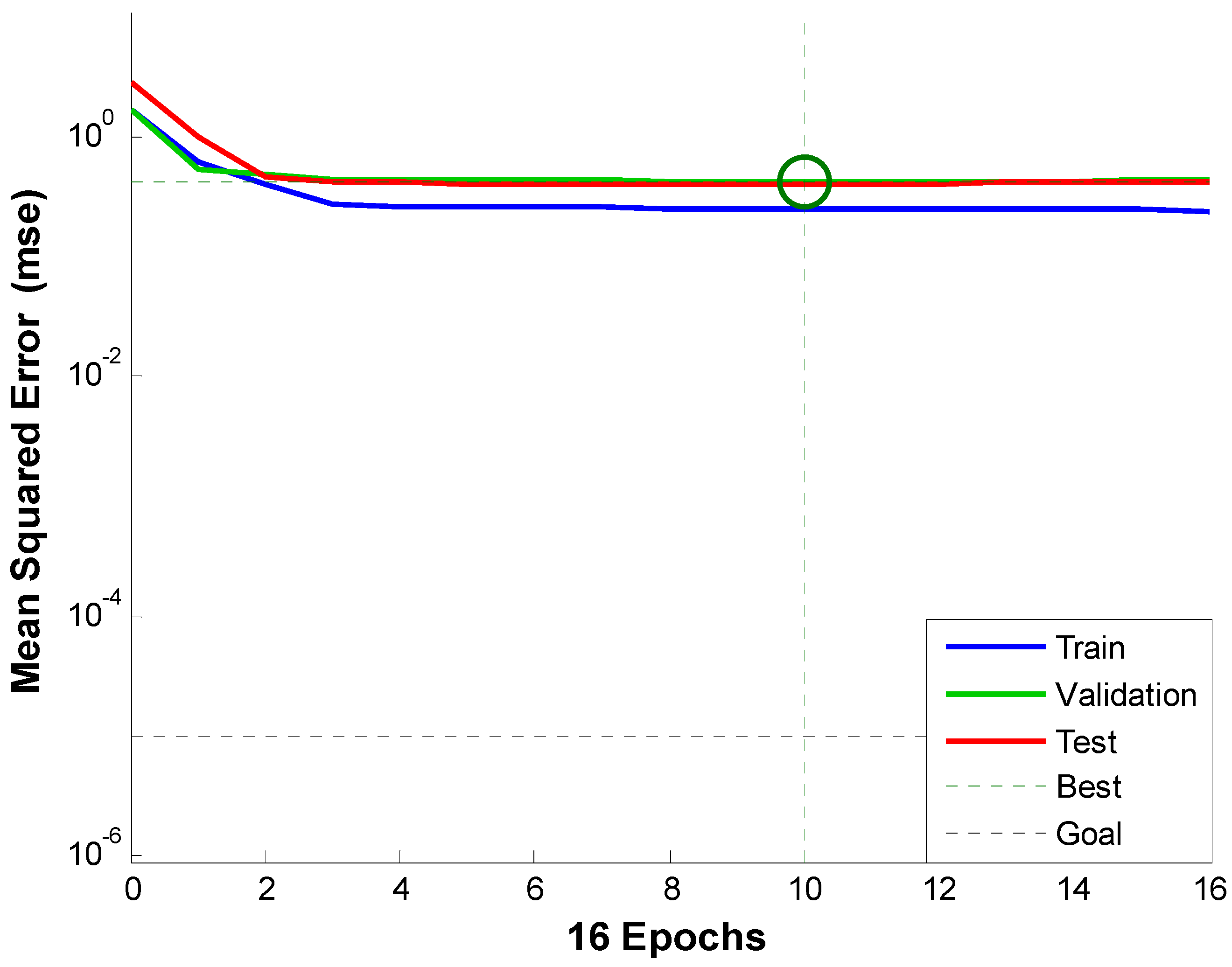
The ANN was trained using the Levenberg-Marquardt (LM) optimization algorithm, which is well known for its rapid convergence and numerical robustness in medium-sized feedforward networks. In this study, the training process converged after 18 epochs, achieving a best validation performance with a mean squared error (MSE) of . At convergence, the network exhibited a low gradient and a stabilized damping factor, indicating the successful convergence of the learning process.
The smooth reduction in the performance function and the stabilization of training parameters confirm that the selected network architecture and training algorithm provided an effective balance between prediction accuracy and generalization capability.
The training performance of the ANN model in terms of mean squared error (MSE) versus epochs is illustrated in
Figure 1.
As shown in
Figure 1, the training, validation, and testing MSE curves decrease smoothly and follow comparable trajectories throughout the learning process. No significant divergence between the training and validation curves was observed, demonstrating that overfitting did not occur. The early-stopping mechanism, activated after six consecutive increases in the validation error, ensured optimal selection of network weights and biases.
3.2. Regression Analysis
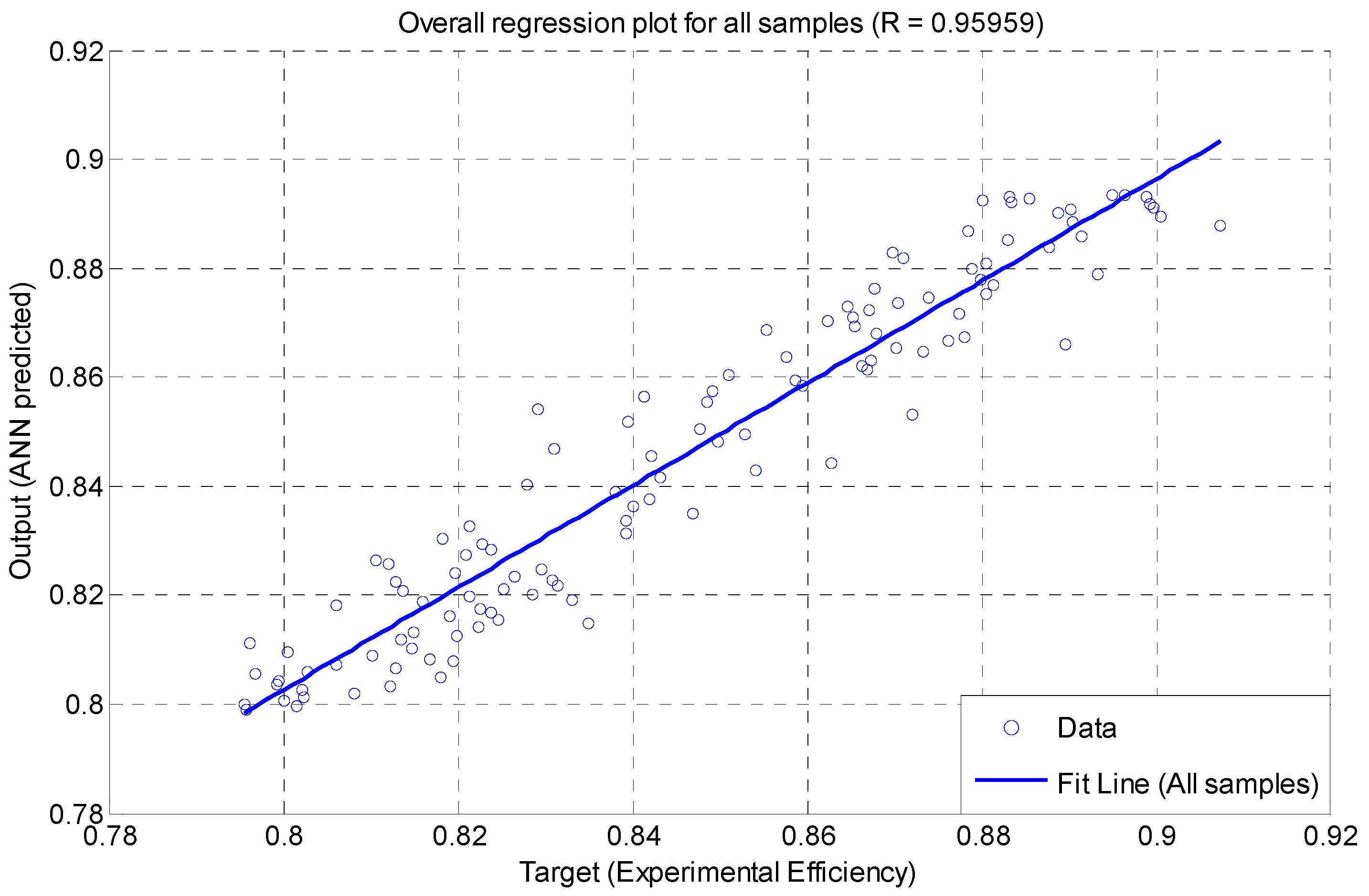
Regression analysis was conducted to evaluate the predictive accuracy of the ANN and to quantify the linear relationship between the experimentally measured drying efficiency and the ANN-predicted values. The overall regression plot (
Figure 2) demonstrates a strong positive linear correlation, indicating that the ANN successfully captured the underlying nonlinear dependency between the input variables and drying efficiency.
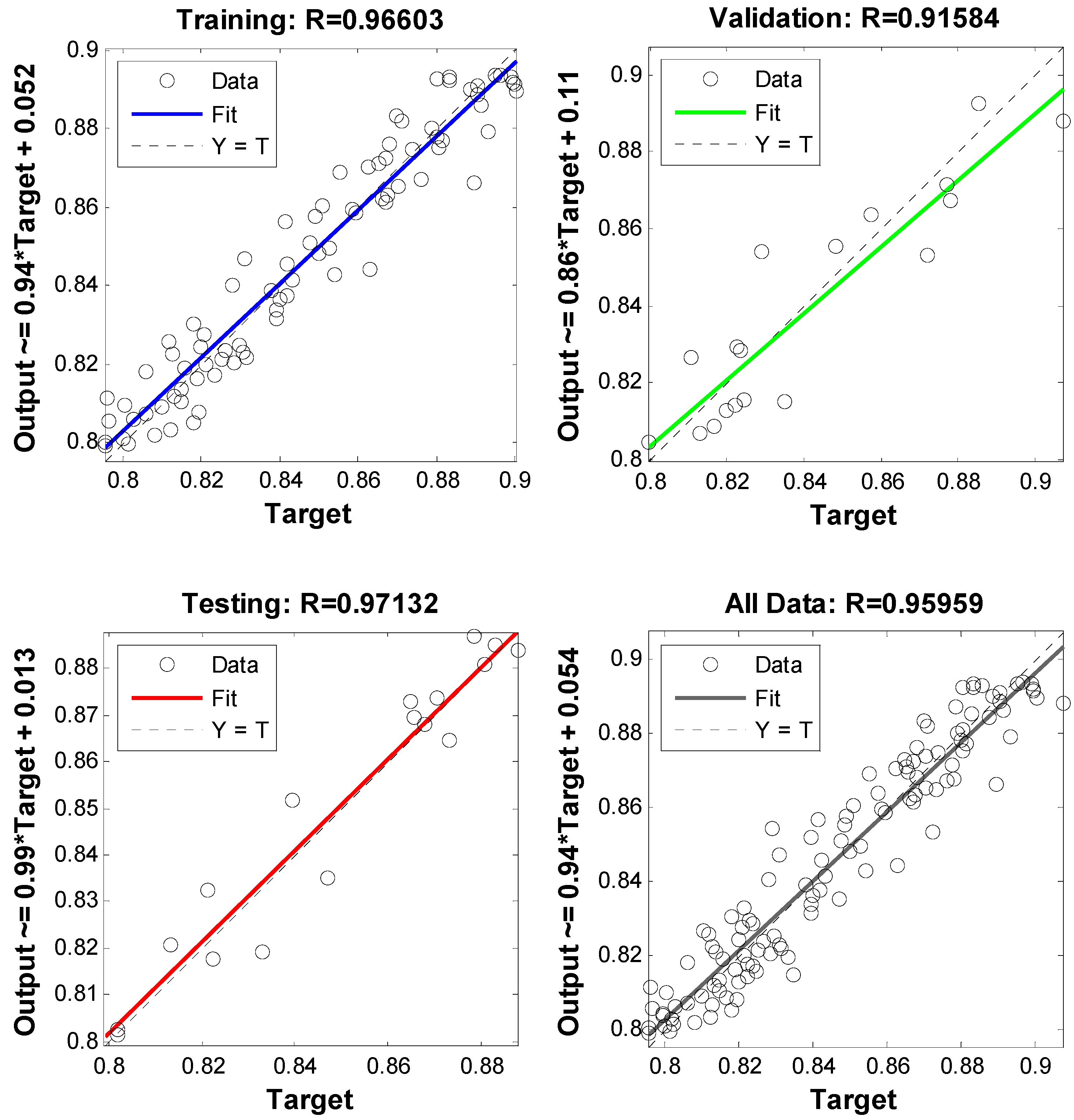
For a detailed evaluation, regression plots were generated separately for the training, validation, testing, and combined datasets (
Figure 3). The corresponding correlation coefficients (
R) obtained from the ANN model are summarized as follows:
Training set: R = 0.96603
Validation set: R = 0.91584
Testing set: R = 0.97132
All data: R = 0.95559
Figure 3.
Regression plots for the training, validation, testing, and combined datasets.
Figure 3.
Regression plots for the training, validation, testing, and combined datasets.
These results confirm that the ANN exhibits strong predictive performance across all dataset partitions. The high correlation coefficients (R > 0.90) for both training and testing datasets indicate the effective learning of drying-efficiency patterns and good generalization to unseen data. The slightly lower R-value obtained for the validation dataset is typical for outdoor solar-drying experiments, where stochastic variations in solar irradiance, ambient humidity, and natural convection airflow are unavoidable. In addition to the high correlation coefficients, the low MSE value confirms that the ANN provides accurate predictions with small absolute errors, ensuring reliable model performance beyond simple linear correlation.
3.3. Comparison Between Experimental and ANN-Predicted Drying Efficiency
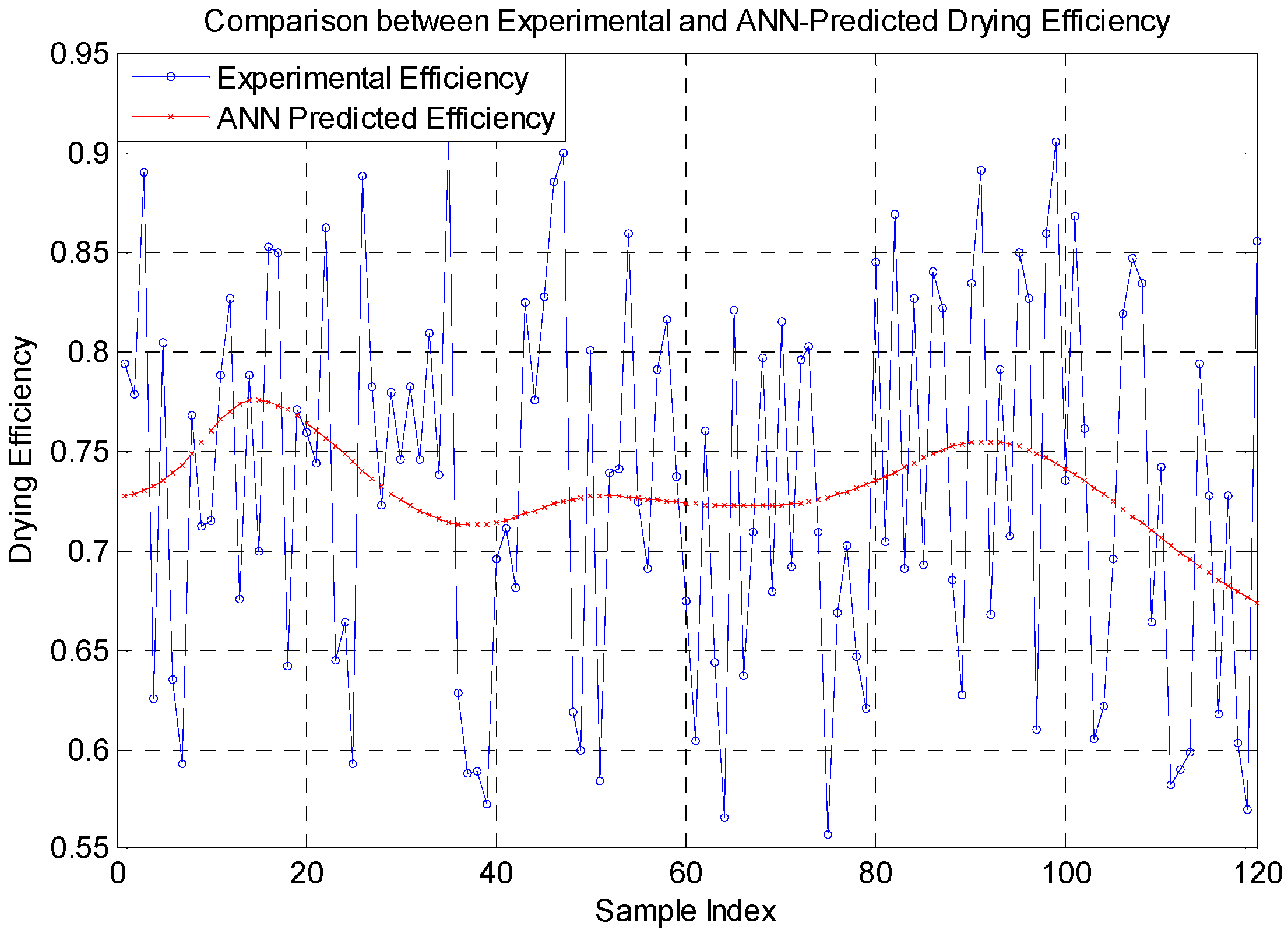
A time-series comparison between the experimentally measured drying efficiency and ANN-predicted values is presented in
Figure 4. The two curves show a high degree of overlap across all 120 samples, demonstrating that the ANN model accurately captured both gradual and rapid variations in drying efficiency under changing environmental conditions.
The ANN successfully reproduced dynamic efficiency fluctuations caused by variations in solar irradiance and ambient relative humidity. Both local maxima and minima in the experimental efficiency curve were closely matched by the ANN predictions, confirming the model’s capability to represent nonlinear and time-varying drying behavior.
The maximum absolute deviation between experimental and predicted efficiency values remained below 0.02 (in normalized units), further validating the suitability of the ANN as a reliable predictive tool for real-time monitoring and control of cabinet-type solar drying systems.
3.4. Error and Residual Analysis
Residual analysis was performed to assess the distribution and magnitude of prediction errors, where residuals were defined as the difference between experimental and ANN-predicted drying efficiency values. The residuals exhibited a narrow and symmetric distribution around zero, with no observable systematic bias.
The absence of structured patterns in the residuals indicates that the ANN did not suffer from underfitting or overfitting and that the prediction errors were primarily random in nature.
Overall, the ANN achieved a low prediction error (MSE = ) and a strong overall correlation coefficient (R = 0.95559 for all data), confirming stable convergence and reliable generalization performance.
3.5. Numerical Comparison Between Experimental and ANN-Predicted Efficiency
To further validate the predictive capability of the developed ANN model, a numerical comparison was carried out between experimentally measured drying-efficiency values and corresponding ANN predictions under different solar-drying conditions. This analysis provides a quantitative assessment of the model’s ability to represent real drying behavior of Plantago major leaves over a wide range of thermal and hygrometric operating conditions.
The representative results summarized in
Table 2 demonstrate that the ANN accurately reproduces nonlinear efficiency trends associated with variations in solar irradiance, chamber temperature, and relative humidity.
The numerical results in
Table 2 show excellent agreement between experimental and ANN-predicted drying-efficiency values. The maximum deviation remained below 0.02 (≈3%), confirming the high predictive accuracy and robustness of the proposed ANN architecture. This close agreement further supports the applicability of the ANN model as a practical tool for real-time performance evaluation and intelligent control of cabinet-type solar dryers.
4. Conclusions
This study developed and validated an artificial neural network (ANN)-based predictive model for estimating the drying efficiency of a cabinet-type solar dryer used for dehydrating Plantago major leaves under natural outdoor conditions. The obtained results demonstrate that the proposed ANN effectively captures the nonlinear and time-varying relationships between solar irradiance, drying-chamber temperature, relative humidity, and overall drying efficiency.
The trained ANN exhibited strong predictive performance, achieving an overall correlation coefficient of R = 0.9556 and a low mean squared error of , indicating accurate agreement between experimental measurements and model predictions. Regression and residual analyses confirmed stable convergence, reliable generalization, and the absence of overfitting, even under fluctuating climatic conditions typical of outdoor solar drying processes.
By relying on a limited set of easily measurable input variables, the proposed ANN model offers a practical and computationally efficient tool for real-time performance evaluation of cabinet-type solar dryers. This capability is particularly valuable for small-scale medicinal-plant processing systems, where consistent drying quality, energy efficiency, and preservation of bioactive compounds are critical.
Despite the strong predictive accuracy achieved, the present study is limited to a single medicinal plant species and summer operating conditions. Future research should focus on extending the dataset to different seasons, incorporating additional plant materials with varying drying characteristics, and integrating hybrid data-driven and physics-based models to further enhance robustness and applicability.
Overall, this work confirms that ANN-based modeling represents a reliable and effective approach for predicting drying efficiency in cabinet-type solar dryers and provides a solid foundation for the development of intelligent monitoring and control strategies in sustainable medicinal-plant drying technologies.




 ,
,