1. Introduction
Suburbanization, in general, has been fundamentally changing the overall image of cities in recent decades [
1]. The first suburbanization tendencies were recorded in the 1970s in Western European countries such as France, Germany, etc. [
2]. In Central and Eastern Europe, suburbanization waves started to manifest themselves only with the change in political and economic regime in the 1990s. During that time, the phenomenon of suburbanization has been the subject of several research studies, both in the Czech Republic and abroad [
3,
4,
5,
6,
7,
8,
9,
10].
Suburbanization is generally considered to be the shift in economic activities from traditional urban areas to the outskirts of cities or to smaller settlements that are well connected to large cities by transport [
11]. The shift in activities to smaller settlements is also sometimes referred to as peri-urbanization [
12]. The most common distinction is between residential, commercial, and industrial suburbanization. Residential suburbanization is defined as a shift in the resident population, where the motivation for this shift is mainly the desire to live in a house with a garden in a healthier and cleaner environment but still within easy reach of all urban services [
13]. In the Czech Republic, the growth of residential suburbs in the hinterland of large cities can be well observed thanks to regular aerial photography [
7].
Commercial suburbanization refers to the shift in commercial activities that were historically located in urban centers or densely populated parts of cities, while in recent years they have been implemented mainly in large commercial centers. This requires a large area for their construction and targets the fact that most of their customers arrive by car. The necessary large areas are often not available in the inner-city areas, and these large shopping complexes have been built on the outskirts of cities, usually close to major traffic routes [
3].
Similarly, industrial suburbanization is partly caused by changes in production technologies and the associated changes in the technical design of industrial buildings, required loads, etc. However, the main reason is that a substantial proportion of raw materials and products are now transported by truck [
1]. Like commercial buildings, there are no areas available for new industrial construction in urban areas that are large enough to provide acceptable access to the major traffic routes that are necessary for truck transport. New industrial complexes are thus once again being built on greenfield sites on the borders of built-up areas [
13]. It is clear from the above that one of the factors enabling such extensive suburbanization is, among other things, the substantial development of car traffic. Research has shown that suburbanization occurs largely in settlements that are well connected to larger cities by transport, especially by high-capacity roads [
2,
14,
15]. Moreover, the increase in the population of suburbs often does not correlate at all with the increase in the population of core cities or entire regions. Several cases have been described where the population of the region is declining while the population of the suburbs of the same region is increasing [
13,
16]. Moreover, this inevitably leads to a reduction in population density [
17,
18]. Thus, overall dispersion has become a common characteristic of modern European cities [
2]. This is, of course, also linked to higher unit costs of building and managing cities, especially in the areas of transport and technical infrastructure [
19].
Some authors try to explain the phenomenon of residential suburbanization in economic terms [
20]. They argue that one of the reasons for this is that cities provide a substantial share of employment opportunities in their regions, but they are also the most expensive places to live, given the quality and availability of infrastructure. Thus, residents try to minimize their cost of living and, in turn, maximize their profit, which leads to working in the city but living outside of it. However, this argument has become increasingly invalid in recent years, as the high demand for housing in the suburbs inevitably leads to rising prices. In the case of individual housing, this has virtually erased the price differentials of housing acquisition in cities and nearby towns. Moreover, in the case of greenfield development proposals, which do not have to respect the current characteristics of the settlement, there is a trend towards a steady shrinkage of individual building plots. This is advantageous both for developers, who can build more houses in the same area and thus make more money, and for the residents themselves, who often want to live in an environment close to nature but with the least possible cost and time requirements for the maintenance of houses and land. It has been shown that small plots are more in demand, and buyers are willing to pay higher unit prices for them. The increase is usually around 10–20% [
21].
In the case of suburbs, it is also necessary to consider the cost of commuting to the city on a virtually daily basis [
20]. Suburban dwellers are much more dependent on quality transport and transport infrastructure [
22]. Due to the daily commute, some suburbs are often referred to as ‘bedroom communities’, i.e., their residents spend most of the day in the city and only go home to sleep [
4].
Although the actors of suburbanization mostly perceive the result of this process as an increase in their living comfort, from an urban planning point of view, it is a rather fundamental problem. One of the negatives that suburbanization brings with it is the loss of agricultural land; just to give an idea, the results of a project published in 2006 put the annual land consumption in European countries at 108,000 ha/year [
23]. This is due, among other things, to the desire of individual municipalities to attract new inhabitants to their territory to develop the municipality. In general, a municipality that is losing its population cannot be described as a settlement that is developing. Moreover, in the conditions of the Czech Republic, tax revenues of municipalities are linked, among other things, to the number of inhabitants. In this way, municipalities are defining new buildable areas in their spatial plans, which were often used for agricultural purposes in the past, although excessive development of vacant areas is certainly not in line with the basic principles of sustainable development. However, proponents of these processes argue that municipalities are only responding to the natural demand of the population for quality housing and other activities outside urban centers and that if municipalities individually reduce the supply of developable land, these activities will only shift to municipalities that offer developable land [
19]. The aim of spatial planning should be to find an acceptable compromise between the requirements of community development and the protection of natural resources [
2]. The proportion of cultivated agricultural land is declining, which means less land for growing food and potentially greater dependence on food imports, although the efficiency of agriculture is increasing thanks to advanced technologies [
2].
Sustainable urban and peri-urban development is one of the key objectives of local governments [
22]. The Agenda for Sustainable Development, which was defined by the United Nations in September 2015, includes in its specific goals the requirement for ‘food security’ and the reduction in hunger to zero, which is linked to the requirement for a relatively dramatic increase in agricultural productivity [
14]. According to this requirement, agricultural land should be increasing, but European statistics show a steady and continuous loss [
2]. On the other hand, there are also suggestions that high-intensity food production in small areas will preserve more of the natural environment than large-scale, lower-intensity farming. However, in the case of suburbs, there is no question of preserving the natural environment [
23].
However, it is not only food production that is threatened by the reduction in the area suitable for agricultural production. Changing the landscape type from natural to artificial inevitably leads to changes in biodiversity, contributes to global climate change, potentially increases the risk of flooding in urbanized areas, and affects groundwater flow [
2,
14,
16,
24,
25].
When locating new development areas on former agricultural land, it is crucial that areas that are less fertile, i.e., have a lower credit rating, are taken up. In the Czech Republic, agricultural land is part of the so-called agricultural land fund, the protection of which is governed by Act No. 334/1992 Coll. on the protection of the agricultural land fund [
26]. It is defined here as one of the components of the environment and an irreplaceable, limited natural resource enabling agricultural production. The Act also defines the basic rules for the management of agricultural land. It is necessary to use mainly non-agricultural land, undeveloped and underused land, or building gaps in built-up and developable areas for development. The Act further divides agricultural land into a total of five classes, with the first being the highest (the best quality agricultural land) and the fifth being the worst.
When designing new construction, it is necessary to disturb the organization of the agricultural land fund as little as possible, not to reduce the possibilities of farming on agricultural land, and to give priority to agricultural land that is of lower quality, i.e., has a lower rating, for new construction. At the same time, soils of the I. and II. rating classes may be used only if other public interests significantly outweigh the public interest in protecting the agricultural land fund. However, this statement was added to the law after its amendment. The agricultural land fund itself cannot be used for construction; if such construction is to take place, the area in question must first be removed from the agricultural land fund. The exclusion is decided by the agricultural land protection authority and is carried out against payment.
To apply these principles in practice, the agricultural land protection authorities are entitled to issue opinions when issuing or updating spatial planning documentation. The purpose of this paper is to find out whether these rules are followed in practice and what proportion of the developable areas in selected cities are defined as agricultural areas belonging to the three highest land quality classes. Given the above, agricultural areas in the I. and II. rating classes should not be proposed for development at all, and the proportion of areas in the III. rating class should be very small. Most of the developable areas on agricultural land should be proposed on land belonging to rating classes IV and V. However, it is necessary to state that many spatial plans of Czech towns are more than 10 years old (with continuous updating), and if the areas were approved as developable in the past under more lenient conditions of agricultural land fund protection, they can still be registered as such.
2. Materials and Methods
To test the hypothesis, a total of 8 smaller towns located in the northeast of the Czech Republic in the Olomouc and Moravian-Silesian regions were selected. Each town has different characteristics in terms of distance from large cities, transport connections, or the natural environment in which it is located. Specifically, the following towns were selected:
Frýdlant nad Ostravicí—a town of less than 10,000 inhabitants located 30 km south of Ostrava in the pleasant foothills of the Moravian-Silesian Beskydy Mountains. Regarding the location, a significant part of the development is occupied by buildings for individual recreation. The buildings are compact in the center and scattered in the peripheral parts [
27];
Jeseník—a former district town with about 10,000 inhabitants located relatively far from large cities; moreover, in an area that is generally less accessible. The town is therefore less attractive in terms of residential suburbanization. The built-up area is relatively compact, and the town includes a small spa [
28];
Studénka—a town with more than 9000 inhabitants—is an important railway junction. A considerable part of the southern part of Studénka is occupied by the local carriage yard. In the center of the town, there are a few low-rise apartment buildings, while on the outskirts, individual residential buildings predominate, but they are relatively compact, concentrated predominantly around the access roads [
29];
Vratimov—a town with approximately 7500 inhabitants, whose cadastral area is directly adjacent to the regional capital, Ostrava, which is the natural focus of economic activities in the region. In the center of Vratimov, the development is relatively compact with low-rise apartment buildings, and in the peripheral parts, individual residential development predominates, which is locally dispersed. In the built-up area of the town, relatively large areas are available for possible further development [
30];
Rýmařov—a town with about 7500 inhabitants. Similarly to Jeseník, it lies in the foothills of the Jeseníky Mountains, but in a place with insufficient transport infrastructure. The built-up area is relatively compact, and the town includes six urban districts of a village character [
31];
Petřvald—a town in Karviná district with approximately 7500 inhabitants, situated east of the city of Ostrava, i.e., on the windward side. The town lies in an area that has been more damaged by mining and industry in the past. In general, it is a town with lower recreational potential, lower housing demand, and lower real estate prices [
32];
Hradec nad Moravicí—a town with approximately 5500 inhabitants situated south of the former district town of Opava. The town has several local districts, but the built-up area is relatively compact. There are seven districts belonging to the town, which have a rather rural character [
33].
Fulnek—a town with about 5500 inhabitants in the past—is less attractive due to poor transport connections. However, this changed with the construction of the motorway between the regional towns of Ostrava and Olomouc about 15 years ago. The built-up area of the town as such is relatively compact, but there is a total of 10 rural districts [
34].
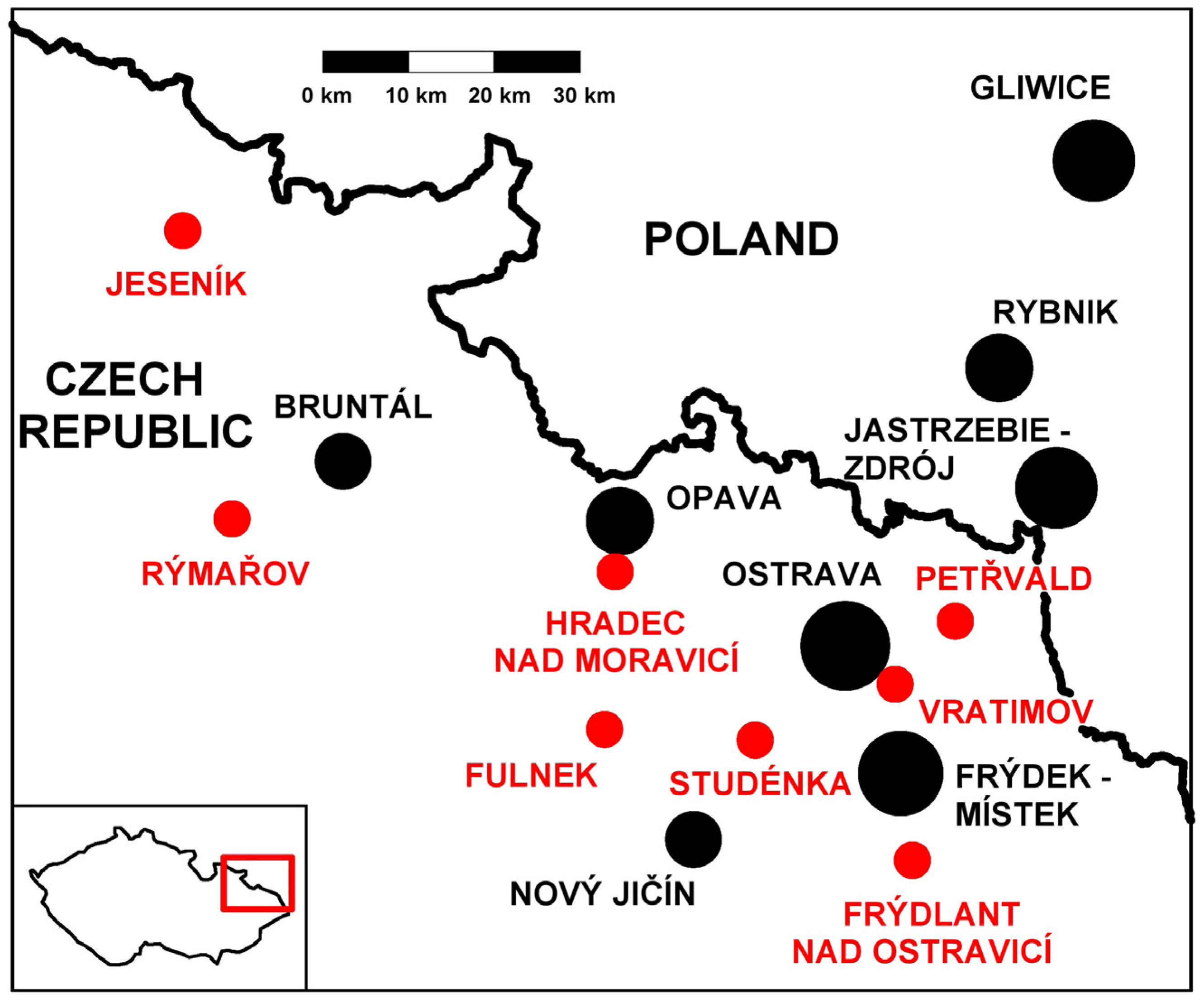
The approximate location of each of the surveyed towns can be seen in
Figure 1.
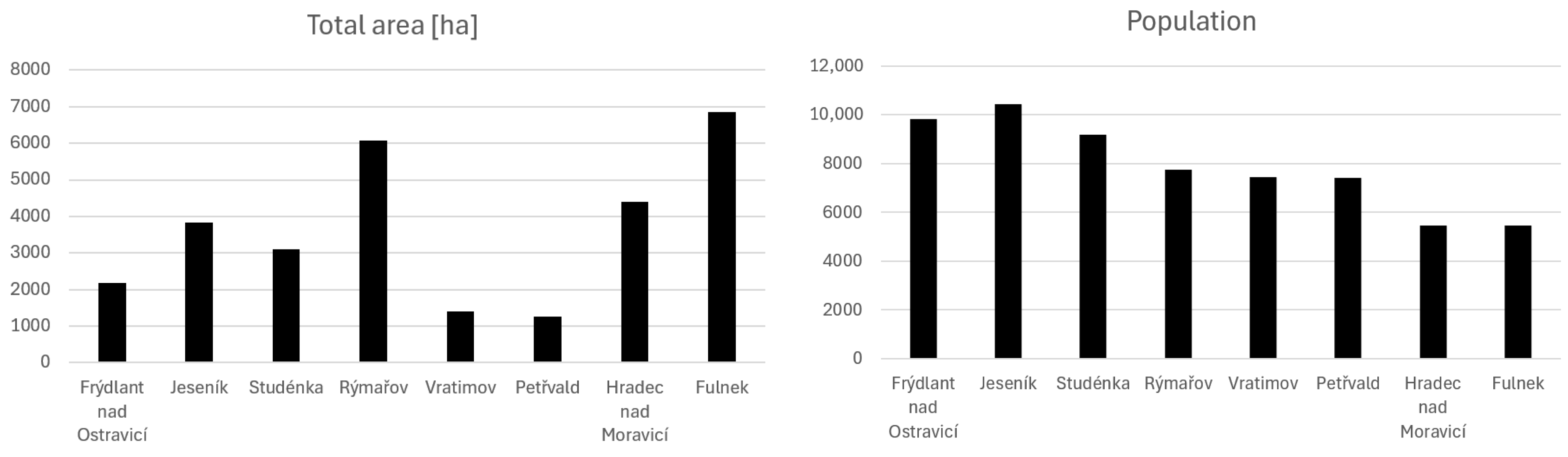
First, data on the total area of the cadastral territory of each town and the total area of land belonging to the agricultural land fund were taken from the land register. A basic comparison of the area and population of cities is shown in
Figure 2.
Each of the towns defines new buildable areas in its zoning plan, the list of which is always given in the text part of the document [
27,
28,
29,
30,
31,
32,
33,
34]. It should be emphasized that for research, only free buildable areas designated for individual housing were analyzed; land that is registered as buildable in zoning plans but is clearly already built up was not taken into consideration. The zoning plans were therefore analyzed, the listed areas were found in the map, the individual parcels on which the developable areas lie were identified, and the creditworthiness of the parcels concerned was verified. This can be determined directly on the cadastral map by clicking on the relevant parcel. If a specific parcel belongs to multiple soil quality classes, each piece of data is recorded separately, i.e., each part of the total area is assigned a specific soil quality class. The areas of entire parcels and any parts with different soil quality are listed directly in the real estate cadaster. If a specific area was registered in the zoning plan as buildable but was not part of the agricultural land fund, it was assigned the attribute “No SQ.” In the land registry, such areas are usually listed as “barren land” or “other areas.” For each city, the total area of all buildable land was also calculated. The procedure is clear from
Figure 3.
The territories of all the above-mentioned towns were analyzed in this way. The only exception was the town of Jeseník, which provides the necessary data directly in its zoning plan, and these data were taken from there.
Given that the requirement to adopt or update a zoning plan is based on the internal needs of individual municipalities and that the documentation therefore varies in age,
Table 1 provides an overview of the dates of approval and last update of the zoning plans of the cities surveyed. The research itself took place in June and July 2025.
In this context, it should also be noted that the condition of increased protection of agricultural land falling within the 1st and 2nd soil quality classes was added to Czech legislation by Amendment No. 41/2015 Coll. with effect from 1 April 2015. If the land was previously designated as buildable in the valid zoning plan, the above statement does not apply to it.
4. Discussion
The results presented in the previous tables are quite surprising in some respects and do not support the hypothesis.
The difference in the size of the administrative areas is not surprising; this size does not necessarily correspond to the population. In this respect, it depends on local conditions, the number of local districts, etc. Also, the total share of agricultural land in the total area of a town is determined by its location, the morphology of the terrain, etc. In the case of towns that have a lower proportion of agricultural land, the situation is mainly due to the extensive forests that the towns have on their territory. However, forests have not been the subject of this research, and their share is thus not reported.
The share of built-up areas is also relatively stable and ranges between 1 and 5% of the total urban area. The difference is again due to the different urban areas. It can thus be concluded that none of the cities studied is significantly substandard in these parameters.
On the other hand, the data presented in
Table 3 and
Table 4 yielded rather surprising results. In general, one would expect, given the above, that the predominance of developable areas would be in the lowest grades, but the opposite is true. Except for Jeseník and Frýdlant nad Ostravicí, where the results can be interpreted as corresponding to expectations, the situation in the case of the other towns is quite the opposite, and it appears that these towns have, for the most part, designed their buildable areas for individual housing on the most agriculturally valuable areas.
The impact of legislative changes is clear here, as only the zoning plan for the town of Frýdlant nad Ostravicí was issued after the relevant amendment to the Act.
In contrast, the results for areas larger than 10,000 m2 show only minor deviations from the summary results for all areas.
5. Conclusions
The proportion of developable land on agriculturally valuable parcels is much higher than originally expected. It is obvious that many towns had already defined their buildable areas several years ago, at a time when the legislative protection of the agricultural land fund was not so strict in the Czech Republic. The situation may be partly due to the greater benevolence of the agricultural land protection authorities, which have commented on spatial planning documentation in the past. It can be expected that with the current stricter protection of agricultural land, the situation will gradually improve, and new development areas will be defined as less agriculturally valuable parcels if necessary. Particularly in the case of approving new zoning plans, which will be subject to stricter legislative protection, it is possible to predict an improvement in the situation, but most cities still tend to update existing plans. It would also be appropriate to regulate or coordinate the amount of newly buildable land at the regional level. In the Czech Republic, however, coordination at the level of municipalities with extended powers appears to be too narrow, while at the regional level it appears to be too broad. There is no intermediate level between these two levels.
Furthermore, a general reduction in the number and extent of buildable areas can certainly be recommended. However, it is practically impossible to return the areas that are currently listed as buildable but have no buildings standing on them yet, nor is there any construction planned on them shortly, back to non-buildable areas. This is referring to the owners of the land, whose property value would be considerably reduced by such a return. On the other hand, the planning authorities are facing constant pressure and requests from owners of currently undeveloped land to convert these areas to developable land, again mainly with the aim of property appreciation. The designation of new land is thus also largely a political issue.