3.1. Analysis of Building Life Cycle Phases
The life cycle of a building is a complex process that includes all phases from idea and planning to demolition or renovation. It represents a certain time interval that consists of four main phases. It is an interdisciplinary process in connection with the technical lifespan, the business plan of the building and, of course, the economic side of the cycle. We can also see, the distribution of individual phases as well as their share in either the time or financial costs is developing over time Over the course of their life cycle, buildings consume significant amounts of resources and contribute to the transformation of areas. This can result in significant economic consequences and impacts on the environment and human health. Therefore, we strive to minimize the environmental impacts of buildings throughout their life cycle [
10].
The process of spending funds to procure a construction project, as an investment, results in an investment. Similarly, an investment goes through various phases, each of which has a further breakdown [
11].
3.1.1. Pre-Investment Phase
If we look at the first phase the pre-investment phase of the life cycle it represents one of the most important stages of this cycle, which fundamentally affects the entire course and success of the implementation of construction. The pre-investment phase represents the period before the actual implementation of construction, during which all necessary preparatory work is carried out. It is a period of planning, preparation, and decision-making, during which the basic parameters of the project are determined, options are evaluated, and conditions for successful implementation are ensured. This phase is crucial for minimizing risks, optimizing costs, and ensuring the quality of construction. Consistent preparations in this phase can lead to more efficient use of resources, shortening the construction period and increasing the likelihood of achieving the set goals.
This phase of the construction life cycle includes interconnected steps, the consistent implementation of which is an important prerequisite for the effective fulfillment of the construction goal:
This step focuses on identifying the reasons for construction and determining the main goals and requirements of investors and stakeholders.
Evaluation of the suitability of the location, preparation of spatial planning documents, environmental impact assessment, and other activities are included in this step.
This is mainly used to assess the economic, technical, environmental, and legal aspects of the project and to estimate costs and benefits.
We mainly understand this to encompass basic proposals, concepts, studies, and project documentation for a building permit.
Within this step, we focus on finding financial resources, securing loans, grants, or other forms of financing.
One of the final stages, within which applications are submitted, necessary documentation is prepared, and legal permits are obtained.
In this stage we focus on the selection of construction companies and contractual partners for the subsequent preparation of contracts.
The pre-investment phase is an integral part of the construction life cycle, influencing its success, efficiency, and sustainability. Consistent and high-quality preparation in the pre-investment phase reduces the risk of unnecessary costs, delays, or legal problems during the construction process. It also ensures that the project will be in compliance with legislation, environmental standards, and market requirements.
It is important to focus on key aspects of the pre-investment phase, since if we focus on correctly estimating costs and benefits, we can achieve the minimization of financial risks and thus ensure economic efficiency in further phases of the life cycle. In addition to this, several key aspects are particularly important, namely the environmental sustainability of the project in connection with the verified technical feasibility of the project. It is necessary not to neglect legal and regulatory compliance by securing all necessary permits in accordance with applicable legislation.
3.1.2. Investment Phase
The investment phase of the construction life cycle is a key period during which the construction itself and the commissioning of the building are carried out. This phase is critical for ensuring the proper progress of the project, the efficient use of financial resources and the achievement of the set goals. The investment phase represents the period from obtaining a building permit or other necessary permits, through the construction itself, to the completion of all construction work and the completion of the building. Its main objective is to ensure that the building is built in accordance with the project documentation adhering to the specified time, budget, and quality.
This phase of the building life cycle also includes interconnected steps that are based on the fulfillment of the previous phase of the life cycle:
This step includes securing all necessary documents, selecting suppliers, and preparing a schedule and budget.
This means evaluating bids and confirming contracts with suppliers and subcontractors.
When the construction itself begins, monitoring progress, quality control, and compliance with safety standards.
For activities in which the project is ideally monitored on a daily basis with prompt and adequate resolution of problems and changes during construction work.
Regular quality control assessments, performance records, or other documentation for the handover of the building.
This phase is usually the most expensive part of the construction life cycle. It is important to effectively manage the budget, control costs, and secure financing. Various financial instruments such as loans, grants, or own resources are often used. The investment phase is exposed to several risks, such as changes in project documentation, delays, budget overruns, technical problems, or material shortages. Risk management includes careful planning, regular checks, flexibility in management, and effective communication between all project participants. After the completion of construction work, there is a final acceptance and handover of the building to the investor or user, ensuring operability and commencement of operation. It also includes the preparation of documentation such as operating manuals or final reports.
The investment phase of the construction life cycle is a key period that determines the success of the entire project. Careful planning, management, and cost and risk control are the conditions required to ensure that the construction will be implemented efficiently, with high quality, and within the specified time. The successful implementation of this phase creates the basis for the long-term sustainability and effective operation of the constructed structure.
3.1.3. Construction Use Phase–Building Management Phase
One of the key phases of the building life cycle is the use phase, which has a fundamental impact on the long-term sustainability, operational efficiency, and environmental footprint of the building. The use phase represents the period during which the building is used for its main purpose—housing, business, public services or other activities. This phase can last for decades, and its proper management has a significant impact on the building’s economic costs, quality of life of users, and environmental sustainability. Effective use and maintenance of a building can extend its lifespan, reduce operating costs, and minimize its negative impacts on the environment, and therefore it is important to be aware of the activities of this phase:
Regular maintenance is essential to maintain the functionality, aesthetics, and safety of a building. Repairs may include replacing worn components, renovating, or upgrading systems (electrical, plumbing, heating).
Effective energy management, waste management, and monitoring of the condition of the building are key to reducing operating costs and environmental impact.
Optimizing energy consumption through technologies such as energy-efficient lighting, building management systems (BMS), or renewable energy sources (solar panels, heat pumps) is the basis for sustainable use.
Regular monitoring of the condition of the building, quality checks, and evaluation of the efficiency of the building’s use allow for the identification of improvement opportunities and the prevention of major problems.
The use phase has a significant share in the overall environmental footprint of a building. To minimize negative impacts, various strategies can be applied, such as energy-efficient technologies and system solutions, the use of renewable energy sources, the implementation of intelligent building management systems, the introduction of regular maintenance to extend the life of building elements, or the education and involvement of users in sustainable practices. In many cases, it is in this phase that the results of the innovations involved are manifested—in addition to information, capital, and organizational structure, innovation culture is called the other side of technological innovation [
12].
The use phase is a key part of a building’s life cycle, influencing its long-term sustainability, economic efficiency, and environmental impact. Because of the huge amount of sustainability criteria in building certification systems, the majority of users and planners lack knowledge about their effects on the certification result and therefore on the quality of the building [
13]. Proper management, modernization, and optimization of operations can significantly contribute to reducing operating costs and environmental impacts. Therefore, it is important to pay increased attention to this phase and implement sustainable practices that will ensure the long-term value and functionality of the building.
3.1.4. Liquidation Phase
The decommissioning phase is becoming increasingly important due to the growing emphasis on sustainability, environmental responsibility, and efficient use of resources. The decommissioning phase of a building represents the final phase of the building’s life cycle, during which it is dismantled and removed. The aim is to end its existence in a safe, efficient, and environmentally sound manner, while ensuring proper waste management and recycling of used materials. The decommissioning process includes the following:
Before the actual disposal, it is necessary to develop a detailed plan that takes into account the technical, environmental, and legal aspects. This includes identifying the materials, their recyclability, and potential hazardous substances. Coordination with the relevant authorities and securing the necessary permits is also important.
This phase involves the gradual dismantling of the structure, wherein it is necessary to minimize environmental and safety risks. Dismantling can be partial or complete, depending on the further use or disposal of the land.
After dismantling, waste is sorted into recyclable materials (metals, wood, plastics, concrete) and hazardous substances. Recycling is key to minimizing the amount of waste in landfills and saving natural resources.
If hazardous substances (asbestos, lead, harmful chemicals) were present in the construction, they must be safely removed in accordance with applicable legislation and environmental standards.
After all debris and waste have been removed, the site will be cleaned up and prepared for further use or reclamation.
Last but not least, it’s important to do not forget impact of individual factors on the project life cycle which are human, political and technical factor [
14].
The disposal phase has a significant impact on the environment. Improper waste management can lead to soil, water, or air pollution. Therefore, it is important to comply with environmental standards, promote recycling, and use environmentally friendly technologies [
15,
16]. Modern methods, such as on-site dismantling or the use of recycling technologies, contribute to minimizing negative impacts. The disposal phase of a building’s life cycle is a key aspect of sustainable development in the construction industry. An efficient and environmentally responsible end to the existence of a building contributes to environmental protection, waste reduction, and optimization of resource use. Currently, it is important to emphasize innovations, legislative requirements, and environmental standards to make this phase as environmentally friendly as possible and, at the same time, economically efficient.
3.2. Case Study
The subject of the case study was a real prefabricated building made of prefabricated wood-based sandwich panels and its alternative solution designed using traditional brick family house technology. The aim was to compare both construction options in terms of their economic sustainability. The reference building is a two-story cubic structure situated above a rectangular single-story base, creating a thoughtfully conceived architectural unit. The design is optimized not only in terms of layout, but also in terms of the selection of materials for the exterior. The total floor area of the structure is 21 × 19 m. The main difference between the options considered is the material base of the load-bearing system. The prefabricated version is based on a wooden structure made of prefabricated panels, while the traditional option uses ceramic masonry elements in combination with reinforced concrete lintels and a ceiling slab. Both structures are based on foundation frames, but the brick option requires more robust foundations due to the higher weight of the object. The roofing is the same in both cases. Since both variants had to meet comparable energy standards, the differences were mainly reflected in the thickness of the perimeter walls and the amount of thermal insulation used, which reflects the specifics of the individual material solutions.
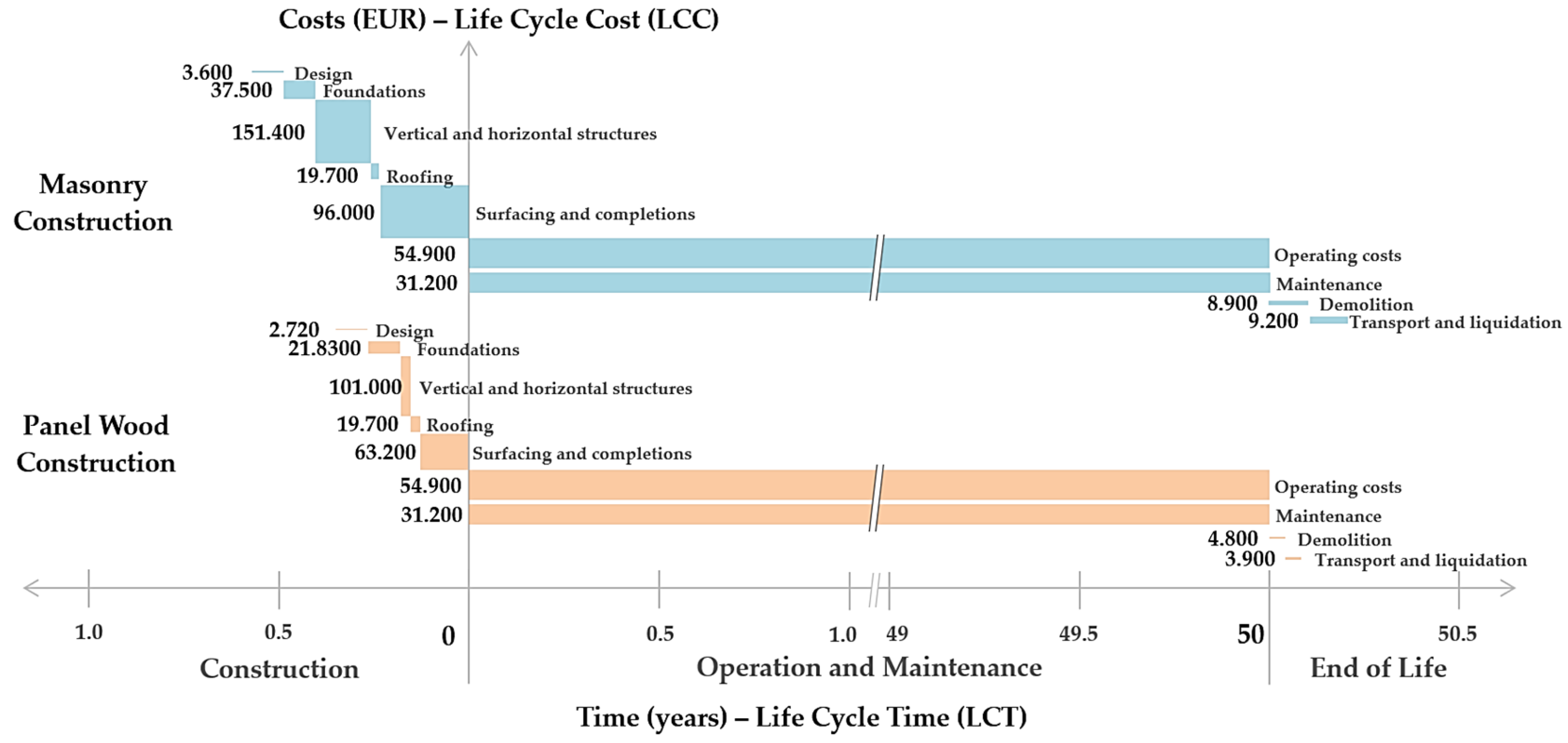
The results of the case study showed that the prefabricated timber structure variant is, in many respects, less economically demanding compared to the masonry alternative (
Figure 1). However, it should be emphasized that this outcome is strongly dependent on the boundary conditions and the applied input parameters. Therefore, the primary aim of the analysis was not only to compare absolute costs, but above all, to identify the share of individual life cycle phases in the overall cost of the structure.
As can be seen in the attached diagram, the construction phase together with the operation phase represent the dominant components of the total costs. This ratio is, however, highly variable and depends on specific input and output parameters. In the case of building operation, the manner of use plays a particularly significant role, as it can substantially influence the long-term economic burden.
The case study focused on smaller building objects, which are generally less complex in terms of economic predictability and whose life cycle is easier to model. For larger construction projects, however, our findings indicate a more pronounced share of costs in the operation phase, which represents a crucial aspect of economic sustainability. This observation highlights the importance of thorough modeling of inputs and outputs throughout the entire building life cycle.
Common risks in such projects include, for example, insufficient reliable data, which requires a data collection phase and consultation with operators; underestimation of environmental and regulatory cost risks, which should be confirmed through modeling; not taking into account new developments in technology during the life cycle of the building, which we can eliminate by regularly updating the LCC model; and last but not least, unclear communications with stakeholders.
LCC includes all related costs of the asset throughout its life cycle. The aim is to optimize the total cost to the owner over the building’s life cycle, not just to achieve the lowest price in the procurement process. LCC is most commonly applied in large projects in areas such as infrastructure and transport projects (highways, bridges, railways), energy and energy projects (large veterinary farms, solar parks, clean technologies), buildings and urban development (complex office blocks, hospitals, university campuses) or IT and industrial facilities with long life cycles (data centers, manufacturing plants).