1. Introduction
Precision trajectory prediction in robotic manipulators is essential for high-stakes applications such as aerospace assembly [
1], surgical automation [
2], and industrial machining [
3]. The UR5 manipulator is widely adopted among commercially available systems due to its flexibility, six degrees of freedom, and compact architecture [
4]. However, achieving reliable trajectory estimation under uncertainty remains a major challenge, especially when real-world data is limited, noisy, or high-dimensional.
Gaussian Process Regression (GPR) has become increasingly applicable in the context of robotics, as it is probabilistic with nonlinear mapping guided uncertainty quantification [
5,
6,
7]. However, conventional GPR has inherent scaling issues and lower data-sparse data accuracy [
8]. This has led to transfer learning and active learning within GPR frameworks to enhance both generalization and sample efficiency [
9,
10].
Transfer learning provides a means to accomplish a similarity-based transfer of knowledge between related source domains and target tasks when the target has limited data and has found success in robot manipulation [
11], inverse dynamics modeling, and grip adaptation [
12]. The alternative active learning approach, conversely, probes only the most educative samples to accelerate the learning process [
13,
14]. The Active Transfer Gaussian Process (ATGP) model utilizes both strategies. In this strategy, models are empowered to synthesize on top of the source data and actively distill their predictions in the target domain [
15].
In trajectory modeling, a variety of techniques have been adapted, including neural networks [
16], support vector machines [
17], and ensemble models [
18]. Nevertheless, such methods lack interpretability or bounds of uncertainty. Surrogate models based on Gaussian Processes, including Kriging and multi-output GPR, have been applied for kinematic reliability analysis [
19], but few have addressed transfer-based learning under structured preprocessing pipelines [
20]. Despite advances in transfer-learning-based GPR, three key gaps remain: (1) no existing framework for UR-series manipulator trajectory prediction that learns from high-dimensional, time-indexed DH parameters under limited target-domain data; (2) absence of robust preprocessing (Modified Z-score outlier removal, median–IQR scaling) combined with PCA-guided, physics-informed synthetic source domain generation; (3) lack of coordinate- and time-resolved, uncertainty-aware reliability metrics alongside accuracy. This is the first ATGP-based UR5 framework that unites these elements into a scalable, real-time capable, uncertainty-aware trajectory prediction solution. This paper proposes a simulation-based framework that leverages ATGP for trajectory prediction of the UR5 manipulator. The key features of this framework include the following:
Robust preprocessing via outlier removal and robust scaling.
Dimensionality reduction using Principal Component Analysis (PCA).
Physically grounded source domain generation using simplified kinematic reasoning.
Multi-output ATGP training and reliability visualization.
The technique offered reaches an accuracy of sub-millimeter and is excellent at generalizing with a small amount of training data. It is more reliable with respect to uncertainty awareness, interpretable, and predictive results compared to conventional GPR and neural methods, making it a good option for robots where high reliability is desired.
2. Methodology
2.1. Problem Definition
This work aims to predict the 3D end-effector trajectory of the UR5 robotic manipulator using uncertain (DH) parameters as input. Each input sample consists of 150 features (15 DH parameters across time steps), while the output is a 30-dimensional vector representing the positions at those time steps.
The issue is the high-dimensionality and few target data, and the need for accurate and uncertainty-aware predictions. This is tackled by utilizing an Active Transfer Learning Gaussian Process (ATGP) model, which maps DH parameters to trajectory outputs utilizing a small target dataset and a physics-informed, synthetic, source domain of data.
2.2. Data Generation and Description
This data is created in a simulation with the help of the UR5 manipulator as a forward kinematics model. Each of the samples encompasses 10 × 15 matrix of (DH) parameters that represent joint configurations at time steps. These are reshaped into dimensional input vectors.
The corresponding outputs are 10 × 3 matrices containing the 3D end-effector positions, reshaped into 3-dimensional vectors. In total, 550,000 trajectory samples are generated to capture the variability in the manipulator’s behavior under uncertain conditions. A subset of these samples is selected for model training and testing, enabling efficient evaluation of the ATGP framework in a high-dimensional, data-rich simulation setting.
2.3. Preprocessing and Feature Normalization
A three-stage preprocessing pipeline is applied to enhance data quality and learning stability:
Outlier Detection and Removal: Outliers in both input and output data are identified using the Modified Z-score method:
where
Samples with
are considered outliers and removed.
Robust Feature Scaling: To normalize features while preserving robustness, median and interquartile range (IQR) are used instead of mean and standard deviation:
where
This reduces sensitivity to extreme values and ensures numerical stability across all 150 input features and 30 outputs.
2.4. Dimensionality Reduction (PCA)
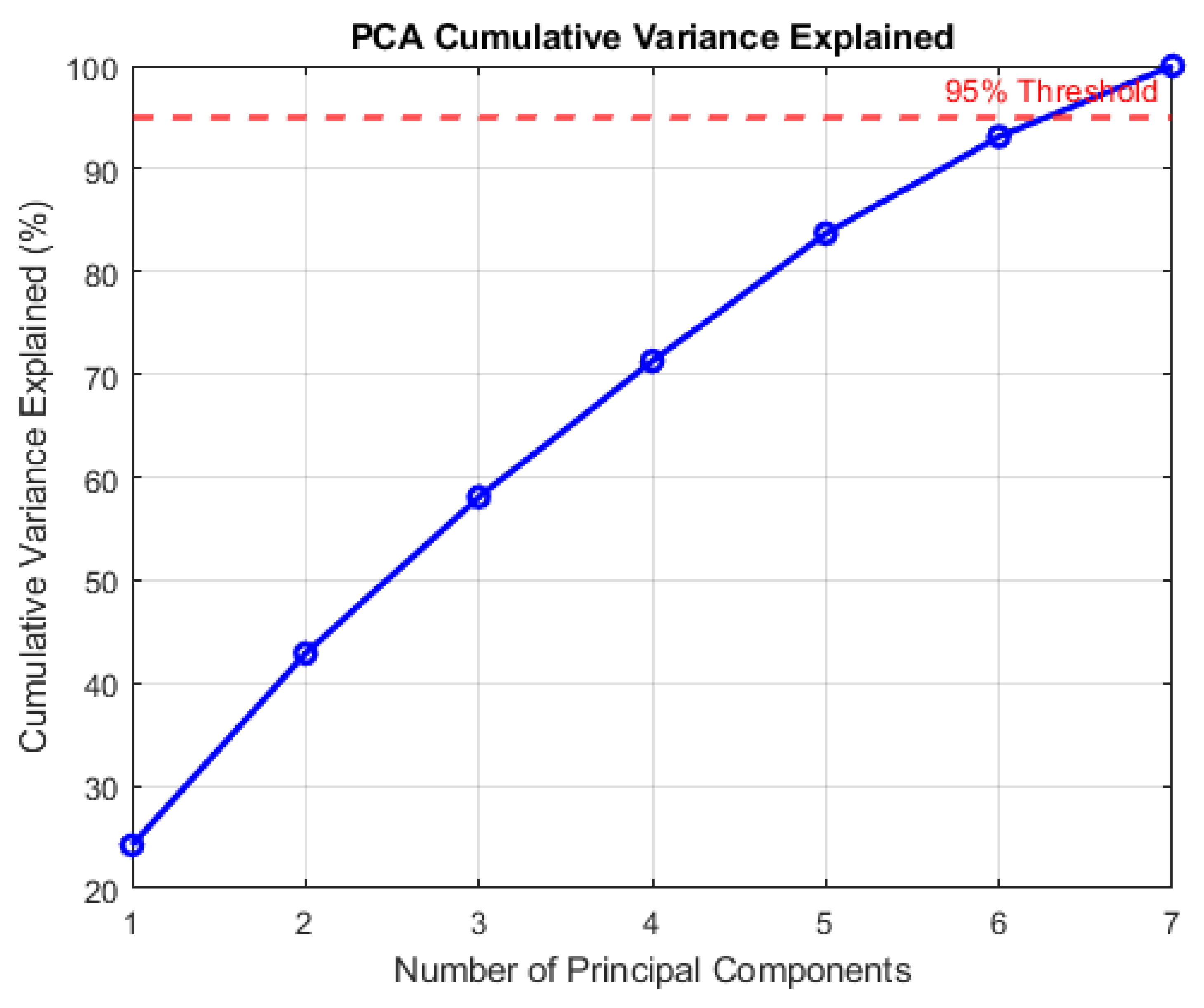
Dimensionality Reduction (PCA): Principal Component Analysis (PCA) is applied to reduce the 150-dimensional input space while preserving at least 95% of the total variance.
Retaining 95% variance required 6 principal components out of the original 150 features. The cumulative variance explained curve (
Figure 1) shows a rapid rise that plateaus after this point, confirming that most of the variance is captured in a reduced subspace. The reduced data is denoted as follows:
where
is the mean of the scaled data and
contains the top
eigenvectors.
2.5. Synthetic Source Domain Construction
To enhance learning in the data-scarce target domain, a synthetic source domain is generated using physically informed approximations of the UR5 manipulator’s kinematics.
Sampling in PCA Space: Source inputs are first generated in the reduced PCA space to ensure coverage and diversity. Let represent source samples over principal components. These are uniformly sampled within the observed bounds of the target data’s PCA distribution.
Inverse PCA Transformation: The source samples are then projected back to the scaled feature space:
where
and
are derived from the PCA on target data.
Back-transformation to Physical DH Space: The scaled source inputs are converted to physical DH parameters using inverse robust scaling:
Each row is reshaped into a 10 × 15 matrix representing synthetic DH parameters over 10 time steps.
Simplified Forward Kinematics for Output Generation: For each synthetic input, a forward kinematics approximation is applied to compute 3D positions using structured DH parameter blocks:
where
are extracted from each joint’s DH parameters. Random noise is added to simulate realistic variability. The simplified forward kinematics used for synthetic source-domain output generation is formulated as follows:
The end-effector position
is taken from the first three elements of the last column of
In this study, only
vary across time steps, with other joint angles fixed at nominal values from
Table 1. Gaussian noise is added to
to simulate realistic variability.
2.6. Active Transfer Learning Gaussian Process (ATGP) Modeling
The proposed model leverages Active Transfer Learning Gaussian Process (ATGP) to accurately predict high-dimensional outputs using limited target data and a synthesized source domain. The framework integrates Gaussian Process Regression (GPR) with knowledge transfer and selective refinement.
Gaussian Process Regression (GPR): Given training inputs
and targets
, GPR assumes
where
is the mean function (usually zero) and
is the covariance function (e.g., squared exponential kernel). The predictive distribution at the test point
is
where
is the kernel matrix,
is the covariance vector, and
is the noise variance.
Transfer Learning Component: ATGP integrates both target domain data
and source domain data
. Each model is trained by combining these datasets while preserving domain relevance. Source and target data are normalized into a common feature space and processed with the same GPR kernel. Domain relevance emerges naturally, as the adaptive enrichment loop continually adds only the highest-error target samples, biasing the model toward the target distribution without explicit weighting. This design choice avoids unnecessary hyperparameter tuning for weight factors, while preserving computational efficiency and scalability. The total training set becomes
The model benefits from the informative structure of which guides learning in the underrepresented regions of .
Active Component (Implicit): While explicit query-based active learning is not applied, the model implicitly selects and prioritizes high-quality target slices and informative synthetic source samples. Explicit query-based active learning was omitted because the sequential high-error sample selection loop already serves a similar purpose while being computationally lighter and better suited for large-scale, real-time deployment. Additionally, robust preprocessing and dimensionality reduction act as a sample refinement mechanism.
Multi-Output Decomposition: The -dimensional output vector represents the and positions of the end-effector across 10 time steps. To preserve this physical structure, 30 independent ATGP regressors are trained—each predicting one coordinate ( or ) at a specific time step. This decomposition allows scalable training and inference while maintaining the interpretability and consistency of spatial predictions.
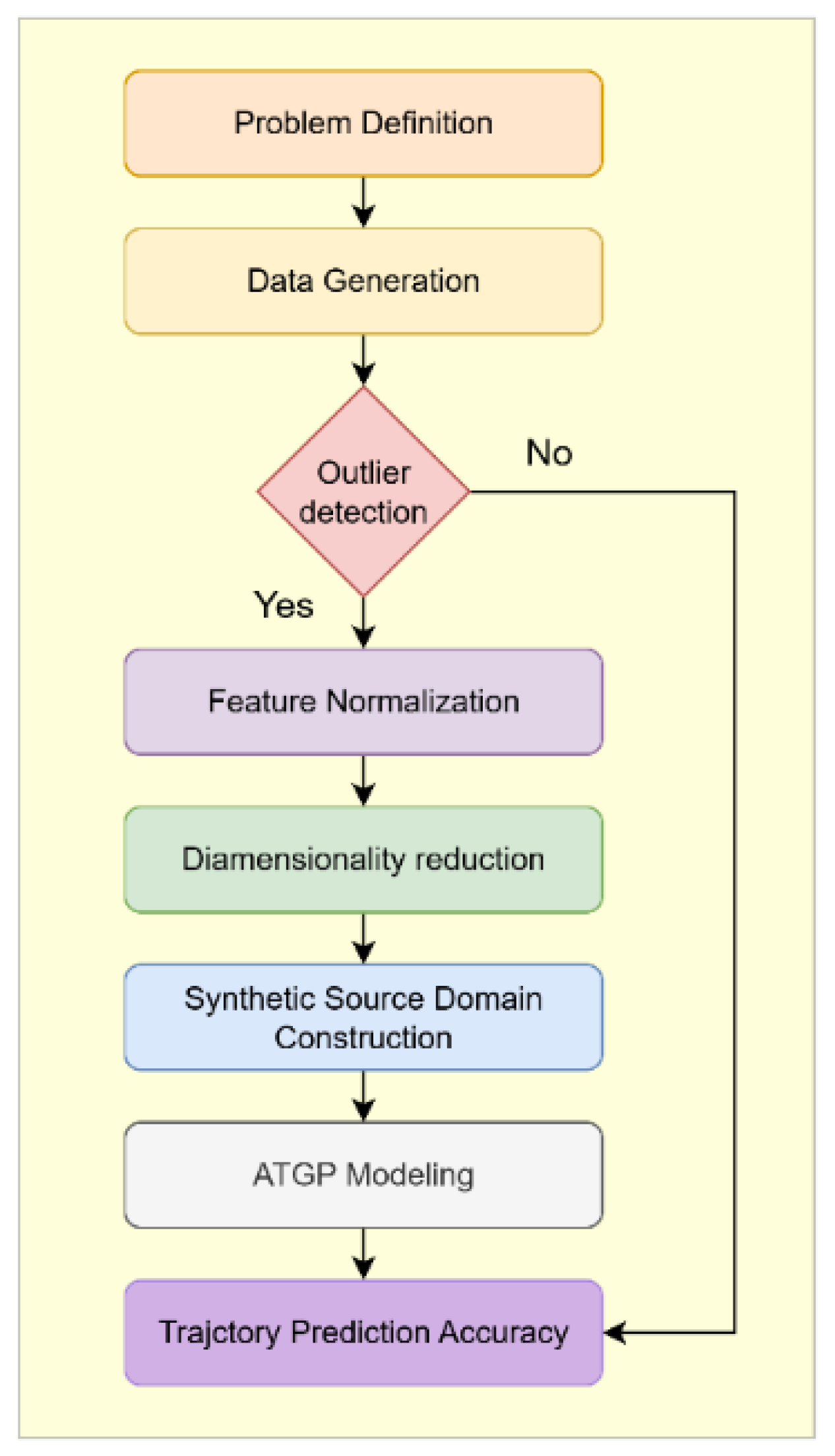
The overall methodology followed in this study is summarized in
Figure 2. It outlines the key stages from data preprocessing and dimensionality reduction to synthetic source generation and ATGP-based multi-output prediction.
3. Simulation Setup
This section outlines the dataset generation strategy, DH parameter modeling, and simulation procedures used to evaluate the proposed ATGP framework for UR5 trajectory prediction under uncertainty.
3.1. Dataset and Evaluation Strategy
The evaluation phase uses a dataset of simulated trajectory samples, each consisting of 150 input values (from 10 time steps × 15 DH parameters) and 30 output values (3D end-effector positions across 10-time steps). This dataset was generated with injected uncertainty and is used exclusively for prediction and reliability evaluation. For training, a separate target-domain dataset was independently generated using the same uncertainty modeling but at a smaller scale—at 15% the size of the main evaluation set. The model was trained using the entire training dataset, along with synthetic source-domain samples generated via PCA-guided sampling and forward kinematics from the source configuration.
Once trained, the model was deployed to predict the entire 550,000-sample evaluation set, which includes random variations and uncertainty. This allowed large-scale estimation of prediction accuracy and system reliability across the full input space. This decoupled setup ensures that the training process remains data-scarce while reliability evaluation is comprehensive and unbiased.
3.2. DH Parameter Modeling and Variation
UR5 robot kinematics are described using standard (DH) parameters. These serve as the input structure for trajectory generation. The nominal joint configuration is listed in
Table 1.
In this study, only
are actuated across time. All other joint angles remain fixed. The time-based actuation profile is shown in
Table 2.
All motion trajectories are generated by varying θ
1 and θ
5, while maintaining fixed values for other joints. To simulate uncertainty, parameter-level noise is introduced to both translational and rotational DH terms. This allows the model to handle real-world perturbations in joint configurations. The applied distribution strategy is summarized in
Table 3.
This stochastic modeling helps benchmark the model’s predictive stability and failure tolerance under diverse input distributions.
3.3. Implementation Details
All simulations were conducted in MATLAB 2023a using the following workflow:
3.3.1. Preprocessing
We selected a modified Z-score threshold of 3.5 as recommended in robust statistics literature [
20], since it effectively identifies extreme deviations even in non-Gaussian datasets while minimizing false positives. From the 5.5 × 10
5 available samples, only 11,175 (≈2.03%) exceeded this threshold and were discarded. This limited removal eliminated high-noise anomalies without impacting on the diversity or representativeness of the retained dataset, ensuring the model was trained on clean yet comprehensive data.
- 2.
Robust scaling using median and IQR.
- 3.
PCA applied to retain 95% f the variance.
3.3.3. Prediction and Evaluation
Model predicts all 550,000 samples from the test dataset.
Metrics include MAE, RMSE, STD, and reliability estimation based on failure thresholds.
This setup provides a scalable, reproducible, and uncertainty-aware evaluation environment for robotic trajectory prediction.
3.3.4. Incremental Training Strategy for Scalability
Rather than training on the full 5.5 × 10⁵-sample target dataset, the ATGP framework starts with only 10 target domain samples. The trained model predicts outputs for all remaining candidates, performs sample-wise error analysis, and identifies the input with the maximum prediction error. Its true output is computed using the original forward-kinematics-based performance function, and this new pair is added to the training set. The process repeats until the desired accuracy is reached. Using this strategy, training the complete 30-output model with just 27 total samples required ~32 s, while generating predictions and error evaluations for the entire 5.5 × 10⁵-sample dataset took ~13 min. This incremental, error-driven enrichment drastically cuts computation and memory cost compared to full-dataset training yet remains practical for large-scale and near-real-time robotic applications.
4. Results and Discussion
This section evaluates the performance of the proposed ATGP model in terms of trajectory accuracy and error reliability across spatial dimensions and joints. The results are supported by representative visualizations grouped into two sets: trajectory prediction analysis and reliability assessment.
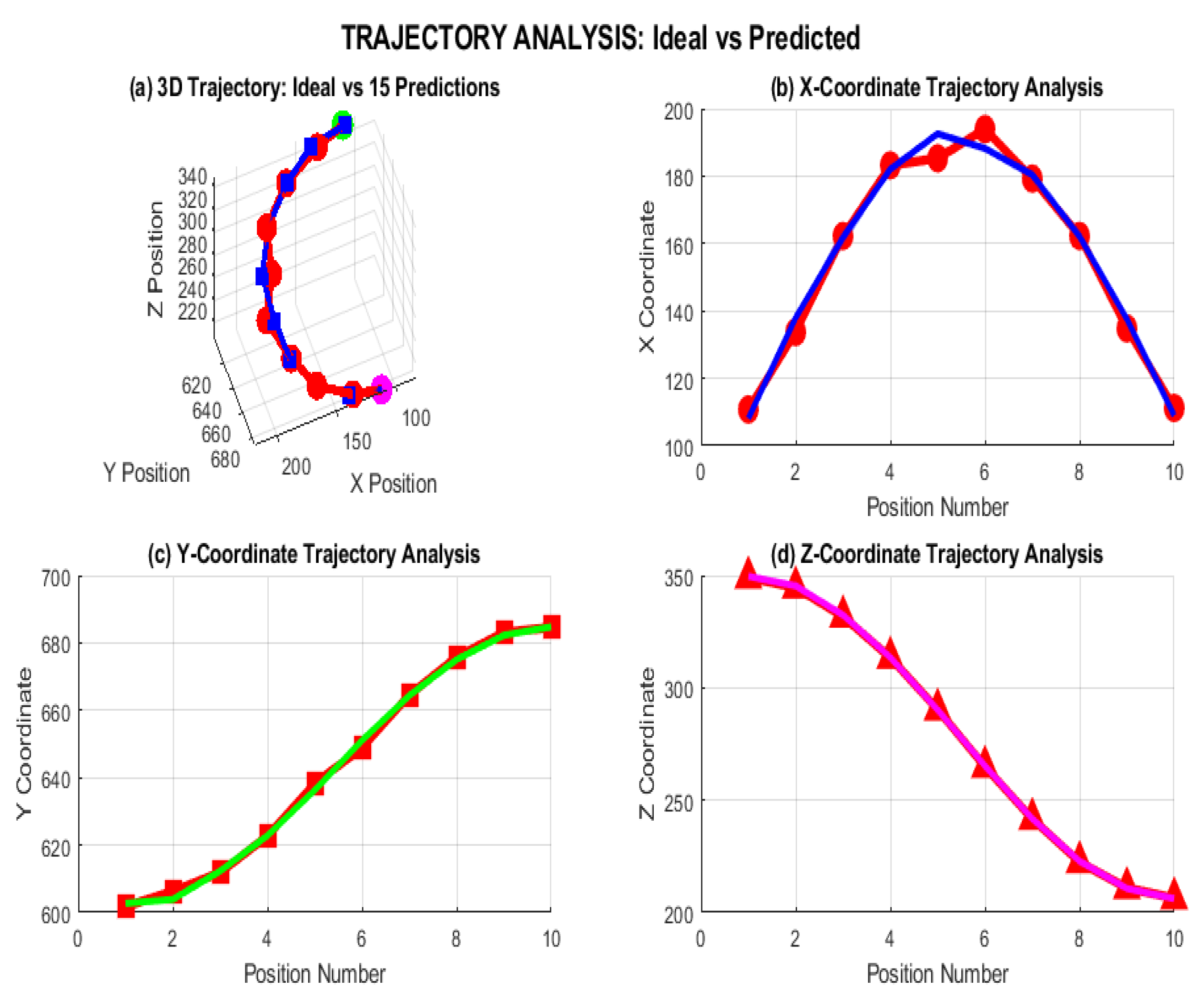
Trajectory prediction accuracy is illustrated in
Figure 3, where four subplots show the close agreement between the predicted and ideal trajectories.
Figure 3a: A 3D trajectory plot indicates that the predicted paths (blue) and the ideal trajectory (red) were closely linked, which validated spatial accuracy by using
time steps.
Figure 3b: The X-coordinate trajectory displays a smooth curve with the predicted line closely matching the ideal path.
Figure 3c: Y-coordinate predictions follow the ground truth with minimal deviation, indicating consistency in upward progression.
Figure 3d: The Z-coordinate prediction tracks the decline in height with high fidelity across all joints. These results confirm that the ATGP model accurately predicts position data in all three spatial dimensions, even under high-dimensional input uncertainty.
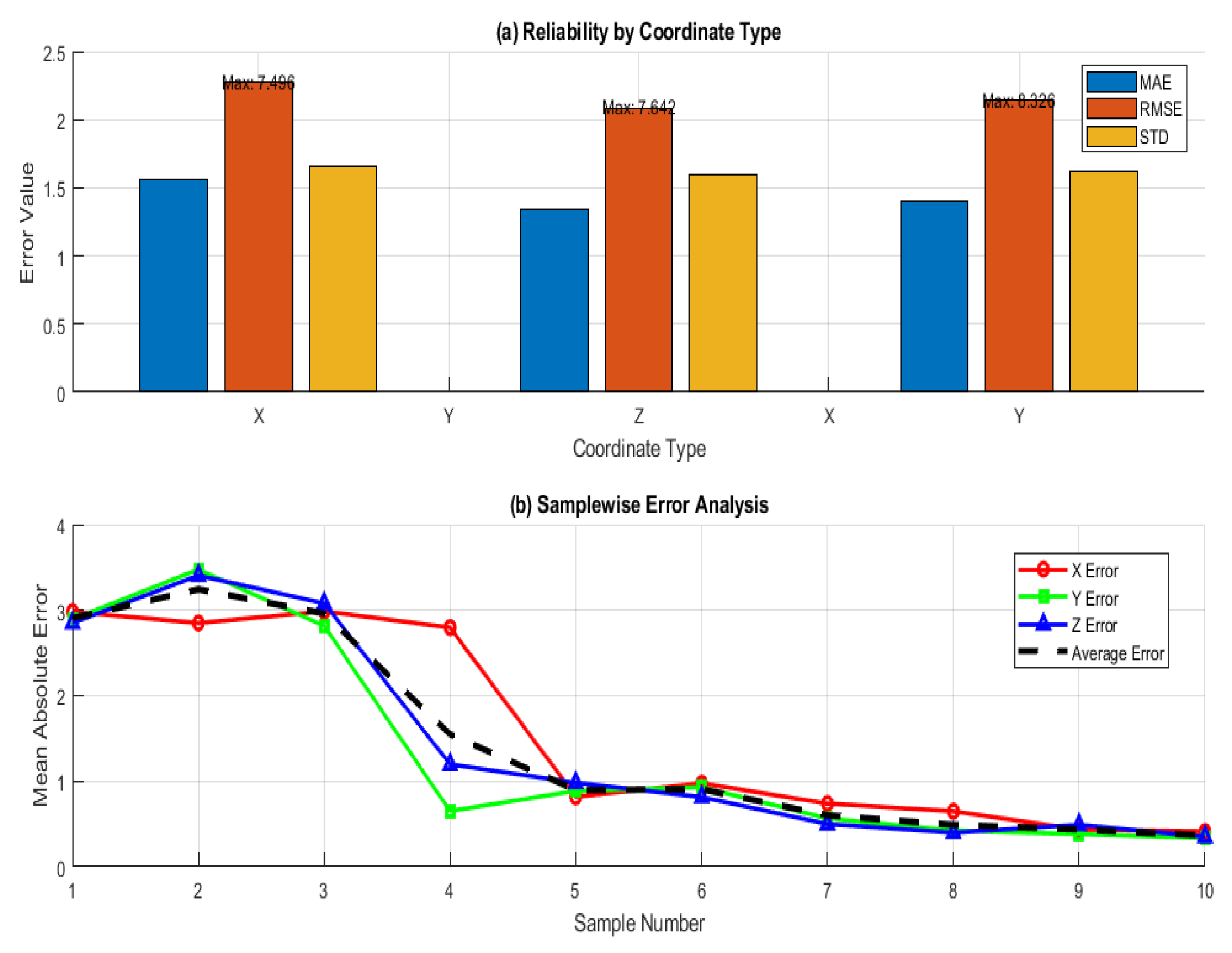
Figure 4 shows a detailed analysis of errors across coordinates and joints, highlighting how the model performs on each component.
Figure 4a: A grouped bar chart compares MAE, RMSE, and STD for the X, Y, and Z coordinates. The X- and Z-axes exhibit slightly higher RMSE than Y, but all errors remain under acceptable bounds (below ~2.5 mm). This indicates balanced performance across dimensions.
Figure 4b: Sample-wise error plots illustrate how prediction accuracy varies across the
-time steps. Samples 1 to 3 show slightly higher errors across all coordinates, while samples 4 to 10 maintain low and stable errors. The average error curve (black dashed line) confirms this trend.
This analysis highlights that the ATGP model performs more consistently in the mid-to-late trajectory phases, possibly due to more structured motion dynamics in those regions.
Visualization and Confidence Evaluation
The predicted trajectories produced by the ATGP model show strong alignment with the ground truth across all spatial dimensions. Visually, the model generalizes well across time steps and joint configurations, with smooth, stable predictions and minimal deviation. Even without displaying explicit confidence intervals, the tight match between predicted and actual paths implies low uncertainty.
To validate these observations, a Monte Carlo Simulation (MCS) was used as a statistical benchmark. Both methods were tested on the same dataset of trajectories using a uniform failure threshold.
Table 4 summarizes the reliability results for both approaches. The ATGP model performs competitively, achieving high prediction accuracy and a low relative error when compared to the MCS baseline—highlighting its effectiveness for uncertainty-aware trajectory modeling.
These results confirm that while ATGP trails slightly behind MCS in raw reliability, it maintains strong accuracy and provides valuable uncertainty estimates with less computational effort, making it well-suited for real-time robotic applications.
5. Conclusions
In this research, a simulation framework based on an Active Transfer Learning Gaussian Process (ATGP) model is developed, enabling accurate and reliable prediction of the trajectory of the UR5 manipulator robotic arm. The combination of strong preprocessing, dimensionality-reduction based on PCA, and a generation of the source domain in the target enables the model to handle high-dimensional input space and limited target data. The results are also characterized by good predictive performance and one that matches well the predicted and ideal trajectory in the three spatial dimensions. Coordinates-based error analysis and joints-based error analysis validate the robustness of the model, especially towards a later stage of the trajectory, where the accuracy level is more decisive. Although the other models exhibit low values of the average absolute error, the ATGP model has low values of both the average absolute error and maintains high reliability in all output channels. The suggested solution allows a scaling and data-efficient approach to the modeling of robotic trajectories in the presence of uncertainty. Though the present work is on simulation, the formulation can be embodied in the application of sensor noise, actuation errors, and online learning. This work has so far been validated only in simulation, meaning real-world tests—subject to sensor noise and unmodeled dynamics—are still pending. While not undermining the presented results, addressing these factors in hardware experiments will be the next step toward full deployment.
Author Contributions
Conceptualization, methodology, software, validation, formal analysis, investigation, visualization, K.A., T.Z. and A.H. Writing and draft preparation, K.A., writing—review and editing, K.A., T.Z. and A.H. Supervision, T.Z. and A.H. Project administration, T.Z. and A.H. All authors have read and agreed to the published version of the manuscript.
Funding
This research received no external funding.
Institutional Review Board Statement
Not applicable.
Informed Consent Statement
Not applicable.
Data Availability Statement
The data that is used for simulating the system on the proposed mathematical model is obtained by using the data presented in
Table 1,
Table 2 and
Table 3.
Acknowledgments
The authors thank the National University of Sciences and Technology (NUST) for providing computational facilities and institutional support.
Conflicts of Interest
The authors declare no conflicts of interest.
References
- Arduengo, M.; Colomé, A.; Lobo-Prat, J.; Sentis, L.; Torras, C. Gaussian-process-based robot learning from demonstration. J. Ambient. Intell. Humaniz. Comput. 2023, 14, 12359–12384. [Google Scholar] [CrossRef]
- Eschmann, H.; Ebel, H.; Eberhard, P. Exploration-exploitation-based trajectory tracking of mobile robots using Gaussian processes and model predictive control. Robotica 2023, 41, 3040–3058. [Google Scholar] [CrossRef]
- Al-Dujaili, A.; Suresh, S. A MATLAB toolbox for surrogate-assisted multi-objective optimization: A preliminary study. In Proceedings of the 2016 on Genetic and Evolutionary Computation Conference Companion (GECCO ’16 Companion), Denver, CO, USA, 20–24 July 2016; pp. 1209–1216. [Google Scholar] [CrossRef]
- Song, J.Z.; Wang, X. Adaptive output-feedback control for switched stochastic time-delay nonlinear systems with uncertain output function. In Proceedings of the 2017 IEEE 56th Annual Conference on Decision and Control (CDC), Melbourne, VIC, Australia, 12–15 December 2017; pp. 268–273. [Google Scholar] [CrossRef]
- Ullrich, L.; McMaster, A.; Graichen, K. Transfer Learning Study of Motion Transformer-based Trajectory Predictions. In Proceedings of the 2024 IEEE Intelligent Vehicle Symposium (IV), Jeju Island, Republic of Korea, 2–5 June 2024; pp. 110–117. [Google Scholar]
- Akabane, R.; Kato, Y. Pedestrian trajectory prediction based on transfer learning for human-following mobile robots. IEEE Access 2021, 9, 126172–126185. [Google Scholar] [CrossRef]
- Huang, R.; Xue, H.; Pagnucco, M.; Salim, F.D.; Song, Y. Vision-Based Multi-Future Trajectory Prediction: A Survey. IEEE Trans. Neural Netw. Learn. Syst. 2025, 36, 13691–13708. [Google Scholar] [CrossRef] [PubMed]
- Liu, J.; Mao, X.; Fang, Y.; Zhu, D.; Meng, M.Q.-H. A Survey on Deep-Learning Approaches for Vehicle Trajectory Prediction in Autonomous Driving. In Proceedings of the 2021 IEEE International Conference on Robotics and Biomimetics (ROBIO), Sanya, China, 27–31 December 2021; pp. 978–985. [Google Scholar]
- Khan, M.; Patel, A.; Chatterjee, A. Multi-Sparse Gaussian Process: Learning based Semi-Parametric Control. In Proceedings of the 2020 IEEE/RSJ International Conference on Intelligent Robots and Systems (IROS), Las Vegas, NV, USA, 24 October 2020–24 January 2021; pp. 5327–5334. [Google Scholar]
- Buisson-Fenet, M.; Solowjow, F.; Trimpe, S. Actively Learning Gaussian Process Dynamics. In Proceedings of the Learning for Dynamics and Control, Berkeley, CA, USA, 10–11 June 2020. [Google Scholar]
- Kontoudis, G.P.; Otte, M. Adaptive Exploration-Exploitation Active Learning of Gaussian Processes. In Proceedings of the 2023 IEEE/RSJ International Conference on Intelligent Robots and Systems (IROS), Detroit, MI, USA, 1–5 October 2023; pp. 9448–9455. [Google Scholar]
- Deisenroth, M.P.; Fox, D.; Rasmussen, C.E. Gaussian Processes for Data-Efficient Learning in Robotics and Control. IEEE Trans. Pattern Anal. Mach. Intell. 2013, 37, 408–423. [Google Scholar] [CrossRef] [PubMed]
- Favaro, A.; Cerri, L.; Galvan, S.; Baena, F.R.Y.; De Momi, E. Automatic Optimized 3D Path Planner for Steerable Catheters with Heuristic Search and Uncertainty Tolerance. In Proceedings of the 2018 IEEE International Conference on Robotics and Automation (ICRA), Brisbane, QLD, Australia, 21–25 May 2018; pp. 9–16. [Google Scholar] [CrossRef]
- Li, C.-Y.; Rakitsch, B.; Zimmer, C. Safe Active Learning for Multi-Output Gaussian Processes. arXiv 2022, arXiv:2203.14849. [Google Scholar] [CrossRef]
- Cao, B.; Pan, S.J.; Zhang, Y.; Yeung, D.-Y.; Yang, Q. Adaptive Transfer Learning. Available online: http://ihome.ust.hk/ (accessed on 3 July 2010).
- Jiang, J.; Yan, K.; Xia, X.; Yang, B. A Survey of Deep Learning-Based Pedestrian Trajectory Prediction: Challenges and Solutions. Sensors 2025, 25, 957. [Google Scholar] [CrossRef] [PubMed]
- Sebastian, B.; Ben-Tzvi, P. Support vector machine based real-time terrain estimation for tracked robots. Mechatronics 2019, 62, 102260. [Google Scholar] [CrossRef]
- Li, Z.; Lin, Y.; Gong, C.; Wang, X.; Liu, Q.; Gong, J.; Lu, C. An Ensemble Learning Framework for Vehicle Trajectory Prediction in Interactive Scenarios. In Proceedings of the 2022 IEEE Intelligent Vehicles Symposium (IV), Aachen, Germany, 4–9 June 2022; pp. 51–57. [Google Scholar]
- Liu, W.-S.; Cheung, S.H.; Cao, W.-J. An efficient surrogate-aided importance sampling framework for reliability analysis. Adv. Eng. Softw. 2019, 135, 102687. [Google Scholar] [CrossRef]
- Obikee, A.C.; Ebuh, G.U.; Obiora-Ilouno, H.O. Comparison of Outlier Techniques Based on Simulated Data. Open J. Stat. 2014, 4, 536–561. [Google Scholar] [CrossRef]
| Disclaimer/Publisher’s Note: The statements, opinions and data contained in all publications are solely those of the individual author(s) and contributor(s) and not of MDPI and/or the editor(s). MDPI and/or the editor(s) disclaim responsibility for any injury to people or property resulting from any ideas, methods, instructions or products referred to in the content. |
© 2025 by the authors. Licensee MDPI, Basel, Switzerland. This article is an open access article distributed under the terms and conditions of the Creative Commons Attribution (CC BY) license (https://creativecommons.org/licenses/by/4.0/).