1. Introduction
1,3,5-Thiadiazines are an important class of heterocyclic compounds with a wide range of practical uses [
1,
2,
3,
4,
5,
6,
7]. Among all possible strategies for constructing a 1,3,5-thiadiazine scaffold, one should especially highlight the direction, based on various variants of the Mannich reaction–double aminomethylation, of various S,N-binucleophilic substrates (thioamides, dithiocarbamates, 2-mercaptoazoles and –azines, thiolactams, etc.), thiomethylation of amines and other N-nucleophiles, etc. [
1,
2,
3,
4,
5,
6,
7]. Due to its efficiency, ease of implementation, and availability of initial reagents, this approach is now perhaps the most popular method among heterocyclic chemists that allows for the production of partially hydrogenated 1,3,5-thiadiazines (or perhydro-1,3,5-thiadiazines) in a single synthetic operation.
It is known from the literature that active methylene compounds, particularly Meldrum’s acid, readily react with heterocumulenes such as isothiocyanates, carbon disulfide, etc., to form 1,3-dinucleophilic reagents [
8,
9,
10]. We decided to study the behavior of the reaction product of Meldrum’s acid with phenyl isothiocyanate—triethylammonium 1-(2,2-dimethyl-4,6-dioxo-1,3-dioxan-5-ylidene)(phenylamino)-methanethiolate—under the conditions of the aminomethylation reaction. It has been established that the mentioned thiolate reacts by double aminomethylation with aqueous HCHO and primary aliphatic and aromatic amines to form 1,3,5-thiadiazine derivatives-2,2-dimethyl-5-(3-phenyl-1,3,5-thiadiazinan-2-ylidene)-1,3-dioxane-4,6-diones that were not previously described in the literature. The scope and limitations of the reaction as well as the properties of the obtained 1,3,5-thiadiazine derivatives are discussed.
2. Results and Discussion
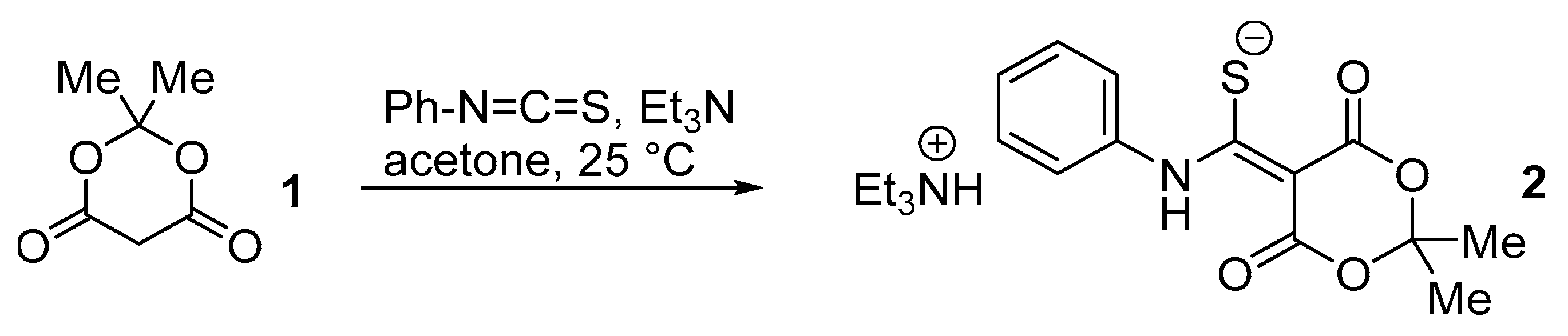
We have established that the reaction of Meldrum’s acid
1 with phenyl isothiocyanate in the presence of triethylamine yields a previously unreported salt: triethylammonium 1-(2,2-dimethyl-4,6-dioxo-1,3-dioxan-5-ylidene)(phenylamino)-methanethiolate
2 (
Scheme 1).
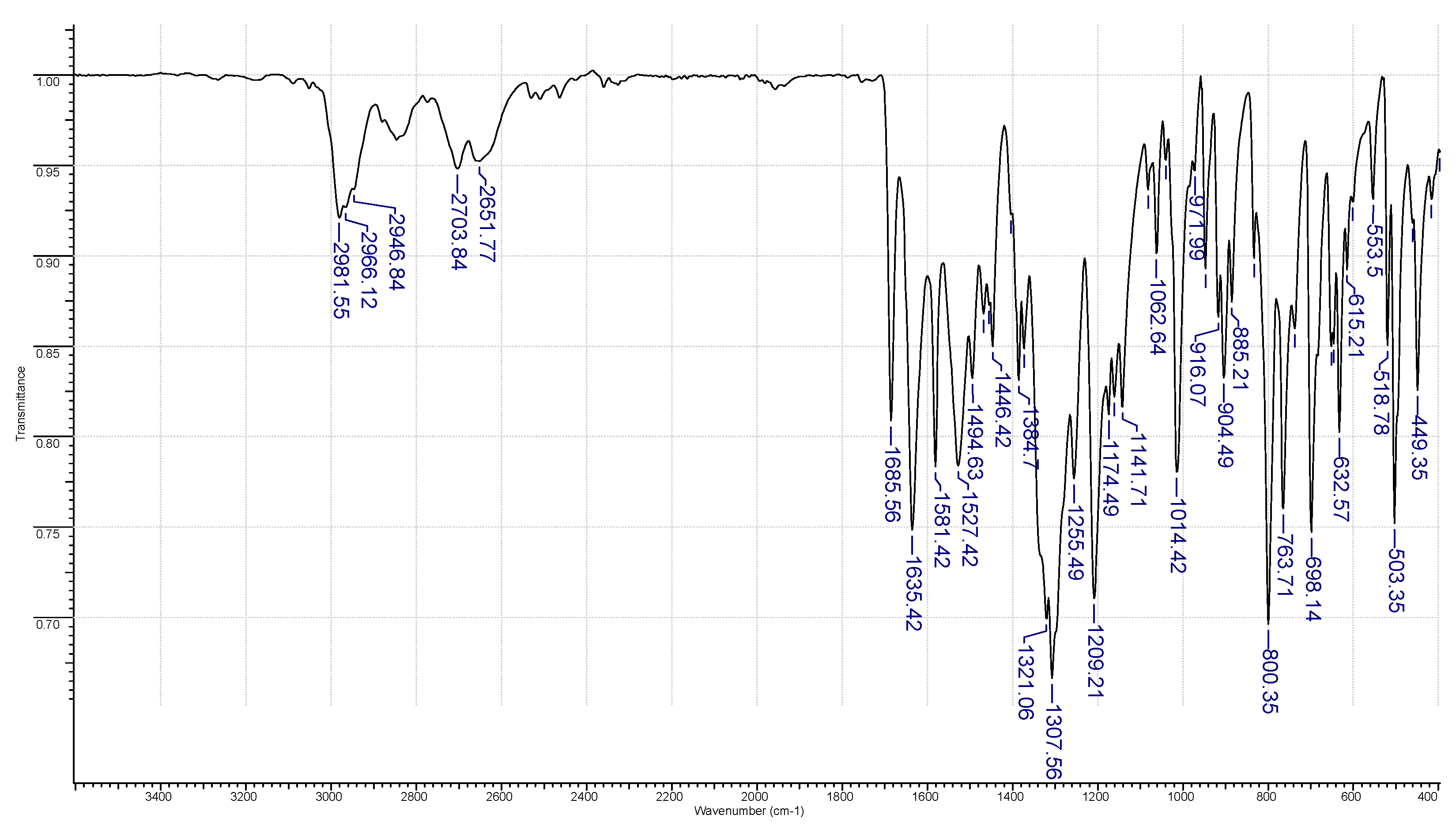
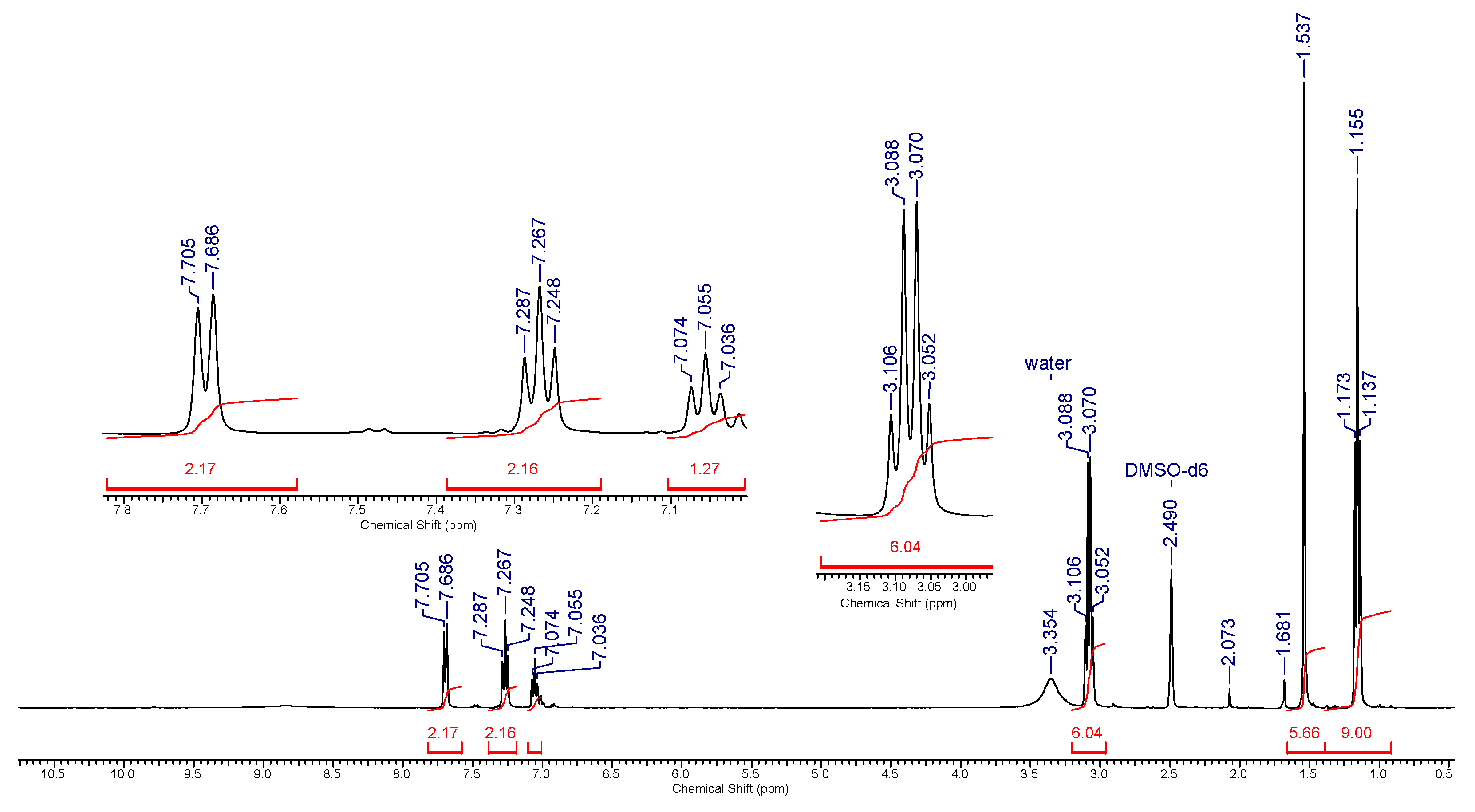
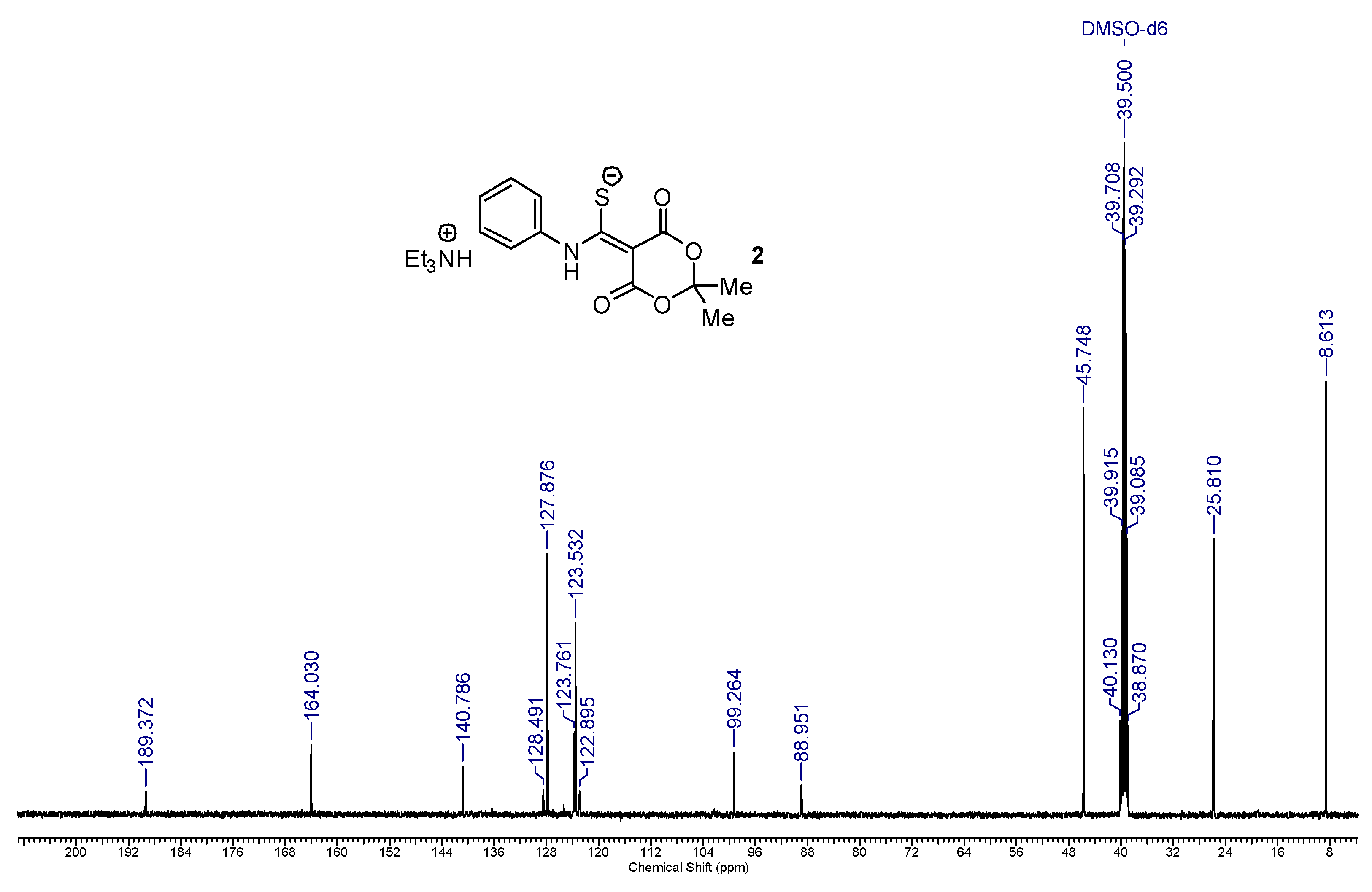
The structure of compound
2 was confirmed by a combination of spectroscopic methods, including IR and NMR spectroscopy (
Figure 1,
Figure 2 and
Figure 3).
We found that thiolates
2 undergo double aminomethylation with aqueous formaldehyde and primary amines to form previously unknown 1,3,5-thiadiazine derivatives
3 (
Scheme 2).
To assess the potential biological activity of compounds 2, 3a (R= 4-ClC6H4), and 3b (R = 3,4-Me2C6H3), we performed in silico predictive analyses using the SwissADME and admetSAR services. The results indicate that thiolate 2 has high gastrointestinal absorption, can cross the blood–brain barrier (BBB), and inhibits the cytochrome P450 isoform CYP2C9. This CYP2C9 inhibitory activity suggests a potential for drug–drug interactions.
In contrast, compounds 3a and 3b also exhibit high gastrointestinal absorption but do not penetrate the BBB. Furthermore, they inhibit the CYP2C19, CYP2C9, and CYP3A4 isoforms, while showing no inhibition of CYP2D6 or CYP1A2.
3. Conclusions
In summary. a novel triethylammonium thiolate salt was successfully synthesized from Meldrum’s acid and phenyl isothiocyanate, and its structure was confirmed by FTIR and NMR data. This compound was then used to produce new 1,3,5-thiadiazine derivatives through a double aminomethylation Mannich-type reaction with formaldehyde and primary amines. Predictive biological activity analysis suggests the initial salt can cross the blood-brain barrier, while the derived compounds exhibit high gastrointestinal absorption but inhibit several key cytochrome P450 isoforms.
4. Experimental
Synthesis of Triethylammonium (2,2-dimethyl-4,6-dioxo-1,3-dioxan-5-ylidene) (phenylamino)methanethiolate (2): Meldrum’s acid (2 g, 0.014 mol) was dissolved in acetone (10 mL). Phenyl isothiocyanate (1.7 mL, 0.014 mol) was added to the resulting solution under vigorous stirring. Triethylamine (2.1 mL, 0.015 mol) was then added dropwise to the mixture; the reaction was exothermic. The mixture was stirred for 4 h at 25 °C, yielding light-yellow crystals. The yield was 4.1 g (77.4%). For analytical purposes, the product was dissolved in a mixture of acetone and ethyl alcohol, and the filtrate was treated with a threefold volume of water.
Synthesis of Compound 3a: Thiolate 2 (0.2 g, 0.5 mmol) was dissolved in ethyl alcohol (5 mL). 4-Chloroaniline (0.1 g, 0.78 mmol) was added to the stirred solution. After the compounds had completely dissolved, aq. 37% HCHO (0.14 mL, 1.87 mmol) was added. The mixture was stirred for 8 h while heating, after which the product was precipitated with an excess of cold water. A white, fine-crystalline powder was obtained with a yield of 0.178 g (78.7%).
Synthesis of Compound 3b: Thiolate 2 (0.2 g, 0.5 mmol) was dissolved in ethyl alcohol (5 mL). Aniline (0.08 g, 0.86 mmol) was added to the stirred solution. After the compounds had completely dissolved, aq. 37% HCHO (0.14 mL, 1.87 mmol) was added. The mixture was stirred for 7 h, after which the product was precipitated with an excess of cold water. A light-yellow powder was obtained with a yield of 0.112 g (50.2%).
Author Contributions
Conceptualization, V.V.D.; methodology, V.V.D. and A.Y.S.; software, A.Y.S.; formal analysis, V.V.D. and A.A.R.; investigation, A.Y.S. and A.A.R.; resources, V.V.D.; data curation, V.V.D.; writing—original draft preparation, A.Y.S.; writing—review and editing, V.V.D.; visualization, A.Y.S. and V.V.D.; supervision, V.V.D.; project administration, V.V.D. All authors have read and agreed to the published version of the manuscript.
Funding
This research received no external funding.
Institutional Review Board Statement
Not applicable.
Informed Consent Statement
Not applicable.
Data Availability Statement
Available from authors.
Conflicts of Interest
The authors declare no conflicts of interest.
References
- Fatima, H.N.; Ahmad, M.; Riaz, T.; Nazir, M.S.; Aslam, S. Recent Advances in the Synthesis of Thiadiazine Derivatives through Multicomponent Reactions. Synth. Commun. 2025, 55, 1655–1679. [Google Scholar] [CrossRef]
- Zadorozhnii, P.V.; Kiselev, V.V.; Kharchenko, A.V. 1,3,5-Oxadiazines and 1,3,5-Thiadiazines. Compr. Heterocycl. Chem. IV 2022, 9, 456–506. [Google Scholar]
- Gouda, M.A.; Abu-Hashem, A.A.; Hussein, H.A.R.; Aly, A.S. Recent Progress on Fused Thiadiazines: A Literature Review. Polycycl. Aromat. Compd. 2022, 42, 2861–2893. [Google Scholar] [CrossRef]
- Dotsenko, V.V.; Frolov, K.A.; Krivokolysko, S.G. Synthesis of Partially Hydrogenated 1,3,5-Thiadiazines by Mannich Reaction. Chem. Heterocycl. Compd. 2015, 51, 109–127. [Google Scholar] [CrossRef]
- Dotsenko, V.V.; Frolov, K.A.; Chigorina, E.A.; Khrustaleva, A.N.; Bibik, E.Y.; Krivokolysko, S.G. New Possibilities of the Mannich Reaction in the Synthesis of N-, S,N-, and Se,N-Heterocycles. Russ. Chem. Bull. 2019, 68, 691–707. [Google Scholar] [CrossRef]
- Akhmetova, V.R.; Rakhimova, E.B. One-Pot Cyclothiomethylation of Amines As Efficient Method for the Synthesis of Saturated Five-, Six-, Seven-, and Eight-Membered S,N-Heterocycles. Russ. J. Org. Chem. 2014, 50, 1711–1731. [Google Scholar] [CrossRef]
- Rodríguez, H.; Suárez, M.; Albericio, F. Thiadiazines, N,N-Heterocycles of Biological Relevance. Molecules 2012, 17, 7612–7628. [Google Scholar] [CrossRef] [PubMed]
- Nenajdenko, V.G. Access to Molecular Complexity. Multicomponent Reactions Involving Five or More Components. Russ. Chem. Rev. 2020, 89, 1274–1336. [Google Scholar] [CrossRef]
- Strozhev, M.F.; Lielbriedis, I.; Neiland, O.Y. 1,3-Dioxane-4,6-Diones in Organic Synthesis (Review). Chem. Heterocycl. Compd. 1991, 27, 457–473. [Google Scholar] [CrossRef]
- Lipson, V.V.; Gorobets, N.Y. One Hundred Years of Meldrum’s Acid: Advances in the Synthesis of Pyridine and Pyrimidine Derivatives. Mol. Divers. 2009, 13, 399–419. [Google Scholar] [CrossRef] [PubMed]
| Disclaimer/Publisher’s Note: The statements, opinions and data contained in all publications are solely those of the individual author(s) and contributor(s) and not of MDPI and/or the editor(s). MDPI and/or the editor(s) disclaim responsibility for any injury to people or property resulting from any ideas, methods, instructions or products referred to in the content. |
© 2025 by the authors. Licensee MDPI, Basel, Switzerland. This article is an open access article distributed under the terms and conditions of the Creative Commons Attribution (CC BY) license (https://creativecommons.org/licenses/by/4.0/).