
Proceeding Paper

Synthesis and Properties of New N-(Hydroxyalkyl)thioacrylamides †
by
Arina A. Reshetnikova
1,
Arina G. Levchenko
1 and
Victor V. Dotsenko
1,2,*
1
Department of Organic Chemistry and Technologies, Kuban State University, 149 Stavropolskaya Str., 350040 Krasnodar, Russia
2
Department of Organic Chemistry, North-Caucasus Federal University, 1 Pushkina Str., 355017 Stavropol, Russia
*
Author to whom correspondence should be addressed.
Presented at the 29th International Electronic Conference on Synthetic Organic Chemistry, 14–28 November 2025; Available online: https://sciforum.net/event/ecsoc-29.
Chem. Proc. 2025, 18(1), 86; https://doi.org/10.3390/ecsoc-29-26860
Published: 12 November 2025

Abstract

Cyanothioacetamide readily reacts with aromatic aldehydes in an aqueous–alcoholic medium in the presence of triethylamine as a catalyst, resulting in arylmethylene cyanothioacetamides (3-aryl-2-cyanothioacrylamides). The latter react with formaldehyde (HCHO), yielding N-(hydroxymethyl) derivatives. This work proposes a method for the preparation of new derivatives of N-(hydroxyalkyl)thioacrylamides. The details of the synthesis and spectral data are discussed. Biological effects are also considered as 2,4-D herbicide antidotes (safeners).

1. Introduction

N-(Hydroxymethyl)thioamides are readily available compounds that are widely used in the synthesis of nitrogen- and sulfur-containing heterocycles, such as 1,3-thiazines, 1,2,4-dithiiazoles, 1,3,5-oxathiazines, 1,3,5-thiadiazines, and thiazolidines. In addition to their application in fine organic synthesis, N-(hydroxymethyl)thioamides are also used for other purposes. For example, some representatives of this series act as bidentate ligands for creating selective sorbents for heavy metal ions such as Cu(II), Cd(II), and Hg(II) [1,2]. These compounds are intermediates in the synthesis of a number of biologically active substances [3,4]. At the same time, the literature presents a limited number of methods for obtaining such compounds, and the variability of structures is not sufficiently high. Thus, N-(hydroxyalkyl)thioamides belong to a promising group of compounds, and the development of methods for their synthesis can be considered an important problem.

2. Results and Discussion

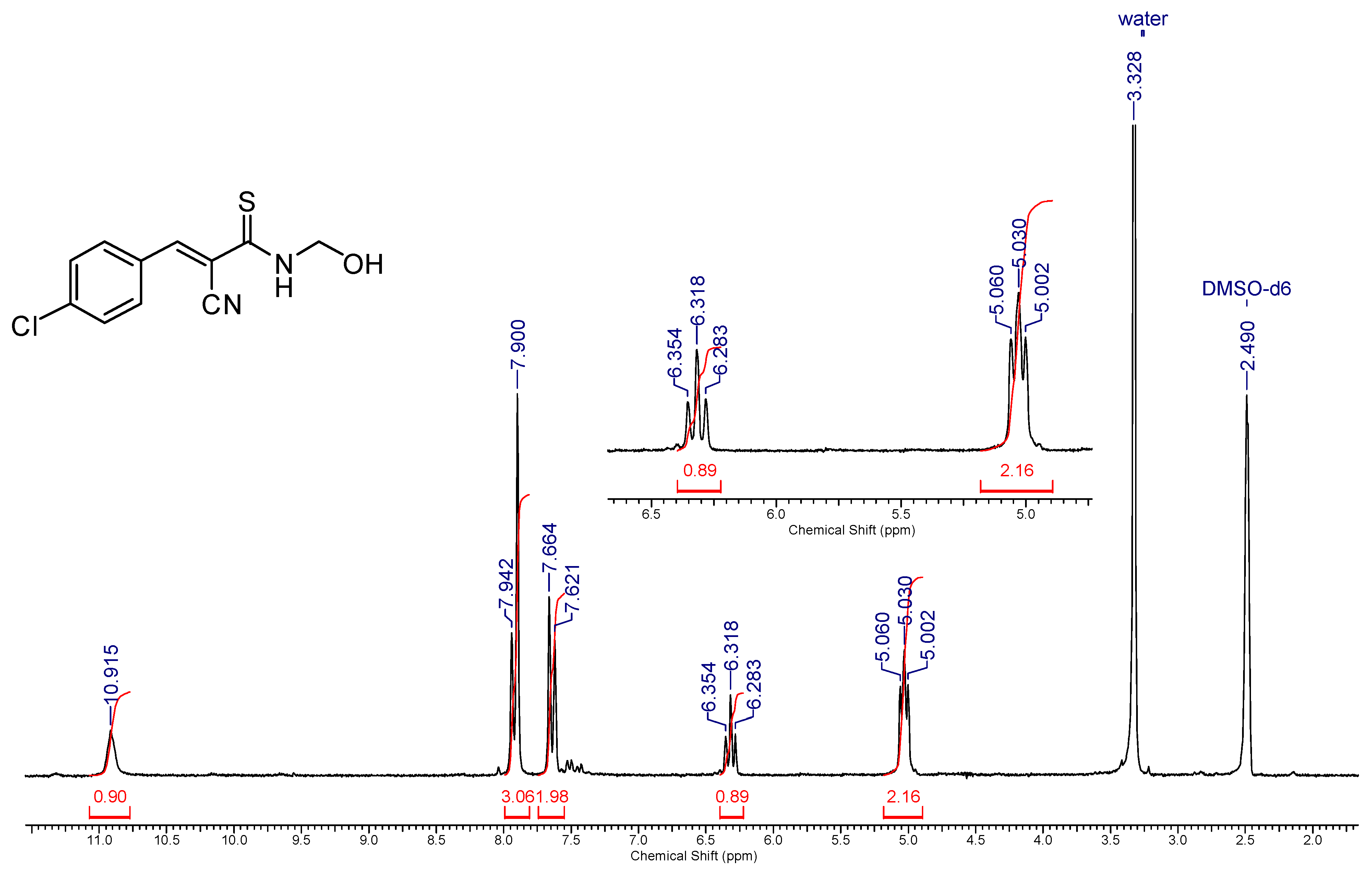
The starting compound 3 was obtained from cyanothioacetamide 1 and aromatic aldehydes 2 in an aqueous–alcoholic medium using a basic catalyst (Scheme 1) [5]. Compound 3 was then reacted with HCHO at 60 °C (Scheme 1) [5]. To confirm the structure of compounds 3 and 4, spectral methods (IR, 1H and 13C NMR spectroscopy) were used (Scheme 1, Figure 1).
It is known that salicylaldehyde 5, when reacting with cyanothioacetamide 1, undergoes intramolecular cyclization, forming product 6. The resulting substance interacts with HCHO to form compound 7 (Scheme 2).
To determine the biological activity of compounds 4 and 7, the Pass Online service was used. Compound 4 is more likely to exhibit properties of an inhibitor of tyrosine kinases (87.4%) and S-methyltransferase of homocysteine (78.2%); it may also exhibit antitumor properties (78.8%) and, to a lesser extent, anti-psoriatic properties (57.3%). The predicted undesirable effects include adrenal cortex hypoplasia (67.9%) and anemia (53.8%). Compound 7 is more likely to exhibit properties as a spasmolytic, diuretic (62.6%), membrane integrity agonist (53.9%), and antifungal agent (44.5%); it is also a potential anti-tuberculosis agent (42.8%). Negative effects may include causing acne (73.2%), various allergic reactions (55.7%), and carcinogenicity (for mice—63.8%).
Compounds 4a and 4c were tested for herbicide safening activity (for reviews, see [6,7]) against the herbicide 2,4-D on sunflower seedlings of the Master variety. The results showed that both compounds have significant activity: for compound 4a, the antidote effect was 66%, and for 4c, it was 30%. The obtained data are promising regarding further research.

3. Experimental Section

Synthesis of starting compounds 3ae and 6. In a 50 mL beaker, 0.01 mol of the starting aldehyde and 0.01 mol of cyanothioacetamide 1 [8] were placed in 15 mL of ethanol. Catalytic amounts of Et3N (2 drops) were added. A yellow or orange precipitate formed within a few minutes; the solid was filtered off and washed with alcohol. The compounds were further reacted without additional purification.
Synthesis of N-(hydroxymethyl)thioacrylamides 4 (ae) and 2-iminocoumarine 7. In a 25 mL beaker, 0.0021 mol of the starting compound (3ae, 6) was placed. Then 3 mL (excess) of 37% aq. HCHO was added, and the temperature in the system was maintained at 50–55 °C, with stirring for 40 min, during which the solution acquired a more intense orange color. Upon cooling, a precipitate formed, which was filtered off and washed with cold distilled water.
(E)-N-(Hydroxymethyl)-3-(4-chlorophenyl)-2-cyanoprop-2-ene thioamide (4a). Yellow powder, 0.34 g (64%). Rf = 0.43 (ethyl acetate). IR spectrum, ν, cm−1: 3444 br, 3322 br (O-H, N-H), 2204 br (C≡N). 1H NMR spectrum (400 MHz, DMSO-d6), δ, ppm: 5.06 m (2H, CH2), 6.33 t (1H, OH), 7.65 d (2H, H Ar), 7.91 s (1H, CH=), 7.93 d (2H, H Ar), 10.93 br.s (1H, NH). 13C NMR spectrum (101 MHz, DMSO-d6) δ, ppm: 70.0 (-CH2OH). 113.91 (=C(CN)-), 116.70 (C≡N), 129.93 (C Ar), 132.18 (C Ar), 132.20 (C Ar), 137.14 (C1 Ar), 145.38 (CH=), 189.60 (C=S),
(E)-N-(Hydroxymethyl)-3-(4-bromophenyl)-2-cyanoprop-2-ene thioamide (4b). Yellow powder weighing 0.34 g (68%). IR spectrum, ν, cm−1: 3415 br, 3317 br (O-H, N-H), 2204 br (C≡N). 13C NMR spectrum (101 MHz, DMSO-d6) δ, ppm: 70.0 (-CH2OH), 113.85 (=C(CN)-), 116.62 (C≡N), 132.81 (C Ar), 132.21 (C Ar), 131.65 (C, Ar), 132.37 (C Ar), 145.39 (CH=), 189.49 (C=S).
(E)-N-(Hydroxymethyl)-3-(3,4-dimethoxyphenyl)-2-cyanoprop-2-ene thioamide (4c). Light orange powder weighing 0.34 g (62%). Rf = 0.473 (ethyl acetate). IR spectrum, ν, cm−1: 3415 br, 3241 br (O-H, N-H), 2221 br (C≡N). 1H NMR spectrum (400 MHz, DMSO-d6), δ, ppm: 7.16 d (1H, H Ar), 6.34 t (1H, OH), 5.06 d (2H, CH2), 7.57 d (1H, H Ar), 7.68 c (1H, CH=), 8.07 s (1H, H Ar), 9.99 br.s (1H, NH), 3.86 s (3H, CH3), 3.82 s (3H, CH3). 13C NMR spectrum (101 MHz, DMSO-d6) δ, ppm: 149.25 (C Ar), 148.12 (C Ar), 126.21 (C Ar), 124.80 (C Ar), 117.59 (C Ar), 117.53 (C Ar), 153.10 (CH=), 109.53 (=C(CN)-), 112.79 (C≡N), 193.12 (C=S), 109.51 (CH2OH), 56.36 (OCH3), 56.00 (OCH3).
(E)-N-(Hydroxymethyl)-3-(4-hydroxy-3-methoxy-5-nitrophenyl)-2-cyanoprop-2-ene thioamide (4d). Ochre powder weighing 0.32 g (64%). IR spectrum, ν, cm−1: 3415 br, 3317 br (O-H, N-H), 2204 br (C≡N). 1H NMR spectrum (400 MHz, DMSO-d6), δ, ppm: 3.93 s (3H, CH2O), 3.97 s (2H, CH3), 7.64 c (1H, H Ar), 7.96 br.d (1H, H Ar), 8.11 s (1H, CH=), 9.88 br.t (1H, OH). 13C NMR spectrum (101 MHz, DMSO-d6) δ, ppm: 192.56 (C=S), 193.93 (2C, Ar), 150.51 (CH=), 150.14 (C Ar), 148.25 (C Ar), 146.45 (C Ar), 145.86 (C Ar), 137.64 (C Ar), 122.30 (=C(CN)-), 127.24 (C≡N), 57.28 (CH2OH), 57.16 (CH3).
2-(Hydroxymethylamino)-2H-chromen-3-carbothioamide (7). Ochre powder weighing 0.35 g (51%). Rf = 0.451 (ethyl acetate). IR spectrum, ν, cm−1: 3400 br (O-H), 3317 br, 3203 br (NH). 1H NMR spectrum (400 MHz, DMSO-d6), δ, ppm: 5.740 t (1H, OH), 8.85 s (1H, H Ar), 7.79 d (1H, H Ar), 7.57 t (1H, H Ar), 7.24 d (1H, H Ar), 7.27 d (1H, H Ar), 5.01 d (2H, CH2), 10.04 br.s (2H, NH2). 13C NMR spectrum (101 MHz, DMSO-d6) δ, ppm: 192.75 (C=S), 153.50 (C=N), 146.74 (C, Ar), 144.16 (C, Ar), 133.72 (C, Ar), 130.80 (C, Ar), 124.96 (C, Ar), 123.22 (C, Ar), 118.73 (C, Ar), 115.54 (C, Ar), 71.52 (CH2OH).

Author Contributions

Conceptualization, V.V.D.; methodology, V.V.D.; formal analysis, A.G.L.; investigation, A.A.R., A.G.L. and V.V.D.; resources, V.V.D.; data curation, V.V.D.; writing—original draft preparation, A.A.R., A.G.L. and V.V.D.; writing—review and editing, A.A.R., A.G.L. and V.V.D.; visualization, A.A.R., A.G.L. and V.V.D.; supervision, V.V.D.; project administration, V.V.D. All authors have read and agreed to the published version of the manuscript.

Funding

This research received no external funding.

Institutional Review Board Statement

Not applicable.

Informed Consent Statement

Not applicable.

Data Availability Statement

The data supporting the conclusions of this article are available from authors.

Conflicts of Interest

The authors declare no conflict of interest.

References

  1. Liu, C.Y.; Chang, H.T.; Hu, C.C. Complexation reactions in a heterogeneous system. Inorg. Chim. Acta 1990, 172, 151–158. [Google Scholar]
  2. Liu, C.Y.; Hu, C.C.; Yeh, K.Y.; Chen, M.J. Synthesis of chelating resins and its application in ligand exchange chromatography. Fresenius J. Anal. Chem. 1991, 339, 877–881. [Google Scholar] [CrossRef]
  3. Yamamoto, S.; Toida, I.; Watanabe, N.; Ura, T. In vitro antimycobacterial activities of pyrazinamide analogs. Antimicrob. Agents Chemother. 1995, 39, 2088–2091. [Google Scholar] [CrossRef] [PubMed]
  4. Shepard, C.C.; Jenner, P.J.; Ellard, G.A.; Lancaster, R.D. An experimental study of the antileprosy activity of a series of thioamides in the mouse. Int. J. Lepr. Other Mycobact. Dis. 1985, 53, 587–594. [Google Scholar] [PubMed]
  5. Dotsenko, V.V.; Chigorina, E.A.; Krivokolysko, S.G. N-hydroxymethylation of 3-aryl-2-cyanoprop-2-ene thioamides. Russ. J. Gen. Chem. 2020, 90, 1199–1206. [Google Scholar] [CrossRef]
  6. Deng, X. A Mini Review on Natural Safeners: Chemistry, Uses, Modes of Action, and Limitations. Plants 2022, 11, 3509. [Google Scholar] [CrossRef] [PubMed]
  7. Deng, X. Current Advances in the Action Mechanisms of Safeners. Agronomy 2022, 12, 2824. [Google Scholar] [CrossRef]
  8. Dyachenko, V.D.; Dyachenko, I.V.; Nenajdenko, V.G. Cyanothioacetamide: A polyfunctional reagent with broad synthetic utility. Russ. Chem. Rev. 2018, 87, 1. [Google Scholar] [CrossRef]

Scheme 1. Ar = 4-ClC6H4 (4a), 4-BrC6H4 (4b), 3,4-(MeO)2C6H3 (4c), 4-HO-3-MeO-5-NO2C6H2 (4d), 2-NO2C6H4 (4e).
Chemproc 18 00086 sch001
Figure 1. 1H NMR spectrum (DMSO-d6) of (E)-N-(Hydroxymethyl)-3-(4-chlorophenyl)-2-cyanoprop-2-enthioamide 4a.
Chemproc 18 00086 g001
Scheme 2. Synthesis and hydroxymethylation of 2-iminochromene 6.
Chemproc 18 00086 sch002
Disclaimer/Publisher’s Note: The statements, opinions and data contained in all publications are solely those of the individual author(s) and contributor(s) and not of MDPI and/or the editor(s). MDPI and/or the editor(s) disclaim responsibility for any injury to people or property resulting from any ideas, methods, instructions or products referred to in the content.