
Proceeding Paper

In Silico Exploration of a Symmetrical Acridine Derivative’s Anti-Alzheimer Activity: Synthesis, AChE/BuChE Binding, and ADMET Prediction †
by
Yousra Ouafa Bouone
*,
Abdeslem Bouzina
and
Nour-Eddine Aouf
Laboratory of Applied Organic Chemistry, Bioorganic Chemistry Group, Department of Chemistry, Sciences Faculty, Badji Mokhtar Annaba University, P.O. Box 12, Annaba 23000, Algeria
*
Author to whom correspondence should be addressed.
Presented at the 29th International Electronic Conference on Synthetic Organic Chemistry, 14–28 November 2025; Available online: https://sciforum.net/event/ecsoc-29.
Chem. Proc. 2025, 18(1), 82; https://doi.org/10.3390/ecsoc-29-26743

Published: 12 November 2025

Abstract

Alzheimer’s disease (AD) numbers among the most precipitative neurodegenerative disorders, constituting a constant subject of interest for medicinal chemistry researchers. The treatment of such disorders remains a challenge due to the complexity of their pathogenesis. Indeed, many factors are involved in the development of AD, including different enzymes such as acetylcholinesterase (AChE) and butyrylcholinesterase (BuChE), whose inhibition results in anti-AD activity, making the development of novel AChE/BuChE inhibitors a possible way to manage Alzheimer’s disease. Besides being a class of compounds with a wide spectrum of biological applications, acridine compounds also number among the most promising agents for the treatment of Alzheimer’s disease through cholinesterase inhibition. The best example to mention is the well-known anti-AD agent Tacrine. However, it was found to have a toxic effect on the liver, making the optimization of this acridine derivative a necessity. Our work was directed towards evaluating in silico a symmetrical acridine analogue as a potential cholinesterase inhibitor with controlled toxicity. A docking study was completed using Glide software (Schrodinger suites), and both AChE (pdb: 4EY6) and BuChE (4BDS) were utilized as drug targets. The molecular docking simulation resulted in satisfying docking score values alongside numerous significant interactions indicating the high stability of the investigated compound within the active sites of the enzymes studied. Additionally, ADMET prediction was carried out for the assessed acridine derivative in order to explore its drug likeness through its pharmacokinetics and toxicity profiles by employing the online servers SwissADME, MolSoft, and ProTox-II.

1. Introduction

Brain-related diseases or neurodegenerative disorders (NDs) affect the health of millions of people all over the world. NDs result from the progressive deterioration of brain cells, leading to different pathologic conditions such as Alzheimer disease, Parkinson’s disease, amyotrophic lateral sclerosis, ataxia, and many others [1].
The design and development of an anti-Alzheimer’s disease drug are challenging processes since there are no complete treatments for Alzheimer’s or other neurological disorders. Synthesis of new agents in order to find new cures for this type of disease is needed from pharmacological and medicinal perspectives [2].
To date, the most effective treatments of Alzheimer’s disease are acetylcholinesterase (AChE) inhibitors such as Donepezil and Galantamine, making AChE the ideal drug target in the development of new anti-AD agents [3].
Acridine and analogues are known for their beneficial biological activities, including antibacterial [4], anticonvulsant [5], and analgesic [6] activities. Furthermore, acridine derivatives have been acknowledged for their efficiency in inhibiting cholinesterase enzymes, resulting in anti-AD effects [7,8,9].
The ongoing need for AD treatments alongside the importance of acridines prompted us to investigate the anticholinesterase effect of a symmetrical acridine compound through in silico studies involving molecular docking in order to study the binding mode and stability of the prepared ligand inside the cavities of both acetylcholiesterase (AChE) and butyrylcholiesterase (BuChE). An ADMET prediction was also employed to evaluate the aptitude of our product as a drug candidate with acceptable ADME and toxicity profiles.

2. Materials and Methods

2.1. Synthesis

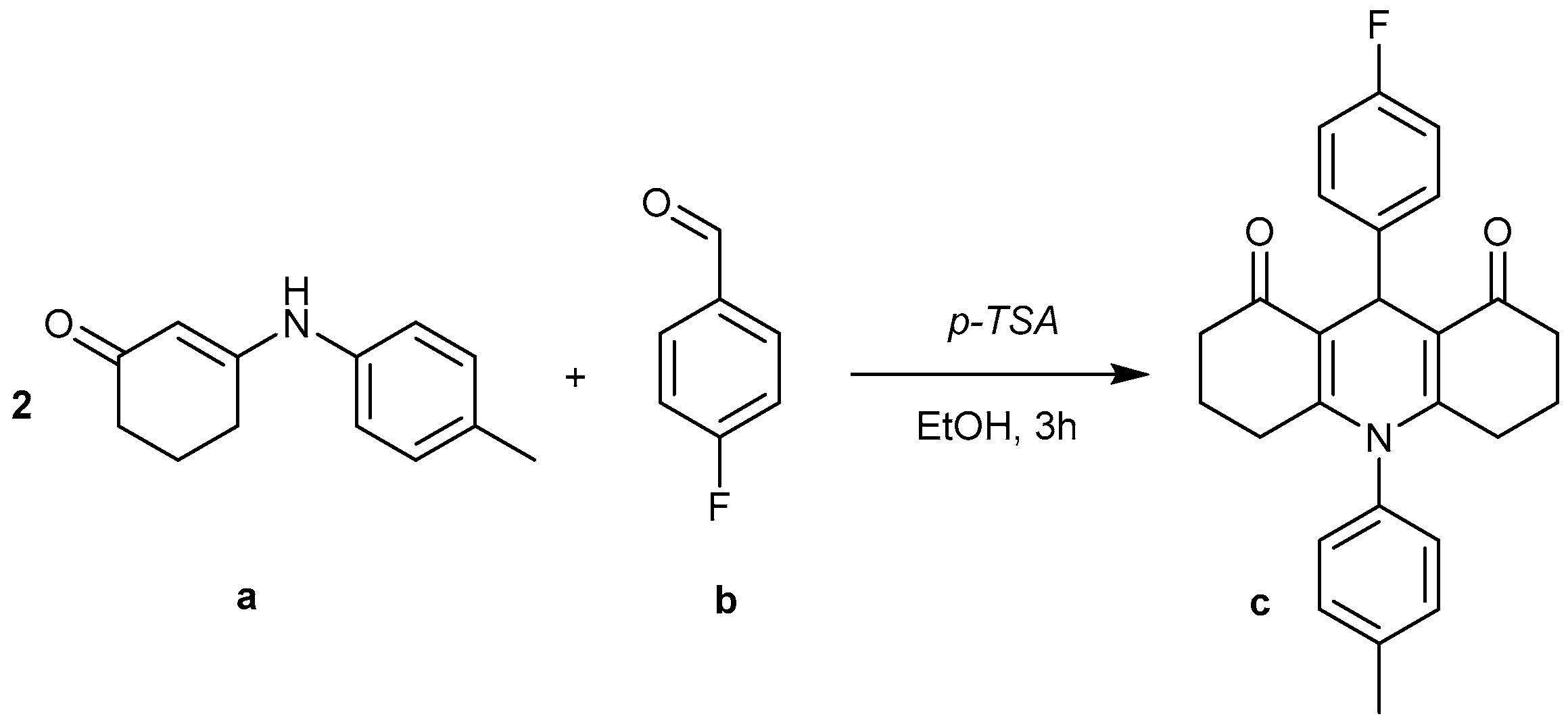
The synthesis of acridine derivative c was carried out using a previously described synthetic protocol [10] (Scheme 1). The obtainment of compound c was confirmed by the presence of all significant signals in proton and carbon NMR spectra depicted in Figures S1 and S2 respectively (Supplementary Material).
9-(4-fluorophenyl)-10-(p-tolyl)-3,4,6,7,9,10-hexahydroacridine-1,8(2H,5H)-dione (Entry a).
1H NMR (400 MHz, Chloroform-d) δ 7.42–7.27 (m, 4H), 7.11 (d, J = 7.3 Hz, 2H), 6.91 (t, J = 8.7 Hz, 2H), 5.34 (s, 1H), 2.44 (s, 3H), 2.35 (dt, J = 16.2, 4.7 Hz, 2H), 2.29–2.12 (m, 4H), 2.04 (dt, J = 17.8, 4.6 Hz, 2H), 1.88 (dd, J = 13.4, 4.8 Hz, 2H), 1.75 (q, J = 11.8 Hz, 2H).

2.2. Molecular Docking

A molecular docking study was carried out using Schrodinger suite (glide) [11] and 3D visualization using Chimera software 1.11.2 [12].

3. Results and Discussion

3.1. Molecular Docking

To evaluate the binding mode of the investigated acridine derivative within the active sites of both acetylcholinesterase (AChE) and butyrylcholinesterase (BuChE), molecular docking simulations were performed using the PDB files 4EY6 [13] and 4BDS [14], respectively.
As a validation step, redocking of the co-crystallized ligands was carried out to ensure the reliability of the docking protocol. Protein structures were prepared using the Protein Preparation Wizard, and the co-crystallized ligands were redocked using extra precision (XP) for AChE and standard precision (SP) for BuChE. The obtained RMSD values were 0.3183 Å for AChE and 0.2266 Å for BuChE, confirming the validity of the docking procedure adopted.
The investigated acridine derivative exhibited stable binding within the active sites of both cholinesterase enzymes, with favorable docking scores of −8.704 kcal/mol for AChE and −8.620 kcal/mol for BuChE (Table 1).
The investigated compound established significant interactions with key residues within the AChE active site. These included a prominent π–cation interaction between the backbone of Trp86 and the protonated nitrogen of the compound, along with multiple types of hydrophobic contact involving residues such as Trp86, Leu130, Trp286, Ala127, Phe297, and many others. In contrast, when docked with BuChE, the acridine derivative investigated exhibited water bridge and Pi-cation bonding with Trp82 (Table 2).

3.2. ADMET Prediction

A potential drug candidate must undergo several evaluations to determine its ability to be absorbed and distributed within the body, including assessments of pharmacokinetic properties and toxicity profiles. In this study, a general in silico prediction of the ADMET parameters of the investigated acridine derivative was performed, and the results are summarized in Table 3.
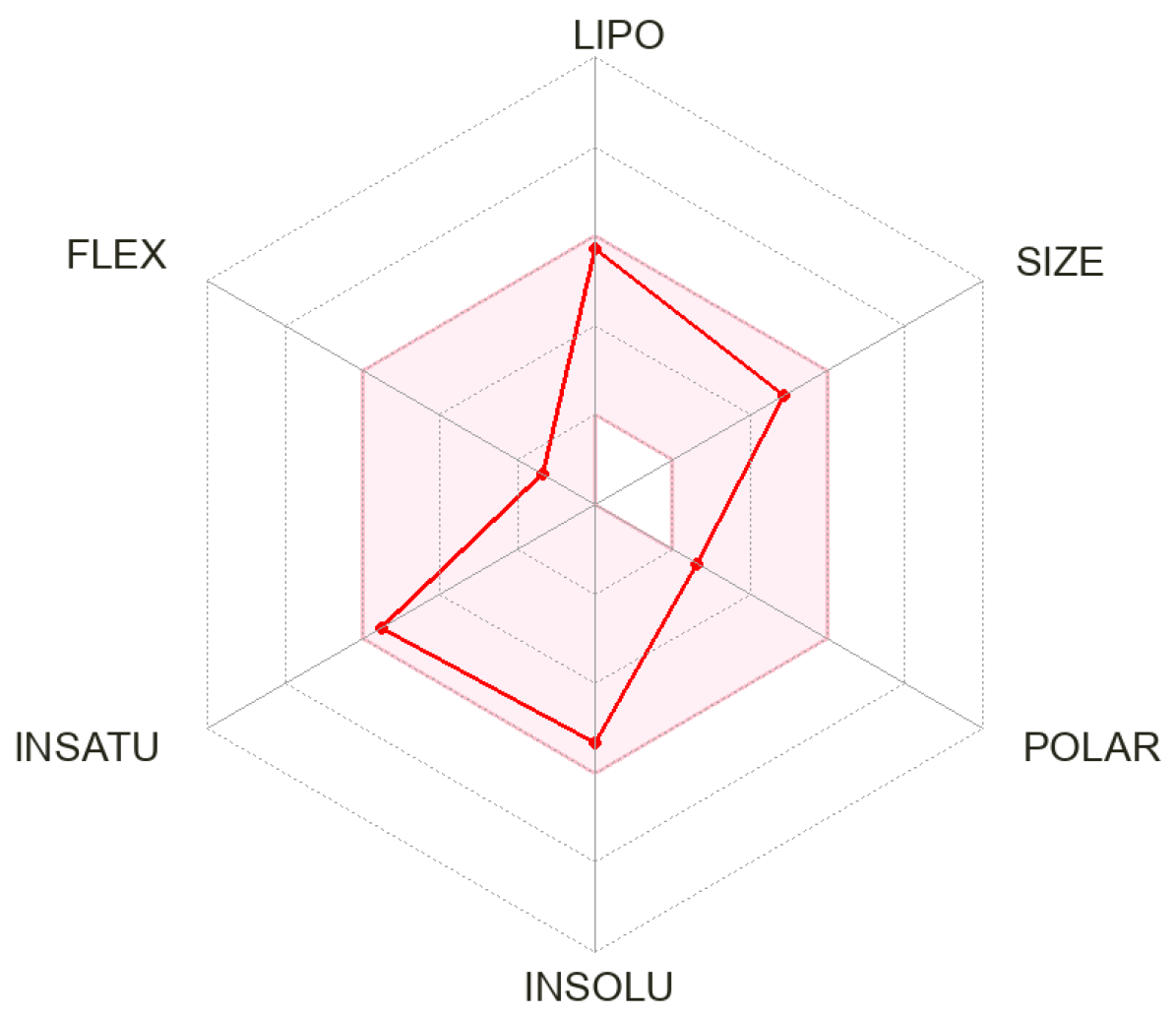
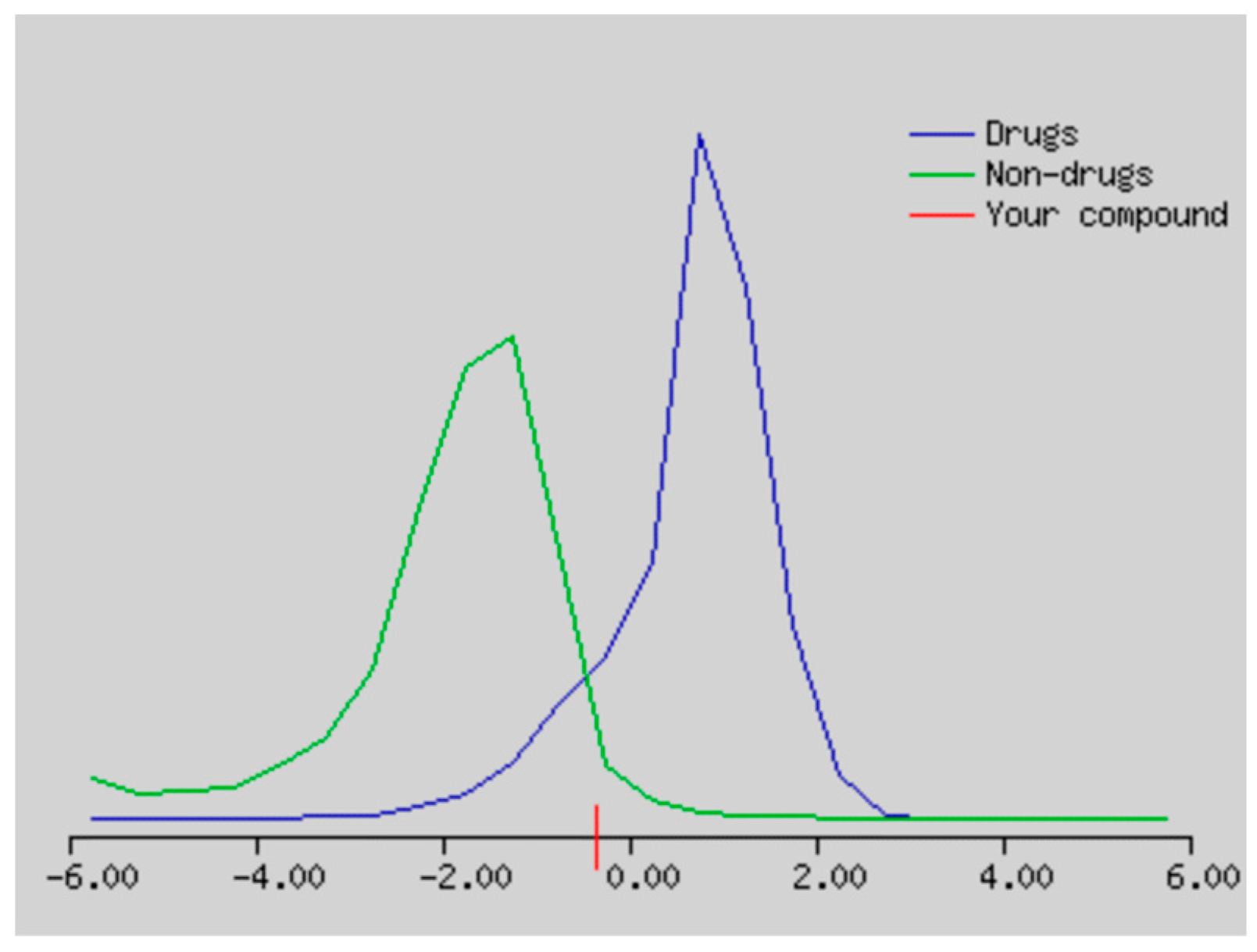
According to the predicted parameters outlined in Table 3, compound a was found to respect the Lipinski’s rule of five [15], exhibiting a molecular weight below 500, three hydrogen bond acceptors, no hydrogen bond donors, two rotatable bonds, and a LogP value of 3.6. The bioavailability radar further highlights the drug-like characteristics of the compound by evaluating parameters such as polarity, solubility, saturation, lipophilicity, flexibility, and size. As displayed in Figure 1, all the evaluated properties of the molecule lie within the optimal range (depicted by the pink region). In addition, the drug-likeness score (DLS) provides a comparative measure of the compound’s potential as a drug candidate by comparing its features against those of approved drugs. The DLS plot depicted in Figure 2 shows that the score for compound a (–0.34) lies near the drug-like region (blue plot), supporting its potential as a promising lead molecule.

4. Conclusions

A symmetrical acridine analogue was synthesized and evaluated through in silico studies to explore its potential as a drug candidate for treating Alzheimer’s disease via cholinesterase inhibition. The ligand exhibited good stability within the active sites of both AChE and BuChE and established interactions with key residues associated with inhibitory activity. Moreover, ADMET predictions yielded favorable results, suggesting that the compound possesses drug-like properties and promising pharmacokinetic characteristics.

Supplementary Materials

The following supporting information can be downloaded at: https://www.mdpi.com/article/10.3390/ecsoc-29-26743/s1, Figure S1: 1H NMR spectrum for compound c; Figure S2: 13C NMR spectrum for compound c.

Author Contributions

Conceptualization, Y.O.B. and A.B.; methodology, A.B.; software, Y.O.B.; validation, A.B., and N.-E.A.; investigation, Y.O.B.; resources, N.-E.A.; writing—original draft preparation, Y.O.B.; writing—review and editing, A.B. All authors have read and agreed to the published version of the manuscript.

Funding

This research received no external funding.

Institutional Review Board Statement

Not applicable.

Informed Consent Statement

Not applicable.

Data Availability Statement

All data generated or analyzed during this study are included in this article.

Conflicts of Interest

The authors declare no conflict of interest.

Abbreviations

The following abbreviations are used in this manuscript:
AChEAcetylcholinesterase
ADAlzheimer’s disease
ADMETAbsorption, distribution, metabolism, excretion, and toxicity
BuChEButyrylcholinesterase
DLSDrug-likeness score
NDsNeurodegenerative disorders

References

  1. Gao, W.; Jing, S.; He, C.; Saberi, H.; Sharma, H.S.; Han, F.; Chen, L. Advancements in neurodegenerative diseases: Pathogenesis and novel neurorestorative interventions. J. Neurorestoratology 2025, 13, 100176. [Google Scholar] [CrossRef]
  2. Abdallah, A.E. Review on anti-alzheimer drug development: Approaches, challenges and perspectives. RSC Adv. 2024, 14, 11057–11088. [Google Scholar] [CrossRef] [PubMed]
  3. Grossberg, G.T. Cholinesterase Inhibitors for the Treatment of Alzheimer’s Disease:: Getting On and Staying On. Curr. Ther. Res. 2003, 64, 216–235. [Google Scholar] [CrossRef] [PubMed]
  4. Wainwright, M. Acridine—A neglected antibacterial chromophore. J. Antimicrob. Chemother. 2001, 47, 1–13. [Google Scholar] [CrossRef] [PubMed]
  5. Mohammadi-Khanaposhtani, M.; Shabani, M.; Faizi, M.; Aghaei, I.; Jahani, R.; Sharafi, Z.; Shamsaei Zafarghandi, N.; Mahdavi, M.; Akbarzadeh, T.; Emami, S.; et al. Design, synthesis, pharmacological evaluation, and docking study of new acridone-based 1,2,4-oxadiazoles as potential anticonvulsant agents. Eur. J. Med. Chem. 2016, 112, 91–98. [Google Scholar] [CrossRef] [PubMed]
  6. Sondhi, S.; Bhattacharjee, G.; Jameel, R.; Shukla, R.; Raghubir, R.; Lozach, O.; Meijer, L. Antiinflammatory, analgesic and kinase inhibition activities of some acridine derivatives. Open Chem. 2004, 2, 1–15. [Google Scholar] [CrossRef]
  7. Makhaeva, G.F.; Lushchekina, S.V.; Boltneva, N.P.; Serebryakova, O.G.; Rudakova, E.V.; Ustyugov, A.A.; Bachurin, S.O.; Shchepochkin, A.V.; Chupakhin, O.N.; Charushin, V.N.; et al. 9-Substituted acridine derivatives as acetylcholinesterase and butyrylcholinesterase inhibitors possessing antioxidant activity for Alzheimer’s disease treatment. Biorg. Med. Chem. 2017, 25, 5981–5994. [Google Scholar] [CrossRef] [PubMed]
  8. Hamulakova, S.; Imrich, J.; Janovec, L.; Kristian, P.; Danihel, I.; Holas, O.; Pohanka, M.; Böhm, S.; Kozurkova, M.; Kuca, K. Novel tacrine/acridine anticholinesterase inhibitors with piperazine and thiourea linkers. Int. J. Biol. Macromol. 2014, 70, 435–439. [Google Scholar] [CrossRef] [PubMed]
  9. Sharma, A.; Piplani, P. Acridine: A Scaffold for the Development of Drugs for Alzheimer’s Disease. Curr. Top. Med. Chem. 2023, 23, 1260–1276. [Google Scholar] [CrossRef] [PubMed]
  10. Liu, F.-J.; Sun, T.-T.; Yang, Y.-G.; Huang, C.; Chen, X.-B. Divergent synthesis of dual 1,4-dihydropyridines with different substituted patterns from enaminones and aldehydes through domino reactions. RSC Adv. 2018, 8, 12635–12640. [Google Scholar] [CrossRef] [PubMed]
  11. Friesner, R.A.; Banks, J.L.; Murphy, R.B.; Halgren, T.A.; Klicic, J.J.; Mainz, D.T.; Repasky, M.P.; Knoll, E.H.; Shelley, M.; Perry, J.K.; et al. Glide:  A New Approach for Rapid, Accurate Docking and Scoring. 1. Method and Assessment of Docking Accuracy. J. Med. Chem. 2004, 47, 1739–1749. [Google Scholar] [CrossRef] [PubMed]
  12. Pettersen, E.F.; Goddard, T.D.; Huang, C.C.; Couch, G.S.; Greenblatt, D.M.; Meng, E.C.; Ferrin, T.E. UCSF Chimera—A visualization system for exploratory research and analysis. J. Comput. Chem. 2004, 25, 1605–1612. [Google Scholar] [CrossRef] [PubMed]
  13. Cheung, J.; Rudolph, M.J.; Burshteyn, F.; Cassidy, M.S.; Gary, E.N.; Love, J.; Franklin, M.C.; Height, J.J. Structures of Human Acetylcholinesterase in Complex with Pharmacologically Important Ligands. J. Med. Chem. 2012, 55, 10282–10286. [Google Scholar] [CrossRef] [PubMed]
  14. Nachon, F.; Carletti, E.; Ronco, C.; Trovaslet, M.; Nicolet, Y.; Jean, L.; Renard, P.-Y. Crystal structures of human cholinesterases in complex with huprine W and tacrine: Elements of specificity for anti-Alzheimer’s drugs targeting acetyl- and butyryl-cholinesterase. Biochem. J. 2013, 453, 393–399. [Google Scholar] [CrossRef] [PubMed]
  15. Lipinski, C.A.; Lombardo, F.; Dominy, B.W.; Feeney, P.J. Experimental and computational approaches to estimate solubility and permeability in drug discovery and development settings. Adv. Drug Deliv. Rev. 2012, 64, 4–17. [Google Scholar] [CrossRef]
Scheme 1. Synthesis of symmetrical acridine derivative (ac).
Chemproc 18 00082 sch001
Figure 1. Bioavailability radar for compound c.
Chemproc 18 00082 g001
Figure 2. Drug likeness estimation curve for compound c.
Chemproc 18 00082 g002
Table 1. Docking scores of the studied ligand inside AChE and BuChE alongside the reference ligands.
EntryStructureDocking Score (kcal/mol)
AChEBuChE
cChemproc 18 00082 i001−8.704−8.620
GalantamineChemproc 18 00082 i002−11.057
TacrineChemproc 18 00082 i003 −9.178
Table 2. Two-dimensional visualization of the acridine compound, galantamine, and tacrine inside the active sites of cholinesterase enzymes.
Entry2D
AChEBuChE
cChemproc 18 00082 i004Chemproc 18 00082 i005
GalantamineChemproc 18 00082 i006
Tacrine Chemproc 18 00082 i007
Table 3. ADMET-predicted properties of compound c.
PropertiesCompound c
Molecular weight (g per mole)401.47
Rotatable bonds2
H-bond donor0
H-bond acceptor3
Log Po/w iLOGP3.60
Log S ESOL−5.32
GIHigh
BBBYes
Log Kp (cm/s)−5.57
Bioavailability score0.55
TPSA (Å2)37.38
DLS score−0.34
Predicted LD50 (mg/kg)1200
Disclaimer/Publisher’s Note: The statements, opinions and data contained in all publications are solely those of the individual author(s) and contributor(s) and not of MDPI and/or the editor(s). MDPI and/or the editor(s) disclaim responsibility for any injury to people or property resulting from any ideas, methods, instructions or products referred to in the content.