
You are currently viewing a new version of our website. To view the old version click .
Chemistry Proceedings
  • Proceeding Paper
  • Open Access

11 November 2025

Synthesis and In Silico Studies of a Novel 1,4-Disubstituted-1,2,3-Triazole-1,3-Oxazole Hybrid System †
,
,
,
,
and
1
Laboratorio de Diseño Molecular, Instituto de Investigaciones Químico Biológicas, Universidad Michoacana de San Nicolás de Hidalgo, Ciudad Universitaria, Morelia C.P. 58030, Michoacán, Mexico
2
Departamento de Alimentos, Centro Interdisciplinario del Noreste, Universidad de Guanajuato, Tierra Blanca C.P. 37975, Guanajuato, Mexico
*
Author to whom correspondence should be addressed.
Presented at the 29th International Electronic Conference on Synthetic Organic Chemistry, 14–28 November 2025; Available online: https://sciforum.net/event/ecsoc-29.
Chem. Proc.2025, 18(1), 63;https://doi.org/10.3390/ecsoc-29-26701 
(registering DOI)

Abstract

In this work, we report an efficient synthetic strategy for accessing novel 1,4-disubstituted-1,2,3-triazole-1,3-oxazole hybrids. The synthesis involves a two-step, three-sequence approach: a multicomponent reaction, subsequent oxidation, and the Van Leusen reaction. This operationally simple protocol proceeds under mild reaction conditions and allows the rapid assembly of structurally diverse heterocyclic systems. Three new hybrid molecules were synthesized and structurally characterized. To investigate their biological potential, we performed bioactivity prediction studies using cheminformatics tools. Polo-like kinase 3 (PLK3), a serine/threonine-protein kinase involved in cell cycle regulation and apoptosis, was identified as a potential molecular target, for which docking studies were performed, obtaining good ligand efficiency.

1. Introduction

Heterocyclic chemistry has continuously evolved over the years, contributing significantly to advancements in biological sciences, chemistry, and materials science [1]. Among heterocyclic compounds, certain scaffolds exhibit remarkable versatility in modulating biological activity depending on their chemical functionality. These scaffolds, often referred to as privileged structures, have become essential frameworks in medicinal chemistry. Thus, one of the current challenges in synthetic and medicinal chemistry is the development of hybrid molecules that combine at least two privileged scaffolds into a single framework. Such molecular hybrids often display enhanced bioactivities compared to the reference drugs [2,3,4].
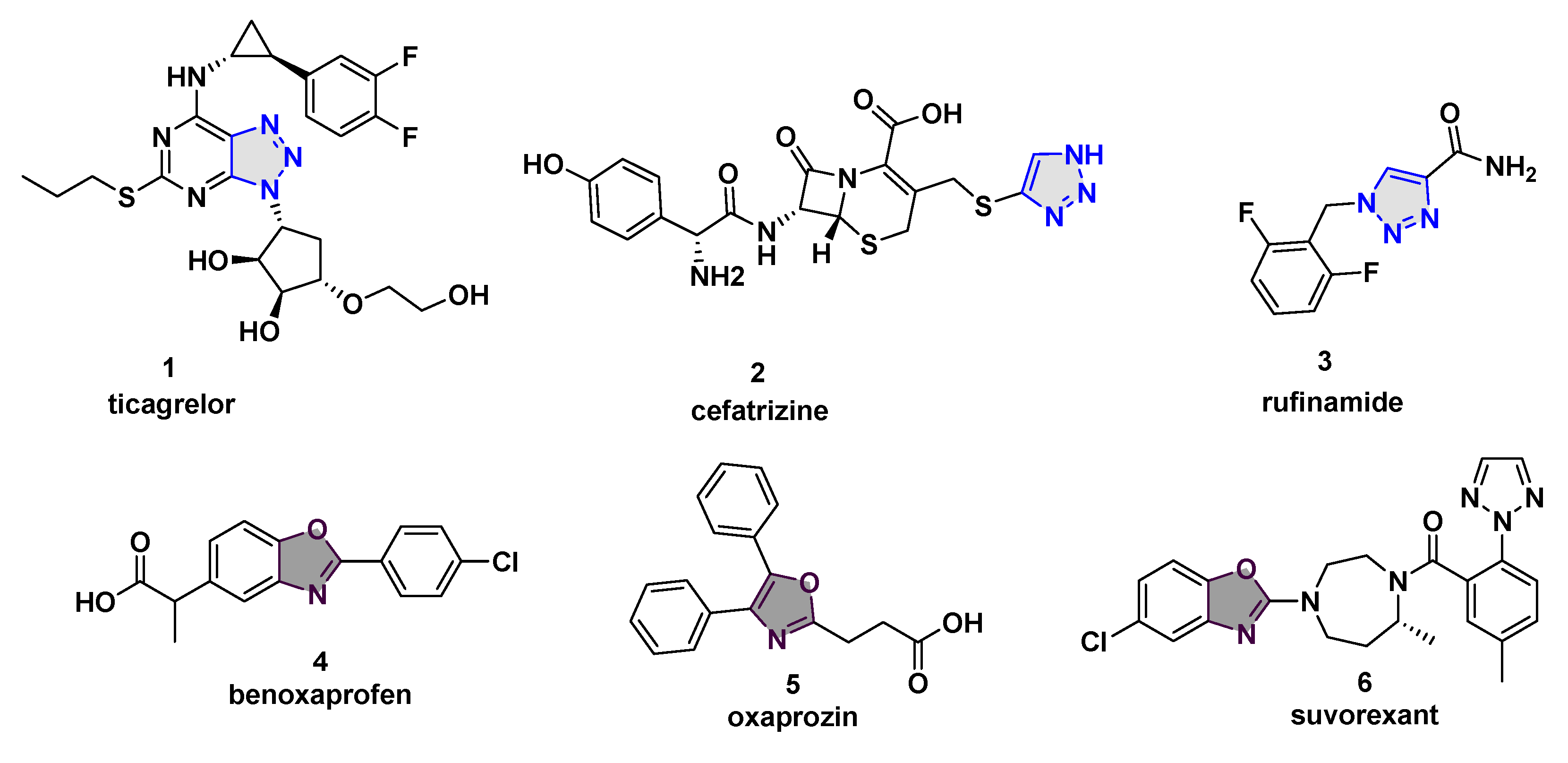
On the other hand, 1,4-disubstituted-1,2,3-triazoles and 1,3-oxazoles are well-recognized privileged motifs widely employed in the design of bioactive compound libraries with potential pharmacological relevance [5,6]. Figure 1 illustrates some FDA-approved drugs that incorporate either a 1,2,3-triazole or a 1,3-oxazole scaffold.
Figure 1. Some examples of drugs containing 1,4-disubstituted-1,2,3-triazoles and 1,3-oxazoles moieties.
In continuation of our research on the development of novel synthetic strategies for the rapid and simple construction of hybrid compounds [7,8], we herein report a concise two-step strategy for the synthesis of three novel 1,4–disubstituted–1,2,3–triazole–1,3–oxazole hybrids. This approach integrates a multicomponent reaction, a subsequent oxidation, and the Van Leusen reaction, obtaining moderate yields. Furthermore, the synthesized compounds were evaluated in silico to predict their potential biological activities, revealing that they may act as promising Polo-like kinase 3 (PLK3) inhibitors, as supported by molecular docking studies.

2. Materials and Methods

2.1. Experimental Section

All reagents, reactants, and solvents were purchased from Merck (Darmstadt, Germany) without further purification. NMR spectra were recorded on a Bruker AMX Advance III spectrometer (500 MHz) (Bruker Daltonics, Bremen, Germany). HRMS spectra were acquired on a Bruker MicroTOF-II spectrometer (Bruker Daltonics, Bremen, Germany). Melting points were determined on a Fisher-Johns melting point apparatus (Fisher Scientific International, Pittsburgh, PA, USA) and are uncorrected.

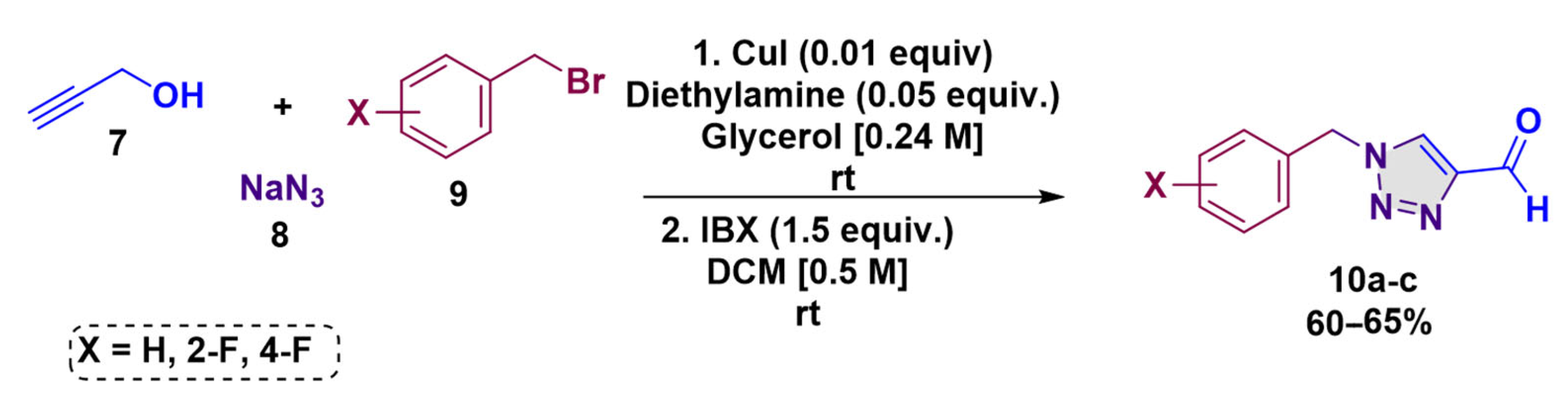
2.2. General Procedure for Aldehyde-1,2,3-Triazol 10a-c

The synthesis of aldehyde–1,2,3-triazole 10a was previously reported by our research group [8]. Compounds 10b and 10c were synthesized following the same procedure, varying only in the benzyl bromide derivative employed.

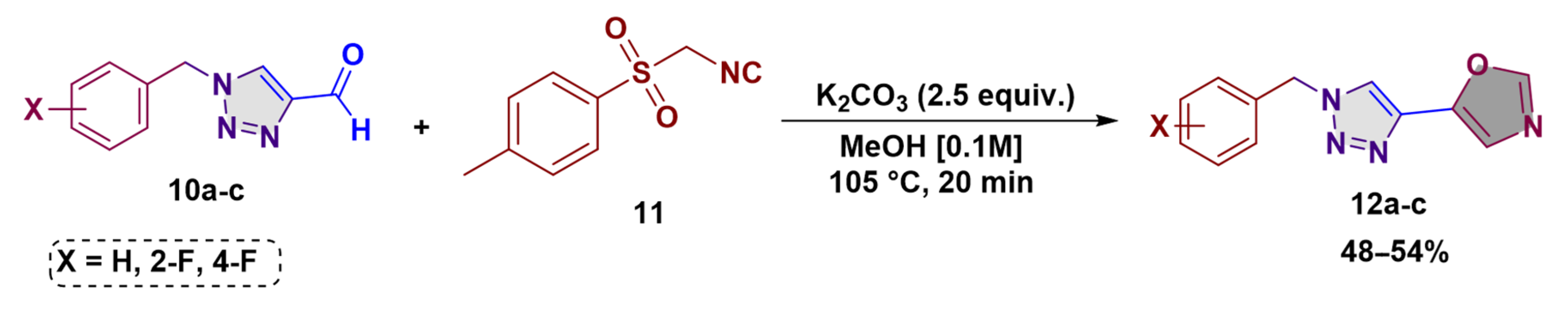
2.3. General Procedure for 1,4-Disubstituted-1,2,3-Triazole-1,3-Oxazoles 12a-c

Aldehyde–triazole 10a-c (1.0 equiv), p-toluenesulfonylmethyl isocyanide (1.1 equiv), and potassium carbonate (2.5 equiv) were placed into a sealed pressure tube. Anhydrous MeOH (0.1 M) was then added, and the mixture was stirred at 120 °C for 30 min until complete consumption of the starting material was confirmed by TLC. The reaction mixture was concentrated to dryness under reduced pressure. The residue was dissolved in 15 mL of DCM and washed with 15 mL of water. The aqueous layer was extracted with DCM (2 × 10 mL). The combined organic extracts were washed with water (2 × 15 mL), dried over anhydrous Na2SO4, and concentrated under reduced pressure. The crude product was purified by column chromatography using hexane/ethyl acetate (6:4, v/v) as the eluent to afford the desired 1,4-disubstituted-1,2,3-triazole-1,3-oxazoles.
5-(1-benzyl-1H-1,2,3-triazol-4-yl)oxazole (12a):
Yellow solid (39 mg, 48%); mp = 129–133 °C; RF = 0.23 (Hex:EtOAc 6:4 v/v);1H-NMR (500 MHz, CDCl3): 7.87 (s, 1H), 7.69 (s, 1H), 7.50 (s, 1H), 7.40–7.38 (m, 3H), 7.32–7.30 (m, 2H), 5.59 (s, 2H). 13C NMR (125 MHz, CDCl3): d = 150.2, 143.7, 137.7, 134.1, 129.2, 129.0, 128.1, 123.0, 120.2, 54.3. HRMS (ESI+): m/z: Calcd. for C12H11N4O[M+H]+: 227.0933; Found: 227.0938.
5-(1-(2-fluorobenzyl)-1H-1,2,3-triazol-4-yl)oxazole (12b):
Yellow solid (33 mg, 38%); mp = 126–130 °C; RF = 0.26 (Hex:EtOAc 6:4 v/v);1H-NMR (500 MHz, CDCl3): 7.89 (s, 1H), 7.79 (s, 1H), 7.51 (s, 1H), 7.42–7.37 (m, 1H), 7.34 (tdd, J = 7.5, 1.7, 0.5 Hz, 2H), 7.20–7.13 (m, 2H), 5.66 (s, 2H). 13C NMR (125 MHz, CDCl3): d = 160.6 (d, J = 248.4 Hz), 150.3, 131.2 (d, J = 8.2 Hz), 130.7 (d, J = 3.2 Hz), 124.9 (d, J = 3.8 Hz), 123.1, 120.3, 115.9 (d, J = 20.9 Hz), 47.9. HRMS (ESI+): m/z: Calcd. for C12H10FN4O[M+H]+: 245.0839; Found: 245.0852.
5-(1-(4-fluorobenzyl)-1H-1,2,3-triazol-4-yl)oxazole (12c):
Yellow solid (28 mg, 41%); mp = 139–143 °C; RF = 0.20 (Hex:EtOAc 6:4 v/v);1H-NMR (500 MHz, CDCl3): 7.89 (s, 1H), 7.70 (s, 1H), 7.50 (s, 1H), 7.33–7.30 (m, 2H), 7.10–7.07 (m, 2H), 5.57 (s, 2H). 13C NMR (125 MHz, CDCl3): d = 162.9 (d, J = 246.1 Hz), 150.3, 143.6, 137.8, 130.0 (d, J = 8.3 Hz), 129.1 (d, J = 29.7 Hz), 123.1, 120.0, 116.2 (d, J = 22.0 Hz), 54.3. HRMS (ESI+): m/z: Calcd. for C12H10FN4O[M+H]+: 245.0839; Found: 245.0846.

2.4. Computational Details

The 2D structures of the designed molecules were sketched using ChemDraw 19.1, converted into 3D structures using Avogadro 2 and optimized to ensure proper geometry and energy minimization. Docking studies were performed using Molegro Virtual Docker 5.0 to predict the binding energies of the designed compounds. The crystal structure of serine/threonine-protein kinase PLK3 was retrieved from the Protein Data Bank (PDB ID: 4B6L). All solvent molecules and non-essential ligands were removed prior to docking. The docking procedure employed the MolDock Score [GRID] with a resolution of 0.30 Å, MolDock SE, and the following parameters: 10 runs, a population size of 50, 1500 maximum iterations, 300 maximum steps, a neighbor distance of 1.0, and an energy threshold of 100. The binding site was defined with coordinates x = 52.64, y = –6.92, z = –2.14, and a radius of 16 Å. With these parameters, an RMSD of 1.14 Å was obtained for the co-crystallized ligand, thereby validating the docking protocol.

3. Results and Discussion

Our study began with the synthesis of the key precursors’ aldehyde-1,2,3-triazoles 10a-c through a two-step sequence, as depicted in Scheme 1. Initially, a three-component multicomponent reaction (3-CR MCR) was performed using propargyl alcohol 7, sodium azide 8, and benzyl bromide derivatives 9a-c according to the conditions reported by Zhao et al. [9]. This MCR involved two sequential processes: a bimolecular nucleophilic substitution (SN2) and a copper-catalyzed alkyne–azide cycloaddition (CuAAC). After the reaction was complete by TLC, the solvent was removed, and the crude product—without further purification—was subjected to mild oxidation using IBX, yielding the aldehyde–1,2,3–triazoles 10a-c in moderate yields.
Scheme 1. Synthesis of aldehyde–1,2,3–triazoles 10a-c via a two-step sequence: MCR/oxidation.
Subsequently, the second reaction step involved the Van Leusen reaction using p-toluenesulfonylmethyl isocyanide (TosMIC) 11 under the conditions previously developed by our group with slight modifications, affording three novel 1,4-disubstituted-1,3-oxazoles hybrids 12a-c in moderate yields within 20 min of reaction time (Scheme 2). Notably, the triazole–oxazole hybrid system scaffold remains scarcely described in the literature; only one report involves the use of isocyanides, and none has employed the Van Leusen reaction as the key step. This highlights the relevance of our work in expanding the structural diversity of this underexplored heterocyclic system.
Scheme 2. Synthesis of 1,4-disubstituted-1,2,3-triazole-1,3-oxazoles hybrids 12a-c via Van Leusen reaction.
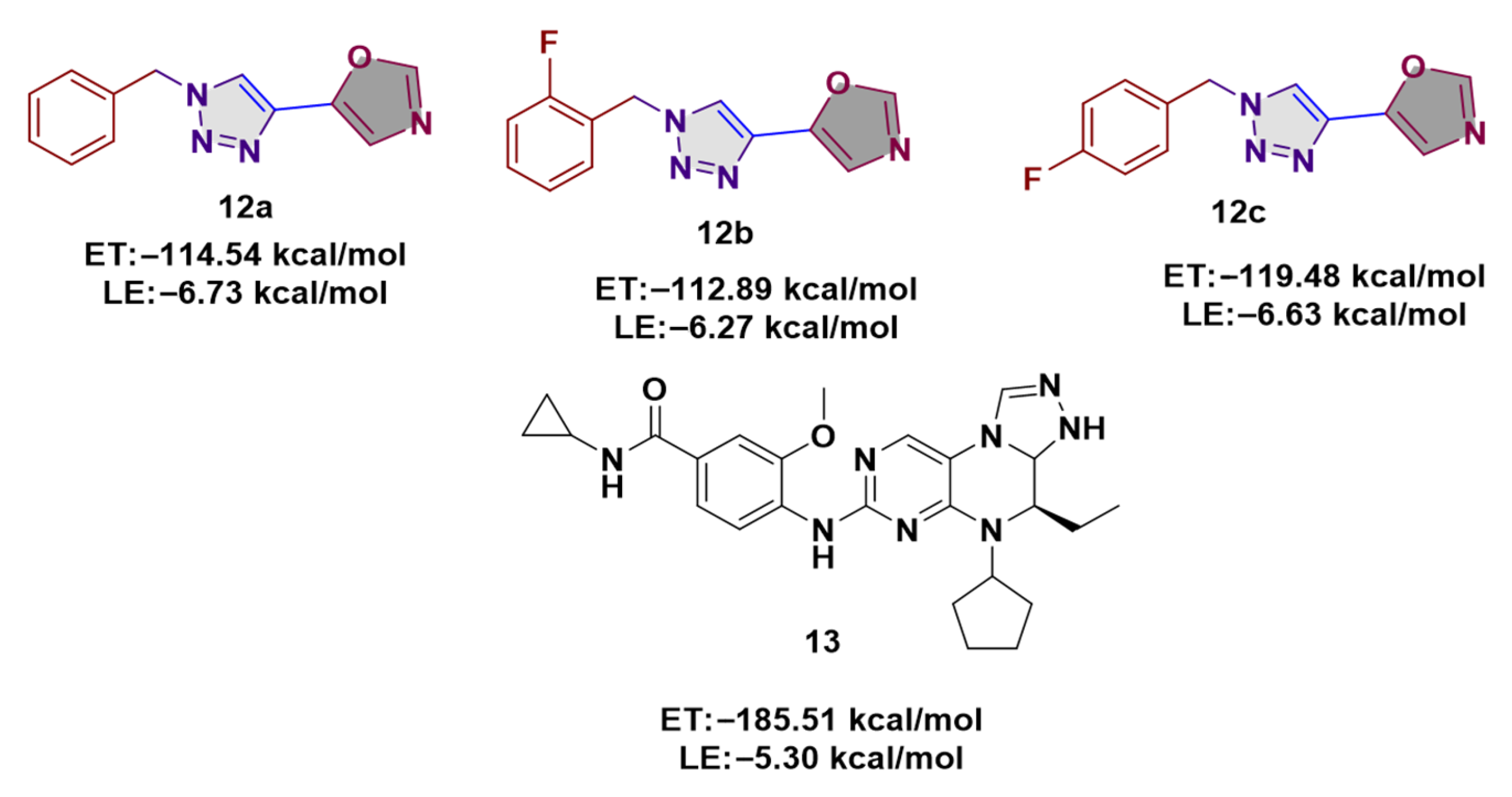
To preliminarily evaluate the biological potential of the synthesized triazole–oxazole hybrids, a target prediction analysis was conducted using the freely accessible PASS-Online platform [10]. This analysis suggested a potential inhibitory activity against the serine/threonine-protein kinase PLK3, a key regulator involved in cell cycle progression, DNA damage response, and apoptosis [11]. Based on this prediction, a molecular docking study was performed with PLK3 (PDB: 4B6L). The docking results (Figure 2) revealed binding energy (ET) values ranging from –112.89 to –119.48 kcal/mol and ligand efficiencies (LE) between –6.27 and –6.73 kcal/mol for the synthesized hybrids (12a-c), compared to the reference ligand 9ZP (ET = –185.51 kcal/mol, LE = –5.30 kcal/mol). Notably, compound 12c displayed the most favorable binding energy (–119.48 kcal/mol) among the synthesized series. Although the hybrids showed less negative binding energies than 9ZP (13), indicating a moderately lower predicted binding affinity, their ligand efficiencies surpassed that of the reference, suggesting a more efficient interaction per heavy atom within the PLK3 active site. This observation is relevant from a drug design perspective, as high ligand efficiency often indicates a better starting point for lead optimization, allowing further substitution or extension without rapidly compromising binding quality.
Figure 2. Binding energy (ET) and ligand efficiency (LE) values for the synthesized triazole–oxazole hybrids 12a-c and the reference inhibitor 13 docked into the PLK3 active site (PDB: 4B6L).
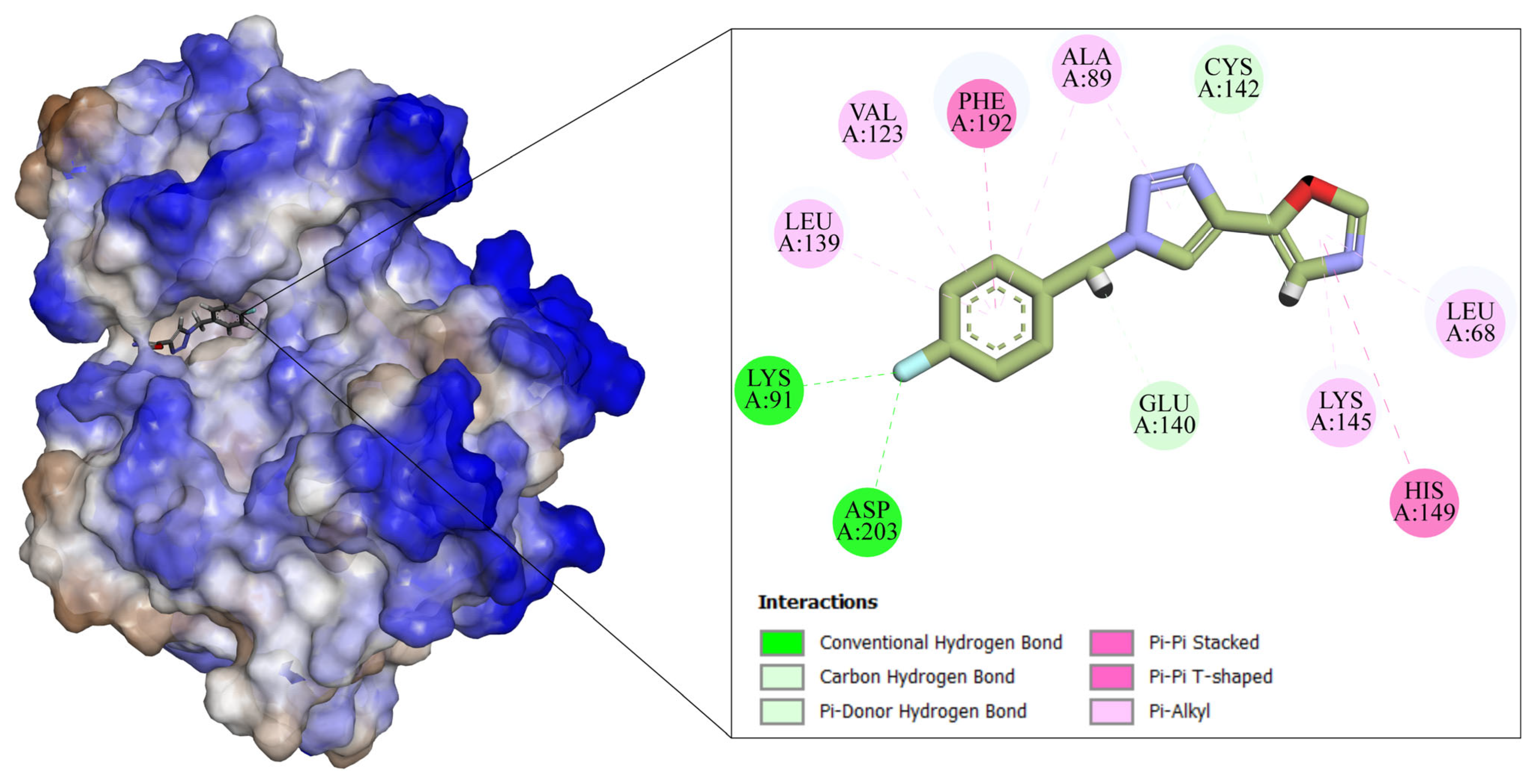
Finally, Figure 3 illustrates the binding mode of the lowest-energy binding compound, 12c, within the active site of PLK3 (PDB: 4B6L). The ligand is stabilized by multiple interactions, including conventional hydrogen bonds with Lys91 and Asp203, as well as π–π stacking interactions with Phe192. Additional hydrophobic contacts with residues such as Leu68, Leu139, and Val123 further contribute to the ligand stabilization. This interaction pattern supports the docking score results, indicating that the hybrid molecule can effectively occupy the binding pocket and potentially interfere with the enzymatic activity of PLK3.
Figure 3. Molecular interactions of hybrid 12c within the active site of serine/threonine-protein kinase PLK3 (PDB: 4B6L) obtained through molecular docking studies.

4. Conclusions

In conclusion, we established a concise two-step synthetic strategy to obtain three novel 1,4-disubstituted-1,2,3-triazole–1,3-oxazole hybrids via the MCR/oxidation/Van Leusen sequence. All compounds were characterized, and in silico studies suggested potential PLK3 inhibition, with compound 12c showing the most favorable binding profile. These findings expand the chemical diversity of triazole–oxazole scaffolds and highlight their promise as starting points for kinase-targeted drug discovery.

Author Contributions

Conceptualization, C.J.C.-G. and E.D.-C.; methodology, C.G.-M. and A.L.C.-G.; software, L.C.-G. and C.G.-M.; validation, A.A.F.-L. and E.D.-C.; formal analysis, L.C.-G. and A.A.F.-L.; investigation, C.J.C.-G.; resources, C.J.C.-G.; data curation, A.L.C.-G. and L.C.-G.; writing—original draft preparation, C.J.C.-G. and C.G.-M.; writing—review and editing C.J.C.-G. and C.G.-M.; visualization, A.A.F.-L.; supervision, C.J.C.-G.; project administration, C.J.C.-G. and L.C.-G.; and funding acquisition, C.J.C.-G. All authors have read and agreed to the published version of the manuscript.

Funding

This work was financially supported by Coordinación de la Investigación Cientifíca CIC-UMSNH (18104).

Institutional Review Board Statement

Not applicable.

Data Availability Statement

The data presented in this study are available on request from the corresponding author.

Conflicts of Interest

The authors declare no conflict of interest.

References

  1. Kerru, N.; Gummidi, L.; Maddila, S.; Gangu, K.K.; Jonnalagadda, S.B. A Review on Recent Advances in Nitrogen-Containing Molecules and Their Biological Applications. Molecules 2020, 25, 1909. [Google Scholar] [CrossRef] [PubMed]
  2. Skoreński, M.; Sieńczyk, M. The Fellowship of Privileged Scaffolds—One Structure to Inhibit Them All. Pharmaceuticals 2021, 14, 1164. [Google Scholar] [CrossRef] [PubMed]
  3. Schneider, P. Privileged Structures Revisited. Angew. Chem. Int. Ed. 2017, 56, 9833–9839. [Google Scholar] [CrossRef] [PubMed]
  4. Shaveta; Mishra, S.; Singh, P. Hybrid molecules: The privileged scaffolds for various pharmaceuticals. Eur. J. Med. Chem. 2016, 124, 500–536. [Google Scholar] [CrossRef] [PubMed]
  5. SM Forezi, L.; Lima, C.G.; Amaral, A.A.; Ferreira, P.G.; de Souza, M.C.B.; Cunha, A.C.; de C. da Silva, F.; Ferreira, V.F. Bioactive 1,2,3-Triazoles: An Account on Their Synthesis, Structural Diversity and Biological Applications. Chem. Rec. 2021, 21, 2782–2807. [Google Scholar] [CrossRef] [PubMed]
  6. Zhang, H.-Z.; Zhao, Z.-L.; Zhou, C.-H. Recent Advance in Oxazole-Based Medicinal Chemistry. Eur. J. Med. Chem. 2018, 144, 444–492. [Google Scholar] [CrossRef] [PubMed]
  7. Aguilar-Morales, C.M.; Araujo-Huitrado, J.G.; López-Hernández, Y.; Contreras-Celedón, C.; Islas-Jácome, A.; Granados-López, A.J.; Solorio-Alvarado, C.R.; López, J.A.; Chacón-García, L.; Cortés-García, C.J. A One-Pot Six-Component Reaction for the Synthesis of 1,5-Disubstituted Tetrazol-1,2,3-Triazole Hybrids and Their Cytotoxic Activity against the MCF-7 Cell Line. Molecules 2021, 26, 6104. [Google Scholar] [CrossRef] [PubMed]
  8. Frías-López, A.A.; Vázquez-Fuentes, S.; Garibay-Manríquez, C.; Reyes de la Cruz, H.; Islas-Jácome, A.; Chacón-García, L.; Díaz-Cervantes, E.; López-Bucio, J.S.; Cortés-García, C.J. Synthesis, in vitro activity and molecular docking of 1,5-disubstituted tetrazol-1,2,3-triazole hybrids against fungal plant pathogen Botrytis cinerea and Colletotrichum gloeosporioides. J. Agric. Food Chem. 2025, in press. [Google Scholar] [CrossRef] [PubMed]
  9. Guo, S.; Zhou, Y.; Dai, B.; Huo, C.; Liu, C.; Zhao, Y. CuI/Et2NH-Catalyzed One-Pot Highly Efficient Synthesis of 1,4-Disubstituted 1,2,3-Triazoles in Green Solvent Glycerol. Synthesis 2018, 50, 2191–2199. [Google Scholar] [CrossRef]
  10. Filimonov, D.A.; Lagunin, A.A.; Gloriozova, T.A.; Rudik, A.V.; Druzhilovskii, D.S.; Pogodin, P.V.; Poroikov, V.V. Prediction of the Biological Activity Spectra of Organic Compounds Using the PASS Online Web Resource. Chem. Heterocycl. Compd. 2014, 50, 444–457. [Google Scholar] [CrossRef]
  11. Zhu, T.; Zhao, C.; Gong, R.; Qian, A.; Wang, X.; Lu, F.; Huo, G.; Qiao, L.; Chen, S. Comprehensive Analysis Reveals PLK3 as a Promising Immune Target and Prognostic Indicator in Glioma. Oncol. Res. 2025, 33, 431–442. [Google Scholar] [CrossRef] [PubMed]
Disclaimer/Publisher’s Note: The statements, opinions and data contained in all publications are solely those of the individual author(s) and contributor(s) and not of MDPI and/or the editor(s). MDPI and/or the editor(s) disclaim responsibility for any injury to people or property resulting from any ideas, methods, instructions or products referred to in the content.

Article Metrics

Citations

Article Access Statistics

Multiple requests from the same IP address are counted as one view.