
Proceeding Paper

Synthesis and Biological Activity Evaluation In Silico of Bis(4-Hydroxy-6H-1,3-Oxazin-6-One) Derivatives and the Products of Their Alcoholysis †
by
Anastasia Andreevna Varvarkina
*,
Denis Andreevich Kolesnik
,
Marina Pavlovna Novikova
,
Igor Pavlovich Yakovlev
and
Polina Olegovna Levshukova
Department of Organic Chemistry, State Federal-Funded Educational Institution of Higher Education «Saint Petersburg State Chemical and Pharmaceutical University of the Ministry of Healthcare of the Russian Federation», Professor Popov str., 14, lit. A, 197022 St. Petersburg, Russia
*
Author to whom correspondence should be addressed.
Presented at the 29th International Electronic Conference on Synthetic Organic Chemistry, 14–28 November 2025; Available online: https://sciforum.net/event/ecsoc-29.
Chem. Proc. 2025, 18(1), 56; https://doi.org/10.3390/ecsoc-29-26712
Published: 11 November 2025

Abstract

Introduction: According to research data, 1,3-oxazines are pharmacologically active substances, as well as the substrates for the synthesis of heterocyclic and acyclic compounds. However, bis(1,3-oxazin-6-one) derivatives are little studied class of compounds, which makes their research a promising direction for the development of modern synthetic chemistry and pharmacy. The aim of this work is to obtain bis(4-hydroxy-6H-1,3-oxazin-6-ones), study their alcoholysis reaction, prove the structure of the obtained products and evaluate their pharmacological potential in silico. Methods: The reflux of isophthalic acid diamide with a twofold excess of substituted malonyl chloride in 1,2-dichloroethane for 15 h led to the production of bis(4-hydroxy-6H-1,3-oxazin-6-ones) (1, 2). As a result of their reflux with absolute ethanol for 5 h acyclic esters of malonamic acids (3, 4) formed. The structure of the obtained compounds was proved by 1H and 13C NMR spectroscopy. The prediction of biological activity was carried out using the GUSAR and PASS online web resources. Results: The yields of compounds 1–4 were 90%, 90%, 93%, 89%, respectively, depending on the nature of the substituent at position C5 of the oxazine cycle. According to the in silico assessment of biological activity, bis(1,3-oxazine-6-ones) exhibited high probability of antitumor activity, while ethyl esters of malonamic acids showed promising anxiolytic, antieczematous, fibrinolytic activities. Conclusions: New bridging 1,3-oxazin-6-ones were synthesized. The reaction of their cleavage by absolute ethanol to malonamic acid esters was studied. The potential biological activity was predicted in silico.

1. Introduction

Research on 1,3-oxazine compounds confirms their importance for modern organic chemistry and pharmacology. The relevance of studying 1,3-oxazine derivatives is due to their wide range of biological activity including antioxidant [1,2], antimicrobial [3,4,5,6] and antitumor [7]. In addition, they are key reagents for the synthesis of new heterocyclic and acyclic compounds [8]. The transition to the poorly studied bis(4-hydroxy-6H-1,3-oxazin-6-one) derivatives is promising, as it will expand the pharmacological potential of this series of compounds, and the study of their chemical properties, particularly the alcoholysis reaction, will allow to obtain new acyclic compounds with potentially promising types of biological activity. The aim of our work was the synthesis of bis(4-hydroxy-6H-1,3-oxazin-6-ones), the study of their ethanolysis reaction, the proof of the structure of the obtained compounds and the estimation of their biological activity in silico. To achieve the goal it was necessary to solve the following main problems:
  • To carry out the reaction of benzene-1,3-dicarboxamide with a twofold excess of substituted malonyl chloride in 1,2-dichloroethane;
  • To implement the interaction of the obtained bis(4-hydroxy-6H-1,3-oxazin-6-ones) with ethanol and to determine the effect of substituents at the C5 position of the oxazine cycle on the yield of the products;
  • To prove the structure of the synthesized compounds using NMR spectroscopy on 1H and 13C nuclei.
  • To conduct in silico screening of biological activity and acute toxicity assessment of the obtained series of substances using the PASS online and GUSAR web resources.

2. Materials and Methods

The reaction of benzene-1,3-dicarboxamide with methylmalonyl chloride and phenylmalonyl chloride was carried out in 1,2-dichloroethane (EDC) with a twofold excess of acid chlorides (1:2) (1.1) and (1.2) (Scheme 1). The yield of 2,2′-(benzene-1,3-diyl)bis(4-hydroxy-5-methyl-6H-1,3-oxazin-6-one) (1) in reaction 1.1 was 90%. The compound 2,2′-(benzene-1,3-diyl)bis(4-hydroxy-5-phenyl-6H-1,3-oxazin-6-one) (2) was obtained in reaction 1.2 with a yield of 90%. The syntheses were carried out for 15 h.
For the products 1 and 2 obtained in reactions 1.1 and 1.2, a reaction with ethanol was conducted. The interaction was performed at the boiling point of alcohol for 5 h (1.3 and 1.4). The end of the reaction was determined by TLC. During the reaction, the oxazine cycles were split along the C6-O bond. The products of this interaction were the following ethyl esters of N-acylmalonamic acids: diethyl 3,3′-(isophthaloylbis(azandiyloxy))bis(3-oxo-2-methylpropanoate) (3) and diethyl 3,3′-(isophthaloylbis(azandiyloxy))bis(3-oxo-2-phenylpropanoate) (4). The yields of compounds 3 and 4 were 93% and 89%, respectively.
1.1–1.2 Synthesis of 2,2′-(benzene-1,3-diyl)bis(4-hydroxy-6H-1,3-oxazin-6-ones) (1, 2). 0.0212 mol of benzene-1,3-dicarboxamide was suspended in EDC, then 0.0424 mol of substituted malonyl chloride was added and the mixture was refluxed for 15 h. The completeness of the reaction was monitored using thin-layer chromatography on TLC Silica gel 60 F254 plates with ethyl acetate as an eluent and UV light detection. After the synthesis, the target products were isolated by vacuum filtration and recrystallized from glacial acetic acid.
1.3–1.4 Synthesis of diethyl 3,3′-(isophthaloylbis(azandiyloxy))bis(3-oxopropanoates) (3, 4).
0.02 mol of 2,2′-(benzene-1,3-diyl)bis(4-hydroxy-6H-1,3-oxazin-6-one) (1, 2) was suspended in 20 mL of ethanol. The reaction mixture was refluxed for 5 h. The completeness of the reaction was monitored using thin-layer chromatography on TLC Silica gel 60 F254 plates with ethyl acetate as an eluent and UV light detection. Obtained products were isolated by vacuum filtration and dried in air.

3. Results

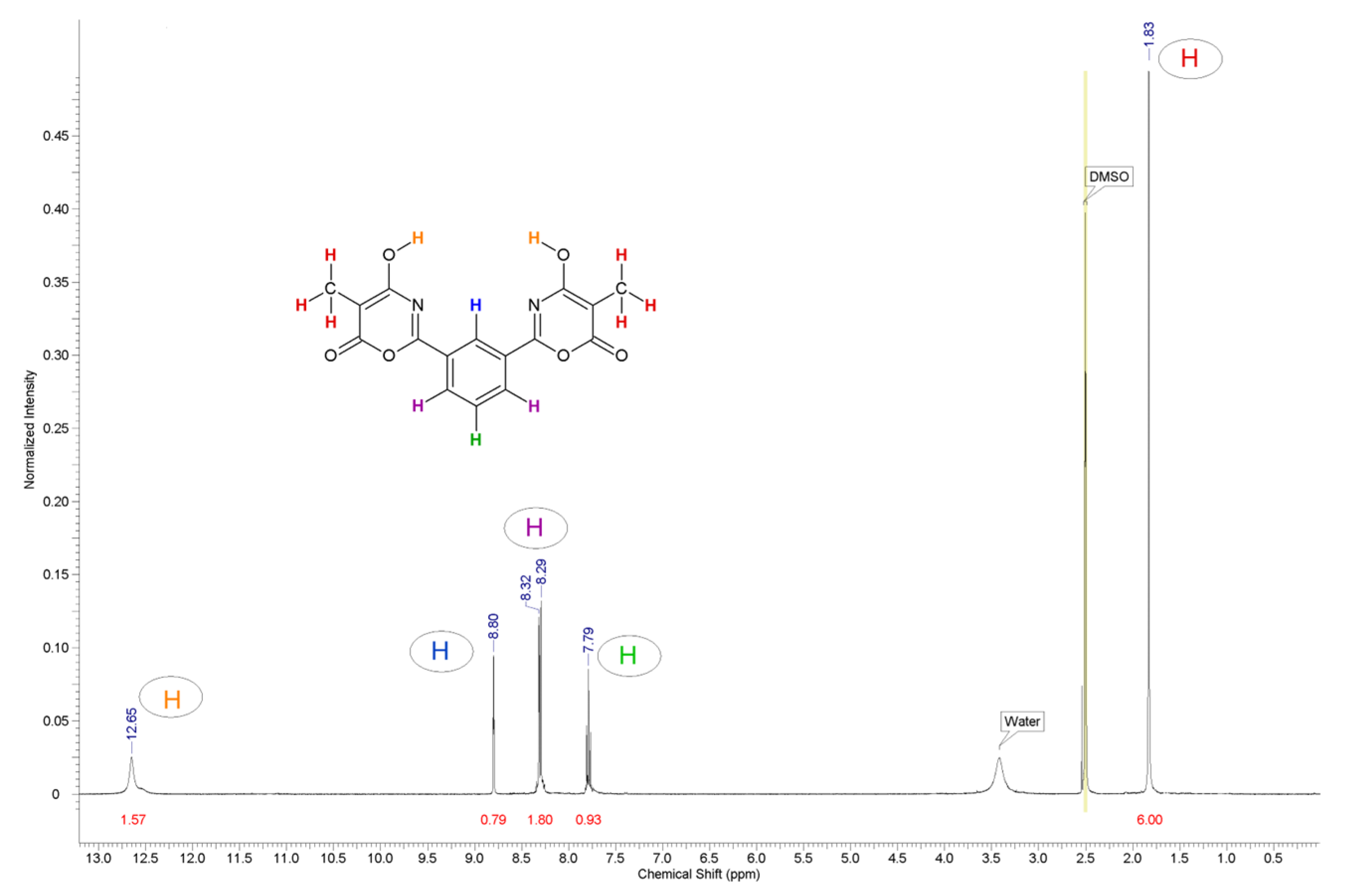
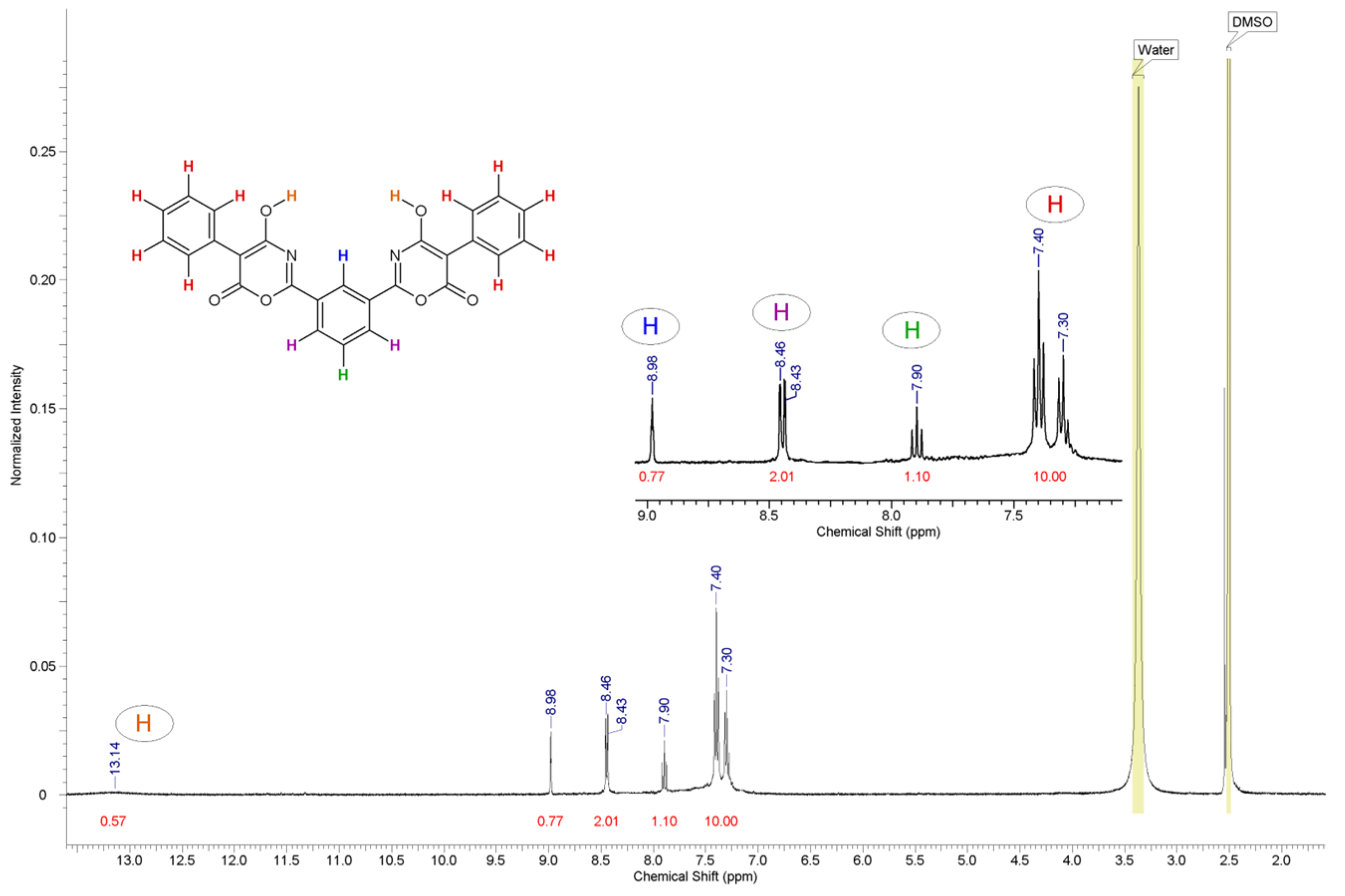
The interaction of benzene-1,3-dicarboxamide and substituted malonyl chloride in a 1:2 ratio led to the formation of bis(4-hydroxy-6H-1,3-oxazin-6-ones) (1, 2) after 15 h of refluxing with a yield of 90%. Further treatment of the latter with ethanol at boiling point resulted in the formation of acyclic ethyl esters of N-acylmalonamic acids (3, 4) with yields of 93% and 89%, respectively, which is due to the nature of the substituent at position C5 of the oxazine cycle: in the presence of an acceptor substituent—phenyl—in the bis(4-hydroxy-6H-1,3-oxazin-6-one) molecule the yield of the product is slightly reduced compared to the corresponding reaction involving a donor substituent—methyl. The structure of the obtained compounds 1–4 was proved by NMR spectroscopy on 1H and 13C nuclei (Figure 1 and Figure 2). 1H and 13C NMR spectra were obtained on a Bruker AM-500 spectrometer from solutions in DMSO-d6.
2,2′-(benzene-1,3-diyl)bis(4-hydroxy-5-methyl-6H-1,3-oxazin-6-one). 1H NMR (DMSO-d6): δ 1.83 (s, 6H, CH3); δ 7.79 (t, 0.93H, C6H4); δ 8.30 (dd, 1.80H, C6H4); δ 8.80 (s, 0.79H, C6H4); δ 12.65 (s, 1.57H, OH). 13C NMR (DMSO-d6): δ 7.83 (CH3); δ 91.23 (C5); δ 127.82 -129.60 (CAr); δ 160.33 (C4); δ 167.70 (C6); δ 162.33 (C2).
2,2′-(benzene-1,3-diyl)bis(4-hydroxy-5-phenyl-6H-1,3-oxazin-6-one). 1H NMR (DMSO-d6): δ 7.30–7.40 (m, 10H, C6H5); δ 7.90–8.98 (m, 3.88H, C6H4); δ 13.14 (s, 0.57H, OH). 13C NMR (DMSO-d6): δ 95.74 (C5); δ 127.26–134.85 (CAr); δ 161.31 (C2); δ 165.89 (C4); δ 167.98 (C6).
Diethyl 3,3′-(isophthaloylbis(azandiyloxy))bis(3-oxo-2-methylpropanoate). 1H NMR (DMSO-d6): δ 1.15 (d, 5.87H, CH3); δ 2.65 (t, 5.92H, CH3); δ 4.25 (q, 3.90H, -CH2-); δ 5.49 (q, 1.88H, -CH-); δ 7.65–8.00 (m, 3.95H, C6H4); δ 10.40 (s, 1.99H, -NH-). 13C NMR (DMSO-d6): δ 30.05 (CH3); δ 47.45 (-CH-); δ 63.34 (-CH2-); δ 51.32 (CH3); δ 128.85–132.38 (CAr); δ 166.83 (C=O); δ 168.43 (COOC2H5).
Diethyl 3,3′-(isophthaloylbis(azandiyloxy))bis(3-oxo-2-phenylpropanoate). 1H NMR (DMSO-d6): δ 2.66 (t, 5.65H, CH3); δ 4.26 (q, 3.94H, -CH2-); δ 5.50 (s, 1.97H, -CH-); δ 7.13–7.39 (m, 9.97H, C6H5); δ 7.65–8.00 (m, 3.89H, C6H4); δ 10.41 (s, 1.72H, -NH-). 13C NMR (DMSO-d6): δ 49.66 (CH3); δ 59.45 (-CH-); δ 63.38 (-CH2-); δ 128.00–132.38 (CAr); δ 166.87 (C=O); δ 168.53 (COOC2H5).

4. Discussion

For compounds 14 biological activity and acute toxicity were determined in silico using the PASS online and GUSAR web resources. The screening results are presented in Table 1, Table 2, Table 3, Table 4 and Table 5.
Based on the analysis of the obtained data it can be concluded that the potential immunosuppressive and antitumor activity in the series of bis(4-hydroxy-6H-1,3-oxazin-6-ones) are equally pronounced and the antieczematous activity is almost completely eliminated when the methyl group is replaced by a phenyl group at the C5 position of the oxazinyl cycle. In the series of diethyl esters N-acylmalonamic acids there is no clear pattern in the manifestation of potential biological activity depending on the nature of the substituent in the C5 position of the oxazine cycle.
According to the results of the acute toxicity assessment based on the classification of chemical compounds by the OECD Project, compounds 3 and 4 are non-toxic when administered subcutaneously and intraperitoneally and belong to classes 4 (5) when administered intravenously and orally. Compound 1 is non-toxic when administered subcutaneously and belongs to classes 5 and 4 in all other cases. Compound 2 also belongs to the 4 (intravenous route of administration) and 5 (in other cases) toxicity classes, which means that all the obtained compounds are practically non-toxic.

5. Conclusions

The synthesis of bis(4-hydroxy-6H-1,3-oxazin-6-ones) was carried out by the interaction of benzene-1,3-dicarboxamide with a twofold excess of substituted malonyl chloride in 1,2-dichloroethane. The yields of compounds 1 and 2 were calculated and amounted to 90%. As a result of ethanolysis of bis(4-hydroxy-6H-1,3-oxazine-6-ones), it was found that the yield of ethyl esters of N-acylmalonamic acids depends on the nature of the substituent at position C5 of the oxazine cycle. When a phenyl group is present, the yield is 89%, and when a methyl group is present, the yield is 93%. The structure of the synthesized compounds 1–4 was reliably proved using NMR spectroscopy on 1H and 13C nuclei. The biological activity and acute toxicity of the obtained compounds were determined using the web resources PASS online and GUSAR. Products 1 and 2 have a high probability of exhibiting immunosuppressive and antitumor activity, while compounds 3 and 4 have anxiolytic, fibrinolytic and antieczematous properties. All of the obtained substances are practically non-toxic.

Author Contributions

Conceptualization, D.A.K. and I.P.Y.; methodology, D.A.K., A.A.V., M.P.N., P.O.L.; software, A.A.V., D.A.K.; investigation, A.A.V., M.P.N.; writing—original draft preparation, A.A.V.; writing—review and editing, A.A.V. and D.A.K.; supervision, D.A.K.; project administration, D.A.K. and I.P.Y. All authors have read and agreed to the published version of the manuscript.

Funding

This research received no external funding.

Institutional Review Board Statement

Not applicable.

Informed Consent Statement

Not applicable.

Data Availability Statement

The original contributions presented in this study are included in the article. Further inquiries can be directed to the corresponding authors.

Conflicts of Interest

The authors declare no conflicts of interest.

Abbreviations

The following abbreviations are used in this manuscript:
EDC1,2-dichloroethane
TLCThin layer chromatography
UVUltraviolet
NMRNuclear magnetic resonance
IPIntraperitoneal route of administration
IVIntravenous route of administration
OralOral route of administration
SCSubcutaneous route of administration
LD50Median lethal dose
PaThe probability the compound is active for a given activity
OECDOrganization for Economic Co-operation and Development

References

  1. Ansari, N.; Khodagholi, F.; Amini, M. 2-Ethoxy-4,5-diphenyl-1,3-oxazine-6-one activates the Nrf2/HO-1 axis and protects against oxidative stress-induced neuronal death. Eur. J. Pharmacol. 2011, 658, 84–90. [Google Scholar] [CrossRef] [PubMed]
  2. Qamar, R.; Saeed, A.; Saeed, M.; Ashraf, Z.; Abbas, Q.; Hassan, M.; Albericio, F. Synthesis, carbonic anhydrase inhibitory activity and antioxidant activity of some 1,3-oxazine derivatives. Drug Dev. Res. 2018, 79, 352–361. [Google Scholar] [CrossRef] [PubMed]
  3. Mathew, B.P.; Kumar, A.; Sharma, S.; Shukla, P.K.; Nath, M. An eco-friendly synthesis and antimicrobial activities of dihydro-2H-benzo- and naphtho-1,3-oxazine derivatives. Eur. J. Med. Chem. 2010, 45, 1502–1507. [Google Scholar] [CrossRef] [PubMed]
  4. Chylińska, J.B.; Janowiec, M.; Urbański, T. Antibacterial activity of dihydro-1,3-oxazine derivatives condensed with aromatic rings in positions 5,6. Br. J. Pharmacol. 1971, 43, 649–657. [Google Scholar] [CrossRef] [PubMed]
  5. Zinad, D.S.; Mahal, A.; Salman, G.A. Synthesis and Antibacterial Activity of Novel 1,3-Oxazine Derivatives. Org. Prep. Proced. Int. 2021, 53, 578–584. [Google Scholar] [CrossRef]
  6. Asifa, M.; Imran, M. Pharmacological Profile of Oxazine and its Derivatives: A Mini Review. Int. J. New Chem. 2020, 7, 60–73. [Google Scholar] [CrossRef]
  7. Zinad, D.S.; Mahal, A.; Mohapatra, R.K.; Sarangi, A.K.; Pratama, M.R.F. Medicinal chemistry of oxazines as promising agents in drug discovery. Chem. Biol. Drug Des. 2020, 95, 16–47. [Google Scholar] [CrossRef] [PubMed]
  8. Komarov, A.V.; Yakovlev, I.P.; Zakhs, V.E.; Prepyalov, A.V. Reaction of Phenylmalonyl Dichloride with 3-Phenylpropynamide and Transformations of the Product by the Action of Some Nucleophiles. Russ. J. Gen. Chem. 2005, 75, 770–773. [Google Scholar] [CrossRef]
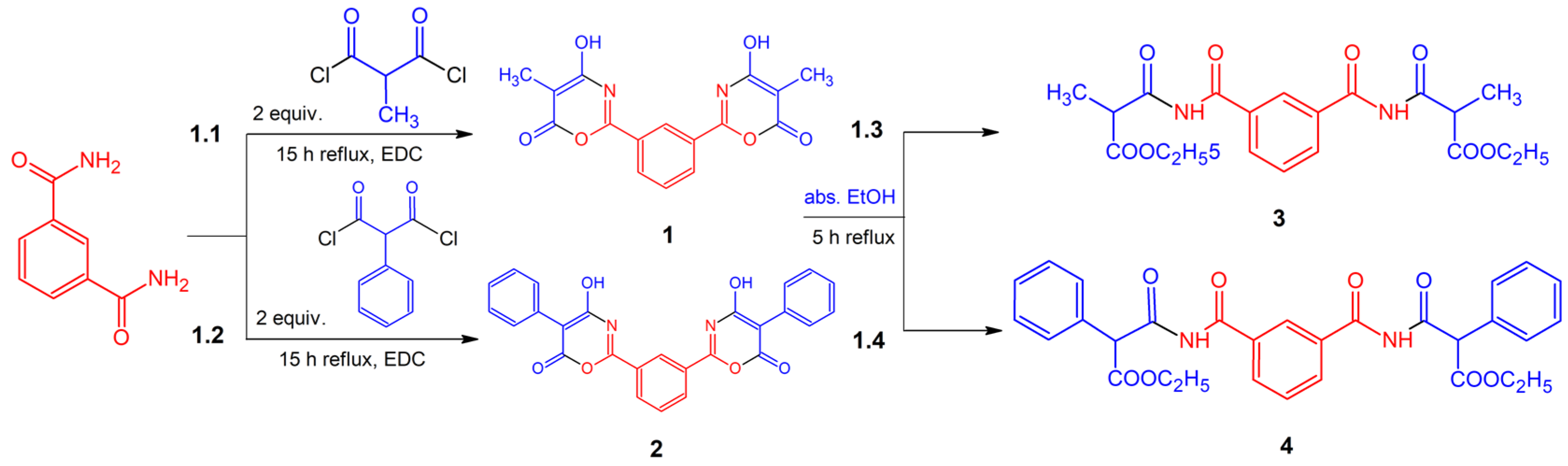
Scheme 1. Interaction of benzene-1,3-dicarboxamide with malonyl chlorides, followed by ethanolysis of products 1 and 2.
Chemproc 18 00056 sch001
Figure 1. 1H NMR spectrum of 2,2′-(benzene-1,3-diyl)bis(4-hydroxy-5-methyl-6H-1,3-oxazine-6-one) in DMSO-d6.
Chemproc 18 00056 g001
Figure 2. 1H NMR spectrum of 2,2′-(benzene-1,3-diyl)bis(4-hydroxy-5-phenyl-6H-1,3-oxazine-6-one) in DMSO-d6.
Chemproc 18 00056 g002
Table 1. Results of biological activity screening of 2,2′-(benzene-1,3-diyl)bis(4-hydroxy-5-methyl-6H-1,3-oxazin-6-one).
ActivityPa
Immunosuppressive0.7
Antitumor0.7
Antieczematous0.7
Table 2. Results of biological activity screening of 2,2′-(benzene-1,3-diyl)bis(4-hydroxy-5-phenyl-6H-1,3-oxazin-6-one).
ActivityPa
Immunosuppressive0.7
Antitumor0.7
Antieczematous0.4
Table 3. Results of biological activity screening of diethyl 3,3′-(isophthaloylbis(azandiyloxy))bis(3-oxo-2-methylpropanoate).
ActivityPa
Anxiolytic0.9
Fibrinolytic0.7
Antieczematous0.6
Table 4. Results of biological activity screening of diethyl 3,3′-(isophthaloylbis(azandiyloxy))bis(3-oxo-2-phenylpropanoate).
ActivityPa
Anxiolytic0.8
Fibrinolytic0.7
Antieczematous0.8
Table 5. Acute toxicity data for synthesized compounds 1–4.
CompoundRat IP LD50 (mg/kg)Rat IV LD50 (mg/kg)Rat Oral LD50 (mg/kg)Rat SC LD50 (mg/kg)
2,2′-(benzene-1,3-diyl)bis(4-hydroxy-5-methyl-6H-1,3-oxazin-6-one)52913520552705
2,2′-(benzene-1,3-diyl)bis(4-hydroxy-5-phenyl-6H-1,3-oxazin-6-one)86014335331540
Diethyl 3,3′-(isophthaloylbis(azandiyloxy))bis(3-oxo-2-methylpropanoate)161421416475616
Diethyl 3,3′-(isophthaloylbis(azandiyloxy))bis(3-oxo-2-phenylpropanoate)151823820082519
Disclaimer/Publisher’s Note: The statements, opinions and data contained in all publications are solely those of the individual author(s) and contributor(s) and not of MDPI and/or the editor(s). MDPI and/or the editor(s) disclaim responsibility for any injury to people or property resulting from any ideas, methods, instructions or products referred to in the content.