
Proceeding Paper

Synthesis and Characterization of 6-(1,3-dimethylureido) dibenzo[c,e][1,2]oxaphosphinine 6-oxide †
by
Marco Bortoluzzi
1,2,
Valentina Beghetto
1,2 and
Valeria Gagliardi
1,2,*
1
Dipartimento di Scienze Molecolari e Nanosistemi, Università Ca’ Foscari Venezia, 30172 Mestre, VE, Italy
2
CIRCC (Consorzio Interuniversitario Reattività Chimica e Catalisi), Via Celso Ulpiani 27, 70126 Bari, BA, Italy
*
Author to whom correspondence should be addressed.
Presented at the 29th International Electronic Conference on Synthetic Organic Chemistry, 14–28 November 2025; Available online: https://sciforum.net/event/ecsoc-29.
Chem. Proc. 2025, 18(1), 45; https://doi.org/10.3390/ecsoc-29-26714
Published: 11 November 2025

Abstract

The compound 6-(1,3-dimethylureido)dibenzo[c,e][1,2]oxaphosphinine 6-oxide was synthesized in a single step, under mild reaction conditions, from the commercially available H-phosphinate 9,10-dihydro-9-oxa-10-phosphaphenanthrene-10-oxide (DOPO) and 1,3-dimethylurea in the presence of a mild oxidant and triethylamine. The reaction led to the formation of a P–N bond between the phosphoryl group and one of the urea nitrogen atoms. The compound was spectroscopically characterized, and thermal properties were investigated.

1. Introduction

H-Phosphinate 9,10-dihydro-9-oxa-10-phosphaphenanthrene-10-oxide (DOPO) is an organophosphorus derivative widely investigated in the field of non-halogenated flame retardants for plastics [1,2]. Among the possible derivatizations of DOPO, the formal replacement of the P-bonded hydrogen atom with nitrogen substituents leads to the formation of phosphonamidates that exhibit peculiar flame-retardant properties thanks to the P-N synergism [3]. For instance, in the condensed phase, phosphorus derivatives promote the formation of a carbonaceous char layer, and nitrogen-containing compounds may promote stability and intumescence in the layer. A common approach to obtaining DOPO-based phosphonamidates is based on the synthesis of 9,10-dihydro-9-oxa-10-phosphaphenanthrene-10-chloride (DOPO-Cl), followed by the displacement of the chlorine atom with a suitable amine. DOPO-Cl can be formed through the Atherton–Todd reaction between DOPO and carbon tetrachloride, but alternative chlorinating agents such as sulfuryl dichloride, trichlorocyanuric acid, chlorine gas, and N-chlorosuccinimide can be employed [4,5,6,7,8,9,10,11,12].
Based on the knowledge developed by our group on the chemistry of DOPO and related organophosphorus species [13,14,15,16] and patented alternative approach for the preparation of DOPO derivatives with P–N bonds, prepared under mild conditions without chlorinated reactants [17,18], in this paper, we report the synthesis and characterization of 6-(1,3-dimethylureido)dibenzo[c,e][1,2]oxaphosphinine 6-oxide (DOPO-Nurea), obtained from DOPO and 1,3-dimethylurea. The thermal behaviour of the new compound was also investigated.

2. Experimental Section

2.1. Materials

9,10-Dihydro-9-oxa-10-phosphaphenanthrene-10-oxide (DOPO) was purchased from Fluorochem (Glossop, UK) and used without further purification. 1,3-Dimethylurea (DMU), other organic reactants, and iodine were Merck (Darmstadt, Germany) products, used as received.

2.2. Characterizations

Carbon, hydrogen, and nitrogen elemental analyses were performed using an Elementar (Langenselbold, Germany) Unicube microanalyzer. ATR-IR spectra were recorded with a Perkin-Elmer (Shelton, CT, USA) Spectrum Two spectrophotometer equipped with diamond ATR. Mono- and bidimensional NMR spectra were collected with a Bruker Avance 400 instrument (Billerica, MA, USA) operating at 400.13 MHz of 1H resonance. 1H and 13C NMR spectra were referenced to tetramethylsilane, while 31P NMR chemical shifts were referred to external 85% H3PO4 in water. Absorption spectra were recorded with a Yoke (Fengxian, China) 6000Plus double-beam spectrophotometer. Steady-state and time-resolved luminescence measurements were carried out with an Edinburgh Instruments (Livingston, UK) FS5 spectrofluorometer. Melting points were registered using a FALC (Treviglio, Italy) 360 D instrument equipped with a camera. Thermogravimetric analyses were performed under N2 flow with a Perkin-Elmer TGA4000 instrument. Differential scanning calorimetry measurements were carried out under N2 with a Mettler Toledo DSC 3.

2.3. Synthesis of DOPO-Nurea

The reaction was carried out in a MBraun (Garching bei München, Germany) MB10 glovebox filled with N2. In a typical preparation, DOPO (0.500 g, 2.3 mmol) was dispersed in 25 mL of anhydrous dichloromethane. Triethylamine (650 μL, 4.7 mmol) was added to the reaction mixture at room temperature. After stirring at room temperature until the complete dissolution of DOPO (about 10 min), DMU (0.203 g, 2.3 mmol) was added. Solid iodine (0.584 g, 2.3 mmol) was introduced into small aliquots, and the solution was left under stirring overnight at room temperature. The solvent was evaporated at reduced pressure, and the product was dissolved with two aliquots of toluene (15 mL each). The by-product triethylammonium iodide was separated by centrifugation, and toluene was removed by evaporation at reduced pressure. The addition of diethyl ether (10 mL) caused the formation of a white powder, which was collected by filtration, washed two times with 5 mL of diethyl ether, and dried under vacuum. Yield: 83% (0.577 g).
Characterization of DOPO-Nurea: Anal. calcd for C15H15N2O3P (302.26 g mol−1,%): C, 59.60; H, 5.00; N, 9.27. Found (%): C, 59.36; H, 5.05; N, 9.23. ATR-IR (cm−1): 3315 νNH, 1687 νCO, 1288 νP = O + δNH. 1H NMR (CDCl3, 300 K) δ 8.07–7.96 (m, 2H, arom-CH+NH), 7.93 (d, 1H, JHH = 7.9 Hz, arom-CH), 7.74 (dd, 1H, JPH = 15.9 Hz, JHH = 7.6 Hz, arom-CH), 7.67 (d, 1H, JHH = 7.6 Hz, arom-CH), 7.47 (td, 1H, JHH = 7.6 Hz, JPH = 3.2 Hz, arom-CH), 7.34 (t, 1H, JHH = 7.7 Hz, arom-CH), 7.22 (t, 1H, JHH = 7.7 Hz, arom-CH), 7.18 (d, 1H, JHH = 8.3 Hz, arom-CH), 2.85 (d, 3H, JHH = 4.5 Hz, N(H)-CH3), 2.62 (d, 3H, JPH = 9.2 Hz, N(P)-CH3). 31P{1H} NMR (CDCl3, 300 K) δ 14.5 (s). 13C{1H} NMR (CDCl3, 300 K) δ 156.2 (d, JPC = 7.4 Hz, CO), 149.7 (d, JPC = 7.5 Hz, arom-Cipso), 136.9 (d, JPC = 7.3 Hz, arom-Cipso), 133.8 (d, JPC = 2.2 Hz, arom-CH), 130.8 (s, arom-CH), 129.8 (d, JPC = 9.6 Hz, arom-CH), 128.8 (d, JPC = 15.4 Hz, arom-CH), 124.9 (s, arom-CH), 124.9 (s, arom-CH), 123.7 (d, JPC = 12.0 Hz, arom-CH), 121.6 (d, JPC = 174.5 Hz, arom-Cipso), 120.8 (d, JPC = 3.1 Hz, arom-Cipso), 120.3 (d, JPC = 7.2 Hz, arom-CH), 31.0 (d, JPC = 4.6 Hz, N(P)-CH3), 27.5 (s, N(H)-CH3). UV-VIS (CH2Cl2, 298 K, nm): <320, 302 sh, 291, 269, 260. PL (solid, λexcitation = 255 nm, nm): 383 (FWHM = 5800 cm−1). τ (λexcitation = 280 nm, λemission = 385 nm, ns): 3.7.

2.4. Computational Simulations

Computational simulations were carried out with the r2SCAN-3c method [19], based on the meta-GGA r2SCAN functional combined with a tailor-made triple-ζ Gaussian atomic orbital basis set and D4 and geometrical counter-poise corrections for London dispersion and basis set superposition error. The C-PCM implicit solvation model was added, considering dichloromethane as a continuous medium [20]. IR simulations were carried out using the harmonic approximation. The software used was ORCA version 5.0.3 [21].

3. Results and Discussion

DOPO-Nurea was synthesized with high yield and purity by reacting under mild conditions a solution containing DOPO, DMU, and two equivalents of triethylamine with stoichiometric iodine, according to the reaction in Scheme 1. The salt by-product of the reaction was easily separated from DOPO-Nurea thanks to the different solubility in toluene.
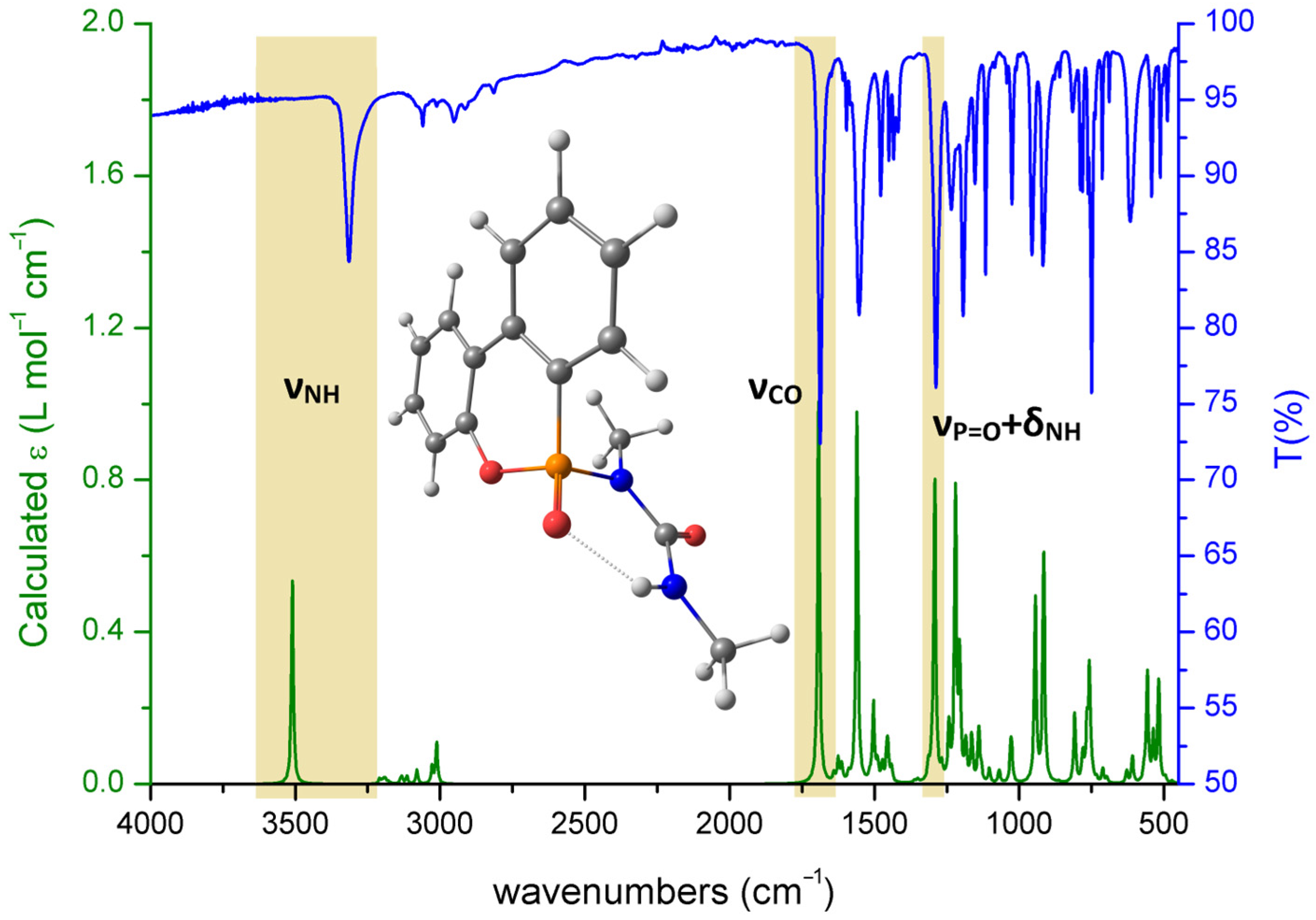
Elemental analysis data agree with the proposed formulation. The ATR-IR spectrum shows a band at 3315 cm−1 attributed to the N-H stretching, while the νCO vibration falls at 1687 cm−1. The P=O stretching was assigned to a band at 1288 cm−1 thanks to the simulation of the IR spectrum carried out on the DFT-optimized geometry of the compound (Figure 1). The computed data revealed that the νP=O vibration is combined with the bending of the N–H bond, thanks to the presence of an intramolecular hydrogen bond involving the two fragments (with computed H–O and N–H distances equal to 1.914 and 1.014 Å, respectively). The computed geometry revealed that the two N–C bonds are markedly different, since the distance involving the P-substituted nitrogen atom is 1.424 Å, 0.078 Å longer than the C(O)-NHMe one (1.346 Å). Considering other geometrical parameters, the two phosphorus–oxygen bond distances are 1.491 and 1.627 Å, with the shortest one corresponding the phosphoryl fragment. The phosphorus centre is roughly tetrahedral, with the τ4 parameter [22] being equal to 0.93.
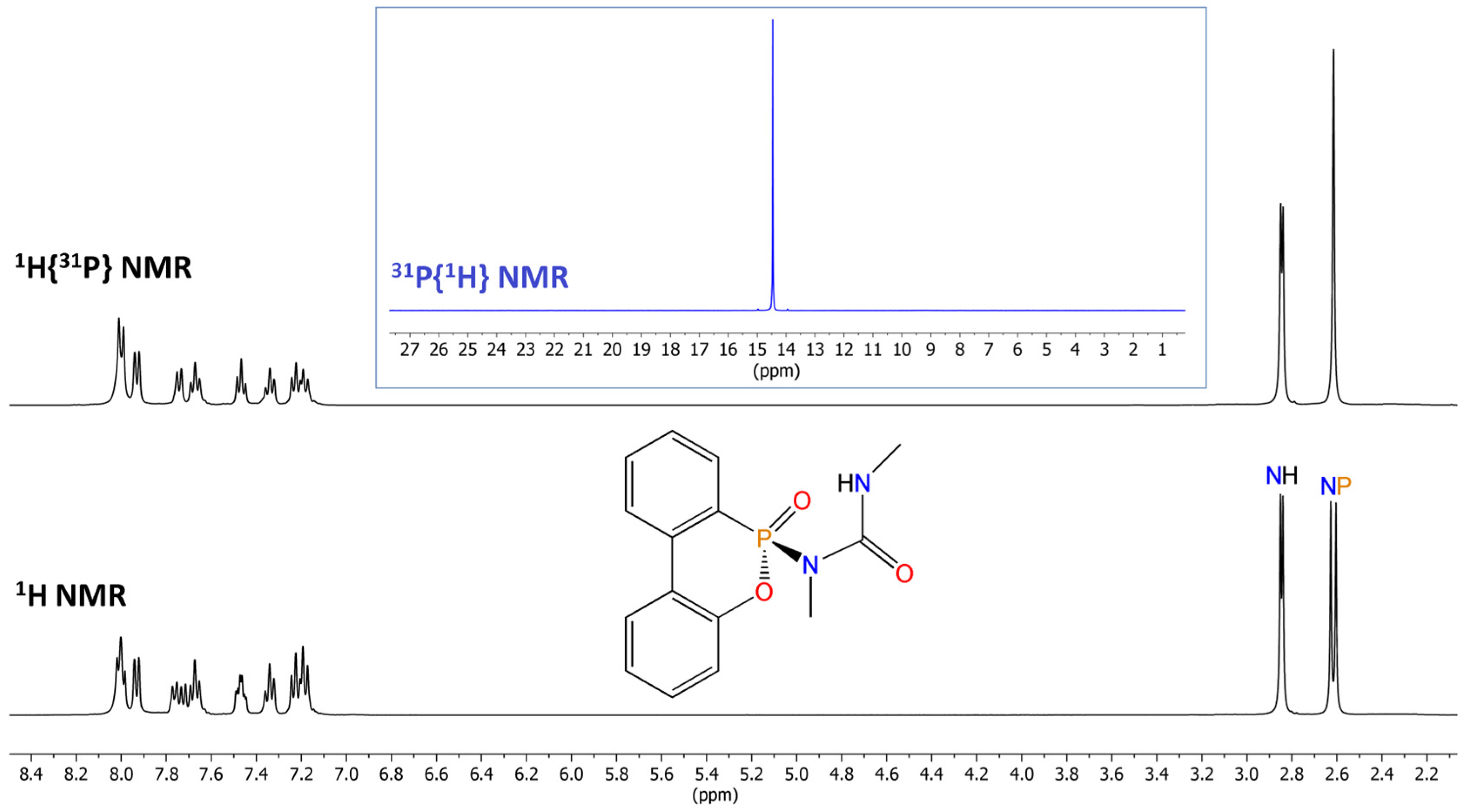
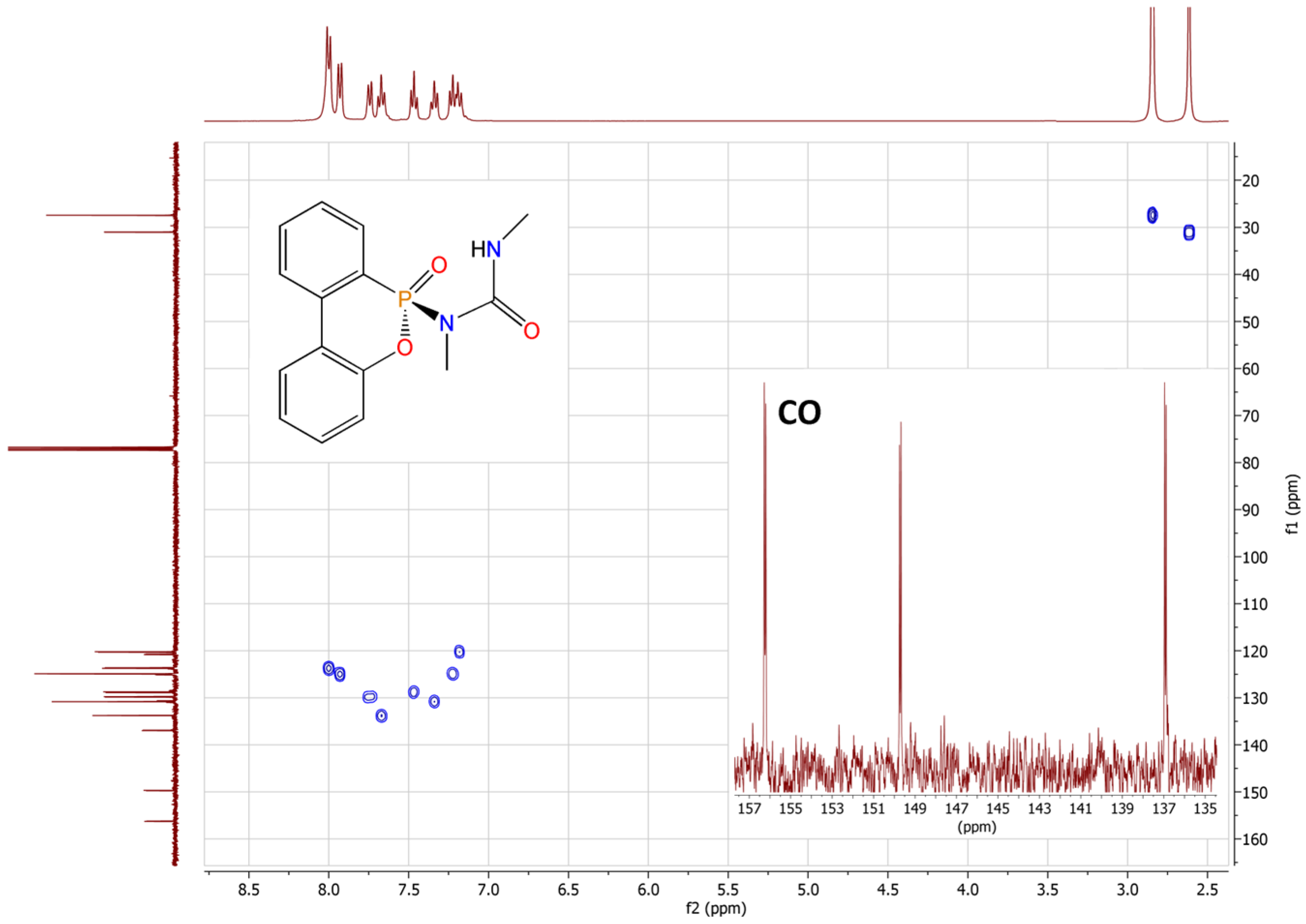
The formation of DOPO-Nurea was confirmed by NMR analysis. In particular, the high-frequency region of the 1H NMR spectrum showed eight resonances attributable to the biphenyl fragment between 8.1 and 7.1 ppm. The NH resonance overlaps around 8.0 ppm. The two non-equivalent methyl groups fall at 2.85 and 2.62 ppm. The first one is a doublet because of the coupling with the N-bonded hydrogen atom (JHH = 4.5 Hz), while the second couples with the 31P isotope (JPH = 9.2 Hz), as shown by the 1H{31P} NMR spectrum. No resonance due to hydrogen atoms directly bonded to the phosphorus atom was observed. Only one sharp signal at 14.5 ppm is present in the 31P{1H} NMR spectrum (Figure 2). The 13C{1H} NMR spectrum is composed of twelve resonances between 180.0 and 120.0 ppm, with four corresponding to Cipso carbon atoms. A doublet at 156.2 ppm with JPC coupling constant equal to 7.4 Hz was assigned to the carbonyl carbon atom. The two methyl signals fall at 31.0 and 27.5 ppm, and only the first one shows the coupling with the phosphorus centre, with JPC equal to 4.6 Hz (Figure 3). The NMR data unequivocally indicate the formation of one P–N bond between DOPO and DMU, and only one isomer of the final product is present in CDCl3 solution.
For what concerns other spectroscopic characterizations, DOPO-Nurea absorbs radiation for wavelengths shorter than 320 nm. Excitation with UV light causes a wide emission centred in the near-ultraviolet range (λmax = 383 nm), attributed to fluorescent decay on the basis of the excited-state lifetime, in the nanosecond range.
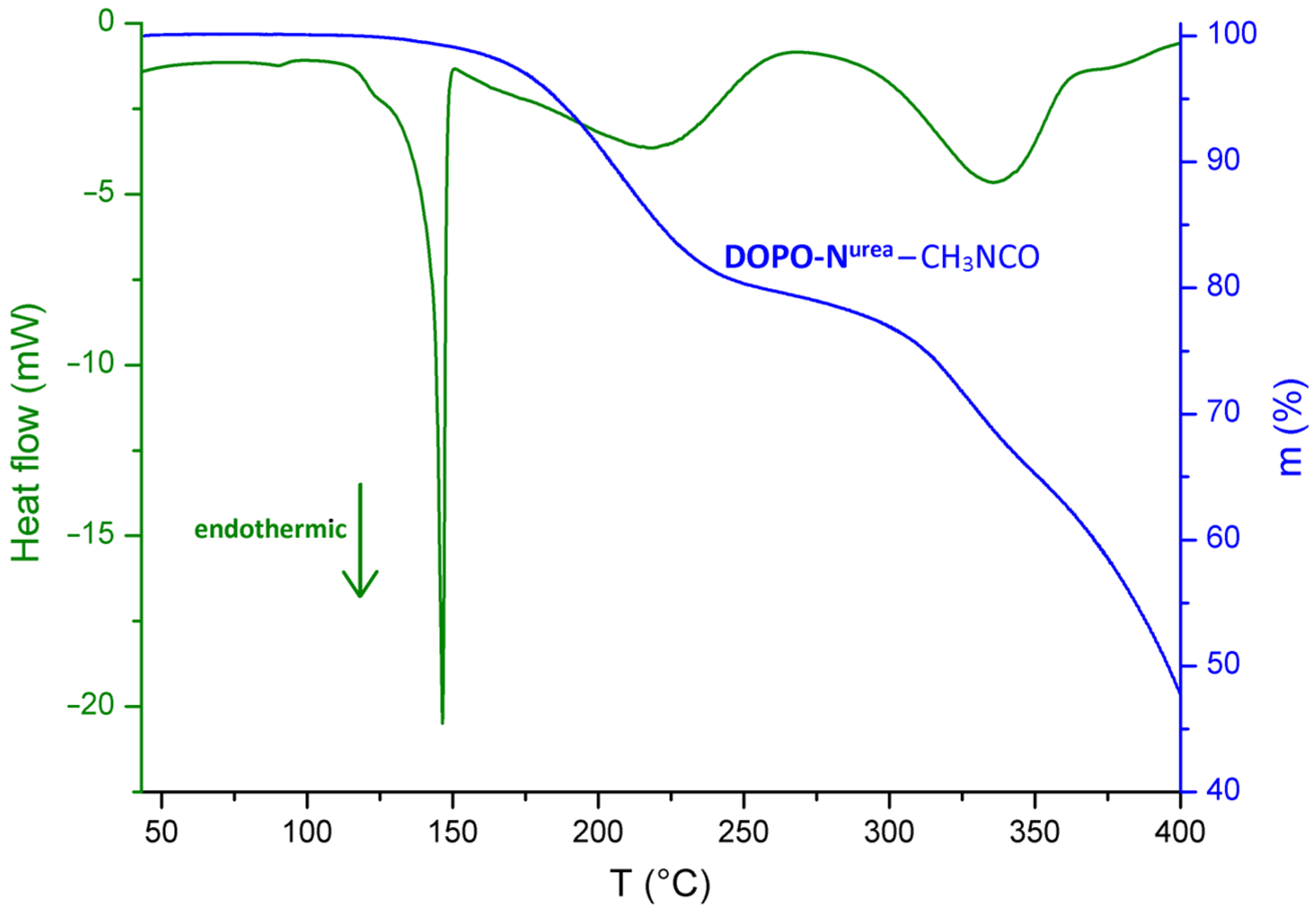
DOPO-Nurea melts without decomposition slightly above 140 °C, a result in line with a sharp endothermic DSC peak centred at 147 °C. The compound starts losing volatile compounds at temperatures above 150 °C. The first decomposition process ends around 240 °C with a residual mass of about 81% (Figure 4). According to recent studies on the thermal decomposition of organic ureas [23], the mass loss is coherent with a proton transfer and elimination of a methyl isocyanate molecule: (C12H8O2P)-NMeC(O)NHMe → (C12H8O2P)-NHMe + O=C=NMe. The TGA curve indicates that the intermediate compound is unstable and further decompositions with mass loss occur at higher temperatures (Figure 4). The flame-retardant properties of DOPO-Nurea in bio-based polymers are currently under investigation.

Author Contributions

Conceptualization, M.B. and V.G.; validation, M.B., V.B. and V.G.; formal analysis, M.B. and V.G.; investigation, M.B. and V.G.; resources, M.B. and V.B.; data curation, M.B., V.B. and V.G.; writing—original draft preparation, M.B., V.B. and V.G.; writing—review and editing, M.B., V.B. and V.G.; visualization, M.B. and V.G.; funding acquisition, V.B. All authors have read and agreed to the published version of the manuscript.

Funding

This research was funded by MIUR, Progetti Competitivi 2021/CMPT212338 and 2022/CMPT222955. The authors thank CIRCC for the financial support. This work is part of the “Network 4 Energy Sustainable Transition-NEST” project (MIUR project code PE000021, Concession Degree No. 1561 of 11 October 2022), in the framework of the NextGenerationEu PNRR plan (CUP C93C22005230007).

Institutional Review Board Statement

Not applicable.

Informed Consent Statement

Not applicable.

Data Availability Statement

The dataset is available on request from the authors.

Conflicts of Interest

The authors declare no conflict of interest.

References

  1. Pack, S. A Review of Non-halogen Flame Retardants in Epoxy-Based Composites and Nanocomposites: Flame Retardancy and Rheological Properties. In Flame Retardants; Visakh, P.M., Arao, Y., Eds.; Springer: Heidelberg, Germany, 2015; pp. 115–130. [Google Scholar]
  2. Marosi, G.; Szolnoki, B.; Bocz, K.; Toldy, A. Reactive and Additive Phosphorus-based Flame Retardants of Reduced Environmental Impact. In Polymer Green Flame Retardants; Papaspyrides, C.D., Kiliaris, P., Eds.; Elsevier: Amsterdam, The Netherlands, 2014; pp. 181–220. [Google Scholar]
  3. Olcay, H.; Gul, C.; Kocak, D.E. Synergism in Nitrogen- and Phosphorus-Based Flame Retardants. In Materials and Chemistry of Flame-Retardant Polyurethanes—Volume 2: Green Flame Retardants; Gupta, R.K., Ed.; ACS Symposium Series: Washington, DC, USA, 2021; pp. 213–247. [Google Scholar]
  4. Wagner, S.; Rakotomalala, M.; Bykov, Y.; Walter, O.; Döring, M. Synthesis of new organophosphorus compounds using the Atherton–Todd reaction as a versatile tool. Heteroatom. Chem. 2012, 23, 216–222. [Google Scholar] [CrossRef]
  5. Gaan, S.; Neisius, M.; Mercoli, P.; Liang, S.; Mispreuve, H.; Näscher, R. Phosphonamidates-Synthesis and Flame Retardant Applications. U.S. Patent 9650497B2, 16 May 2017. [Google Scholar]
  6. Jian, R.; Wang, P.; Duan, W.; Wang, J.; Zheng, X.; Weng, J. Synthesis of a Novel P/N/S-Containing Flame Retardant and Its Application in Epoxy Resin: Thermal Property, Flame Retardance, and Pyrolysis Behavior. Ind. Eng. Chem. Res. 2016, 55, 11520–11527. [Google Scholar] [CrossRef]
  7. Gaan, S.; Neisius, M.; Mercoli, P.; Liang, S.; Mispreuve, H.; Näscher, R. Novel Phosphonamidates-Synthesis and Flame Retardant Application. WIPO WO2013020696A3, 10 May 2013. [Google Scholar]
  8. Neisius, N.M.; Lutz, M.; Rentsch, D.; Hemberger, P.; Gaan, S. Synthesis of DOPO-Based Phosphonamidates and their Thermal Properties. Ind. Eng. Chem. Res. 2014, 53, 2889–2896. [Google Scholar] [CrossRef]
  9. Salmeia, K.A.; Baumgartner, G.; Jovic, M.; Gössi, A.; Riedl, W.; Zich, T.; Gaan, S. Industrial Upscaling of DOPO-Based Phosphonamidates and Phosphonates Derivatives Using Cl2 Gas as a Chlorinating Agent. Org. Process Res. Dev. 2018, 22, 1570–1577. [Google Scholar] [CrossRef]
  10. Salmeia, K.A.; Flaig, F.; Rentsch, D.; Gaan, S. One-Pot Synthesis of P(O)-N Containing Compounds Using N-Chlorosuccinimide and Their Influence in Thermal Decomposition of PU Foams. Polymers 2018, 10, 740. [Google Scholar] [CrossRef] [PubMed]
  11. Tada, Y.; Sunada, A.; Watanabe, R.; Kanazawa, M.; Utsumi, K. Synthesis of Trispirocyclotriphosphazenes with Oxaphosphorine Rings and Their Crystal and Molecular Structures. Inorg. Chem. 2021, 60, 5014–5020. [Google Scholar] [CrossRef] [PubMed]
  12. Kukla, P.; Greiner, L.; Eibl, S.; Döring, M.; Schönberger, F. Novel phosphorus-containing silazanes as flame retardants in epoxy resins. React. Funct. Polym. 2022, 170, 105120. [Google Scholar] [CrossRef]
  13. Marra, G.; Bortoluzzi, M.; Agostinis, L. One-Pot Synthesis of Phosphoramidates from dibenzo[1,3,2]dioxaphosphepine-6-oxide. Chem. Proc. 2023, 14, 18. [Google Scholar] [CrossRef]
  14. Bortoluzzi, M.; Ghincolov, S.; Agostinis, L. Alternative Synthesis of Phosphonate Derivatives of 9,10-Dihydro-9-oxa-10-phosphaphenanthrene-10-oxide. Chem. Proc. 2023, 14, 19. [Google Scholar] [CrossRef]
  15. Gagliardi, V.; Castro, J.; Beghetto, V.; Expósito, M.; Bortoluzzi, M. Luminescence of the Conjugate Bases of [2-(2-Hydroxyphenyl)phenyl]phosphinic Acid and Single-Crystal X-Ray Structure Determination of Sodium [2-(2-Hydroxyphenyl)phenyl]phosphinate. Organics 2025, 6, 10. [Google Scholar] [CrossRef]
  16. Ferraro, V.; Castro, J.; Agostinis, L.; Bortoluzzi, M. Dual-emitting Mn(II) and Zn(II) halide complexes with 9,10-dihydro-9-oxa-10-phosphaphenanthrene-10-oxide as ligand. Inorg. Chim. Acta 2023, 545, 121285. [Google Scholar] [CrossRef]
  17. Agostinis, L.; Ghincolov, S.; Bortoluzzi, M. Preparation process of P(=O)-heteroatom derivatives of dibenzooxaphosphacycles. WIPO WO2023094526A1, 1 June 2023. [Google Scholar]
  18. Bortoluzzi, M.; Agostinis, L.; Ghincolov, S.; Ferraro, V.; Marra, G.; Castro, J. Straightforward synthesis of 9,10-dihydro-9-oxa-10-phosphaphenanthrene-10-oxide derivatives containing P–N bonds. Chem. Pap. 2023, 77, 7999–8006. [Google Scholar] [CrossRef]
  19. Grimme, S.; Hansen, A.; Ehlert, S.; Mewes, J.-M. r2SCAN-3c: A “Swiss army knife” composite electronic-structure method. J. Chem. Phys. 2021, 154, 064103. [Google Scholar] [CrossRef] [PubMed]
  20. Cossi, M.; Rega, N.; Scalmani, G.; Barone, V. Energies, structures, and electronic properties of molecules in solution with the C-PCM solvation model. J. Comput. Chem. 2003, 24, 669–681. [Google Scholar] [CrossRef] [PubMed]
  21. Neese, F. Software update: The ORCA program system–Version 5.0. WIREs Comput. Mol. Sci. 2022, 12, e1606. [Google Scholar] [CrossRef]
  22. Yang, L.; Powell, D.R.; Houser, R.P. Structural variation in copper(I) complexes with pyridylmethylamide ligands: Structural analysis with a new four-coordinate geometry index, τ4. Dalton Trans. 2007, 955–964. [Google Scholar] [CrossRef] [PubMed]
  23. Honorien, J.; Fournet, R.; Glaude, P.-A.; Sirjean, B. Theoretical Study of the Thermal Decomposition of Urea Derivatives. J. Phys. Chem. A 2022, 126, 6264–6277. [Google Scholar] [CrossRef] [PubMed]
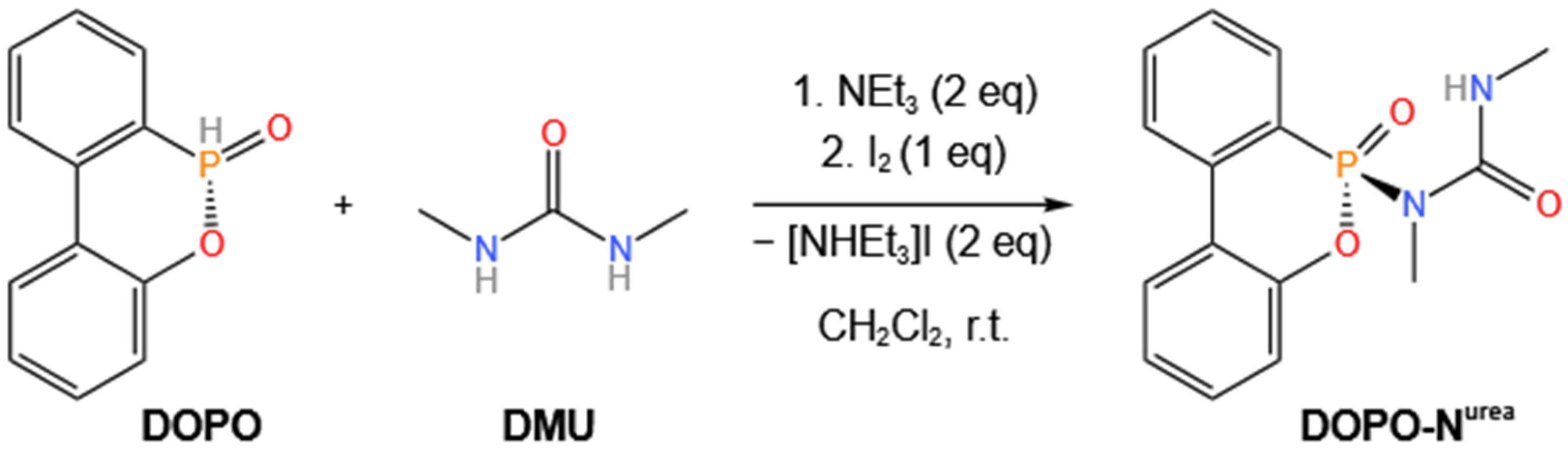
Scheme 1. Reaction between DOPO and DMU in presence of NEt3 and I2.
Chemproc 18 00045 sch001
Figure 1. ATR-IR spectrum (blue line) and unscaled simulated IR spectrum (green line; Lorentzian broadening, FWHM = 8 cm−1) of DOPO-Nurea. DFT-optimized structure of DOPO-Nurea (P, orange; O, red; N, blue; C, grey; H, white).
Chemproc 18 00045 g001
Figure 2. 1H NMR, 1H{31P} NMR, and 31P{1H} NMR spectra of DOPO-Nurea. CDCl3, 300 K.
Chemproc 18 00045 g002
Figure 3. 13C-HSQC NMR spectrum of DOPO-Nurea. 1H{31P} NMR spectrum shown in the direct dimension. Inset: high-frequency region of the 13C{1H} NMR spectrum. CDCl3, 300 K.
Chemproc 18 00045 g003
Figure 4. DSC (green line) and TGA (blue line) curves of DOPO-Nurea.
Chemproc 18 00045 g004
Disclaimer/Publisher’s Note: The statements, opinions and data contained in all publications are solely those of the individual author(s) and contributor(s) and not of MDPI and/or the editor(s). MDPI and/or the editor(s) disclaim responsibility for any injury to people or property resulting from any ideas, methods, instructions or products referred to in the content.