Proceeding Paper

Preparation, Characterization and in Silico Study of Some Pyrimidine Derivatives That Contain a Chalcone Group and Study of Their Biological Activity †

by
Salwa R. Abdulameer
,
Raad Saad Jihad
* and
Hiba Salman Alghanmy
Directorate General of Muthanna Education, Samawa 66001, Iraq
*
Author to whom correspondence should be addressed.
Presented at the 29th International Electronic Conference on Synthetic Organic Chemistry, 14–28 November 2025; Available online: https://sciforum.net/event/ecsoc-29.
Chem. Proc. 2025, 18(1), 42; https://doi.org/10.3390/ecsoc-29-26827
Published: 12 November 2025

Abstract

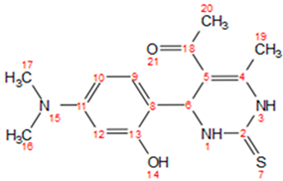
An important class of heterocyclic chemicals are pyrimidine derivatives, providing a wide spectrum of biological activities in the form of antibacterial, antifungal, anti-HIV, anti-hypertensive, anti-inflammatory, anti-cancer, anti-convulsant, anti-depressant, and anti-tuberculosis acts. The chalcone group also has a significant impact on the pharmacological activity of compounds used for therapeutic purposes, acting as antibiotics, antioxidants, and anti-cancer agents. In this research, the derivative 1-(4-(4-(dimethylamino)-2-hydroxyphenyl)-6-methyl-2-thioxo-1,2,3,4-tetrahydropyrimidin-5-yl) ethan-1-one was prepared. From the reaction of thiourea with acetyl acetone and 4-dimethylamino-2-hydroxybenzaldehyde, the product was then reacted with some aldehydes in the presence of ethanol and a little hydrochloric acid as a catalyst, after which the product was reacted with some aldehydes to prepare chalcone. The prepared derivatives were characterized by FT-IR, 1H-NMR, and 13C-NMR spectra, the melting point was measured, and the biological activity of the prepared compounds as antibacterials was studied. Molecular docking also determined the anti-breast cancer potential of these derivatives by docking the prepared derivatives with PDB:3eqm protein using the MOE 2015.10 program. The prepared compounds showed good efficacy as antibacterial agents against Gram-negative bacteria at diluted concentrations. Additionally, molecular docking studies demonstrated good efficacy of some derivatives as breast cancer inhibitors, along with a study of the toxic effects of the prepared compounds using the ProTox 3.0 program prediction of toxicity of chemicals.

1. Introduction

Pyrimidine, a polymeric organic base that is one of the basic units for the construction of DNA and RNA (deoxyribonucleic acid and ribonucleic acid) [1], is a hexagonal one-ring system containing two nitrogen atoms. It is also one of the important organic compounds used in the preparation of many pyrimidine derivatives of biological importance [2]. As for chalcone compounds, they are an unsaturated α, β ketone group and are considered biologically important compounds [3,4].
In this paper, a new group of pyrimidine derivatives containing a chalcone group was prepared. Chalcones are a major class of natural products found in the peels of fruits and vegetables, spices, tea, and soy-based foodstuffs and have been extensively studied for a wide range of biological, antifungal, antibacterial, anti-inflammatory, and antioxidant properties [5,6]. Changes in their composition have allowed a high degree of versatility that has proven useful in the development of a new class of drugs with improved efficacy and lower toxicity. On the other hand, many researchers believe that chalcone has an “important anti-cancer effect” that has a significant impact on natural ingredients, as well as the anti-cancer group. The aromatic groups of chalcone can lead to significant changes in anti-cancer activity [7]. As the microwave has many advantages, including high yield, high selectivity, small amounts of by-products, moderate reaction conditions, and shorter time, we can obtain high purity with simple processes. In 1986, it was reported by two groups (Gedye and Giguere/Majetich) and became a basic technology in the synthesis of various heterocyclic compounds through cyclic reactions as well as in coupling reactions [8]. Heating or interaction with microwaves are a very important process in view of the coupling of microwave rays directly with the molecules that are present in the reaction mixture [9], which leads to a rapid rise in temperatures and thus faster reactions, while with traditional heating, the temperature on the outer surface is higher than it is on the inside [10].

2. Experimental

2.1. Materials and Methods

All the used chemicals were obtained from commercial sources, with a purity range of 95–98%, and were used as received (without further purification). Melting points of all synthesized compounds were measured in open capillary tubes in a Gallenkamp MFB-600 melting point apparatus. FT-IR spectra measurements were recorded using an FT-IR-8400S-Shimadizu spectrophotometer. 1H-NMR and 13C-NMR spectra were recorded on a VARIAN-INOVA 400 MHZ spectrophotometer (Konstanz, Germany). DMSO was used as a solvent, and tetramethylsilane (TMS) was used as an internal standard.

2.2. General Procedure for the Synthesis 1-)4dimethylamino)-2-hydroxyphenyl)-6-methyl-2-thioxo-1,2,3,4-tetrahydropyrimidin-5-yl) ethan-1-one (a)

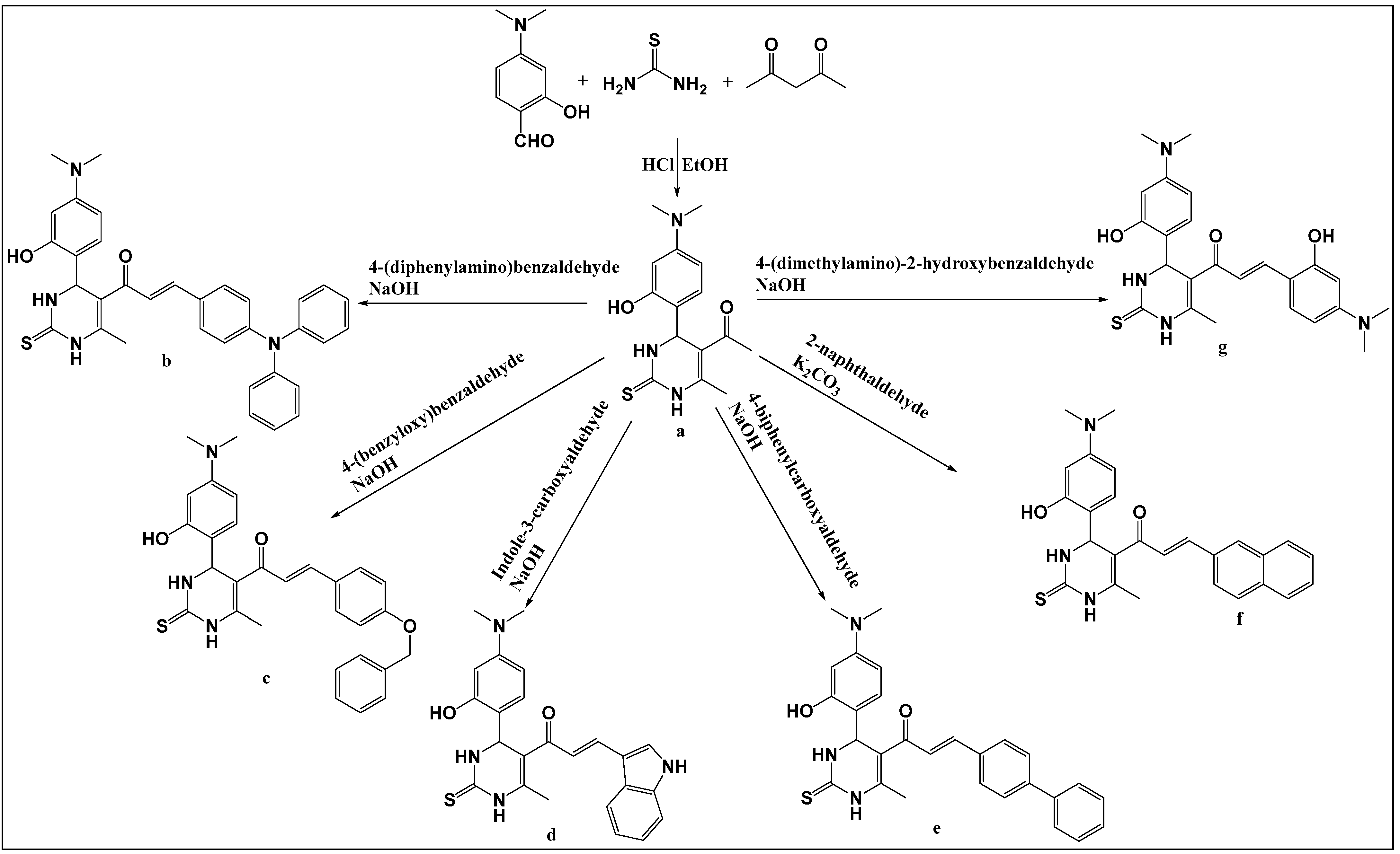
Equivalent moles (1 mmol) of thiourea, 4-dimethylamino-2-hydroxybenzaldehyde, and acetyl acetone were mixed in a 100 mL single-mouthed round flask to which 25 mL ethanol was added with some drops of hydrochloric acid as a catalyst. The mixture was scaled up, and the reaction was followed by TLC using a mobile phase of methanol: dichloromethane in a ratio of 9:1, after which the product was cooled, and the solid product was filtered and then recrystallized from ethanol [11].

2.3. General Procedure for the Synthetic Derivatives (b–g)

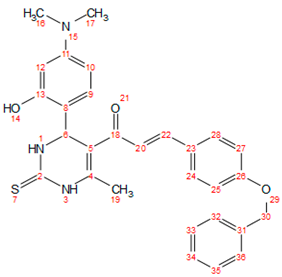
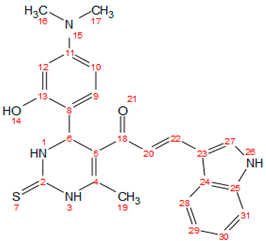
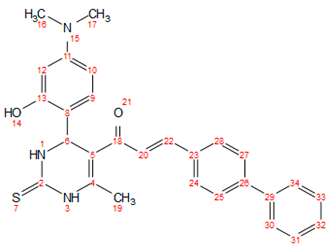
In total, 0.33 mmol (0.1 g) of pyrimidine and 0.09, 0.07, 0.048, 0.006, 0.052, and 0.055 g of 4-(diphenylamino) benzaldehyde, 4-benzyl oxybenzaldehyde, iodine-3-carboxyaldehyde, 4-diphenylcarboxyaldehyde, 2-naphthaldehyde, and 4-dimethylamino)-2-hydroxybenzaldehyde were mixed, respectively, in a single-mouth round flask. A total of 100 mL was added to it, followed by 5 mL ethanol and 0.04 g of sodium hydroxide; then water and DMF were added to it in a ratio of 2:2 mL, and the mixture was irradiated for 15–20 min under conditions (1 atmosphere, 200 watts, and 80 °C). The reaction was performed by TLC, using a mobile phase of ethyl acetate: n-hexane in a ratio of 2:4. After the end of the reaction, the product was cooled, the solvent was evaporated using a rotary evaporator, and the rest was added to 30 mL of water and extracted using 3 × 30 mL of acetate. The ethyl and the organic layer were dried using magnesium sulfate, the mixture was filtered, the solvent was evaporated, and the resulting product was recrystallized with ethanol [7,12].

3. Results and Discussion

Numerous studies have shown the importance of heterocyclic compounds and their derivatives, as they make up more than 90% of pharmaceutical compounds. Therefore, researchers were interested in preparing these compounds to for their benefits in the pharmaceutical and medical fields, such as antibacterial, antifungal, antiviral, anti-cancer, and other applications.

3.1. Identification of the Prepared Compounds

The compounds were prepared according to the preparation methods used in the work method, shown in Scheme 1, and the compounds were identified using the melting point technique, as well as by following the spectroscopic methods represented by infrared spectra (IR), proton nuclear magnetic resonance (1H NMR spectra), and carbon (13C NMR spectra) for all derivatives [13,14], as appearing in the following Table 1 and Table 2.

3.2. Biological Activity

A study of the biological effectiveness of the prepared derivatives (a–g) was conducted on a type of Gram-negative bacteria, Escherichia Coli. These bacteria were chosen because of their importance in the medical field, as they cause many serious diseases, as well as the nature of their resistance to antibiotics and therapeutic chemicals. It is noted in Table 3 (a) that compound (b) shows a mediate inhibitory effect on the Gram-negative bacteria Escherichia Coli, compound (c) shows a weak inhibitory effect against the negative bacteria, and compounds (d, f, and g) have a strong inhibitory effect on the negative bacteria Escherichia Coli. It is believed that there is a relationship between the structural formula of the compound and its biological effectiveness. The compound’s containment of heterocyclic rings works to increase biological activity, in addition to (OH, -N(Me)2) working to increase biological effectiveness [15,16].

3.3. In Silico Study

In silico study of the derivatives (1–7) was performed, with LD50 predicted computationally using the ProTox server and their anti-breast cancer potential assessed by docking with the PDB:3eqm protein using the MOE 2015 program, as shown below.

3.3.1. LD50 Test by Protox 3.0 Online

The LD50 test determines the median lethal dose, which is the amount of a substance required to kill 50% of the test group (usually animals such as mice or rats). This test measures the acute toxicity of the substance; the lower the LD50 number, the more potent and lethal the substance is, as less of it is needed to cause death in half of the samples. The results are usually presented in milligrams of the substance per kilogram of body weight, which helps in comparing the relative safety of different products. ProTox 3.0 is a computational tool that predicts the oral toxicity of compounds by comparing their two-dimensional chemical structures with a database of known compounds, thereby estimating the dose that may be lethal to 50% of the tested animals. This approach aims to reduce the need for animal testing and provides a faster and less costly method to assess the potential acute toxicity of the compound.
The LD50 values of derivatives are shown in Table 4 below.

3.3.2. Molecular Docking Study

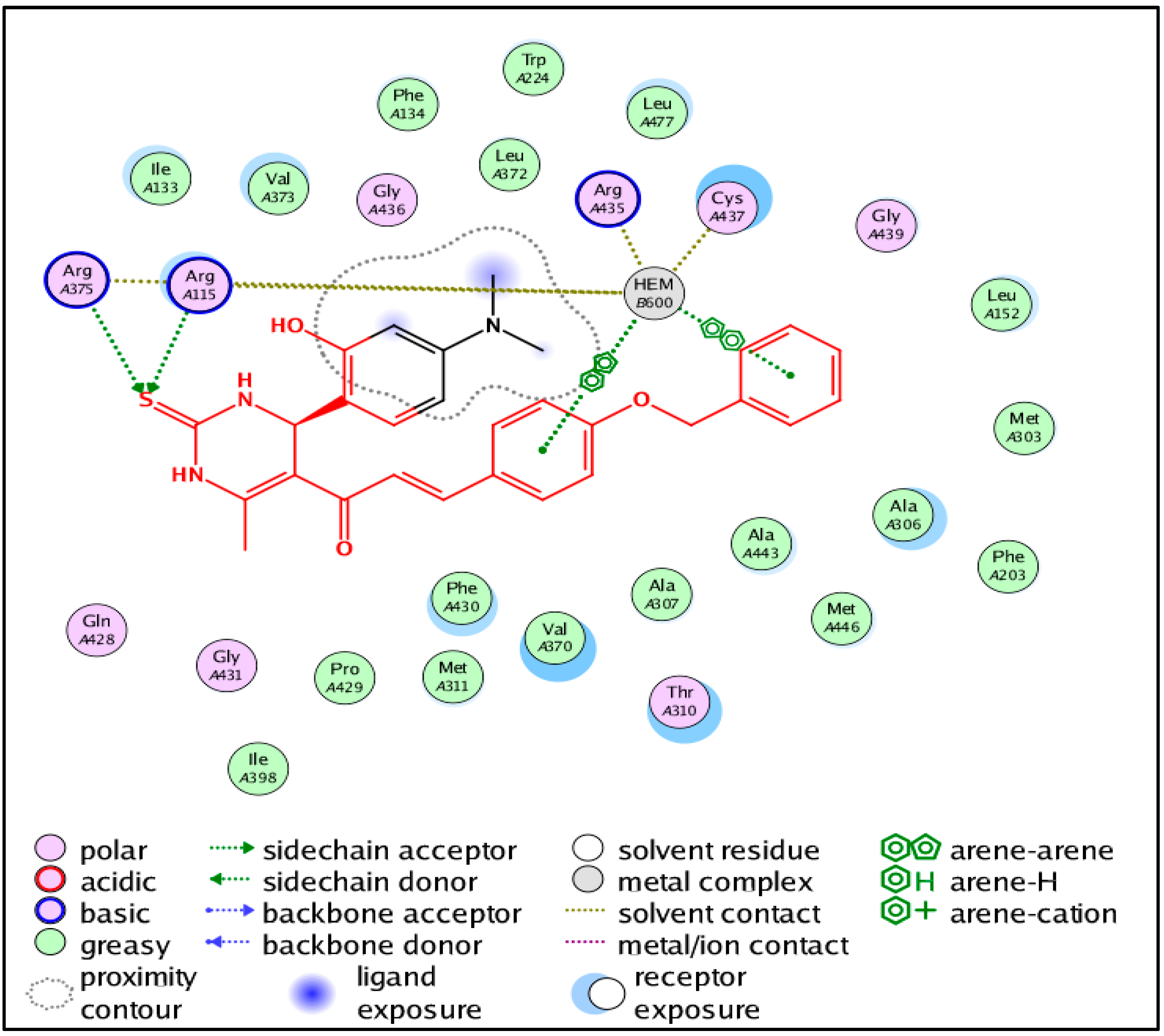
Table 5 displays the results of the molecular docking and docking scores for each ligand interaction with the PDB:3eqm receptor (Human Placental Aromatase Cytochrome P450 Protein) using MOE 2015.10. The results show that chain A of the PDB:3eqm receptor has the greatest binding affinity, with derivative (c) having a general docking energy of about -10.1140 kcal/mol and a total of two interaction sites [17]. Shown of Figure 1 is a two-dimensional diagram that explained the relationship between the binding sites of ligand (c)-the best docking score-with the protein (PDB: 3eqm).

4. Conclusions

In this work, some derivatives containing the pyrimidine ring and the chalcone group were prepared and studied in terms of their structure, as well as their effectiveness as antibacterial agents in the laboratory, and the lethal dose was studied using the ProTox 3.0 program. The results were very good in this regard. Additionally, their potential as breast cancer inhibitors was studied using molecular docking techniques by the MOE 2015.10 program, where molecular docking studies suggest strong binding affinity of some derivatives with the target protein, proposing them as potential breast cancer inhibitors.

Author Contributions

Conceptualization, S.R.A., R.S.J. and H.S.A.; methodology, S.R.A., R.S.J. and H.S.A.; software, S.R.A., R.S.J. and H.S.A.; validation, S.R.A., R.S.J. and H.S.A.; formal analysis, S.R.A., R.S.J. and H.S.A.; data curation, S.R.A., R.S.J. and H.S.A.; writing—original draft preparation, S.R.A., R.S.J. and H.S.A.; writing—review and editing, S.R.A., R.S.J. and H.S.A.; visualization, S.R.A., R.S.J. and H.S.A. All authors have read and agreed to the published version of the manuscript.

Funding

This research received no external funding.

Institutional Review Board Statement

Not applicable.

Informed Consent Statement

Not applicable.

Data Availability Statement

The original contributions presented in this study are included in the article material. Further inquiries can be directed to the corresponding author.

Acknowledgments

The authors are thankful Faiza Abdul kareem AL-Basrah University for making and analyzer NMR spectra.

Conflicts of Interest

The authors declare no conflict of interest.

References

  1. Shamroukh, A.H.; Rashad, A.E.; Abdelmegeid, F.M.E. The chemistry of pyrido [2,3-d] pyrimidines and their applications. J. Chem. Pharm. Res. 2016, 8, 734–772. [Google Scholar]
  2. Bhata, A.R.; Dongrea, R.S.; Naikoob, G.A.; Hassanb, I.U.; Araca, T. Proficient synthesis of bioactive annulated pyrimidine de-rivatives. J. Taibah Univ. Sci. 2017, 11, 1047–1069. [Google Scholar] [CrossRef]
  3. Ashid, M.; Yogi, P.; Katariya, D.; Agarwal, P.; Joshi, A. Pyrmidine: Medical and Biological Significance a Review. World J. Pharm. Pharm. Sci. 2016, 5, 990–1009. [Google Scholar]
  4. Bansal, S.; Chaudhary, A.N.; Kothiyal, P. Microwave Assisted Synthesis and Antibacterial Activity of Pyrimidine Derivatives. Int. J. Pharm. Pharm. Sci. 2013, 5, 346–348. [Google Scholar]
  5. Gaonkar, S.L.; Vignesh, U.N. Synthesis and pharmacological properties of chalcones: A review. Res. Chem. Intermed. 2017, 43, 6043–6077. [Google Scholar] [CrossRef]
  6. Solankee, A.; Tailor, R. An efficient synthesis of some new chalcone, acetyl pyrazoline and amino pyrimidine bearing 1,3,5- triazine nucleus as potential antimicrobial and antitubercular agent. Chem. Int. 2016, 2, 189–200. [Google Scholar]
  7. Jihad, R.S.; Abdul-Rida, N.A.; Al-Shamari, A.M.J.; Al-Masoudi, N.A.; Saeed, B.A. Design, synthesis, and in-silico study of new letrozole derivatives as prospective anticancer and antioxidant agents. Z. Fur Naturforschung Sect. B-A J. Chem. Sci. 2023, 78, 343–353. [Google Scholar] [CrossRef]
  8. Mamtora, M.J.; Mahetar, J.G.; Jadeja, J.J.; Manawar, R.B.; Shah, M.K. An efficient Suzuki Reaction Using a New Benzothiazol/pd(II) Species as Catalyst in Aqueous Media. World J. Pharm. Pharm. Sci. 2015, 4, 1046–1052. [Google Scholar]
  9. Al-Abo, A.M.H. Synthesis of Functionalized Isatins, Benzoxazoles, Isoflavones, Coumarins, by Site-Selective Suzu-ki-Miyaura Cross-Coupling Reactions. Ph.D. Thesis, University Rostock, Rostock, Germany, 2015. [Google Scholar]
  10. Willemse, T.; Schepens, W.; Van Vlijmen, H.W.T.; Maes, B.U.W.; Ballet, S. Suzuki–Miyaura Cross-Coupling A Versatile Tool. Pept. Diversif. Cyclization Catal. 2017, 7, 74. [Google Scholar] [CrossRef]
  11. Hela, S.; Younes, M.; Ridha, S. Synthesis of 3,4-dihydropyrimidin-2(1H)-ones/thiones via Biginelli reaction promoted by bismuth(III)nitrate or PPh3 without solvent. Arab. J. Chem. 2016, 9, S510–S514. [Google Scholar]
  12. Hayam, H.S.; Ahmed, H.S.; Aymn, E.R. Synthesis and biological evaluation of some pyrimidine, pyrimido2,1-b1,3thiazine and thiazolo3,2-apyrimidine derivatives. Acta Pharm. 2006, 56, 231–244. [Google Scholar]
  13. Silverstein, R.M.; Bassler, G.C. Spectrometric identification of organic compounds. J. Chem. Educ. 1962, 39, 546. [Google Scholar] [CrossRef]
  14. Hollas, J.M. Modern Spectroscopy, 4th Education; John Wiley & Sons Ltd.: Hoboken, NJ, USA, 2004; p. 123. [Google Scholar]
  15. Sara, S.H. Synthesis and Identifacation of New Type of Antimicrobal Polymer and the Study of Their Biological Activity. Master’s Thesis, Qadisiya University, Al Diwaniyah, Iraq, 2014; pp. 52–54. [Google Scholar]
  16. Hakan, A.; Nizami, D.; Gulay, B.; Cemal Koray, O.; Cevdet, A. Antimicrobial Activity of Some Thiourea Derivatives and Their Nickel and Copper Complexes. Molecules 2009, 14, 519–527. [Google Scholar] [CrossRef] [PubMed]
  17. Liu, Z.; Liu, Y.; Zeng, G.; Shao, B.; Chen, M.; Li, Z.; Jiang, Y.; Liu, Y.; Zhang, Y.; Zhong, H. Application of molecular docking for the degradation of organic pollutants in the environmental remediation: A review. Chemosphere 2018, 203, 139–150. [Google Scholar] [CrossRef] [PubMed]
Scheme 1. Synthesis of chalcone derivatives.
Chemproc 18 00042 sch001
Figure 1. A two-dimensional diagram showing the binding sites of ligand (c) with the protein (PDB: 3eqm).
Chemproc 18 00042 g001
Table 1. Spectral identification of derivatives.
The
Spectrum
The GroupThe Derivatives
abcdefg
FT-IR (KBr) in cm−1N-H&OH3391337833683380337733833403
C-Harom30803108,
3069
30083058309030903090
C-Hali2963,
2824
2924,
2864
2967,
2927
2924,
2854
2969,
2854
2960,
2850
2968,
2854
C=Ocha-163916541650166616501650
C=Ccha.-163016281630162716311630
C=C arm.1597,
1488
1594,
1490
1554,
1405
1584,
1490
1566,
1407
1560,
1405
1569,
1515
1H-NMR (DMSO-d6, 400 MHz, δppm)C19-H2.342.382.292.262.372.372.35
C16&17-H2.932.932.852.822.852.952.89
C6-H5.825.845.835.905.855.775.78
C-Har. & C(20+22)-H7.29–6.587.66–6.517.76–6.348.29–6.267.73–6.298.45–6.208.41–6.10
N1-H9.399.34 9.81 9.04 9.579.239.10
N3-H9.729.789.889.129.649.689.60
O-H10.8110.2610.6711.0910.1410.0010.65
others2.25 (C20-H)-5.01 (C30-H)---8.82 (C32-OH)
13C-NMR (DMSO-d6, 100 MHz, δppm)C-1919.0319.0319.0119.6819.3519.4319.01
C-(16+17)39.3640.6339.8339.6739.5639.9139.84
C-651.3551.4951.8151.8450.8149.2950.25
C-5112.91112.69112.91112.63113.40113.60112.35
C-2030.01127.13127.60127.62127.58127.45126.81
C-22-147.28145.33136.36145.68145.34144.99
C-4151.34148.62148.46149.16149.86148.53148.53
Car.157.11–99.62159.68–99.83158.48–100.47155.28–98.56155.52–99.55155.96–99.20157.23–97.88
C-2173.33176.52 175.87 173.98174.21175.32174.17
C-18189.44185.32185.41185.69185.71186.37184.59
others--68.73 (C-30)---39.65 C-(30 + 31)
97.88 (C-30)
Table 2. Physical properties of derivatives.
No.Formulam.p (oC)ColorRfYield (%)Phase
aChemproc 18 00042 i001190–191Brown0.5489solid
bChemproc 18 00042 i002193–194Brown0.5877solid
cChemproc 18 00042 i003198–200 Blackish brown0.61 79solid
dChemproc 18 00042 i004187–189 Red0.67 82solid
eChemproc 18 00042 i005178–180Brown0.6375solid
fChemproc 18 00042 i006165–167Blackish brown0.77 85solid
gChemproc 18 00042 i007173–175Red0.69 81solid
Table 3. Inhibition values of the prepared compounds.
no.abcdefg
Inhibition zones (mm)2311421115
Table 4. LD50 values determined by ProTox 3.0 for the prepared compounds.
The Derivativeabcdefg
LD50 (mg/Kg)17001700785785170017001700
Table 5. Binding energies of synthetic derivatives with PDB:3eqm.
The DerivativeDocking Score (kcal/mol)RankingrsmdAmino Acid Interaction
a−7.207111.4506SER 314, VAL 369, VAL 370
b−9.573411.5638MET 374
c−10.114011.8279ARG 115, ARG 375
d−8.727621.0964ARG 115, ARG 375, GLY 431, GLY 436, THR 310
e−8.937511.7236ARG 115, ARG 375
f−8.443211.7314ALA 438, ARG 115, THR 141, ARG 435, PHE 430
g−9.126811.4235ARG 115, ARG 375
Disclaimer/Publisher’s Note: The statements, opinions and data contained in all publications are solely those of the individual author(s) and contributor(s) and not of MDPI and/or the editor(s). MDPI and/or the editor(s) disclaim responsibility for any injury to people or property resulting from any ideas, methods, instructions or products referred to in the content.