
Proceeding Paper

One-Pot Synthesis of 3-Tetrazolylmethyl-4H-Chromen-4-Ones via Ugi-Azide Reaction †
by
Diana García-García
1,
Karla A. González-Pérez
1,
Indhira A. González-Gámez
2 and
Rocío Gámez-Montaño
1,*
1
Departamento de Química, Universidad de Guanajuato, Noria Alta, S/N, Col. Noria Alta, Guanajuato 36050, Mexico
2
Department of Chemistry, Arkansas State University, Colón 76270, Mexico
*
Author to whom correspondence should be addressed.
Presented at the 29th International Electronic Conference on Synthetic Organic Chemistry, 14–28 November 2025; Available online: https://sciforum.net/event/ecsoc-29.
Chem. Proc. 2025, 18(1), 23; https://doi.org/10.3390/ecsoc-29-26855
Published: 12 November 2025

Abstract

1,5-disubstituted tetrazoles (1,5-Ds-T) are heterocyclic bioisosteres of the cis-amide bond, commonly found in bioactive compounds, pharmaceuticals, and functional materials. Chromones are privileged scaffolds widely present in natural products that are well known for their diverse biological activities, including anticancer, antimicrobial, antidiabetic, anti-inflammatory, and antioxidant properties. Isocyanide-based multicomponent reactions, such as the Ugi-Azide (UA-4CR), provide a versatile strategy for synthesizing 1,5-Ds-T, which can be incorporated into other privileged heterocyclic or commercially available drugs. Herein, we describe a sonochemical one-pot synthesis of 1,5-Ds-T connected to chromone under mild conditions, highlighting their potential relevance in medicinal chemistry.

1. Introduction

Heterocyclic compounds containing carbon and at least one heteroatom (nitrogen, oxygen, or sulfur) are fundamental structural motifs in medicinal chemistry [1]. In recent years, bis-heterocycles have attracted attention due to the synergistic enhancement of their physicochemical and biological properties, offering promising applications across various fields [2,3]. However, the synthesis of bis-heterocycles remains challenging, as conventional methods typically involve multiple steps, resulting in non-eco-friendly protocols that require an extensive amount of reagents and an excess of solvents in purification procedures, as well as reduced overall yields [4].
One-pot synthetic processes are one of the green synthetic tools that have emerged in modern organic synthesis as key strategies in the development of sustainable processes. Among them, isocyanide-based multicomponent reactions (IMCRs) are particularly valuable for the green synthesis of nitrogen-containing heterocycles, including 1,5-Ds-T [5,6]. The UA-4CR is especially noteworthy, as it enables the one-pot synthesis of 1,5-Ds-T derivatives. The reaction proceeds through the condensation of an aldehyde or ketone with a primary amine, followed by the incorporation of an isocyanide and an azide source, commonly trimethylsilyl azide (TMSN3), which produces hydrazoic acid in situ [7,8,9,10,11,12,13].
MCRs have been employed for the direct construction of heterocycles. However, heterocyclic moieties can also serve as substituents in MCR inputs, thereby increasing the complexity of the final product [14]. In 2014, Gámez-Montaño et al. reported the use of 3-formylchromone in the UA-4CR, employing indium (III) chloride as a catalyst (Scheme 1) [15], highlighting the potential of integrating heterocyclic frameworks into MCR.
Herein, we report a sonochemical one-pot synthesis of 3-tetrazolylmethyl-4H-chromen-4-ones via the UA-4CR under free catalyst conditions, affording good overall yields (59–70%) (Scheme 1). This strategy approach provides a valuable platform for generating novel tetrazole–chromone analogs with potential application in medicinal chemistry and materials science.

2. Results and Discussion

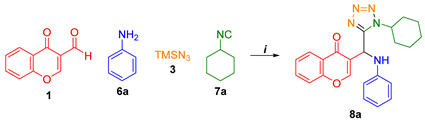
Initially, the synthesis of 1,5-DS-1H-T (8a) via a UA-4CR, which involves 3-formylchromone (1), aniline (6a), trimethylsilylazide (3), and cyclohexyl isocyanide (7a) under conventional conditions in EtOH at room temperature (Table 1, Entry 1), yielded 8a at 56%. Recently, we introduced the green USI-assisted UA-4CR under solvent-free conditions [9]; however, the model proposed herein yielded unsatisfactory performance. When the reaction was performed using EtOH, a moderate yield was obtained (Table 1, entries 2–3).
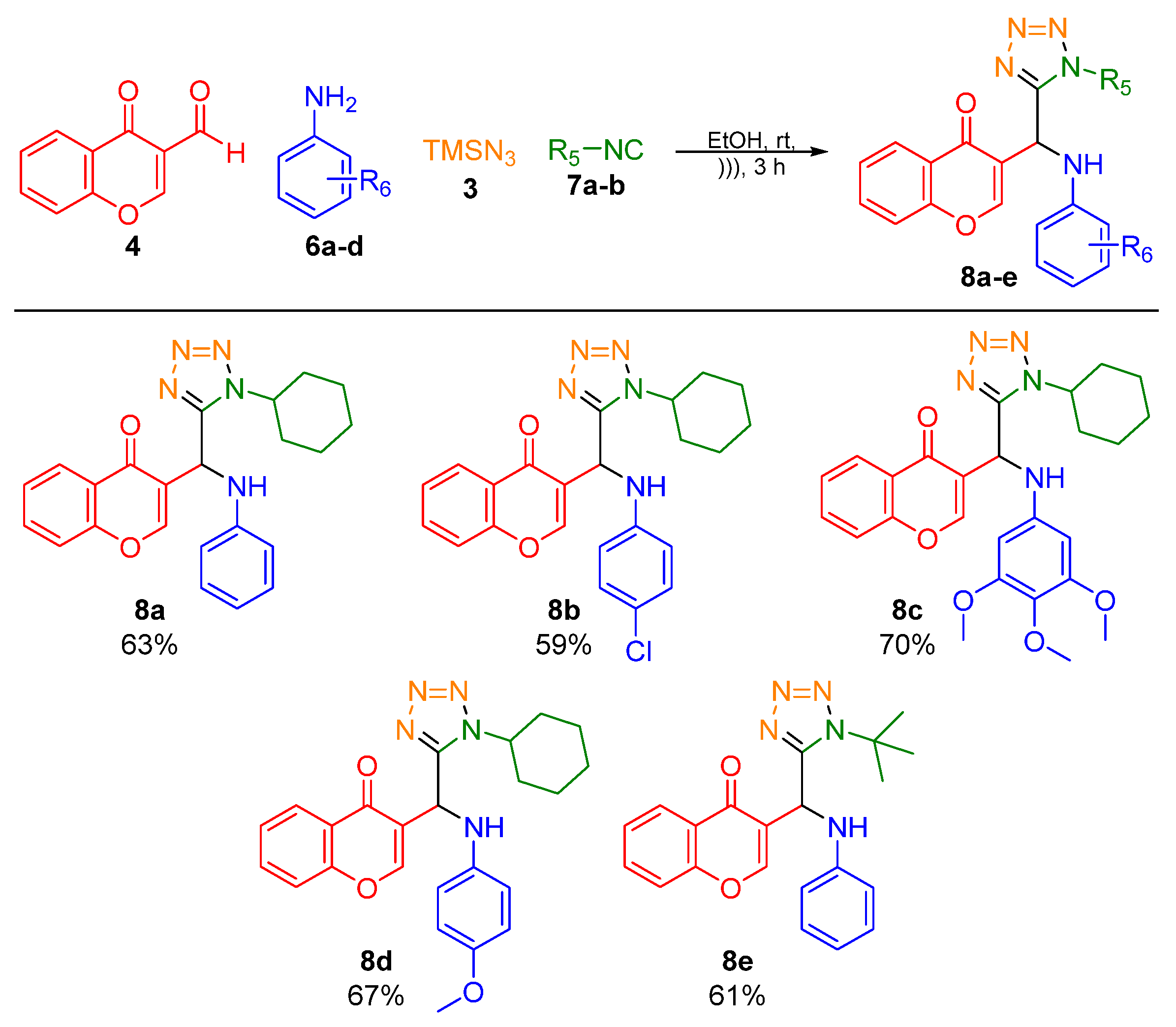
Using the optimized conditions, a series of 3-tetrazolylmethyl-4H-chromen-4-ones (8ae) was depicted (Scheme 2). The effect of the electronic nature of the amine component was evaluated; the methodology does not work for aliphatic amines. The final products were obtained with moderate yields (59–70%).

3. Experimental Methods

3.1. General Experimental Information

NMR spectra (1H and 13C) were obtained on a Bruker Ascend 400 MHz, with deuterated chloroform (CDCl3). Chemical shifts (δ) are indicated in ppm, with tetramethylsilane (TMS) as reference. Coupling constants (J) are provided in Hertz (Hz) and signal multiplicities are described with standard abbreviations: singlet (s), doublet (d), triplet (t), quartet (q), and multiplet (m). MestReNova software (version 14.2.0-26256) was used for spectral analysis. TLC on silica gel F254 aluminum sheets was used for monitoring the reaction, which was visualized under UV at 254 nm. The purification was performed by column chromatography using silica gel (230–400 mesh). Elution was performed with hexane and ethyl acetate, which were also used in TLC and retention factor (Rf) calculations. All reagents from Sigma-Aldrich were used without purification.

3.2. Procedure

In a sealed vial, 3-formylchromone (1, 1.0 equiv.), amine (2ad, 1.0 equiv.), trimethylsilylazide (3, 1.0 equiv.), and isocyanide (7ab, 1.0 equiv.) were dissolved in EtOH (1.0 M), then the reaction mixture was sonicated at room temperature, affording the corresponding 1,5-Ds-Ts (8ae).

3.3. Spectral Data

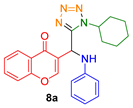
  • 3-((1-cyclohexyl-1H-tetrazol-5-yl)(phenylamino)methyl)-4H-chromen-4-one (8a)
Chemproc 18 00023 i002
White solid, Rf = 0.37 (30% ethyl acetate in hexanes), 1H (400 MHz, CDCl3, 25 °C, TMS) δ 8.31 (s, 1H), 8.18 (dd, J = 8.0, 1.4 Hz, 1H), 7.68 (ddd, J = 8.5, 7.1, 1.7 Hz, 1H), 7.47–7.41 (m, 2H), 7.21–7.14 (m, 2H), 6.82–6.75 (m, 1H), 6.72–6.67 (m, 2H), 6.17 (d, J = 7.1 Hz, 1H), 4.97 (d, J = 7.1 Hz, 1H), 4.74–4.65 (m, 1H), 2.08–1.87 (m, 8H), 1.50–1.37 (m, 2H); 13C NMR (100 MHz, CDCl3) δ 176.6, 156.5, 155.3, 154.1, 145.1, 134.1, 129.5, 125.5, 123.4, 121.3, 119.3, 118.3, 113.7, 58.3, 44.5, 33.2, 32.6, 29.6, 25.1, 24.8.
 
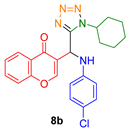
  • 3-(((4-chlorophenyl)amino)(1-cyclohexyl-1H-tetrazol-5-yl)methyl)-4H-chromen-4-one (8b)
Chemproc 18 00023 i003
Yellow solid, Rf = 0.37 (30% ethyl acetate in hexanes), 1H (400 MHz, CDCl3, 25 °C, TMS) δ 8.27 (d, J = 0.7 Hz, 1H), 8.19 (ddd, J = 8.0, 1.9, 0.5 Hz, 1H), 7.70 (ddd, J = 8.7, 7.1, 1.7 Hz, 1H), 7.48–7.41 (m, 2H), 7.15–7.09 (m, 2H), 6.66–6.61 (m, 2H), 6.15 (d, J = 7.7 Hz, 1H), 5.15 (d, J = 7.8 Hz), 4.73–4.61 (m, 1H), 2.02–1.78 (m, 8H), 1.53–1.38 (m, 2H); 13C NMR (100 MHz, CDCl3) δ 176.6, 156.4, 155.6, 154.0, 143.5, 134.3, 129.5, 125.8, 125.6, 124.2, 123.4, 121.1, 118.4, 114.9, 58.4, 44.5, 33.3, 32.8, 25.2, 24.8.
 
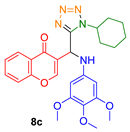
  • 3-((1-cyclohexyl-1H-tetrazol-5-yl)((3,4,5-trimethoxyphenyl)amino)methyl)-4H-chromen-4-one (8c)
Chemproc 18 00023 i004
Yellow solid, Rf = 0.14 (30% ethyl acetate in hexanes), 1H (400 MHz, CDCl3, 25 °C, TMS) δ 8.21 (s, 1H), 8.04 (d, J = 7.9 Hz, 1H), 7.59–7.54 (m, 1H), 7.35–7.28 (m, 2H), 6.06 (d, J = 7.9 Hz), 5.86 (s, 2H), 5.01 (d, J = 8.1 Hz, 1H), 4.53–4.45 (m, 1H), 3.61 (s, 6H), 3.59 (s, 3H), 1.87–1.72 (m, 8H), 1.35–1.23 (m, 2H); 13C NMR (100 MHz, CDCl3) δ 175.2, 155.0, 1545, 153.0, 152.7, 140.3, 133.0, 129.9, 124.5, 124.2, 122.0, 120.5, 117.1, 90.4, 63.0, 59.7, 57.0, 54.7, 43.1, 31.8, 31.5, 24.0, 23.8, 23.5.
 
  • 3-((1-cyclohexyl-1H-tetrazol-5-yl)((4-methoxyphenyl)amino)methyl)-4H-chromen-4-one (8d)
Chemproc 18 00023 i005
Yellow oil, Rf = 0.25 (30% ethyl acetate in hexanes), 1H (400 MHz, CDCl3, 25 °C, TMS) δ 8.29 (s, 1H), 8.18 (dd, J = 8.1, 1.7 Hz, 1H), 7.69 (ddd, J = 8.6, 7.1, 1.7 Hz, 1H), 7.47 (dd, J = 8.6, 1.2, 1H), 7.42 (ddd, J = 8.6, 7.2, 1.7, 1H), 6.77 (d, J = 8.9 Hz, 2H), 6.66 (d, J = 8.9 Hz, 2H), 6.06 (s, 1H), 4.69–4.59 (m, 1H), 4.47 (s, 1H), 3.72 (s, 3H), 2.11–1.79 (m, 7H), 1.51–1.38 (m, 3H); 13C NMR (100 MHz, CDCl3) δ 176.9, 155.5, 153.8, 139.0, 134.4, 125.8, 125.8, 123.6, 122.7, 121.8, 118.5, 118.4, 116.1, 115.3, 58.5, 55.8, 46.1, 33.4, 32.9, 25.5, 25.0.
 
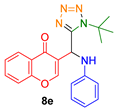
  • 3-((1-(tert-butyl)-1H-tetrazol-5-yl)(phenylamino)methyl)-4H-chromen-4-one (8e)
Chemproc 18 00023 i006
White solid; Rf = 0.32 (30% ethyl acetate in hexanes)), 1H (400 MHz, CDCl3, 25 °C, TMS) δ 8.31 (s, 1H, CH), 8.16 (d, J = 8.0 Hz, 1H), 7.70–7.66 (m, 1H), 7.47 (d, J = 8.4 Hz, 1H), 7.43–7.39 (m, 1H), 7.19–7.15 (m, 2H), 6.80–6.75 (m, 1H), 6.68 (d, J = 7.9 Hz, 2H), 6.46 (d, J = 7.6 Hz, 1H), 4.79–4.76 (m, 1H), 1.85 (s, 9H); 13C NMR (100 MHz, CDCl3) δ 176.9, 156.5, 155.6, 134.1, 129.6, 125.6, 125.5, 123.5, 118.4, 113.3, 62.3, 45.2, 30.0.

4. Conclusions

The main contribution of the present work is to the multicomponent one-pot synthesis and pharmaceutical fields.
The use of heterocyclic input in UA-4CR increased the complexity of 1,5-disubstituted tetrazoles, thereby enhancing their potential applications.
This protocol offers several advantages, including one-pot synthesis, good overall yields, an alternative green energy source, short reaction times, an eco-friendly solvent, operational simplicity, and the avoidance of toxic catalysts.

Author Contributions

Conceptualization, R.G.-M.; methodology, D.G.-G., K.A.G.-P. and I.A.G.-G.; software, D.G.-G.; validation, R.G.-M.; formal analysis, R.G.-M.; investigation, D.G.-G.; resources, R.G.-M.; data curation, D.G.-G.; writing—original draft preparation, D.G.-G.; writing—review and editing, D.G.-G. and R.G.-M.; visualization, R.G.-M.; supervision, R.G.-M.; project administration, R.G.-M.; funding acquisition, R.G.-M. All authors have read and agreed to the published version of the manuscript.

Funding

D.G.-G. (4039492/1233507) and K.A.G.-P. (4067210/2119263) thanks SECIHTI-México for the scholarship. R.G.-M. thanks DAIP-UG, for financial support through UG-CIIC 066/2024 project.

Institutional Review Board Statement

Not applicable.

Informed Consent Statement

Not applicable.

Data Availability Statement

No new data were created or analyzed in this study. Data sharing is not applicable to this article.

Conflicts of Interest

The authors declare that there is no conflict of interest.

References

  1. Buntrock, R.E. Review of Heterocyclic Chemistry, 5th Edition. J. Chem. Educ. 2012, 89, 1349–1350. [Google Scholar] [CrossRef]
  2. Marshall, C.M.; Federice, J.G.; Bell, C.N.; Cox, P.B.; Njardarson, J.T. An Update on the Nitrogen Heterocycle Compositions and Properties of U.S. FDA-Approved Pharmaceuticals (2013–2023). J. Med. Chem. 2024, 67, 11622–11655. [Google Scholar] [CrossRef] [PubMed]
  3. Al-Jumaili, M.H.A.; Hamad, A.A.; Hashem, H.E.; Hussein, A.D.; Muhaidi, M.J.; Ahmed, M.A.; Albanaa, A.H.A.; Siddique, F.; Bakr, E.A. Comprehensive Review on the Bis–Heterocyclic Compounds and Their Anticancer Efficacy. J. Mol. Struct. 2023, 1271, 133970. [Google Scholar] [CrossRef]
  4. Zhu, J.; Bienaymé, H. (Eds.) Front Matter. In Multicomponent Reactions; Wiley: Hoboken, NJ, USA, 2005. [Google Scholar] [CrossRef]
  5. Zhu, J. Multicomponent Reactions in Organic Synthesis; John Wiley & Sons: Hoboken, NJ, USA, 2015. [Google Scholar]
  6. Hayashi, Y. Pot Economy and One-Pot Synthesis. Chem. Sci. 2016, 7, 866–880. [Google Scholar] [CrossRef] [PubMed]
  7. Neochoritis, C.G.; Zhao, T.; Dömling, A. Tetrazoles via Multicomponent Reactions. Chem. Rev. 2019, 119, 1970–2042. [Google Scholar] [CrossRef] [PubMed]
  8. Niu, J.; Wang, Y.; Yan, S.; Zhang, Y.; Ma, X.; Zhang, Q.; Zhang, W. One-Pot Ugi-Azide and Heck Reactions for the Synthesis of Heterocyclic Systems Containing Tetrazole and 1,2,3,4-Tetrahydroisoquinoline. Beilstein J. Org. Chem. 2024, 20, 912–920. [Google Scholar] [CrossRef] [PubMed]
  9. Pharande, S.G.; Corrales Escobosa, A.R.; Gámez-Montaño, R. Endogenous Water-Triggered and Ultrasound Accelerated Synthesis of 1,5-Disubstituted Tetrazoles via a Solvent and Catalyst-Free Ugi-Azide Reaction. Green Chem. 2017, 19, 1259–1262. [Google Scholar] [CrossRef]
  10. Pharande, S.G.; Rentería-Gómez, M.A.; Gámez-Montaño, R. Isocyanide Based Multicomponent Click Reactions: A Green and Improved Synthesis of 1-Substituted 1 H-1,2,3,4-Tetrazoles. New J. Chem. 2018, 42, 11294–11298. [Google Scholar] [CrossRef]
  11. Swami, S.; Shrivastava, R.; Sharma, N.; Agarwala, A.; Verma, V.P.; Singh, A.P. An Ultrasound-Assisted Solvent and Catalyst-Free Synthesis of Structurally Diverse Pyrazole Centered 1,5-Disubstituted Tetrazoles via One-Pot Four-Component Reaction. Lett. Org. Chem. 2022, 19, 795–802. [Google Scholar] [CrossRef]
  12. Unnamatla, M.V.B.; Islas-Jácome, A.; Quezada-Soto, A.; Ramírez-López, S.C.; Flores-Álamo, M.; Gámez-Montaño, R. Multicomponent One-Pot Synthesis of 3-Tetrazolyl and 3-Imidazo[1,2-a]Pyridin Tetrazolo[1,5-a]Quinolines. J. Org. Chem. 2016, 81, 10576–10583. [Google Scholar] [CrossRef] [PubMed]
  13. Rentería-Gómez, A.; Islas-Jácome, A.; Cruz-Jiménez, A.E.; Manzano-Velázquez, J.C.; Rojas-Lima, S.; Jiménez-Halla, J.O.C.; Gámez-Montaño, R. Synthesis of 2-Tetrazolylmethyl-Isoindolin-1-Ones via a One-Pot Ugi-Azide/(N-Acylation/Exo-Diels–Alder)/Dehydration Process. ACS Omega 2016, 1, 943–951. [Google Scholar] [CrossRef] [PubMed]
  14. Vicente–García, E.; Kielland, N.; Lavilla, R. Functionalization of Heterocycles by MCRs. In Multicomponent Reactions in Organic Synthesis; Zhu, J., Wang, Q., Wang, M., Eds.; Wiley: Hoboken, NJ, USA, 2014; pp. 159–182. [Google Scholar] [CrossRef]
  15. Cano, P.A.; Islas-Jácome, A.; González-Marrero, J.; Yépez-Mulia, L.; Calzada, F.; Gámez-Montaño, R. Synthesis of 3-Tetrazolylmethyl-4H-Chromen-4-Ones via Ugi-Azide and Biological Evaluation against Entamoeba Histolytica, Giardia Lamblia and Trichomona Vaginalis. Bioorg. Med. Chem. 2014, 22, 1370–1376. [Google Scholar] [CrossRef] [PubMed]
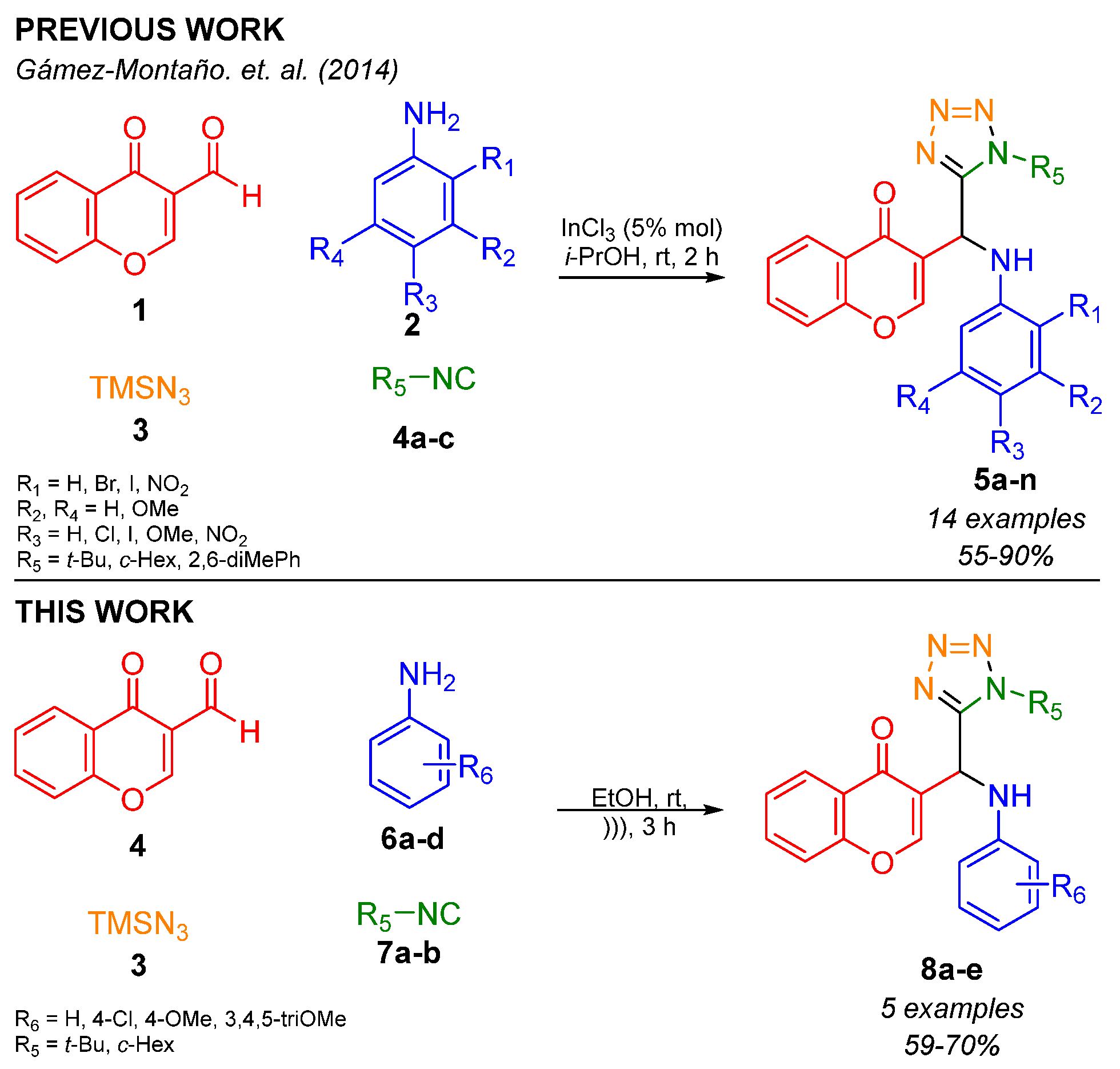
Scheme 1. Previous report of the synthesis of 3-tetrazolylmethyl-4H-chromen-4-ones [15].
Chemproc 18 00023 sch001
Scheme 2. Synthesis of 3-tetrazolylmethyl-4H-chromen-4-one’s scope.
Chemproc 18 00023 sch002
Table 1. Screening conditions for the synthesis of molecule 8a.
Chemproc 18 00023 i001
EntrySolventTemperatureTimeYield (%)
1EtOH ar.t.12 h56
2--- br.t.3 hTraces
3EtOH br.t.3 h63
a stirring, b sonication.
Disclaimer/Publisher’s Note: The statements, opinions and data contained in all publications are solely those of the individual author(s) and contributor(s) and not of MDPI and/or the editor(s). MDPI and/or the editor(s) disclaim responsibility for any injury to people or property resulting from any ideas, methods, instructions or products referred to in the content.