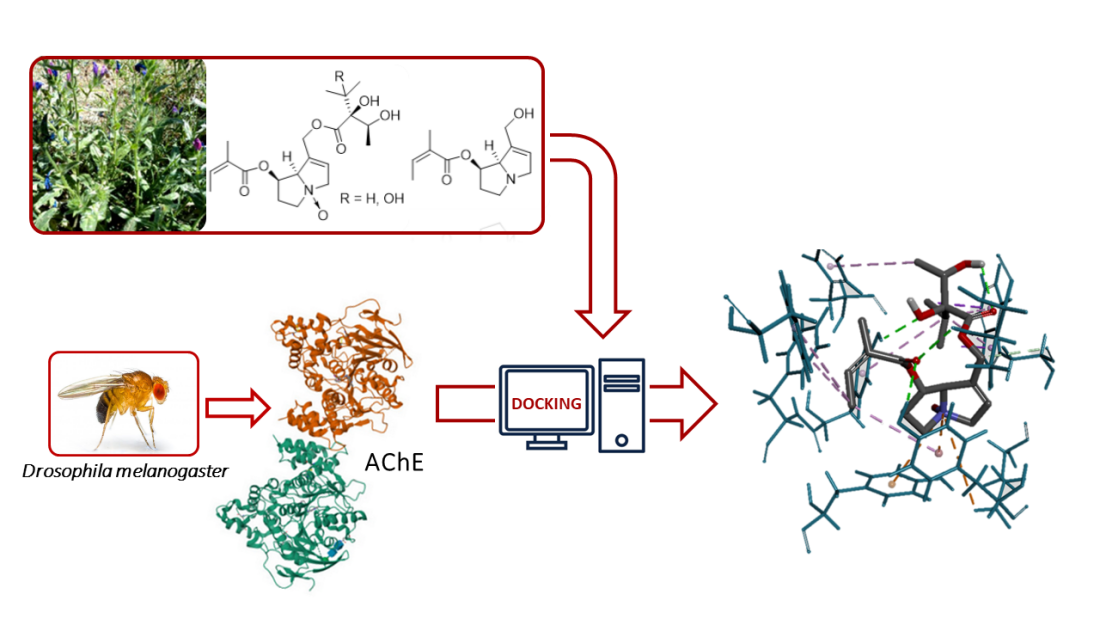

Acetylcholinesterase as a Target for Heliotridine-Type Alkaloids Isolated from Plants: A Computational Study †


Abstract
1. Introduction
2. Materials and Methods
3. Results and Discussion
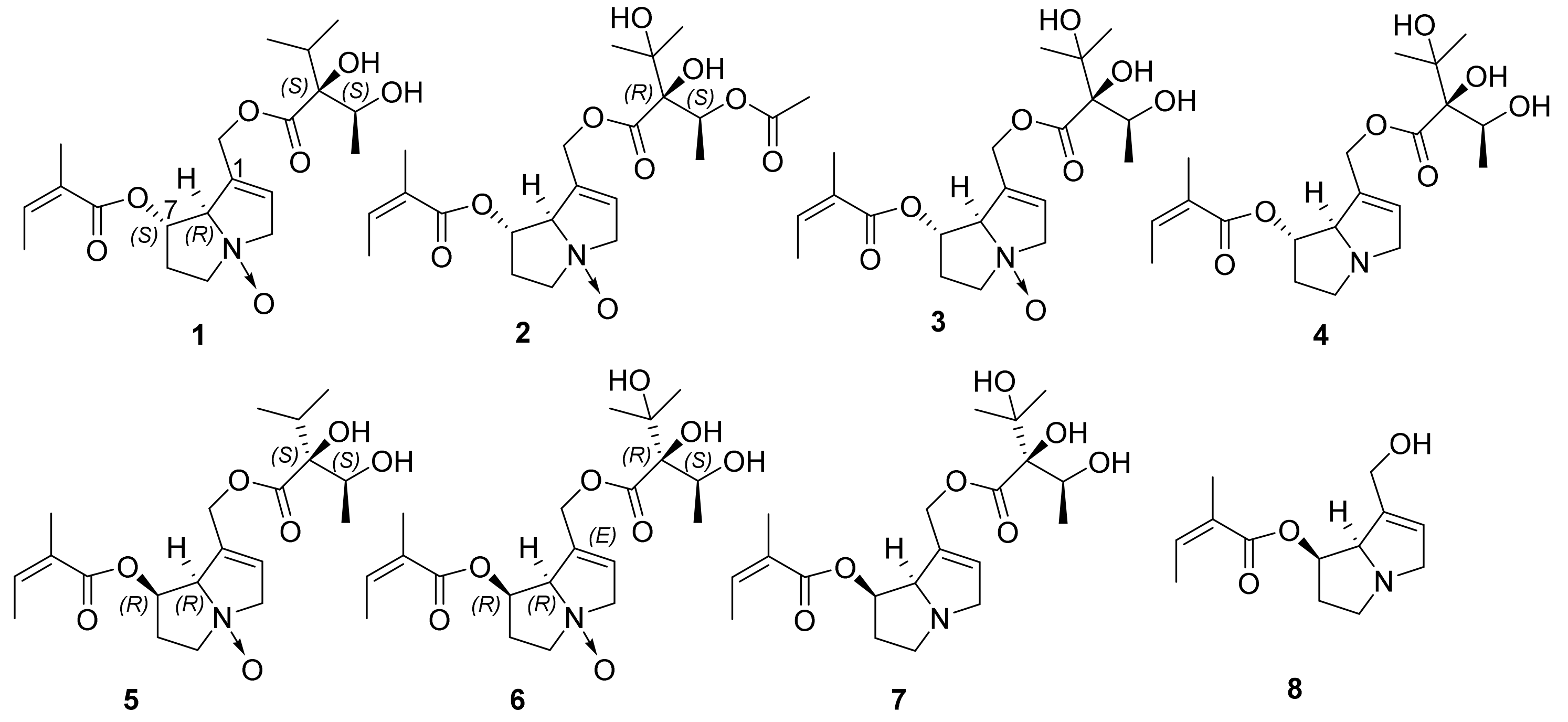
3.1. Molecular Docking of Natural Alkaloids 1–8 as AChE Inhibitors and Correlation with Known Experimental Data
3.2. Molecular Docking of Natural Alkaloids 1–8 as Insect AChE Inhibitors
3.3. Structural Comparison of Torpedo californica AChE and Drosophila melanogaster AChE
3.4. ADME/Toxicity Prediction of the Compounds 1–8
4. Conclusions
Supplementary Materials
Author Contributions
Funding
Institutional Review Board Statement
Informed Consent Statement
Data Availability Statement
Acknowledgments
Conflicts of Interest
References
- Peitzika, S.C.; Pontiki, E. A Review on Recent Approaches on Molecular Docking Studies of Novel Compounds Targeting Acetylcholinesterase in Alzheimer Disease. Molecules 2023, 28, 1084. [Google Scholar] [CrossRef] [Scilit] [PubMed]
- Casida, J.E.; Durkin, K.A. Anticholinesterase insecticide retrospective. Chem. Biol. Interact. 2013, 203, 221–225. [Google Scholar] [CrossRef] [Scilit] [PubMed]
- Pang, Y.-P.; Brimijoin, S.; Ragsdale, D.W.; Zhu, K.Y.; Suranyi, R. Novel and Viable Acetylcholinesterase Target Site for Developing Effective and Environmentally Safe Insecticides. Curr. Drug Targets 2012, 13, 471–482. [Google Scholar] [CrossRef] [Scilit] [PubMed]
- Hazuki, I.N.; Shukor, M.Y. Acetylcholinesterase as an In Vitro Assay for Insecticides: A Mini Review. JEMAT 2018, 6, 7–12. [Google Scholar] [CrossRef] [Scilit]
- Pavela, R. History, Presence and Perspective of Using Plant Extracts as Commercial Botanical Insecticides and Farm Products for Protection against Insects—A Review. Plant Protect. Sci. 2016, 52, 229–241. [Google Scholar] [CrossRef] [Scilit]
- Benamar, H.; Tomassini, L.; Venditti, A.; Marouf, A.; Bennaceur, M.; Nicoletti, M. Pyrrolizidine alkaloids from Solenanthus lanatus DC. with acetylcholinesterase inhibitory activity. Nat. Prod. Res. 2016, 30, 2567–2574. [Google Scholar] [CrossRef] [Scilit] [PubMed]
- Benamar, H.; Tomassini, L.; Venditti, A.; Marouf, A.; Bennaceur, M.; Serafini, M.; Nicoletti, M. Acetylcholinesterase inhibitory activity of pyrrolizidine alkaloids from Echium confusum Coincy. Nat. Prod. Res. 2016, 31, 1277–1285. [Google Scholar] [CrossRef] [Scilit] [PubMed]
- Sanner, M.F. Python: A programming language for software integration and development. J. Mol. Graph. Mod. 1999, 17, 57.e61. [Google Scholar]
- Galdeano, C.; Coquelle, N.; Cieslikiewicz-Bouet, M.; Bartolini, M.; Perez, B.; Clos, M.V.; Silman, I.; Jean, L.; Colletier, J.P.; Renard, P.Y.; et al. Increasing Polarity in Tacrine and Huprine Derivatives: Potent Anticholinesterase Agents for the Treatment of Myasthenia gravis. Molecules 2018, 23, 634. [Google Scholar] [CrossRef] [Scilit] [PubMed]
- Nachon, F.; Rosenberry, T.L.; Silman, I.; Sussman, J.L. A Second Look at the Crystal Structures of Drosophila melanogaster Acetylcholinesterase in Complex with Tacrine Derivatives Provides Insights Concerning Catalytic Intermediates and the Design of Specific Insecticides. Molecules 2020, 25, 1198. [Google Scholar] [CrossRef] [Scilit] [PubMed]
- Trott, O.; Olson, A.J. AutoDock Vina: Improving the speed and accuracy of docking with a new scoring function, efficient optimization, and multithreading, J. Comp. Chem. 2010, 31, 455–461. [Google Scholar] [CrossRef] [Scilit] [PubMed]
- Korb, O.; Stützle, T.; Exner, T.E. PLANTS: Application of Ant Colony Optimization to Structure-Based Drug Design. In Lecture Notes in Computer Science; Springer: Berlin, Germany, 2006; Volume 4150, pp. 247–258. [Google Scholar]
- Korb, O.; Stützle, T.; Exner, T.E. Empirical Scoring Functions for Advanced Protein-Ligand Docking with PLANTS. J. Chem. Inf. Model. 2009, 49, 84–96. [Google Scholar] [CrossRef] [Scilit] [PubMed]
- BIOVIA; Dassault Systèmes. Discovery Studio Visualizer, v21.1.0.20298; Dassault Systèmes: San Diego, CA, USA, 2021; Available online: https://discover.3ds.com/discovery-studio-visualizer-download (accessed on 20 December 2023).
- Yang, H.; Lou, C.; Sun, L.; Li, J.; Cai, Y.; Wang, Z.; Li, W.; Liu, G.; Tang, Y. admetSAR 2.0: Web-service for prediction and optimization of chemical ADMET properties. Bioinformatics 2018, 35, bty707. [Google Scholar] [CrossRef] [Scilit] [PubMed]
- Cheng, F.; Li, W.; Zhou, Y.; Shen, J.; Wu, Z.; Liu, G.; Lee, P.W.; Tang, Y. admetSAR: A compre-hensive source and free tool for evaluating chemical ADMET properties. J. Chem. Inf. Model. 2012, 52, 3099–3105. [Google Scholar] [CrossRef] [Scilit] [PubMed]
- AdmetSAR. Available online: http://lmmd.ecust.edu.cn/admetsar2/ (accessed on 8 January 2024).
- Botić, T.; Defant, A.; Zanini, P.; Žužek, M.C.; Frangež, R.; Janussen, D.; Kersken, D.; Knez, Ž.; Sepčić, K.; Mancini, I. Discorhabdin alkaloids from Antarctic Latrunculia spp. sponges as a new class of cholinesterase inhibitors. Eur. J. Med. Chem. 2017, 136, 294–304. [Google Scholar] [CrossRef] [Scilit] [PubMed]
- Yan, X.; Kang, H.; Feng, J.; Yang, Y.; Tang, K.; Zhu, R.; Yang, L.; Wang, Z.; Cao, Z. Identification of Toxic Pyrrolizidine Alkaloids and Their Common Hepatotoxicity Mechanism. Int. J. Mol. Sci. 2016, 17, 318. [Google Scholar] [CrossRef] [Scilit] [PubMed]
- Wei, X.; Ruan, W.; Vrieling, K. Current Knowledge and Perspectives of Pyrrolizidine Alkaloids in Pharmacological Applications: A Mini-Review. Molecules 2021, 26, 1970. [Google Scholar] [CrossRef] [Scilit] [PubMed]
- Gonzalez-Coloma, A.; Reina, M.; Gutierrez, C.; Fraga, B.M. Natural insecticides: Structure diversity, effects and structure-activity relationships. a case study. Atta-ur-Rahman (Ed.) Stud. Nat. Prod. Chem. 2002, 26, 849–879. [Google Scholar] [CrossRef] [Scilit]
- Pang, Y.P. Insect Acetylcholinesterase as a Target for Effective and Environmentally Safe Insecticides. In Advances in Insect Physiology; Elsevier Ltd.: Amsterdam, The Netherlands, 2014; Volume 46, pp. 435–494. ISSN 0065-2806. [Google Scholar] [CrossRef] [Scilit]
- Wiesner, J.; Kříž, Z.; Kuča, K.; Jun, D.; Koča, J. Acetylcholinesterases—The structural similarities and differences. J. Enzyme Inhib. Med. Chem. 2007, 22, 417–424. [Google Scholar] [CrossRef] [Scilit] [PubMed]


| Compound | Torpedo californica AChE | Drosophila melanogaster AChE | ||
|---|---|---|---|---|
| Energy by Vina (kcal/mol) | PLANTS Score | Energy by Vina (kcal/mol) | PLANTS Score | |
| 1 | −9.010 | −102.2 | −8.686 | −96.67 |
| 2 | −8.608 | −103.73 | −8.202 | −102.09 |
| 3 | −7.795 | −108.72 | −7.464 | −90.59 |
| 4 | −9.120 | −103.37 | −8.103 | −98.54 |
| 5 | −8.047 | −102.75 | −7.815 | −99.22 |
| 6 | −7.795 | −92.48 | −6.416 | −94.69 |
| 7 | −8.228 | −112.25 | −7.629 | −104.91 |
| 8 | −7.463 | −94.34 | −7.712 | −87.92 |
| Original ligand | −11.333 a | −105.30 a | −13.201 b | −114.31 b |
Disclaimer/Publisher’s Note: The statements, opinions and data contained in all publications are solely those of the individual author(s) and contributor(s) and not of MDPI and/or the editor(s). MDPI and/or the editor(s) disclaim responsibility for any injury to people or property resulting from any ideas, methods, instructions or products referred to in the content. |
© 2024 by the authors. Licensee MDPI, Basel, Switzerland. This article is an open access article distributed under the terms and conditions of the Creative Commons Attribution (CC BY) license (https://creativecommons.org/licenses/by/4.0/).
Share and Cite
Defant, A.; Cheriet, T.; Mancini, I. Acetylcholinesterase as a Target for Heliotridine-Type Alkaloids Isolated from Plants: A Computational Study. Chem. Proc. 2024, 16, 102. https://doi.org/10.3390/ecsoc-28-20223
Defant A, Cheriet T, Mancini I. Acetylcholinesterase as a Target for Heliotridine-Type Alkaloids Isolated from Plants: A Computational Study. Chemistry Proceedings. 2024; 16(1):102. https://doi.org/10.3390/ecsoc-28-20223
Chicago/Turabian StyleDefant, Andrea, Thamere Cheriet, and Ines Mancini. 2024. "Acetylcholinesterase as a Target for Heliotridine-Type Alkaloids Isolated from Plants: A Computational Study" Chemistry Proceedings 16, no. 1: 102. https://doi.org/10.3390/ecsoc-28-20223
APA StyleDefant, A., Cheriet, T., & Mancini, I. (2024). Acetylcholinesterase as a Target for Heliotridine-Type Alkaloids Isolated from Plants: A Computational Study. Chemistry Proceedings, 16(1), 102. https://doi.org/10.3390/ecsoc-28-20223