Article

Diabetes Complications in Primary Care: Epidemiological Patterns and Associated Factors

by
Angela Claudia Paixão Soares de Magalhães
1,*,
Thatiana Lameira Maciel Amaral
2,
Maurício Teixeira Leite de Vasconcellos
3 and
Gina Torres Rego Monteiro
4
1
Surgery Department in Medical Course, Center for Health and Sports Sciences, Federal University of Acre, Rio Branco 69915-900, AC, Brazil
2
Postgraduate Program in Public Health, Center for Health and Sports Sciences, Federal University of Acre, Rio Branco 69915-900, AC, Brazil
3
National School of Statistical Sciences, Brazilian Institute of Geography and Statistics, Rio de Janeiro 20231-050, RJ, Brazil
4
Sergio Arouca National School of Public Health, Oswaldo Cruz Institute, Rio de Janeiro 21041-210, RJ, Brazil
*
Author to whom correspondence should be addressed.
Diabetology 2026, 7(6), 107; https://doi.org/10.3390/diabetology7060107

Submission received: 1 May 2026 / Revised: 23 May 2026 / Accepted: 26 May 2026 / Published: 2 June 2026

Abstract

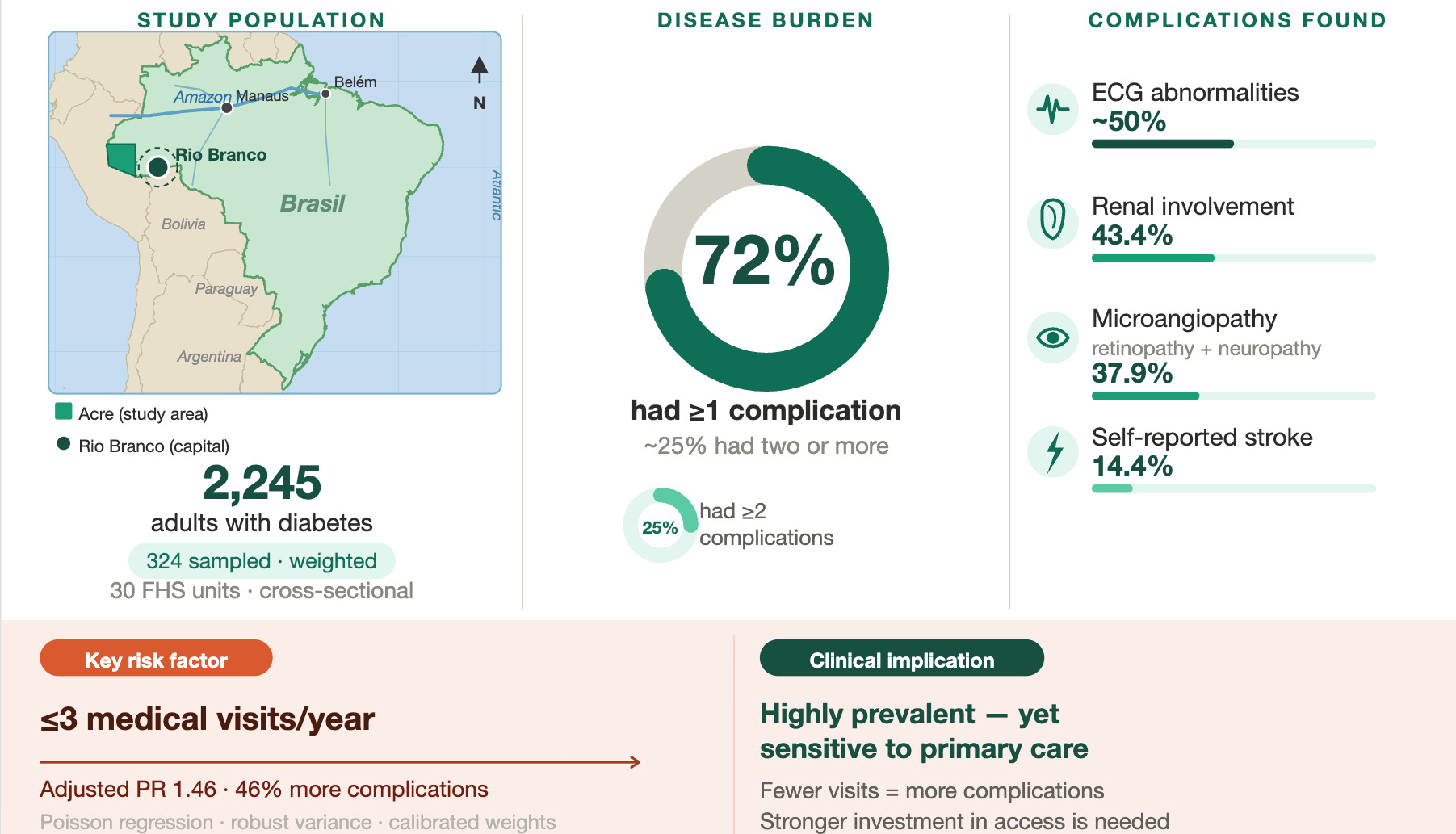
Diabetes mellitus (DM) is increasing worldwide and places a substantial burden on health systems through its complications. Background/Objectives: To identify factors associated with DM-related complications in adults receiving primary care in Rio Branco, Acre, western Brazilian Amazon. Methods: Population-based cross-sectional study in 30 Family Health Strategy (FHS) units; 324 participants, weighted to represent 2245 adults with DM. Four binary outcomes were analyzed: self-reported stroke, electrocardiographic (ECG) abnormalities, microangiopathy, and any complication. Associations were estimated through using Poisson regression with robust variance. Results: About 72% of participants had at least one complication. Any complication was independently associated with male sex (PR = 1.23), age ≥ 60 years (PR = 1.25), hypertension (PR = 1.34), illiteracy (PR = 1.18), and ≤3 medical appointments in the previous 12 months (PR = 1.46). Distinct factors emerged for each individual outcome. Conclusions: DM complications were highly prevalent and associated with multifactorial determinants, supporting risk stratification, early detection, and targeted interventions in primary care.

Graphical Abstract

1. Introduction

Diabetes mellitus (DM) is one of the most prevalent chronic noncommunicable diseases worldwide, affecting approximately 11% of the global population and accounting for 12% of deaths among people younger than 60 years in 2020 [1,2]. In Brazil, DM affects 9.2% of adults [3], with higher prevalence among women older than 30 years, individuals with low educational attainment, and those who are overweight or obese [4]. In Rio Branco, Acre, the self-reported prevalence of DM among adults aged 18–59 years is 5.6% [5].
Chronic hyperglycemia drives endothelial inflammation, arterial wall thickening, and progressive occlusion of medium-caliber (macroangiopathy) and small-caliber (microangiopathy) vessels, affecting the neurological, ophthalmic, renal, and cardiovascular systems [6]. Socioeconomic and cultural determinants, including access to health services, shape both the occurrence and severity of complications [7]. In Brazil, the Unified Health System (SUS) has delivered care to people with DM through the Family Health Strategy (FHS) for more than two decades and is the country’s main surveillance platform for chronic conditions [8]. Even so, glycemic control remains highly variable among FHS users, with uncontrolled blood glucose reported in up to 70% of patients [9].
Poor glycemic control underlies the major macrovascular and microvascular complications of DM, including ischemic brain disease, coronary heart disease, chronic kidney disease, retinopathy, neuroarthropathy, peripheral vascular disease, and diabetic foot syndrome (DFS)—the leading cause of nontraumatic amputations worldwide [10].
Multiple sociodemographic, behavioral, and clinical determinants contribute to the development of DM complications. Age, sex, race/ethnicity, and educational attainment modulate risk, often reflecting broader social and health inequities [11]. Behavioral factors such as smoking and alcohol consumption increase vascular risk, whereas clinical features including hypertension, insulin use, and longer DM duration have been consistently associated with higher complication rates. Psychosocial determinants—particularly anxiety, depression, and poor self-rated health—are also linked to worse outcomes. Delayed recognition of complications in populations with socioeconomic disadvantage or limited healthcare access contributes to higher mortality [12].
We aimed to identify factors associated with DM-related complications and to outline a risk profile that can inform screening strategies in primary care, particularly in regions historically underrepresented in the literature, such as the Brazilian Amazon.

2. Materials and Methods

2.1. Study Design and Settings

We conducted a population-based cross-sectional study of adults with DM registered in the Family Health Strategy (FHS) of Rio Branco, Acre, in the western Brazilian Amazon. Data came from the Study of Chronic Diseases from the Perspective of Quality in Health (Edoc-Quali), carried out between April and July 2019, which enrolled individuals with DM with or without systemic arterial hypertension (SAH). The manuscript follows the STROBE (Strengthening the Reporting of Observational Studies in Epidemiology) recommendations [13].

2.2. Participants

Adults (≥18 years) with a medical diagnosis of DM registered at the FHS were eligible. Exclusion criteria were pregnancy, type 1 DM, cognitive impairment that precluded the interview, and missing data for the primary outcome [14].

2.3. Sampling

Sampling followed a two-stage design. First, 30 FHS units were selected; second, participants with DM were drawn from their registration records. The sample size calculation assumed a DM prevalence of 10.0%, a minimum proportion of 7.0%, and an error of 3.5%, yielding a minimum of 308 adults with DM, with a further 20% added to cover losses and refusals. The final sample comprised 324 individuals, adjusted by calibrated population weights to represent 2245 adults with DM.

2.4. Data Collection and Measurements

Sociodemographic data and personal pathological history were collected through a structured questionnaire, which included the abbreviated version of the Instrument for the Assessment of Attitudes Toward Taking Medicines (IAAFTR), the reduced version of the Primary Care Assessment Tool (PCA-Tool), and Batalla’s test. Anthropometric data were measured twice, and the mean value was used; weight was measured with a G-Tech® Bal Gl 200 (Accumed, Rio de Janeiro, Brazil) digital scale (50 g resolution) on a flat surface and height with a Sanny® portable stadiometer (American Medical do Brasil LTDA, São Paulo, Brazil) (millimeter resolution).
A 12-lead electrocardiogram (ECG) was recorded with an Alfamed Compassus 3000 portable device (Alfamed, São Paulo, Brazil) in supine position after at least 10 min of rest; tracings were obtained at 25 mm/s and 10 mm = 1.0 mV calibration [15]. ECG reports were issued by a cardiologist. Atrial fibrillation or flutter, left chamber overload, conduction block, electrically inactive areas and Q- or T-wave abnormalities were considered DM-related when identified [16]. An independent panel of three additional cardiologists, not involved in data collection, validated the list of DM-related abnormalities.
Biological samples were used to measure glycated hemoglobin (HbA1c), creatinine, triglycerides, LDL cholesterol, and albuminuria. Blood was drawn after a 12 h fast and a midstream 50 mL urine sample was collected; all samples were processed in a single reference laboratory. Triglycerides < 150 mg/dL and LDL ≤ 100 mg/dL were classified as normal; HbA1c < 7.0% was considered adequate control; albuminuria < 30 mg/g was considered normal [17]. The glomerular filtration rate was estimated using the CKD-EPI equation [18].

2.5. Outcomes

Four binary outcomes were analyzed:
  • Presence of electrocardiographic (ECG) abnormalities;
  • Self-reported cerebrovascular accident (stroke);
  • Microangiopathy, defined as self-reported history of diabetic foot or retinopathy;
  • Any complication, defined as the presence of any cardiovascular, microangiopathic, and/or renal complication.
These outcomes differ in pathophysiology, severity, diagnostic certainty, and temporal course, and were therefore analyzed individually. The composite outcome “any complication” was defined a priori as a pragmatic indicator of the overall burden of clinically relevant complications managed in primary care, rather than as a single disease entity, and is interpreted accordingly in light of the heterogeneity of its components. Chronic nephropathy was not modeled as a separate outcome in the present study, as it was the focus of a dedicated analysis of this same cohort [19]; renal involvement was nonetheless incorporated into the composite “any complication” outcome.

2.6. Independent Variables

Sociodemographic characteristics: sex (male; female), age (18–59 years; ≥60 years), self-reported skin color (white; non-white), marital status (with partner; without partner), and educational attainment (illiterate; primary; secondary or higher).
Personal and pathological history: smoking (never; former; current), alcohol consumption (never; former; current), physical activity (yes; no), obesity (yes; no), depression (yes; no), insomnia (yes; no), anxiety (yes; no), stress (yes; no), self-rated health (positive; negative), number of comorbidities (≤3; >3), triglyceridemia (normal; abnormal), and LDL levels (normal; abnormal).
Evolution and control of the disease: Batalla test (adherence: 3 items answered correctly; non-adherence), IAAFTR (positive > 7 points; negative), medication obtained at the FHS (yes; no), polypharmacy (≥4 medications; <4), time since diagnosis (<10 years; ≥10 years), treatment duration (<10 years; ≥10 years), glycemic control (HbA1c < 7%), sugar consumption (yes; no), insulin treatment (yes; no).
Quality of care: home visit from the FHS (yes; no), medical consultation in the previous 3 months at the FHS (yes; no), number of medical consultations in the previous 12 months (≥4; ≤3), service evaluation (positive; negative), and overall quality assessment (positive; negative). The PCA-Tool score (affiliation, utilization, accessibility, longitudinal integration, care system, available services, provided services, family, and community orientation) was dichotomized as high (≥6.6) or low.

2.7. Statistical Analysis

Descriptive statistics based on absolute and relative frequencies were calculated, accounting for the complex sample design and calibrated weights, with population estimates (N). Inference was performed using the Wald statistic based on the sampling plan and the F distribution. A 95% confidence level was adopted.
Bivariate analyses were conducted using Poisson regression with robust variance, with prevalence ratios (PR) used to evaluate the associations between independent variables and the outcomes. Poisson regression with robust variance was chosen because the outcomes were common (prevalence ≥ 10%), in which case PRs provide more valid estimates than odds ratios derived from logistic regression. Variables with p < 0.20 in the bivariate analysis were included in a multivariable Poisson model with stepwise forward selection. The final model retained variables with p ≤ 0.05 and biological plausibility. All analyses were performed in RStudio for macOS (version 2025).

2.8. Ethics

The study followed Brazilian guidelines on research ethics (Resolution 466/2012 of the Brazilian National Health Council). All participants signed the informed consent form. The study was approved by the Research Ethics Committee of the Federal University of Acre (CAAE 84549317.0.0000.5009; approval number 2.753.401).

2.9. Use of Generative AI

Generative artificial intelligence (GenAI) was not used to generate text or data, nor to assist in study design, data collection, analysis, or interpretation. Editorial assistance was limited to superficial language editing (grammar, spelling, punctuation and formatting) and graphic’s layout, which according to the journal’s policy does not require disclosure.

3. Results

A total of 324 individuals were analyzed, weighted to represent 2245 adults with DM. Seventy-two percent of participants presented at least one complication: ECG abnormalities were identified in roughly half of participants, self-reported stroke in 14.4%, renal involvement in 40.4% (analyzed in detail as a separate outcome in a dedicated study of this cohort [19]), and microangiopathy in 37.0%. About 25% accumulated two or more complications.
Bivariate Poisson regression with robust variance (Table 1) identified outcome-specific patterns. For self-reported stroke (Table 1), the unadjusted prevalence ratio (PR) was higher in adults aged ≥ 60 years (PR = 1.10; 95% CI 1.03–1.18), in those with systemic arterial hypertension (SAH; PR = 1.14; 95% CI 1.08–1.21), in those with four or more comorbidities (PR = 1.15; 95% CI 1.08–1.23), and in those with previous hospitalization for DM (PR = 1.10; 95% CI 1.00–1.21). Greater alcohol intake on the ordinal scale was inversely associated with stroke (PR = 0.90; 95% CI 0.83–0.98). Stroke also increased linearly with the number of self-reported and total complications (PR per additional complication = 1.31; 95% CI 1.23–1.38, and PR = 1.14; 95% CI 1.09–1.19, respectively). Sex, educational attainment, smoking, BMI, dyslipidemia, and glycemic control were not associated with stroke in bivariate analysis.
Microangiopathy (Table 1) was associated with several mental health and treatment intensity markers: anxiety (PR = 1.54; 95% CI 1.13–2.12), stress (PR = 1.38; 95% CI 1.03–1.84), depression (PR = 1.46; 95% CI 1.09–1.95), negative self-rated health (PR = 1.53; 95% CI 1.14–2.05), smoking (PR = 1.53; 95% CI 1.10–2.14), the ordinal smoking score (PR = 1.19; 95% CI 1.01–1.40), and insulin use (PR = 1.56; 95% CI 1.08–2.26). Markers of disease severity were also prominent: hospitalization for DM (PR = 1.92; 95% CI 1.45–2.54), two or more hospitalizations (PR = 1.85; 95% CI 1.36–2.52), and hospitalization after FHS referral (PR = 2.39; 95% CI 1.74–3.28). Positive attitudes toward medication (IAAFTR) had a protective effect (PR = 0.67; 95% CI 0.46–0.97).
ECG abnormalities (Table 1) were more prevalent among adults aged ≥ 60 years and among men (PR = 1.41; 95% CI 1.10–1.80 for both), among those with SAH (PR = 1.51; 95% CI 1.08–2.10), macroalbuminuria (PR = 1.78; 95% CI 1.38–2.29), and ≤3 medical appointments in the preceding year (PR = 1.69; 95% CI 1.26–2.26). The number of concurrent complications carried the strongest association (PR = 2.45; 95% CI 2.11–2.84). Notably, anxiety (PR = 0.79; 95% CI 0.63–0.99) and stress (PR = 0.75; 95% CI 0.58–0.97) were inversely associated with ECG abnormalities, in the opposite direction of the association observed for microangiopathy.
For the composite outcome any complication (Table 1), age ≥ 60 years (PR = 1.35; 95% CI 1.15–1.59), male sex (PR = 1.22; 95% CI 1.06–1.40), lower educational attainment (PR = 1.19; 95% CI 1.08–1.32), the ordinal smoking score (PR = 1.09; 95% CI 1.00–1.18), SAH (PR = 1.38; 95% CI 1.10–1.73), macroalbuminuria (PR = 1.41; 95% CI 1.30–1.52), prior hospitalization for DM (PR = 1.19; 95% CI 1.03–1.38), and ≤3 medical appointments in the preceding year (PR = 1.40; 95% CI 1.30–1.51) were all positively associated. The count of self-reported and total complications again showed strong, graded associations (PR = 2.09; 95% CI 1.77–2.48, and PR = 1.86; 95% CI 1.67–2.07, respectively). Risk factors traditionally considered relevant—obesity, dyslipidemia, physical inactivity, sugar intake, and inadequate glycemic control—were not statistically significant in bivariate analysis for any of the four outcomes.
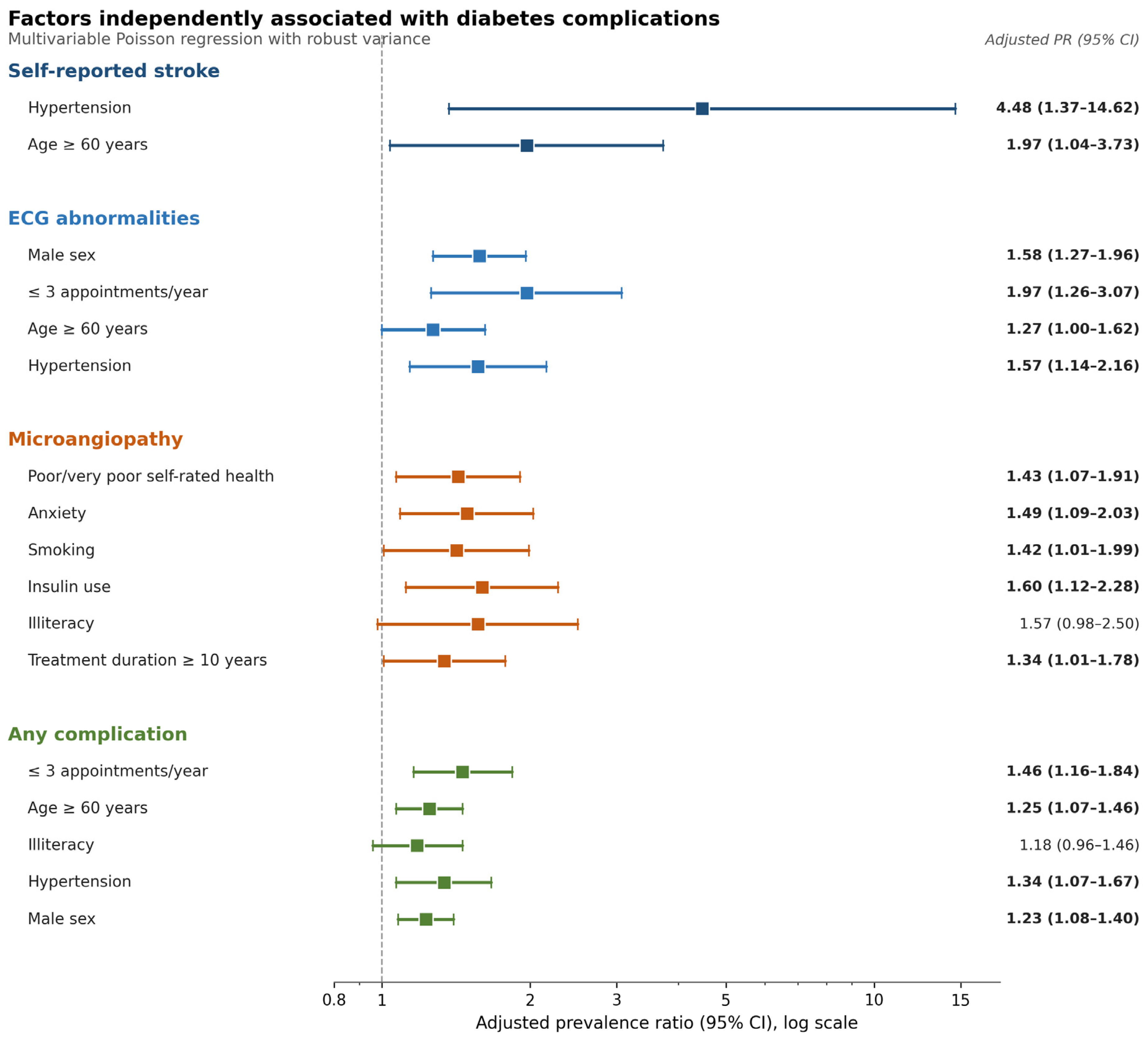
After adjustment in the multivariable Poisson model (Figure 1), self-reported stroke remained associated with SAH (adjusted PR = 4.48; 95% CI 1.37–14.62) and age ≥ 60 years (PR = 1.97; 95% CI 1.04–3.73). ECG abnormalities were associated with male sex (PR = 1.58; 95% CI 1.27–1.96), SAH (PR = 1.57; 95% CI 1.14–2.16), age ≥ 60 years (PR = 1.27; 95% CI 1.00–1.62), and ≤3 medical appointments in the preceding year (PR = 1.97; 95% CI 1.26–3.07). Microangiopathy was associated with poor/very poor self-rated health (PR = 1.43; 95% CI 1.07–1.91), anxiety (PR = 1.49; 95% CI 1.09–2.03), smoking (PR = 1.42; 95% CI 1.01–1.99), insulin use (PR = 1.60; 95% CI 1.12–2.28), illiteracy (PR = 1.57; 95% CI 0.98–2.50), and treatment duration ≥ 10 years (PR = 1.34; 95% CI 1.01–1.78). Any complication was associated with male sex (PR = 1.23; 95% CI 1.08–1.40), age ≥ 60 years (PR = 1.25; 95% CI 1.07–1.46), SAH (PR = 1.34; 95% CI 1.07–1.67), illiteracy (PR = 1.18; 95% CI 0.96–1.46), and ≤3 medical appointments in the preceding year (PR = 1.46; 95% CI 1.16–1.84).

4. Discussion

Most adults with DM followed at FHS units in this study had at least one cardiovascular or microangiopathic complication. The associated factors spanned sociodemographic, clinical, and psychosocial domains, including age ≥ 60 years, male sex, low educational attainment, SAH, number of medical appointments, smoking, longer DM duration, anxiety, insulin use and poor self-rated health.
The overall frequency of complications in our sample was high relative to a recent Brazilian population-based study that assessed any complication (cardiovascular, renal, retinopathy and DFS) among more than 6000 adults and reported a prevalence of 37.6% [20]. When considered separately, the frequency of self-reported stroke in our sample exceeded figures from other Brazilian primary care populations, which typically fall below 3% [21].
Microangiopathic manifestations such as retinopathy and DFS are typically associated and have reported prevalences of up to 50% [22,23], corroborating our findings. Regarding kidney damage, most Brazilian studies report a frequency below 10% [24,25]; however, direct evaluations using serum creatinine and estimated glomerular filtration rate reveal prevalences of 30–40% in Brazil [26,27] and in other countries such as China [28], consistent with our results.
Advancing age contributes to the risk of DM and its complications, partly through senescence of pancreatic β-cells. In our sample, older adults had a higher likelihood of any complication, self-reported stroke and ECG abnormalities. Most participants were ≥60 years old, physically inactive, had hypertriglyceridemia, and were obese—a profile strongly linked to DM and its complications [29].
Men tend to experience a higher frequency and severity of DM-related complications than women. In a Russian cohort of 389 patients with DM, 68.7% of those with carotid stenosis were men [30]; in a Ghanaian cohort of 7838 adults with DM followed for 8.6 years, roughly 5% of men and 3% of women developed DFS [31]. Ischemic stroke, retinopathy, and nephropathy are also more common in men [32,33]. In our study, ECG abnormalities were independently associated with male sex. Men often deprioritize preventive care because of work schedules and beliefs that health services are needed only in the presence of complications or emergencies [34,35]. Primary care teams should address these gaps with targeted health education and tailored engagement strategies.
Lower educational attainment is a well-documented determinant of DM, SAH, and their complications, both in Brazil [36] and globally [37]. Limited health literacy restricts understanding of medical guidance and its translation into daily self-care, reducing treatment effectiveness. These effects have been linked to poorer medication adherence and to higher rates of cardiac, renal and diabetic foot complications [38,39,40,41].
Coexisting DM and SAH amplifies the inflammatory substrate of atherosclerosis and increases both the frequency and severity of cardiovascular disease [42]. Individuals with both conditions have roughly twice the frequency of ischemic stroke compared with those with DM alone [43]. In a cohort of 8282 adults with DM, sustained exposure to elevated systolic blood pressure increased stroke risk [44]. Our findings—SAH associated with self-reported stroke, ECG abnormalities, and any complication—reinforce the harmful interaction of these two conditions and the need for routine monitoring.
Managing coexistent DM and SAH is particularly challenging when insulin therapy is required. Insulin use typically reflects advanced disease and β-cell failure together with prolonged cumulative exposure to hyperglycemia [45]. Accordingly, the association between insulin use and microangiopathy observed in our cross-sectional data most plausibly reflects greater disease severity and longer hyperglycemic exposure rather than a direct effect of insulin itself, a temporal distinction that our study design cannot establish. Consistent with this interpretation, patients on insulin showed a higher prevalence and greater severity of microvascular lesions in our sample, in line with previous reports [46]. Early, appropriate insulin therapy can protect the microcirculation [47], but resistance to starting insulin is common among clinicians [48]—who still often regard it as a last-resort treatment—and among patients, owing to stigma, injection-related discomfort and the additional cost of parenteral administration [49].
Functional limitations from DM complications and recurrent hospitalizations impair quality of life and daily functioning, increase healthcare utilization, and hinder lifestyle modification, worsening self-perceived health [50]. Beyond the perception of being ill, living with DM and its comorbidities generates fear and uncertainty; mood disorders such as depression and anxiety are frequent and undermine adherence to treatment and self-care, and people with anxiety are 47% more likely to develop DM than those without [51].
The association between anxiety and microangiopathy observed here is therefore plausible, although the cross-sectional design does not allow us to determine whether anxiety preceded the diagnosis of complications. Screening for anxiety in people with DM is a priority to deliver targeted mental health care and improve quality of life in this population [52].
An apparently paradoxical finding was that anxiety and stress were inversely associated with ECG abnormalities, opposite to their positive association with microangiopathy. Several non-exclusive explanations are plausible, none of which can be confirmed by a cross-sectional design. First, the temporal sequence cannot be established, and reverse causation or detection bias cannot be excluded: individuals with greater anxiety may attend the service and undergo clinical evaluation more frequently, favoring earlier identification and management of cardiovascular risk. Second, ECG abnormalities in this population were largely silent and not necessarily accompanied by perceived symptoms, so they may predominate in less symptomatic, less anxious patients. Third, given the number of associations tested across the four outcomes, a chance finding cannot be ruled out. We therefore regard the inverse association between anxiety/stress and ECG abnormalities as hypothesis-generating, requiring confirmation in longitudinal studies, and we refrain from any causal interpretation.
Regular follow-up is essential to reduce complication rates among people with—or at risk of—DM. Current guidelines recommend at least four medical appointments per year to allow monitoring and early diagnosis of complications. Achieving this target remains a major global challenge for health systems and a core responsibility of primary care. Lack of regular follow-up has been consistently linked to higher rates of microangiopathic complications [53].
Several traditionally recognized risk factors—obesity, dyslipidemia, physical inactivity, sugar intake, and inadequate glycemic control—were not statistically associated with any of the four outcomes, which contrasts with much of the previous literature. Rather than indicating a true absence of effect, this pattern most likely reflects methodological constraints. Although adequate for the overall prevalence estimates, the sample size provided limited statistical power for the less frequent outcomes and for detecting modest associations. Key clinical variables, such as HbA1c and body mass index, were analyzed as dichotomous rather than continuous measures, which reduce statistical efficiency and may obscure graded relationships. Moreover, these risk factors were highly prevalent throughout the sample, limiting the contrast between exposed and unexposed groups in this relatively homogeneous primary care population. These results should therefore be interpreted with caution and not as evidence that such factors are irrelevant to DM complications. In populations with a high burden of chronic complications, lifestyle modifications are commonly adopted as a disease consequence; therefore, the absence of a given risk factor at the time of assessment does not preclude its exposure at earlier stages of the patient’s clinical course.

4.1. Practical Implications

These findings translate into several actionable priorities for primary care. First, risk stratification should explicitly incorporate the determinants identified here—older age, male sex, hypertension, low educational attainment, and infrequent follow-up—to identify patients who would benefit most from intensive monitoring and early detection. Second, ensuring the recommended minimum of four annual appointments, coupled with active outreach to patients who attend infrequently, may enable timelier diagnosis of complications. Third, the consistent association between psychosocial factors and microangiopathy supports the routine integration of mental health screening, particularly for anxiety and depression, into diabetes care. Fourth, tailored strategies are needed to engage men, who tend to underuse preventive services, through flexible scheduling and targeted health education. Finally, integrated, multidisciplinary management that links primary care with timely referral for cardiovascular, renal, and psychosocial care is likely to be the most effective approach to mitigating the high burden of complications observed in this setting.

4.2. Strengths and Limitations

The cross-sectional design precludes causal inference between exposures and outcomes. Nevertheless, the probabilistic sample with population calibration, combined with a standardized data collection protocol, enabled a comprehensive profile of individuals with DM in this setting. The study provides context-specific evidence on the primary care management of DM in a region historically underrepresented in the scientific literature.
Further limitations should be acknowledged. Some outcomes (stroke and microangiopathy) and several exposures were self-reported and are therefore subject to recall and reporting bias, which may misclassify both prevalence and associations; this was mitigated, though not eliminated, through the use of a structured questionnaire, through ECG tracings interpreted by a cardiologist and validated by an independent panel of three cardiologists, and through laboratory-based assessment of renal and metabolic parameters. The electrocardiographic abnormalities considered are also heterogeneous and relatively non-specific to diabetes [15]; the independent cardiology panel was intended to reduce, but cannot entirely remove, the resulting misclassification. Likewise, the composite outcome aggregates conditions that differ in pathophysiology, severity, and diagnostic certainty, and should be read as a pragmatic global indicator of disease burden rather than a homogeneous entity.
Residual confounding cannot be excluded. Potentially relevant variables—including medication classes other than insulin, more granular socioeconomic indicators, and the duration and severity of hypertension—were not fully modeled, and some clinical variables (such as HbA1c and body mass index) were dichotomized rather than analyzed continuously. Finally, some adjusted estimates, most notably the association between hypertension and self-reported stroke (adjusted PR = 4.48; 95% CI 1.37–14.62), were imprecise, with wide confidence intervals reflecting the small number of events for the less frequent outcomes; these point estimates should therefore be interpreted with caution, even though the associations remained statistically significant.

5. Conclusions

In this population-based study of adults with DM registered in the Family Health Strategy of Rio Branco, western Brazilian Amazon, 72% of participants had at least one cardiovascular, renal, or microangiopathic complication. Associated factors were multifactorial and differed by outcome: male sex, older age, hypertension, low educational attainment, and fewer medical appointments were linked to any complication, whereas anxiety, smoking, insulin use, longer disease duration, and poor self-rated health were linked to microangiopathy. These findings reinforce the multifactorial nature of DM complications and highlight the need for integrated, multidisciplinary primary care strategies, with emphasis on risk stratification, mental health screening and timely referral for specialized cardiovascular, renal, and psychosocial care.

Author Contributions

Conceptualization, A.C.P.S.d.M. and T.L.M.A.; methodology, T.L.M.A., M.T.L.d.V. and A.C.P.S.d.M.; formal analysis, A.C.P.S.d.M. and M.T.L.d.V.; data curation, A.C.P.S.d.M.; writing—original draft preparation, A.C.P.S.d.M.; writing—review and editing, T.L.M.A., M.T.L.d.V. and G.T.R.M.; supervision, T.L.M.A. and G.T.R.M. All authors have read and agreed to the published version of the manuscript.

Funding

This research was funded by the Brazilian National Council for Scientific and Technological Development (CNPq)—Call MCTI/CNPQ/MS-SCTIE-DECIT 06/2013, supporting strategic research for the Brazilian Health System through the Brazilian Network for Health Technology Assessment (REBRATS), grant number 401081/2013-3; and by the Acre Research Foundation (FAPAC)—Call PPSUS 001/2013 of the Research Program for the Brazilian Unified Health System (MS/CNPq/FAPAC/SESACRE), grant number 6068-14-0000029. The APC will be funded by the corresponding author’s institution.

Institutional Review Board Statement

The study was conducted in accordance with the Declaration of Helsinki and approved by the Research Ethics Committee of the Federal University of Acre (CAAE 84549317.0.0000.5009; approval number 2.753.401, issued on 5 July 2018).

Informed Consent Statement

Informed consent was obtained from all subjects involved in the study.

Data Availability Statement

The datasets generated and/or analyzed during the current study are not publicly available because of restrictions related to the protection of participants’ privacy but are available from the corresponding author on reasonable request and after approval by the Research Ethics Committee of the Federal University of Acre.

Acknowledgments

The authors thank the Municipal Health Secretariat of Rio Branco and the Family Health Strategy teams for their support in data collection, as well as all participants of the study.

Conflicts of Interest

The authors declare no conflicts of interest. The funders had no role in the design of the study; in the collection, analyses, or interpretation of data; in the writing of the manuscript; or in the decision to publish the results.

Abbreviations

The following abbreviations are used in this manuscript:
BMIbody mass index
CIconfidence interval
CKD-EPIChronic Kidney Disease Epidemiology Collaboration
DFSdiabetic foot syndrome
DMdiabetes mellitus
ECGelectrocardiogram
FHSFamily Health Strategy
HbA1cglycated hemoglobin
IAAFTRInstrument for the Assessment of Attitudes Toward Taking Medicines
LDLlow-density lipoprotein
PCA-ToolPrimary Care Assessment Tool
PRprevalence ratio
SAHsystemic arterial hypertension
STROBEStrengthening the Reporting of Observational Studies in Epidemiology
SUSSistema Único de Saúde (Brazilian Unified Health System)

References

  1. Sun, H.; Saeedi, P.; Karuranga, S.; Pinkepank, M.; Ogurtsova, K.; Duncan, B.B.; Stein, C.; Basit, A.; Chan, J.C.; Mbanya, J.C.; et al. IDF Diabetes Atlas: Global, Regional and Country-Level Diabetes Prevalence Estimates for 2021 and Projections for 2045. Diabetes Res. Clin. Pract. 2022, 183, 109119. [Google Scholar] [CrossRef]
  2. Magliano, D.J.; Boyko, E.J. IDF Diabetes Atlas 10th Edition Scientific Committee. In IDF Diabetes Atlas, 10th ed.; International Diabetes Federation: Brussels, Belgium, 2021. [Google Scholar]
  3. Muzy, J.; Campos, M.R.; Emmerick, I.; Silva, R.S.D.; Schramm, J.M.D.A. Prevalência de diabetes mellitus e suas complicações e caracterização das lacunas na atenção à saúde a partir da triangulação de pesquisas. Cad. Saúde Pública 2021, 37, e00076120. [Google Scholar] [CrossRef]
  4. Malta, D.C.; Bernal, R.T.I.; Sá, A.C.M.G.N.; Silva, T.M.R.; Iser, B.P.M.; Duncan, B.B.; Schimdt, M.I. Diabetes autorreferido e fatores associados na população adulta brasileira: Pesquisa Nacional de Saúde, 2019. Ciênc. Saúde Coletiva 2022, 27, 2643–2653. [Google Scholar] [CrossRef]
  5. Ministério da Saúde do Brasil. Vigitel Brasil 2021: Estimativas Sobre Frequência e Distribuição Sociodemográfica de Fatores de Risco e Proteção para Doenças Crônicas nas Capitais dos 26 Estados Brasileiros e no Distrito Federal em 2021; Ministério da Saúde: Brasília, Brazil, 2022.
  6. Roman, G. Increased Prevalence of Cardiovascular Risk Factors in Newly Diagnosed Type 2 Diabetes Patients—A Retrospective Study. Acta Endocrinol. 2021, 17, 331–336. [Google Scholar] [CrossRef] [PubMed]
  7. Aguiar de Sousa, N.; Da Silva Lima, J.; Cesário Teixeira, T.; Braga Linhares, C.; Lopes Montes, J.V.; Souza Marques, J.V. Fatores de risco e complicações em diabéticos/hipertensos cadastrados no Hiperdia. Sanare-Rev. Políticas Públicas 2019, 18, 45–52. [Google Scholar] [CrossRef]
  8. Mendes, E.V. O cuidado das condições crônicas na atenção primária à saúde. Rev. Bras. Promoção Saúde 2018, 31, 1–3. [Google Scholar] [CrossRef]
  9. Fontbonne, A.; Cesse, E.A.P.; Sousa, I.M.C.; Chaves, V.L.V.; Carvalho, E.F.; Bezerra, A.F.B. Risk factor control in hypertensive and diabetic subjects attended by the Family Health Strategy in the state of Pernambuco, Brazil: The SERVIDIAH study. Cad. Saúde Pública 2013, 29, 1195–1204. [Google Scholar] [CrossRef][Green Version]
  10. Curado, D.S.P.; Gomes, D.F.; Silva, T.B.C.; Almeida, P.H.R.F.; Tavares, N.U.L.; Areda, C.A.; da Silva, E.N. Direct Cost of Systemic Arterial Hypertension and Its Complications in the Circulatory System from the Perspective of the Brazilian Public Health System in 2019. PLoS ONE 2021, 16, e0253063. [Google Scholar] [CrossRef]
  11. Alaryni, A. Assessment and Factors Contributing to the Quality of Life in Diabetes Mellitus Patients: A Cross-Sectional Single-Center Study. Cureus 2024, 16, e54381. [Google Scholar] [CrossRef] [PubMed]
  12. Han, J.; Kim, G.; Ju, Y.J.; Lee, S.Y. Five-Year Trajectory about Screening for Complication of Diabetic Kidney Disease and Cardiovascular Disease Mortality: Focusing on Regional Difference. Kidney Blood Press. Res. 2024, 49, 345–355. [Google Scholar] [CrossRef]
  13. von Elm, E.; Altman, D.G.; Egger, M.; Pocock, S.J.; Gøtzsche, P.C.; Vandenbroucke, J.P.; STROBE Initiative. The Strengthening the Reporting of Observational Studies in Epidemiology (STROBE) statement: Guidelines for reporting observational studies. Lancet 2007, 370, 1453–1457. [Google Scholar] [CrossRef] [PubMed]
  14. Amaral, T.L.M.; Sampaio, A.F.S.; Amaral, C.A.; Portela, M.C.; Monteiro, G.T.R.; Vasconcellos, M.T.L. Estudo das doenças crônicas sob a ótica da qualidade em saúde: Aspectos metodológicos. Saúde Pesqui. 2023, 16, 1–15. [Google Scholar] [CrossRef]
  15. Kligfield, P.; Gettes, L.S.; Bailey, J.J.; Childers, R.; Deal, B.J.; Hancock, E.W.; van Herpen, G.; Kors, J.A.; Macfarlane, P.; Mirvis, D.M.; et al. Recommendations for the Standardization and Interpretation of the Electrocardiogram. J. Am. Coll. Cardiol. 2007, 49, 1109–1127. [Google Scholar] [CrossRef]
  16. Stern, S.; Sclarowsky, S. The ECG in Diabetes Mellitus. Circulation 2009, 120, 1633–1636. [Google Scholar] [CrossRef]
  17. Szwarcwald, C.L.; Malta, D.C.; Pereira, C.A.; Figueiredo, A.W.; Almeida, W.S.; Machado, I.E.; Bacal, N.S.; da Silva, A.G.; Júnior, J.B.S.; Rosenfeld, L.G. Valores de referência para exames laboratoriais de colesterol, hemoglobina glicosilada e creatinina da população adulta brasileira. Rev. Bras. Epidemiol. 2019, 22, e190002.supl.2. [Google Scholar] [CrossRef]
  18. Kelly, D.M.; Ademi, Z.; Doehner, W.; Lip, G.Y.H.; Mark, P.; Toyoda, K.; Wong, C.X.; Sarnak, M.; Cheung, M.; Herzog, C.A.; et al. Chronic Kidney Disease and Cerebrovascular Disease: Consensus and Guidance From a KDIGO Controversies Conference. Stroke 2021, 52, e328–e346. [Google Scholar] [CrossRef]
  19. Oliveira Pontes, U.O.; Monteiro, G.T.R.; Amaral, C.A. Prevalência e fatores associados à doença renal crônica em pacientes diabéticos. Rev. Context. Saúde 2024, 24, e14517. [Google Scholar] [CrossRef]
  20. Neves, R.G.; Tomasi, E.; Duro, S.M.S.; Saes-Silva, E.; Saes, M.O. Complicações por diabetes mellitus no Brasil: Estudo de base nacional, 2019. Ciênc. Saúde Coletiva 2023, 28, 3183–3190. [Google Scholar] [CrossRef]
  21. Silva, L.K.C.; Sousa, C.D.D.; Viana, R.T.; Jucá, R.V.B.M.; Lopes, J.M.; Faria, C.D.C.M.; Castro, S.S.; Lima, L.A.O. Stroke in Brazil: Prevalence, activity limitations, access to healthcare, and physiotherapeutic treatment. Arq. Neuropsiquiatr. 2024, 82, s00441792094. [Google Scholar] [CrossRef] [PubMed] [PubMed Central]
  22. Faselis, C.; Katsimardou, A.; Imprialos, K.; Deligkaris, P.; Kallistratos, M.; Dimitriadis, K. Microvascular Complications of Type 2 Diabetes Mellitus. Curr. Vasc. Pharmacol. 2020, 18, 117–124. [Google Scholar] [CrossRef] [PubMed]
  23. Yin, L.; Zhang, D.; Ren, Q.; Su, X.; Sun, Z. Prevalence and Risk Factors of Diabetic Retinopathy in Diabetic Patients: A Community-Based Cross-Sectional Study. Medicine 2020, 99, e19236. [Google Scholar] [CrossRef]
  24. Gouvêa, E.C.D.P.; Szwarcwald, C.L.; Damacena, G.N.; Moura, L.D. Autorrelato de diagnóstico médico de doença renal crônica: Prevalência e características na população adulta brasileira, Pesquisa Nacional de Saúde 2013 e 2019. Epidemiol. Serv. Saúde 2022, 31, e2021385. [Google Scholar] [CrossRef]
  25. Ministério da Saúde do Brasil. Diretrizes Clínicas para o Cuidado ao Paciente com Doença Renal Crônica—DRC no Sistema Único de Saúde; Ministério da Saúde: Brasília, Brazil, 2014.
  26. Pinto, F.M.; Ferreira, S.F. Nefropatia diabética. Braz. J. Nephrol. 2005, 27, 32–34. [Google Scholar]
  27. Maciel, R.O.; Vasconcelos, M.R.S.A.; Andrade, C.R. Nefropatia diabética—Incidência e fatores de risco associados. Braz. J. Health Rev. 2019, 2, 3808–3823. [Google Scholar] [CrossRef]
  28. Xia, Z.; Luo, X.; Wang, Y.; Xu, T.; Dong, J.; Jiang, W.; Jiang, Y. Diabetic Kidney Disease Screening Status and Related Factors: A Cross-Sectional Study of Patients with Type 2 Diabetes in Six Provinces in China. BMC Health Serv. Res. 2024, 24, 489. [Google Scholar] [CrossRef] [PubMed]
  29. ElSayed, N.A.; Aleppo, G.; Aroda, V.R.; Bannuru, R.R.; Brown, F.M.; Bruemmer, D.; Collins, B.S.; Hilliard, M.E.; Isaacs, D.; Johnson, E.L.; et al. 8. Obesity and Weight Management for the Prevention and Treatment of Type 2 Diabetes: Standards of Care in Diabetes—2023. Diabetes Care 2023, 46, S128–S139. [Google Scholar] [CrossRef] [PubMed]
  30. Klimontov, V.V.; Koroleva, E.A.; Khapaev, R.S.; Korbut, A.I.; Lykov, A.P. Carotid Artery Disease in Subjects with Type 2 Diabetes: Risk Factors and Biomarkers. J. Clin. Med. 2021, 11, 72. [Google Scholar] [CrossRef]
  31. Sarfo-Kantanka, O.; Kyei, I.; Mbanya, J.C.; Owusu-Ansah, M. Diabetes-Related Foot Disorders among Adult Ghanaians. Diabet. Foot Ankle 2018, 9, 1511678. [Google Scholar] [CrossRef]
  32. Weldegiorgis, M.; Woodward, M. The Impact of Hypertension on Chronic Kidney Disease and End-Stage Renal Disease Is Greater in Men than Women: A Systematic Review and Meta-Analysis. BMC Nephrol. 2020, 21, 506. [Google Scholar] [CrossRef]
  33. Tanabe, H.; Saito, H.; Kudo, A.; Machii, N.; Hirai, H.; Maimaituxun, G.; Tanaka, K.; Masuzaki, H.; Watanabe, T.; Asahi, K.; et al. Factors Associated with Risk of Diabetic Complications in Novel Cluster-Based Diabetes Subgroups: A Japanese Retrospective Cohort Study. J. Clin. Med. 2020, 9, 2083. [Google Scholar] [CrossRef]
  34. Silva, J.L.L.; Lima, V.F.D.; Abreu, L.M.; Ramos, G.F.S.; Costa, F.S.; Messias, C.M. Associação entre variáveis sociodemográficas e hábitos de vida em homens com diabetes. Res. Soc. Dev. 2021, 10, e44310515214. [Google Scholar] [CrossRef]
  35. Karimova, K.; Friedmacher, C.M.; Lemke, D.; Glushan, A. Development of Diabetes Complications within Coordinated and Structured Primary Healthcare (2011–2020): A 10-Year Retrospective Cohort Study of over 200,000 Patients in Germany. BJGP Open 2024, 8, BJGPO.2024.0061. [Google Scholar] [CrossRef]
  36. Reis, J.M.C.D.; Wanzeller, R.R.M.; Meireles, W.M.; Andrade, M.C.D.; Gomes, V.H.G.A.; Arrais, J.A.A.; Ishak, G. Demographic and Socioeconomic Profiles of Patients Admitted with Diabetic Foot Complications in a Tertiary Hospital in Belem, Pará. Rev. Col. Bras. Cir. 2020, 47, e20202606. [Google Scholar] [CrossRef]
  37. Ueno, H.; Ishikawa, H.; Suzuki, R.; Izumida, Y.; Ohashi, Y.; Yamauchi, T.; Kadowaki, T.; Kiuchi, T. The Association between Health Literacy Levels and Patient-Reported Outcomes in Japanese Type 2 Diabetic Patients. SAGE Open Med. 2019, 7, 2050312119865647. [Google Scholar] [CrossRef]
  38. Liao, Y.S.; Tsai, W.C.; Chiu, L.T.; Kung, P.T. Educational Attainment Affects the Diagnostic Time in Type 2 Diabetes Mellitus and the Mortality Risk of Those Enrolled in the Diabetes Pay-for-Performance Program. Health Policy 2023, 138, 104917. [Google Scholar] [CrossRef] [PubMed]
  39. Slåtsve, K.B.; Claudi, T.; Lappegård, K.T.; Jenum, A.K.; Larsen, M.; Nøkleby, K.; Tibballs, K.; Cooper, J.G.; Sandberg, S.; Buhl, E.S.; et al. Level of Education Is Associated with Coronary Heart Disease and Chronic Kidney Disease in Individuals with Type 2 Diabetes: A Population-Based Study. BMJ Open Diabetes Res. Care 2022, 10, e002867. [Google Scholar] [CrossRef]
  40. Wang, Z.; Bai, X.; Wang, M.; Li, F.; Sun, T.; Liu, W.; Xu, Z.; Shen, D.; Wang, L.; Li, M.; et al. Risk Factors for Diabetic Retinopathy in Young and Middle-Aged Patients: A Retrospective Study. BMC Ophthalmol. 2024, 24, 544. [Google Scholar] [CrossRef]
  41. Alrashed, F.A.; Iqbal, M.; Al-Regaiey, K.A.; Ansari, A.A.; Alderaa, A.A.; Alhammad, S.A.; Alsubiheen, A.M.; Ahmad, T. Evaluating Diabetic Foot Care Knowledge and Practices at Education Level. Medicine 2024, 103, e39449. [Google Scholar] [CrossRef] [PubMed]
  42. Yamazaki, D.; Hitomi, H.; Nishiyama, A. Hypertension with Diabetes Mellitus Complications. Hypertens. Res. 2018, 41, 147–156. [Google Scholar] [CrossRef]
  43. Alloubani, A.; Saleh, A.; Abdelhafiz, I. Hypertension and Diabetes Mellitus as a Predictive Risk Factor for Stroke. Diabetes Metab. Syndr. 2018, 12, 577–584. [Google Scholar] [CrossRef]
  44. Yang, R.; Jiang, H.; Xing, Z.; Ding, H.; Yin, Z.; Fu, L.; Tai, S. Cumulative Blood Pressure Predicts Risk of Stroke in Individuals with Type 2 Diabetes. Diabetes Metab. Syndr. 2024, 18, 102988. [Google Scholar] [CrossRef] [PubMed]
  45. Botrel, F.Z.; Faria, K.J.; Silva, B.A.B.E.; Nascimento, G.F.; Diniz, M.M.; Morais, A.A.; Cortez, D.N. Adesão à terapêutica medicamentosa e fatores associados em Diabetes mellitus tipo 2. Medicina 2021, 54, e178248. [Google Scholar] [CrossRef]
  46. Yapislar, H.; Gurler, E.B. Management of Microcomplications of Diabetes Mellitus: Challenges, Current Trends, and Future Perspectives in Treatment. Biomedicines 2024, 12, 1958. [Google Scholar] [CrossRef]
  47. Bolli, G.B.; Home, P.D.; Porcellati, F.; Riddle, M.C.; Gerstein, H.C.; Lucidi, P.; Fanelli, C.G.; Owens, D.R. The Modern Role of Basal Insulin in Advancing Therapy in People with Type 2 Diabetes. Diabetes Care 2025, 48, dci240104. [Google Scholar] [CrossRef]
  48. López-Simarro, F.; Cols-Sagarra, C.; Mediavilla Bravo, J.J.; Cañís-Olivé, J.; Hernández-Teixidó, C.; González Mohíno Loro, M.B. Actualización en el uso de insulinas para el médico de familia. Med. Fam. Semer. 2022, 48, 54–62. [Google Scholar] [CrossRef]
  49. Capoccia, K.; Odegard, P.S.; Letassy, N. Medication Adherence with Diabetes Medication: A Systematic Review of the Literature. Diabetes Educ. 2016, 42, 34–71. [Google Scholar] [CrossRef]
  50. Pouwer, F.; Mizokami-Stout, K.; Reeves, N.D.; Pop-Busui, R.; Tesfaye, S.; Boulton, A.J.M.; Vileikyte, L. Psychosocial Care for People with Diabetic Neuropathy: Time for Action. Diabetes Care 2024, 47, 17–25. [Google Scholar] [CrossRef]
  51. Basiri, R.; Seidu, B.; Rudich, M. Exploring the Interrelationships between Diabetes, Nutrition, Anxiety, and Depression: Implications for Treatment and Prevention Strategies. Nutrients 2023, 15, 4226. [Google Scholar] [CrossRef]
  52. Franquez, R.T.; De Souza, I.M.; Bergamaschi, C.C. Interventions for Depression and Anxiety among People with Diabetes Mellitus: Review of Systematic Reviews. PLoS ONE 2023, 18, e0281376. [Google Scholar] [CrossRef] [PubMed]
  53. Wang, C.; Kuo, H.C.; Cheng, S.F.; Hung, J.L.; Xiong, J.H.; Tang, P.L. Continuity of Care and Multiple Chronic Conditions Impact Frequent Use of Outpatient Services. Health Inform. J. 2020, 26, 318–327. [Google Scholar] [CrossRef]
Figure 1. Forest plot of factors independently associated with diabetes-related complications: adjusted prevalence ratios (PR) and 95% confidence intervals from multivariable Poisson regression with robust variance.
Diabetology 07 00107 g001
Table 1. Unadjusted prevalence ratios (PR) and 95% confidence intervals from bivariate Poisson regression with robust variance for factors associated with each diabetes-related outcome (self-reported stroke, microangiopathy, ECG abnormalities and any complication) in adults with diabetes followed by the Family Health Strategy.
Associated FactorSelf-Reported StrokeMicroangiopathyECG AbnormalitiesAny Complication
Sociodemographic and lifestyle factors
Age ≥ 60 years1.10 (1.03–1.18)0.98 (0.73–1.32)1.41 (1.10–1.80)1.35 (1.15–1.59)
Male sex1.01 (0.94–1.08)0.98 (0.73–1.32)1.41 (1.10–1.80)1.22 (1.06–1.40)
Non-white skin color1.04 (0.96–1.13)1.34 (0.89–2.02)0.86 (0.66–1.11)0.95 (0.80–1.12)
Without partner1.01 (0.94–1.08)0.90 (0.67–1.22)1.07 (0.85–1.34)1.02 (0.88–1.17)
Lower educational attainment0.98 (0.94–1.03)1.68 (1.06–2.66)1.16 (0.98–1.36)1.19 (1.08–1.32)
Smoker (former or current)0.98 (0.91–1.06)1.53 (1.10–2.14)1.06 (0.84–1.35)1.17 (1.00–1.38)
Smoking (ordinal 3 categories)1.00 (0.96–1.03)1.19 (1.01–1.40)1.04 (0.92–1.18)1.09 (1.00–1.18)
Alcohol use (former or current)0.95 (0.81–1.12)0.62 (0.18–2.16)0.96 (0.47–1.97)0.80 (0.44–1.46)
Alcohol use (ordinal 3 categories)0.90 (0.83–0.98)0.86 (0.45–1.65)1.08 (0.71–1.64)0.91 (0.66–1.27)
Physical inactivity (general)0.99 (0.92–1.06)1.05 (0.78–1.43)1.02 (0.81–1.29)1.00 (0.86–1.16)
Physical activity score (sum)0.90 (0.76–1.06)1.43 (0.65–3.13)0.99 (0.61–1.63)1.00 (0.72–1.41)
BMI ≥ 30 kg/m21.04 (0.96–1.12)0.94 (0.69–1.29)0.90 (0.70–1.16)0.97 (0.84–1.14)
Health conditions
Anxiety1.04 (0.97–1.12)1.54 (1.13–2.12)0.79 (0.63–0.99)0.97 (0.84–1.12)
Stress1.01 (0.94–1.09)1.38 (1.03–1.84)0.75 (0.58–0.97)0.96 (0.83–1.12)
Insomnia1.03 (0.96–1.11)1.15 (0.85–1.55)0.81 (0.64–1.02)0.99 (0.85–1.14)
Depression1.05 (0.97–1.13)1.46 (1.09–1.95)0.80 (0.62–1.03)0.98 (0.84–1.14)
Negative self-rated health0.98 (0.91–1.05)1.53 (1.14–2.05)0.86 (0.67–1.12)1.03 (0.88–1.20)
Systemic arterial hypertension1.14 (1.08–1.21)1.14 (0.79–1.64)1.51 (1.08–2.10)1.38 (1.10–1.73)
Number of comorbidities (≥4)1.15 (1.08–1.23)1.13 (0.84–1.53)0.95 (0.75–1.19)1.12 (0.96–1.30)
Hypertriglyceridemia1.00 (0.93–1.07)0.93 (0.69–1.25)1.00 (0.79–1.26)0.96 (0.83–1.11)
High LDL cholesterol1.01 (0.94–1.09)0.86 (0.63–1.18)0.83 (0.65–1.06)0.88 (0.76–1.03)
Inadequate glycemic control (HbA1c ≥ 7%)0.99 (0.91–1.07)0.84 (0.62–1.14)1.16 (0.89–1.52)0.98 (0.84–1.15)
Sugar consumption1.03 (0.93–1.13)1.15 (0.79–1.67)0.94 (0.68–1.30)0.93 (0.75–1.15)
Macroalbuminuria0.99 (0.80–1.23)1.14 (0.56–2.31)1.78 (1.38–2.29)1.41 (1.30–1.52)
Treatment, follow-up and quality of care
Non-adherence (Batalla test)1.02 (0.92–1.12)0.96 (0.64–1.44)1.52 (0.97–2.40)1.26 (0.96–1.65)
Positive attitudes toward medication (IAAFTR)0.98 (0.87–1.11)0.67 (0.46–0.97)1.00 (0.67–1.49)0.95 (0.77–1.18)
Does not obtain medication at FHS0.93 (0.85–1.01)1.13 (0.81–1.57)0.90 (0.69–1.18)0.86 (0.72–1.02)
Polypharmacy (≥4 medications)1.06 (0.99–1.14)1.14 (0.85–1.54)1.05 (0.83–1.32)1.04 (0.90–1.20)
DM duration ≥ 10 years1.02 (0.95–1.10)1.30 (0.97–1.74)1.17 (0.93–1.48)1.12 (0.97–1.30)
Treatment duration ≥ 10 years1.02 (0.95–1.10)1.18 (0.88–1.59)1.22 (0.97–1.53)1.09 (0.94–1.26)
Insulin use0.93 (0.84–1.02)1.56 (1.08–2.26)0.88 (0.58–1.35)1.06 (0.84–1.34)
FHS home visit > 4 months ago0.94 (0.88–1.00)1.27 (0.94–1.71)0.97 (0.77–1.22)0.93 (0.81–1.08)
≤3 medical appointments in 12 months0.99 (0.80–1.24)1.26 (0.59–2.66)1.69 (1.26–2.26)1.40 (1.30–1.51)
>3 months since last appointment1.06 (0.96–1.16)0.80 (0.52–1.22)0.87 (0.63–1.20)0.92 (0.75–1.12)
Hospitalization for DM1.10 (1.00–1.21)1.92 (1.45–2.54)0.86 (0.62–1.18)1.19 (1.03–1.38)
≥2 hospitalizations1.04 (0.93–1.17)1.85 (1.36–2.52)0.68 (0.43–1.09)1.09 (0.90–1.33)
Hospitalization after FHS referral1.04 (0.88–1.23)2.39 (1.74–3.28)0.84 (0.45–1.56)1.21 (0.97–1.52)
Negative service evaluation0.99 (0.91–1.08)1.07 (0.76–1.50)1.12 (0.87–1.44)0.95 (0.79–1.13)
Low PCA-Tool score (<6.6)1.00 (0.92–1.08)1.21 (0.84–1.73)0.96 (0.74–1.25)1.09 (0.91–1.31)
Other complications used as predictors
ECG abnormalities (as predictor)1.04 (0.97–1.12)
Microangiopathy (as predictor)0.96 (0.89–1.03)1.08 (0.85–1.36)
Self-reported complications (count)1.31 (1.23–1.38)1.09 (0.87–1.37)2.09 (1.77–2.48)
Number of complications (count)1.14 (1.09–1.19)2.45 (2.11–2.84)1.86 (1.67–2.07)
Any complication (as predictor)1.20 (1.15–1.26)
PR = unadjusted prevalence ratio from bivariate Poisson regression with robust variance; CI = confidence interval; ECG = electrocardiographic; BMI = body mass index; LDL = low-density lipoprotein; HbA1c = glycated hemoglobin; FHS = Family Health Strategy; PCA-Tool = Primary Care Assessment Tool; IAAFTR = Instrument for the Assessment of Attitudes Toward Taking Medicines. Values in bold denote p < 0.05. A dash (—) indicates that the variable was not included as a candidate predictor for that outcome.
Disclaimer/Publisher’s Note: The statements, opinions and data contained in all publications are solely those of the individual author(s) and contributor(s) and not of MDPI and/or the editor(s). MDPI and/or the editor(s) disclaim responsibility for any injury to people or property resulting from any ideas, methods, instructions or products referred to in the content.