
Article

Negative Association of SGLT2 Inhibitors with Epilepsy Risk Compared with DPP-4 Inhibitors in Type 2 Diabetes: A Target Trial Emulation

1
Department of Pediatric Neurology, Center of Pediatrics and Adolescent Medicine, Central Hospital Bremen, 28205 Bremen, Germany
2
Medical Clinic I, Cardiology and Angiology, University Hospital of Giessen and Marburg, Campus Giessen, 35392 Giessen, Germany
3
Cardiologicum Bremerhaven, Sanecum Group GmbH, 27574 Bremerhaven, Germany
4
Department of Cardiology, Kerckhoff-Clinic, 61231 Bad Nauheim, Germany
5
Cardio-Pulmonary Institute (CPI), 35392 Giessen, Germany
6
Epidemiology, IQVIA, Main Airport Center, Unterschweinstiege 2–14, 60549 Frankfurt, Germany
*
Authors to whom correspondence should be addressed.
These authors contributed equally to this work.
Diabetology 2026, 7(6), 104; https://doi.org/10.3390/diabetology7060104
Submission received: 13 April 2026 / Revised: 14 May 2026 / Accepted: 25 May 2026 / Published: 1 June 2026
(This article belongs to the Special Issue Efficacy, Safety and Real-World Evidence of Hypoglycemic Drugs)

Abstract

Background: Epilepsy is a frequent neurological comorbidity in type 2 diabetes. Sodium–glucose cotransporter-2 inhibitors (SGLT2i) exert metabolic, vascular, and anti-inflammatory actions beyond glucose lowering, suggesting potential neuroprotective properties. We assessed whether SGLT2i use is associated with a reduced incidence of epilepsy compared with dipeptidyl peptidase-4 inhibitors (DPP-4i). Methods: We emulated a target trial using a retrospective observational cohort of adults with type 2 diabetes initiating SGLT2i or DPP-4i from a large real-world database. Propensity scores were estimated using a SuperLearner algorithm, and stabilized inverse probability of treatment weights were applied to balance baseline characteristics. Weighted Kaplan–Meier and Cox regression models were used to estimate hazard ratios (HRs) for incident epilepsy. Results: Among 176,728 patients (mean age 68 years; 39% women), 43% received SGLT2i. The weighted incidence of epilepsy was 2.05 versus 2.45 per 1000 person-years for SGLT2i and DPP-4i, respectively. SGLT2i treatment was associated with a significantly lower risk of epilepsy (HR 0.72, 95% CI 0.61–0.86; p < 0.001). Conclusions: In this large real-world study, initiation of SGLT2 inhibitors was associated with a lower incidence of epilepsy compared with DPP-4 inhibitors. The absolute difference in event rates was small (2.05 vs. 2.45 cases per 1000 person-years), and residual confounding cannot be excluded. These findings should therefore be regarded as hypothesis-generating and warrant prospective research to confirm causality and clarify potential mechanisms.

1. Introduction

Epilepsy represents one of the most common chronic neurological disorders worldwide, affecting tens of millions of individuals across diverse populations [1]. The disease is highly heterogeneous, not only in terms of seizure phenotypes and underlying etiologies, but also regarding long-term trajectories and treatment responses [2]. A hallmark of epilepsy is the recurrence of seizures driven by pathological hypersynchronization of neuronal networks [3,4]. Although conventional antiepileptic medications are effective in controlling seizures for a substantial proportion of patients, therapeutic resistance remains a major clinical challenge. Patients with drug-refractory epilepsy often experience far-reaching consequences beyond seizure activity itself, including impaired cognitive function, psychosocial burden, and elevated rates of psychiatric comorbidity [5,6]. Active prevalence is estimated at approximately 0.5–1%, and lifetime prevalence at approximately 7.6 per 1000 persons, corresponding to more than 50 million affected individuals globally [1]. Patients with type 2 diabetes mellitus carry a substantially higher risk: population-based cohorts have reported epilepsy incidence rates approximately 1.5- to 2.5-fold higher than in non-diabetic individuals, with particularly pronounced increases in older adults [7,8].
Over recent decades, the introduction of numerous new antiepileptic drugs with distinct mechanisms of action has expanded the therapeutic opportunities. Nevertheless, the overall prognosis for many individuals has improved only modestly, underlining the need for novel treatment strategies and preventive approaches [9].
Increasingly, research has shifted toward the interplay between epilepsy and systemic comorbidities [10]. Metabolic disorders such as type 2 diabetes mellitus and obesity are of particular relevance, as they not only contribute to cerebrovascular risk but may also influence neuronal excitability and seizure susceptibility via shared mechanisms such as chronic inflammation, mitochondrial dysfunction, and disturbances in glucose and insulin signaling [7,11,12]. Several studies reported an elevated risk for epilepsy in diabetic patients, in populations with both type 1 and type 2 diabetes mellitus [8].
The mechanisms linking type 2 diabetes with an elevated risk of epilepsy are multifactorial. Recurrent hypoglycemic episodes can directly provoke seizures and may, over time, contribute to neuronal injury, whereas chronic hyperglycemia is associated with oxidative stress, advanced glycation end-product accumulation, blood–brain barrier dysfunction, and altered neuronal excitability. In addition, diabetes-related cerebrovascular disease, chronic low-grade inflammation, and mitochondrial dysfunction all favor epileptogenesis [7,11,12]. Large population-based studies in both type 1 and type 2 diabetes have confirmed this association, with Lu and colleagues demonstrating a significantly increased incidence of epilepsy in patients with type 2 diabetes, particularly following episodes of severe hypoglycemia [8].
Antidiabetic therapies thus emerge as an intriguing field of investigation. Beyond their established metabolic effects, certain agents—such as SGLT2 inhibitors—have been suggested to exert neuroprotective or anti-inflammatory actions that could modulate epileptogenesis [13]. In contrast, dipeptidyl peptidase-4 inhibitors (DPP-4i), another commonly prescribed class of antidiabetic drugs, primarily act through glucose-lowering and have not demonstrated major extra-glycemic benefits in vascular outcomes [14]. A better understanding of how these two treatment classes compare with respect to epilepsy risk could open new therapeutic perspectives. To minimize confounding by indication, we selected DPP-4 inhibitors as the active comparator: both classes are typically prescribed at a comparable stage of the type 2 diabetes treatment algorithm, and DPP-4 inhibitors have not been shown to exert major extra-glycemic actions [14], allowing any difference in epilepsy incidence to be more confidently attributed to SGLT2-specific effects rather than to differences in patient profile. GLP-1 receptor agonists, although also widely prescribed, were not chosen as the comparator because they exhibit pleiotropic anti-inflammatory and potentially neuroprotective properties that would obscure a class-specific signal. Despite the biological plausibility of a neuroprotective effect of SGLT2 inhibitors and the increasing recognition of epilepsy as a relevant comorbidity in type 2 diabetes, large-scale real-world comparisons of SGLT2 inhibitors with an appropriate active comparator regarding incident epilepsy are scarce. The present study was therefore designed to address this knowledge gap. Using a target trial emulation framework in a nationwide German outpatient database, we tested the prespecified hypothesis that initiation of an SGLT2 inhibitor is associated with a lower incidence of epilepsy than initiation of a DPP-4 inhibitor in adults with type 2 diabetes.

2. Methods

2.1. Study Design and Data Source

We performed a retrospective observational study emulating a target trial comparing SGLT2 inhibitors with DPP4 inhibitors among adults with type 2 diabetes. The specification of the target trial and its operationalization in the IQVIA Disease Analyzer database are summarized in Supplementary Table S1. The study used the IQVIA Disease Analyzer database, which contains anonymized longitudinal data on patient demographics, diagnoses, prescriptions, and clinical outcomes from routine outpatient practices in Germany.

2.2. Patient Selection

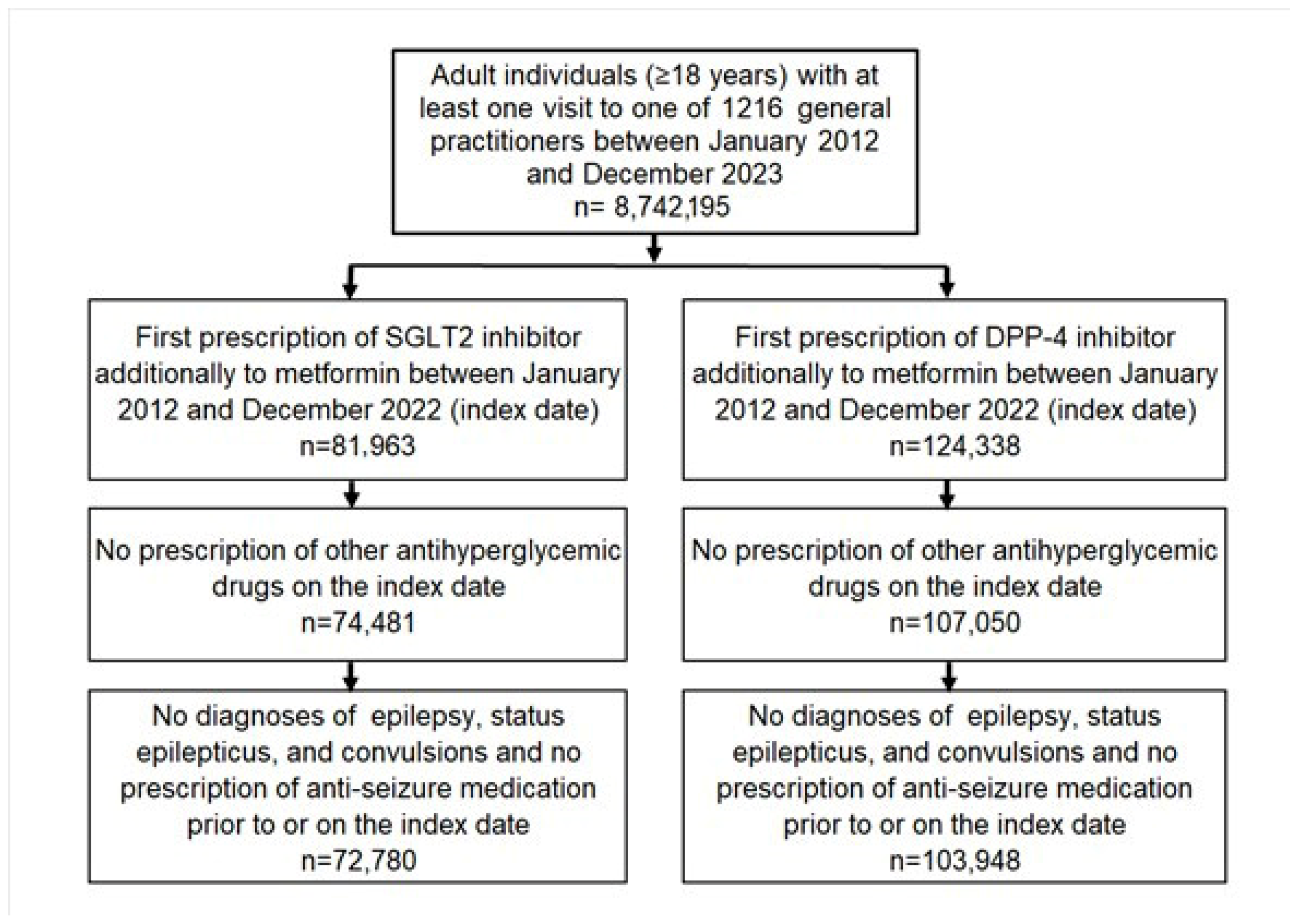
Eligible patients aged 18 or above were adults with type 2 diabetes who newly initiated either an SGLT2 inhibitor or a DPP4 inhibitor during the study period. The date of the first prescription defined the baseline. Patients with a prior diagnosis of epilepsy before baseline were excluded. Follow-up started at treatment initiation and continued until incident epilepsy, death, five years of follow-up, or end of data availability, whichever occurred first (Figure 1).

2.3. Exposure

The exposure was initiation of an SGLT2 inhibitor, compared with initiation of a DPP4 inhibitor. Drug initiation was defined according to the first filled prescription.

2.4. Outcome

The primary outcome was incident epilepsy, identified using validated diagnostic codes from inpatient or outpatient encounters. Patients with prevalent epilepsy at baseline were excluded.

2.5. Covariates

Baseline covariates included demographic factors, comorbidities, concomitant medications, and other clinical characteristics measured before treatment initiation that could influence the choice of therapy and risk of epilepsy.

2.6. Statistical Analysis

To control for confounding, propensity scores were estimated using a SuperLearner ensemble that combined logistic regression and decision tree classifiers through cross-validation and convex weight optimization. These scores were then used to generate stabilized inverse probability of treatment weights (IPTWs), which were trimmed at the 1st and 99th percentiles to mitigate the influence of extreme weights. Balance of baseline covariates after weighting was evaluated using standardized mean differences (SMDs), with SMD < 0.1 considered acceptable.
Weighted Kaplan–Meier estimators were used to describe the incidence of epilepsy in each treatment group. For the primary analysis, weighted Cox proportional hazards regression with robust variance estimators was applied to estimate hazard ratios (HRs) and 95% confidence intervals (CIs) comparing SGLT2 inhibitors with DPP4 inhibitors. Prespecified subgroup analyses were performed by age (<60 vs. ≥60 years) and sex.As a sensitivity analysis, weighted Cox regression was additionally adjusted for baseline HbA1c to account for residual confounding. In a second sensitivity analysis, the weighted Cox regression was repeated while applying a six-month grace period after treatment initiation to account for potential latency in the effect of exposure on epilepsy risk.

2.7. Ethical Standards

Data reporting followed STROBE guidelines for observational trials. Only aggregated, anonymized patient data were used in these analyses. This study was performed in accordance with the Declaration of Helsinki, the guidelines for Good Practice of Secondary Data Analysis [15], and the ICMJE Recommendations for the Conduct, Reporting, Editing and Publication of Scholarly Work in Medical Journals. Since only anonymized data were used, which could not be traced back to individual persons, the research protocol did not have to be approved by the local ethics committee, and it was not necessary to obtain informed consent from individual patients to participate in the study. We confirm that we have read the Journal’s position on issues involved in ethical publication and affirm that this report is consistent with those guidelines.

3. Results

3.1. Study Population

The emulated trial included 176,728 patients with type 2 diabetes (mean age 68 years, 39% women), of whom 43% initiated an SGLT2 inhibitor and 57% initiated a DPP4 inhibitor. Before weighting, several baseline covariates differed between groups. After applying stabilized inverse probability of treatment weights, all covariates were well balanced, with standardized mean differences below 0.1, indicating successful control of confounding.

3.2. Diagnostic Assessment of Weighting

Propensity scores estimated using the SuperLearner ensemble showed good overlap between SGLT2 inhibitor and DPP4 inhibitor users (Supplementary Figure S1). The distribution of stabilized inverse probability of treatment weights was centered around 1 with only moderate dispersion, and trimming at the 1st and 99th percentiles effectively limited extreme values (Supplementary Figure S2). Covariate balance was substantially improved after weighting: standardized mean differences, which were as high as 0.35 before weighting, were reduced to below 0.1 for all baseline covariates after weighting (Supplementary Figure S3).

3.3. Incidence and Risks

During up to five years of follow-up, the weighted incidence of epilepsy was 2.05 cases per 1000 person-years among SGLT2 inhibitor users compared with 2.45 cases per 1000 person-years among DPP4 inhibitor users. Weighted Cox regression showed that SGLT2 inhibitor initiation was associated with a 28% lower hazard of epilepsy compared with DPP4 inhibitors (HR 0.72, 95% CI 0.61–0.86; p < 0.001).
When stratified by age, SGLT2 inhibitors were associated with a lower risk of epilepsy in patients aged 60 years or older (HR 0.71, 95% CI 0.58–0.87; p = 0.001), whereas no significant association was observed among patients younger than 60 years (HR 0.80, 95% CI 0.56–1.15; p = 0.224). In analyses by sex, SGLT2 inhibitor use was associated with a lower risk of epilepsy in women (HR 0.65, 95% CI 0.50–0.84; p = 0.001), while the association among men did not reach conventional statistical significance (HR 0.80, 95% CI 0.62–1.00; p = 0.054) (Table 1).

3.4. Sensitivity Analyses

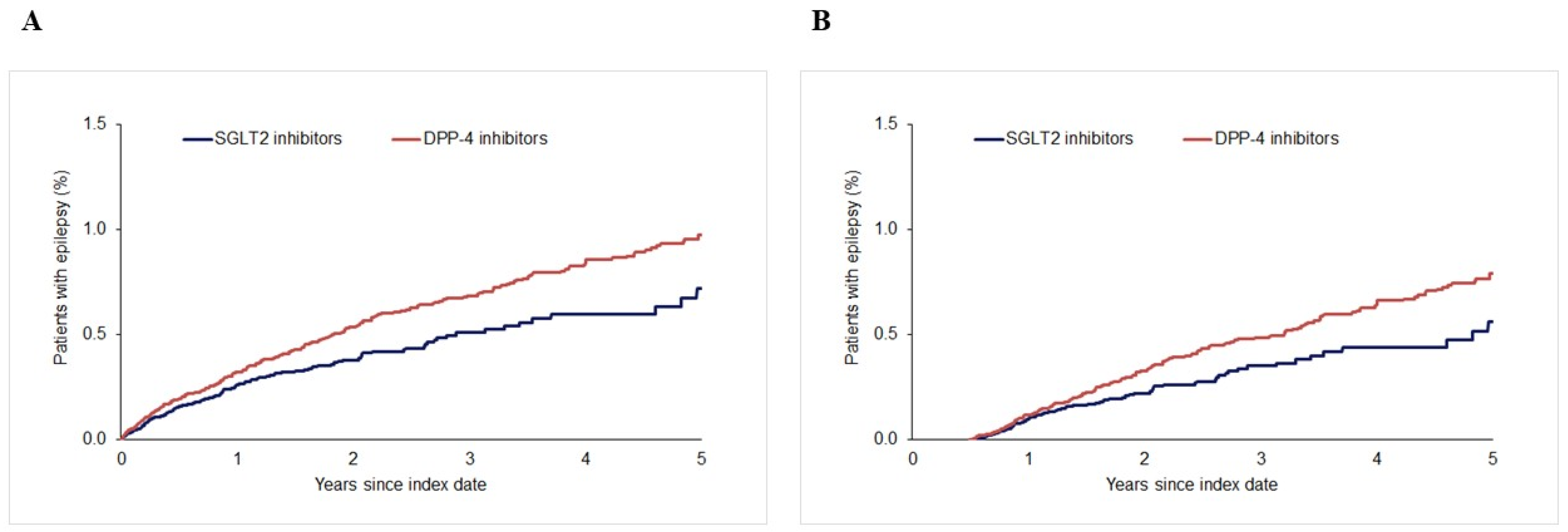
Results were robust in sensitivity analyses. Weighted Cox regression additionally adjusted for baseline HbA1c produced similar hazard ratios, and repeating the analysis with a six-month grace period after treatment initiation yielded consistent findings (Table 2 and Figure 2).

4. Discussion

In our target trial emulating study, we show a significantly reduced incidence of epilepsy in diabetic patients after SGLT2i therapy. Initiation of SGLT2i was consistently associated with a lower risk of epilepsy compared with DPP-4i. This signal stayed robust across multiple sensitivity analyses, suggesting that SGLT2 inhibitor use may be associated with a reduced incidence of epilepsy in patients with type 2 diabetes. Given the observational design, this association should be regarded as hypothesis-generating rather than as direct evidence of a preventive effect.
Although our study demonstrates only statistical associations and does not provide direct mechanistic evidence, several biological pathways may plausibly underlie a protective effect of SGLT2 inhibitors against epilepsy. Patients with type 2 diabetes are typically characterized by insulin resistance, chronic low-grade inflammation, and metabolic dysfunction. While both SGLT2 and DPP-4 inhibitors effectively lower glucose levels, SGLT2 inhibitors exert a broader range of systemic and neural effects that could influence seizure susceptibility.
A modest, physiologically regulated increase in circulating ketone bodies under SGLT2 inhibition [16] may contribute to improved cerebral energy efficiency, partially resembling the metabolic milieu induced by a ketogenic diet—a well-established therapeutic approach for drug-resistant epilepsy [17,18,19]. Nevertheless, this mechanism alone is unlikely to account for the observed association.
More compelling are the pleiotropic effects of SGLT2 inhibition on mitochondrial function, oxidative stress [20], and neuroinflammation [21]—three processes intricately linked to epileptogenesis [22]. SGLT2 inhibitors have been shown to enhance mitochondrial biogenesis and efficiency, reduce reactive oxygen species, and attenuate systemic and central inflammatory signaling, including pathways mediated by NF-κB and IL-1β [16,23]. Such effects may preserve neuronal integrity and synaptic stability.
Furthermore, emerging evidence indicates that SGLT transporters are expressed in glial and neuronal tissues [24,25], implying potential direct actions within the brain. Inhibition of these transporters could modulate neuronal glucose handling, stabilize intracellular ion gradients, and influence neurotransmitter balance—particularly by promoting GABAergic inhibition and reducing glutamatergic excitation [26]. Together, these changes may elevate the seizure threshold and decrease neuronal hyperexcitability.
Taken collectively, the combination of improved metabolic flexibility, reduced oxidative and inflammatory stress, and potential direct modulation of neuronal excitability provides a biologically coherent framework through which SGLT2 inhibitors might contribute to reduced seizure risk in patients with type 2 diabetes.
The many other possible effects of SGLT2i, which are evident in various other organs such as the heart [16] and kidneys [27], may also play a role in the prevention of epilepsy. SGLT2i inhibitors protect the kidney through hemodynamic, metabolic, anti-inflammatory, and vascular mechanisms. These include improved endothelial function, reduced renal hypoxia, and suppression of maladaptive inflammatory pathways [28]. Inflammation, hypoxia, formation of oxidative stress, and vascular dysfunction are all mechanisms that play a role in the development and maintenance of epilepsy [29]. This could be another possible reason for the association with reduced epilepsy incidence observed for SGLT2 inhibitors, which DPP4s, for example, may not bring about, as their effect tends to be limited to lowering blood glucose levels [14].
In this context, the more pronounced association of SGLT2 inhibitor use with reduced epilepsy incidence in patients >60 years of age could also be interpreted, namely with a potentially stronger role of vascular/degenerative mechanisms in older cohorts. Another noteworthy finding is the gender differences we observed, with a significant association in women and borderline in men. Of course, possible differences in medication adherence must be taken into account as a reason [30,31]. On the other hand, these data shed light on a previously unexplored field: possible gender differences in the development and pathomechanisms of epilepsy and possible comorbidities. Women may experience stronger effects of certain antiseizure medications because sex hormones modulate key neuronal pathways. Estrogen can enhance excitatory signaling, while progesterone-derived neurosteroids potentiate GABA inhibition, shifting seizure susceptibility. In addition, sex-specific differences in chloride homeostasis (NKCC1/KCC2), neuroinflammation, and glial responses alter network excitability. These mechanisms may be involved in the antiseizure effect of drugs like SGLT2i in women [32,33,34].
What preclinical/experimental evidence is there to support the antiepileptic effect of SGLT2i? In a rat model (pentylenetetrazol-induced seizures), dapagliflozin reduced seizure activity and improved EEG parameters; the authors discuss reduced glucose availability and possible membrane/ion effects as mechanisms [35]. Several animal studies and reviews show anticonvulsant effects of β-hydroxybutyrate/acetoacetate and exogenous ketones; postulated mechanisms include GABA/glutamate modulation, mitochondrial/energy effects, HDAC inhibition, and NLRP3 inflammasome attenuation [36]. In summary, it can be said that there are preclinical indications that SGLT2i could reduce seizures and possibly delay epileptogenesis, but the evidence is still limited and inconsistent. The animal evidence is more robust for ketone bodies. However, clinical prevention data (e.g., ‘prevention of epilepsy’) are currently lacking.
Our findings are in close agreement with the recent target trial emulation by Zhao and colleagues, who reported a comparable reduction in incident epilepsy among adults with type 2 diabetes initiating SGLT2 inhibitors versus DPP-4 inhibitors in a Chinese regional cohort [37]. The remarkable similarity of effect estimates across two independent populations, healthcare systems, and analytic teams provides reciprocal external validation and supports the robustness of the observed association. At the same time, the fact that both studies share a comparable observational design also implies that they share comparable methodological limitations, in particular the impossibility of fully excluding residual confounding. Confirmatory prospective evidence, therefore, remains desirable.
It should be emphasized that the absolute difference in epilepsy incidence between groups was modest (2.05 vs. 2.45 cases per 1000 person-years), corresponding to a number needed to treat that is too large to justify SGLT2 inhibitor use for the prevention of epilepsy alone. The clinical relevance of our finding, therefore, lies primarily in adding a further potential pleiotropic benefit of SGLT2 inhibitors in patients who already have other indications for the drug class, rather than in changing prescription patterns on the basis of epilepsy risk per se.

5. Strengths and Limitations

This study has several strengths. It was designed explicitly as a target trial emulation, thereby reducing common biases of observational research by prespecifying eligibility criteria, treatment strategies, follow-up, outcome, and analysis. We used the large and representative IQVIA Disease Analyzer database, which provides longitudinal real-world data from routine outpatient practices in Germany, ensuring broad coverage and high external validity within this healthcare setting. Confounding was addressed by a SuperLearner-based propensity score approach with stabilized inverse probability of treatment weighting, which achieved excellent balance across a wide range of baseline covariates. Furthermore, results were robust across sensitivity analyses, including additional adjustment for baseline HbA1c and application of a six-month grace period after treatment initiation.
Nevertheless, several limitations must be acknowledged. First, as with all observational studies, the possibility of residual confounding remains despite the use of advanced weighting methods. Second, misclassification of epilepsy is possible, as diagnoses were based on routine care coding without independent validation. Third, certain potentially relevant factors, such as socioeconomic status, lifestyle behaviors, or treatment adherence, were not available in the database and could not be adjusted for. Fourth, drug exposure was defined from prescriptions, which may not fully reflect actual medication intake. Moreover, the findings reflect patients captured in German outpatient practices and may not be directly generalizable to other health systems or populations. In addition, several clinically relevant variables that may differ between SGLT2 inhibitor and DPP-4 inhibitor users were not available in our database and could therefore not be incorporated into the weighting procedure. These include duration of diabetes prior to treatment initiation, estimated glomerular filtration rate and other measures of renal function, detailed cardiovascular disease burden beyond ICD-10-coded diagnoses (such as left ventricular ejection fraction or NT-proBNP levels), treatment adherence, smoking status, body mass index, and socioeconomic indicators. Channeling of younger and metabolically healthier patients toward SGLT2 inhibitors, or, conversely, channeling of patients with chronic kidney disease toward DPP-4 inhibitors, remains possible. The same caveat applies to the comparable findings of Zhao and colleagues [37], in whose Chinese regional dataset analogous variables were similarly unavailable. Confirmation in prospective randomized studies, in which baseline characteristics are balanced by design, is therefore essential before causal claims can be made.

6. Future Directions

Several lines of further research follow from our findings. First, a prospective randomized trial would be required to establish causality between SGLT2 inhibitor use and a reduced incidence of epilepsy; given the relatively low absolute event rate, an event-driven design enriched for high-risk subgroups (e.g., older adults, patients with diabetic cerebrovascular disease, or those with heart failure) would be most informative. Second, head-to-head comparisons of SGLT2 inhibitors with GLP-1 receptor agonists are warranted to disentangle class-specific pleiotropic effects on epileptogenesis. Third, mechanistic translational studies should clarify whether the observed signal is mediated primarily by ketone-body-associated metabolic shifts, by anti-inflammatory and antioxidative pathways, or by direct neuronal actions of SGLT inhibition at the blood–brain barrier. Finally, replication of our findings in independent international cohorts and in subgroups stratified by chronic kidney disease, heart failure phenotype, and antiseizure medication exposure will be important to define the populations most likely to benefit.
In summary, our findings indicate that initiation of SGLT2 inhibitors is associated with a lower incidence of epilepsy compared with DPP-4 inhibitors in a large, real-world diabetic population. The absolute difference in event rates is small, and residual confounding cannot be entirely excluded. The robustness of this association across multiple analytic approaches and subgroups, together with the consistent findings of Zhao and colleagues [37], nevertheless supports the hypothesis that SGLT2 inhibition may exert effects beyond glucose lowering. Prospective studies are required to confirm causality before SGLT2 inhibitors can be considered as part of a preventive strategy in patients with diabetes at elevated risk for epilepsy.

Supplementary Materials

The following supporting information can be downloaded at: https://www.mdpi.com/article/10.3390/diabetology7060104/s1, Table S1: Steps and specifications of the target trial emulation design; Figure S1: The distribution of propensity scores by treatment group; Figure S2: The distribution of stabilized inverse probability of treatment weights; Figure S3: Covariate balance before and after IPTW.

Author Contributions

C.D., J.S., M.L., S.S. and K.K.: analysis and interpretation of the data, reviewing the manuscript critically for important intellectual content, final approval of the version to be published, and agreement to be accountable for all aspects of the work in ensuring that questions related to the accuracy or integrity of any part of the work are appropriately investigated and resolved. C.D., M.L. and K.K.: conception of the design of the study and acquisition of study data. All authors have read and agreed to the published version of the manuscript.

Funding

Publication costs were funded by the JLU CAREER Program of the Faculty of Medicine at the Justus Liebig University of Giessen for Jamschid Sedighi.

Institutional Review Board Statement

Since only anonymized data were used, which could not be traced back to individual persons, the research protocol did not have to be approved by the local ethics committee.

Informed Consent Statement

Since only anonymized data were used, which could not be traced back to individual persons, it was not necessary to obtain informed consent from individual patients to participate in the study.

Data Availability Statement

Data will be made available by Karel Kostev upon reasonable request. Data cannot be traced back to individual persons.

Acknowledgments

We confirm that we have used current ILAE seizure and epilepsy classification schemes [38].

Conflicts of Interest

K.K. is an employee of IQVIA. J.S. received a speaker’s/consulting honoraria from AstraZeneca and Bayer. M.L. is an employee of Sanecum Group GmbH and received a speaker’s/consulting honoraria from Novartis, Pfizer, Sequiris, Vifor, AstraZeneca, Boehringer Ingelheim, and Bristol-Myers-Squibb. S.S. received a speaker’s/consulting honoraria from AstraZeneca, Novartis, Berlin-Chemie, Bristol-Myers-Squibb, Boehringer Ingelheim, Lilly, Bayer, and Pfizer. The remaining authors declare that the research was conducted in the absence of any commercial or financial relationships that could be construed as potential conflicts of interest.

References

  1. Beghi, E.; Giussani, G.; Sander, J.W. The natural history and prognosis of epilepsy. Epileptic Disord. 2015, 17, 243–253. [Google Scholar] [CrossRef] [PubMed]
  2. Duncan, J.S.; Sander, J.W.; Sisodiya, S.M.; Walker, M.C. Adult epilepsy. Lancet 2006, 367, 1087–1100. [Google Scholar] [CrossRef]
  3. Stafstrom, C.E.; Carmant, L. Seizures and epilepsy: An overview for neuroscientists. Cold Spring Harb. Perspect. Med. 2015, 5, a022426. [Google Scholar] [CrossRef] [PubMed]
  4. Blumenfeld, H. Impaired consciousness in epilepsy. Lancet Neurol. 2012, 11, 814–826. [Google Scholar] [CrossRef]
  5. Perucca, E.; Perucca, P.; White, H.S.; Wirrell, E.C. Drug resistance in epilepsy. Lancet Neurol. 2023, 22, 723–734. [Google Scholar] [CrossRef]
  6. Fattorusso, A.; Matricardi, S.; Mencaroni, E.; Dell’Isola, G.B.; Di Cara, G.; Striano, P.; Verrotti, A. The Pharmacoresistant Epilepsy: An Overview on Existent and New Emerging Therapies. Front. Neurol. 2021, 12, 674483. [Google Scholar] [CrossRef]
  7. Shlobin, N.A.; Sander, J.W. Drivers for the comorbidity of type 2 diabetes mellitus and epilepsy: A scoping review. Epilepsy Behav. 2020, 106, 107043. [Google Scholar] [CrossRef]
  8. Lu, C.L.; Chang, Y.H.; Sun, Y.; Li, C.Y. A population-based study of epilepsy incidence in association with type 2 diabetes and severe hypoglycaemia. Diabetes Res. Clin. Pract. 2018, 140, 97–106. [Google Scholar] [CrossRef]
  9. Beghi, E. Efficacy and tolerability of the new antiepileptic drugs: Comparison of two recent guidelines. Lancet Neurol. 2004, 3, 618–621. [Google Scholar] [CrossRef]
  10. Doege, C.; Luedde, M.; Kostev, K. Association Between Angiotensin Receptor Blocker Therapy and Incidence of Epilepsy in Patients With Hypertension. JAMA Neurol. 2022, 79, 1296–1302. [Google Scholar] [CrossRef] [PubMed]
  11. Tien, N.; Wu, T.Y.; Lin, C.L.; Chu, F.Y.; Wang, C.C.N.; Hsu, C.Y.; Tsai, F.J.; Fang, Y.J.; Lim, Y.P. Association of epilepsy, anti-epileptic drugs (AEDs), and type 2 diabetes mellitus (T2DM): A population-based cohort retrospective study, impact of AEDs on T2DM-related molecular pathway, and via peroxisome proliferator-activated receptor gamma transactivation. Front. Endocrinol. 2023, 14, 1156952. [Google Scholar] [CrossRef]
  12. Rho, J.M.; Boison, D. The metabolic basis of epilepsy. Nat. Rev. Neurol. 2022, 18, 333–347. [Google Scholar] [CrossRef]
  13. Gholami, M.; Coleman-Fuller, N.; Salehirad, M.; Darbeheshti, S.; Motaghinejad, M. Neuroprotective Effects of Sodium-Glucose Cotransporter-2 (SGLT2) Inhibitors (Gliflozins) on Diabetes-Induced Neurodegeneration and Neurotoxicity: A Graphical Review. Int. J. Prev. Med. 2024, 15, 28. [Google Scholar] [CrossRef]
  14. Scheen, A.J. Cardiovascular Effects of New Oral Glucose-Lowering Agents: DPP-4 and SGLT-2 Inhibitors. Circ. Res. 2018, 122, 1439–1459. [Google Scholar] [CrossRef]
  15. Swart, E.; Gothe, H.; Geyer, S.; Jaunzeme, J.; Maier, B.; Grobe, T.G.; Ihle, P.; German Society for Social Medicine and Prevention; German Society for Epidemiology. Good Practice of Secondary Data Analysis (GPS): Guidelines and recommendations. Gesundheitswesen 2015, 77, 120–126. [Google Scholar] [CrossRef]
  16. Pabel, S.; Hamdani, N.; Luedde, M.; Sossalla, S. SGLT2 Inhibitors and Their Mode of Action in Heart Failure-Has the Mystery Been Unravelled? Curr. Heart Fail. Rep. 2021, 18, 315–328. [Google Scholar] [CrossRef] [PubMed]
  17. Neal, E.G.; Chaffe, H.; Schwartz, R.H.; Lawson, M.S.; Edwards, N.; Fitzsimmons, G.; Whitney, A.; Cross, J.H. The ketogenic diet for the treatment of childhood epilepsy: A randomised controlled trial. Lancet Neurol. 2008, 7, 500–506. [Google Scholar] [CrossRef] [PubMed]
  18. Roehl, K.; Sewak, S.L. Practice Paper of the Academy of Nutrition and Dietetics: Classic and Modified Ketogenic Diets for Treatment of Epilepsy. J. Acad. Nutr. Diet. 2017, 117, 1279–1292. [Google Scholar] [CrossRef]
  19. Schoeler, N.E.; Marston, L.; Lyons, L.; Halsall, S.; Jain, R.; Titre-Johnson, S.; Balogun, M.; Heales, S.J.R.; Eaton, S.; Orford, M.; et al. Classic ketogenic diet versus further antiseizure medicine in infants with drug-resistant epilepsy (KIWE): A UK, multicentre, open-label, randomised clinical trial. Lancet Neurol. 2023, 22, 1113–1124. [Google Scholar] [CrossRef]
  20. Zugner, E.; Yang, H.C.; Kotzbeck, P.; Boulgaropoulos, B.; Sourij, H.; Hagvall, S.; Elmore, C.S.; Esterline, R.; Moosmang, S.; Oscarsson, J.; et al. Differential In Vitro Effects of SGLT2 Inhibitors on Mitochondrial Oxidative Phosphorylation, Glucose Uptake and Cell Metabolism. Int. J. Mol. Sci. 2022, 23, 7966. [Google Scholar] [CrossRef] [PubMed]
  21. Alami, M.; Zerif, E.; Khalil, A.; Hajji, N.; Ramassamy, C.; Lacombe, G.; Laurent, B.; Cohen, A.A.; Wikowski, J.M.; Gris, D.; et al. Neuroprotective effects of SGLT2 inhibitors empagliflozin and dapagliflozin on Abeta(1-42)-induced neurotoxicity and neuroinflammation in cellular models of Alzheimer’s disease. J. Alzheimers Dis. 2025, 105, 464–480. [Google Scholar] [CrossRef] [PubMed]
  22. Rana, A.; Musto, A.E. The role of inflammation in the development of epilepsy. J. Neuroinflammation 2018, 15, 144. [Google Scholar] [CrossRef]
  23. Davri, A.S.; Katsenos, A.P.; Tulyaganova, G.K.; Tzavellas, N.P.; Simos, Y.V.; Kanellos, F.S.; Konitsiotis, S.; Dounousi, E.; Niaka, K.; Bellou, S.; et al. The SGLT2 inhibitor empagliflozin exerts neuroprotective effect against hydrogen peroxide-induced toxicity on primary neurons. Metab. Brain Dis. 2024, 40, 15. [Google Scholar] [CrossRef]
  24. Murasheva, A.; Fuks, O.; Timkina, N.; Mikhailova, A.; Vlasov, T.; Samochernykh, K.; Karonova, T. SGLT-2 Inhibitors’ and GLP-1 Receptor Agonists’ Influence on Neuronal and Glial Damage in Experimental Stroke. Biomedicines 2024, 12, 2797. [Google Scholar] [CrossRef]
  25. Vemula, S.; Roder, K.E.; Yang, T.; Bhat, G.J.; Thekkumkara, T.J.; Abbruscato, T.J. A functional role for sodium-dependent glucose transport across the blood-brain barrier during oxygen glucose deprivation. J. Pharmacol. Exp. Ther. 2009, 328, 487–495. [Google Scholar] [CrossRef]
  26. Tripathi, S.; Nathan, C.L.; Tate, M.C.; Horbinski, C.M.; Templer, J.W.; Rosenow, J.M.; Sita, T.L.; James, C.D.; Deneen, B.; Miller, S.D.; et al. The immune system and metabolic products in epilepsy and glioma-associated epilepsy: Emerging therapeutic directions. JCI Insight 2024, 9, e174753. [Google Scholar] [CrossRef]
  27. Lee, S.A.; Riella, L.V. Narrative Review of Immunomodulatory and Anti-inflammatory Effects of Sodium-Glucose Cotransporter 2 Inhibitors: Unveiling Novel Therapeutic Frontiers. Kidney Int. Rep. 2024, 9, 1601–1613. [Google Scholar] [CrossRef]
  28. Upadhyay, A. SGLT2 Inhibitors and Kidney Protection: Mechanisms Beyond Tubuloglomerular Feedback. Kidney360 2024, 5, 771–782. [Google Scholar] [CrossRef]
  29. Pitkanen, A.; Lukasiuk, K. Mechanisms of epileptogenesis and potential treatment targets. Lancet Neurol. 2011, 10, 173–186. [Google Scholar] [CrossRef] [PubMed]
  30. Venditti, V.; Bleve, E.; Morano, S.; Filardi, T. Gender-Related Factors in Medication Adherence for Metabolic and Cardiovascular Health. Metabolites 2023, 13, 1087. [Google Scholar] [CrossRef] [PubMed]
  31. Puskas, C.; Hogg, R.S. Unlocking adherence: Is gender the key? Lancet HIV 2015, 2, e2–e3. [Google Scholar] [CrossRef]
  32. Christian, C.A.; Reddy, D.S.; Maguire, J.; Forcelli, P.A. Sex Differences in the Epilepsies and Associated Comorbidities: Implications for Use and Development of Pharmacotherapies. Pharmacol. Rev. 2020, 72, 767–800. [Google Scholar] [CrossRef]
  33. Reddy, D.S.; Thompson, W.; Calderara, G. Molecular mechanisms of sex differences in epilepsy and seizure susceptibility in chemical, genetic and acquired epileptogenesis. Neurosci. Lett. 2021, 750, 135753. [Google Scholar] [CrossRef]
  34. Kight, K.E.; McCarthy, M.M. Using sex differences in the developing brain to identify nodes of influence for seizure susceptibility and epileptogenesis. Neurobiol. Dis. 2014, 72, 136–143. [Google Scholar] [CrossRef]
  35. Erdogan, M.A.; Yusuf, D.; Christy, J.; Solmaz, V.; Erdogan, A.; Taskiran, E.; Erbas, O. Highly selective SGLT2 inhibitor dapagliflozin reduces seizure activity in pentylenetetrazol-induced murine model of epilepsy. BMC Neurol. 2018, 18, 81. [Google Scholar] [CrossRef]
  36. Simeone, T.A.; Simeone, K.A.; Rho, J.M. Ketone Bodies as Anti-Seizure Agents. Neurochem. Res. 2017, 42, 2011–2018. [Google Scholar] [CrossRef] [PubMed]
  37. Zhao, H.; Zhang, B.; Zhuo, L.; Yin, Y.; Sun, Y.; Shen, P.; Jiang, Z.; Zhan, S. Association Between Use of Sodium–Glucose Cotransporter 2 Inhibitors and Epilepsy: A Population-Based Study Using Target Trial Emulation. Diabetes Care 2025, 48, 827–836. [Google Scholar] [CrossRef] [PubMed]
  38. Beniczky, S.; Trinka, E.; Wirrell, E.; Abdulla, F.; Al Baradie, R.; Alonso Vanegas, M.; Auvin, S.; Singh, M.B.; Blumenfeld, H.; Bogacz Fressola, A.; et al. Updated classification of epileptic seizures: Position paper of the International League Against Epilepsy. Epilepsia 2025, 66, 1804–1823. [Google Scholar] [CrossRef] [PubMed]
Figure 1. Selection of study patients.
Diabetology 07 00104 g001
Figure 2. Cumulative five-year incidence of epilepsy in type 2 diabetes patients treated with SGLT2 and DPP-4 (Kaplan–Meier curves). (A) Without grace period. (B) With a grace period of six months.
Diabetology 07 00104 g002
Table 1. Association between SGLT2 therapy and the risk of epilepsy (age- and sex-stratified weighted Cox regression).
Patient SubgroupsIncidence (Cases per 1000 Person-Years) Among SGLT2 UsersIncidence (Cases per 1000 Person-Years) Among DPP-4i UsersHazard Ratio (95% CI)p Value
Total2.052.450.72 (0.61–0.86)<0.001
Patients aged < 60 years1.551.900.80 (0.56–1.15)0.224
Patients aged ≥ 60 years2.262.660.71 (0.58–0.87)0.001
Female patients2.202.590.65 (0.50–0.84)0.001
Male patients1.962.360.80 (0.62–1.00)0.054
Table 2. Association between SGLT2 therapy and the risk of epilepsy (sensitivity analyses).
Regression ModelHazard Ratio (95% CI)p Value
Weighted Cox regression adjusted for baseline HbA1c0.73 (0.54–0.98)0.035
Weighted Cox regression with a six-month grace period0.72 (0.51–0.91)0.006
Disclaimer/Publisher’s Note: The statements, opinions and data contained in all publications are solely those of the individual author(s) and contributor(s) and not of MDPI and/or the editor(s). MDPI and/or the editor(s) disclaim responsibility for any injury to people or property resulting from any ideas, methods, instructions or products referred to in the content.